Cryptanalysis and Improvement
of a Multi-Server Authenticated
Key Agreement by Chen and
Lee’s Scheme
ITC 3/47
Journal of Information Technology and Control
Vol. 47 / No. 3 / 2018 pp. 431-446
DOI 10.5755/j01.itc.47.3.17361 © Kaunas University of Technology
Cryptanalysis and Improvement of a Multi-Server Authenticated
Key Agreement by Chen and Lee’s Scheme
Received 2016/12/30 Accepted after revision 2018/07/30
http://dx.doi.org/10.5755/j01.itc.47.3.17361
Corresponding author: [email protected]
Azeem Irshad, Husnain Naqvi, Shehzad Ashraf Chaudhry
Department of Computer Science & Software Engineering, International Islamic University, Islamabad e-mail: [email protected], [email protected], [email protected]
Muhammad Usman
Department of Computer Science, Faculty of Natural Science, Quaid-I-Azam University, Islamabad, Pakistan e-mail: [email protected]
Muhammad Shafiq
Department of Information Technology, University of Gujrat, Gujrat, Pakistan, e-mail: [email protected]
Omid Mir
The Institute of Networks and Security, Johannes Kepler University Linz, Austria, e-mail: [email protected]
Ambrina Kanwal
Department of Computer Science, Bahria University, Islamabad, Pakistan, e-mail: [email protected]
back to Li et al. and Lee et al., in 2000. Since then, numerous multi-server authentication techniques have been put forth. Nonetheless, the research academia looks for more secure and efficient authentication protocols. Re-cently, Chen and Lee’s scheme presented a two-factor multi-server key agreement protocol, which is found to be prone to impersonation, stolen smart card, key-compromise impersonation attack, and trace attacks. Besides, the scheme is also found to have the inefficient password modification procedure. We propose an improved pro-tocol that counters the above limitations in almost an equivalent computation cost. Moreover, our propro-tocol is supplemented with formal security analysis using BAN logic along with performance analysis and evaluation. KEYWORDS:Multi-server authentication, cryptanalysis, biometrics, remote authentication, attack.
1. Introduction
In peer-to-peer environment, Multi-Server Authen-tication (MSA) permits the quick accessibility of nu-merous online multimedia-based services to users on the basis of a single registration. The architecture of MSA [39, 29] is favorable for both sides, i.e. service providers as well as users. This is because the users need not remember more than one password due to single registration of a trusted third party. Similarly, the MSA architecture eases the service providers of the maintenance of verifier database for each tered user, and the trouble of individualized regis-trations. The users count on a single registration of a trusted third party to benefit from services of differ-ent service providers. The MSA setting would com-prise numerous users (Ui), servers (Sj), and a regis-tration centre (RC). The trust flows from RC towards users and servers, as RC registers these entities in the initialization setup on confidential channel. Then on-wards, the users could benefit themselves of the ser-vices offered by service providers.
Previously, numerous MSA-based schemes gearing towards augmentation in security and efficiency have been presented. Yet, it is believed on account of frequent threats and weaknesses that more resil-ient MSA protocols need to be demonstrated. Earlier in 2000, Lee and Chang [34] presented a key agree-ment protocol for MSA framework. The scheme was found vulnerable to masquerading attack and com-promised anonymity [51]. Thereafter, Tsaur [47] pre-sented a remote subscriber-based MSA scheme em-ploying RSA crypto-primitives as well as Lagrange interpolating polynomials. The protocol was exposed to password-guessing threat [47]. Then, Li et al. [35] presented a password-based MSA protocol in an ar-tificial neural network system, which requires high training time and a bit higher cost. Thereafter, Lin et al. [39] presented an ElGamal digital signature
Section 2 relates to a review of Chen and Lee’s pro-tocol. Section 3 studies the cryptanalysis of Chen and Lee’s protocol. Section 4 illustrates our proposed work. Section 5 would demonstrate the security and performance evaluation analysis. The last section wraps up the presented work.
2. Preliminaries
This section briefly illustrates some salient features of hash function, and bio-hashing process.
2.1. Hash Function
A hash function [9, 14, 26], defined as h:{0,1}* →{0, 1}τ
where τ denotes a safe length, generating γ string of pre-determined length as output from inputting a random string ω of any length, i.e., γ = h(ω), maintains the following characteristics:
_ To define the first characteristic, a one-way hash function serves as a hard problem to alter the string ω without updating the hash digest h(ω).
_ For the second characteristic, it is hard to form a string ω generating h(ω) as preimage resistance. _ For the third characteristic, it is hard to produce ω
and ω´provided ω ≠ω´where as h(ω)= h(ω´) holds as well.
The advantage of attacker may be shown by the fol-lowing formalization:
2
requirements to be applied in smart card based applications.After that, Juang [29] presented a symmetric cryptosystem-based MSA protocol, however having scalability problems due to maintaining users’ verifier-repository at server’s end for all users. Next, Chang and Lee [8] also demonstrated a MSA protocol, which was discovered to be susceptible for privileged-insider and server masquerading threats [38, 18]. Liao and Wang [38], subsequently introduced another dynamic ID-based remote user authenticated key agreement for MSA architecture. Hsiang and Shih [18] discovered the protocol [38] as vulnerable to privileged insider and spoofing threats, and also put forward an improved protocol. Lee et al. [33] remarked that the scheme [18] is unable to accomplish mutual authentication agreement, and onwards demonstrated an enhanced protocol. Nonetheless, Chen and Lee [11] analyzed that the protocol [7] is incapable of providing the security feature of smart card security to comply with two-factor authentication. Besides, [7] also could not resist impersonation attack and bears an inefficient password modification steps due to RC’s involvement. After a deep analysis of Chen and Lee’s scheme [11], we came to know that this protocol sustains stolen smart card attack that leads to the disclosure of session key and password. This protocol is prone to spoofing and trace attack as well. In addition, the scheme bears a defective password-alteration phase. The current study work ascertains few weaknesses in Chen and Lee’s scheme [11] and presents an enhanced protocol ensuring security with efficiency as supported with formal analysis. Moreover, the strength of session key establishment in our protocol is ratified under BAN-logic and random oracle-based formal analysis.
Section 2 relates to a review of Chen and Lee’s protocol. Section 3 studies the cryptanalysis of Chen and Lee’s protocol. Section 4 illustrates our proposed work. Section 5 would demonstrate the security and performance evaluation analysis. The last section wraps up the presented work.
2. Preliminaries
This section briefly illustrates some salient features of hash function, and bio-hashing process.
2.1 Hash Function
A hash function [9, 14, 26], defined as h:{0,1}*→ {0,1}𝜏𝜏𝜏𝜏
where 𝜏𝜏𝜏𝜏 denotes a safe length, generating 𝛾𝛾𝛾𝛾 string of pre-determined length as output from inputting a random string
𝜔𝜔𝜔𝜔 of any length, i.e., 𝛾𝛾𝛾𝛾 = h(𝜔𝜔𝜔𝜔), maintains the following characteristics:
1. To define the first characteristic, a one-way hash function serves as a hard problem to alter the string𝜔𝜔𝜔𝜔
without updating the hash digest h(𝜔𝜔𝜔𝜔).
2. For the second characteristic, it is hard to form a string
𝜔𝜔𝜔𝜔generatingh(𝜔𝜔𝜔𝜔)as preimage resistance.
3. For the third characteristic, it is hard to produce𝜔𝜔𝜔𝜔Rand
𝜔𝜔𝜔𝜔' provided 𝜔𝜔𝜔𝜔R ≠ 𝜔𝜔𝜔𝜔' where as h(𝜔𝜔𝜔𝜔)= h(𝜔𝜔𝜔𝜔') holds as well.
The advantage of attacker may be shown by the following formalization:
𝐴𝐴𝐴𝐴𝐴𝐴𝐴𝐴𝐴𝐴𝐴𝐴Ⱥ𝐻𝐻𝐻𝐻𝐻𝐻𝐻𝐻𝐻𝐻𝐻𝐻𝐻𝐻𝐻𝐻(𝑡𝑡𝑡𝑡𝑒𝑒𝑒𝑒) =𝑃𝑃𝑃𝑃𝑃𝑃𝑃𝑃𝑃𝑃𝑃𝑃[(𝜔𝜔𝜔𝜔,𝜔𝜔𝜔𝜔′)⟸𝑅𝑅𝑅𝑅Ⱥ:𝜔𝜔𝜔𝜔 ≠ 𝜔𝜔𝜔𝜔′𝑎𝑎𝑎𝑎𝑎𝑎𝑎𝑎𝐴𝐴𝐴𝐴ℎ(𝜔𝜔𝜔𝜔) =ℎ(𝜔𝜔𝜔𝜔′)], (1)
where Pro[Ete] stands for the event Ete’s probability of
conducting the random experiment, and (𝜔𝜔𝜔𝜔,𝜔𝜔𝜔𝜔′)⟸ 𝑅𝑅𝑅𝑅Ⱥ
depicts the selected random pair (𝜔𝜔𝜔𝜔,𝜔𝜔𝜔𝜔′) by the adversary.
In this set-up, Ⱥ is probabilistic, while the probability related to advantage 𝐴𝐴𝐴𝐴𝐴𝐴𝐴𝐴𝐴𝐴𝐴𝐴Ⱥ𝐻𝐻𝐻𝐻𝐻𝐻𝐻𝐻𝐻𝐻𝐻𝐻𝐻𝐻𝐻𝐻(𝑡𝑡𝑡𝑡𝑒𝑒𝑒𝑒) can be calculated using the random choices as given by Ⱥin execution time te. The
hashing function h( )is assumed to be resistant to collision, in case𝐴𝐴𝐴𝐴𝐴𝐴𝐴𝐴𝐴𝐴𝐴𝐴Ⱥ𝐻𝐻𝐻𝐻𝐻𝐻𝐻𝐻𝐻𝐻𝐻𝐻𝐻𝐻𝐻𝐻(𝑡𝑡𝑡𝑡
𝑒𝑒𝑒𝑒)≤ 𝜖𝜖𝜖𝜖holds for adequately small 𝜖𝜖𝜖𝜖> 0.
2.2 Bio-Hashing
The bio-hashing, being one of the mechanisms to ensure three-factor authentication, complements the two-factor authentication framework with another biometric factor to boost the security. Many studies employing bio-hashing as a three-factor authentication mechanism can be witnessed lately [12, 41]. The sample from biometric scanning tends to behave differently each time it is collected. The bio-hashing function engenders a randomly generated, compressed set of codes by converting the finger-impression codes in so-called biocodes. The hamming distance assists in differentiating the set of various biocodes. Thus, the bio-hashing function is known for countering the de-synchronization problem that might result in capturing the biometric imprints [28].
3. A Review and Cryptanalysis of Chen and Lee’s Scheme
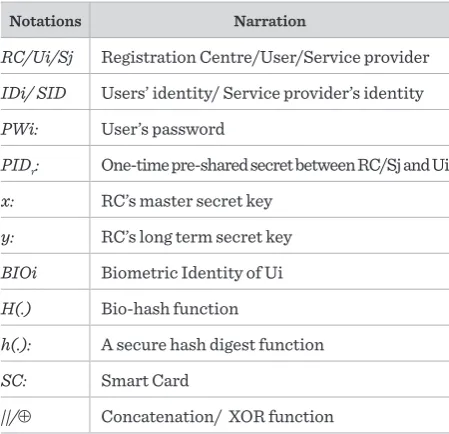
We employed a few notations to make the protocol comprehensible, as given in Table 1.
Table 1 Notation Guide
(1)
where Pro[Ete ] stands for the event Ete’s probability of conducting the random experiment, and (ω, ω´)⇐ RȺ depicts the selected random pair (ω, ω´) by the adversary. In this set-up, Ⱥ is probabilistic, while the probability related to advantage
2
requirements to be applied in smart card based applications. After that, Juang [29] presented a symmetric cryptosystem-based MSA protocol, however having scalability problems due to maintaining users’ verifier-repository at server’s end for all users. Next, Chang and Lee [8] also demonstrated a MSA protocol, which was discovered to be susceptible for privileged-insider and server masquerading threats [38, 18]. Liao and Wang [38], subsequently introduced another dynamic ID-based remote user authenticated key agreement for MSA architecture. Hsiang and Shih [18] discovered the protocol [38] as vulnerable to privileged insider and spoofing threats, and also put forward an improved protocol. Lee et al. [33] remarked that the scheme [18] is unable to accomplish mutual authentication agreement, and onwards demonstrated an enhanced protocol. Nonetheless, Chen and Lee [11] analyzed that the protocol [7] is incapable of providing the security feature of smart card security to comply with two-factor authentication. Besides, [7] also could not resist impersonation attack and bears an inefficient password modification steps due to RC’s involvement. After a deep analysis of Chen and Lee’s scheme [11], we came to know that this protocol sustains stolen smart card attack that leads to the disclosure of session key and password. This protocol is prone to spoofing and trace attack as well. In addition, the scheme bears a defective password-alteration phase. The current study work ascertains few weaknesses in Chen and Lee’s scheme [11] and presents an enhanced protocol ensuring security with efficiency as supported with formal analysis. Moreover, the strength of session key establishment in our protocol is ratified under BAN-logic and random oracle-based formal analysis.
Section 2 relates to a review of Chen and Lee’s protocol. Section 3 studies the cryptanalysis of Chen and Lee’s protocol. Section 4 illustrates our proposed work. Section 5 would demonstrate the security and performance evaluation analysis. The last section wraps up the presented work.
2. Preliminaries
This section briefly illustrates some salient features of hash function, and bio-hashing process.
2.1 Hash Function
A hash function [9, 14, 26], defined as h:{0,1}*→ {0,1}𝜏𝜏𝜏𝜏
where 𝜏𝜏𝜏𝜏 denotes a safe length, generating𝛾𝛾𝛾𝛾 string of pre-determined length as output from inputting a random string
𝜔𝜔𝜔𝜔 of any length, i.e., 𝛾𝛾𝛾𝛾 = h(𝜔𝜔𝜔𝜔), maintains the following characteristics:
1. To define the first characteristic, a one-way hash function serves as a hard problem to alter the string𝜔𝜔𝜔𝜔
without updating the hash digest h(𝜔𝜔𝜔𝜔).
2. For the second characteristic, it is hard to form a string
𝜔𝜔𝜔𝜔generatingh(𝜔𝜔𝜔𝜔)as preimage resistance.
3. For the third characteristic, it is hard to produce𝜔𝜔𝜔𝜔Rand
𝜔𝜔𝜔𝜔' provided 𝜔𝜔𝜔𝜔R ≠ 𝜔𝜔𝜔𝜔' where as h(𝜔𝜔𝜔𝜔)= h(𝜔𝜔𝜔𝜔') holds as well.
The advantage of attacker may be shown by the following formalization:
𝐴𝐴𝐴𝐴𝐴𝐴𝐴𝐴𝐴𝐴𝐴𝐴 Ⱥ𝐻𝐻𝐻𝐻𝐻𝐻𝐻𝐻𝐻𝐻𝐻𝐻𝐻𝐻𝐻𝐻(𝑡𝑡𝑡𝑡𝑒𝑒𝑒𝑒) =𝑃𝑃𝑃𝑃𝑃𝑃𝑃𝑃𝑃𝑃𝑃𝑃[(𝜔𝜔𝜔𝜔,𝜔𝜔𝜔𝜔′)⟸𝑅𝑅𝑅𝑅Ⱥ:𝜔𝜔𝜔𝜔 ≠ 𝜔𝜔𝜔𝜔′𝑎𝑎𝑎𝑎𝑎𝑎𝑎𝑎𝐴𝐴𝐴𝐴 ℎ(𝜔𝜔𝜔𝜔) =ℎ(𝜔𝜔𝜔𝜔′)], (1)
where Pro[Ete] stands for the event Ete’s probability of
conducting the random experiment, and (𝜔𝜔𝜔𝜔,𝜔𝜔𝜔𝜔′)⟸𝑅𝑅𝑅𝑅Ⱥ
depicts the selected random pair (𝜔𝜔𝜔𝜔,𝜔𝜔𝜔𝜔′) by the adversary.
In this set-up, Ⱥ is probabilistic, while the probability related to advantage 𝐴𝐴𝐴𝐴𝐴𝐴𝐴𝐴𝐴𝐴𝐴𝐴Ⱥ𝐻𝐻𝐻𝐻𝐻𝐻𝐻𝐻𝐻𝐻𝐻𝐻𝐻𝐻𝐻𝐻(𝑡𝑡𝑡𝑡𝑒𝑒𝑒𝑒) can be calculated using the random choices as given by Ⱥin execution time te. The
hashing function h( )is assumed to be resistant to collision, in case𝐴𝐴𝐴𝐴𝐴𝐴𝐴𝐴𝐴𝐴𝐴𝐴Ⱥ𝐻𝐻𝐻𝐻𝐻𝐻𝐻𝐻𝐻𝐻𝐻𝐻𝐻𝐻𝐻𝐻(𝑡𝑡𝑡𝑡𝑒𝑒𝑒𝑒)≤ 𝜖𝜖𝜖𝜖holds for adequately small 𝜖𝜖𝜖𝜖> 0.
2.2 Bio-Hashing
The bio-hashing, being one of the mechanisms to ensure three-factor authentication, complements the two-factor authentication framework with another biometric factor to boost the security. Many studies employing bio-hashing as a three-factor authentication mechanism can be witnessed lately [12, 41]. The sample from biometric scanning tends to behave differently each time it is collected. The bio-hashing function engenders a randomly generated, compressed set of codes by converting the finger-impression codes in so-called biocodes. The hamming distance assists in differentiating the set of various biocodes. Thus, the bio-hashing function is known for countering the de-synchronization problem that might result in capturing the biometric imprints [28].
3. A Review and Cryptanalysis of Chen and Lee’s Scheme
We employed a few notations to make the protocol comprehensible, as given in Table 1.
Table 1 Notation Guide can be calculated using the random choices as given by Ⱥ in execution time te. The hashing function h( ) is assumed to be resistant to collision, in case 𝐴𝐴𝐴𝐴𝐴𝐴𝐴𝐴𝐴𝐴𝐴𝐴Ⱥ𝐻𝐻𝐻𝐻𝐻𝐻𝐻𝐻𝐻𝐻𝐻𝐻𝐻𝐻𝐻𝐻(𝑡𝑡𝑡𝑡𝑒𝑒𝑒𝑒) ≤𝜖𝜖𝜖𝜖 holds for adequately small 𝐴𝐴𝐴𝐴𝐴𝐴𝐴𝐴𝐴𝐴𝐴𝐴Ⱥ𝐻𝐻𝐻𝐻𝐻𝐻𝐻𝐻𝐻𝐻𝐻𝐻𝐻𝐻𝐻𝐻(𝑡𝑡𝑡𝑡𝑒𝑒𝑒𝑒) ≤𝜖𝜖𝜖𝜖> 0.
2.2. Bio-Hashing
The bio-hashing, being one of the mechanisms to en-sure three-factor authentication, complements the
two-factor authentication framework with another biometric factor to boost the security. Many studies employing bio-hashing as a three-factor authenti-cation mechanism can be witnessed lately [12, 41]. The sample from biometric scanning tends to behave differently each time it is collected. The bio-hash-ing function engenders a randomly generated, com-pressed set of codes by converting the finger-im-pression codes in so-called biocodes. The hamming distance assists in differentiating the set of various biocodes. Thus, the bio-hashing function is known for countering the de-synchronization problem that might result in capturing the biometric imprints [28].
3. A Review and Cryptanalysis of
Chen and Lee’s Scheme
We employed a few notations to make the protocol comprehensible, as given in Table 1.
The Chen and Lee’s protocol includes a few of partici-pating entities, particularly a trusted RC, users Ui and numerous servers Sj. Both users and servers get reg-istered before hand of mutual authentication phase. For this purpose, Sj shares the secret PIDr with on confidential channel. The working of Chen and Lee’s protocol [11] is outlined next.
Table 1 Notation Guide
Notations Narration
RC/Ui/Sj Registration Centre/User/Service provider IDi/ SID Users’ identity/ Service provider’s identity PWi: User’s password
PIDr: One-time pre-shared secret between RC/Sj and Ui x: RC’s master secret key
y: RC’s long term secret key BIOi Biometric Identity of Ui H(.) Bio-hash function
h(.): A secure hash digest function
SC: Smart Card
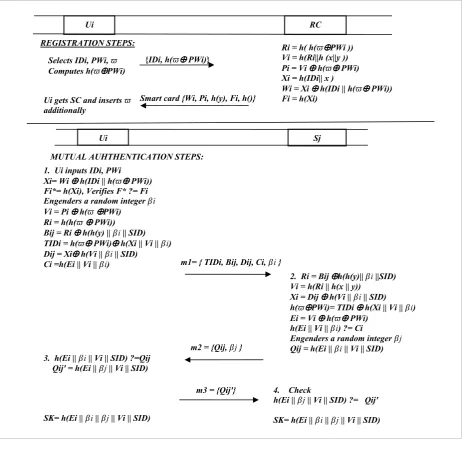
Figure 1
Chen and Lee’s protocol’s registration and mutual authentication phases
3
Figure 1 Chen and Lee’s protocol’s registration and mutual authentication phases The Chen and Lee’s protocol includes a few of
participating entities, particularly a trusted RC, users Ui and numerous servers Sj. Both users and servers get registered before hand of mutual authentication phase. For this purpose, Sj shares the secret PIDr with on confidential channel. The working of Chen and Lee’s protocol [11] is outlined next.
3.1 Design of Chen and Lee’s protocol
The Chen and Lee’s protocol involves two procedures, i.e. 1) registration procedure and 2)
login and authentication procedure as exhibited in Figure 1.
3.1.1 User Registration Process
The user completes its registration process by employing the succeeding steps with RC:
1. Initially, Ui selects its identity IDi, password PWi, and engenders a random number𝜛𝜛. Thereafter, itcalculates h(𝜛𝜛 PWi) and sends {IDi, h(𝜛𝜛 PWi)} to registration centre. 2. Next, the registration centre calculates
Ri=h(h(𝜛𝜛 PWi)), Vi=h(Ri||h(x||y)), Pi=Vi h(𝜛𝜛PWi), Xi=h(IDi ||x), Wi = Xi h(IDi||
Smart card {Wi, Pi, h(y), Fi, h()}
{IDi, h(𝜛𝜛 PWi)} Ri = h( h(Vi = h(Ri||h (x||y )) 𝜛𝜛PWi ))
Pi = Vi h(𝜛𝜛 PWi)
Xi = h(IDi|| x )
Wi = Xi h(IDi || h(𝜛𝜛 PWi))
Fi = h(Xi)
1. Ui inputs IDi, PWi
Xi= Wi h(IDi || h(𝜛𝜛 PWi))
Fi*= h(Xi), Verifies F* ?= Fi
Engenders a random integer 𝛽𝛽i
Vi = Pi h(𝜛𝜛 PWi)
Ri = h(h(𝜛𝜛 PWi))
Bij = Ri h(h(y) || 𝛽𝛽i || SID)
TIDi = h(𝜛𝜛 PWi) h(Xi || Vi || 𝛽𝛽i)
Dij = Xi h(Vi || 𝛽𝛽i || SID)
Ci =h(Ei || Vi || 𝛽𝛽i)
REGISTRATION STEPS:
m1= { TIDi, Bij, Dij, Ci, 𝛽𝛽i }
2. Ri = Bij h(h(y)|| 𝛽𝛽i ||SID)
Vi = h(Ri || h(x || y))
Xi = Dij h(Vi || 𝛽𝛽i || SID)
h(𝜛𝜛PWi)= TIDi h(Xi || Vi || 𝛽𝛽i)
Ei = Vi h(𝜛𝜛 PWi)
h(Ei || Vi || 𝛽𝛽i) ?= Ci
Engenders a random integer 𝛽𝛽j
Qij = h(Ei || 𝛽𝛽i || Vi || SID)
Ui gets SC and inserts 𝜛𝜛
additionally
Ui Sj
Ui RC
MUTUAL AUHTHENTICATION STEPS:
3. h(Ei || 𝛽𝛽i || Vi || SID) ?=Qij
Qij' = h(Ei || 𝛽𝛽j || Vi || SID)
SK= h(Ei || 𝛽𝛽i || 𝛽𝛽j || Vi || SID)
m3 = {Qij'} 4. Check
h(Ei || 𝛽𝛽j || Vi || SID) ?= Qij'
SK= h(Ei || 𝛽𝛽i || 𝛽𝛽j || Vi || SID)
m2 = {Qij, 𝛽𝛽j }
Selects IDi, PWi, 𝜛𝜛
Computes h(𝜛𝜛PWi)
3.1. Design of Chen and Lee’s Protocol
The Chen and Lee’s protocol involves two procedures, i.e. 1) registration procedure and 2) login and authen-tication procedure as exhibited in Figure 1.
3.1.1. User Registration Process
The user completes its registration process by em-ploying the succeeding steps with RC:
1 Initially, Ui selects its identity IDi, password PWi, and engenders a random number ϖ. Thereafter, it calculates h(ϖ ⊕ PWi) and sends {IDi, h(ϖ ⊕ PWi)} to registration centre.
3 Next, Ui receives smart card and adds the factor ϖ in it to finalize the registration
3.1.3. Login and Authentication Procedure
We illustrate login and authentication procedure in this sub-section.
1 In login process, Ui is approved from the smart card to initiate the authentication process. For the said objective, Ui inserts its identity and password, i.e. (IDi and PWi). This is followed by the smart card computation of Xi= Wi ⊕ h(IDi || h(ϖ ⊕ PWi)), Fi*= h(Xi) parameters. Then, the user compares the equation, i.e. F* ?= Fi. If it holds valid, then the user engenders a random number βi, and calculates Vi = Pi ⊕ h(ϖ ⊕ PWi), Ri=h(h(ϖ ⊕PWi)), Bij = Ri ⊕ h(h(y) || βi || SID), TIDi=h(ϖ ⊕PWi) ⊕ h(Xi || Vi || βi), Dij = Xi⊕ h(Vi ||βi || SID) and Ci =h(Ei || Vi || βi). Thereafter, Ui submits the parameters m1= {TIDi, Bij, Dij, Ci, βi } to service provider.
2 The service provider receives m1= { TIDi, Bij, Dij, Ci, βi} and calculates Ri=Bij ⊕ h(h(y) || βi ||SID), Vi = h(Ri || h(x || y)), Xi = Dij ⊕ h(Vi || βi|| SID), h(ϖ ⊕PWi)= TIDi ⊕ h(Xi || Vi || βi) and Pi = Vi ⊕ h(ϖ ⊕ PWi). Thereafter, it compares the equation, i.e. h(Pi || Vi || βi) ?= Ci. If valid, it creates a random number βi, calculates Qij = h(Pi || βi || Vi || SID) and sends m2 = {Qij, βj} towards user for the purpose of verification.
3 Then, Ui calculates h(Pi || βi || Vi || SID) and also verifies the equation, i.e. h(Pi || βi || Vi || SID) ?=Qij. If this equality is valid, Ui calculates Qij’ = h(Pi || βj || Vi || SID) and submits the message m3 = {Qij’} to service provider for further confirmation with βj challenge.
4 The service provider receives m3 and computes h(Pi || βj || Vi || SID). Next, the service provider ver-ifies the equation, i.e. h(Pi || βj || Vi || SID) ?= Qij’. If this equality holds true, the service provider fur-ther computes the agreed session key with Ui as SK= h(Pi || βi || βj || Vi || SID).
3.2. Pitfalls in Chen and Lee’s Protocol
The Chen and Lee’s protocol has been found prone to stolen smart card threat, user masquerading threat, trace threat, key compromise impersonation threat. At the same time, the protocol bears an expensive password alteration process. Before recounting those pitfalls, we describe an attack model.
3.2.1. Attack Model
In this study, an adversary Ⱥ is assumed to be profi-cient [4, 40, 42] in the following skills:
1 Ⱥ could apply reverse engineering procedures on the stolen smart card contents and attempt to guess low-entropy secrets, like password or identity. 2 Ⱥ could intercept the messages on insecure
chan-nel and manipulate by modifying or replaying the same contents.
3 Ⱥ could be any legal user (insider) behaving mali-ciously.
3.2.2. Cryptanalysis and Drawbacks
The details of reported attacks and other limitations in Chen and Lee’s scheme are given below:
a Stolen smart card threat
An adversary Ⱥ may trigger this attack if he/she could access the smart card contents which are not proper-ly encrypted before storage. In our protocol, the smart card contains the parameters {Wi, Pi, Fi,ϖ , h(), h(y)} while the messages that may be intercepted on public channel are m1= {TIDi, Bij, Dij, Ci, βi }, m2 = {Qij, βj } and m3 = {Qij’}. Given that βi and SID could be accessed on public channel, and h(y) could be approached from stolen card, the attacker may produce h(h(y) || βi||SID) and approach Ri’ factor by calculating Ri’ = Bij ⊕ h(h(y) || βi || SID). Subsequently, owing to the acces-sibility of ’ϖ’ random integer in smart card, Ⱥ may ini-tiate an offline-dictionary attack to guess the original password of Ui. Now, the adversary attempts all dic-tionary strings as password (PWi*) in computing Ri*= h(h(ϖ ⊕ PWi*) and verifying the equation, i.e. Ri’ ?= Ri*. Whenever the adversary finds the matching equa-tion, the former will come to know the right password. After having the password PWi guessed, the adversary may compute Vi’= h(ϖ ⊕ PWi) ⊕ Pi. Onwards, Ⱥ may comfortably establish the legal session key on execut-ing the hash function as h(Pi || βi || βj || Vi’ || SID). In this manner, the attacker may easily guess the identi-cal (valid) session key SK after stealing the smart card, as constructed by the legitimate members. Hence the protocol is prone to stolen smart card threat.
b User impersonation threat
The attacker may compute Vi = Pi ⊕ h(ϖ ⊕ PWi) and Ri=h(h(ϖ ⊕PWi)). Subsequently, Ⱥ makes a guess of the IDi string after checking the entire set of potential strings IDi* by verifying the equations, i.e., Xi*= Wi ⊕ h(IDi* || h(ϖ ⊕PWi)) and Fi ?= h(Xi*), frequently. On positive matching, the legal identity (IDi) and Xi* are exposed. Thereafter, Ⱥ engenders a random number βi and calculates Bij = Ri⊕h (h(y) || βi || SID), TIDi = h(ϖ ⊕ PWi) h(Xi || Vi || βi), Dij = Xi⊕ h(Vi || βi || SID) and Ci =h(Pi || Vi || βi). Ultimately, Ⱥ designs authenti-cation request as m1= {TIDi, Bij, Dij, Ci, βi } effectively. c Trace attack
In this threat, the attacker could discover the session participants on the basis of distinguishing and com-paring known parameters between different sessions of the same participants. In scheme [11], a privileged insider with known h(y), could eavesdrop the request m1={ TIDi, Bij, Dij, Ci, βi} acting maliciously and try to trace the similarity between different sessions through Ri after calculating Ri = Bij ⊕ h (h(y) || βi ||SID). The Ri parameter is not changed among various sessions con-structed between user and server, in case the user does not update his/her PWi or ϖ parameters in SC. Thus, the scheme [11] is vulnerable to trace threat.
d Key-compromise impersonation threat (KCI) In KCI attack, the attacker may use the guessed or sto-len factor of some user to spoof as a service provider. The Chen and Lee’s protocol is vulnerable to KCI threat, if the data contents in user’s smart card are accessed by attacker. After accessing the password of Ui, as shown in Section 3.2.2(a), the attacker could impersonate as a service provider by designing a mes-sage m2 = {Qij, βj} after generating a random integer βj, and constructing Qij* as Qij* = h(Pi || βi || Vi || SID). This is because Pi and Vi factors could be produced by maneuvering the smart card factors as depicted in Section 3.2.2(b). The message m2 is submitted to user, and will be duly verified by user, though fake. In this manner, a successful spoofing attack could be launched towards user in scheme [11].
e No session key security
In case the parameters Pi and Vi are recovered by the attacker out of data stolen from smart card, the adver-sary might calculate past session keys through eaves-dropping βi, βj and computing session key, i.e. SK= h(Pi || βi || βj || Vi || SID).
f No direct password alteration
The Chen and Lee’s scheme claims that user does not
consult RC to modify the password; nonetheless, the scheme [11] does not provide any procedure for alter-ing PWi without the involvement of RC. The alteration of the password needs updating Pi=Vi ⊕ h(ϖ ⊕PWi), whenever the password PWi is modified. Here, Ri is employed for computing Vi, as Vi = h(Ri || h (x||y)). Moreover, Ri is a parameter that cannot be construct-ed without password, i.e. Ri = h(h(ϖ ⊕ PWi)). Con-sequently, Ui will need to consult Sj every instant to update Ri since it does not possess the parameter h(x||y). The above proof negates the claim of Chen and Lee’s scheme for the capability of password alter-ation without engaging RC.
4. The Proposed Model
The multi-server architecture involves three partici-pating entities namely; registration centre (RC), user (Ui), and server or service provider (Sj). RC enables to register users and provide services from servers onwards. In initialization, the RC chooses its master secret key as x and another long term secret integer as y. These two parameters are utilized in registering all users. RC calculates h(x || y) and h(y) and then shares these parameters with all legal service providers Sj, using a confidential channel. The contributed model also includes three sub-procedures, i.e., user registra-tion procedure, login and authenticaregistra-tion procedure, and password alteration method as illustrated below:
4.1. User Registration Procedure
To become a legal subscriber of the network, the user performs the succeeding steps with RC:
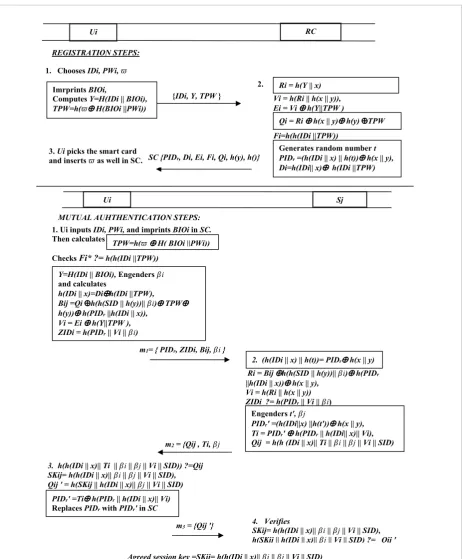
Figure 2
The proposed protocol (Registration and mutual authentication)
7
Figure 2 The proposed protocol (Registration and mutual authentication){IDi, Y, TPW } Vi = h(Ri || h(x || y)),
Ei = Vi h(Y||TPW )
Fi=h(h(IDi ||TPW))
1. Ui inputs IDi, PWi, and imprints BIOi in SC. Then calculates
Checks Fi* ?= h(h(IDi ||TPW)) REGISTRATION STEPS:
m1= { PIDr, ZIDi, Bij, 𝛽𝛽i }
Ri = Bij h(h(SID || h(y))|| 𝛽𝛽i) h(PIDr
||h(IDi || x)) h(x || y),
Vi = h(Ri || h(x || y)) ZIDi ?= h(PIDr || Vi || 𝛽𝛽i)
3. Ui picks thesmart card and inserts𝜛𝜛as wellin SC.
Ui Sj
Ui RC
MUTUAL AUHTHENTICATION STEPS:
3. h(h(IDi || x)|| Ti || 𝛽𝛽i || 𝛽𝛽j || Vi || SID)) ?=Qij SKij= h(h(IDi || x)|| 𝛽𝛽i || 𝛽𝛽j || Vi || SID),
Qij ' = h(SKij || h(IDi || x)|| 𝛽𝛽j || Vi || SID)
m3 = {Qij '} 4. Verifies SKij= h(h(IDi || x)||
𝛽𝛽i || 𝛽𝛽j || Vi || SID),
h(SKij || h(IDi || x)|| 𝛽𝛽j || Vi || SID) ?= Qij '
m2 = {Qij , Ti, 𝛽𝛽j
Imrprints BIOi,
Computes Y=H(IDi || BIOi),
TPW=h(𝜛𝜛 H(BIOi ||PWi))
Agreed session key =SKij= h(h(IDi || x)|| 𝛽𝛽i || 𝛽𝛽j || Vi || SID)
1. Chooses IDi, PWi, 𝜛𝜛
Ri = h(Y || x) 2.
Generates random number t
PIDr =(h(IDi || x) || h(t)) h(x || y),
Di=h(IDi|| x) h(IDi ||TPW)
Qi = Ri h(x || y) h(y) TPW
Y=H(IDi || BIOi), Engenders 𝛽𝛽i
and calculates
h(IDi || x)=Dih(IDi ||TPW),
Bij =Qi h(h(SID || h(y))|| 𝛽𝛽i) TPW
h(y)) h(PIDr ||h(IDi || x)),
Vi = Ei h(Y||TPW ),
ZIDi = h(PIDr || Vi || 𝛽𝛽i)
PIDr' =Ti h(PIDr || h(IDi || x)|| Vi)
Replaces PIDrwith PIDr' in SC
Engenders t', 𝛽𝛽j
PIDr' =(h(IDi||x) ||h(t')) h(x || y),
Ti = PIDr' h(PIDr || h(IDi|| x)|| Vi),
Qij = h(h (IDi || x)|| Ti || 𝛽𝛽i || 𝛽𝛽j || Vi || SID)
2. (h(IDi || x) || h(t))= PIDr h(x || y)
TPW=h(𝜛𝜛 H( BIOi ||PWi))
4.2. Login and Authentication Procedure
The mutual authentication phase between Ui and Sj is given below:1 In this procedure, the user seeks authenticated access of services from server on account of RC. To serve the purpose, Ui inputs the identity IDi and password PWi into smart card while inputs biometric BIOi into the scanner. Then smart card computes TPW=h(ϖ ⊕ H(BIOi || PWi)) and checks whether Fi* ?= h(h(IDi || TPW)). If true, then Ui creates a random integer βi, and calculates Y= H(IDi || BIOi), h(IDi || x) = Di ⊕ h(IDi || TPW), Bij = Qi ⊕ h(h(SID || h(y)) || βi) ⊕TPW ⊕ h(y)) ⊕ h(PIDr || h(IDi || x)), Vi = Ei ⊕ h(Y || TPW), and TIDi = h(PIDr || Vi || βi). Next, Ui sends the message m1= {PIDr, TIDi, Bij, βi} to Sj for verification.
2 RC , after receiving m1= { PIDr, TIDi, Bij, βi} com-putes (h(IDi || x) || h(t))=PIDr⊕ h(x || y), Ri = Bij ⊕ h(h(SID || h(y)) || βi) ⊕ h(PIDr || h(IDi || x)) ⊕h(x || y) and Vi = h( Ri || h(x || y)). Next, RC further com-putes h(PIDr || Vi || βi) and compares TIDi ?= h(PIDr || Vi || βi). If the equation is verified, RC will create a random integer t’ and calculate PIDr’ =(h(IDi || x) || h(t’)) ⊕ h(x || y), Ti = PIDr’ ⊕ h(PIDr || h(IDi || x) || Vi) and Qij = h(h(IDi || x) || Ti || βi|| βj|| Vi || SID) after generating a random number βj. Ultimately, RC sends the message m2 = {Qij , Ti, βj } to Ui. 3 After receiving m2, Ui computes h(h(IDi || x) || βi||
βj || Vi || SID)) and compares the equation h(h(IDi || x) || Ti || βi|| βj || Vi || SID)) ?=Qij .
4 If the equation is verified, Ui further calculates SKij= h(h(IDi || x) || βi|| βj || Vi || SID), Qij ‘ = h(SKij || h(IDi || x) || βj || Vi || SID) and forwards m3 = {Qij ‘} towards server so that it may verify the βj-based challenge. At the same time, Ui calculates PIDr’=Ti⊕h(PIDr || h(IDi || x) || Vi) and replaces the parameter PID with PIDr’ in SC.
5 The server (Sj), after receiving m3, calculates SKij= h(h(IDi || x)|| βi|| βj || Vi || SID). Afterwards, it ver-ifies the equation, i.e. h(SKij || h(IDi || x) || βj || Vi || SID) ?= Qij ‘. On successful verification, it con-structs session key with user as h(h(IDi || x) || βi|| βj || Vi || SID), finally. The details of the contributed protocol can be witnessed from Figure 2.
4.3. Password Alteration Mechanism
Ui may alter his/her password through initiating the password alteration steps, into another password
(PWinew) without getting any assistance out of registration centre. These steps are illustrated below. 1 Initially, the user shall insert its SC into the read-er for inputting identity (IDi*), password (PWi*) and imprinting its biometric factor BIOi* into the scanner device. Thereafter, the SC calculates TP-W=h(ϖ ⊕ H(BIOi ||PWi)) and checks Fi* ?=h(h(IDi ||TPW)). If this equality holds, then user proceeds to the next step.
2 Afterwards, the smart card calculates TPW=h(ϖ ⊕ H(BIOi || PWi)) and computes Vi = Ei ⊕ h(H(IDi || BIOi)||TPW), Qi* = Qi ⊕ TPW, h(IDi || x) = Di ⊕ h(IDi || TPW).
3 Subsequently, the user shall insert a new pass-word (PWinew). The smart card then calculates TPW’=h(ϖ ⊕ H(BIOi||PWinew)), Einew = Vi ⊕ h(H(I-Di || BIOi) || TPW’), Qinew = Qi*⊕ TPW’, Dinew= h(IDi || x)⊕h(IDi || TPW’) and Finew = h(h(IDi || TPW’)). 4 Next, the values Di, Ei, Fi, and Qi are replaced by
Dinew, Einew, Finew, and Qinew in the smart card.
5. Security Analysis
A comprehensive discussion on the security anal-ysis of proposed model is provided in the following sub-sections.
5.1. Replay Attacks
In replay attacks, the intercepted messages are re-played without undergoing modifications to betray any legal member [1, 3, 17, 19, 44].
5.2. Modification Attacks
The attacker could alter the intercepted parameters to resubmit to the intended party, in case a protocol is designed with least focus on resisting the modifica-tion attack.
If any adversary tries to alter the public parameters {PIDr, ZIDi, Bij, βi, Qij , Ti, βj, Qij ‘}, Ⱥ will be unable to reconstruct these contents {ZIDi, Bij, Qij , Qij ‘} by creating fresh session variables, since the construc-tion of these messages requires the knowledge of Vi and h(IDi || x) which are only known to the legitimate participants. Hence, the legitimate participant will be able to detect any malicious participant. Therefore, the contributed scheme may easily thwart this threat.
5.3. Password or Secret Guessing Threat
The guessing attack is possible if the adversary tries to guess the password of user or some Sj’s long term se-cret on account of intercepted parameters. In the pro-posed scheme, Ⱥ can approach the factors {PIDr, ZIDi, Bij, βi, Qij , Ti, βj, Qij ‘} on little inspection of any public channel. Nevertheless, an attacker could not derive the password, since it is not utilized as a factor for the calculation of any parameter; hence it minimizes the chances of guessing the corresponding parameters.5.4. Stolen-Verifier Threats
The adversary could embezzle with valuable data which are stored at server’s end; and the database of Ui’s secrets like passwords or other parameters, could be utilized to impersonate as the legitimate users. The proposed scheme provides mutual authentication without depending on database maintenance on Sj or RC’s end. This suggests that the stolen verifier attack is defeated in our scheme.
5.5. Offline-Dictionary Attack Based on
Stolen Smart Card Contents
In this attack, the attacker attempts various combi-nations of dictionary contents after having the stolen smart card information [23, 46].
Using SC, an attacker might try to manipulate with its available contents of smart card i.e., {PIDr, Di, Ei, Fi, Li, Qi, h()}. For guessing the password from Ei, Fi and Qi parameters, Ⱥ needs to know IDi, r and BIOi to guess PWi from TPW, where TPW= h(r ⊕ H(BIOi ||PWi)). Consequently, the offline-dictionary attack using SC cannot be launched in polynomial time.
5.6. Session Key Security
This security feature warrants the knowledge of ses-sion key only to the known legitimate parties, such as user and service provider.
In the contributed protocol, the established session key is designed as SK= h(h(IDi || x)|| βi|| βj || Vi || SID). For constructing a valid session key, an attacker shall require h(IDi || x) and Vi contents. If the user’s identi-ty is stolen or guessed by adversary, the latter may not be able to assemble h(IDi || x) as the adversary does not possess the parameter x. This stops the adversary from establishing a valid SK, contrary to scheme [11]. Furthermore, Ⱥ shall require Vi for creating a val-id SK, nonetheless, an attacker is not able to recover Vi as Ⱥ does not possess TPW, BIOi, and Ei factors. Therefore, there is much less of a chance for attacker to initiate this attack.
5.7. Known-Key Security
This feature ensures the confidentiality of private keys even if session key for a specific session gets re-vealed [2, 30].
Given that the agreed session key SK= h(h(IDi|| x)||βi || βj ||Vi || SID) does not include Ui’s password PWi as a factor, though it bears h(IDi || x), again the attacker may not derive x which is the high entropy master se-cret key of RC. Owing to this, the attacker might not recover the factors or parameters from an exposed session key. Thus, the contributed protocol is immune and fully complies with known-key security.
5.8. Mutual Authentication
The compliance to this feature lets the involved par-ticipants verify one another in the proposed scheme. In this scheme, both of the participants verify one another on account of h(IDi || x) and Vi. These both parameters are only accessible to adversary if the secrets of both RC and Sj are exposed, and not other-wise. The attacker cannot recover h(IDi || x) from PIDr by computing (h(IDi || x)||h(t)) = PIDr⊕ h(x||y), since it does not possess h(x||y). At the same time, the acces-sibility to Vi requires the information of either PWi and BIOi, or h(x || y).