Please cite this article as: P. Fattahi, V. Azizi, M.Jabbari, Lot Streaming in No-wait Multi Product Flowshop Considering Sequence Dependent Setup Times and Position Based Learning Factors, International Journal of Engineering (IJE), TRANSACTIONS A: Basics Vol. 28, No. 7, (July 2015) 1031-1039
International Journal of Engineering
J o u r n a l H o m e p a g e : w w w . i j e . i rLot Streaming in No-wait Multi Product Flowshop Considering Sequence Dependent
Setup Times and Position Based Learning Factors
P. Fattahi*a, V. Azizib, M.Jabbaria
aDepartment of Industrial Engineering, Bu-Ali Sina University bDepartment of Industrial Engineering, K.N.Toosi University
P A P E R I N F O
Paper history: Received 15 March 2015
Received in revised form 10 May 2015 Accepted 11 June 2015
Keywords:
No-wait Flowshop Lot Streaming
Sequence dependent Setup Times Variable Neighborhood Search Tabu Search, Simulated Annealing
A B S T R A C T
In this paper, a flowshop scheduling problem is studied. The importance of this study is that it considers different constraints simultaneously. These constraints are Lot Streaming, Position based learning factors, sequence dependent setup times and the fact that the flowshop line is no-wait. Lot streaming divide the lots of products into portions called sublots in order to reduce the lead times and work-in-process, and increase the machine utilization rates. The objective is to minimize the makespan. To clarify the system, mathematical model of the problemis presented. Since the problemis strongly NP-hard, two hybrid metaheuristics algorithms are proposed to solve the problem. These algorithms are based on the Variable Neighborhood Search (VNS), which is proved as an effective method for combinatorial optimization problems. In the proposed VNS, an efficient scheme for neighborhood search based on Tabu Search (TS) and Simulated Annealing (SA) is presented to strengthen the local searches. At the last part, computation results are provided to evaluate the efficiency of VNSSA and VNSTS. In order to verify the effectiveness of proposed algorithms, Relative percentage Deviation along with statistical analysis is presented.The computational results show that VNSSA outperforms VNSTS in most instances.
doi: 10.5829/idosi.ije.2015.28.07a.09
1. INTRODUCTION1
Scheduling of production systems with multiple products is affected by a number of factors such as learning parameters, sequence dependent setup times and lot streaming. Lot streaming has served an important role in scheduling problems. This technique reduces the required setup times as well as the amount of storage space. In this paper, a real world problem is modeled. In this problem, a no-wait, m-machine flowshop is studied by considering learning effects and sequence dependent setup times in which products must be produced in batches and lot streaming is basically considered in scheduling.
In recent years, there has been a focus on lot streaming in scheduling problems. These studies can be
1*Corresponding Author’s Email: [email protected] (P. Fattahi)
categorized using nine different criteria as mentioned by Surin and Jaiprakash [1].
2. LITERATURE REVIEW
No-wait flow shop has several applications in modern manufacturing and servicing environments. According to Rock [2], no-wait flowshop scheduling problem with more than two machines is strongly NP-hard. Gilmore and Gomory [3] provided polynomial time algorithms for two-machine no-wait flow shop scheduling problem. There was no important progress in no-wait flowshop scheduling until recent two decades. Kumar et al. [4] studied a m-machine no-wait flowshop scheduling problem with multi products. They proposed Genetic Algorithm to solve the problem. Aldowasian and Alahverdi [5] studied M-machine no-wait flowshop and proposed a heuristic method and compared it with previous results obtained by other researches. They proved that new method performs better on average. Rabeiee et al. [6] investigated the scheduling of a no-wait two-machine flowshop considering anticipatory sequence-dependent set-up times. Laha and Supkal [7] studied no-wait m-machine flowshop scheduling and presented a constructive heuristic to solve the problem. There are many researches focusing lot streaming in production system. Among them, Szendrovits [8] research was one of the first researches modeling a single product multi-stage production system. Pots and Baker [9] studied flowshop scheduling with lot streaming in order to minimize the length of flow shop schedule. Yoon and Ventura [10] studied a lot streaming flow shop scheduling problem and proposed a hybrid Genetic algorithm to solve it. Tseng and Liao [11] considered a n-job m-machine lot streaming problem in a flow shop scheduling and proposed a net benefit of movement (NBM) algorithm and a discrete particle swarm optimization (DPSO) algorithm to minimize the total weighted earliness and tardiness. Behnamian et al. [13] have studied the problem of sequence dependent set-up time hybrid flowshop scheduling with the objectives of minimizing the makespan and sum of the earliness and tardiness of jobs. They proposed a hybrid VNS-SA algorithm and compared the results with the previous results obtained by Genetic Algorithm. The comparison showed that the hybrid solution is effective. Hansen et al. [14] investigated about variable neighborhood search in different situations such as combinatorial problems and compared its efficiency, effectiveness and robustness with other algorithms.
Pan et al. [15] proposed a discrete harmony search algorithm to solve lot streaming flow shop. They compare their algorithm with previous results and demonstrate the effectiveness of the proposed DHS. Pan and Ruiz [15] consider a n-job m- machine lot streaming flow shop scheduling with sequence dependent setup times under both the idling and no-idling production cases with the objective of minimizing maximum completion time. Ventura and Yoon [16] investigated a
n-job m-machine flowshop scheduling problem and consider equal sublots and limited capacity buffers with blocking and proposed a new Genetic Algorithm to solve the problem. They proved that NGA outperforms GA on the average. Ramezanian et al. [17] discussed a multi-product multi period integrated lot-sizing and scheduling problem considering overlapping in operations. They provided the mixed integer programing model and two heuristic to solve the problem. Vijaychakaravarthy et al. [18] studied a n-job m-machine lot-streaming problem in flowshop with variable size sublots and also to determine the optimal sublot size. They provided an improved sheep flock heredity algorithm (ISFHA) and Artificial Bee Colony (ABC) algorithm to minimize the makespan and total flow time.
Biskup [19] and Cheng and Wang [20] are pioneers in applying learning effects in scheduling problems. Lee and Wu [21] considered learning effect in two-machine flowshop scheduling problem with the criterion of minimizing completion time. Wang and Xia [22] considered the assumption of increasing dominance machine into the flowshop scheduling problem with learning effects. Chen et al. [23] studied two-machine flowshop scheduling problem including learning effect with respect to two criteria: minimizing total completion time and the weighted sum of maximum tardiness. Wang and Liu [24] developed two-machine flowshop scheduling problem with deterioration and learning effects. Isler et al. [25] proposed two-machine flowshop scheduling problem to minimize total earliness and tardiness penalties with learning effects assumption. Li et al [26] studied two-machine flowshop scheduling with truncated learning effects to minimize the total completion time. Cheng et al. [27] addressed two-machine flowshop scheduling with a truncated learning function to minimize the makespan. They described a branch and bound algorithm to obtain the optimal solutions in small size instances and a genetic algorithm to obtain near optimal solutions in large-scale instances.
3. PROBLEM DESCRIPTION
The objective of this paper is to minimize the makespan in a novel model that considers simultaneously no-wait,
m-machine flowshop with multiple products
In order to produce each sublot of products on machines, the setup operation has to be done before starting the process. It should be considered that sequence of products affects the setup times. Therefore, the required setup time of sublot r(𝑟 ∈ 𝐿)of product j on machine m depends on its previous product (i). Also, if sublot r is in position 𝜏 on machine m, its required process time (𝑝𝑖𝑚𝜏 ) is calculated based on the truncation learning formula,𝑝𝑖𝑚𝜏 = 𝑝𝑖𝑚𝜏 ′∗ max{𝜏𝛼𝑚, 𝛽𝑚}, where
𝑝𝑖𝑚𝜏 ′is the actual process times, 𝛼𝑚 is learning effect parameter for machine m and 𝛽𝑚 is the control parameter limiting the learning parameter and do not let the processing time to drop to zero.
In this paper, the following notations are used to formulate the problem:
N: set of products N= {1, 2,…, n};
i,j,l: Product index, 𝑖 , 𝑗, 𝑙 ∈ N;
C: Maximum number of sublots
L: set of sublots for each product, L= {1, 2,…, C};
r,p:sublot index, 𝑟, 𝑝 ∈ L;
𝑇: set of positions T={1,2,…,n*C};
𝜏: position index 𝜏 ∈ T;
M: set of machines M={1, 2,…, m};
m:Machine index, m∈ M;
𝑠𝑑𝑠𝑡𝑖𝑗𝑟𝑚: sequence dependent setup time for sublot r of product j on machine m when j is placed after product i;𝑖 ≠ 𝑗
𝑠𝑑𝑠𝑡𝑗𝑗𝑟𝑚: sequence dependent setup time for sublot r of product j on machine m when j is at the first of the sequence;
𝑝𝑖𝑚: process time of product i on machine m;
𝛼𝑚: Learning effect of 𝑚th machine
𝛽𝑚: Truncation factor for learning effect of 𝑚th machine.
𝐿𝑅(𝜏, 𝑚): Learning rate for the sublot in position 𝜏 on machine 𝑚. 𝐿𝑅(𝜏, 𝑚) = max{𝜏𝛼𝑚, 𝛽
𝑚} , ∀ 𝑚 ∈ 𝑀 Variables of the mathematical model are as follows:
𝑥𝑖𝑗𝑟𝜏: 1, if sublot r of product j is processed at position 𝜏 when product j is processed after product i; 0 otherwise;
𝑥𝑗𝑗𝑟𝜏: l , if sublot r of product j is processed at position 𝜏 when product j is at the first sequence; 0 otherwise
𝑓𝜏𝑚: Processing completion time of part in position 𝜏 on machine m;
𝑆𝜏𝑚: Start time of doing operation on sublot in position
𝜏on machine m;
𝐶𝑚𝑎𝑥 : Makespan
The mathematical model of problem is presented as follows:
Min 𝑍 = 𝐶𝑚𝑎𝑥 (1)
Subject to:
∑𝑛𝑗=1𝑥𝑗𝑗𝑟𝜏= 1 𝑟 = 1, 𝜏 = 1 (2)
∑𝑖=1𝑛 ∑𝑗=1𝑛 ∑𝐶𝑟=1𝑥𝑖𝑗𝑟𝜏= 1 𝜏 ≥ 𝐶 + 1 (3)
∑𝑛𝑗=1𝑥𝑖𝑗𝑟𝜏+1= ∑𝑛𝑙=1𝑥𝑙𝑖𝑝𝜏
∀𝑖 ∈ 𝑁, ∀𝜏 ∈ 𝑇
r=1, p=c
(4)
𝑥𝑖𝑗𝑟𝜏= 𝑥𝑖𝑗(𝑟−1)𝜏−1
𝜏 ≥ 2, 𝑟 ≥ 2
∀𝑖 ∈ 𝑁 , ∀𝑗 ∈ 𝑁 (5)
∑𝑗=1𝑛 ∑𝑟=1𝐶 ∑𝑛∗𝐶𝜏=1𝑥𝑖𝑗𝑟𝜏≤ 𝐶 ∀𝑖 ∈ 𝑁, 𝑖 ≠ 𝑗 (6)
∑𝑖=1𝑛 ∑𝑟=1𝐶 ∑𝑛∗𝐶𝜏=1𝑥𝑖𝑗𝑟𝜏≤ 𝐶 ∀𝑗 ∈ 𝑁 (7)
𝑠𝜏𝑚≥ ∑𝑁𝑗=1𝑥𝑗𝑗𝑟𝜏∗ 𝑠𝑑𝑠𝑡𝑗𝑗𝑟𝑚 𝜏 = 1, ∀𝑚 ∈ 𝑀, 𝑟 = 1 (8)
𝑓𝜏𝑚= 𝑠𝜏𝑚+ ∑𝑛𝑗=1𝑥𝑗𝑗𝑟𝜏∗
𝐿𝑅(𝜏, 𝑚) ∗ 𝑝𝑗𝑚/𝑐
𝜏 = 1, ∀𝑚 ∈ 𝑀, 𝑟 = 1 (9)
𝑠𝜏𝑚≥ 𝑓𝜏(𝑚−1) 𝜏 ≥ 2, 𝑚 ≥ 2 (10)
𝑠𝜏𝑚= 𝑓(𝜏−1)𝑚+
∑𝑛𝑗=1∑𝑛𝑗=1∑𝐶𝑟=1𝑥𝑖𝑗𝑟𝜏∗
𝑠𝑑𝑠𝑡𝑖𝑗𝑟𝑚
𝜏 ≥ 2 , ∀𝑚 ∈ 𝑀 (11)
𝑠𝜏𝑚≥ 𝑓(𝜏−1)(𝑚+1)+
∑𝑛𝑖=1∑𝑛𝑗=1∑𝐶𝑟=1𝑥𝑖𝑗𝑟𝜏∗
𝑠𝑑𝑠𝑡𝑖𝑗𝑟(𝑚+1)−
∑𝑛𝑖=1∑𝑛𝑗=1∑𝐶𝑟=1𝑥𝑖𝑗𝑟𝜏∗
𝐿𝑅(𝜏, 𝑚) ∗ 𝑝𝑗𝑚/𝑐
𝜏 ≥ 2, ∀𝑚 ∈ 𝑀 (12)
𝑠𝜏𝑚≥ 𝑠𝜏(𝑚+1)−
∑𝑛𝑖=1∑𝑛𝑗=1∑𝐶𝑟=1𝑥𝑖𝑗𝑟𝜏∗
𝐿𝑅(𝜏, 𝑚) ∗ 𝑝𝑗𝑚/𝑐
𝜏 ≥ 2, ∀𝑚 ∈ 𝑀 (13)
𝑓𝜏𝑚=
𝑆𝜏𝑚+ ∑𝑛𝑖=1∑𝑛𝑗=1∑𝐶𝑟=1𝑥𝑖𝑗𝑟𝜏∗
𝐿𝑅(𝜏, 𝑚) ∗ 𝑝𝑗𝑚/𝑐
𝜏 ≥ 2, ∀𝑚 ∈ 𝑀 (14)
𝑥𝑖𝑗𝑟𝜏∈ {0,1}
∀𝑖, 𝑗 ∈ 𝑁, ∀𝜏 ∈ 𝑇,
∀𝑟 ∈ 𝐿
(15)
𝑠τm≥ 0 ∀𝑚 ∈ 𝑀, ∀𝜏 ∈ 𝑇 (16)
𝑓τm≥ 0 ∀𝑚 ∈ 𝑀, ∀𝜏 ∈ 𝑇 (17)
by just one sublot. Constraint set (4) indicates that if the position 𝜏 is assigned to the last sublot of product i, the first sublot of a next product should be assigned to the next position(𝜏 + 1). Constraint set (5) ensures that a product sublot set should process continuously on a set of sequences. Constraints (6) and (7) require each sublot to be assigned to a sequence. Constraint (8) calculates the start time of processing first sublot of first product on first machine. Constraint set (9) calculates the time when the process on first sublot of first product is finished. Constraint (10) and (11) calculate the start time of processing sublots on other machines. Constraints (12), (13) limits the start time of processing on machines considering no-wait conditions. Constraint set (14) calculates finish time of processing sublots in sequence 2 to n*C on all machines. Constraint (15) ensures that 𝑥𝑖𝑗𝑟𝜏are binary variables and constraints (16), (17) specify the nonnegative variables.
4. PROPOSED SOLVING APPROACHES
As it is mentioned by Rock [2], a simple form of no-wait flowshop scheduling is NP-Hard. Therefore, this problem that is a developed form of Rock's problem is strongly NP-hard too. In this case, exact methods are not practical in solving real-world problems. In this part, three practical metaheuristics (VNS,TS, SA) are described thoroughly and from these approaches, two hybrid solution procedures are introduced.
Solution representation for both of these proposed methods is an integer string of n, where n is the number of products and initial solutions are generated randomly. 4. 1. Variable Neighborhood Search VNS is one of the widest applicable metahehuristics known until now. It is based on local search methods. VNS starts from an initial solution and proceed with local changes in order to improve the value of objective function. In this algorithm, 𝑁𝑘 neighborhood structures are defined. The local searches are based on these neighborhood structures. Searching procedure is continued until the stopping condition is met. Steps of the basic VNS are as follows.
Select the set of neighborhood structures 𝑁𝑘 , k=1,…,𝑘𝑚𝑎𝑥that will be used in the search; find an initial solution 𝑥, choose a stoping condition;
Repeat the following until the stopping condition is met :
(1) Set 𝑘 ← 1;
(2) Until 𝑘 = 𝑘𝑚𝑎𝑥 repeat the following steps: (a) Shaking. Generate a point 𝑥́ at random from the
𝑘𝑡ℎ neighborhood of x
(b) Local search. Apply some local search method
with 𝑥́ as initial solution; denote with 𝑥" the so obtained local optimum;
(c) Move or not. If this local optimum is better than the incumbent, move there (𝑥 ← 𝑥") and continue the search with 𝑁1 (𝑘 ← 1); otherwise , set 𝑘 ← 𝑘 + 1;
4. 1. 1. Neighborhood Structure Neighborhood structure is a mechanism leading to a new set of neighborhood solutions. This structure should eliminate unnecessary moves. In this paper, three neighborhood structures are used. The first structure randomly selects two elements in current solution and exchanges them (swap). Second structure chooses an element and put it just before another random element (insert). Third one reverses the elements which are located between two randomly chosen elements (reversion).
4. 2. Simulated Annealing Simulated Annealing (SA) was first introduced by Kirkpatrick et al. [28]. It is inspired from process of melting and refreezing materials. SA can escape from being trapped into local optimum solutions by searching for fair solutions, in small probability.
SA procedure starts with random solutions. In each iteration, the moves decreasing the energy will always be accepted while fair moves will only be accepted with a small probability. Therefore, SA will also accept bad solutions with small probability, determined by Boltzmann function, exp (− ∆
𝐾𝑇)where 𝐾 and 𝑇 are predetermined constant and the current temperature, respectively. Also ∆ is the difference of objective values between the current solution and the new solution.
If the calculated Boltzmann function value is more than a uniform random number between 0 and 1, then the bad solution should be accepted.
4. 2. 1. Cooling Schedule Cooling schedule has a great influence on the success of the SA optimization algorithm. The parameters of cooling schedule consist of initial temperature, equilibrium state and a cooling function. In this article, the initial temperature is defined as the maximum difference between the fitness function value of solution seeds in the initial population.
𝑡𝑖=log (𝑖)𝑡𝑖−1 (19)
4. 3. Tabu Search Tabu search is a metaheuristic method capable of obtaining optimal or near optimal solutions in to a wide variety of problems. This algorithm was first introduced by Glover [29] Using a flexible memory structure, Tabu Search algorithm provides conditions to search the solution space strategically and prevent the procedure from becoming trapped at locally optimal solutions. This memory function can vary over the time span in order to intensify or diversify the search procedure. In this algorithm, there is a forbidden list of potential solutions called Tabu list. The Tabu list will be updated in each iteration of algorithm. One of the most important parameters of Tabu Search is the strategy that set the rules of making Tabu list. Tabu tenure determines how long the corresponding solutions need to be tabooed.
4. 3. 1. Neighborhood Solution Set Size In this paper, Tabu Search is designed in a way that considers all possible states of cods for each problem.
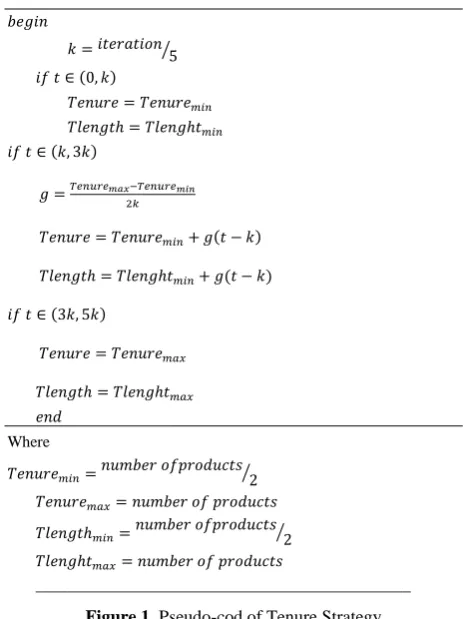
4. 3. 2. Tabu Tenur Tabu tenure determines how long the corresponding solutions need to be tabooed. Furthermore, the size of tabu list is of great importance. In this paper, the tabu tenure strategy is similar to strategy explained by Li et al. [30]. The pseudo-cod tenure strategy is shown in Figure 1.
4. 4. Hybrid Solution
4. 4. 1. VNSSA In order to improve the performance of metaheuristics, Simulated Annealing and Variable Neighborhood Search are joined together. SA has the ability to explore the solution space and improve VNS performance by intensifying local searches. To clarify the hybrid method, consider three steps of VNS described in 2.1, the neighborhood structures are selected at first step.
In the second step, a new solution is generated as described in shaking part. For the next step, local search, instead of using simple local search, SA algorithm operators do search the solution space. At the third phase, the obtained solution from SA algorithm is compared with the initial solution. If the solution is better, it will be replaced. At the last part the stop condition is checked and these steps will continue until the stop condition is met.
𝑏𝑒𝑔𝑖𝑛
𝑘 = 𝑖𝑡𝑒𝑟𝑎𝑡𝑖𝑜𝑛 5⁄
𝑖𝑓 𝑡 ∈ (0, 𝑘)
𝑇𝑒𝑛𝑢𝑟𝑒 = 𝑇𝑒𝑛𝑢𝑟𝑒𝑚𝑖𝑛
𝑇𝑙𝑒𝑛𝑔𝑡ℎ = 𝑇𝑙𝑒𝑛𝑔ℎ𝑡𝑚𝑖𝑛
𝑖𝑓 𝑡 ∈ (𝑘, 3𝑘)
𝑔 =𝑇𝑒𝑛𝑢𝑟𝑒𝑚𝑎𝑥−𝑇𝑒𝑛𝑢𝑟𝑒𝑚𝑖𝑛
2𝑘
𝑇𝑒𝑛𝑢𝑟𝑒 = 𝑇𝑒𝑛𝑢𝑟𝑒𝑚𝑖𝑛+ 𝑔(𝑡 − 𝑘)
𝑇𝑙𝑒𝑛𝑔𝑡ℎ = 𝑇𝑙𝑒𝑛𝑔ℎ𝑡𝑚𝑖𝑛+ 𝑔(𝑡 − 𝑘)
𝑖𝑓 𝑡 ∈ (3𝑘, 5𝑘)
𝑇𝑒𝑛𝑢𝑟𝑒 = 𝑇𝑒𝑛𝑢𝑟𝑒𝑚𝑎𝑥
𝑇𝑙𝑒𝑛𝑔𝑡ℎ = 𝑇𝑙𝑒𝑛𝑔ℎ𝑡𝑚𝑎𝑥
𝑒𝑛𝑑
Where
𝑇𝑒𝑛𝑢𝑟𝑒𝑚𝑖𝑛=𝑛𝑢𝑚𝑏𝑒𝑟 𝑜𝑓𝑝𝑟𝑜𝑑𝑢𝑐𝑡𝑠⁄2
𝑇𝑒𝑛𝑢𝑟𝑒𝑚𝑎𝑥= 𝑛𝑢𝑚𝑏𝑒𝑟 𝑜𝑓 𝑝𝑟𝑜𝑑𝑢𝑐𝑡𝑠
𝑇𝑙𝑒𝑛𝑔𝑡ℎ𝑚𝑖𝑛=𝑛𝑢𝑚𝑏𝑒𝑟 𝑜𝑓𝑝𝑟𝑜𝑑𝑢𝑐𝑡𝑠⁄2
𝑇𝑙𝑒𝑛𝑔ℎ𝑡𝑚𝑎𝑥= 𝑛𝑢𝑚𝑏𝑒𝑟 𝑜𝑓 𝑝𝑟𝑜𝑑𝑢𝑐𝑡𝑠
_______________________________________________
Figure 1. Pseudo-cod of Tenure Strategy
4. 4. 2. VNSTS The hybrid VNS-TS algorithm has many similarities to hybrid VNS-SA algorithm. In the other words, all steps are the same except local search. The structure of hybrid VNS-TS algorithm is based on Variable Neighborhood Search. However, hybrid algorithm enhance local search phase by using Tabu Search operators. So, the algorithm starts as VNS and for the local search use TS algorithm instead of simple local search.
5. COMPUTATIONAL RESULTS
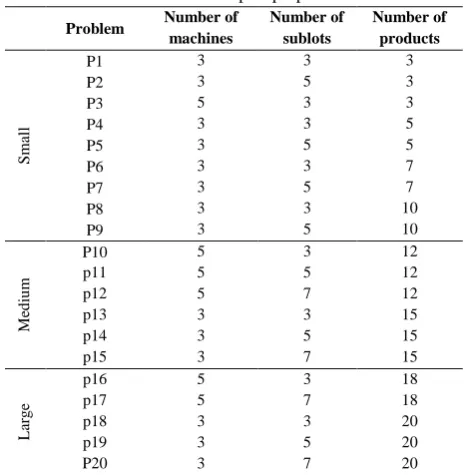
and large problems. Table 2 shows the properties of each instance.
In these problems, sequence dependent setup are drawn from a uniform distribution over the interval [1,50] and process times are uniformly distributed over the interval [1,50]. The learning parameter of machines,
𝛼, is considered "-0.3" and truncation factor of machines, 𝛽, is "0.7" for all machines. To solve the problems, proposed metaheuristics are coded by MATLAB software. Furthermore, the mixed integer linear programming is coded with GAMS IDE (ver. 23.5) software. The instances are solved on a PC with Intel Corei5, 2 GHz and 4G memory.
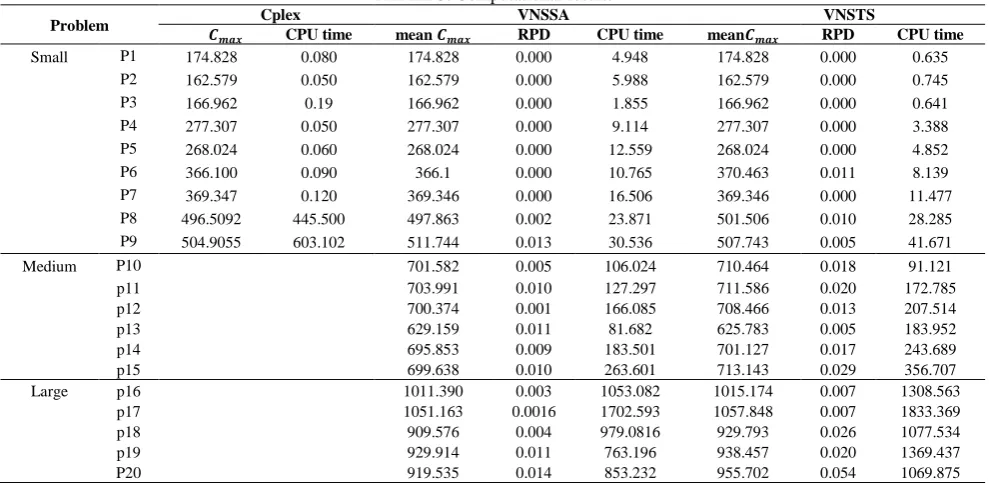
The obtained results are specified in Table 3. The effectiveness of algorithms is compared using a well-known criteria, Relative Percentage Deviation (RPD). RPD factor is computed as Equation (20) and compare the performance of each procedure to other procedures for each instance.
(20)
𝑅𝑃𝐷 =𝑎𝑙𝑔𝑜𝑟𝑖𝑡ℎ𝑚𝑠𝑜𝑙𝑢𝑡𝑖𝑜𝑛−𝑚𝑖𝑛𝑖𝑚𝑢𝑚𝑠𝑜𝑙𝑢𝑡𝑖𝑜𝑛
𝑚𝑖𝑛𝑖𝑚𝑢𝑚 𝑠𝑜𝑙𝑢𝑡𝑖𝑜𝑛
A statistical test is proposed in this paper to compare the ability of metaheuristics at finding the best solution. This statistical test can be based on ANOVA or nonparametric tests. Before choosing between ANOVA and nonparametric test, the hypothesis of normality should be checked for both VNSSA RPDs and VNSTS RPDs. The test is performed using Minitab software. Figures 2 and 3 show the results of normality test for VNSSA and VNSTS, respectively. These tests are based on the ANDERSON-DARLING method with 0.05 significance level. As it is obvious in the picture, the p-value of tests are less than the required significance level. Therefore, both VNSSA and VNSTS have normal distribution. In order to select proper ANOVA test, the variances of VNSTS and VNSSA are tested. This test identifies whether the variances are same or not.
TABLE 1. Parameter designs
Metaheuristic Parameter
Appropriate quantity according to Taguchi method
Small Medium Large
SA
Population size
5 7 15
Maximum
iteration 5 15 15
Number of movements
10 20 20
𝛼 0.999 0.999 0.999
𝐾 1 1 1
TS Maximum
iteration 20 40 100
TABLE 2. Samples properties
Number of products Number of sublots Number of machines Problem 3 3 3 P1 S mal l 3 5 3 P2 3 3 5 P3 5 3 3 P4 5 5 3 P5 7 3 3 P6 7 5 3 P7 10 3 3 P8 10 5 3 P9 12 3 5 P10 M ed iu
m p11 p12 5 5 5 7 12 12
15 3 3 p13 15 5 3 p14 15 7 3 p15 18 3 5 p16 La rg
e p17 5 7 18
20 3 3 p18 20 5 3 p19 20 7 3 P20
The results of the test show that the p-value is less than the significance level, the variances are not equal. Considering these observations, the appropriate test of comparing the RPDs of two methods is Two-Sample T-test. In this test, the null hypothesis is the equality of mean of VNSTS RPD and VNSSA RPD. This hypothesis is rejected when the mean of VNSTS RPDs are greater than mean of VNSSA RPDs. The results of ANOVA is summarized in Table 4. The P-Value is less than 0.05 so the null hypothesis is rejected in this test, and the mean of VNSSA RPDs are less than the VNSTS RPDs. This fact illustrates the better performance of
VNSSA compared with VSTS. To compare
metaheuristics, another important factor is computational time. Figure 4 compares the performance of proposed metaheuristics considering computational time. 0.06 0.05 0.04 0.03 0.02 0.01 0.00 -0.01 -0.02 99 95 90 80 70 60 50 40 30 20 10 5 1
RPD Values for VNSTS
Pe rc en t Mean 0.0121 StDev 0.01349 N 20 AD 0.934 P-Value 0.014
Probability Plot RPD Values for VNSTS
Normal
TABLE 3. Computational results
Problem Cplex VNSSA VNSTS
𝑪𝒎𝒂𝒙 CPU time mean 𝑪𝒎𝒂𝒙 RPD CPU time mean𝑪𝒎𝒂𝒙 RPD CPU time
Small P1 174.828 0.080 174.828 0.000 4.948 174.828 0.000 0.635
P2 162.579 0.050 162.579 0.000 5.988 162.579 0.000 0.745
P3 166.962 0.19 166.962 0.000 1.855 166.962 0.000 0.641
P4 277.307 0.050 277.307 0.000 9.114 277.307 0.000 3.388
P5 268.024 0.060 268.024 0.000 12.559 268.024 0.000 4.852
P6 366.100 0.090 366.1 0.000 10.765 370.463 0.011 8.139
P7 369.347 0.120 369.346 0.000 16.506 369.346 0.000 11.477
P8 496.5092 445.500 497.863 0.002 23.871 501.506 0.010 28.285
P9 504.9055 603.102 511.744 0.013 30.536 507.743 0.005 41.671
Medium P10 701.582 0.005 106.024 710.464 0.018 91.121
p11 703.991 0.010 127.297 711.586 0.020 172.785
p12 700.374 0.001 166.085 708.466 0.013 207.514
p13 629.159 0.011 81.682 625.783 0.005 183.952
p14 695.853 0.009 183.501 701.127 0.017 243.689
p15 699.638 0.010 263.601 713.143 0.029 356.707
Large p16 1011.390 0.003 1053.082 1015.174 0.007 1308.563
p17 1051.163 0.0016 1702.593 1057.848 0.007 1833.369
p18 909.576 0.004 979.0816 929.793 0.026 1077.534
p19 929.914 0.011 763.196 938.457 0.020 1369.437
P20 919.535 0.014 853.232 955.702 0.054 1069.875
TABLE 4. Two-sample T for VNSTS vs. VNSSA
Method Number Mean Standard Deviation Standard Error of Mean
VNSTS 20 0.0121 0.0135 0.0030
VNSSA 20 0.00473 0.00512 0.0011
Difference = mu (VNSTS) - mu (VNSSA)***Estimate for difference: 0.00737***95% lower bound for difference: 0.00185 T-Test of difference = 0 (vs >): T-Value = 2.28 P-Value = 0.016 DF = 24
0.020 0.015 0.010 0.005 0.000 -0.005 -0.010 99
95 90 80 70 60 50 40 30 20 10 5
1
RPD Values for VNSSA
Pe
rc
en
t
Mean 0.004731 StDev 0.005120
N 20
AD 1.421
P-Value <0.005
Probability Plot of RPD Values for VNSSA
Normal
Figure 3. VNSSA normality test
Figure4. Comparison of computational time for VNSSA and
VNSTS
6. CONCLUSION
This paper dealt with the "no-wait flowshop scheduling problem" to minimize the makespan with respect to lot streaming, sequence-dependent setup times and truncated learning function. The problem is modeled using mixed integer linear programming. On account of the fact that this problem is strongly NP-hard, therefore, two hybridmetaheuristics are proposed to solve real-word problems.
These metaheuristics are based on the "Variable Neighborhood Search" and are empowered using "Simulated annealing" and "Tabu Search". Different sample problems are provided and solved by each procedure and results are analyzed to compare the performance of procedures in different problem conditions. Furthermore, a thorough investigation basedon ANOVA is presented to determine the best procedure. The results show that for small problems, both methods have approximately same performance. However, for large problems, VNSSA out performs VNSTS.
2 4 6 8 10 12 14 16 18 20
0 200 400 600 800 1000 1200 1400 1600 1800 2000
Sample Number
C
P
U
Ti
m
e
7. REFERENCES
1. Sarin, Subhash C., and Puneet Jaiprakash. Flow shop lot
streaming. Springer, 2007.
2. Röck, Hans., "The three-machine no-wait flow shop is
NP-complete.", Journal of the ACM (JACM), Vol. 31, No. 2,
(1984), 336-345.
3. Gilmore, Paul C., and Ralph E. Gomory., "Sequencing a one
state-variable machine: A solvable case of the traveling
salesman problem.", Operations Research, Vol. 12, No. 5,
(1964), 655-679.
4. Kumar, Subodha, Tapan P. Bagchi, and C. Sriskandarajah., "Lot
streaming and scheduling heuristics for< i> m</i>-machine no-wait flowshops.", Computers & Industrial Engineering, Vol 38, No. 1, (2000), 149-172.
5. Aldowaisan, Tariq, and Ali Allahverdi., "New heuristics for< i> m</i>-machine no-wait flowshop to minimize total completion time.", Omega, Vol. 32, No. 5 (2004), 345-352.
6. Rabiee, M., M. Zandieh, and A. Jafarian., "Scheduling of a no-wait two-machine flow shop with sequence-dependent setup
times and probable rework using robust
meta-heuristics.", International Journal of Production
Research, Vol. 50, No. 24, (2012), 7428-7446.
7. Laha, Dipak, and Sagar U. Sapkal., "An improved heuristic to minimize total flow time for scheduling in the< i>
m</i>-machine no-wait flow shop.", Computers & Industrial
Engineering, Vol. 67, (2014), 36-43.
8. Szendrovits, Andrew Z., "Manufacturing cycle time
determination for a multi-stage economic production quantity
model.", Management Science, Vol. 22, No. 3 (1975), 298-308.
9. Potts, C. N., and K. R. Baker., "Flow shop scheduling with lot streaming.", Operations Research Letters, Vol. 8, No. 6 (1989), 297-303.
10. Yoon, Suk-Hun, and Jose A. Ventura., "An application of
genetic algorithms to lot-streaming flow shop scheduling." IIE Transactions, Vol. 34, No. 9, (2002), 779-787.
11. Tseng, Chao-Tang, and Ching-Jong Liao., "A discrete particle swarm optimization for lot-streaming flowshop scheduling
problem.", European Journal of Operational Research, Vol.
191, No. 2, (2008), 360-373.
12. Pan, Quan-Ke, Mehmet Fatih Tasgetiren, Ponnuthurai
Nagaratnam Suganthan, and Yun-Chia Liang., "Solving lot-streaming flow shop scheduling problems using a discrete
harmony search algorithm.", In Evolutionary Computation
(CEC), 2010 IEEE Congress on, pp. 1-6. IEEE, 2010.
13. Behnamian, J., SMT Fatemi Ghomi, and M. Zandieh., "A
multi-phase covering Pareto-optimal front method to multi-objective scheduling in a realistic hybrid flowshop using a hybrid
metaheuristic." Expert Systems with Applications Vol.36, No. 8
(2009), 11057-11069.
14. Hansen, Pierre, and Nenad Mladenović. Variable neighborhood
search. Springer US, (2005).
15. Pan, Quan-Ke, and Rubén Ruiz., "An estimation of distribution algorithm for lot-streaming flow shop problems with setup times.", Omega, Vol. 40, No. 2, (2012), 166-180.
16. Ventura, José A., and Suk-Hun Yoon., "A new genetic algorithm
for lot-streaming flow shop scheduling with limited capacity buffers.", Journal of Intelligent Manufacturing, Vol. 24, No. 6, (2013), 1185-1196.
17. Ramezanian, Reza, Mohammad Saidi-Mehrabad, and Ebrahim
Teimoury., "A mathematical model for integrating lot-sizing and
scheduling problem in capacitated flow shop
environments.", The International Journal of Advanced
Manufacturing Technology, Vol. 66, No. 1-4, (2013), 347-361.
18. Vijaychakaravarthy, G., S. Marimuthu, and A. Naveen Sait.,
"Comparison of Improved Sheep Flock Heredity Algorithm and Artificial Bee Colony Algorithm for lot Streaming in m-Machine
Flow Shop Scheduling.", Arabian Journal for Science and
Engineering, Vol. 39, No. 5, (2014), 4285-4300.
19. Biskup, Dirk., "Single-machine scheduling with learning
considerations.", European Journal of Operational Research, Vol. 115, No. 1, (1999), 173-178.
20. Cheng, TC Edwin, and Guoqing Wang., "Single machine
scheduling with learning effect considerations.", Annals of Operations Research, Vol. 98, No. 1-4, (2000), 273-290.
21. Lee, Wen-Chiung, and Chin-Chia Wu., "Minimizing total
completion time in a two-machine flowshop with a learning effect.", International Journal of Production Economics, Vol. 88, No. 1, (2004), 85-93.
22. Wang, J. B., and Z. Q. Xia., "Flow-shop scheduling with a learning effect.", Journal of the Operational Research Society, Vol. 56, No. 11, (2005), 1325-1330.
23. Chen, P., C. C. Wu, and W. C. Lee., "A bi-criteria two-machine
flowshop scheduling problem with a learning effect.", Journal of the Operational Research Society, Vol. 57, No. 9, (2006), 1113-1125.
24. Wang, Ji-Bo, and Li-Li Liu., "Two-machine flow shop problem
with effects of deterioration and learning.", Computers & Industrial Engineering, Vol. 57, No. 3, (2009), 1114-1121.
25. İşler, Mesut Cemil, Bilal Toklu, and Veli Çelik., "Scheduling in
a two-machine flow-shop for earliness/tardiness under learning
effect." The International Journal of Advanced Manufacturing
Technology, Vol. 61, No. 9-12, (2012), 1129-1137.
26. Li, Der-Chiang, Peng-Hsiang Hsu, Chin-Chia Wu, and TC
Edwin Cheng., "Two-machine flowshop scheduling with
truncated learning to minimize the total completion
time.", Computers & Industrial Engineering, Vol. 61, No. 3, (2011), 655-662.
27. Cheng, T. C. E., Chin-Chia Wu, Juei-Chao Chen, Wen-Hsiang
Wu, and Shuenn-Ren Cheng., "Two-machine flowshop scheduling with a truncated learning function to minimize the
makespan.", International Journal of Production Economics,
Vol. 141, No. 1, (2013), 79-86.
28. Kirkpatrick, Scott, C. Daniel Gelatt, and Mario P. Vecchi.,
"Optimization by simmulated annealing.", Science, Vol. 220, No. 4598, (1983), 671-680.
29. Glover, Fred., "Tabu search-part I.", ORSA Journal on
computing, Vol. 1, No. 3, (1989), 190-206.
30. Li, Jun-qing, Quan-ke Pan, and Yun-Chia Liang., "An effective
hybrid tabu search algorithm for multi-objective flexible
job-shop scheduling problems.", Computers & Industrial
Lot Streaming in No-wait Multi Product Flowshop Considering Sequence Dependent
Setup Times and Position Based Learning Factors
P. Fattahia, V. Azizib, M.Jabbaria
aDepartment of Industrial Engineering, Bu-Ali Sina University bDepartment of Industrial Engineering, K.N.Toosi University
P A P E R I N F O
Paper history: Received 15 March 2015
Received in revised form 10 May 2015 Accepted 11 June 2015
Keywords:
No-wait Flowshop Lot Streaming
Sequence dependent Setup Times Variable Neighborhood Search Tabu Search, Simulated Annealing
ديكچ
نیدنچ نامزمه نتفرگ رظن رد هعلاطم نیا تیمها .تسا هدش هعلاطم یهاگراک نایرج یدنینامز هلاسم کی هلاقم نیا رد
یاه نامز ،تیعقوم ساسا رب یریگدای یاهروتکاف ،اه هتشابنا رد شرب اه تیدودحم نیا .تسا نامزمه روط هب تیدودحم
ک نایرج طخ هک تیعقاو نیا و یلاوت هب هتسباو میظنت یاه نامز شهاک روظنم هب هتشابنا نایرج .تسا هفقو نودب یهاگرا
میسقت ،دنوش یم هدیمان هتشابنا ریز احلاطصا هک ییاه تمسق هب ار تلاوصحم یاه هتشابنا ،ماجنا لاح رد یاهراک و لیوحت
رک هنیمک هلاسم نیا رد فده .دهد یم شیازفا زین ار نیشام یرو هرهب خرن لمع نیا اب و دنک یم .تسا اهراک لک مامتا نامز ند
تدش هب هلاسم هک ییاجنآ زا .تسا هدش هئارا هلاسم یضایر لدم ،متسیس لصفم حیضوت روظنم هب
NP-hard
متیروگلا ود ،تسا
ریغتم یگیاسمه یوجتسج ساسا رب اه متیروگلا نیا .تسا هدش داهنشیپ هلاسم لح یارب یبیکرت یراکتباارف
(VNS)
کی هک
رد یلحم یوجتسج راتخاس تیوقت روظنم هب .دنا هدش داجیا ،تسا یتابیکرت یزاس هنیهب لئاسم رد رثوم و اراک شور
VNS
زا ،
عونمم یوجتسج
(TS)
یجیردت دیربت یزاس هیبش و
(SA)
تهج یتابساحم جیاتن ،هلاقم ینایاپ تمسق رد .تسا هدش هدافتسا
یبایزرا
VNSSA
و
VNSTS
ب .دنا هدش هئارا هئارا یرامآ لیلحت اب هارمه یبسن فارحنا دصرد ،اه متیروگلا ندوب رثوم دییات یار
هک دهد یم ناشن یتابساحم جیاتن .تسا هدش
VNSSA
.دهد یم ناشن دوخ زا یرتهب درکلمع اه هنومن رثکا رد