Available Online atwww.ijcsmc.com
International Journal of Computer Science and Mobile Computing
A Monthly Journal of Computer Science and Information Technology
ISSN 2320–088X
IMPACT FACTOR: 6.017
IJCSMC, Vol. 6, Issue. 8, August 2017, pg.116 – 122
Technique for Density Based Clustering
Using Neural Network in Data Mining
Avneet Kaur, Kamaljeet Kaur
Computer Science and Engineering, Sri Guru Granth Sahib World University Fatehgarh Sahib, India Computer Science and Engineering, Sri Guru Granth Sahib World University Fatehgarh Sahib, India
[email protected], [email protected]
Abstract—The clustering is the technique in which similar and dissimilar type of data is clustered in different clusters for batter analysis of the input data. The algorithm of DBSCAN is applied in which EPS is calculated which will be the central point and from the central point Euclidean distance is calculated to define similarity and dissimilarity of the input data. In the existing algorithm EPS is calculated dynamically but Euclidian distance statically which reduce accuracy of clustering. In this work, back propagation algorithm is been applied which calculate Euclidian distance dynamically and simulation study is conducted which shows that proposed improvement increase accuracy of clustering and reduce execution time.
Keywords— Clustering, DBSCAN, Back-propagation, Accuracy, Execution time
I. INTRODUCTION
II. LITERATURE REVIEW
Guangchun Luo, et.al, proposed system of cluster analysis occupies a pivotal position in data mining, and the DBSCAN algorithm is a standout amongst the most broadly utilized algorithms for clustering. Nonetheless, when the existing parallel DBSCAN algorithms make data partitions, the original database is normally divided into several disjoint partitions; with the increase in data dimension, the splitting and consolidation of high-dimensional space will consume a lot of time [14]. To solve the problem, this paper proposes a parallel DBSCAN algorithm (S_DBSCAN) based on Spark, which can quickly realize the partition of the original data and the mix of the clustering results. It is divided into the following strides: 1) partitioning the raw data based on a random sample, 2) computing local DBSCAN algorithms in parallel, 3) merging the data partitions based on the centroid.
Dianwei Han, et.al, analyzed that DBSCAN is an outstanding clustering algorithm which is based on density and can identify arbitrary shaped clusters and eliminate noise data. Be that as it may, parallelization of DBSCAN is a testing work on the grounds that based on MPI or OpenMP environments, there exist the issues of lack of fault tolerance and there is no guarantee that workload is balanced. Also, programming with MPI requires data scientists to have an advanced experience to handle communication between nodes which is a big challenge [15]. DBSCAN algorithm has been extremely famous since it can identify arbitrary shaped clusters and additionally handle noisy data
Nagaraju S, et.al, introduce an efficient approach for clustering analysis to detect embedded and nested adjacent clusters utilizing idea of density based notion of clusters and neighborhood difference. Basically the proposed algorithm is improved version basic DBSCAN algorithm, proposed to address the clustering problem with the utilization global density parameters in basic DBSCAN algorithm and problem of detecting nested adjacent clusters in EnDBSCAN algorithm. The experimental results that suggested that proposed algorithm is more effective in detecting embedded and nested adjacent clusters compared both DBSCAN and EnDBSCAN without adding any additional computational complexity [16].
Jianbing Shen, et.al, proposes a real-time picture superpixel segmentation method with 50fps by utilizing the Density-Based Spatial Clustering of Applications with Noise (DBSCAN) algorithm. In order to decrease the computational costs of superpixel algorithms, the method received a quick two-stage framework. In the principal clustering stage, the DBSCAN algorithm with color similarity and geometric confinements is utilized to quickly cluster the pixels, and afterward small clusters are merged into superpixels by their neighborhood through a distance measurement defined by color and spatial features in the second merging stage [17]. A robust and straightforward distance function is defined for getting better superpixels in these two stages
Ilias K. Savvas, et.al, propose standout amongst the most fascinating and productive techniques, in order to locate and extract information from data storehouses is clustering, and DBSCAN is a successful density based algorithm which clusters data concurring its characteristics [18]. Be that as it may, its fundamental burden is its severe computational complexity which proves the technique exceptionally inadequate to apply on big datasets. Despite the fact that DBSCAN is an exceptionally very much studied technique, a completely operational parallel version of it, has not been accepted yet by mainstream researchers. In this work, a three phase parallel version of DBSCAN is presented. The obtained experimental results are exceptionally promising and demonstrate the correctness, the scalability, and the effectiveness of the technique.
Ahmad M. Bakr, et.al, The proposed algorithm enhances the incremental clustering process by limiting the search space to partitions as opposed to the whole dataset which results in significant improvements in the performance compared to relevant incremental clustering algorithms [19]. Experimental results with datasets of various sizes and dimensions demonstrate that the proposed algorithm speeds up the incremental clustering process by factor up to 3.2 compared to existing incremental algorithms. The algorithm incrementally partitions the dataset to reduce the search space to every partition as opposed to filtering the whole dataset. After that the algorithm incrementally forms and updates dense regions in every partition. Following identifying possible dense regions in every partition, the algorithm utilizes an inter-connectivity measure to merge dense regions to shape the final number of clusters.
III. DBSCAN ALGORITHM
these input parameters they should be picked with incredible accuracy by considering both the scale of the dataset and the closeness of the objects all together not to affect an excessive amount of both the speed of the algorithm and the effectiveness of the outcomes. To settle the right values of these parameters one by and large engages an exploration phase of trials and errors in which the clustering is run several times with distinct values of the parameters. The DBSCAN algorithm can identify clusters in extensive spatial data sets by taking a gander at the local density of database components, utilizing one and only input parameter. Besides, the client gets a proposal on which parameter value that would be reasonable. Along these lines, minimal knowledge of the domain is required. The DBSCAN can likewise figure out what data ought to be classified as noise or outliers. Regardless of this, its working process is quick and scales extremely well with the extent of the database – linearly. By utilizing the density distribution of nodes in the database, DBSCAN can categorize these nodes into separate clusters that characterize the diverse classes. DBSCAN can discover clusters of arbitrary shape. In any case, clusters that lie close to each other have a tendency to have a place with a similar class.
IV. RESEARCH METHODOLOGY
In the DBSCAN algorithm the most dense region is calculated from the dataset. The central point is calculated from the most dense region which is the called EPS value of the dataset. To calculate similaritybetween the data points of the data Euclidian distance is calculated from central point to all other points. The elements which are similar is clustered in one dataset and other are in the second dataset. In the base paper, to improve accuracy of clustering EPS values is calculated in the dynamic manner which leads to the clustering of the points which are remained unclustered. To achieve more accuracy of clustering technique of back propagation will be applied which calculate Euclidian distance in the dynamic manner and increase accuracy and reduce execution time of improved DBSCAN algorithm.
Algorithm
Input: Dataset for clustering, desired and output patterns Output: Clustering of input data
1. MList of objects that may change their centriods 2. D Most dense regions in the dataset
3. For each point p(i) in P do 4. Cnearest centriod () 5. Function nearest centriod () 6. initpopulation P 7. evaluate P ;
8. Network ConstructNetworkLayers() InitializeWeights(Network, test cases) For ( i=0;i=P ;i++)
SelectInputPattern(Input fault values) ForwardPropagate(p)
BackwardPropagateError(P) UpdateWeights(P )
End Return (P) 9. CP;
10. Mupdate centriod 11. End
12. For each r to M 13. For each ri in M do 14. c <-ri new_centroid 15. Co<-ri old_centroid
16. Apply incDbscanDel to remove ri from co 17. Apply incDbscanAdd to insert ri to cn 18. Add updated dense regions to D 19. end for
20. For each di in D do
21. For each dj in D and i – j do
22. If inter_connectivty (di,dj) > a merge 23. merge(di,dj)
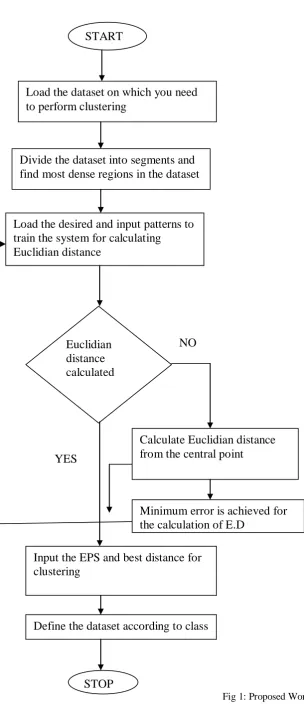
Fig 1: Proposed Work
START
Load the dataset on which you need
to perform clustering
Divide the dataset into segments and
find most dense regions in the dataset
Load the desired and input patterns to
train the system for calculating
Euclidian distance
Euclidian
distance
calculated
Calculate Euclidian distance
from the central point
Minimum error is achieved for
the calculation of E.D
Input the EPS and best distance for
clustering
Define the dataset according to class
STOP
NO
As illustrated in figure 1, the flowchart of the proposed improvement which is done in the DBSCAN algorithm to improve accuracy of clustering. In the existing DBSCAN algorithm EPS value is calculated dynamically and Euclidian distance is calculated statically which reduce efficiency of the algorithm. This work is based on to calculate Euclidian distance dynamically due to which technique back propagation algorithm is applied which define the Euclidian distance in the iterative manner and distance at which error is minimum is the final Euclidian distance . When the final Euclidean distance is considered similar and dissimilar type of data is clustered for analysis
Results and Discussion
The proposed and existing algorithm is implemented in MATLAB to test on the desired dataset.
Fig 2: Incremental DBSCAN algorithm
As shown in figure 2, the algorithm of DBSCAN is applied which will cluster the similar and dissimilar type of data from the most dense region in the input dataset
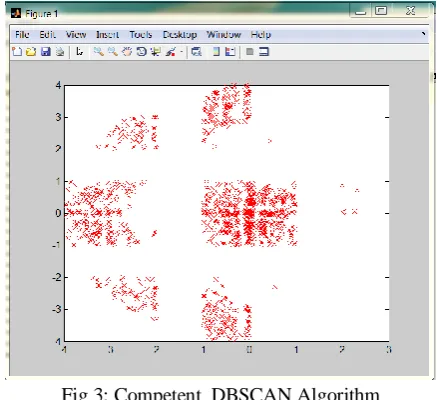
Fig 3: Competent DBSCAN Algorithm
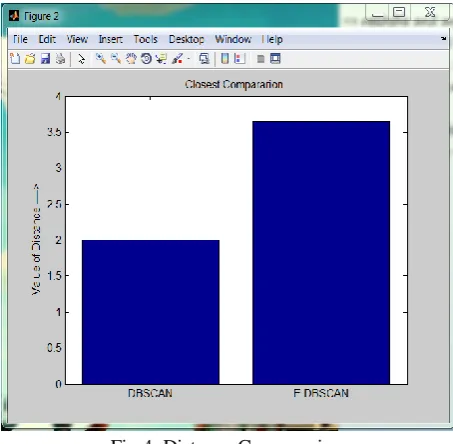
Fig 4: Distance Compression
As shown in figure 4, the distance of the proposed and Incremental DBSCAN algorithm is compared and it is been analyzed that distance of Competent DB-SCAN algorithm is more accuracy than existing DBSCAN Algorithm
Parameter Incremental DBSCAN
Competent DBSCAN Accuracy 86 percent 92 percent Time 5.5 second 4.71 seconds Distance 2 3.7
EPS 1.33 0.9 Noise Ratio 22 Percent 16 percent F-Measure 0.25 0.55
Table 1: Table of comparison
As illustrated in table 1, the Performance of Incremental DBSCAN algorithm and Competent DBSCAN algorithm is compared in terms of accuracy, time, distance and EPS
V. CONCLUSION
In this work, it is been concluded that density based clustering is the efficient type of clustering in which clusters are defined on the density of the input data. The DBSCAN is the algorithm in which EPS value is calculated which will be central point and Euclidean distance is calculated from the central point which define similarity and dis-similarity of the data. In the existing work, Euclidian distance is calculated in the static manner which is made dynamic in proposed work using boltzman learning algorithm. The proposed improvement leads to increase accuracy of the clustering and reduction in execution time.
R
EFERENCES
[1] Anand M. Baswade, Kalpana D. Joshi and Prakash S. Nalwade, “A Comparative Study Of K-Means and Weighted K-Means for Clustering,” International Journal of Engineering Research & Technology, Volume 1, Issue 10, December-2012
[2] Neha Aggarwal, Kirti Aggarwal and Kanika Gupta, “Comparative Analysis of k-means and Enhanced K-means clustering algorithm for data mining”, International Journal of Scientific & Engineering Research, Volume 3, Issue 3, August-2012
[4] Manpreet Kaur and Usvir Kaur, “Comparison Between K-Mean and Hierarchical Algorithm Using Query Redirection”, International Journal of Advanced Research in Computer Science and Social , Volume 3, Issue 7, July 2013 ISSN: 2277 128X
[5] Tapas Kanungo , David M. Mount , Nathan S. Netanyahu Christine, D. Piatko , Ruth Silverman and Angela Y. Wu, “An Efficient K-Means Clustering Algorithm: Analysis and Implementation ,” IEEE Transactions on Pattern Analysis and Machine Intelligence,
Volume 24, July 2002
[6] Amar Singh and Navot Kaur, “To Improve the Convergence Rate of K-Means Clustering Over K-Means with Weighted Page Rank Algorithm,” International journal of Advanced Research in Computer Science and Software Engineering, Volume 3, Issue 8, August 2012
[7] Amar Singh and Navot Kaur, “To Improve the Convergence Rate of K-Means Clustering Over K-Means with Weighted Page Rank Algorithm,” International journal of Advanced Research in Computer Science and Software Engineering, Volume 3, Issue 8, August 2012.
[8] Harpreet Kaur and Jaspreet Kaur Sahiwal, “Image Compression with Improved K-Means Algorithm for Performance Enhancement,” International Journal of Computer Science and Management Research, Volume 2, Issue 6, June 2013
[9] Osamor VC, Adebiyi EF, Oyelade JO and Doumbia S “Reducing the Time Requirement of K-Means Algorithm” PLoS ONE, Volume 7, Issue 12, 2012
[10] Azhar Rauf, Sheeba, Saeed Mahfooz, Shah Khusro and Huma Javed, “Enhanced K-Mean Clustering Algorithm to Reduce Number of Iterations and Time Complexity,” Middle-East Journal of Scientific Research, pages 959-963, 2012
[11] Kajal C. Agrawal and Meghana Nagori, “Clusters of Ayurvedic Medicines Using Improved K-means Algorithm,” International Conf. on Advances in Computer Science and Electronics Engineering, 2013.
[12] M. N. Vrahatis, B. Boutsinas, P. Alevizos and G. Pavlides, “The New k-Windows Algorithm for Improving the k-Means Clustering Algorithm,” Journal of Complexity 18, pages 375-391, 2002.
[13] Chieh-Yuan Tsai and Chuang-Cheng Chiu, “Developing a feature weight self-adjustment mechanism for a K-means clustering algorithm,” Computational Statistics and Data Analysis, pages 4658-4672, Volume 52, 2008
[14] Guangchun Luo, Xiaoyu Luo, Thomas Fairley Gooch, Ling Tian, Ke Qin,” A Parallel DBSCAN Algorithm Based On Spark”, 2016, IEEE, 978-1-5090-3936-4
[15] Dianwei Han, Ankit Agrawal, Wei−keng Liao, Alok Choudhary,” A novel scalable DBSCAN algorithm with Spark”, 2016, IEEE, 97879-897-99-4
[16] Nagaraju S,Manish Kashyap, Mahua Bhattacharya,” A Variant of DBSCAN Algorithm to Find Embedded and Nested Adjacent Clusters”, 2016, IEEE, 978-1-4673-9197-9
[17] Jianbing Shen, Xiaopeng Hao, Zhiyuan Liang, Yu Liu, Wenguan Wang, and Ling Shao,” Real-time Superpixel Segmentation by DBSCAN Clustering Algorithm”, 2016, IEEE, 1057-7149
[18] Ilias K. Savvas, and Dimitrios Tselios,” Parallelizing DBSCAN Algorithm Using MPI”, 2016, IEEE, 978-1-5090-1663-1