© 2018 IJSRCSEIT | Volume 3 | Issue 3 | ISSN : 2456-3307
A Review of Classification Methods for Social Emotion
Analysis
Selvapriya .M1, Dr. Maria Priscilla .G2
1Research Scholar, Student Member, IEEE , Department of Computer Science, Sri Ramakrishna College of Arts and
Science, Formerly S.N.R SONS College(Autonomous), Coimbatore, Tamilnadu, India
2Assistant Professor, Senior Member, IEEE, Head, Department of Computer Science, Sri Ramakrishna College of
Arts and Science, Formerly S.N.R SONcollege(Autonomous), Coimbatore, Tamil Nadu, India
ABSTRACT
Emotion classification has a broad range of applications. There are many application which uses Facial Expression to evaluate human nature, feelings, judgment, opinion. Recognizing Human Facial Expression is not a simple task because of some circumstances due to illumination, facial occlusions, face color/shape etc. Moreover, online comments are typically characterized by a sparse feature space, which makes the corresponding emotion classification tasks are very difficult. In our research work, social emotional classifications are classified through artificial neural network (ANN), deep learning and rich hybrid neural network (HNN) which will directly and indirectly used to recognize human expression in various conditions. This review also focuses on an up-to-date hybrid deep-learning approach combining a convolutional neural network (CNN) for the spatial features of an individual frame and long short-term memory (LSTM) for temporal features of consecutive frames. The analysed methodologies are implemented using Matlab. The experimental results show that the CNN model attained better classification accuracy compared than rich Hybrid Neural Network (HNN) and Artificial Neural Network (ANN) schemes. The performance evaluation conducted was proved that the each and every method has unique advantage and disadvantages among each other.
Keywords: Artificial Neural Network (ANN), Hybrid Neural Network (HNN), convolutional neural network (CNN)
I.
INTRODUCTION
Social network sites nowadays serve as important medium of communication and dissemination of information to its users. The amount of information available on the internet is increasing very quickly due to the process of publication to the internet becoming very easy [1]. The rise of internet has led to a tremendous information and opinion overload [2]. It also leads to huge amount of textual information ever produced [3]. Generally, the social networks sites are a form of blogging that allows
users to publish brief text posts (usually with a strict length limit of not more than 200 characters) [4].
gradually becoming a platform where information, ideas and opinions converge. Nowadays, many people make their decisions under the influence of the social sites they follow. Social site posts are considered as rich sources of emotion and opinion data [5]. It is of great interest to mining user emotions in asocial sites community for the purpose of public opinion tracking, content filtering and customer relationship management [6].
Emotion processing in text is currently a hot and active area in the field of Natural Language Processing (NLP). Textual emotion detection or classification is one task that many scholars and researchers concentrate on. Though the details may vary, the general goal is the same – to detect and recognize the type of emotion, for example, happiness, anger and surprise, conveyed by the target document [7].
In this study, CNN based classification approach is classifying textual emotions. The method to classify emotions using the emotion cause extraction technique, based on the combination of CNN and effectual sparse coding on SemEvaldata. We consider it as a novel method because are unaware of any previous emotion classification works using this technique. We focus on identifying emotions based on posts extracted from the first English dataset was used in [35]. We take emotion cause events as entrance point to overcome some of the drawbacks of traditional approaches. Emotions and reactions triggered by the same event are assumed to be similar, so the errors caused by rhetoric can be reduced. Also, deep-level information is taken into account. The experiment results show that the system can extract emotion cause events from social sites posts with a good accuracy. Based on an efficient cause event extraction, the emotion classification result of the system improves noticeably.
The organization of this work is given as like follows: In this section, short introduction about the focus of
this research is discussed. In section 2 discusses about various research methodologies. In section 3 performance evaluation that was conducted to know the better research methodology. In section 4, the findings of this overall research work is concluded shortly.
II.
SOCIAL EMOTION CLASSIFICATION USING
VARIOUS METHODS:
Facial emotions are important factors in human communication that help us understand the intentions of others. In general, people infer the emotional states of other people, such as joy, sadness, and anger, using facial expressions and vocal tone. According to different surveys, verbal components convey one-third of human communication, and nonverbal components convey two-thirds. Among several nonverbal components, by carrying emotional meaning, facial expressions are one of the main information channels in interpersonal communication. Therefore, it is natural that research of facial emotion has been gaining lot of attention over the past decades with applications not only in the perceptual and cognitive sciences, but also in affective computing and computer animations. So for there are several methods used to analysed in our research work, the convolutional neural network (CNN), Artificial Neural Network (ANN) and Hybrid Neural Network (HNN) used for performance evaluation.
A. SOCIAL EMOTION CLASSIFICATION
rate variability (HRV) and in galvanic skin response (GSR).
Siraj et al., (2006) Presented Human's emotion can be detected based on the physiological measurements, facial expression and vocal recognition. Since human shows the same facial muscles when expressing a particular emotion, therefore the emotion can be quantified. In this study, six primary emotions such as anger, disgust, fear, happiness, sadness and surprise were classified using Neural Network. Real dataset of facial expression images were captured and processed to prepare for Neural Network training and testing. The dataset was tested on Multilayer Layer Perceptron with Backpropagation learning algorithm and Regression analysis.
Liu and Sourina (2014) research, explores real-time Electroencephalogram (EEG)-based emotion recognition algorithm using Higuchi Fractal Dimension (FD) Spectrum. They recognize EEG as a nonlinear and multi-fractal signal, hence its FD spectrum can give a better understanding of the nonlinear property of EEG using Support Vector Machines as a classifier. They test their approach on both DEAP and their own dataset. On DEAP database, they report a classification accuracy of 8 emotions 53.7% in subject dependent classification. (Srivastava et al (2014)) research, depicts models for Classification of DEAP’s EEG data to different energy bands using wavelet transform and neural networks. They divide EEG signal into different bands using discrete wavelet transformation with db8 wavelet function for processing. Statistical and energy based features are extracted from the bands, based on the features emotions are classified with feed forward neural network with weight optimized algorithm like PSO.
B. ARTIFICIAL NEURAL NETWORKS
Dony et al., (1995) presented a tutor a overview of neural networks as signal processing tools for image compression. They are well suited to the problem of image compression due to their massively parallel
and distributed architecture. Their characteristics are analogous to some of the features of our own visual system, which allow us to process visual information with much ease. For example, multilayer perceptions can be used as nonlinear predictors in differential pulse-code modulation (DPCM). Such predictors have been shown to increase the predictive gain relative to a linear predictor. Another active area of research is in the application of Hebbian learning to the extraction of principal components, which are the basis vectors for the optimal linear Karhunen-Loeve transform (KLT). These learning algorithms are iterative, have some computational advantages over standard eigendecomposition techniques, and can be made to adapt to changes in the input signal. Yet another model, the self-organizing feature map (SOFM), has been used with a great deal of success in the design of codebooks for vector quantization (VQ).
Janssen et al., (2008) Described an application of emotion recognition in human gait by means of kinetic and kinematic data using artificial neural nets. Two experiments were undertaken, one attempting to identify participants’ emotional states from gait patterns, and the second analyzing effects on gait patterns of listening to music while walking. In the first experiment gait was analyzed as participants attempted to simulate four distinct emotional states (normal, happy, sad, angry). In the second experiment, participants were asked to listen to different types of music (excitatory, calming, no music) before and during gait analysis. Derived data were fed into different types of artificial neural nets.
Stuhlsatz et al., (2011) proposed a Generalized Discriminant Analysis (GerDA) based on Deep Neural Networks (DNNs) to learn discriminative features of low dimension optimized with respect to a fast classification from a large set of acoustic features for emotion recognition. On nine frequently used emotional speech corpora, we compare the performance of GerDA features and their subsequent linear classification with previously reported benchmarks obtained using the same set of acoustic features classified by Support Vector Machines (SVMs). It show that low-dimensional GerDA features capture hidden information from the acoustic features leading to a significantly raised unweighted average recall and considerably raised weighted average recall.
Iqbal et al., (2012) Proposed a new approach for image recognition using Artificial Neural Networks. Initially an original gray scale intensity image has been taken for transformation. The Input image has been added with Salt and Peeper noise. Adaptive median Filter has been applied on noisy image such that the noise can be removed and the output image would be considered as filtered Image. The estimated Error and average error of the values stored in filtered image matrix have been calculated with reference to the values stored in original data matrix for the purpose of checking of proper noise removal. Now each pixel data has been converted into binary number (8 bit) from decimal values. A set of four pixels has been taken together to form a new binary number with 32 bits and it has been converted into a decimal. This process continues to produce new data matrix with new different set of values. This data matrix has been taken as original data matrix and saved in data bank. Now for recognition, a new test image has been taken and the same steps as salt & pepper noise insertion, removal of noise using adaptive median filter as mentioned earlier have been applied to get a new test matrix. Now the average error of the second image with respect to
original image has been calculated based on the both generated matrices.
C. TRANSFER LEARNING AND DEEP LEARNING
Tesauro et al., (1992) examined whether temporal difference methods for training connectionist networks, such as Suttons's TO(λ) algorithm, can be successfully applied to complex real-world problems. A number of important practical issues are identified and discussed from a general theoretical perspective. These practical issues are then examined in the context of a case study in which TO(λ) is applied to learning the game of backgammon from the outcome of self-play. This is apparently the first application of this algorithm to a complex nontrivial task. It is found that, with zero knowledge built in, the network is able to learn from scratch to play the entire game at a fairly strong intermediate level of performance, which is clearly better than conventional commercial programs, and which in fact surpasses comparable networks trained on a massive human expert data set. The hidden units in these network have apparently discovered useful features, a longstanding goal of computer games research. Furthermore, when a set of hand-crafted features is added to the input representation, the resulting networks reach a near-expert level of performance, and have achieved good results against world-class human play.
Mesnil et al., (2011) described different kinds of layers we trained for learning representations in the setting of the Unsupervised and Transfer Learning Challenge. The strategy of our team won the final phase of the challenge. It combined and stacked different one-layer unsupervised learning algorithms, adapted to each of the five datasets of the competition. This paper describes that strategy and the particular one-layer learning algorithms feeding a simple linear classifier with a tiny number of labeled training samples (1 to 64 per class).
Sun et al., (2014) proposed to learn a set of high-level feature representations through deep learning, referred to as Deep hidden IDentity features (DeepID), for face verification. We argue that DeepID can be effectively learned through challenging multi-class face identification tasks, whilst they can be generalized to other tasks (such as verification) and new identities unseen in the training set. Moreover, the generalization capability of DeepID increases as more face classes are to be predicted at training. DeepID features are taken from the last hidden layer neuron activations of deep convolutional networks (ConvNets). When learned as classifiers to recognize about 10, 000 face identities in the training set and configured to keep reducing the neuron numbers along the feature extraction hierarchy, these deep ConvNets gradually form compact identity-related features in the top layers with only a small number of hidden neurons. The proposed features are extracted from various face regions to form complementary and over-complete representations.
Fan et al., (2014) presented a very easy-to-implement deep learning framework for face representation. Our method bases on a new structure of deep network (called Pyramid CNN). The proposed Pyramid CNN adopts a greedy-filter-and-down-sample operation, which enables the training procedure to be very fast and computation-efficient. In addition, the structure of Pyramid CNN can
naturally incorporate feature sharing across multi-scale face representations, increasing the discriminative ability of resulting representation.
Shin et al., (2016) exploit three important, but previously understudied factors of employing deep convolutional neural networks to computer-aided detection problems. We first explore and evaluate different CNN architectures. The studied models contain 5 thousand to 160 million parameters, and vary in numbers of layers. We then evaluate the influence of dataset scale and spatial image context on performance. Finally, we examine when and why transfer learning from pre-trained ImageNet (via fine-tuning) can be useful. We study two specific computer-aided detection (CADe) problems, namely thoraco-abdominal lymph node (LN) detection and interstitial lung disease (ILD) classification.
D. EMOTION RECOGNITION USING SPARSE
ENCODING
Buciu et al., (2004) presented a novel algorithm for learning facial expressions in a supervised manner. This algorithm is derived from the local non-negative matrix factorization (LNMF) algorithm, which is an extension of non-negative matrix factorization (NMF) method. We call this newly proposed algorithm discriminant non-negative matrix factorization (DNMF). Given an image database, all these three algorithms decompose the database into basis images and their corresponding coefficients. This decomposition is computed differently for each method.
whether the sparse representation is correctly computed. Unconventional features such as downsampled images and random projections perform just as well as conventional features such as eigenfaces and Laplacianfaces, as long as the dimension of the feature space surpasses certain threshold, predicted by the theory of sparse representation. This framework can handle errors due to occlusion and corruption uniformly by exploiting the fact that these errors are often sparse with respect to the standard (pixel) basis. The theory of sparse representation helps predict how much occlusion the recognition algorithm can handle and how to choose the training images to maximize robustness to occlusion.
Zhang et al., (2012) Introduced a method of facial expression recognition based on the sparse representation classifier (SRC) is presented. Two typical appearance facial features, i.e., local binary patterns (LBP) and Gabor wavelets representations are extracted to evaluate the performance of the SRC method on facial expression recognition tasks. Three representative classification methods, including artificial neural network (ANN), K-nearest neighbor (KNN), support vector machines (SVM), are used to compare with the SRC method.
El-Sayed et al., (2013) we propose a method for facial expression recognition (FER). This method provides new insights into two issues in FER: feature extraction and robustness. For feature extraction we are using sparse representation approach after applying multiple Gabor filter and then using support vector machine (SVM) as classifier.
Liu et al., (2013) proposed a novel face recognition method, called sparse representation-based classification on k-nearest subspace (SRC-KNS). Our method first exploits the distance between the test image and the subspace of each individual class to determine the nearest subspaces and then performs SRC on the selected classes. Actually,
SRC-KNS is able to reduce the scale of the sparse representation problem greatly and the computation to determine the nearest subspaces is quite simple.
Therefore, SRC-KNS has a much lower
computational complexity than the original SRC. In order to well recognize the occluded face images, we propose the modular SRC-KNS. For this modular method, face images are partitioned into a number of blocks first and then we propose an indicator to remove the contaminated blocks and choose the nearest subspaces. Finally, SRC is used to classify the occluded test sample in the new feature space. Compared to the approach used in the original SRC work, our modular SRC-KNS can greatly reduce the computational load.
Levi et al., (2015) Presented a novel method for classifying emotions from static facial images. Our approach leverages on the recent success of Convolutional Neural Networks (CNN) on face recognition problems. Unlike the settings often assumed there, far less labeled data is typically available for training emotion classification systems. Our method is therefore designed with the goal of simplifying the problem domain by removing confounding factors from the input images, with an emphasis on image illumination variations. This, in an effort to reduce the amount of data required to effectively train deep CNN models. To this end, we propose novel transformations of image intensities to 3D spaces, designed to be invariant to monotonic photometric transformations. These are applied to CASIA Webface images which are then used to train an ensemble of multiple architecture CNNs on multiple representations. Each model is then fine-tuned with limited emotion labeled training data to obtain final classification models.
dictionary. It has been shown that not all Gabor filters in a typical Gabor bank is necessary and efficient in facial expression recognition. Also we proposed a voting system in the test phase of algorithm to find the best matching expression.
Shakeel et al., (2016) proposed a new approach for recognition of low-resolution face images by using sparse coding of local features. The proposed algorithm extracts Gabor features from a low-resolution gallery image and a query image at different scales and orientations, then projects the features separately into a new low-dimensional feature space using sparse coding that preserves the sparse structure of the local features. To determine the similarity between the projected features, a coefficient vector is estimated by using linear regression that determines the relationship between the projected gallery and query features. On the basis of this coefficient vector, residual values will be computed to classify the images. To validate our proposed method, experiments were performed using three databases (ORL, Extended-Yale B, and CAS-PEAL-R1), which contain images with different facial expressions and lighting conditions.
E. TRAINING IN HYBRID NEURAL NETWORKS
Chen et al., (2005) proposed a high specificity and sensitivity algorithm called PromPredictor for recognizing promoter regions in the human genome. PromPredictor extracts compositional features and CpG islands information from genomic sequence, feeding these features as input for a hybrid neural network system (HNN) and then applies the HNN for prediction. It combines a novel promoter recognition model, coding theory, feature selection and dimensionality reduction with machine learning algorithm.
Hossain et al., (2013) Described the Neural Network is a platform to implement artificial intelligence and universally used neural network is Backpropagation (BP). Local minimum, slower convergence,
premature saturation, training pattern
overspecialization limits the performance of Backpropagation algorithm. To withstand those problems several modified algorithms was proposed. A faster superintendent algorithm named Hybrid Backpropagation algorithm (HBP) is used in this paper because of training of the neural network is found from Back-propagation with Chaotic Learning (BPCL) with different types of chaos, Maximization of gradient function (BPfast) and Error back-propagation (EBP) to mitigate the limitations of BP.
Zheng et al., (2016) proposed stability training as a lightweight and effective method to stabilize deep neural networks against natural distortions in the visual input. Stability training makes the output of a neural network more robust by training a model to be constant on images that are copies of the input image with small perturbations. As such, our method can enable higher performance on noisy visual data than a network without stability training. We demonstrated this by showing that our method makes neural networks more robust against common types of distortions coming from random cropping, JPEG compression and thumbnail resizing.
Li et al., (2017) Introduced a novel model of semantically rich hybrid neural network (HNN) which leverages unsupervised teaching models to incorporate semantic domain knowledge into the neural network to bootstrap its inference power and interpretability. To our best knowledge, this is the first successful work of incorporating semantics into neural networks to enhance social emotion classification and network interpretability.
focuses on an up-to-date hybrid deep-learning approach combining a convolutional neural network (CNN) for the spatial features of an individual frame and long short-term memory (LSTM) for temporal features of consecutive frames. Furthermore, evaluation metrics of FER-based approaches were introduced to provide standard metrics for comparison. Evaluation metrics have been widely evaluated in the field of recognition, and precision and recall are mainly used.
F. ANALYSIS
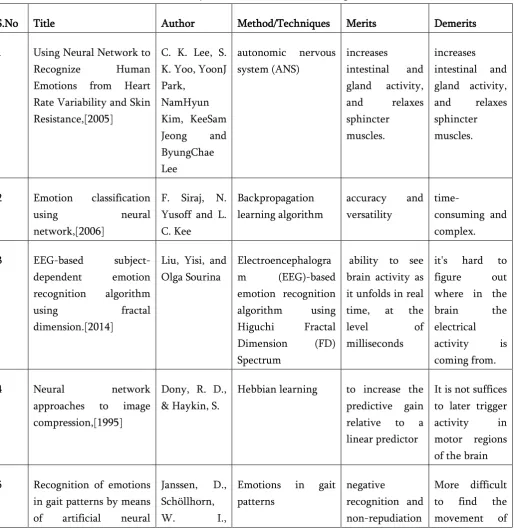
The performance analysis of this work is done to identify the merits and demerits of these methodologies. So that, the comparison can be made between the methodologies that were discussed above. The analysis of this work is given in the following table 1.
Table 1. Analysis of the discussed methodologies
S.No Title Author Method/Techniques Merits Demerits
1 Using Neural Network to
Recognize Human
Emotions from Heart Rate Variability and Skin Resistance,[2005]
2 Emotion classification
using neural
3 EEG-based
subject-dependent emotion it unfolds in real time, at the
Hebbian learning to increase the predictive gain relative to a linear predictor
It is not suffices to later trigger activity in motor regions of the brain
5 Recognition of emotions in gait patterns by means of artificial neural
nets,[2008] Lubienetzki,
6 Emotion-based image
retrieval—An artificial
for acoustic emotion recognition,[2011]
Flexibility It is to complex in
Buciu, I. Discriminant
non-negative matrix
11 Facial expression
recognition using sparse representation,[2012]
Zhang, S., Zhao, X. I. A. O. M. I. N. G., & Lei, B.
Computational simplicity.
Invariance to grayscale
changes
Good
performance.
information captured by it is limited. Only pixel difference
is used,
magnitude information ignored.
12 Robust facial expression recognition via sparse
representation and
multiple gabor
filters,[2013]
El-Sayed, R. S., El Kholy, A., & El-Nahas, M. Y.
facial expression recognition (FER).
most of the training data is redundant.
computing cost can be huge and the speed of recognition
in an
embedded scenario is terrible
13 Emotion recognition in
the wild via
convolutional neural
networks and mapped binary patterns,[2015]
Levi, G., & Hassner, T.
Convolutional Neural Networks (CNN)
this method is
powerful in
classification
High
computational cost.
They use to need a lot of training data.
14 A hybrid neural network system for prediction and recognition of promoter
regions in human
genome,[2005]
Chen, C. B., & Li, T.
hybrid neural
network system
(HNN)
to represent the image pixels in a suitable color space
Lot of noisy images
15 Bootstrapping Social
Emotion Classification with Semantically Rich
Hybrid Neural
Networks,[2017]
X. Li, Y. Rao, H. Xie, R. Y. K. Lau, J. Yin and F. L. Wang
rich hybrid neural network (HNN)
its inference
power and
interpretability.
16 A Brief Review of Facial Emotion Recognition
Based on Visual
Information,[2018]
Ko, B. C. convolutional neural network (CNN)
accuracy in image
recognition problems.
enhance their emotion
classification effectiveness
High
computational cost.
They use to need a lot of training data.
From this analysis table, we can conclude that the every methodologies proposed previously consists of various merits and demerits in their way of application. All the merits and demerits involved in these works are considered for the review from which new methodology can be proposed by combining the merits of all the methodologies. The performance analysis were conducted to check the consistent level of the various proposed methodologies which is described detailed in the following sections.
III.
EXPERIMENTATION RESULTS
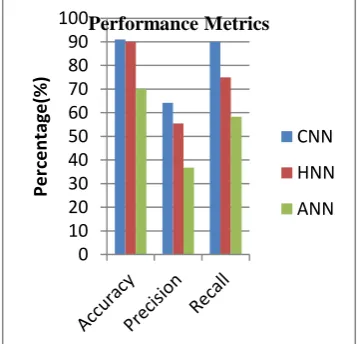
The performance evaluation is done to know the improvement of various research methodologies which was plotted in the graphical representation. The evaluation
Figure 1. Overall performance numerical values for all emotion classification methods
metrics are classified into three methods using different attributes: precision, recall, accuracy. The performance evaluations are compared between few research works that are CNN, HNN and ANN.
Precision: the precision (p) is defined as TP/(TP+FP) Recall: The recall(R) is defined as TP/(TP+FN)
Accuracy: The Accuracy (Acc) is defined as (TP+TN)/Total Population
Where TP is the number of true Positives in the dataset, FN is the number of false negative and FP is the number of false positives.
The overall numerical evaluation of all emotion classification schemes are illustrated in Fig 1. It demonstrates that the CNN attained high performance compared than other schemes like HNN and ANN. When number of data’s increased means, the performance of CNN also increased.
IV.
CONCLUSION AND FUTURE WORK
Social emotion classification aims to predict the aggregation of emotional responses embedded in online comments contributed by various users. Such a task is inherently challenging because extracting relevant semantics from free texts is a classical research problem. In our research work, the several methodologies are discussed. The CNN attained the high performance compared than other schemes like HNN and ANN. The analysed methodologies are implemented using Matlab. The experimental results show that the CNN model attained better
0 10 20 30 40 50 60 70 80 90 100
P
er
ce
n
tag
e(%
)
Performance Metrics
CNN
HNN
classification accuracy compared than Hybrid Neural Network (HNN) and Artificial Neural Network (ANN) schemes. The performance evaluation conducted was proved that the each and every method has unique advantage and disadvantages among each other.
V.
REFERENCES
[1]. Z. Jiang and C. Lu, "A latent semantic analysis based method of gettingthe category attribute of words," Proceedings - 2009 International
Conference on Electronic Computer
Technology, ICECT 2009, pp. 141–146, 2009. [2]. I. Hendrickx and V. Hoste, "Coreference
resolution on blogs andcommented news,"
Lecture Notes in Computer Science
(includingsubseries Lecture Notes in Artificial
Intelligence and Lecture Notes
inBioinformatics), vol. 5847 LNAI, pp. 43–53, 2009.
[3]. P. Inrak and S. Sinthupinyo, "Applying latent semantic analysis to classifyemotions in Thai text," in ICCET 2010 - 2010 International Conferenceon Computer Engineering and Technology, Proceedings, 2010, vol. 6, no.1, pp. 450–454.
[4]. Kaplan, A. M., &Haenlein, M. (2011). The early bird catches the news: Nine things 668you should know about micro-blogging. Business Horizons, 54, 105–113.
[5]. Pak, A., &Paroubek, P. (2010). Twitter as a corpus for sentiment analysis and 684opinion mining. In Proceedings of LREC Vol. 2010. [6]. Zhang, C., Zeng, D., Li, J., Wang, F.-Y., &Zuo,
W. (2009). Sentiment analysis of chinese 710documents: From sentence to document level. Journal of the American Society for 711Information Science and Technology, 60, 2474–2487.
[7]. Mihalcea, R., & Liu, H. (2006). A corpus-based
approach to finding happiness. In
681Proceedings of the AAAI spring symposium
on computational approaches to 682Weblogs (p. 19).
[8]. F. Siraj, N. Yusoff and L. C. Kee, "Emotion classification using neural network," 2006 International Conference on Computing & Informatics, Kuala Lumpur, 2006, pp. 1-7. [9]. C. K. Lee, S. K. Yoo, YoonJ Park, NamHyun
Kim, KeeSam Jeong and ByungChae Lee, "Using Neural Network to Recognize Human Emotions from Heart Rate Variability and Skin Resistance," 2005 IEEE Engineering in
Medicine and Biology 27th Annual
Conference, Shanghai, 2005, pp. 5523-5525. [10]. Liu, Yisi, and Olga Sourina. "EEG-based
subject-dependent emotion recognition algorithm using fractal dimension." Systems, Man and Cybernetics (SMC), 2014 IEEE International Conference on. IEEE, (2014). [11]. M. Iqbal Quraishi, J. Pal Choudhury and M.
De, "Image recognition and processing using Artificial Neural Network," 2012 1st International Conference on Recent Advances in Information Technology (RAIT), Dhanbad, 2012, pp. 95-100.
[12]. A. Stuhlsatz, C. Meyer, F. Eyben, T. Zielke, G. Meier and B. Schuller, "Deep neural networks for acoustic emotion recognition: Raising the benchmarks," 2011 IEEE International Conference on Acoustics, Speech and Signal Processing (ICASSP), Prague, 2011, pp. 5688-5691.
[13]. Janssen, D., Schollhorn, W. I., Lubienetzki, J., Folling, K., Kokenge, H., & Davids, K. (2008). Recognition of emotions in gait patterns by means of artificial neural nets. Journal of Nonverbal Behavior, 32(2), 79-92.
[14]. Dony, R. D., & Haykin, S. (1995). Neural network approaches to image compression. Proceedings of the IEEE, 83(2), 288-303. [15]. K. A. Olkiewicz and U. Markowska-Kaczmar,
Science and Information Technology, Wisla, 2010, pp. 89-96.
[16]. Iranmanesh, S., & Mahdavi, M. A. (2009). A differential adaptive learning rate method for back-propagation neural networks. World Academy of Science, Engineering and Technology, 50(1), 285-288.
[17]. Tesauro, G. (1992). Practical issues in temporal difference learning. In Advances in neural information processing systems (pp. 259-266). [18]. Mesnil, G., Dauphin, Y., Glorot, X., Rifai, S.,
Bengio, Y., Goodfellow, I., . & Vincent, P. (2011, July). Unsupervised and transfer learning challenge: a deep learning approach. In Proceedings of the 2011 International Conference on Unsupervised and Transfer Learning workshop-Volume 27(pp. 97-111). JMLR. org.
[19]. Sun, Y., Wang, X., & Tang, X. (2014). Deep learning face representation from predicting 10,000 classes. In Proceedings of the IEEE Conference on Computer Vision and Pattern Recognition (pp. 1891-1898).
[20]. Shin, H. C., Roth, H. R., Gao, M., Lu, L., Xu, Z., Nogues, I., . & Summers, R. M. (2016). Deep convolutional neural networks for computer-aided detection: CNN architectures, dataset characteristics and transfer learning. IEEE transactions on medical imaging, 35(5), 1285-1298.
[21]. Fan, H., Cao, Z., Jiang, Y., Yin, Q., & Doudou, C. (2014). Learning deep face representation. arXiv preprint arXiv:1403.2802.
[22]. Buciu, I. (2004, September). A new sparse image representation algorithm applied to facial expression recognition. In Machine Learning for Signal Processing, 2004. Proceedings of the 2004 14th IEEE Signal Processing Society Workshop (pp. 539-548). IEEE.
[23]. Levi, G., & Hassner, T. (2015, November). Emotion recognition in the wild via convolutional neural networks and mapped
binary patterns. In Proceedings of the 2015 ACM on international conference on multimodal interaction (pp. 503-510). ACM. [24]. M. Abdolali and M. Rahmati, "Facial expression
recognition using sparse coding," 2013 8th Iranian Conference on Machine Vision and Image Processing (MVIP), Zanjan, 2013, pp. 150-153.
[25]. M. S. Shakeel and Kin-Man-Lam, "Recognition of low-resolution face images using sparse coding of local features," 2016 Asia-Pacific Signal and Information Processing Association Annual Summit and Conference (APSIPA), Jeju, 2016, pp. 1-5.
[26]. J. Wright, A. Y. Yang, A. Ganesh, S. S. Sastry and Y. Ma, "Robust Face Recognition via Sparse Representation," in IEEE Transactions on Pattern Analysis and Machine Intelligence, vol. 31, no. 2, pp. 210-227, Feb. 2009.
[27]. Zhang, S., Zhao, X. I. A. O. M. I. N. G., & Lei, B. (2012). Facial expression recognition using sparse representation. WSEAS transactions on systems, 11(8), 440-452.
[28]. El-Sayed, R. S., El Kholy, A., & El-Nahas, M. Y. (2013). Robust facial expression recognition via sparse representation and multiple gabor filters. International Journal of Advanced Computer Science and Applications, 4(3).
[29]. Mi, J. X., & Liu, J. X. (2013). Face recognition using sparse representation-based classification on k-nearest subspace. PloS one, 8(3), e59430. [30]. Zheng, S., Song, Y., Leung, T., & Goodfellow, I.
(2016). Improving the robustness of deep neural networks via stability training. In Proceedings of the IEEE Conference on Computer Vision and Pattern Recognition (pp. 4480-4488).
[32]. Chen, C. B., & Li, T. (2005). A hybrid neural network system for prediction and recognition of promoter regions in human genome. Journal of Zhejiang University. Science. B, 6(5), 401. [33]. X. Li, Y. Rao, H. Xie, R. Y. K. Lau, J. Yin and F.
L. Wang, "Bootstrapping Social Emotion Classification with Semantically Rich Hybrid Neural Networks," in IEEE Transactions on Affective Computing, vol. 8, no. 4, pp. 428-442, Oct.-Dec. 1 2017.
[34]. Ko, B. C. (2018). A Brief Review of Facial Emotion Recognition Based on Visual Information. sensors, 18(2), 401.
[35]. arloStrapparava and RadaMihalcea.