Volume 5, Issue 7, July 2016
2290 All Rights Reserved © 2016 IJSETR
Development of Polynomial Based Programfor Pure Bending Analysis of SSSS
Rectangular Thin Isotropic Plate.
Adah, E. I
.,Onwuka, D. O
., Ibearugbulem, O. M.
Abstract
-
The study is aimed at developing a Polynomial Based Program for analysis of SSSS rectangular plate using polynomial shape functions derived for SSSS Plate. This shape functions were substituted in the Total Potential Energy functional equation derived based on Ritz energy equation to obtain expression for the coefficient of amplitude of deflection which was used to compute other parameters. The program is written based on the derived expressions using Matlab programming language in which provision is made for input by user. The values of coefficients of deflection, moments and shear forceswere obtained from running the program, and were compared with those of earlier studies. The percentage difference for aspect ratios of 1.0, 1.2,1.5, 1.6 and 2.0for amplitude of deflection and maximum deflection at the center of the plate were all 0.00% and 0.00% respectively.Those of bending moments and shear force coefficients were all less than 0.007% for both x-& y-directions. These indicate that the values from this program showinsignificant difference. Therefore, the present program is an easier and simpler approach for analyzing SSSS rectangular plate for bending.Index Terms-Program, Polynomial shape functions, Pure
Bending,Rectangular Plate.
Symbols
w = Deflection;wmax = Maximum Deflection; v = Poisson
Ratio.
U,V= Deflection parts in x-&y- Directions for Non-dimensional Parameters.
R or r = Non dimensional Parameter in x- direction and is equal x/a.
Q or q = Non dimensional Parameter in Y- direction and is equal y/b.
∫ = Definite Integral from 0 to 1;s = Aspect Ratio =b/a a = dimension along X-direction;b = dimension along y- direction .
usor u = Coefficient of amplitude of deflection in terms of s, α
= Deflection Coefficient.
β or beta = Moment Coefficient considered at the center along R- direction.
β1 or beta1= Moment Coefficient considered at the center
along Q-direction.
δ or delta = Shear force Coefficient along R- direction. δ1or delta1= Shear Force Coefficient along Q- direction.
Mxmax, andMymax= Maximum Moment at the center of plate in
x-and y-directions.
VxandVy= Shear Force in x-& y-directions respectively
w''R = ∂ 2w ∂𝑅2; w'' Q =∂ 2w ∂𝑄2; w'' RQ =∂ 2w ∂R ∂Q ; k'' R = ∂ 2k ∂𝑅2; k''Q = ∂2k ∂𝑄2; k'' RQ = ∂2k ∂R ∂Q
yr ,yq = coefficients of slope in R & Q direction.
I. INTRODUCTION
Thin isotropic rectangular plates with all the four edges simply supported (SSSS), have been analyzed by earlier researchers such as Navier[1], Levy [2] and Timoshenko &Woinowsky-Krieger [3] using trigonometric assumed shape function. The researchers did this by substituting the shape function into the governing differential equation followed by direct integration of the equation. Ibearugbulem, Ezeh and Ettu[4] reported that there was 2.4% average percentage difference between the work of [1] and [2].
All round simply supported (i.eSSSS) rectangular plate has also been analyzed using energy and approximate approaches by some other researchers such as Ventsel and Krauthammer [5], Ugural[6], Ugural&Fenster[7] in order to obtain a more accurate solution to SSSS plate given the difference in the exact methods and the difficulty of integrating the governing differential equation, yet none of these Scholars arrived at the same result, as there was still minimal differences.
Ref. [4], usespolynomial functions to represent the deformed shape of SSSS plate. Their results when compared with that of [3], show percentage differences which were all less than 5% with an average percentage difference of 2.89%.When comparing their result with [5], it was noted that the percentage differences were all less than 5.2%. Also, Ibearugbulem, Ettu and Ezeh[8], used direct integration and work error approach for pure bending analysis of SSSS rectangular plate and obtained results which when compared with those of [3] were comparatively close.
In all the works both exact and approximate methods done using both trigonometric and polynomial shape function, there were still problems such as difficulties in the direct Integration of the governing differential equations, complexity of the derivation oflengthy equations, time consumption and serious effort required.Consequently, these methods employing trigonometric and polynomial functions, are not appealing and commonly used in plate bending analysis. This is complicated by unavailability of computer programs to ease the solution of plate problems. As such, this present work is concerned with developmentcomputer program based on polynomial shape
Volume 5, Issue 7, July 2016
2291 All Rights Reserved © 2016 IJSETR
function for the analysis of pure bending of SSSS rectangular plate.The use of the computer program for the analysis of pure bending of SSSS rectangular plate is a simpler and less time consuming. See Schematic diagram of SSSS plate Fig. 1.
X or R
b
Y or Q
a
Fig. 1: Schematic diagram of SSSS Rectangular Plate.
II. FUNDAMENTAL EQUATIONS
The shape function of SSSS plate was derived by Ibearugbulem[9]by assuming a deflected shape function (w) of a SSSS plate carrying a uniformly distributed load, q (kN/m), in form of polynomial series.The series was truncated at the fifth term and the deflected shape is given as:
w = A(R-2R3+R4)(Q-2Q3+Q4) (1) let k = (R-2R3+R4)(Q-2Q3+Q4) (2) Hence, (1) becomes:
w = Ak (3)
Considering (2) in x-y directions,we havefor R-direction (4)
U = (R-2R3+R4) (4)
And for the Q-Direction, it becomes:
V = (Q-2Q3+Q4) (5) Therefore,(2) can be given as:
k = U*V (6)
Substituting (6) into (3), yields:
w = A(U*V) (7)
The total potential energy functional,Π,of rectangular plate subject to pure bending as given by [9] and [5] is given as (8) Π =Da 2𝑏3 ∫∫ [ 1 𝑃4 (w'' R )2+2 𝑃2(w'' RQ )2+(w''Q)2] ∂R∂Q-abq ∫∫ w∂R∂Q (8) Equation (3) was substituted in (8) within the integral of 0 to 1, to obtain (9) Π =2𝑏Da3 A 2∫∫ [ 1 P4 (k′′R) 2 +P22(k'' RQ )2+(k''Q)2] ∂R∂Q - abqA ∫∫ k∂R∂Q (9) wherep = a/b
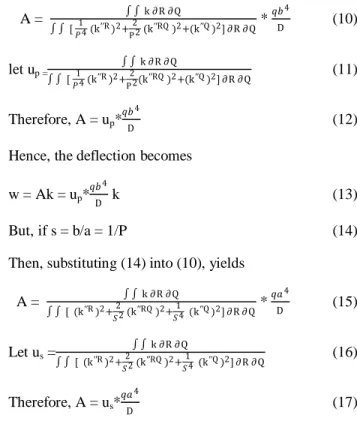
Minimizing (9) and making A the subject of the equation, gives A = ∫ ∫ k ∂R ∂Q ∫ ∫ [ 1 𝑃4 (k′′R)2+ 2 P 2 (k′′RQ)2+(k′′Q)2] ∂R ∂Q * 𝑞𝑏 4 D (10) let up = ∫ ∫ k ∂R ∂Q ∫ ∫ [ 1 𝑃4 (k′′R)2+ 2 P 2(k′′RQ)2+(k′′Q)2] ∂R ∂Q (11) Therefore, A = up* 𝑞𝑏4 D (12)
Hence, the deflection becomes w = Ak = up*
𝑞𝑏4
D k (13)
But, if s = b/a = 1/P (14) Then, substituting (14) into (10), yields
A = ∫ ∫ k ∂R ∂Q ∫ ∫ [ (k′′R)2+2 𝑆 2 (k ′′RQ)2+1 𝑆 4 (k′′Q)2] ∂R ∂Q * 𝑞𝑎 4 D (15) Let us = ∫ ∫ k ∂R ∂Q ∫ ∫ [ (k′′R)2+2 𝑆 2 (k′′RQ)2+ 1 𝑆 4 (k′′Q)2] ∂R ∂Q (16) Therefore, A = us* 𝑞𝑎4 D (17)
Hence, the deflected shape function for aspect ratio, s = b/a is given as (18) w = us* 𝑞𝑎4 D k (18) if α = usk (19) then, w = α 𝑞𝑎4 D (20)
Equation (2) was substituted into (16) and each term was integrated within the limits of 0 to 1, and values of R and Q at plate center were substituted and the resultevaluated, to have the values of α.
Similarly, the moment at the mid span of the plate, was analyze using the following equations:
Mx = -D( ∂2w 𝑎2∂𝑅2 + v ∂2w 𝑏2∂𝑄2 ) (21) My= -D(v ∂2w 𝑎2∂𝑅2 + ∂2w 𝑏2∂𝑄2 ) (22)
Substituting (18) into(21) and (22), we get(23) and (24) Mx= -usqa2( ∂2k ∂𝑅2 + v ∂2k 𝑆2∂𝑄2 ) (23) My = -usqa2(v ∂2k ∂𝑅2 + ∂2k S ∂𝑄2 ) (24) let β = -us( ∂2k ∂𝑅2 + v ∂2k 𝑆2∂𝑄2 ) (25)
Volume 5, Issue 7, July 2016
2292 All Rights Reserved © 2016 IJSETR
and β1 = -us(v
∂2k ∂𝑅2 +
∂2k
S ∂𝑄2 ) (26)
Then,(23) and (24) become respectively:
Mx = β 𝑞𝑎2 (27)
My= β1 𝑞𝑎2 (28)
Substituting(2) into (25) and (26) and differentiateeach term and then substitute values of R and Q to get β and β1.
Similarly, the shear force 'V' was calculated using the following equations Vx = -D[ ∂3w 𝑎3∂𝑅3 +(2-v) ∂3w 𝑎𝑏2 ∂𝑅 ∂𝑄2 ] (29) Vy = -D[ ∂3w 𝑏3∂𝑄3 + (2-v) ∂3w 𝑎2b ∂𝑅2∂Q ] (30)
Substituting (18) into (29) and (30), gives (31) and (32)
Vx = -usqa[ ∂3k ∂𝑅3 + (2-v) ∂3k S2 ∂𝑅 ∂𝑄2 ] (31) Vy = -usqa [ ∂3k 𝑆3∂𝑄3+ (2-v) ∂3k S ∂𝑅2∂Q ] (32) Let δ = -us[ ∂3k ∂𝑅3 + (2-v) ∂3k S2 ∂𝑅 ∂𝑄2 ] (33) andδ1 = -us[ ∂3k 𝑆3∂𝑄3 + (2-v) ∂3k S ∂𝑅2∂Q ] (34)
Therefore, the shear force in the x and y directions are as follows,
Vx = δqa (35)
Vy= δ1qa (36)
Equation (2) was substituted in (33) and (34) and each term differentiated,and the values of R and Q substituted to get δ and δ1.
III. COMPUTER PROGRAMMING
Matlab programming codes were applied to the formulas above in a clear and simple manner to develop the program. The algorithm is shown below:
PROGRAM ALGORITHM Start
Input plate dimensions, a and b; udl, Q. Calculate aspect ratio, s =b/a
Input Poisson ratio, v; plate thickness, h; young's modulus, E; and specific density of plate material, ρ. Calculate flexural rigidity, D.
Calculate coefficient of amplitude of deflection, us=
∫ ∫ k ∂r ∂r ∫ ∫ [ (k′′r)2+2
𝑆 2 (k′′rq)2+ 1
𝑆 4 (k′′q)2] ∂r ∂r
Input values of r and q for maximum deflection Calculate amplitude of deflection, A = us*
𝑄𝑎4
D Calculate coefficient of deflection, α = usk
Calculate maximum Deflection ,w = α*𝑄𝑎4 D
Input values of r1 and q1 for maximum or center moment
Calculate the coefficients of Maximum moment, β = -us(
∂2k ∂𝑅2 + v
∂2k 𝑆2∂𝑄2 )
Calculate Maximum Moment, Mxmax = βQa2
Calculate the coefficients of Maximum moment, β1 = -us(v
∂2k ∂𝑅2 +
∂2k S ∂𝑄2 )
Calculate Maximum Moment, Mymax = β1Qa2
Input values of r4 and q4 for maximum shear force in x-direction
Calculate the coefficients of maximum shear force, δ = -us[
∂3k
∂𝑅3 + (2-v)
∂3k
S2 ∂𝑅 ∂𝑄2 ]
Calculate Maximum shear force in x-direction, Vxmax = δQa
Input values of r5 and q5 for maximum shear force in y-direction
Calculate the coefficients of maximum shear force, δ1 = -us[
∂3k
𝑆3∂𝑄3 + (2-v)
∂3k S ∂𝑅2∂Q ]
Calculate Maximum shear force in x-direction, Vymax = δ1Qa
End
Volume 5, Issue 7, July 2016
2293 All Rights Reserved © 2016 IJSETR
IV. RESULTS AND DISCUSIONS
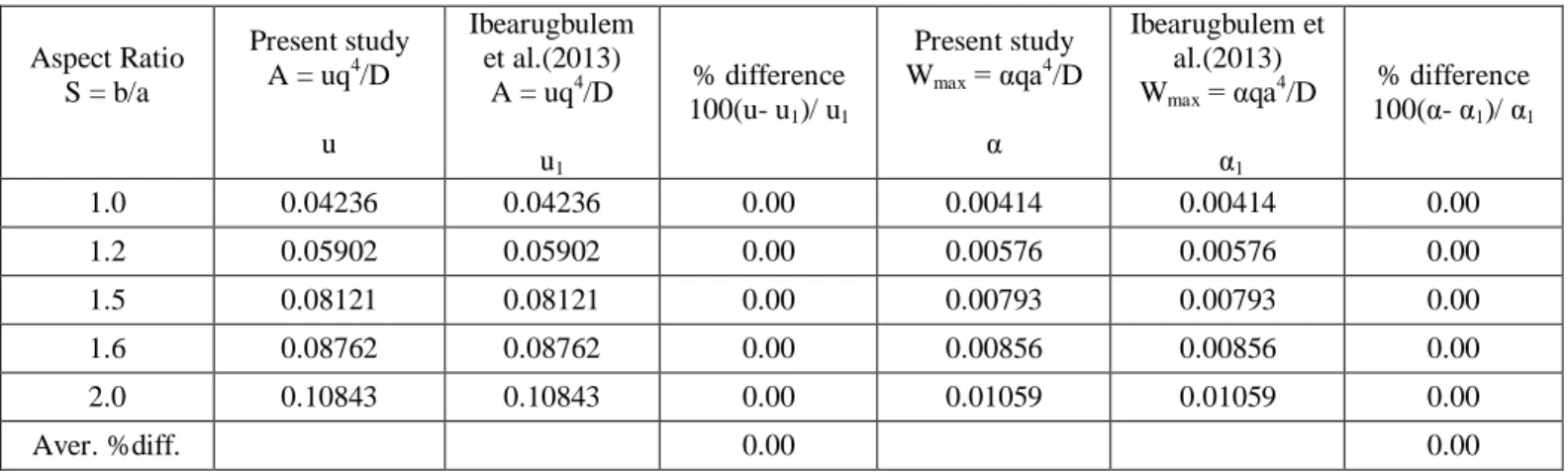
The results obtained from the computerprogram are given in Tables 1-3. In order to validate this program, the results obtained were compared with those of [4] as shown in Table 1, for coefficients of amplitude of deflection 'u' and deflection 'α'. The percentage differences foraspect ratios of 1.0, 1.2, 1.5, 1.6 and 2.0 were all 0.00% for u and 0.00% for α. This indicates that the percentage difference between the results obtained from the developed program and those obtained from [4] are insignificant or zero. Also, the values of coefficient of moment 'β'were compared as shown on Table 2 and the average percentage difference was -0.002% for x-axis & 0.00% for y-axis.They agrees very well with results from [8].
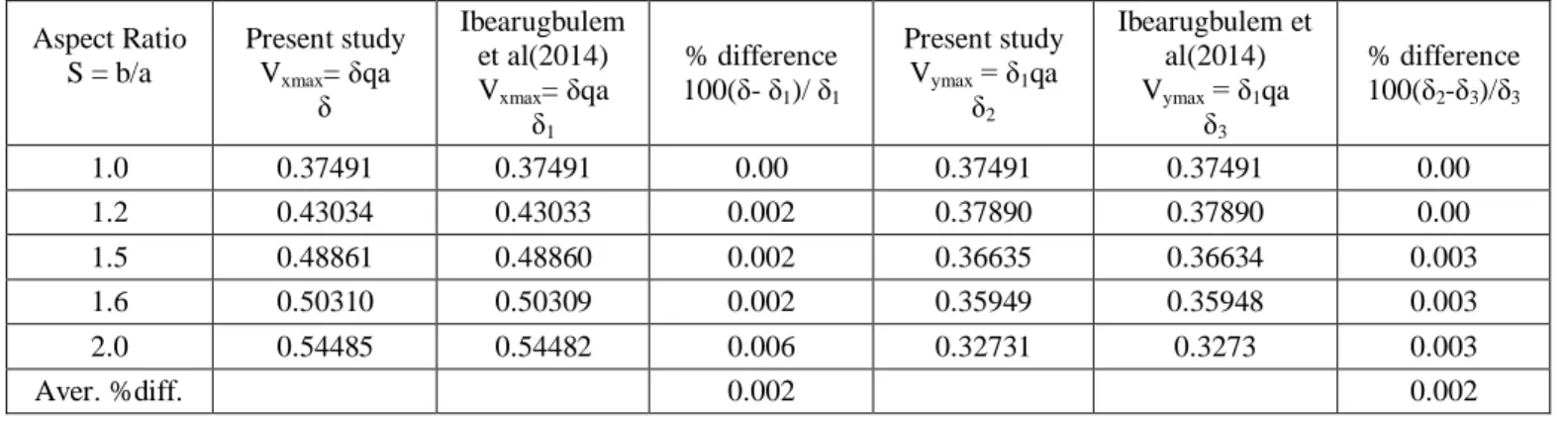
Furthermore, from Table 3, values of coefficient of shear force 'δ' were compared with those from Ibearugbulem, Ezeh and Ettu [10] and the percentage differences were all less than 0.007% with an average of 0.002% in both directions. This indicate that thesoftware program in this present study is adequate
.
V. CONCLUSION
The values obtained from the developed program of this present study compared very well with values from earlier researches. All the percentage differences are less than 0.007% which indicate that the developed program is adequate for analysis of rectangular SSSS plate. It can therefore be concluded that, the developed program of this present study is a simpler and faster approach to analyzing SSSS rectangular plate.
Table1: Comparison of coefficients ofamplitude deflection 'u' and deflection'α'from present study andIbearugbulem et al. (2013) Aspect Ratio S = b/a Present study A = uq4/D u Ibearugbulem et al.(2013) A = uq4/D u1 % difference 100(u- u1)/ u1 Present study Wmax = αqa4/D α Ibearugbulem et al.(2013) Wmax = αqa4/D α1 % difference 100(α- α1)/ α1 1.0 0.04236 0.04236 0.00 0.00414 0.00414 0.00 1.2 0.05902 0.05902 0.00 0.00576 0.00576 0.00 1.5 0.08121 0.08121 0.00 0.00793 0.00793 0.00 1.6 0.08762 0.08762 0.00 0.00856 0.00856 0.00 2.0 0.10843 0.10843 0.00 0.01059 0.01059 0.00 Aver. %diff. 0.00 0.00
Table 2: Comparison of coefficients ofbending moment 'β'from present study andIbearugbulem et al.(2013) Aspect Ratio S = b/a Present study Mxmax = βqa2 β Ibearugbulem et al.(2013) Mxmax = βqa2 β1 % difference 100(β- β1)/ β1 Present study Mymax = β1qa2 β2 Ibearugbulem et al.(2013) Mymax = β1qa2 β3 % difference 100(β2- β3)/ β3 1.0 0.05163 0.05163 0.00 0.05163 0.05163 0.00 1.2 0.06686 0.06686 0.00 0.05502 0.05502 0.00 1.5 0.08629 0.08629 0.00 0.05668 0.05668 0.00 1.6 0.09176 0.09177 -0.01 0.05673 0.05673 0.00 2.0 0.10927 0.10927 0.00 0.05591 0.05591 0.00 Aver. %diff. -0.002 0.00
Volume 5, Issue 7, July 2016
2294 All Rights Reserved © 2016 IJSETR
Table 3: Comparison of coefficients of shear force 'δ' from present study and Ibearugbulem et al.(2014) Aspect Ratio S = b/a Present study Vxmax= δqa δ Ibearugbulem et al(2014) Vxmax= δqa δ1 % difference 100(δ- δ1)/ δ1 Present study Vymax = δ1qa δ2 Ibearugbulem et al(2014) Vymax = δ1qa δ3 % difference 100(δ2-δ3)/δ3 1.0 0.37491 0.37491 0.00 0.37491 0.37491 0.00 1.2 0.43034 0.43033 0.002 0.37890 0.37890 0.00 1.5 0.48861 0.48860 0.002 0.36635 0.36634 0.003 1.6 0.50310 0.50309 0.002 0.35949 0.35948 0.003 2.0 0.54485 0.54482 0.006 0.32731 0.3273 0.003 Aver. %diff. 0.002 0.002
APPENDIX
clc%PROGRAM FOR SSSS PLATE
a = input('Enter plate dimension along x-axis-length- a(m):'); b = input('Enter plate dimension along y-axis-width- b(m):'); Q = input('Enter the udl Q(kN/m):');
echo on s = b/a echo off
%The flexural Rigidity of plate D is v = input('Enter value of poission ratio v:'); h = input('Enter the thickness h(m):');
E = input('Enter the value of young modulus E:'); p = input('Enter the value of specific density p:'); D = E*h^3/(12*(1-v^2)); syms r q U = r-2*r^3+r^4; V = q-2*q^3+q^4; diff(U,2); (diff(U,2))^2; y1 = int((diff(U,2))^2,r,0,1); z1 = int(V^2,q,0,1); Y1 = y1*z1; diff(V,2); (diff(V,2))^2; y2 = int(U^2,r,0,1); z2 = int((diff(V,2))^2,q,0,1); Y2 = y2*z2; diff(U,1); diff(V,1); y3 = int((diff(U,1))^2,r,0,1); z3 = int((diff(V,1))^2,q,0,1); Y3 = y3*z3; y4 = int(U,r,0,1); z4 = int(V,q,0,1); Y4 = y4*z4;
Volume 5, Issue 7, July 2016
2295 All Rights Reserved © 2016 IJSETR
u = vpa(Y4/(Y1+(2*Y3/s^2)+(Y2/s^4)),5) %maximum deflection
r = input('Enter value of r for deflection r:'); q = input('Enter value of q for deflection q:'); k = (r-2*r^3+r^4)*(q-2*q^3+q^4); %Amplitude is A = u*Q*a^4/D alpha = vpa((u*k),7) Wmax = vpa((alpha*Q*a^4/D),7) %Center Moment
r1 = input('Enter value of r for center moment r1:'); q1 = input('Enter value of q for center moment q1:');
beta = vpa(-u*((12*r1^2-12*r1)*(q1-2*q1^3+q1^4)+(v/s.^2)*(r1-2*r1^3+r1^4)*(12*q1^2-12*q1)),5) Mxmax = vpa(beta*Q*a^2,5)
beta1 = vpa(-u*(v*(12*r1^2-12*r1)*(q1-2*q1^3+q1^4)+(1/s.^2)*(r1-2*r1^3+r1^4)*(12*q1^2-12*q1)),5) Mymax = vpa(beta1*Q*a^2,5)
%max Shear Force
r4 = input('Enter the value for Vx r4:'); q4 = input('Enter the value for Vx q4:');
delta =vpa(-u*((24*r4-12)*(q4-2*q4^3+q4^4)+((2-v)/s.^2)*(1-6*r4^2+4*r4^3)*(12*q4^2-12*q4)),5) Vxmax = vpa(delta*Q*a,5)
r5 = input('Enter the value for Vy r5:'); q5 = input('Enter the value for Vy q5:');
delta1 = vpa(-u*(((2-v)/s.^1)*(12*r5^2-12*r5)*(1-6*q5^2+4*q5^3)+(1/s.^3)*(r5-2*r5^3+r5^4)*(24*q5-12)),5) Vymax = vpa(delta1*Q*a,5)
REFERENCES [1] C. L. M. N Navier, “Bulletin des Science de la
SocietePhilomarhique,” de Paris, 1823.
[2]M. Levy, “Memoire sur la theorie des plaques elastiques planes,” Journal of Pure and Applied Mathematics, vol. 3, pp 219, 1899. [3]S.P.Timoshenkoand S. Woinowsky-Krieger, “Theory of plates and
shells”, 2nd ed., New York; McGraw Hills, 1959.
[4] O. M. Ibearugbulem, J. C. Ezeh and L. O.Ettu,“Pure Bending Analysis of Thin Rectangular SSSS Plate Using Taylor-Maclaurin Series”, International Journal of Civil and Structural Engineering, Vol. 3, No. 4, pp. 685-691, 2013.
[5] E. Ventsel, andT. Krauthamer,“Thin Plates and Shells: Theory, Analysis and Applications” New York, Marcel Dekker, 2001. [6] A. C.Ugural, “Stresses in Plate and Shells” 2nd ed,Singapore,
McGraw-hill, 1999.
[7] A.C.Uguraland S.K.Fenster, “Advanced Strength & Applied Elasticity” 4th ed, New Jersey, Prentice Hall, 2003.
[8] O.M. Ibearugbulem, L. O. Ettu and J. C. Ezeh, “Direct Integration and Work Principle as a new approach in Bending Analysis of Isotropic Rectangular Plates,” The International Journal of Engineering and Science (IJES), Vol. 2, Issue 3, pp. 28-36, 2013.
[9] O. M.Ibearugbulem, “Application of direct variational principles in elastic stability of rectangular flat thin plates,”Ph.D thesis submitted to Postgraduate school, Federal University of Technology, Owerri, 2012.
[10] O.M.Ibearugbulem, J. C. Ezeh andL. O. Ettu,“Energy Methods in Theory of Rectangular Plates: Use of Polynomial Shape Functions,” Owerri, Liu House of Excellence Ventures, 2014.
Edward I. Adah:M. Eng., Researcher, Department of
Civil Engineering, Federal University of Technology, Owerri, Nigeria.
David O. Onwuka:Ph.D, Associate Professor, Department of Civil Engineering, Federal University of Technology, Owerri, Nigeria.
Owus M. Ibearugbulem:Ph.D, Senior Lecturer, Department of Civil Engineering, Federal University of Technology, Owerri, Nigeria.