Ahmad Taleb
A Thesis in
The Department of
Computer Science and Software Engineering
Presented in Partial Fullfilment of the Requirements for the Degree of Doctor of Philosophy (Computer Science) at
Concordia University Montreal, Quebec, Canada
April, 2011
c
CONCORDIA UNIVERSITY
School of Graduate Studies
This is to certify that the thesis prepared
By: Ahmad Taleb
Entitled: Query Optimization and Execution for Multi-Dimensional OLAP and submitted in partial fulfillment of the requirements for the degree of
Doctor of Philosophy (Computer Science)
complies with the regulations of the University and meets the accepted standards with respect to originality and quality.
signed by the examining committee:
A. Agarwal Chair
D. Lemire External Examiner
L. Wang External to Program
T. Fancott Examiner
V. Haarslev Examiner
T. Eavis Thesis Supervisor
Approved By
Chair of Department or Graduate Program Director
Spring 2011
Dean of Faculty
Ahmad Taleb
Online Analytical Processing (OLAP) is a database paradigm that supports the rich analysis of multi-dimensional data. While current OLAP tools are primarily constructed as extensions to conventional relational databases, the unique modeling and processing requirements of OLAP systems often make for a relatively awkward fit with RDBM systems in general, and their embedded string-based query languages in particular. In this thesis, we discuss the design, implementation, and evaluation of a robust multi-dimensional OLAP server. In fact, we focus on several distinct but related themes. To begin, we investigate the integration of an open source embedded storage engine with our own OLAP-specific indexing and access methods. We then present a comprehensive OLAP query algebra that ultimately allows developers to create expressive OLAP queries in native client languages such as Java. By utilizing a formal algebraic model, we are able to support an intuitive Object Oriented query API, as well as a powerful query optimization and execution engine. The thesis describes both the optimization methodology and the related algorithms for the efficient execution of the associated query plans. The end result of our research is a comprehensive OLAP DBMS prototype that clearly demonstrates new opportunities for improving the accessibility, functionality, and performance of current OLAP database management systems.
ACKNOWLEDGEMENTS
It is really an honour and a privilege to express my gratitude and indebtedness to my supervisor, Todd Eavis for his priceless support, encouragement and inspiration. His rich experience, wealth of knowledge, and critical and creative thinking has given me direction and insight in pursuing this research.
Special thanks are extended to my uncle Dr. Nasser Taleb for his kindness, support and encouragement. He does not realize how much I have learned from him. I am really glad that I have an uncle like him in my life.
Also, I would like to take this opportunity to personally thank all of my colleagues and friends who have been so supportive and giving of their time especially Yassine Chakir, Yasser Mahmood, Ahmad Al-Tamimi, Nour Eddine Caidi, Mohamad Solihat, Lami Abu Sharikh and Waqas.
Finally, I treasure the invaluable support and encouragement of my dear mother and father. I also owe my loving thanks to my wife and my children. They have endured a lot from my research and traveling. If not for their support, understanding and encouragement it would not be possible to complete this research.
List of Tables xii
List of Figures xiii
1 Introduction 1
1.1 Research overview . . . 3
1.2 Thesis Structure . . . 6
2 Basic Background Material 7 2.1 Introduction . . . 7
2.2 Defining OLAP . . . 8
2.2.1 OLAP: A Functional Definition . . . 8
2.3 The Data Warehouse and Data Cube . . . 11
2.3.1 Data Warehouse Architecture . . . 11
2.3.2 The Data Cube . . . 13
2.4 Background . . . 14
2.4.1 Sidera ROLAP Architecture . . . 15
2.4.2 Sidera Backend Architecture . . . 16
2.4.2.1 Cube Indexing . . . 16
2.4.2.2 Hierarchical Attribute Representation . . . 18
2.4.2.3 Caching . . . 19 v
2.4.2.4 Backend Query Engine Model . . . 22
2.5 Berkeley DB . . . 23
2.5.1 Architecture of Berkeley DB . . . 25
2.5.2 Berkeley DB databases and environments . . . 26
2.6 XML DOM . . . 28
2.7 Conclusions . . . 29
3 Efficient OLAP Storage Engine 30 3.1 Introduction . . . 30
3.2 Related Work . . . 32
3.3 Motivation . . . 38
3.4 Encoding Dimension Tables and the Fact Table . . . 41
3.4.1 Encoding Dimension Tables . . . 43
3.4.2 Encoding the Fact Table . . . 47
3.4.3 Dimension Table Storage . . . 50
3.4.3.1 Hierarchical Attributes . . . 51
3.4.3.2 Non-Hierarchical Attributes . . . 54
3.5 Cube Indexing Integration . . . 58
3.5.1 Berkeley R-tree Model . . . 60
3.6 Integration of Berkeley DB with other Sidera Components . . . 67
3.7 Backend Processing Logic . . . 70
3.7.1 The Query Resolution Algorithms . . . 70
3.7.2 Query Transformations . . . 72
3.7.3 Query Processing . . . 74
3.7.4 Post Processing . . . 77
3.8 Experimental Results . . . 77
3.8.1 The Test Environment . . . 78
3.8.3 Single Node Experimental Evaluation . . . 81
3.8.3.1 Index Construction . . . 83
3.8.3.2 OLAP Query Resolution . . . 85
3.8.4 Parallel Experimental Evaluation . . . 90
3.9 Review of Research Objectives . . . 92
3.10 Final Thoughts . . . 94
3.11 Conclusions . . . 95
4 OLAP Query Language 97 4.1 Introduction . . . 97
4.2 Related Work . . . 100
4.3 Motivation . . . 104
4.4 Preliminary Material . . . 104
4.4.1 Sidera OLAP Model . . . 105
4.4.2 Object Oriented OLAP Query . . . 110
4.5 OLAP Algebra . . . 113
4.5.1 OLAP Algebra Operations . . . 115
4.5.1.1 SELECTION Operator . . . 115
4.5.1.2 PROJECTION Operator . . . 117
4.5.1.3 Set operations on Data Cubes . . . 119
4.5.1.4 CHANGE LEVEL Operator . . . 121
4.5.1.5 CHANGE BASE Operator . . . 122
4.5.1.6 PIVOT Operation . . . 124
4.5.1.7 DRILL ACROSS Operator . . . 124
4.5.2 Algebra Simplifications . . . 127
4.6 OLAP Grammar . . . 127
4.7 OLAP Algebraic laws for Improving OLAP Expression Trees . . . . 131
4.7.1 Laws involving SELECTION . . . 136
4.7.1.1 Better Joins . . . 137
4.7.1.2 Combining conditions . . . 140
4.7.1.3 Pushing laws . . . 141
4.7.1.4 Pulling laws . . . 143
4.7.2 Laws involving PROJECTION . . . 145
4.7.2.1 Decomposition Law . . . 148
4.7.3 Laws for CHANGE LEVEL and CHANGE BASE . . . 149
4.7.3.1 Removal Law . . . 149
4.7.3.2 Pushing and Pulling Laws . . . 150
4.7.3.3 Merging Law . . . 151
4.7.4 Commutative, Associative and Trivial Laws . . . 153
4.8 OLAP Metadata Storage . . . 154
4.8.1 OLAP Metadata Grammar . . . 155
4.8.1.1 Simple OLAP Schema . . . 160
4.9 Review of Research Objectives . . . 161
4.10 Conclusion . . . 163
5 Multi-Dimensional OLAP Query Processor 165 5.1 Introduction . . . 165
5.2 Related Work . . . 170
5.3 Motivation . . . 174
5.4 Parsing OLAP XML Queries . . . 175
5.4.1 DOM Parsing . . . 176
5.4.2 Sidera Parser: DOM graph to Parse Tree . . . 177
5.6.1 Conversion to Initial OLAP Logical Query Plan . . . 183
5.7 Improving the OLAP Logical Query Plan . . . 186
5.8 OLAP Physical Query Plan Generation . . . 193
5.8.1 Estimating Sizes of intermediate Cubes . . . 195
5.8.1.1 Estimating the Size of a PROJECTION . . . 196
5.8.1.2 Estimating the Size of a SELECTION . . . 198
5.8.1.3 Estimating the Size of UNION, INTERSECTION, DIFFERENCE199 5.8.1.4 Estimating the Size of a CHANGE LEVEL . . . 200
5.8.1.5 Reducing the Cost of the Logical Query Plan . . . . 201
5.8.2 Choosing an order for binary operators . . . 203
5.8.3 Implementations for OLAP algebraic operators . . . 207
5.8.3.1 Choosing a SELECTION Method . . . 207
5.8.3.2 Choosing a PROJECTION Method . . . 210
5.8.3.3 Choosing Binary Operations Methods . . . 211
5.8.3.4 Choosing a Method for CHANGE LEVEL and CHANGE BASE212 5.8.4 Pipelining OLAP operations . . . 212
5.8.4.1 Pipelining SELECTION . . . 213
5.8.4.2 Pipelining PROJECTION . . . 213
5.8.4.3 Pipelining Binary Operations . . . 215
5.8.4.4 Pipelining CHANGE LEVEL . . . 217
5.8.5 Physical Query Plan Notation . . . 217
5.8.5.1 Access method . . . 217
5.8.5.2 Physical Operators for SELECTION . . . 218
5.8.5.3 Physical Operators for PROJECTION . . . 219
5.8.5.4 Physical Operators for Binary Operations . . . 220 ix
5.8.5.5 Physical Operator for CHANGE LEVEL . . . 221
5.8.5.6 Additional Physical Operators (Get realValues) . . . 221
5.8.5.7 Final Physical Query Plan . . . 222
5.9 OLAP Query Execution . . . 224
5.9.1 In-memory Hash Table Representation . . . 226
5.9.2 Index Based SELECTION Algorithm . . . 229
5.9.2.1 Cost of the SELECTION operation . . . 236
5.9.3 Algorithms for the PROJECTION operator . . . 238
5.9.4 Hash Table Based Algorithms for Binary Operations . . . 243
5.9.4.1 UNION . . . 244
5.9.4.2 INTERSECTION . . . 245
5.9.4.3 DIFFERENCE . . . 245
5.9.4.4 DRILL ACROSS . . . 245
5.9.4.5 Cost of Binary operations . . . 246
5.9.5 Algorithms for CHANGE LEVEL Operation . . . 246
5.10 The Sidera Server . . . 251
5.11 Result Sets . . . 257
5.12 Review of Research Objectives . . . 259
5.13 Conclusions . . . 262
6 Experimental Results 264 6.1 Introduction . . . 264
6.2 The Test Environment . . . 265
6.3 Current Query Processor Implementation . . . 269
6.4 Single Node Experimental Evaluation . . . 271
6.4.1 Query Engine with and withoutLAW 5 . . . 271
6.4.3 Index scan Versus Sequential cube scan . . . 277
6.4.4 Query Compilation Time versus Query execution Time . . . . 278
6.4.5 Validating the Cost Model . . . 279
6.4.6 Scalability . . . 281
6.5 The Sidera OLAP Query Engine versus Query Engines . . . 285
6.5.1 Sidera Query Engine versus MySQL . . . 286
6.5.1.1 Dimension Count . . . 287
6.5.1.2 Fact Table Size . . . 289
6.5.2 Sidera Engine versus Microsoft SQL Analysis Service . . . 290
6.5.2.1 Dimension Count . . . 291
6.5.2.2 Fact Table Size . . . 292
6.5.2.3 Sidera Engine versus MOLAP SQL Analysis Services 294 6.6 Parallel Query Engine Resolution . . . 296
6.7 Conclusions . . . 299
7 Conclusions and Future Work 300 7.1 Summary . . . 300 7.2 Future Work . . . 302 7.3 Final Thoughts . . . 304 Bibliography 305 A Twelve SQL Queries 316 B Sixteen SQL Queries 319 xi
List of Tables
6.1 Dimension Tables. . . 267 6.2 Estimated cost (Block I/O and processing time) versus actual time. . 281
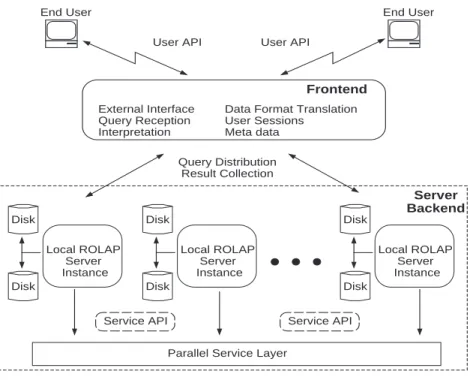
1.1 The Parallel ROLAP Server Architecture. . . 4
2.1 Pivot Operation . . . 10
2.2 Slicing and Dicing a three-dimensional cube. . . 10
2.3 Roll-up and Drill-down on a simple three dimensional cube. . . 11
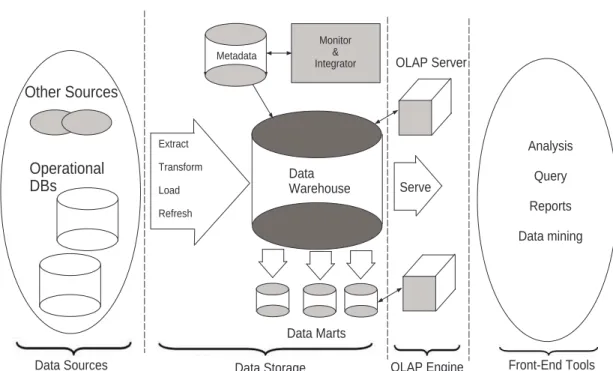
2.4 Data Warehouse Architecture . . . 12
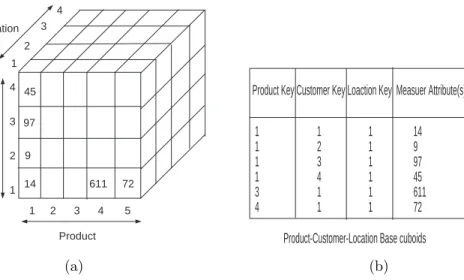
2.5 Two views of the base cuboid of a three dimensional cube. (a) MOLAP model and (b) ROLAP model. . . 14
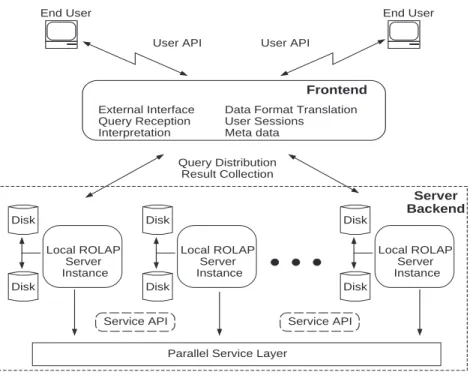
2.6 The Parallel ROLAP Server Architecture. . . 16
2.7 (a) Hilbert packing and (b) physical file on disk. . . 18
2.8 The hMap data structure of mapGraph. . . 20
2.9 The xMap data structure. . . 20
2.10 Components on each of the local processing node . . . 23
2.11 Berkeley DB Subsystems . . . 27
3.1 A simple Star Schema. . . 42
3.2 User-supplied (native) data values for the data warehouse. . . 44
3.3 Encoding Employee dimension. . . 45
3.4 Product Mapping Table (Linear dimension). . . 46
3.5 Customer Mapping Table (Linear dimension). . . 47
3.6 Encoded Fact Table/base view (Sales/ABC). . . 48 xiii
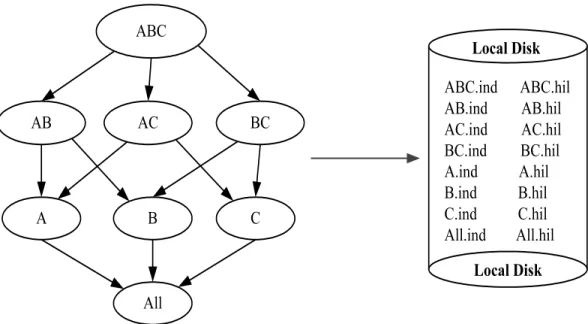
3.7 Lattice of 3-dimensional cube(ABC). . . 49
3.8 Product-Employee (AB) data cuboid. . . 50
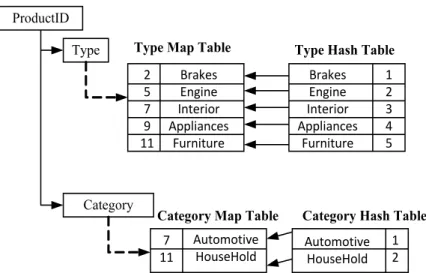
3.9 Recno Berkeley DB databases for (a) the Type attribute in dimension Product and (b) the Province attribute in dimension Customer. . . . 52
3.10 Enhanced mapGraph for Product dimension. . . 54
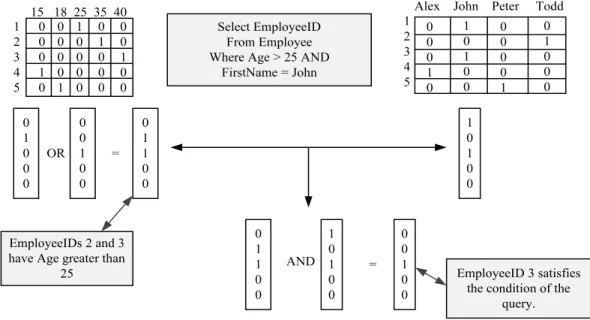
3.11 Employee Bitmap indexes (Age and FirstName). . . 55
3.12 Usage of Bitmap Indexes. . . 57
3.13 Three-dimensional indexed cube (Sales) on local disk. . . 59
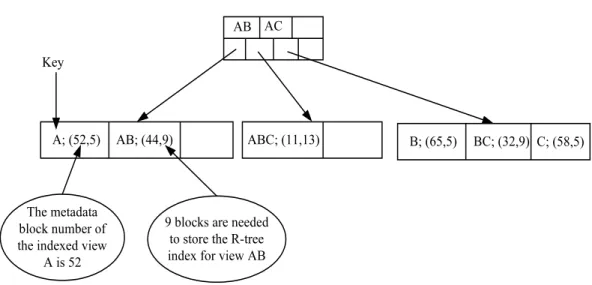
3.14 Berkeley Btree index that has references to all indexed group-bys stored in one Berkeley DB physical file . . . 61
3.15 Hilbert R-tree indexing of the three-dimensional cube (Sales) before and after the integration of the Berkeley DB with our server. . . 63
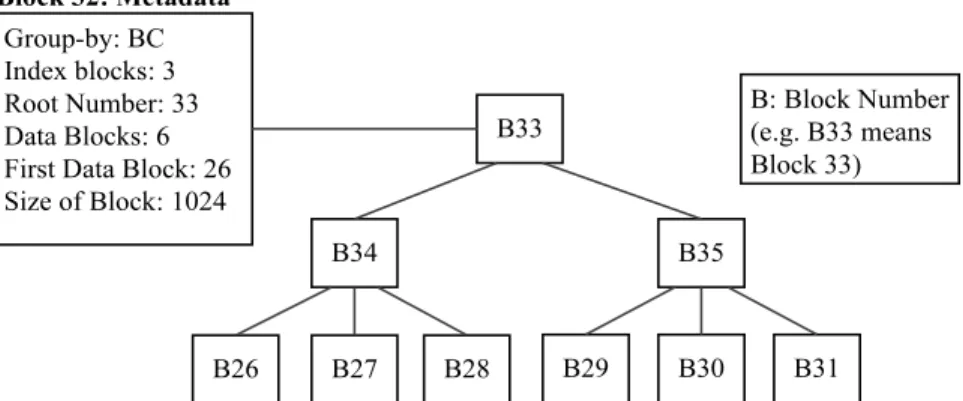
3.16 Blocks occupied in the Berkeley DB physical file for the R-tree index for group-by BC. . . 65
3.17 Hilbert R-tree index physical files. . . 65
3.18 The physical structure of the indexed cube for three-dimensional cube (Sales). . . 66
3.19 The indexed cube for the three-dimensional cube (Sales) without using Berkeley DB. . . 66
3.20 Block diagram of the software architecture on each local processing nodes. . . 69
3.21 Hilbert R-tree Search. . . 75
3.22 Sample SQL queries. . . 82
3.23 Comparison of the running time of three different sets of queries for Berkeley Btree versus FastBit bitmap. . . 82
3.24 Index Construction using Sidera DBMS supported by Berkeley versus Sidera Hilbert R-tree index of the three cube sizes. . . 84
3.26 Comparison of Berkeley supported Sidera Query Engine versus Sidera
Query Engine for three different query counts. . . 87
3.27 Berkeley Database Hit Rate for three query counts. . . 88
3.28 Comparison of Berkeley supported Sidera DBMS versus the old Sidera DBMS for the three different cube sizes. . . 89
3.29 Comparison of Berkeley supported Sidera DBMS versus the old Sidera DBMS, as a function of dimension count. . . 89
3.30 Comparison of answering OLAP hierarchical queries in Berkeley supported Sidera DBMS versus Sidera DBMS for three cube sizes. . . 91
3.31 Parallel wall clock time for index construction. . . 92
3.32 (a) MySQL Basic Architecture (b) MySQL Architecture after adding our OLAP storage engine (OLAPStorage). . . 95
4.1 (a) Sidera Conceptual Cube Model and (b) Simple Symmetric hierarchies for Customer and Time. . . 106
4.2 (a) Simple Object Oriented OLAP model grammar.(b) Simple Object Oriented OLAP model. . . 108
4.3 OLAP query written in SQL. . . 112
4.4 OLAP query written in MDX. . . 112
4.5 Basic OLAP query written in OOP Java. . . 114
4.6 (a) The three dimensional cubeSOLD. (b) The result of the SELECTION(Time.Month = Jan)SOLD query. . . 117
4.7 The result of PROJECTION operator. . . 119 4.8 Two Cubes(C1 and C2) share common feature and measure attributes. 120
4.9 (a)C1 INTERSECTIONC2 (b)C1 UNIONC2(c)C1 DIFFERENCE
C2. . . 121
4.10 Result of a change level operation. . . 123
4.11 Result of the CHANGE BASE operation. . . 123
4.12 Pivot Operation: (a) the original view. (b) the result of the PIVOT operation. . . 124
4.13 Two cubes (C1 and C2) with different measure attributes. . . 126
4.14 Two cubes (C1 and C2) with different measure attributes. . . 126
4.15 Core operations of the OLAP algebra. . . 128
4.16 PROJECTION elements. . . 129
4.17 SELECTION elements. . . 130
4.18 Set Operations. . . 131
4.19 Change Level, Change Base and Pivot operations. . . 132
4.20 Drill Across operation. . . 132
4.21 The XML format for the OLAP query illustrated in Figure 4.5. . . . 133
4.22 (a) Translation of SQL to an intial relational algebra expression. (b) The effect of applying some relational algebra laws. . . 134
4.23 Initial OLAP algebra tree. . . 136
4.24 Two-dimensional cube with the most detailed level values. . . 138
4.25 Initial SELECTION expression tree. . . 139
4.26 After applying LAW 1 the initial tree of Figure 4.25. . . 140
4.27 SELECTION pushing laws. . . 142
4.28 (a) Initial OLAP expression tree and (b) its equivalent after applying the SELECTION pushing laws. . . 144
4.29 (a) Initial OLAP expression tree. (b) Improving the initial expression by pulling SELECTION up and then pushing it down the tree. . . 145
4.31 (a) Initial OLAP expression tree. (b) Improving the initial expression
by decomposing the PROJECTION. . . 149
4.32 (a) Initial OLAP expression tree. (b) Result of pulling up CHANGE LEVEL(K).151 4.33 (a) Initial OLAP expression tree. (b) Result of merging two CHANGE LEVELs.153 4.34 Commutative and Associative rules. . . 154
4.35 DATABASE Element. . . 156
4.36 Cube Schema. . . 156
4.37 Dimension Schema. . . 157
4.38 Hierarchy Element. . . 158
4.39 Simple Hierarchy Schema. . . 159
4.40 Multiple and Parallel Hierarchies. . . 160
4.41 Sample OLAP Schema. . . 162
5.1 The major parts of the query processor. . . 167
5.2 Sidera Backend Query Processor. . . 168
5.3 Query Compilation and Execution Steps. . . 169
5.4 OLAP XML query to parse tree . . . 176
5.5 XML DOM graph/tree . . . 178
5.6 Parse Tree. . . 180
5.7 Initial OLAP Algebra. . . 185
5.8 Translation of the parse tree of Figure 5.6 to an initial OLAP algebra tree . . . 186
5.9 The effect of query rewriting. . . 189
5.10 Cube Sale Schema. . . 190
5.11 Complex OLAP query in a simple string form. . . 191
5.12 Initial OLAP Logical Query Plan of Complex Query in Figure 5.11. . 192
5.13 A preferred OLAP logical query plan showing the effects of our OLAP query optimizer on Figure 5.12 . . . 194
5.14 Notation for the size of cubes and dimension tables. . . 196
5.15 Cube Sale statistics. . . 202
5.16 Logical query plan for an OLAP query defined by our OLAP grammar. 203 5.17 Two candidates (a) and (b) for the preferred Logical query plan in Figure 5.16. . . 204
5.18 Three ways to union four cubes. . . 205
5.19 (a) Initial plan tree with cost (5400). (b) Optimized plan tree with cost (2850). . . 206
5.20 Execution of a pipelined SELECTION. . . 214
5.21 (a) Execution of a pipelined PROJECTION. (b) Block PROJECTION result until the PROJECTION process terminates. . . 215
5.22 A physical plan for the logical query plan of Figure 5.9. . . 223
5.23 OLAP physical query plan for OLAP logical plan of Figure 5.10. . . . 225
5.24 Example of is block intersect()function. . . 235
5.25 Hash Table Array stores the result of the PROJECTION operation. . 244
5.26 Result of PROJECTION. (b) Result of CHANGE LEVEL. . . 251
5.27 A block diagram of the software architecture on each Sidera Backend processing node. . . 254
5.28 The Sidera frontend. . . 254
5.29 The Sidera Backend Node. . . 258
5.30 Result Set DTD Grammar. . . 259
5.31 Result sent from the frontend to the client side as an XML message. . 260
6.2 Query running time with and without LAW 5 as the number of dimensions increases in the data cube. . . 274 6.3 Query response time with and without LAW 2, LAW 4 and LAW 13
as the size of the fact table varies. . . 275 6.4 Query response time with and without LAW 2, LAW 4 and LAW 13
as the size of the number of dimension varies. . . 275 6.5 Comparison of number of blocks retrieved for the query engine before
and after the use of LAW 2, LAW 4 and LAW 13 for the same queries. 276 6.6 Sequential Scan versus Hilbert R-Tree index Scan. . . 278 6.7 Query compilation time compared to Query execution time for different
query groups (group i is answered from i-dimensional cuboids). . . . 280 6.8 Initial and preferred OLAP query plan and its equivalent in SQL. . . 282 6.9 Four Possible physical plans. . . 283 6.10 Execution time for sixteen OLAP queries as a function of the data
cube size. . . 285 6.11 Comparison of resolving OLAP queries using our OLAP query engine
against MySQL Query Engine. . . 288 6.12 Comparison of the Sidera query engine with MySQL server. . . 289 6.13 Sidera Query Engine against MySQL Engine as the number of records
increases. . . 290 6.14 Comparison of our query engine versus Microsoft SQL Analysis Services.292 6.15 Comparison of the Sidera engine versus Microsoft Analysis Services for
three different cube sizes. . . 293 6.16 Running time in the Sidera Server versus the MOLAP SQL server. . . 294 6.17 Sidera Engine versus Microsoft Analysis Services (MOLAP storage). . 295
6.18 Sidera Engine (fully materialized cube) versus Microsoft Analysis Services (MOLAP storage). . . 296 6.19 Parallel clock time for distributed query resolution. . . 298 6.20 Parallel speedup. . . 298
Introduction
Data warehousing and Online Analytical Processing (OLAP) are two of the most im-portant components of contemporary Decision Support Systems (DSS). Collectively, they allow organizations to make effective decisions regarding both their current and future state. That being said, current OLAP tools are primarily constructed as exten-sions to conventional relational database management systems. As a result, they can be constrained by both conceptual and architectural elements primarily designed for transaction processing systems. Our primary focus in the current research is therefore the design of a robust infrastructure that specifically targets OLAP storage, querying, and processing requirements.
Commercially, a number of vendors have offered more OLAP-oriented products in recent years. Both Microsoft Analysis Services [66, 55] and Oracle OLAP [89], for example, offer partial solutions in this context. While ultimately linked to their flagship relational database management systems, which store warehouse data as a series of standard tables, these products also provide options for the storage of OLAP
cubes, a data model often associated with OLAP query processing. Still, indexing
and access options are somewhat limited and are designed primarily for environments
2
where resource requirements (particularly memory) are relatively modest. Given that data warehouses are at least partly defined by their sheer size, these “small scale” solutions are not ideally suited to the needs of contemporary — or future — decision support environments.
In addition, all current warehouse/OLAP systems utilize query mechanisms that were designed decades ago. Specifically, they rely upon a combination of string based query languages such as SQL and MDX, along with various proprietary extensions. These languages (and their APIs) have little in common with the safe, flexible Ob-ject Oriented languages commonly used in today’s development environments. Not only do these languages make client side programming less effective (e.g., no com-pile time type checking, no semantic verification, no ability to re-factor code, plus the requirement to interleave distinct programming models), but they also make it very difficult for the DBMS server to effectively exploit OLAP-specific constructs at query resolution time. In other words, the requirement to work with existing query languages and APIs largely prevents the backend server from effectively optimizing user queries to take full advantage of either OLAP conceptual structures (e.g., con-cept hierarchies and aggregation paths) or physical layer extensions (e.g., enhanced indexing or sorting opportunities).
For these reasons, we are currently investigating the design, implementation, and evaluation of an OLAP-aware multidimensional storage and query engine. In short, the server is designed to efficiently resolve OLAP queries written in native OOP languages such as Java. While the DBMS interface is intended to be clean and intuitive, the infrastructure required to provide this functionality is quite complex. To this end, we propose a comprehensive multi-dimensional OLAP algebra, as well as
an associated language grammar, that can be used to support the language libraries visible to the client side programmer (We note that the client libraries themselves are the subject of a related PhD thesis). The DBMS backend natively supports the OLAP algebra and is able to optimize initial query plans and execute them efficiently. Given the complexity of the query resolution process, we have chosen to ground our conceptual work by integrating the core research themes into a working OLAP prototype. Known as Sidera, the current system [38] was designed from the ground up as a high performance parallel OLAP server and consists of a set of (largely uncoordinated) components that provide various OLAP-specific services (e.g., data structure generation, indexing, querying). Figure 1.1 shows the parallel Sidera system model. While providing basic functionality, the existing Sidera server only supports trivial range queries that have been hard-coded in a proprietary syntax. In the remainder of this thesis we will discuss how Sidera has been extended in order to provide (i) a comprehensive OLAP algebra that will eventually support a full range of OLAP queries (ii) a robust OLAP query grammar that provides a concrete foundation for client side languages (iii) a reliable and efficient OLAP storage engine that can be exploited by the query resolution engine (iv) an execution environment that takes full advantage of the first three elements of this list.
1.1
Research overview
The current research is essentially divided into three stages. In the first stage, we explore the design of a robust OLAP storage engine that supports the processing workload typically found in multi-Terabyte OLAP environments. In particular, we seek to provide reliable and efficient disk storage, with all of the functionality one
4 Disk Local ROLAP Server Instance Disk
Parallel Service Layer
Local ROLAP Server Instance Disk Service API Service API Frontend
End User End User
User API User API
Query Distribution Result Collection Disk Local ROLAP Server Instance Disk Disk Server Backend External Interface Query Reception Interpretation
Data Format Translation User Sessions
Meta data
Figure 1.1: The Parallel ROLAP Server Architecture.
would expect in a contemporary DBMS (e.g., optimized block layout, caching, lock-ing). To do so, we have integrated the open source Berkeley DB libraries into the existing Sidera code base. In addition, we have incorporated bitmap indexing facil-ities into Sidera in order to provide significant performance improvements for query processing that relies on arbitrary attribute restrictions. Experimental evaluation demonstrates that not only does the new storage engine provided a dramatically sim-plified representation of the OLAP data store, but that even view construction and access times have improved by 15 - 25%.
In the second stage, we have focused on a comprehensive multi-dimensional OLAP algebra and associated XML-based query grammar. Similar in scope to the relational algebra that has supported relational database management systems for the past 30+ years, the OLAP algebra consists of a small set of core operations that collectively
define the processing logic found in OLAP environments. In addition, the query grammar is extensively supplemented with various meta data elements that allow for a very expressive representation of the basic operations. Taken together, the algebra and augmented grammar can support intuitive queries that more directly map to the object oriented conceptual model typically associated with the OLAP domain.
In the third stage, we extend the Sidera server to exploit both the storage and query facilities presented above. In particular, we discuss the primary properties of the OLAP operations and present an extensive series of laws for manipulating the initial user queries that arrive from the client side. Specifically, we borrow from existing relational database theory to identify parsing and optimization mechanisms that allow the server to transform initial — often naive — query plans into ones that utilize fewer computational and physical resources and, thus, are likely to execute much more quickly. In conjunction with the plan optimization strategies, we provide an extensive treatment of physical execution plans and algorithms that allow the server to actually carry out the logic of the derived plans. To support the choices that we have made, we provide an extensive experimental evaluation that addresses the value of the optimization and execution strategies. In addition, we compare the latest version of Sidera with a pair of enterprise database management systems often used in data warehouse settings (MySQL and Microsoft Analysis Services). The results suggest that even when the test scenarios are ideally suited to the commercial systems, the methods utilized by the Sidera server show great potential in practical warehouse settings.
6
1.2
Thesis Structure
The thesis is organized as follows. Chapter 2 provides basic background mate-rial needed to understand Online Analytical Processing (OLAP), the Sidera DBMS, Berkeley DB, and the XML parsing used in the storage engine. The succeeding chap-ters present the core contributions of the thesis. Chapter 3 describes the integration of the Berkeley DB and the FastBit components into our OLAP server. It also presents a series of experimental results that highlight the various performance advantages of our OLAP storage engine.
Chapter 4 describes the comprehensive multi-dimensional OLAP algebra and grammar, as well as the metadata components. An extensive treatment of OLAP operations and their logical manipulation is provided. Chapter 5 discusses the design of the DBMS query compilation framework. Specifically, we look at the two primary components: (i) the query compiler that parses and optimizes initial query plans using the laws defined in the previous chapter and (ii) the OLAP query execution engine that translates the query plan into a physical result set. A set of execution algorithms is also presented for each of the primary OLAP operations. In addition, we discuss the integration of the new storage and query components into Sidera’s parallel execution environment.
Chapter 6 provides an extensive set of experimental results that assesses the via-bility of our storage, optimization and execution strategy. Finally, in Chapter 7, we offer final conclusions and briefly describe possible future work.
Basic Background Material
2.1
Introduction
Enterprise systems are becoming increasingly more complex. Organizations today utilize a mixture of older, centralized systems and newer, distributed systems. A wide variety of technologies is provided by an even larger number of vendors. Faced with this environment, IT departments have started to develop new concepts and tools both for managing information technologies, and processing the wealth of data and information generated by them.
In this chapter, we examine the current trends, technologies, and terminology relevant to an understanding of Online Analytical Processing or OLAP[23, 25, 31]. Section 2.2 defines On-line Analytical Processing. In Section 2.3, we discuss the data warehouse and the data cube. In Section 2.4, we briefly describe the Sidera parallel ROLAP backend architecture, and its software framework. In Section 2.5, we provide an overview of the Berkeley DB model. We present the DOM parsing in Section 2.6, while Section 2.7 concludes the chapter with brief summary
8
2.2
Defining OLAP
The term OLAP was not coined until 1992. In that year E. F. Codd, who first introduced the relational data model in 1970, presented a report entitled “Providing OLAP (on-line analytical processing) to user-analysts: An IT mandate”[25]. In this paper Codd indicated the twelve elements required of any OLAP application. The following five points are perhaps the most important themes taken from his report:
1. Multidimensional conceptual view. The primary focus is the relationship between dimensions, rather than the presentation of transactional records. 2. Transparency. The end user should not have to be concerned about the details
of data access or conversions.
3. Accessibility. OLAP should present the user with a single logical schema of the data, as opposed to a complex physical model.
4. Flexible reporting. The DBMS must be capable of presenting data to be syn-thesized, or information resulting from animation of the data model, according to any possible orientation.
5. Unlimited dimensional and aggregation levels. A serious tool should support at least 15 dimensions.
2.2.1
OLAP: A Functional Definition
While commercial OLAP systems may provide many functions, there is a minimal set that can and should be defined by any OLAP application. These functions are listed below, while graphical models are shown in Figures 2.1, 2.2, and 2.3.
• Pivot. This OLAP operation allows users to re-organize the axes of the cube. Pivot deals with presentation. Figure 2.1 provides a simple example of how the pivot operation works in practice.
• Slice. This is an operation whereby we select a subset of a multi-dimensional array (or cube) corresponding to a single value for one dimension member. This operation allows the user to focus in on values of interest. Figure 2.2 shows the process for a single value of the “color dimension”.
• Dice. The dice operation is a slice on more than two dimensions of a data cube (or more than two consecutive slices). The user can draw attention to mean-ingful blocks of aggregated data. In Figure 2.2, we show a multi-dimensional subcube of a larger cube space.
• Roll-up. This is a specific analytical technique whereby the user navigates among levels of data ranging from the most detailed (down) to the most sum-marized (up) along a concept hierarchy. Figure 2.3 illustrates how the “color dimension”, originally listed at the most detailed level, is aggregated in order to provide a break down by summer and winter colors.
• Drill down. This is a specific analytical technique whereby the user navi-gates among levels of data ranging from the most summarized (up) to the most detailed (down) along a concept hierarchy. Figure 2.3 shows how the “item dimension” is broken down to its item number.
10
Month
Product
Original View Pivot View
Region
Month
Product Region
Figure 2.1: Pivot Operation
Original View
Item Name
skirt dress shirts pant all
Color
all white pastel dark
all large
medium small
skirt dress shirts pant all
medium small
large
all
Item Name
Size Colordark
Slice
skirt dress shirts
Item Name pastel dark Color Dice Size Size medium small
Original View
Item Name
skirt dress shirts pant all
Color
all white pastel dark
all large
medium
small
skirt dress shirts pant all
medium small large all Item Name Size Color Roll-up on color Size Summer Winter
item1 item2 item3 item4 item5 item6 iitem7 item8 iitem9 item10
all large
medium
small
Size
all white pastel dark
Color
Drill down on item
Item Number
Figure 2.3: Roll-up and Drill-down on a simple three dimensional cube.
2.3
The Data Warehouse and Data Cube
We note that the concept of the data warehouse begins with the physical separation of a company’s operational and decision support environments. In other words, a data warehouse is a distinct corporate database management system (DBMS) that is designed to facilitate super fast queries times, as well as the analysis of multidimen-sional data. The data warehouse is the central data repository for virtually all OLAP systems.
2.3.1
Data Warehouse Architecture
Data warehouses can be seen as a three-tier architecture [23, 53]. The canonical data warehouse architecture is shown in Figure 2.4. The possible data sources are shown on the left. Information is extracted from various legacy systems and operational
12 Other Sources Operational DBs Data Sources Extract Transform Load Refresh Data Warehouse Metadata Monitor & Integrator Data Marts Data Storage OLAP Server Serve Analysis Query Reports Data mining
OLAP Engine Front-End Tools
Figure 2.4: Data Warehouse Architecture
sources, consolidated, summarized, and loaded into the data warehouse. Strictly speaking, this first step is outside the scope of the warehouse proper. Several data marts are shown in the second stage; each one is a small warehouse designed for a specific department. At this stage, we have the actual data warehouse, which contains the “decision support” data and associated software. We can refer to this component as the first tier. The second tier contains the OLAP server/engine that allows the users to access and analyze data in the warehouse. In practice, there are many forms of OLAP servers; they are used for the same aims but they differ in their internal data representations. Finally, the third tier includes the front end tools that provide a graphical interface for the top managers and decision makers.
2.3.2
The Data Cube
The data cube is a multidimensional data model that supports OLAP processing. It can be described as a data abstraction that allows one to view aggregated data from a number of perspectives. A data cube consists of dimensions and measures. Dimensions are also known as attributes. Attributes can be of two types. Feature
attributes represent entities, such as employee and product. Measure attributes refer to the items of interest. The measure attributes are aggregated according to the feature attributes.
For ad-dimensional space,{A1, A2, . . . , Ad}we haveO(2d) attribute combinations.
We often refer to this collection of views as the power set. In OLAP, views are also known ascuboids orgroup-bys. Each view represents a distinct combination of feature attributes, and can be seen as presenting an aggregation of the measure attribute.
The data cube consists of the base cuboid plus (2d)-1 cuboids. Since the base
cuboid contains all the feature attributes, it can be used to compute all the coarser cuboids by aggregating across one or more of its dimensions. The data cube can be described as “full” if it contains all 2d possible views, or “partial” if only a subset of
views has been constructed.
The group-bys can be pre-computed and stored to disk to improve real time query performance. If the data is physically stored as a multi-dimensional array, we have what is called a MOLAP design. MOLAP provides implicit indexing along the axes of the multi-dimensional array but performance sometimes deteriorates as the space — and the associated cube array — becomes more sparse (high dimensionality/high cardinality). Relational OLAP, or ROLAP, stores group-bys (view/cuboids) as dis-tinct tables and tends to scale well since only those records that actually exist are
14 4 3 2 1 Customer 1 2 3 4 5 Product 1 2 3 4 Location 45 97 9 14 611 72 (a)
Product Key Customer Key Loaction Key Measuer Attribute(s) 1 1 1 14 1 2 1 9 1 3 1 97 1 4 1 45 3 1 1 611 4 1 1 72
Product-Customer-Location Base cuboids
(b)
Figure 2.5: Two views of the base cuboid of a three dimensional cube. (a) MOLAP model and (b) ROLAP model.
materialized and stored. However, it requires explicit multidimensional indexing in order to be used effectively.
Figure 2.5 shows the construction of the base cuboid of a three dimensional cube (Product, Customer, Location). Figure 2.5(a) presents the MOLAP model, while Figure 2.5(b) depicts the ROLAP case.
2.4
Background
In this section, we present a simple architectural overview of the current Sidera sys-tem. In particular, we look at the backend architecture that performs the query resolution.
2.4.1
Sidera ROLAP Architecture
Contemporary data warehouses have grown enormously in size, with the largest now pushing into the multi-terabyte range. For these massive data sets, multi-CPU sys-tems offer great potential. The Sidera server was designed from the ground up as a high performance parallel OLAP server.
Figure 2.6 provides a simple illustration of the hardware/ software architecture for the query engine. Here, the Sidera frontend node represents the server’s public interface. Its core function is to receive user requests and to pass them along to back-end nodes for resolution. The frontback-end node does not participate in query resolution, other than to collect the final result from the backed instances and return it to the user.
Queries are distributed to each of the p nodes in parallel, allowing each of the processing nodes to participate equally in every query. Load balancing errors due to set partitioning are typically less than 2%. In effect, each backend node serves as an independent ROLAP server that is fully responsible for storage, indexing, query planning, I/O, buffering, and meta data management. Note that a Parallel Service API provides functionality (sorting, aggregation, communication, etc.) that allows local servers (backend nodes) to operate independently.
Sidera provides cube generation algorithms that are fully parallelized and are load balanced and communication efficient on both shared disk and shared nothing cluster architectures. Methods for both full cube (all 2d views) and partial cube (<
2d) materialization are supported [30, 80, 83]. After running the cube generation
algorithm, each backend node houses a portion of each of the O (2d) cuboids in the
16 Disk Local ROLAP Server Instance Disk
Parallel Service Layer
Local ROLAP Server Instance Disk Service API Service API Frontend
End User End User
User API User API
Query Distribution Result Collection Disk Local ROLAP Server Instance Disk Disk Server Backend External Interface Query Reception Interpretation
Data Format Translation User Sessions
Meta data
Figure 2.6: The Parallel ROLAP Server Architecture.
2.4.2
Sidera Backend Architecture
Recall that each backend node operates independently to answer a query from the cuboids that are housed in each of the nodes. In this section, we will describe the backend architecture in terms of the constituent components on the local nodes. In particular, we will discuss the indexing of the cube, as well as the hierarchical data structures and caching framework used to support hierarchical queries. Finally, we describe the software architecture utilized on each processing node.
2.4.2.1 Cube Indexing
As mentioned in the previous section, each node contains a fragment of each of the O(2d) cuboids in order to improve the query response time. However, it is important
indexing is critical. In Sidera’s case, explicit multi-dimensional indexing is provided by a forest of parallelized R-trees. The R-tree [50] indexes are packed using a Hilbert space filling curve [99] so that arbitrary k-attribute range queries more closely map to the physical ordering of records on disk. For each cuboid fragment on a node, the basic process is as follows:
1. Sort the data based upon the Hilbert sort order [99]. Associate each of the n points (records) with m pages of size n/M. Write the base level to disk as (cuboid name.hil).
2. Associate each of the m leaf node pages with an ID that will be used as a file offset by parent bounding boxes.
3. Construct the remainder of the R-tree index by recursively packing the bounding boxes of lower levels until the root node is reached.
The end result is a Hilbert-packed R-tree for each cuboid fragment in the system. The Hilbert packed R-tree is stored on disk as two physical files: a .hil file that houses the data in Hilbert sort order, and a .ind file that houses the R-tree metadata and the bounding boxes that represent the index tree.
Figure 2.7 illustrates the structure of a small Hibert packed R-tree, with n = 18 and M = 3. In Figure 2.7(a), we see the data points (B3-B8) organized via the Hilbert curve. Boxes that represent the index (B0-B3) are then constructed as described above. In Figure 2.7(b) we see the physical files (.hil and .ind) that are used to store the Hilbert packed R-tree for a given group-by (cuboid). As you can see in Figure 2.7(b), each index block contains the IDs of the blocks that are accessed from it. B0 contains the IDs of B1 and B2 that, in turn contain the IDs of the data
18
Figure 2.7: (a) Hilbert packing and (b) physical file on disk.
blocks B3, B4, B5, B6, B7, and B8. However, Blocks (B3 . . . B8) hold the Hilbert ordered records.
2.4.2.2 Hierarchical Attribute Representation
One of the most important research problems in the area of Decision Support Systems is the efficient manipulation of hierarchical dimensions stored in the data warehouse, thereby improving the efficiency of querying multidimensional data [105, 107, 74, 34, 84, 69, 60, 90, 76, 64, 63, 21, 57, 101]. However, little research effort has focused upon the manipulation of simple and complex hierarchies in ROLAP at query run-time.
Sidera supports the hierarchal queries by building mapGraph [39], a suite of al-gorithms and data structures for the manipulation of attribute hierarchies in “real time”. mapGraph builds upon the notion of hierarchylinearity[115, 75]. We say that
a hierarchy is linear if for alldirect descendants A(j) ofA(i) there are|A(j)|+ 1 values,
x1 < x2. . . < x|A(j)| in the range 1. . .|A(i)|such that
A(j)[k] = xXk+1
l=xk A(i)[l]
where the array index notation [ ] indicates a specific value within a given hierarchy level. Informally, we can say that if a hierarchy is linear, there is a contiguous range of values R(j) onA(j) that may be aggregated into a contiguous rangeR(i) on A(i).
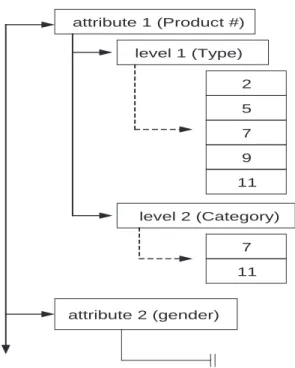
Sidera uses a sorting technique to establish linearity for each dimension hierarchy, with data subsequently being stored at the finest level of granularity. It then uses a compact, in-memory data structure called mapGraph to support efficient real time transformations between arbitrary levels of the dimension hierarchy [39]. While a number of commercial products and several research papers do support hierarchical processing forsimple hierarchies — those that can be represented as a balanced tree — mapGraph is unique in that it can enforce linearity on unbalanced hierarchies (optional nodes), as well as hierarchies defined by many-to-many parent/child rela-tionships. The end result is that users may intuitively manipulate complex cubes at arbitrary granularity levels and can invoke drill down and roll up operations at will. Figure 2.8 provides an illustration of the hMap structure that is used for the simplest hierarchy forms, while Figure 2.9 provides the structure that is used for the unbalanced hierarchy forms.
2.4.2.3 Caching
While the parallel indexing facilities provided by the Sidera server support effective disk-to-memory transfer characteristics, optimal query response time relies to a great
20 attribute 1 (Product #) level 1 (Type) attribute 2 (gender) level 2 (Category) 2 5 7 11 9 7 11
Figure 2.8: The hMap data structure of mapGraph.
1 2 6 16 1 2 12 16 1 2 14 16 1 2 8 12 1 2 10 12 1 2 3 2 4 6 Legend
base attribute max
vector index
extent on an effective caching framework. Given the sizable memory capacity of our parallel ROLAP server, it is expected that a significant proportion of user queries will be answered in whole or in part from a hot cache. Sidera provides a natively multi-dimensional, hierarchy-aware caching model. Specifically, resolved partial queries are cached on each node of the parallel machine. For a newk-attribute range query, with ranges {R1, R2, . . . , Rk}, the cache mechanism must determine if, for each attribute
Ai, the rangeRi of the user query is a subset of the range onAi of the cached query.
If, for all k attributes, subset ranges are found, the cached query is used in place of disk retrieval. At present, the Cache Manager does not process partial matches. That is, it does not answer queries partly from the cache and partly from disk. This, however, is the subject of ongoing research. Specifically, the logic required for this form of decision making will eventually be integrated into the query optimizer.
The Cache Manager is used in conjunction with the mapGraph to perform trans-lations between hierarchy levels. For a k-attribute user query, an arbitrary number of attributes can be re-mapped simultaneously. Note that queries are cached in their preliminary state — that is, they are cached in their base attribute form before final transformations have been applied. This permits hierarchies to be mapped to arbi-trary levels — caching at levels above the base would prevent the cache from answering queries at finer levels of granularity. It is important to note that the cache forms the basis of the core Five Form query model. Specifically, all OLAP servers should be able to support at least five basic OLAP-specific queries: roll-up, drill-down, slice, dice, and pivot. The query engine transparently manipulates the cache contents to further refine previous user queries. A drill down, for example, is produced merely by translating hierarchy levels within the current cache.
22
2.4.2.4 Backend Query Engine Model
The software architecture on each processing node forms a clean modular design. Fig-ure 2.10 illustrates how the cube indexing, hierarchy, caching, and view components fit into the larger framework. The first three have already been discussed. The View Manager maintains meta-data about the format and sort orders of views physically stored on disk. It is used when queries cannot be resolved from the Cache.
Algorithm 1 provides a high level description of Sidera’s query resolution logic. At startup, each local node initializes the mapGraph hierarchy manager with meta data that describes the dimension hierarchies and then initializes the View Manager by scanning the local cube fragment. Because partial data cubes (subset of 2d) are
often constructed in practice, the View Manager can then be used to identify the cheapest surrogate view that can resolve the user query. The frontend broadcasts the queries to each processing node (backend) so that a partial result can be computed. The main backend thread will then invoke the query engine module to process the received query from the frontend.
The query interface is designed to be transparent, so that the user need not be aware of physical storage properties. For this reason, before query resolution takes place, the user’s query must be transformed, taking into account the dimensions’ hierarchical specifications, the existence of the cheapest surrogate group-by, and the attribute sort orders. An initial result is obtained either from the cache or, if neces-sary, from disk. If obtained from the cache, relevant records will be retrieved via the Cache Manager. Otherwise, disk access is required. In this case, raw data is received from the Hilbert R-tree indexes and eventually inserted into the Cache.
View Manager Hierarchy Manager Multi-dimensional Caching Query Transformation Hilbert R-tree Indexing Query Resolution Parallel Service API I/O Subsystem
Figure 2.10: Components on each of the local processing node
Once the initial result set has been resolved against the base level data, post pro-cessing must be performed in order to produce the final result. The initial results must be translated back into the level of detail required by the user. This function is again performed in conjunction with the mapGraph Hierarchy Manager. A Parallel Sample Sort [104] is performed to order records as per the user request and to permit efficient merging and aggregation. Note that the sorting subsystem is heavily opti-mized to minimize the movement of multi-value records. If surrogates or hierarchies have been specified, some form of additional aggregation will also be required. At this point, each processing node has part of the final result as per the user request. Finally, if results are required on the front end, then we collect partial result from each node with an MPI Gather operation.
2.5
Berkeley DB
Some applications require only the simple file system read/write services. Others need all the power and flexibility that relational, hierarchical, and/or object databases
24
Algorithm 1Backend node server 1: Initialize the main backend server
2: Initialize the mapGraph Hierarchy Manager (hM) with the dimension hierarchy meta data
3: Initialize the View Manager (vM) with meta data about the physically stored cube
4: While server is running do
1. receive a set M of user-defined query (uQ) parameters
2. transform query using the mapGraph Hierarchy and View Managers 3. check the Cache Manager (cM) for a match on uQ
4. if a valid match is found in the local Cache Manager then 6: get initial result I from the Cache Manager
5. else {otherwise, go to disk to answer the query}
8: get initial result I by accessing the disk to answer the query(uQ) 9: add I to the Cache Manager
6. end if
7. perform OLAP post processing on the initial result I. 8. if results required on front end then
12: collect R with MPI Allgather 9. end if
offer. Berekely DB falls between the low level file system and the high-level relational, hierarchical, and object-oriented engines. Berkeley has an advantage over full DBMS systems in that it it does not add the complexity and processing overhead required to support full database query languages.
Berkeley DB is a general-purpose library written in the C programming language that can be used as a fast, cost-effective data management layer for application de-velopers. Because it is an embedded library, it can be compiled and linked directly into the target application. Berkeley DB is available on all main commercial or open source operating systems. Berkeley DB provides a simple function-call API for data access and management in C, C++, and Java, as well as a wide variety of popular scripting languages.
2.5.1
Architecture of Berkeley DB
It is important to remember that Berkeley DB is not a full relational, hierarchical, or object-oriented database management system. However, there are five major subsys-tems in Berkeley DB that can be used to implement high-level database functionality without the need for significant query processing overhead or memory resources.
The five main subsystems that are provided by Berkeley DB are, as follows: 1. Access Methods. The access subsystem provides several different ways of
organizing data. This includes methods for inserting, deleting, and updating entries in the database. Berkeley DB offers four access methods: Btree, Hash, Queue, and Recno. The Btree stores data in a balanced tree structure [14], while the Hash access method implements the extended linear hashing algorithm [71]. The Queue access method stores fixed length records sequentially, with logical
26
record numbers as keys. Finally, the Recno access method includes both fixed and variable length records with logical record numbers as keys. When the database is created, the developer can select the appropriate access method for the application. Berkeley DB uses a default access method if none is selected. 2. Buffer Pool. Berkeley DB offers a shared memory cache used to store the
most frequently accessed data. The cached data can then accessed and shared among the processes using the database files.
3. Transactions. Berkeley’s transaction subsystem ensures that the data doesn’t get corrupted if a group of database recordes changes from one state to another. We can think of transaction in terms of the ACIDity property [94].
4. Locking. the locking subsystem uses the two phase locking [91] mechanism to provide concurrent access and isolation in the database.
5. Logging. The ACIDity property is supported by a write-ahead logging imple-mentation [91].
Figure 2.11 shows the relationships between the subsystems in Berkeley DB. As depicted in Figure 2.11, an application invokes the access methods and the transaction APIs to perform Berkeley DB operations. The access methods and transaction sub-systems in turn make calls into the Memory Pool, Locking and Logging subsub-systems on behalf of the application.
2.5.2
Berkeley DB databases and environments
In this section, we briefly review some of the important concepts that one must understand when building a Berkeley DB application. A Berkeley database contains
Figure 2.11: Berkeley DB Subsystems
records which consist of key/value pairs. Because of this pairing of keys and data, we may think of a Berkeley database as a two column relation. Keys and data may be arbitrarily complex. A Berkeley database contains a single collection of data organized according to a chosen access method at database creation time (Hash, Btree, Recno, or Queue). A database in Berkeley would normally be referred to as a table in most database systems. Consequently, a standard Berkeley database application uses multiple Berkeley database files. However, Berkeley DB also offers a mechanism called anenvironmentthat can efficiently manage and coordinate multiple databases. A Berkeley database environment is essentially equivalent to a database in relational database systems. Finally, a Berkeley handle is a reference to the physical Berkeley implementation. For example, to use a Berkeley database, you have to obtain a database handle.
A Berkeley DB environment is important when dealing with multiple, related databases. It can be used to efficiently pack hundred of databases into a single file, thereby significantly simplifying the design of the application. Moreover, since
28
Berkeley is just a library that can be linked into the application space, there is no external server to control threads and manage tables. Instead, Berkeley environments serve as a common place where various control and management functions can be staged.
2.6
XML DOM
As mentioned in Chapter 1, OLAP queries will be received by the Sidera server in XML-based format. In this short section, we briefly review the key concepts rele-vant to the process of parsing the XML OLAP query. XML is an extensible markup language and can essentially be described as a text based notational mechanism for representing arbitrary, self-describing data elements. Because it is text based, it may be shared across a wide variety of computing platforms. The XML DOM (Docu-ment Object Model) defines a standard way for accessing and manipulating XML documents [32]. According to DOM, everything in the XML document is a node. DOM nodes include the document node, element node, attribute node, text node, and comment node. The XML DOM presents the XML data as a tree structure often referred to as a node tree. The terms “parent”, “children”, and “siblings” are used to describe the relationships between the nodes in the node-tree. The tree itself starts at the root node and moves downward towards the text nodes at the leaf level.
A DOM parser is used to create the DOM node tree (this will be discussed in Chapter 5). In other words, the parser can be used to read the XML document and convert it into nodes that can be accessed and manipulated with programming lan-guages such as Java, C++, etc. By using an XML DTD (Document Type Definition) — essentially an XML schema — we can formally define what elements, attributes,
and entities are legal in the XML document. Therefore, the DOM parser not only converts the XML to a DOM node tree, but it also verifies if the received XML matches the XML DTD.
2.7
Conclusions
Both the size and complexity of data analysis has grown enormously in recent years. Typically a data warehouse is used to support the process of data analysis since the warehouse represents a large, consistent repository for enterprise-wide corporate in-formation. In turn, OLAP systems allow users to manipulate the data contained in the data warehouse. In this chapter, we have examined the concepts of Online Analytical Processing and the data cube. OLAP operations were illustrated along with explanations on how these operations are performed so as to provide mean-ingful measures of summarized multi-dimensional data. We also examined the data warehouse architecture as a three tiered model. We then presented the architectural model for the Sidera platform, a robust parallel OLAP server designed for cluster applications. The server consists of a publicly accessible frontend and a collection of identical backend servers.
We then discussed the architecture of the open source Berkeley embedded database. Specifically, we showed the five major subsystems in Berkeley DB that can be used to implement high-level database functionality. Finally, we presented the XML DOM parser that is used to parse the XML OLAP query on the frontend server. The DOM parser will be further discussed in Chapter 5.
Chapter 3
Efficient OLAP Storage Engine
3.1
Introduction
One of the more important problems in the area of Decision Support Systems is the efficient access and querying of multi-dimensional data stored in the data warehouse [105, 107, 74, 34, 84, 69, 60, 90, 76, 64, 63, 21, 57, 101]. Somewhat surprisingly, perhaps, relatively little research has been published on this topic. It is true that a number of data structures and indexing methods have been developed for OLAP-oriented multi-dimensional data. However, to our knowledge, no attempt has been made to integrate such concepts into viable DBMS systems.
We begin by noting that the Sidera server[38] is intended to be an OLAP DBMS. In fact, the first subject that one must focus on in the implementation of an OLAP DBMS is the OLAP storage engine that is responsible for how the data of the data warehouse is stored effectively on disk, as well as quickly accessed. The existing storage engine of the Sidera server employs several components (indexing, hierarchy manager, caching, etc.) that are used to answer multi-dimensional OLAP queries in a very efficient manner. Specifically, for a d-dimensional fact table that is associated with d dimensions, the current Sidera storage engine creates the R-tree indexed data
cube as a (2*2d) separate standard disk files. As was illustrated in Section 2.4, two
separate files (with .ind and .hil suffixes) represent the R-tree indexing for a group-by in a d-dimensional cube. These simple files are not databases in any sense and cannot efficiently support DBMS/OLAP queries. Moreover, they are underpowered because of a lack of reliability (transactions, concurrency and recovery) and are at a performance disadvantage relative to a true database system. However, as was discussed in Section 2.4, Berkeley DB combines the power of a relational storage engine (scalability, reliability, transactions, etc.) with the simplicity of a file system-based data storage. Therefore, Berkeley DB has the potential to improve the existing storage engine in the Sidera server.
In this chapter, we describe in detail the integration of Berkeley DB functionality into the Sidera server [38]. In addition, we discuss the storage of dimension tables. Recall that while the Sidera storage engine stores a cube by means of the R-tree indexing method, it does not currently maintain the data for the dimension tables. In general, therefore, our approach is to merge our existing code base that is used to implement the backend Sidera server with the embedded Berkeley DB discussed in Section 2.5. Dimensions tables are then encoded into a compact integer format. Specifically, non-hierarchical attributes are stored as a set of FastBit bitmap indexes, while hierarchical attributes are stored as Berkeley DB databases. Ultimately, the integrated architecture is a very efficient OLAP storage engine that will allow us to explore query resolution and optimization research that would be difficult, if not impossible, to evaluate in a simulated DBMS environment.
This chapter is organized as follows. In Section 3.2, we will discuss previous work. Section 3.3 will present the primary motivation of our work. In Section 3.4,
32
we discuss how the native data of the data warehouse is represented in our server. A detailed description on how the data of the dimension tables are stored on disk and accessed is provided in Section 3.5. A detailed description on how we integrate the existing Sidera Cube Indexing and Access components with Berkeley DB is provided in Section 3.5. In Section 3.6, we describe the integration of the Berkeley code base into other Sidera server components. In Section 3.7, we illustrate the structure of the query engine following the integration process. Extensive experimental results are provided in Section 3.8. Section 3.9 is a review of chapter objectives with final thought about our storage engine provided in Section 3.10. The chapter’s conclusions are provided in Section 3.11.
3.2
Related Work
The multidimensional data from data warehouses or data marts are presented to business users by OLAP servers. In practice, there are many forms of OLAP servers (e.g. MOLAP, ROLAP and HOLAP). They are used for the same aims; however, they differ in their internal data representations (Relational, Multidimensional, etc.). As was illustrated in Section 2.3, central to OLAP is the data cube that consists of the base group-by plus (2d)-1 group-bys. While the cube can be defined as a
logical data model, it often forms the basis of a physical model as well. Specifically the group-bys (views) can be pre-computed and stored to disk to improve real time query performance. Therefore, the first issue that one must address with the design and implementation of an OLAP server is how to deal with the very large amounts of historical data found in fact tables, cuboids and dimension tables. Specifically, we must look at the best indexes, representations and data structures that support
the efficient manipulation of the data in the data warehouse. In this section, we will review the academic literature that has been developed for the storage, representation, indexing and accessing of data in the data warehouse (fact tables, dimension tables, cubes, hierarchies, etc.). Moreover, we will also discuss some of the existing OLAP storage engines used in commercial OLAP servers [3, 66, 55, 102, 78, 2, 1] and identify the benefits provided by them, as well as their weaknesses.
A number of data structures and indexing methods [10, 18, 19, 42, 54, 67, 65, 72, 106, 111] have been developed for OLAP-oriented multi-dimensional data. A number of papers [65, 111, 67, 72, 106] have studied the reduction of cube size in ROLAP by exploiting the fact that a large amount of the data in the cube is redundant. For example, Key [65], BU-BST [111] and QC-Tables [67] eliminate redundancy from the cube by removing redundant tuples. They don’t focus on how the data is finally stored on disk, however, but simply on what tuples are to be removed.
Sismanis et al. [106] propose a non-relational tree-based cube structure (called DWARF) that eliminates prefix and suffix redundancies to create a cube data struc-ture that is both compressed and searchable along attribute hierarchies. In other words, the DWARF cube supports the representation of dimension hierarchies while removing redundancy from cube data. QC-Trees [72] accomplishes much of the same redundancy-reduction of DWARF. However, DWARF [106] and QC-trees exploit com-plex tree-based models that are not straight-forward and not supported by any widely used product. Moreover, they suggest storing the entire cube as a monolithic rela-tion of fixed sized tuples, which is far from compact. In particular, a large number of NULL values for records that are associated with cuboids with a low number of dimensions would be introduced since they store the non-redundant data in a single
34
relation. The CURE cube [79] accomplishes much the same objectives as [106, 72] but with a more compact table storage and simpler structures. It supports the repre-sentation of dimension hierarchies and relatively compact table storage. Specifically, instead of storing the non-redundant data in one single relation, they exploit appro-priate data representations that store tuples, according to the cuboid (group-by) they belong to. That being said, the ROLAP storage techniques in [106, 72, 10] lack the multi-dimensional indexing schemes that are essential in ROLAP servers in order to accelerate selective queries.
Apart from the structures that were developed for the compact representation of the data cube in the ROLAP environment[106, 72, 10], a significant number of publi-cations [49, 98, 97, 44] focused on indexing methods that speed access to data in the data warehouse (fact tables, cuboids and dimension tables). In [49], the authors use a group of B-trees to index the multi-dimensional data of the data cube. Roussopoulos et al. [97] propose a data cube indexing scheme called cube tree. The cube tree is based upon the concept of a packed R-tree [98]. A complete study of general purpose multi-dimensional indexing techniques is provided in [44]. In essence, although many of these methods make use of relatively intuitive designs, in practice only a couple of these methods have found their way into practical/commercial systems. A signif-icant amount of academic research has been focused on the R-tree and its variants [98, 50, 15] (there is some commercial support for R-tree indexing in DBMS systems such as Oracle). Guttman is the first to have described the structure of the R-tree as a true multi-dimensional extension of the B-tree [50]. In [103], the authors propose the R+-tree, a variation of the R-tree, that does not allow for overlapping between bounding boxes at the same level of the tree index. Another variation of the R-tree
described in [15] is called the R*-tree reduces overlapping during node splitting by using object re-insertion technique.
Space filling curves are another popular approach that supports multi-dimensional
indexing. In short, these curves convert the multi-dimensional space into a single dimension. The single dimension can then be indexed by a “regular” index like a B-tree. The analysis of the most common space filling curves — Hilbert, Peano, row-wise and Gray, described by Jagadish [59] — identified the Hilbert curve as the most effective for multi-dimensional queries. Roussopoulos and Leifker [98] described how the R-tree can be created based on the lowX packing mechanism. Kamel and Faloutsos [62] presented an improved technique that utilized the Hilbert curve as a pre-packing mechanism for the R-tree. In practice, the Hilbert curve has generally been shown to be the most effective curve [62] because it ensures that points that are close to one another in the original space are close to one another on the final curve. Commercially, various OLAP servers [3, 89