VCU Scholars Compass
Computer Science Publications
Dept. of Computer Science
2017
SOTXTSTREAM: Density-based self-organizing
clustering of text streams
Avory C. Bryant
Virginia Commonwealth University, [email protected]
Krzysztof J. Cios
Virginia Commonwealth University
Follow this and additional works at:
http://scholarscompass.vcu.edu/cmsc_pubs
Part of the
Computer Engineering Commons
Copyright: This is an open access article, free of all copyright, and may be freely reproduced, distributed, transmitted, modified, built upon, or otherwise used by anyone for any lawful purpose. The work is made available under the Creative Commons CC0 public domain dedication.
This Article is brought to you for free and open access by the Dept. of Computer Science at VCU Scholars Compass. It has been accepted for inclusion in Computer Science Publications by an authorized administrator of VCU Scholars Compass. For more information, please contact
Downloaded from
SOTXTSTREAM: Density-based self-organizing
clustering of text streams
Avory C. Bryant1,2*, Krzysztof J. Cios1,3
1 Department of Computer Science, Virginia Commonwealth University, Richmond, VA, United States of
America, 2 Naval Surface Warfare Center Dahlgren Division, US Navy, Dahlgren, VA, United States of America, 3 Institute of Theoretical and Applied Informatics, Polish Academy of Sciences, Gliwice, Poland
Abstract
A streaming data clustering algorithm is presented building upon the density-based self-organizing stream clustering algorithm SOSTREAM. Many density-based clustering algo-rithms are limited by their inability to identify clusters with heterogeneous density.
SOSTREAM addresses this limitation through the use of local (nearest neighbor-based) density determinations. Additionally, many stream clustering algorithms use a two-phase clustering approach. In the first phase, a micro-clustering solution is maintained online, while in the second phase, the micro-clustering solution is clustered offline to produce a macro solution. By performing self-organization techniques on micro-clusters in the online phase, SOSTREAM is able to maintain a macro clustering solution in a single phase. Leveraging concepts from SOSTREAM, a new density-based self-organizing text stream clustering algorithm, SOTXTSTREAM, is presented that addresses several shortcomings of SOSTREAM. Gains in clustering performance of this new algorithm are demonstrated on several real-world text stream datasets.
Introduction
A primary means for sharing information amongst people is through the production and con-sumption of text. This fact can be observed in one’s daily interactions with text-based informa-tion sources such as news articles, blog/micro-blog posts, websites, academic publicainforma-tions, search engine queries/results, email, and computer logs. A common theme amongst these information sources is that they are naturally observed as a sequence or stream of text-based objects (e.g., article, post, query, or email). Given their abundance and size, the analysis of text streams is an important problem with respect to the analysis of big data.
One such analysis, useful in the exploration of large unlabeled datasets, is cluster analysis. In addition to the text-based applications of document organization; topic extraction; and out-lier detection, in a streaming setting cluster analysis can be applied to problems of change-point detection. Examples of applications include identifying emergent trends in Twitter posts [1–3] and user queries [4], identifying new and tracking existing news stories [2,5–7], and identifying spam emails [8].
a1111111111 a1111111111 a1111111111 a1111111111 a1111111111 OPEN ACCESS
Citation: Bryant AC, Cios KJ (2017)
SOTXTSTREAM: Density-based self-organizing clustering of text streams. PLoS ONE 12(7): e0180543.https://doi.org/10.1371/journal. pone.0180543
Editor: M. Sohel Rahman, Bangladesh University of
Engineering and Technology, BANGLADESH
Received: August 15, 2016 Accepted: June 17, 2017 Published: July 7, 2017
Copyright: This is an open access article, free of all
copyright, and may be freely reproduced, distributed, transmitted, modified, built upon, or otherwise used by anyone for any lawful purpose. The work is made available under theCreative Commons CC0public domain dedication.
Data Availability Statement: All data used in this
research is freely and publicly available from sources which are cited in the paper.
Funding: This work was funded in part by the
Naval Surface Warfare Center Dahlgren Division’s In-house Laboratory Independent Research Program. There was no additional external funding received for this study.
Competing interests: The authors have declared
Traditional non-streaming clustering approaches focus on the offline analysis of static, unordered data (e.g., partitioning, hierarchical, density-based, model-based, and grid-based cluster analysis). Here data is assumed to be stationary as well as independently and identically distributed. However, with streaming data such assumptions may be invalidated due to the potential for concept drift. Concept drift can best be described with respect to supervised learning, where properties of the target variable change over time.
An in-depth description of concept drift is presented in [9] with respect to Bayesian deci-sion theory. Assuming a categorical response variable, concept drift is defined as changes in the data’s class conditional probabilities and/or prior class probabilities. Thus, the posterior probability of some object belonging to some class may change over time. In such a setting one can view clustering as follows, first assume that data is produced from some generative model. For example, object and class label pairs drawn from the joint probability density distribution defined by the conditional and prior probability distributions. With respect to clustering, objects are presented without class labels. Here the goal of clustering can be viewed as group-ing the objects into sets, clusters, which correlate to the groupgroup-ing, sets, defined by the hidden class labels. With this in mind, concept drift may be described with respect to unsupervised learning, where properties of the generative model change over time.
In addition to the differences mentioned above, the learning step faces increased memory and processing restrictions not seen in the non-streaming environment. First, with respect to time, learning is restricted to the time frame of the stream, as at any stream timetthe learner’s view of the stream is restricted to stream objects arriving at or beforet(i.e., the learner cannot look ahead into the future). Second, a stream’s arrival rate acts as an upper bound on per-object learning time (i.e., per-objects must be processed at the rate at which they arrive). Third, as the size of a stream may be unbounded, at any timet, it is unfeasible to maintain all prior objects (i.e., previously observed objects must be discarded).
A solution to the above issues is the use of adaptive online single-pass clustering algorithms. Adaptive clustering algorithms have the ability to grow or shrink the number of recognized clusters (i.e., capture the dynamics of the stream). In online learning, learning is restricted to one object at a time with an updated model being available after every object. Finally, a single-pass algorithm performs a single-single-pass over all objects never revisiting an object twice. An example of such a clustering algorithm is the Leader-Follower Clustering Algorithm (LFCA) [10,11] which represents a greedy approach to the problem. A popular stream clustering approach, that trades-off between the benefits of online versus offline learning, is the CLU-STREAMalgorithm [12]. Here online clustering is performed at a micro level. This micro solu-tion at any time can be passed to an offline clustering step; this step producing a macro solution by clustering the micro solution.
InLFCA, summary representations of clusters (e.g., statistics such as centroids) are main-tained online following the arrival of each new stream object. Here each new object is inserted into its nearest existing cluster assuming some insertion criterion is met. An insertion effec-tively updates the nearest cluster’s state (e.g., its cluster centroid is adjusted in the direction of the new object, and its weight increased) where the insertion criterion is associated with some distance-based threshold. If the insertion criterion is not met, a new singleton (single object) cluster is created from the new object. In either case, the object is immediately discarded and model updated. This last point leads to an important property of cluster summary representa-tions; namely that they be incrementally updateable (i.e., without having to access all past inserted objects). Generally, the effect of such an update is relative to the current weight of the cluster that is also subject to some process of decay. In addition to this insertion process, sev-eral other cluster maintenance operations may be performed such as the deletion of old clus-ters; merging of near clusclus-ters; and splitting of large, disperse clusters. Examples ofLFCA
stream clustering algorithms includeCLUSTREAM,DENSTREAM[13],STREAMOPTICS
[14],MRSTREAM[15],CLUSTREE[16],SOSTREAM[17],HASTREAM[18,19], and
SOTXTSTREAM.
Three of the above density-based approaches are designed to handle clusters of heteroge-neous density:STREAMOPTICS,MRSTREAM, andHASTREAM.STREAMOPTICSis a method for visualizing streams and is similar to the non-streaming density-basedOPTICS
[20].MRSTREAMuses a grid-based clustering approach used to model data at multiple resolu-tions (i.e., densities). Unfortunately, such an approach is not well suited given high-dimen-sional data.HASTREAM, another hierarchical approach, maintains a density-based minimum spanning tree of clusters, where an offline clustering is produced via hierarchical edge cutting (seeHDBSCAN[21]).HASTREAMmaintains micro-clusters online using theDENSTREAM
orCLUSTREEmethods (i.e., this approach is primarily focused on the offline phase). In regards to the aboveLFCAstream clustering algorithm,SOSTREAMis unique with respect to its use of self-organizing concepts. InSOSTREAM, the nearest cluster is updated by the new object, whereas its nearest neighbors are updated by the nearest cluster (i.e., this learn-ing approach is similar to updatlearn-ing performed in Self-Organizlearn-ing Maps (SOM) [22]). As with
LFCA, the winning cluster and its neighborhood are updated if and only if some insertion cri-terion is meet (e.g., the distance between the nearest cluster and the new object is below or equal to some distance threshold). ForSOSTREAM, this distance threshold is set to the dis-tance between the nearest cluster and itskth-nearest neighbor (i.e., the distance threshold is dynamic and cluster-dependent). Finally, the winning cluster’s neighborhood is examined for potential mergers eliminating the need for performing a separate offline clustering step.
This last point represents the primary motivation behind theSOTXTSTREAMand
SOSTREAMalgorithms, which is the elimination of the offline clustering step required to pro-duce a macro clustering solution. In both cases, this is achieved by effectively reducing the number of micro-clusters in the online phase via aSOM-like approach. With this in mind, the main contributions ofSOTXTSTREAMcorrespond to improvements to theSOSTREAM algo-rithm for clustering streaming text, which include:
• Redesign of the algorithm with respect to the use of Cosine distance, as opposed to Euclid-ean, which is more appropriate for computing distances between documents.
• Redesign of the algorithm to effectively, with respect to performance, reduce the number of micro-cluster produced.
• Evaluation performed on several real-world disparate text stream with synthetic concept drift.
The remainder of this paper is structured as follows: prior work in clustering streaming text is presented in Background,SOTXTSTREAMis introduced in Materials and Methods, perfor-mance ofSOTXTSTREAMis evaluated in Results and Discussion, and findings summarized in Conclusion.
Background
Here prior work focusing on the use of online clustering approaches for the analysis of text is presented. Note the generic use of the term object, referring to a stream datum observation, is dropped in favor of document.
In [1,4], theIncrementalDBSCAN[23] clustering algorithm is used to maintain an online
DBSCAN[24] clustering solution on a sliding window of stream documents (user queries [4] and Twitter tweets [1]). This approach relies on the fact that theDBSCANalgorithm clusters
data by local neighborhood observations. Specifically, it is assumed that the insertion or removal of a document has a local affect on the clustering solution. Unique aspects of the two approaches includes leveraging of click-through information [4], the use of a temporal penalty function [1], and the use of geographic information [1].
Online variants of thekMEANSclustering algorithm [8,25,26] have been applied to cluster document streams (websites [25], email [8], and Twitter tweets [26]). While [25] is a multi-pass iterative clustering approach, operating on stream segments, it does perform fading which is characteristic of online approaches. Specifically, a fading learning rate is applied at each iteration ofkMEANSsuch that clusters are faded across segments. Concepts from
kMEANS++[27], a non-random seedingkMEANSalgorithm that guarantees an approximate solution, are incorporated into a stream clustering algorithm in [8]. Here a merge-and-reduce technique is used to maintain a set of core-sets, document set summaries, representing an approximate solution to akMEANS++seeding (i.e., this is actually a solution to the kME-DIODSproblem). In [26], an approximate kernel matrix of the stream is maintained using importance sampling where clustering is applied to the eigen decomposition of said matrix (i.e., kernel-basedkMEANS).
Numerous examples of the online processing of text streams can be seen in work on topic detection and tracking [2,5–7] focusing on streaming news articles. In these works, the main applications are first story detection and tracking. Similar toLFCA, first nearest neighbor clas-sification is used where new documents are compared directly to previously observed docu-ments. Here cluster membership of documents are maintained, as opposed to cluster summaries, where new documents are assigned to the cluster of their nearest prior document or assigned to a new cluster. Unique aspects of this work includes the use time-dependent doc-ument distances [5–7], and normalizing distances given some set of labeled documents [6,7]. Additionally, [7] is unique in its use of text distances based on the minimum distance between overlapping text segments.
A computational bottleneck ofLFCAlies in its solution to thek-nearest neighbor problem. An approximate solution to thek-nearest neighbor problem for high-dimensional data is Locality Sensitive Hashing LSH [28]. LSH hashes observations into bins such that similar observations are more likely to be hashed into the same bin (i.e., similar observations will have the same hash value with high probability whereas dissimilar observations will have the same hash value with low probability). In this way the complexity of identifying similar or near neighbors is reduced by limiting searches to the set of observations within the same bin. In [2] first nearest neighbor classification of documents is performed using the random projections method of LSH [29], adapted for the Cosine distance. Here a constant number of prior docu-ments is maintained by limiting the number of docudocu-ments assigned to each bin. This mainte-nance is performed by the removal of older documents in overflowing bins. Similarly, in [30], LSH is used withLFCAon a stream of XML documents. Here XML documents and their clus-ters are maintained as graphs where bloom filclus-ters are used to optimize set-based distance cal-culations.LFCAis performed on the XML graphs using the min-wise independent
permutations method of LSH [31], adapted for the Jaccard distance.
Given their popular usage in text modeling, there exists prior work in online topic models as seen in [32,33] for text streams. In [32], online topic-models are investigated for several topic models including von Mises-Fisher, Dirichlet Compound Multinomial, and Latent Dirichlet Allocation models. All approaches assume some initial model, where model updating procedures are presented for the insertion of new documents. In addition to the online topic models, an online-offline process is introduced that maintains the topic model online, periodi-cally optimizing said model with an offline step (e.g., Gibbs sampling for Latent Dirichlet Allo-cation) using a set of previously observed documents. In [33] a multinomial mixture model of
terms is combined with a translation model, used to model the relationship between terms and phrases, and fading model that discounts the effect of older documents. Here the topic model is maintained online byLFCAusing summary statistics required to maintain a multinomial for each topic.
In [34], aLFCAstream clustering algorithm is presented for text and categorical data. This approach is novel with respect to the maintained cluster statistics, and includes sparse repre-sentations of weighted non-zero co-occurrence counts for terms. A similar approach is seen in [35] that combines social network and text-based distances into a single distance measure. Non-document clustering solutions to the problem of event detection in text streams are seen in [3,36]. An offline approach to identifying emergent topics is presented in [3] by the identifi-cation and clustering of emergent terms in stream segments. This approach also incorporates social-network information (i.e., Twitter data) to detect emergent topics. In [36], the problem being investigated is that of maintaining frequent itemsets over a sliding window of stream instances with offline clustering. Lastly, in [37,38] the focus is on maintaining dense compo-nents of a streaming term co-occurrence graph (i.e., graph-based approaches).
An important pre/online processing step relevant to the performance of document cluster-ing is that of term (feature) weightcluster-ing. Term weightcluster-ing relies on some statistical knowledge of term usage in a document collection. However, in the streaming setting, term usage statistics may be unknown, incomplete, or subject to drift. This problem is not considered in this work, as online methodologies are compared with several offline ones (i.e., non-streaming cluster-ing). Still, a review of potential solutions is presented below.
In [39], it is shown that some representative background corpus can be used for Term Fre-quency—Inverse Document Frequency (TF-IDF) weighting with a negligible effect on perfor-mance. Similarly, in [40],incrementalTF-IDF, continuously updating of term usage statistics, is shown to be effective given a sufficiently large set of initial documents.
Term weighting solutions [41–43] focus on weighting terms by their arrival rate in the stream (i.e., positively correlating term arrival rate with significance). Offline approaches pre-sented in [41] and [43] use a popular method of modeling term burstiness by arrival rate [44], and by segmenting the stream and modeling expected random segment term counts using a binomial distribution. An online approach is presented in [42] by maintaining incremental means of term arrival rates. Similarly, [45] addresses the problem of maintaining online approximate frequent item counts, under polynomial decay, in data streams, though their focus is not on text.
Finally, supervised approaches such as [7,46] perform term weighting assuming some known categorization of the documents. In [46], categories are assumed to represent separate network news text streams where significant terms are those that are highly weighted across many networks. Conversely, in [7], categories represent topics where a term’s weight is increased if it occurs in a small number of topics.
Materials and methods
Definitions
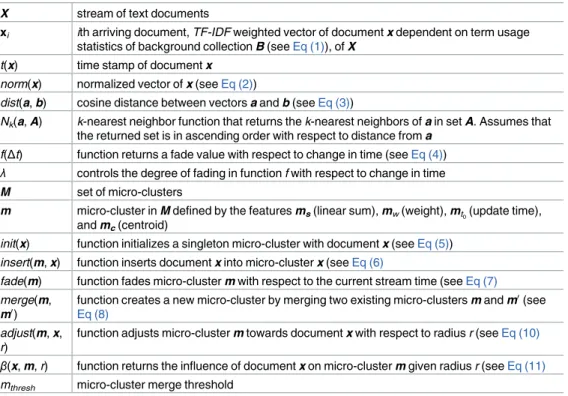
In this section definitions are presented for the required elements of theSOTXTSTREAM algo-rithm, summarized inTable 1.
LetX =hx0,. . .,xi,. . .idefine a continuous stream of text documents, such that for all
docu-mentsxi,i= 0. . .|X|−1, indexiindicates stream arrival order. Note that at any indexi, all
doc-uments in the stream with indexXihave been observed, whereas documents with indexX>i
have yet to be observed. Additionally, let functiontdefine a time-stamp functiont:xi!
an integer offset from the start of the stream, initialized to 0 (i.e.t(x0) = 0). While time-stamp
functiontallows one to define time epochs in which several or no stream documents arrive, for simplicity, here it is assumed thatt(xi) =i.
For each stream document, letxirepresent a term-frequency vector of lengthdsuch that
xi2Z d
0, andxi,j,j= 0. . .d−1, is the frequency of termjin documenti. Furthermore, assume
the existence of some background document collectionB where Bj= |{b2Bjbj>0}| is the
number of documents inB containing termj. Let functiontfidf(xi,j,B) return theTF-IDF
weighted value of termjin documentxigiven background corpusB:
tfidfðxi;j;BÞ ¼xi;j log jBj
Bj ; ð1Þ
wheretfidfðxi;j;BÞ 2Rd
0. For the remainder of this paper, all references to stream
docu-ments, sayx, refer to theTF-IDFweighted vector ofx, xj= 0. . .d−1=tfidf(x,j,B), not the
term-frequency vector. For any vectorx2Rd
0, normalize functionnormreturns the normalized vector ofx:
normðxÞ ¼ x
jjxjj ð2Þ
wherenormðxÞ 2Rd
0and ||norm(x)|| = 1.
Table 1. SOTXTSTREAM functions and parameters. X stream of text documents
xi ith arriving document, TF-IDF weighted vector of document x dependent on term usage
statistics of background collection B (seeEq (1)), of X
t(x) time stamp of document x
norm(x) normalized vector of x (seeEq (2))
dist(a, b) cosine distance between vectors a and b (seeEq (3))
Nk(a, A) k-nearest neighbor function that returns the k-nearest neighbors of a in set A. Assumes that
the returned set is in ascending order with respect to distance from a
f(Δt) function returns a fade value with respect to change in time (seeEq (4)) λ controls the degree of fading in function f with respect to change in time
M set of micro-clusters
m micro-cluster in M defined by the features ms(linear sum), mw(weight), mt0(update time), and mc(centroid)
init(x) function initializes a singleton micro-cluster with document x (seeEq (5))
insert(m, x) function inserts document x into micro-cluster x (seeEq (6)
fade(m) function fades micro-cluster m with respect to the current stream time (seeEq (7)
merge(m, m0)
function creates a new micro-cluster by merging two existing micro-clusters m and m0(see
Eq (8)
adjust(m, x, r)
function adjusts micro-cluster m towards document x with respect to radius r (seeEq (10)
β(x, m, r) function returns the influence of document x on micro-cluster m given radius r (seeEq (11)
mthresh micro-cluster merge threshold
For any two vectorsx;y2Rd
0, distance functiondistreturns the distance betweenx and y.
Here functiondistis defined using cosine distance:
distðx;yÞ ¼1 xy
jjxjjjjyjj ð3Þ
wheredist(x, y)2[0, 1].
Given a set of vectorsY, positive integerk, and vectorx, let functionNk(x, Y) return the set
ofknearest neighbors, defined bydist, ofx in Y. Assume that nearest neighbors inNk(x, Y) are
returned in ascending order according to their distance fromx, such that first index of the
returned set is the nearest instance inY from x.
StreamX is modeled by maintaining a set of micro-clusters M whose state prior to
observ-ing documentxiis dependent on the previously observedi−1 documents,X<i. At document
xi, each micro-clusterm2M represents a subset of documents, mX<i, whereM represents
a clustering ofX<isuch that
S
m2Mm = X<iand8m, m02M where m6¼m0,m\m0=;. The
set of documents in micro-clusterm define its summary representation, a time-dependent
weight and centroid, using the fading function:
fðDtÞ ¼2 lDt ð4Þ
Note that this assumes that each document contributes a weight of one to the model at insertion (i.e., atΔt= 0). Micro-cluster based clustering can be attributed to theBIRCH[47] algorithm, with a faded variant for streaming introduced inCLUSTREAM[12]. The following micro-cluster definition, insertion, and fading schemes are similar to theCLUSTREAM
approach.
Definition 1 (Micro-Cluster) For a subset of documentsYX<i,micro-clusterm at stream
timet=t(xi) is defined by the triplehs,w,t0i. Herewis the micro-cluster’s weight,w=∑y2Y
f(t−t(y)); s the weighted linear sum of the normalizedTF-IDFweighted documents in
Y, s =∑y2Yf(t−t(y))×norm(y); andt0the time at which the micro-cluster was last updated,
t0= maxy2Yt(y). Additionally, let c be the centroid of m defined as c = s/w.
Any documentx can be used to initialize a singleton micro-cluster m according to the
func-tioninitas follows:
initðxÞ ¼ hnormðxÞ;1;tðxÞi ð5Þ
Note that in Def 1 it is assumed that the set of all previously observed documents,X<i, is
maintained throughout the stream; an impractical assumption asX may be unbounded.
Fortu-nately, the summarizing variables of each micro-cluster,hs,w,t0i, can be updated incremen-tally at the insertion of each stream document (see [12]). Consider the insertion of stream documentxiwith time stampt=t(xi) into some micro-clusterm. In this case, m can be
updated by fadingm’s variables before incrementing it with document xias seen in function insert:
insertðm;xiÞ ¼ hfðt mt0Þ msþnormðxiÞ;fðt mt0Þ mwþ1;ti ð6Þ
Likewise, for any unaffected micro-clusterm06¼m at time stampt,m0can be faded without
insertion according to the functionfade:
fadeðm0 Þ ¼ hfðt m0 t0Þ m 0 s;fðt m 0 t0Þ m 0 w;ti ð7Þ
Any pair of micro-clustersm and m0can be merged to create a new micro-cluster. This is
achieved by the fading and addition of their variables as seen in functionmerge:
mergeðm;m0Þ ¼ hfðt m t0Þ msþfðt m 0 t0Þ m 0 s; fðt mt0Þ mwþfðt m 0 t0Þ m 0 w;ti ð8Þ
Recall that theSOMalgorithm [22] is used to produce a lower dimensional representation of a dataset by mapping instances onto a grid of nodes (e.g., a 2-dimensional square grid). This mapping is obtained by learning a vector of weights, of the same dimension as the instances in the dataset, for each node, that are used to map instances onto the grid (i.e., to the closest node given the distance between a nodes weight vector and an instance). Node weight learning is performed over a series of learning steps (batch observation of the dataset) where for a given datasetX, at each next steps+1 the weight vectorWv(s+ 1) of nodev is updated as follows:
Wvðsþ1Þ ¼ X
x2X
WvðsÞ þyðu;v;sÞaðsÞðx WvðsÞÞ ð9Þ
where functionαis the learning rate (monotonically decreasing with respect tos),u is the
clos-est node tox (according to the distance between x and the weight vector of node u), andθis a neighborhood function that returns the distance fromu to v at steps(e.g, a Gaussian function centered atu with monotonically decreasing variance with respect to steps). Note that the dis-tance returned by the neighborhood functionθis not related to node weight vectors, but rather the location of nodes on the grid.
Similar to the concept of updating neighbors of the winning node inSOM, when inserting stream documentxiat timet=t(xi) into winning micro-clusterm, some neighboring
micro-clusterm0may likewise be updated, adjusted, by the insertion. Neighboring micro-clusterm0
can be adjusted, non-insertion, byxiaccording to functionadjustdefined as: adjustðm0;x i;rÞ ¼ hfðt m 0 t0Þ m 0 sþbðxi;m 0;rÞ normðx iÞ; fðt m0 t0Þ m 0 wþbðxi;m 0;rÞ;ti: ð10Þ
where functionβdefines the degree of influence, weight of the adjustment, the insertion ofxi
has on neighboring micro-clusterm0given some radiusr(0r1). bðxi;m
0;rÞ ¼e distðxi;m 0 Þ
2r2 ð11Þ
Note that influence functionβis dependent on the distance fromm0
toxiand radiusr.
Spe-cifically, given a fixed radius, functionbetais monotonically decreasing with respect to this dis-tance. Also note that 0β(xi,m0,r)1 as 0dist(xi,m0)1.
In contrast toSOM, inSOTXTSTREAMa dynamic set of micro-clusters is updated (as opposed to a grid of nodes) at the arrival of each new document (as opposed to batch observa-tion of the entire dataset). Addiobserva-tionally, updating is limited to the new document’s nearest micro-cluster (Eq (6)), and some neighboring set of micro-clusters (Eq (10)). Furthermore, in
SOTXTSTREAM,Eq (11)represents the learning weight expressed by the productθ(u, v,s)α(s) inEq (9)whereθis a Gaussian function. Finally, whileSOM(Eq (9)) updates nodes (micro-clusters) by a signed difference, the update inSOTXTSTREAM(Eq (10)) is equivalent to an online mean with respect to the weight of a micro-cluster.
Stream clustering algorithm
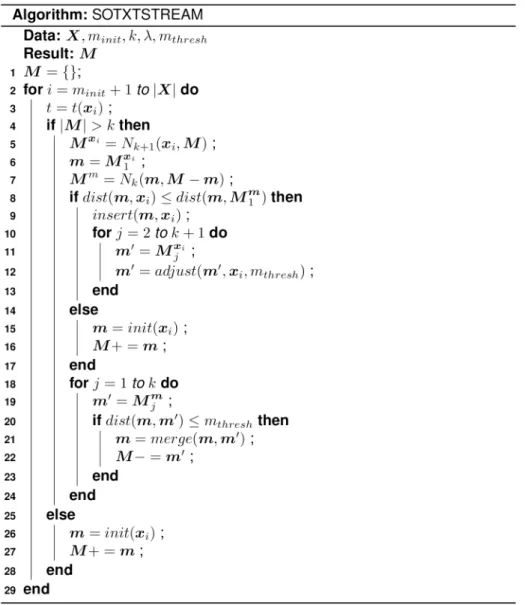
In this section theSOTXTSTREAMclustering algorithm (Fig 1) is described. Beginning with some document streamX and empty set of micro-clusters M, for next stream document xi, if
the current number of micro-clusters is less than or equal tokthan a new singleton micro-cluster is created for the new document (Eq (5)) and inserted intoM. This is a necessary
requirement as the algorithm requires at leastkmicro-clusters to form ak-nearest neighbor-hood. Note that the set of micro-clustersM is initialized with singleton micro-clusters (Eq (5)) for the firstk+ 1 documents (i.e., after initialization |M| =k+ 1 with the next document occur-ring at indexk+ 2). For small values ofk, and perhaps general, one may consider initializing the set of micro-clusters to some fixed number of initial stream documents. However, though not reported here, such an initialization has shown to have a negligible impact on clustering performance in our experimentation.
If the number of micro-clusters is greater thank, than thek+ 1 nearest neighborhood
Mxi M for stream document x
iis found along with theknearest neighborMm2M of xi’s
nearest micro-clusterm¼Mxi
1. Note that the distance between a stream documentx and
Fig 1. Pseudo-code for the SOTXTSTREAM algorithm.
micro-clusterm is calculated between document vector x and micro-cluster centroid vector mc. New document,xi, is inserted into its nearest micro-cluster (Eq (6)),m, if the distance
fromxitom is less than or equal to the distance between m and its nearest micro-cluster in M.
As with a violation of the size criteria onM, if xiis not inserted intom, then xiis used to create
a singleton micro-cluster (Eq (5)) which is inserted intoM.
Next, ifxiwas inserted into its nearest micro-clusterm, then xi’s remainingknearest
neigh-bor micro-clusters (Mxi m) are adjusted towards x
i(Eq (10)). Radiusrof the influence
func-tion (Eq (11)) is set to the merge thresholdmthresh. Note that such an approach represents a
weighted competitive learning approach. Here self-organizing is dependent on the degree of intersections between the twok-nearest micro-cluster sets ofm and xi. Finally, the nearest
micro-clusterm is merged with itsk-nearest neighbors if the distance between them is less than or equal to merge thresholdmthresh(Eq (8).
Though not addressed here, a common step in micro-cluster basedLFCAapproaches, such asSOTXTSTREAM, is the periodic deletion of aging micro-clusters by a minimum weight threshold. For evaluation purposes, this step was not performed, though the algorithm out-lined inFig 1could be easily modified to perform deletion (e.g., using the previously defined
fadefunction (Eq (8)).
Other stream clustering algorithms
In this section we describe two stream clustering algorithms that are used to evaluate the per-formance ofSOTXTSTREAMin Results and Discussion.SOSTREAMwhichSOTXTSTREAM
builds upon, and a basicLFCA-based stream clustering algorithm which we refer to as
LSTREAM.LSTREAMis most related to the prior work presented on topic detection and tracking [2,5–7], and may be viewed as a simple baseline with respect to micro-cluster approaches [12–19].
Most importantly, likeSOTXTSTREAM, these approaches require a single online phase to produce a macro clustering solution via the merging of micro-clusters. Whereas most other micro-cluster approaches require an additional offline clustering phase. For this reason we limited our analysis to the listed approaches.
SOSTREAM. Two versions ofSOSTREAMare present in [17], corresponding to versions
with and without fading. The fading version can be interpreted as being equivalent to SOTXT-STREAMwith respect to initializationEq (5), insertionEq (6), fadingEq (7), and merging
Eq (8)of micro-clusters.
A micro-cluster inSOSTREAMis defined by the triple<c,n,r>representing a micro-cluster’s centroid, weight, and radius. Note that equivalent insertion and merging functions for centroidc can be defined with respect to weightn, faded according toEq (7). For example, the centroid of micro-clusterm, mc, can be updated by inserting stream documentx as mc=
(mn×mc+x)/(mn+1). Similarily, the centroid of micro-clusterm can be merged with the
cen-troid of some other micro-clusterm0byðmnmcþm
0 nm 0 cÞ=ðmnþm 0 nÞ. Radiusrof
micro-clusterm is initialized to 0 and updated at insertions into m. This update sets the value ofrto the distance fromm to itsk-nearest neighbor in the set of current micro-clustersM,r¼
distðm;Mm
kÞwhereM
m=N
k(m, M−m).
Similar toEq (10), when inserting stream documentx into winning micro-cluster m some
neighboring micro-clusterm0ofm may likewise be updated, adjusted, by the insertion. The
centroid of neighboring micro-clusterm0,m0
c, is adjusted bym as follows: m0 c¼m 0 cþabðmc;m 0 c;mrÞ ðmc m 0 cÞ ð12Þ
defined inEq (11). Differences between Eqs (10) and (12) are discussed below within the con-text of the streaming algorithm.
SOSTREAMfollows the streaming algorithm outlined inFig 1with several key differences. First, inSOSTREAM, documentxiis inserted into its nearest micro-cluster,m, if the distance
fromxitom is less than or equal to the distance between m and itsk-nearest neighbor
micro-cluster inM. Recall fromFig 1, inSOTXTSTREAM, this insertion threshold is set to the dis-tance betweenm and its nearest neighbor in M. Several factors contributed to the choice of the
latter approach. Primarily, use of the nearest neighbor decouples the use ofkin the insertion decision from its use in the neighborhood adjusting and merging processes. With respect to
SOSTREAM, this dependence results in a preference towards solutions with smaller values of
k, which limits the effect of the adjusting and merging phases.
Second, inSOSTREAM, ifxiis inserted into its nearest micro-clusterm, then m’sk-nearest
neighbors inM are adjusted towards m (Eqs (12) and (11)). Recall fromFig 1, in SOTXT-STREAM,xi’s remainingk-nearest neighbor micro-clusters (Mxi m) are adjusted towards xi
(Eqs (10) and (11)). The latter approach is selected for several reasons. Adjusting towards the new documentxi, as opposed to its nearest micro-clusterm is more similar to the original SOMapproach. Additionally, while it seems more appropriate to updatem’s nearest neighbors
with respect toSOM; the use of the cosine distance confounds such an approach. Specifically, as cosine distance does not ensure the triangle inequality, closeness toxi’s nearest neighborm
does not guarantee closeness toxi. In addition to this last point, recall inSOMthat a node’s
neighborhood is determined with respect to the node grid structure. As no such grid structure exists here, limiting updates to neighbors ofm (as opposed to xi) seemed inappropriate.
Other differences in the adjustment of neighboring micro-clusters, observed in Eqs (10) and (12), include the following. First,Eq (12)updates a micro-cluster by a signed difference, whileEq (10)is equivalent to an online mean with respect to the weight of a micro-cluster. The latter approach being more appropriate for micro-clusters representing document cen-troids where it is assumed that centroidc2Rd
0. Second, inEq (12), the effect of an
adjust-ment on a micro-cluster’s centroid is independent of the micro-cluster’s size, whereas inEq (10)the effect is relative to the micro-cluster’s weight (i.e., the larger the weight, the smaller the impact and vice versa). This requires the use of an additional parameter,α, inEq (12)to reduce the effect of the adjustment. Third, inEq (12), the radius of the influence functionEq (11)) is set to the radius ofm, mr, which is the distance betweenm and itsknearest neighbor inM.
Recall fromFig 1, inSOTXTSTREAM, the radius of the influence function is set to the merge thresholdmthresh. This latter approach is chosen due to the relationship between the fading and
merging processes. Specifically, as the merge threshold effectively defines a minimum distance between micro-clusters, its use in defining the impact a new stream document has on neigh-boring micro-clusters seemed appropriate.
Finally, inSOSTREAM, the merging of neighboring micro-clusters, as seen inFig 1, has the addition requirement (i.e., in addition to the distance threshold) that the area of the micro-clusters, defined by their radii, must be overlapping. Note that this makes the use of a merge threshold optional inSOSTREAMwhere the overlapping criterion might be deemed sufficient. However, it has been observed that the performance ofSOSTREAMis highly dependent on the use of a merge threshold. Similarly, though not reported here, our experiments indicate that the use of the overlapping criterion has a negligible effect on performance while using a merge threshold.
LSTREAM. To simplify the description ofLSTREAMalong with the interpretation of its
results,SOTXTSTREAM’s micro-cluster definition Def 1 along with its initializationEq (5), insertionEq (6), fadingEq (7), and mergingEq (8)functions are reused inLSTREAM.
With respect to the stream clustering algorithm,LSTREAMrequires a single distance-based threshold parameter,dthresh, and is outlined as follows. A new document is inserted into its
nearest existing micro-cluster if their distance is less than or equal todthresh. Otherwise a new
micro-cluster is created for the new document. If the new document is inserted into an exist-ing micro-cluster, then the updated micro-cluster is merged with any existexist-ing micro-clusters withindthreshdistance from it.
Note the performance ofLSTREAM, with respect toSOTXTSTREAM, is of particular inter-est as it lacks theSOM-like adjustment phase while incorporating a more aggressive merging phase. Thus, the benefits of the adjustment phase inSOTXTSTREAMcan be observed with respect toLSTREAM. In particular, the number of micro-cluster produced by each algorithm is of interest, along with their evaluation performance.
Results and discussion
To evaluate the performance ofSOTXTSTREAMseveral real-world text collections were used, and results compared withSOSTREAM,kMEANS,LSTREAM.kMEANSwas chosen to con-trast the performance of the streaming approaches with a popular non-streaming clustering algorithm. Synthetic versions of each collection were created to examine the performance of each algorithm given concept drift.
Note that Cosine distance was used in all of the algorithms, along with normalizedTF-IDF
weighted document.
Experiment
Two methods were used to produce stream orderings for each text collections (i.e. the order in which documents arrive). First, a random ordering which is equivalent to sampling without replacement from the prior class distribution of the collection. Stream orderings of this type were considered to lack concept drift as they are dependent on the observed prior class distri-bution of the collection.
Second, a random ordering which is based on randomly generating the order in which clas-ses arrive in the stream. Stream orderings of this type were considered to exhibit concept drift as the prior class distribution is dependent on the random class ordering and are highly depen-dent on the position of the stream. Streams of this second type are referred to as synthetic ver-sions of the dataset.
Note that in the first random ordering, random sampling without replacement, sampling is not independent, but does satisfy exchangeability. In the case of the second random ordering, the classes are mutually exclusive within the stream, and exchangeability is no longer satisfied. In other words, all orderings are not equally likely as some orderings have zero probability due to the classes being mutually exclusive within the stream.
Performance results are reported as the average performance given 100 random orderings of the above two types for each dataset. In the case ofkMEANSwhere the effects of data order-ing are minimal, a sorder-ingle orderorder-ing was used. Note that documents are not evenly distributed across categories in all cases except for the20newsgroupscollection.
Adjusted Rand Index (ARI) [48] was used to evaluate the performance of the clustering algorithms on each dataset. ARI is a similarity measure between two data clusterings that is adjusted for chance and is related to accuracy. For a fair comparison, optimal parameters with respect to ARI were discovered via grid search, at 10−2precision, over a range of their values. Optimal parameters were chosen by the maximum average ARI performance over the 100 ran-dom orderings
Data. Five unique text datasets were selected for evaluation, representing a diverse sample
of potential text streams (e.g., message posts, news articles, scientific publications, and email).
20newsgroups [49,50] Subset of the 20newsgroups collection, 9,595 documents from 10
cate-gories, of message posts collected from various news groups. Documents were limited to the set of top 10 most distinct categories (see definition of distinct below).
arxiv2015 [51] Subset of the arXiv collection, 8424 documents from 40 categories, of scientific
bibliographic publications limited to documents published in 2015. Documents labeled by multiple categories were discarded, and only documents from the remaining top 40 most distinct categories kept.
ecue [52] Collection of 9,978 emails, categorized as spam or non-spam, collected from a single
individual’s mailbox.
reuters21578 [50,53] Subset of the Reuters21578 collection, 8,257 documents from 65
catego-ries, of Reuters newswire articles. Documents labeled by multiple categories were discarded.
tdt2 [50,54] Subset of the NIST Topic Detection and Tracking collection, 9,302 documents, of
news documents collected from multiple sources. Documents labeled by multiple categories were discarded, and only documents from the remaining top 30 largest categories kept.
syn20newsgroups, synarxiv2015, synreuters21578, syntdt2 Synthetic versions of the 20news-groups,arxiv2015,reuters21578, andtdt2datasets generated by defining their document stream orderings as follows. For each dataset, categories were randomly ordered and the first three categories marked as active. Documents were then randomly drawn, without replacement, from the active categories until a category was exhausted of documents. At which point the next category in the category ordering was marked as active and the process continued until all categories were exhausted. Note that theecuedataset was not included as it consisted of only two categories.
Here a category is defined as being distinct when the ratio of the category’s intra-document similarity versus its inter-document similarity is small (with respect to the ratios of all catego-ries). For inter and intra-document similarity calculations, the average pair-wise document similarity was used. For two datasets,20newsgroupsandarxiv2015, it was deemed necessary to limit analysis to the set of most distinct categories. In particular, this was due to the existence of hierarchical relationships within the categorizations (e.g., one category might be a child of another).
Data preprocessing. Recall that each document is represented as a normalizedTF-IDF
weighted vector of terms. In all cases, except forarxiv2015, datasets were obtained in the form of document term frequency vectors (i.e., no term tokenization or filtering was required). With respect toarxiv2015, the Lucene Letter tokenizer was used along with several existing Lucene filters (Standard, ASCIIFolding, Lowercase, Length (3), Stop (default list), and Porter-Stem). For each document collection, the number of terms was limited to the top 2000 selected by term document frequency. Additionally, for each document collection, term usage statistics forTF-IDFweighting were calculated using the entire collection (i.e., the actual collection was used as the background collectionB inEq (1)). Finally, documents consisting of fewer than 10 terms, not necessarily unique, were discarded. Note that the number of documents reported above is the remaining number of documents after applying all of the above filters. In all cases, the actual number of discarded documents due to term and document length filtering was minimal.
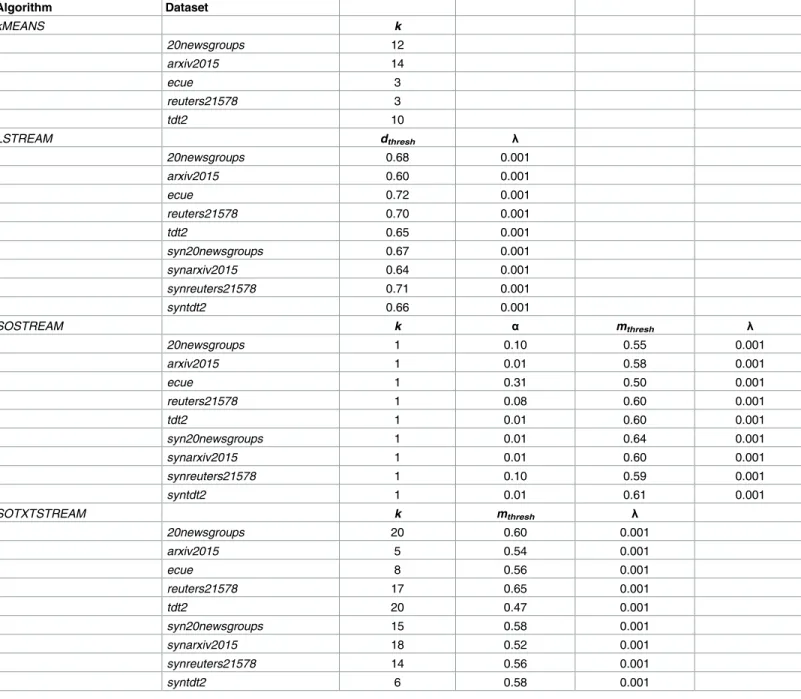
Parameters of clustering algorithms. Descriptions of each of the optimized parameter
along with their range of possible values for each clustering approach are as follows:
kMEANS Number of clusters 1k100.
LSTREAM Distance threshold 0dthresh1 for insertion and merging.
SOSTREAM Number of nearest neighbors 1k20 for insertion, adjusting, and merging; constant learning rate 0<α1 for adjusting; and cluster merge threshold 0<mthresh<1.
SOTXTSTREAM Number of nearest neighbors 1k20 for adjusting and merging, and cluster merge threshold 0<mthresh<1.
In addition to the above parameters,SOSTREAMandSOTXTSTREAMrequire a fading parameterλ. Given a dataset containingndocuments,λwas set such that the weight of the first document at the end of the stream,f(n), is equal to1
n: 1
n¼2
ln ð13Þ
Eq (13)can be rearranged to solve forλas follows:
l¼ log2
1
n
n ð14Þ
Note that in practice the value of this parameter would be set using domain knowledge or memory/computational constraints. For example, given a stream of news documents one may choose aλthat fades out old documents after a month. Optimal values for each algorithm-dataset pair are reported inTable 2.
Results
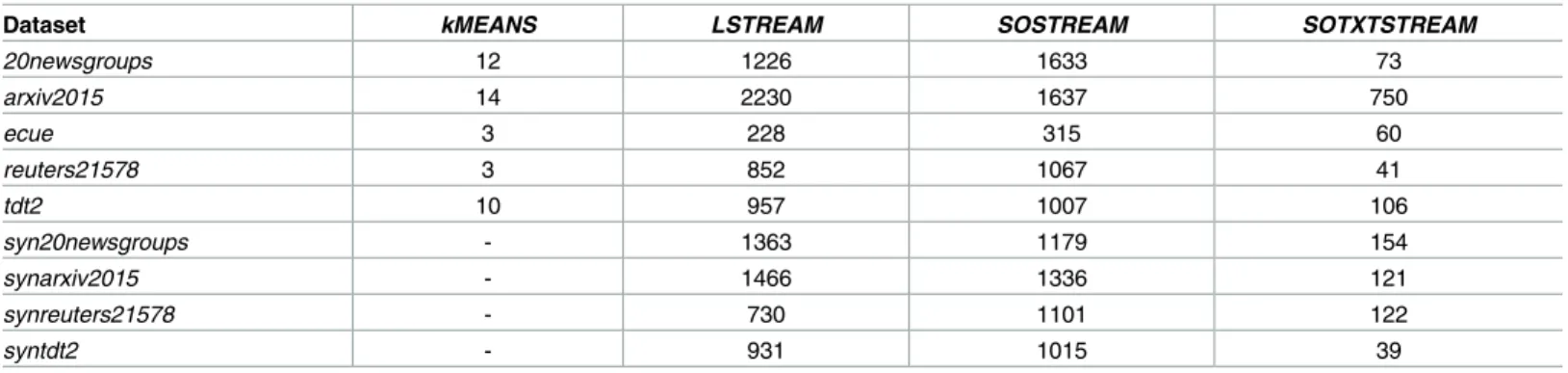
Tables3,4and5show the average ARI, Purity, and number of cluster results for each cluster-ing method and evaluation dataset pair. Purity of a cluster is defined as the ratio of documents belonging to the majority category in a cluster, whereas Purity of a clustering is the weighted (by cluster size) average of cluster purity with respect to its clusters. As Purity is naturally biased towards solutions that produce a large amount of clusters, the discussion and conclu-sions are focused on ARI results. In all cases, ARI performance ofSOTXTSTREAM outper-forms or is equivalent to the performance of the other two streaming algorithms,LSTREAM
andSOSTREAM. Additionally,SOTXTSTREAMoutperformskMEANS, by ARI, in four of the five non-synthetic datasets. ARI performance forkMEANSis not reported on the synthetic datasets as its performance is independent of stream ordering.
The poor overall performance onecuecan be attributed to the classification scheme of the data. Consider that documents are expected to cluster around topical similarities given the fea-tures and weighting scheme used (i.e., the distinction between spam and non-spam emails may not be entirely topical). In such a case, Purity is a more appropriate measure where results can be interpreted as the correlation between the topical categorization and some other catego-rization scheme (i.e, topical versus spam/non-spam). In fact, all algorithms perform relatively well on theecuedataset with respect to Purity. In any case, there appears to be a clear correla-tion between a document’s topic and its being spam/non-span. Thus, poor ARI performance is undoubtedly due to the existence of numerous within-category topics.
With respect to number of clusters,SOTXTSTREAMproduces far less clusters than the two other streaming algorithms,LSTREAMandSOSTREAM. This reduced number of clusters undoubtedly contributes to the overall superiority ofSOTXTSTREAMwith respect to ARI
performance. Of course parameters could be selected for bothLSTREAMandSOSTREAMto produce solutions which result in a smaller number of micro-clusters, though these solution would result in a decrease in ARI performance. In other words, neither solution can effectively, with respect to ARI performance, reduce the number of clusters as compared to
SOTXTSTREAM.
To test the significance of the ARI performance results Wilcoxon signed-ranks tests [55] were used. This approach being suggested in [56] for comparing two classifiers over multiple datasets.Table 6shows the resulting p-values from these tests, for each pair of clustering algo-rithms, which was applied to the ARI performance reported inTable 3. From these results, one
Table 2. Clustering parameters.
Algorithm Dataset kMEANS k 20newsgroups 12 arxiv2015 14 ecue 3 reuters21578 3 tdt2 10 LSTREAM dthresh λ 20newsgroups 0.68 0.001 arxiv2015 0.60 0.001 ecue 0.72 0.001 reuters21578 0.70 0.001 tdt2 0.65 0.001 syn20newsgroups 0.67 0.001 synarxiv2015 0.64 0.001 synreuters21578 0.71 0.001 syntdt2 0.66 0.001 SOSTREAM k α mthresh λ 20newsgroups 1 0.10 0.55 0.001 arxiv2015 1 0.01 0.58 0.001 ecue 1 0.31 0.50 0.001 reuters21578 1 0.08 0.60 0.001 tdt2 1 0.01 0.60 0.001 syn20newsgroups 1 0.01 0.64 0.001 synarxiv2015 1 0.01 0.60 0.001 synreuters21578 1 0.10 0.59 0.001 syntdt2 1 0.01 0.61 0.001 SOTXTSTREAM k mthresh λ 20newsgroups 20 0.60 0.001 arxiv2015 5 0.54 0.001 ecue 8 0.56 0.001 reuters21578 17 0.65 0.001 tdt2 20 0.47 0.001 syn20newsgroups 15 0.58 0.001 synarxiv2015 18 0.52 0.001 synreuters21578 14 0.56 0.001 syntdt2 6 0.58 0.001 https://doi.org/10.1371/journal.pone.0180543.t002
Table 3. Clustering performance by ARI.
Dataset kMEANS LSTREAM SOSTREAM SOTXTSTREAM
20newsgroups 0.66 0.39 0.25 0.69 arxiv2015 0.60 0.46 0.44 0.50 ecue 0.19 0.19 0.23 0.23 reuters21578 0.47 0.74 0.68 0.94 tdt2 0.70 0.77 0.70 0.93 syn20newsgroups - 0.32 0.30 0.47 synarxiv2015 - 0.50 0.48 0.81 synreuters21578 - 0.45 0.58 0.60 syntdt2 - 0.74 0.65 0.85 https://doi.org/10.1371/journal.pone.0180543.t003
Table 4. Clustering performance by purity.
Dataset kMEANS LSTREAM SOSTREAM SOTXTSTREAM
20newsgroups 0.78 0.76 0.69 0.79 arxiv2015 0.70 0.83 0.79 0.74 ecue 0.89 0.90 0.91 0.90 reuters21578 0.62 0.85 0.80 0.87 tdt2 0.73 0.94 0.91 0.97 syn20newsgroups - 0.71 0.68 0.65 synarxiv2015 - 0.71 0.70 0.81 synreuters21578 - 0.73 0.76 0.74 syntdt2 - 0.92 0.87 0.92 https://doi.org/10.1371/journal.pone.0180543.t004
Table 5. Number of clusters.
Dataset kMEANS LSTREAM SOSTREAM SOTXTSTREAM
20newsgroups 12 1226 1633 73 arxiv2015 14 2230 1637 750 ecue 3 228 315 60 reuters21578 3 852 1067 41 tdt2 10 957 1007 106 syn20newsgroups - 1363 1179 154 synarxiv2015 - 1466 1336 121 synreuters21578 - 730 1101 122 syntdt2 - 931 1015 39 https://doi.org/10.1371/journal.pone.0180543.t005
Table 6. Wilcoxon signed-ranks test p-values.
Algorithm LSTREAM SOSTREAM SOTXTSTREAM
kMEANS 0.496 0.301 0.129
LSTREAM - 0.250 0.004
SOSTREAM - - 0.004
can conclude that the difference between ARI performance ofSOTXTSTREAMis significant with repect to the performance of bothLSTREAMandSOSTREAM.
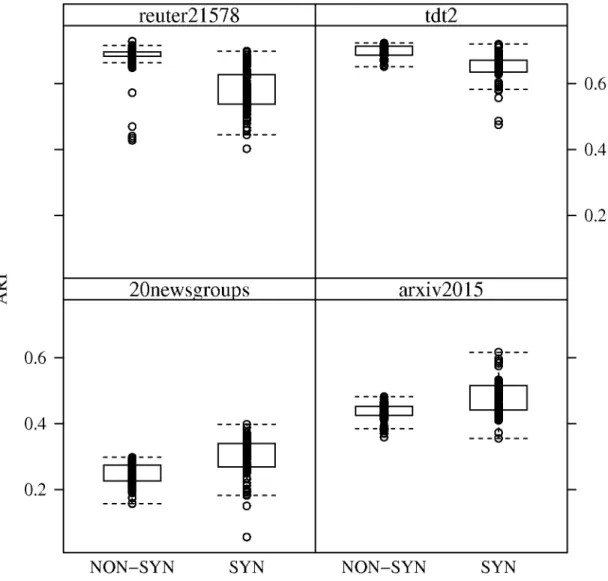
By comparing ARI performance of the algorithms with respect to synthetic versus non-syn-thetic datasets, one can observe the impact of concept drift. In most cases, performance decreases, in varying degrees, with the presence of concept drift. An interesting case is the
arxiv2015dataset where ARI performance actually increases across all streaming algorithms. The reason for these changes in ARI performance can be observed in Figs2and3, which show boxplots of ARI performance forSOTXTSTREAMandSOSTREAMin the presence of concept drift. Namely, the variance in ARI performance for the randomly generated stream orderings is greater with concept drift.
In fact one might conclude that performance ofSOSTREAMis less effected by concept drift, though with an overall lower average performance. However, this difference in variance is most likely attributed to the number of micro-clusters produced by the two algorithms.
Fig 2. ARI performance of SOTXTSTREAM in the presence of concept drift. ARI performance box-plots for SOTXTSTREAM with respect to synthetic and non-synthetic random stream orderings. In each run, parameters were
set to those listed inTable 2.
Also, this may primarily speak to the robustness of the selected parameters with respect to con-cept drift. In particular, as parameters were optimized with respect to average performance over all random orderings.
Parameter analysis
InFig 4, the ARI performance ofSOTXTSTREAMversus values for parametersk,mthresh, and
λare plotted. With respect to the choice ofk,Fig 4A, for all datasets, optimal performance is observed at relatively small values ofkwith respect to the specified range. Additionally, in all cases, a decrease in ARI performance is observable following some clear change point (peak or elbow). Furthermore, the rate of decrease following the change point appears to be dataset dependent. Fortunately, an acceptable default value ofkis observed aroundk= 10 (i.e., near maximum performance for all datasets).
Fig 3. ARI performance of SOSTREAM in the presence of concept drift. ARI performance box-plots for
SOSTREAM with respect to synthetic and non-synthetic random stream orderings. In each run, parameters were set to
those listed inTable 2.
For the choice of theλparameter,Fig 4C, the performance of each dataset is optimal at the same point. Unsurprisingly, as for all datasets, this point is at the constant chosen for each dataset as a function of its size (i.e., parameter optimization was performed at this value). Not-withstanding the aforementioned bias, in some cases poor performance is observed asλ approaches zero (at which point no fading is performed). Note that in practice, larger values of
λ, will result in vectors being faded to 0. In order to avoid this from happening, the largest value ofλconsidered here is 0.01. Additionally, this situation can be avoided completely through the periodic removal of aging clusters.
Fig 4. Parameter analysis of SOTXTSTREAM. ARI performance plots for SOTXTSTREAM algorithm parameters (k (A), mthresh(B),λ (C)) on all datasets. In each run, parameters were set to those listed inTable 2(sans the parameter under investigation). Additionally, ARI performance is the average value across 100 random stream orderings.
In the case of themthreshparameter,Fig 4B, performance of each dataset is optimal within
the [0.5–0.6] range. This appear to be a good threshold in general given text documents, and the use ofTF-IDFweighting and cosine distance (see optimal parameters forLSTREAM,
SOSTREAM, andSOTXTSTREAMinTable 2). As with the choice ofk, these results suggest the existence of a reasonable default value for themthreshparameter.
Finally, inFig 5ARI performance ofSOSTREAMversus values for parametersα,k,mthresh,
andλare plotted. With respect toα,Fig 5A, the optimal choice ofαappears to be dataset dependent, though performance does converge to zero asαapproaches one. Additionally, a
Fig 5. Parameter analysis of SOSTREAM. ARI performance plots for the SOSTREAM algorithm parameters (α(A), k (B), mthresh(C),
λ(D)) on all datasets. In each run, parameters were set to those listed inTable 2(sans the parameter under investigation). Additionally, ARI performance is the average value across 100 random stream orderings.
good default value is observable atα= 0. However, atα= 0 the self-organizing phase has no effect on results (i.e., learning rate is zero).
For the choice ofk,Fig 5B, in all datasets performance drops sharply wherek>1. In fact, over the course of these experiments it was observed that such cases,k>1, were only viable at
α= 0. Similarly, note that in all of the cases whereα>0 the optimal choice ofkis one (see
Table 2). These last two observations suggest thatkis highly dependent onαand vice versa. This dependence is complicated inSOSTREAMas the valuekis reused in three cluster micro-cluster maintenance operations (insertion, neighborhood adjusting, and merging), whereas only one of these operations (neighborhood adjusting) is dependent onα.
As withSOTXTSTREAM, performance is optimal for all datasets within the [0.5–0.6] range of themthreshparameter,Fig 5C. Additionally, recall the optional use ofmthreshinSOSTREAM,
as a merge criterion of overlapping micro-cluster radii is applied. Performance of this option is seen here wheremthresh= 1, and it is decidedly poor. Lastly, for theλparameter,Fig 5D,
perfor-mance seems to be unaffected by the choice of this value. This supports the previous assertion withSOTXTSTREAM. In particular, that variability in performance overλis primarily due to its use in the self-organizing phase. However, as all of the datasets are randomly ordered, it’s difficult to draw conclusions with respect to the effect of the fading parameterλon
performance.
Conclusion
A new density-based self-organizing text stream clustering algorithmSOTXTSTREAMwas presented, and shown to perform better than theSOSTREAMalgorithm (the sole prior approach to density-based self-organizing stream clustering) on several real-world text streams. This improved performance was achieved by addressing several shortcomings of SOSTREAM. Specifically, this involved removing the use of a fixed learning rate, and decou-pling the dependence of three cluster maintenance phases (insertion, adjusting, and merging) on a single neighborhood size parameter. This had the added benefit of eliminating the high dependence the fixed learning rate has on the choice of the neighborhood size parameter in
SOSTREAM. Likewise,SOTXTSTREAMwas shown superior, in several cases, and competitive, in the remaining cases, to a popular non-streaming clustering approach. This comparison is significant asSOTXTSTREAMis limited to a single pass over the data.
In addition to improving performance,SOTXTSTREAMis dependent on two parameters (kandmthresh), as compared toSOSTREAM’s three (k,mthresh, andα). Note that here the choice
of theλparameter, which both algorithms employ, is expected to be made with some degree of domain knowledge with respect to the desired clusterings.
Future work includes investigating insertion criteria for the nearest cluster of a new stream instance, and methods for calculating influence of an instance on neighboring clusters. Also, experiments conducted over the course of this work has shown potential for replacing the fixedmthreshparameter with a dynamic one (e.g., an online meankdistance of instances within
a sliding window).
Acknowledgments
This work was funded in part by the Naval Surface Warfare Center Dahlgren Division’s In-house Laboratory Independent Research Program. There was no additional external funding received for this study.
Author Contributions
Conceptualization: Avory C. Bryant, Krzysztof J. Cios. Data curation: Avory C. Bryant.
Formal analysis: Avory C. Bryant, Krzysztof J. Cios. Funding acquisition: Avory C. Bryant, Krzysztof J. Cios. Investigation: Avory C. Bryant, Krzysztof J. Cios. Methodology: Avory C. Bryant, Krzysztof J. Cios. Project administration: Krzysztof J. Cios. Resources: Avory C. Bryant.
Software: Avory C. Bryant. Supervision: Krzysztof J. Cios.
Validation: Avory C. Bryant, Krzysztof J. Cios. Visualization: Avory C. Bryant.
Writing – original draft: Avory C. Bryant, Krzysztof J. Cios. Writing – review & editing: Avory C. Bryant, Krzysztof J. Cios.
References
1. Lee CH. Mining Spatio-temporal Information on Microblogging Streams Using a Density-based Online Clustering Method. Expert Syst Appl. 2012; 39(10):9623–9641.https://doi.org/10.1016/j.eswa.2012.02. 136
2. PetrovićS, Osborne M, Lavrenko V. Streaming First Story Detection with Application to Twitter. In: Human Language Technologies: The 2010 Annual Conference of the North American Chapter of the Association for Computational Linguistics. HLT’10. Stroudsburg, PA, USA: Association for Computa-tional Linguistics; 2010. p. 181–189. Available from:http://dl.acm.org/citation.cfm?id=1857999. 1858020
3. Cataldi M, Di Caro L, Schifanella C. Emerging Topic Detection on Twitter Based on Temporal and Social Terms Evaluation. In: Proceedings of the Tenth International Workshop on Multimedia Data Min-ing. MDMKDD’10. New York, NY, USA: ACM; 2010. p. 4:1–4:10. Available from:http://doi.acm.org/10. 1145/1814245.1814249
4. Wen JR, Nie JY, Zhang HJ. Query Clustering Using User Logs. ACM Trans Inf Syst. 2002; 20(1):59– 81.https://doi.org/10.1145/503104.503108
5. Yang Y, Pierce T, Carbonell J. A Study of Retrospective and On-line Event Detection. In: Proceedings of the 21st Annual International ACM SIGIR Conference on Research and Development in Information Retrieval. SIGIR’98. New York, NY, USA: ACM; 1998. p. 28–36. Available from:http://doi.acm.org/10. 1145/290941.290953
6. Allan J, Papka R, Lavrenko V. On-line New Event Detection and Tracking. In: Proceedings of the 21st Annual International ACM SIGIR Conference on Research and Development in Information Retrieval. SIGIR’98. New York, NY, USA: ACM; 1998. p. 37–45. Available from:http://doi.acm.org/10.1145/ 290941.290954
7. Brants T, Chen F, Farahat A. A System for New Event Detection. In: Proceedings of the 26th Annual International ACM SIGIR Conference on Research and Development in Informaion Retrieval. SIGIR’03. New York, NY, USA: ACM; 2003. p. 330–337. Available from:http://doi.acm.org/10.1145/ 860435.860495
8. Ackermann MR, Ma¨rtens M, Raupach C, Swierkot K, Lammersen C, Sohler C. StreamKM++: A Cluster-ing Algorithm for Data Streams. J Exp Algorithmics. 2012; 17:2.4:2.1–2.4:2.30.https://doi.org/10.1145/ 2133803.2184450
9. Gama Ja, Zˇ liobaitėIe, Bifet A, Pechenizkiy M, Bouchachia A. A Survey on Concept Drift Adaptation. ACM Comput Surv. 2014; 46(4):44:1–44:37.https://doi.org/10.1145/2523813