DePaul University DePaul University
Via Sapientiae
Via Sapientiae
College of Computing and Digital MediaDissertations College of Computing and Digital Media
Fall 10-3-2019
Automatic inference of causal reasoning chains from student
Automatic inference of causal reasoning chains from student
essays
essays
Simon Mark Hughes
DePaul University, [email protected]
Follow this and additional works at: https://via.library.depaul.edu/cdm_etd
Part of the Artificial Intelligence and Robotics Commons
Recommended Citation Recommended Citation
Hughes, Simon Mark, "Automatic inference of causal reasoning chains from student essays" (2019). College of Computing and Digital Media Dissertations. 19.
https://via.library.depaul.edu/cdm_etd/19
This Dissertation is brought to you for free and open access by the College of Computing and Digital Media at Via Sapientiae. It has been accepted for inclusion in College of Computing and Digital Media Dissertations by an
AUTOMATIC INFERENCE OF CAUSAL
REASONING CHAINS FROM STUDENT
ESSAYS
BY
SIMON HUGHES
A DISSERTATION SUBMITTED TO THE SCHOOL OF COMPUTING, COLLEGE OF COMPUTING AND DIGITAL MEDIA OF DEPAUL UNIVERSITY IN PARTIAL FULFILLMENT OF THE REQUIREMENTS
FOR THE DEGREE OF DOCTOR OF PHILOSOPHY
DEPAUL UNIVERSITY CHICAGO, ILLINOIS
DePaul University
College of Computing and Digital Media
Dissertation Verification
This doctoral dissertation has been read and approved by the dissertation committee below according to the requirements of the Computer and Information Systems PhD program and DePaul University.
Name: Simon Hughes Title of dissertation:
AUTOMATIC INFERENCE OF CAUSAL REASONING CHAINS FROM STUDENT ESSAYS Date of Dissertation Defense:
October 3rd, 2019 Peter Hastings Dissertation Advisor* Noriko Tomuro 1st Reader Jonathan Gemmell 2nd Reader Barbara Di Eugenio 3rd Reader Daniela Raicu
4th Reader (if applicable)
5th Reader (if applicable)
* A copy of this form has been signed, but it may only be viewed after submission and approval of FERPA request letter.
AUTOMATIC INFERENCE OF CAUSAL
REASONING CHAINS FROM STUDENT
ESSAYS
Abstract
While there has been an increasing focus on higher-level thinking skills arising from the Common Core Standards, many high-school and middle-school students struggle to combine and integrate information from multiple sources when writing essays. Writing is an important learning skill, and there is increasing evidence that writing about a topic develops a deeper understand-ing in the student. However, gradunderstand-ing essays is time consumunderstand-ing for teachers, resulting in an increasing focus on shallower forms of assessment that are easier to automate, such as multiple-choice tests. Existing essay grading software has attempted to ease this burden but relies on shallow lexico-syntactic features and is unable to understand the structure or validity of a student’s arguments or explanations. Without the ability to understand a student’s reasoning pro-cesses, it is impossible to write automated formative assessment systems to assist students with improving their thinking skills through essay writing.
In order to understand the arguments put forth in an explanatory essay in the science domain, we need a method of representing the causal structure of a piece of explanatory text. Psychologists use a representation called a
causal model to represent a student’s understanding of an explanatory text. This consists of a number of core concepts, and a set of causal relations linking them into one or more causal chains, forming a causal model. In this thesis
I present a novel system for automatically constructing causal models from student scientific essays using Natural Language Processing (NLP) techniques. The problem was decomposed into 4 sub-problems - assigning essay concepts to words, detecting causal-relations between these concepts, resolving coreferences within each essay, and using the structure of the whole essay to reconstruct a causal model. Solutions to each of these sub-problems build upon the predictions from the solutions to earlier problems, forming a sequential pipeline of models. Designing a system in this way allows later models to correct for false positive predictions from downstream models. However, this also has the disadvantage that errors made in earlier models can propagate through the system, negatively impacting the upstream models, and limiting their accuracy. Producing robust solutions for the initial 2 sub problems, detecting concepts, and parsing causal relations between them, was critical in building a robust system.
A number of sequence labeling models were trained to classify the con-cepts associated with each word, with the most e↵ective approach being a bidirectional recurrent neural network (RNN), a deep learning model com-monly applied to word labeling problems. This is because the RNN used pre-trained word embeddings to better generalize to rarer words, and was able to use information from both ends of each sentence to infer a word’s concept. The concepts predicted by this model were then used to develop causal rela-tion parsing models for detecting causal connecrela-tions between these concepts. A shift-reduce dependency parsing model was trained using the SEARN
algo-rithm and out-performed a number of other approaches by better utilizing the structure of the problem and directly optimizing the error metric used.
Two pre-trained coreference resolution systems were used to resolve coreferences within the essays. However a word tagging model trained to predict anaphors combined with a heuristic for determining the antecedent out-performed these two systems. Finally, a model was developed for parsing a causal model from an entire essay, utilizing the solutions to the three previous problems. A beam search algorithm was used to produce multiple parses for each sentence, which in turn were combined to generate multiple candidate causal models for each student essay. A reranking algorithm was then used to select the optimal causal model from all of the generated candidates.
An important contribution of this work is that it represents a system for parsing a complete causal model of a scientific essay from a student’s writ-ten answer. Existing systems have been developed to parse individual causal relations, but no existing system attempts to parse a sequence of linked causal relations forming a causal model from an explanatory scientific essay. It is hoped that this work can lead to the development of more robust essay grad-ing software and formative assessment tools, and can be extended to build solutions for extracting causality from text in other domains. In addition, I also present 2 novel approaches for optimizing the micro-F1 score within the
design of two of the algorithms studied - the dependency parser discussed in Chapter 5 and the reranking algorithm discussed in Chapter 7. The depen-dency parser uses a custom cost function to estimate the impact of parsing mistakes on the overall micro-F1 score, while the reranking algorithm allows
the micro-F1 score to be optimized by tuning the beam search parameter to
Acknowledgements
The research reported here was supported by the Institute of Education Sci-ences, U.S. Department of Education, through Grant R305F100007 to Univer-sity of Illinois at Chicago. The opinions expressed are those of the author and do not represent views of the Institute or the U.S. Department of Education.
Contents
List of Tables xiii
List of Figures xx
List of Equations xxii
List of Algorithms xxiii
1 Introduction 1
1.1 Overview . . . 1
1.2 Causal Models . . . 3
1.3 Problem Statement and Research Questions . . . 4
1.3.1 Research Question 1 . . . 5
1.3.2 Research Question 2 . . . 6
1.3.3 Research Question 3 . . . 8
1.3.4 Research Question 4 . . . 10
1.4 Contributions of this Work . . . 11
1.5 Potential Applications . . . 11
2 From Student Essays to Causal Models - The Dataset 14 2.1 Situation Models . . . 14
2.2 Causal Models . . . 15
2.3 The Construction of Causal Models for Explanatory Essays . . 16
2.4 Analysis of the Dataset . . . 19
2.4.1 Concept Code Analysis . . . 20
2.4.2 Causal Relation Analysis . . . 24
2.5 Anaphora and Coreference . . . 25
3 Related Work 26 3.1 Causal Relation Extraction . . . 26
3.2.1 Rhetorical Structure Theory . . . 29
3.2.2 Automated Discourse Parsing . . . 30
3.2.3 Detecting Argumentative Discourse Relations . . . 31
3.3 Multi-Label Classification Problems . . . 32
3.3.1 Problem Transformation Methods . . . 33
3.3.1.1 Binary Relevance . . . 33
3.3.1.2 BR+ . . . 33
3.3.1.3 Classifier Chains . . . 33
3.3.1.4 The Label Powerset Method . . . 34
3.3.1.5 Stacking . . . 34
3.3.2 Algorithm Adaptation Methods . . . 35
3.4 Structured Learning . . . 36
3.4.1 Challenges in Structured Learning . . . 37
3.4.2 Sequence Labeling . . . 40
3.4.2.1 Linear Chain Probabilistic Graphical Models 41 3.4.2.2 Transformation Based Learning . . . 42
3.4.2.3 The Sliding Window Method . . . 42
3.4.2.4 Recurrent Methods . . . 43
3.4.3 Data Driven Natural Language Parsing . . . 43
3.4.4 Bayesian Networks . . . 44
3.4.5 The Structured Perceptron . . . 45
3.4.6 Reranking . . . 47
3.4.7 Large Margin Methods . . . 47
3.4.8 Imitation Learning . . . 48
3.5 Deep Learning for Natural Language Processing . . . 49
3.5.1 Neural Word Embeddings . . . 50
3.5.2 Beyond Bag of Words Models . . . 52
3.5.3 Recursive Neural Networks . . . 52
3.5.4 Recurrent Neural Networks . . . 53
3.5.5 Convolutional Neural Networks . . . 55
4 A Word Tagging Model for Essay Concepts 58 4.1 Evaluation Metrics . . . 59
4.1.1 Precision, Recall and the F1 score . . . 60
4.1.2 AUC . . . 61
4.1.3 Micro and Macro Averaging . . . 62
4.1.4 Optimizing the Micro-F1 Metric . . . 63
4.2 Experimental Design . . . 63
4.3 Statistical Testing . . . 66
4.5 Feature Extraction and Selection . . . 69
4.5.1 Features Evaluated . . . 70
4.5.2 Forward Selection . . . 72
4.5.3 Feature Selection Results . . . 72
4.6 Problem Transformation Methods . . . 79
4.7 Model Evaluation . . . 80
4.7.1 Window-Based Word Tagging Model . . . 81
4.7.2 Conditional Random Field . . . 83
4.7.3 Hidden Markov Model . . . 84
4.7.4 Structured Perceptron . . . 86
4.7.5 Recurrent Neural Network . . . 88
4.8 Summary of Results and Discussion . . . 92
4.8.1 Micro-F1 Performance . . . 93
4.8.2 Macro F1 Performance . . . 96
4.8.3 Performance By Individual Concept Code . . . 97
4.8.4 Statistical Analysis . . . 99
4.8.5 Extensibility to Other Texts and Domains . . . 101
4.9 Conclusions . . . 102
5 Causal Relation Extraction 104 5.1 Evaluation Metrics . . . 107
5.2 Experimental Design . . . 108
5.3 Pre-Processing . . . 108
5.4 Model Evaluation . . . 109
5.4.1 RNN Word Tagging Model . . . 109
5.4.1.1 Hyper-Parameter Tuning . . . 110 5.4.1.2 Results . . . 112 5.4.2 Stacked Model . . . 114 5.4.2.1 Feature Selection . . . 114 5.4.2.2 Hyper-Parameter Tuning . . . 115 5.4.2.3 Results . . . 115
5.4.3 Shift-Reduce Dependency Parser . . . 116
5.4.3.1 Shift-Reduce Transition-Based Dependency Pars-ing . . . 117
5.4.3.2 Features Evaluated . . . 119
5.4.3.3 Feature Selection . . . 122
5.4.3.4 Hyper-Parameter Tuning . . . 127
5.4.3.5 Results . . . 128
5.5 Summary of Results and Discussion . . . 129
5.5.2 Macro F1 Performance . . . 132
5.5.3 Performance By Causal Relation Frequency . . . 134
5.5.4 Performance By Causal Relation Type . . . 136
5.5.5 Statistical Analysis . . . 139
5.5.6 Extensibility to Other Texts and Domains . . . 140
5.6 Conclusions . . . 141
6 Coreference Resolution 143 6.1 Anaphora Annotations and Coreference Resolution . . . 145
6.2 Experimental Design . . . 146
6.3 Evaluation Metrics . . . 147
6.4 Pre-Processing . . . 147
6.5 Predicting Anaphors . . . 147
6.6 Predicting Anaphor Concept Codes . . . 148
6.6.1 Coreference Resolution for Resolving Antecedents . . . 149
6.6.2 Resolving Antecedents using the Predicted Concept Codes152 6.6.3 Results . . . 153
6.6.4 Statistical Analysis . . . 154
6.6.5 Impact on Overall Word Tagging Performance . . . 155
6.7 Predicting Anaphor Causal Relations . . . 156
6.8 Summary and Discussion . . . 158
6.9 Extensibility to Other Texts and Domains . . . 159
6.10 Conclusions . . . 159
7 Inferring a Causal Model of an Essay 161 7.1 Evaluation Metrics . . . 163
7.2 Experimental Design . . . 163
7.3 Pre-Processing . . . 164
7.4 Model Evaluation . . . 164
7.4.1 Transition-Based Essay Parsing Model . . . 166
7.4.1.1 Features Evaluated . . . 166 7.4.1.2 Feature Selection . . . 169 7.4.1.3 Hyper-Parameter Tuning . . . 172 7.4.1.4 Results . . . 173 7.4.2 Reranking Model . . . 175 7.4.2.1 Features Evaluated . . . 178 7.4.2.2 Feature Selection . . . 179 7.4.2.3 Hyper-Parameter Tuning . . . 183 7.4.2.4 Results . . . 184
7.5.1 Micro-F1 Performance . . . 187
7.5.2 Macro-F1 Performance . . . 189
7.5.3 Statistical Analysis . . . 191
7.5.4 Extensibility to Other Texts and Domains . . . 192
7.6 Conclusions . . . 192
8 Summary and Conclusions 195 8.1 Summary . . . 196 8.2 Conclusions . . . 198 8.3 Future Work . . . 200 References 202 Appendices 227 A Essay Prompts 228 A.1 Coral Bleaching . . . 228
A.2 Skin Cancer . . . 229
B Example Source Documents 230 B.1 Coral Bleaching . . . 230
B.1.1 Background: What is “Coral Bleaching?” . . . 230
B.1.2 Coral Bleaching Reports per Year . . . 232
B.2 Skin Cancer . . . 232
B.2.1 Background: Skin Damage . . . 232
B.2.2 Latitude and Direct Sunlight . . . 233
C Essay Scoring and Inter-Rater Reliability Procedure 235 D Example Essays 237 D.1 Coral Bleaching . . . 237 D.1.1 Example 1 . . . 237 D.1.2 Example 2 . . . 237 D.1.3 Example 3 . . . 238 D.2 Skin Cancer . . . 239 D.2.1 Example 1 . . . 239 D.2.2 Example 2 . . . 239 D.2.3 Example 3 . . . 240
E Word Tagging Performance By Algorithm and Code 241 E.1 Coral Bleaching . . . 241
E.2 Skin Cancer . . . 245
F Causal Relation Performance by Relation and Frequency 248 F.1 Coral Bleaching . . . 248
F.2 Skin Cancer . . . 251
G The Shift-Reduce Dependency Parser Algorithm 253 G.1 The Arc-Eager Transition System . . . 254
G.2 The Modified Arc-Eager Transition System . . . 255
G.3 The Dynamic Oracle . . . 257
G.4 The Parser and Oracle in Action . . . 261
G.5 Imitation Learning: Applying Reinforcement Learning to Train a Shift-Reduce Parser . . . 263
List of Tables
2.1 Dataset Sizes and Vocabulary . . . 19
2.2 Coral Bleaching Essay Statistics . . . 19
2.3 Skin Cancer Essay Statistics . . . 20
2.4 Concept Code Statistics . . . 20
2.5 Coral Bleaching Concept Code Dependencies . . . 21
2.6 Skin Cancer Concept Code Dependencies . . . 22
2.7 Percentage of Words and Sentences Assigned Each Concept Code in the Coral Bleaching Dataset . . . 23
2.8 Percentage of Words and Sentences Assigned Each Concept Code in the Skin Cancer Dataset . . . 23
2.9 Causal Relation Statistics . . . 24
2.10 Anaphora Statistics . . . 25
4.1 Dataset Partition Sizes . . . 66
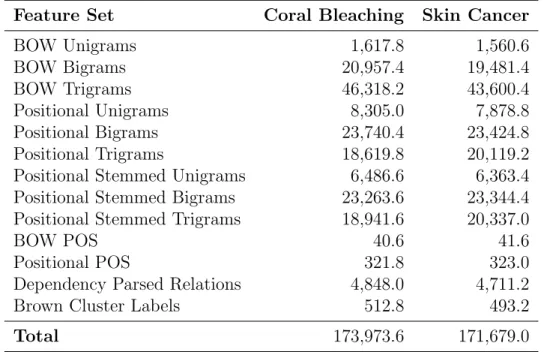
4.2 Average Number of Features in Each Feature Set Across All Cross-Validation Runs (Window Size - 9 Words). . . 74
4.3 Each Feature Set Ranked by Micro-F1 Score When Used in Isolation (Window Size - 9 Words). . . 75
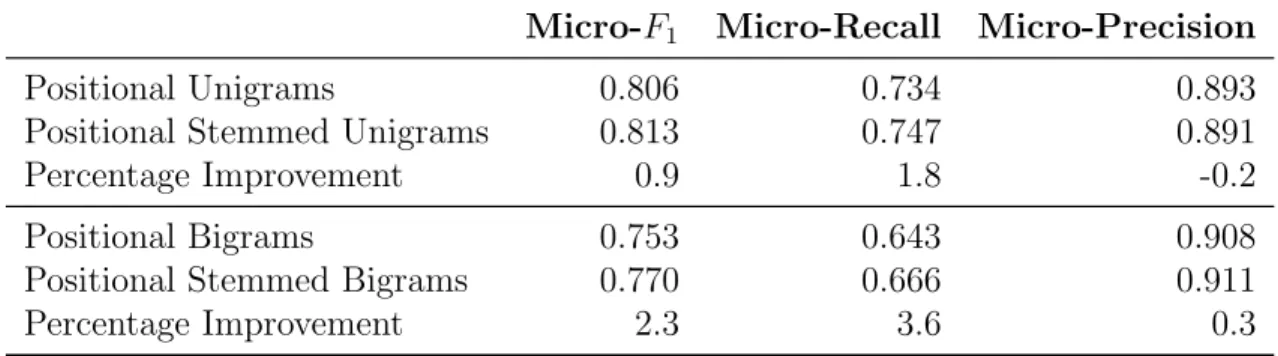
4.4 Impact of Stemming on Classification Accuracy on the Coral Bleaching Validation Dataset . . . 76
4.5 Impact of Stemming on Classification Accuracy on the Skin Cancer Validation Dataset . . . 76
4.6 Micro F1 Score as Additional Feature Sets Are Added by For-ward Selection (Window Size - 9 Words). Pos. = Positional, Dep. = Dependency . . . 77
4.7 The Reduction in Number of Features for the Window-Based Tagging Model as a Result of Feature Selection. Window Size = 9 Words . . . 78
4.8 Problem Transformation Method Accuracy (Micro F1 score) . 80 4.9 Window-Based Tagging Model Classification Accuracy on the Coral Bleaching Dataset . . . 82
4.10 Window-Based Tagging Model Classification Accuracy on the Skin Cancer Dataset . . . 82 4.11 CRF Classification Accuracy on the Coral Bleaching Dataset . 84 4.12 CRF Classification Accuracy on the Skin Cancer Dataset . . . 84 4.13 HMM Classification Accuracy on the Coral Bleaching Dataset 85 4.14 HMM Classification Accuracy on the Skin Cancer Dataset . . 86 4.15 Structured Perceptron Classification Accuracy on the Coral
Bleach-ing Dataset . . . 87 4.16 Structured Perceptron Classification Accuracy on the Skin
Can-cer Dataset . . . 88 4.17 Recurrent Neural Network Classification Accuracy on the Coral
Bleaching Dataset . . . 90 4.18 Recurrent Neural Network Classification Accuracy on the Skin
Cancer Dataset . . . 90 4.19 Impact of Pre-Trained Word Embeddings on RNN Classification
Accuracy on the Coral Bleaching Validation Dataset . . . 91 4.20 Impact of Pre-Trained Word Embeddings on RNN Classification
Accuracy on the Skin Cancer Validation Dataset . . . 91 4.21 Impact of Using a Bidirectional RNN on Classification Accuracy
on the Coral Bleaching Validation Dataset . . . 92 4.22 Impact of Using a Bidirectional RNN on Classification Accuracy
on the Skin Cancer Validation Dataset . . . 92 4.23 Test Data Accuracy by Algorithm on the Coral Bleaching Dataset.
All metrics listed are micro metrics. . . 93 4.24 Test Data Accuracy by Algorithm on the Skin Cancer Dataset.
All metrics listed are micro metrics. . . 93 4.25 Macro Test Data Metrics by Algorithm on the Coral Bleaching
Dataset . . . 96 4.26 Macro Test Data Metrics by Algorithm on the Skin Cancer
Dataset . . . 96 4.27 Test DataF1 Score by Algorithm by Code on the Coral
Bleach-ing Dataset . . . 97 4.28 Test Data F1 Score by Algorithm by Code on the Skin Cancer
Dataset . . . 98 4.29 Comparing the Performance of the Di↵erent Algorithms on the
Coral Bleaching Dataset with the RNN Model Using McNe-mar’s Test . . . 100 4.30 Comparing the Performance of the Di↵erent Algorithms on the
5.1 RNN causal relation Micro-F1 scores on the Coral Bleaching
validation data across di↵erent hyper-parameter values. . . 111 5.2 RNN causal relation Micro-F1 scores on the Skin Cancer
vali-dation data across di↵erent hyper-parameter values. . . 111 5.3 Bidirectional RNN Causal Relation Classification Accuracy on
the Coral Bleaching Dataset . . . 112 5.4 Bidirectional RNN Causal Relation Classification Accuracy on
the Skin Cancer Dataset . . . 112 5.5 RNN Micro-Recall on Overlapping vs Non-Overlapping Causal
Relations . . . 113 5.6 The Reduction in Number of Features for the Stacked Model as
a Result of Feature Selection . . . 115 5.7 Stacked Model Causal Relation Classification Accuracy on the
Coral Bleaching Dataset . . . 116 5.8 Stacked Model Causal Relation Classification Accuracy on the
Skin Cancer Dataset . . . 116 5.9 Baseline Dependency Parser Features . . . 120 5.10 Higher Order Dependency Parser Features . . . 122 5.11 Parsing Model Accuracy for the Best Feature Sets with and
Without Stemming for the Coral Bleaching Dataset . . . 123 5.12 Parsing Model Accuracy for the Best Feature Sets with and
Without Stemming for the Skin Cancer Dataset . . . 123 5.13 Each Baseline Feature Set Ranked by Micro-F1 Score When
Used in Isolation (using Stemmed Features). . . 124 5.14 Micro F1 Score as Additional Feature Sets Are Added by
For-ward Selection (Stemmed Features). . . 126 5.15 The Reduction in Number of Features for the Shift-Reduce
De-pendency Parser as a Result of Feature Selection . . . 127 5.16 Shift Reduce Parser Causal Relation Classification Accuracy on
the Coral Bleaching Dataset . . . 128 5.17 Shift Reduce Parser Causal Relation Classification Accuracy on
the Skin Cancer Dataset . . . 128 5.18 Test Data Accuracy by Algorithm on the Coral Bleaching Dataset.
All metrics are micro metrics. Probs = Probabilities. . . 129 5.19 Test Data Accuracy by Algorithm on the Skin Cancer Dataset.
All metrics are micro metrics. Probs = Probabilities . . . 129 5.20 Micro F1 Score on the Test Data with Di↵erent Cost Functions 131
5.21 Micro-Recall on Sentences with Overlapping vs Non-Overlapping Causal Relations on the Coral Bleaching Test Dataset . . . 132
5.22 Micro-Recall on Sentences with Overlapping vs Non-Overlapping Causal Relations on the Skin Cancer Test Dataset . . . 132 5.23 Macro Test Data Metrics by Algorithm on the Coral Bleaching
Dataset . . . 133 5.24 Macro Test Data Metrics by Algorithm on the Skin Cancer
Dataset . . . 133 5.25 A Comparison of the MicroF1 Scores of the 3 Algorithms Across
the Causal Relation Categories on the Coral Bleaching Data. Some Simple Text Statistics are Included for Each Category. Freq. = Frequency . . . 137 5.26 A Comparison of the MicroF1 Scores of the 3 Algorithms Across
the Causal Relation Categories on the Skin Cancer Data. Some Simple Text Statistics are Included for Each Category. Freq. = Frequency . . . 137 5.27 Comparing the Performance of the Di↵erent Algorithms on the
Coral Bleaching Dataset with the Shift-Reduce Parser Using McNemar’s Test . . . 139 6.1 RNN Classification Accuracy for Detecting Anaphors in the
Coral Bleaching and Skin Cancer Datasets . . . 148 6.2 Training Data Classification Accuracy for Detecting Anaphor
Concept Codes using the Optimal Set of Filters. All Metrics are Micro Metrics. . . 150 6.3 Optimal Set of Filters For Each Training Dataset . . . 151 6.4 Validation Data Classification Accuracy for Detecting Only Anaphor
Concept Codes (‘Anaphora Codes’), Only Concept Codes and On Both Sets of Codes. All Metrics are Micro Metrics. . . 153 6.5 Test Data Classification Accuracy for Detecting Only Anaphor
Concept Codes Using Both Coreference Resolution Models as Well as the Heuristic Approach. All Metrics are Micro Metrics. 154 6.6 Comparing the Performance of the Coreference Resolution Parsers
on the Skin Cancer Dataset with the Heuristic Approach Using McNemar’s Test . . . 155 6.7 Test Data Classification Accuracy for Detecting Only Anaphor
Concept Codes (‘Anaphora Codes’), Only Concept Codes and On Both Sets of Codes. All Metrics are Micro Metrics. . . 155 6.8 Validation Data Classification Accuracy for Detecting Causal
Relations With and Without the Anaphora Causal Relations. All Metrics are Micro Metrics. . . 157
6.9 Test Data Classification Accuracy for Detecting Causal Rela-tions With and Without the Anaphora Causal RelaRela-tions. All Metrics are Micro Metrics. . . 157 7.1 Baseline - Shift Reduce Sentence Parser Causal Relation
Clas-sification Accuracy on the Coral Bleaching Dataset. All metrics were calculated at the essay level. . . 164 7.2 Baseline - Shift Reduce Sentence Parser Causal Relation
Classi-fication Accuracy on the Skin Cancer Dataset. All metrics were calculated at the essay level. . . 165 7.3 Each Essay Level Feature Set Ranked by Micro-F1 Score When
Used in Isolation with the Sentence Level Features. Adj. = Adjacent . . . 170 7.4 Micro F1 Score as Additional Feature Sets Are Added by
For-ward Selection. Adj. = Adjacent . . . 171 7.5 The Reduction in the Number of Additional Features Added
for the Essay Parsing Model as a Result of Feature Selection. Addl. = Additional, Fts. = Features . . . 171 7.6 Sentence Parser and Essay Parser Causal Relation Classification
Accuracy on the Coral Bleaching Dataset. TD = Training Data, VD = Validation Data . . . 173 7.7 Sentence Parser and Essay Parser Causal Relation Classification
Accuracy on the Skin Cancer Dataset. TD = Training Data, VD = Validation Data . . . 173 7.8 Each Baseline Feature Set Ranked by Micro-F1 Score When
Used in Isolation. Stats. = Statistics, Conf. = Confidence, Rel. = Relation. . . 180 7.9 Micro F1 Score as Additional Feature Sets Are Added by
For-ward Selection. Stats. = Statistics, Conf. = Confidence, Rel. = Relation. . . 181 7.10 The Reduction in Number of Features for the Reranking Model
as a Result of Feature Selection . . . 183 7.11 Sentence Parser and Reranker Causal Relation Classification
Accuracy on the Coral Bleaching Dataset . . . 184 7.12 Sentence Parser and Reranker Causal Relation Classification
Accuracy on the Skin Cancer Dataset . . . 184 7.13 The Impact of Beam Size on the Accuracy Metrics and the Size
of the Generated Causal Models in the Coral Bleaching Valida-tion Dataset. Max. = Maximum, Rels. = Causal RelaValida-tions. All Metrics are Micro Metrics. . . 186
7.14 The Impact of Beam Size on the Accuracy Metrics and the Size of the Generated Causal Models in the Skin Cancer Validation Dataset. Max. = Maximum, Rels. = Causal Relations. All Metrics are Micro Metrics. . . 186 7.15 Test Data Accuracy by Algorithm on the Coral Bleaching Dataset.
All Metrics are Micro Metrics. Sent. = Sentence, Feats. = Fea-tures . . . 187 7.16 Test Data Accuracy by Algorithm on the Skin Cancer Dataset.
All Metrics are Micro Metrics. Sent. = Sentence, Feats. = Features, Probs. = Probabilities . . . 188 7.17 Macro Test Data Metrics by Algorithm on the Coral Bleaching
Dataset . . . 189 7.18 Macro Test Data Metrics by Algorithm on the Coral Bleaching
Dataset . . . 190 7.19 Comparing the Performance of the Di↵erent Algorithms on the
Coral Bleaching Dataset with the Reranking Approach Using McNemar’s Test . . . 191 E.1 Test Data Metrics for the Window-Based Tagger on the Coral
Bleaching Dataset . . . 241 E.2 Test Data Metrics for the CRF on the Coral Bleaching Dataset 242 E.3 Test Data Metrics for the HMM on the Coral Bleaching Dataset 242 E.4 Test Data Metrics for the Structured Perceptron on the Coral
Bleaching Dataset . . . 243 E.5 Test Data Metrics for the Bidirectional RNN on the Coral
Bleach-ing Dataset . . . 244 E.6 Test Data Metrics for the Window-Based Tagger on the Skin
Cancer Dataset . . . 245 E.7 Test Data Metrics for the CRF on the Skin Cancer Dataset . . 245 E.8 Test Data Metrics for the HMM on the Skin Cancer Dataset . 246 E.9 Test Data Metrics for the Structured Perceptron on the Skin
Cancer Dataset . . . 246 E.10 Test Data Metrics for the Bidirectional RNN on the Skin Cancer
Dataset . . . 247 F.1 Causal Relation Classification Accuracy (micro-F1 score) by
Al-gorithm, Relation and Frequency . . . 250 F.2 Causal Relation Classification Accuracy (micro-F1 score) by
G.1 Parser Trace for Projective Causal Relations Example . . . 262 G.2 Parser Trace for Non-Projective Causal Relations . . . 263
List of Figures
2.1 Causal model for Coral Bleaching . . . 16 2.2 Causal model for Skin Cancer . . . 16 2.3 An Annotated Coral Bleaching Essay . . . 18 3.1 Recursive Autoencoder. Image from Socher et al 2011, “Figure
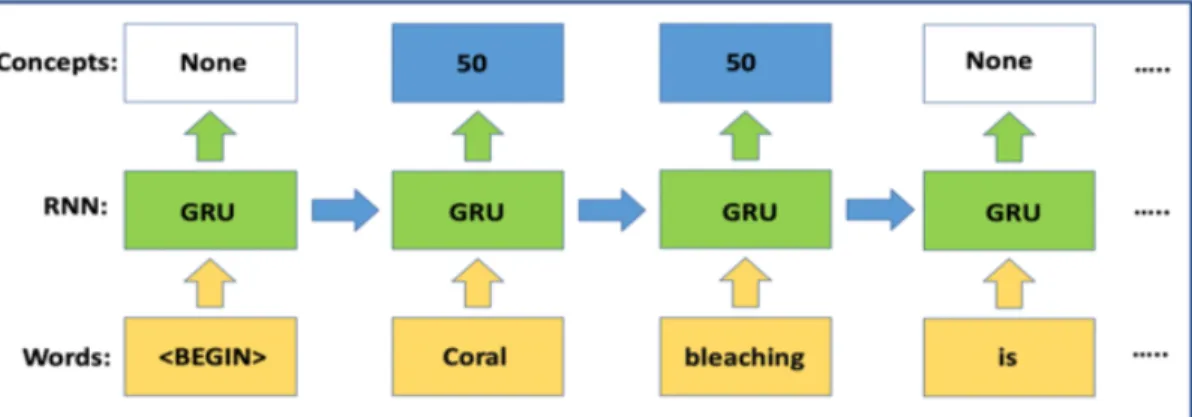
1”, page 151 of ‘Proceedings of the 2011 Conference on Empir-ical Methods in Natural Language Processing’ [206] . . . 53 3.2 Illustration of an RNN applied to a word labeling problem. The
recurrent cell in this example is a Gated-Recurrent Unit (GRU) 55 3.3 Convolutional Deep Belief Network architecture. Image from
Krizhevsky and Hinton 2010, “Figure 4: The architecture of our convolutional net”, page 5 [122] . . . 56 4.1 Labeling words with concept codes. Each box represents a
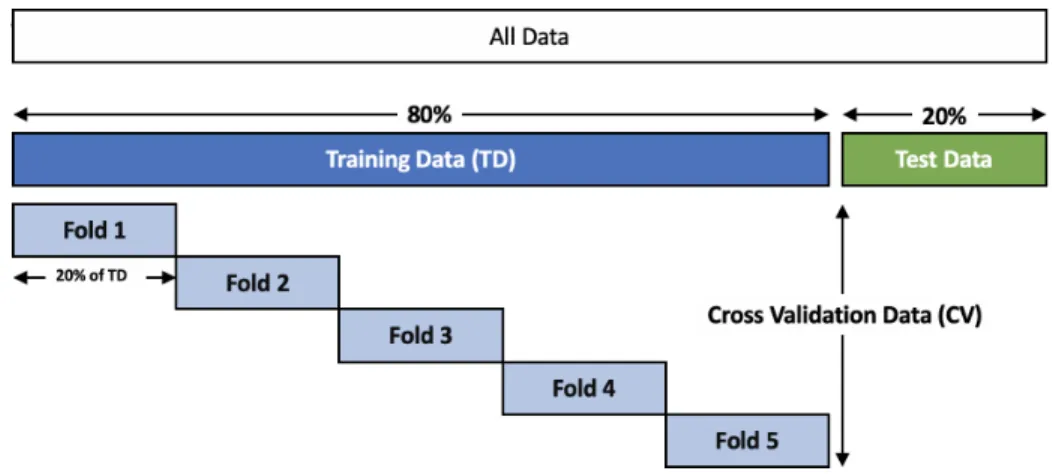
sep-arate concept, with the code denoted by the green circle. . . . 59 4.2 The Di↵erent Dataset Partitions. For Each Fold, the Validation
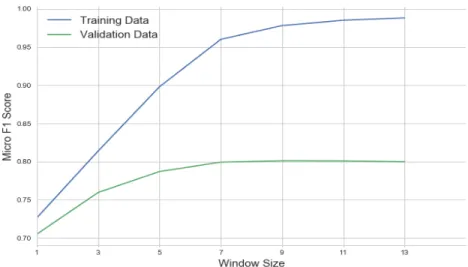
Data (CV) is Shown in Light Blue. The Remaining Data within each Fold was Used for the Training Data (CV) for that Fold. 65 4.4 Maximum Micro-F1 score By Window Size For Skin Cancer . 73
4.3 Maximum Micro-F1 score By Window Size For Coral Bleaching 73
4.5 Maximum Micro-F1 Score by Number of Feature Sets (Window
Size - 9 Words) . . . 78 5.1 Extracting causal relations between concepts. Each box
repre-sents a separate concept, with the code denoted by the green circle. The cause-e↵ect relations are indicated by the blue ar-rows, each arrow going from causer to e↵ect code. . . 105 5.2 Example coral bleaching dependency parse structure. Each box
represent a concept, with the code denoted by the green circle. The cause-e↵ect relations are indicated by the blue arrows, each arrow going from causer to e↵ect code . . . 117
5.3 Maximum Micro-F1Score by Number of Feature Sets (Stemmed
Features) . . . 125 5.4 Micro F1 Score By Frequency For the 3 Causal Relation
Ex-traction Algorithms on the Coral Bleaching Data . . . 134 5.5 Micro F1 Score By Frequency For the 3 Causal Relation
Ex-traction Algorithms on the Skin Cancer Data . . . 135 6.1 Resolving coreferences involving concept codes. Each box
rep-resents a separate concept, with the code denoted by the green circle. The cause-e↵ect relations are indicated by the blue ar-rows, each arrow going from causer to e↵ect code. Causal re-lations resolved by coreference resolution have red arrows, with the coreferences using bold red text. . . 145 7.1 Generating a causal model from parsed causal relations. Each
box represents a separate concept, with the code denoted by the green circle. The cause-e↵ect relations are indicated by the blue arrows, each arrow going from causer to e↵ect code. Causal re-lations resolved by coreference resolution have red arrows, with the coreferences using bold red text. . . 162 7.2 The Distribution of the Number of Causal Relations Per Essay
in the Coral Bleaching Dataset (Actual vs. Predicted by the Sentence Parser) . . . 177 7.3 The Distribution of the Number of Causal Relations Per
Es-say in the Skin Cancer Dataset (Actual vs. Predicted by the Sentence Parser) . . . 178 B.1 A healthy coral . . . 230 B.2 This map of the Pacific Ocean shows coastal regions most
af-fected by coral bleaching (darker areas near land masses). . . . 231 B.3 Coral Bleaching Reports Per Year . . . 232 B.4 A section of healthy skin . . . 232 B.5 The dark patch to the right of this person’s eye is caused by a
basal cell carcinoma. . . 233 B.6 Important lines of latitude . . . 234 G.1 Arc-Eager Transition System, from [155] . . . 256 G.2 Modified Arc-Eager Transition System for Parsing Causal
Re-lations . . . 256 G.3 Parser Example - Projective Causal Relations . . . 261 G.4 Parser Example - Non-Projective Causal Relations . . . 262
List of Equations
2.1 Equation 2.1 . . . 21 3.1 Equation 3.1 . . . 37 4.1 Equation 4.1 . . . 60 4.2 Equation 4.2 . . . 60 4.3 Equation 4.3 . . . 61 4.4 Equation 4.4 . . . 61 4.5 Equation 4.5 . . . 62 4.6 Equation 4.6 . . . 62 4.7 Equation 4.7 . . . 62 4.8 Equation 4.8 . . . 62 4.9 Equation 4.9 . . . 63 4.10 Equation 4.10 . . . 63 4.11 Equation 4.11 . . . 65 4.12 Equation 4.12 . . . 81 4.13 Equation 4.13 . . . 81 7.1 Equation 7.1 . . . 179 G.1 Equation G.1 . . . 264List of Algorithms
7.1 The GEN(x) Function for the Reranking Model . . . 176 G.1 The Dynamic Oracle Algorithm . . . 259
Chapter 1
Introduction
1.1
Overview
In the US, educational standards have improved as a result of the Common Core Standards and also the Next Generation science standards [107, 161]. These standards push for the development and assessment of higher-level thinking and reasoning skills, including an understanding of scientific reason-ing, evaluating scientific theories, explanations and evidence, and understand-ing material from multiple documents in di↵erent formats. However, many middle school, high school and even college students struggle to combine in-formation from multiple documents in science and history [15, 243].
Writing is considered to be one of the key 21st century skills and has
become an important part of many national standards. The U.S. Common Core State Standards [107, 161] now require students to improve their writing skills by developing the ability to synthesize and summarize text, formulate arguments and link ideas to texts and argumentation [68]. Writing is also an important learning skill as it can help develop higher-order thinking skills such as communication and logical reasoning skills in addition to the core literacy skills of reading and writing. Writing has been shown to promote a higher level of comprehension of information from multiple sources [14, 245] because it provides opportunities to transform the source text and synthesize and integrate information [98, 244] across sources.
By forcing the writer to process information more deeply, it is also thought that writing promotes the construction of a ‘situation model’, a mental model of the topic which leads to better understanding than more superficial tasks [120]. To develop better writing skills it is important for students to get both practice at writing essays and receive personalized feedback [116].
However, due to increasing class sizes and the time taken to e↵ectively grade written assignments, the dominant form of assessment in US classrooms and colleges has become the multiple choice test, in place of essay writing [239]. This is due to the ease at which the multiple choice test can be constructed and automatically graded.
To help address these problems with essay grading and make it a more practical form of assessment, considerable work has been conducted into creat-ing automated essay assessment software (or AES, e.g. [128, 204]). Proponents of AES software claim that AES systems can perform on a par with, or in some cases better than human graders when evaluated in terms of inter-rater reliabil-ity [163, 203, 204] and level of agreement with human graders [185]. However, most of this work has been focused on traditional essay grading - summative assessments where each essay receives a single grade only. An alternative form of assessment is formative assessment - rather than providing a student with a single score they are provided with feedback throughout the essay writing process. This feedback highlights areas of potential improvement to help the students to become more proficient writers, and typically covers many di↵erent aspects of writing providing a more holistic assessment rather than a single score for the entire essay.
While time spent practicing reading and writing is strongly predictive of ability, receiving timely feedback is particularly critical to the quality of improvement in writing skills [10, 127]. Research into providing automated feedback during essay writing has primarily focused on extending traditional AES systems to provide automated feedback to students as they construct the essays rather than designing new approaches specifically to solve this problem. Existing AES systems rely heavily on surface level features of an essay - such as the word count, syntax, quality of the grammar, and lexical proficiency (variety and rarity of words used) [185, 48]. While these features have proven e↵ective at predicting an essay’s grade by measuring the student’s overall writing competency, they are insufficient to e↵ectively judge the relevancy and appropriateness of the essay response [164, 56, 247]. A similar criticism of AES systems is on the grounds of ‘construct validity’, specifically the algorithms fail to determine the writer’s level of understanding and knowledge of the subject matter [185, 40], nor the strength and validity of their arguments [48]. As a result, the level of feedback provided by these systems is restricted to ‘writing mechanics’ - matters of form, structure and style of essay writing. It is not surprising then that studies have shown that providing feedback from these systems results primarily in improvements in writing mechanics but not overall quality when measured in terms of subject matter understanding, and validity of arguments [205].
To provide personalized feedback to improve higher-level writing and reasoning skills, it is necessary to understand the arguments put forth in an essay, and evaluate them for validity and completeness with respect to the essay question and source text. This requires a departure from the methods used in traditional AES systems in order to provide more e↵ective writing feedback. While some work has been conducted into providing some forms of automated formative assessment (e.g. [68]), little work has focused on determining the level and quality of causal reasoning presented in an essay. Natural Language Processing (NLP) is a sub-field of computer science and artificial intelligence (AI), that studies algorithms for understanding and modeling natural language data. This work focuses on building an application to identify causal relations in explanatory scientific essays. Specifically, this research investigates NLP and machine learning methods for automating the construction of ‘causal models’ from written essays, as explained in the next section. Creating a solution to this problem would not only have many potential applications in education, but could also be adapted to extract causality from more general scientific texts.
1.2
Causal Models
In order to understand the causal reasoning in an explanatory essay, we re-quire a method of representing the causal structure of an essay. Psychologists construct mental models which attempt to describe the thought processes and mental algorithms underlying certain tasks to better understand how humans perform them. In their 1983 book ‘Strategies of Discourse Comprehension’ [230], Van Dijk and Kintsch described a form of mental model of text compre-hension called a ‘Situation Model’. A form of situation model that specifically describes causal reasoning is referred to as a ‘Causal Model’. This defines a set of core concepts for a particular domain along with causal inferences between these concepts representing cause-e↵ect relations. These inferences can be connected to form causal chains which represent a logical sequence of inferences in an explanatory essay. Causal models can therefore be used to represent the causal reasoning present in an essay in a human and machine readable format. Given a set of essays annotated according to such a model, a machine learning system can then be created to recreate these mental models automatically from the essay texts. Causal models and the essay annotation scheme will be discussed in more detail in chapter 2.
1.3
Problem Statement and Research
Ques-tions
Science education has focused on explaining causality for some time [242, 26, for example]. However, automatically detecting causality in scientific essays has received little attention in the literature. Research into causality detection has instead focused on di↵erent kinds of texts [33, for instance]. Presumably due to the difficulty of the task, most work in this area has attempted to address a simpler problem - detecting the presence or absence of causal rela-tions only between certain sub-types of causal relation, such as between two noun-phrases [11], or between nouns and verbs only [79]. To overcome these limitations in the types of causal relation that can be detected, this research has focused on developing techniques to automatically infer complete causal models for scientific essays directly from essay texts. As previously described, a ‘causal model’ consists of a series of concepts linked together through causal relations. To automatically construct a causal model of an essay, a system would need to first identify the core essay concepts referenced in the essay, and then determine the causal relations between these concepts. To accurately identify concepts and causal relations between concepts, the system would also need to resolve anaphoric references within the essay text. Finally, the system would need to analyze the essay holistically to determine how all the concepts are connected to one another via causal relations in order to construct a causal model of the entire essay. Consequently, this problem has been decomposed into four simpler sub-problems:
1. How do we automatically label words with their associated essay con-cepts from a pre-defined causal model?
2. How do we determine the causal links between essay concepts?
3. Can we improve the accuracy of the word-tagging and causal relation extraction models by first resolving coreferences within the text?
4. Can we utilize the overall structure of the essay to improve the system’s accuracy?
For each of these problems, the current literature was used to determine the best approach or approaches that were most likely to solve the problem, and re-phrase each problem as a specific research question in order to incorpo-rate the di↵erent approaches. These will be described in the following sections.
1.3.1
Research Question 1
Problem 1 states:
“How do we automatically label words with their associated essay concepts from a pre-defined causal model?”
This is a word labeling or word-tagging problem - for each word in a sentence, assign zero, one or more concepts from the causal model to that word. This is related to a number of sequence labeling problems which are common in the field of NLP, for example part-of-speech tagging and named-entity recognition. The most commonly used approach for solving a sequence labeling problem is to use a linear chain probabilistic graphical model (dis-cussed in section 3.4.2.1). These are a simple form of probabilistic graphical model that are used to solve sequence labeling problems because they are able to model both the probability of the label given the current and previous words, and also given the previous labels. Two of the most common examples of this type of model include Hidden-Markov Models (HMM) and Conditional Random Fields (CRF), and both have been successfully applied to many NLP sequence labeling tasks, including part-of-speech tagging, named entity recog-nition, information extraction and text segmentation [129]. In general, the CRF algorithm out-performs the HMM because it does not su↵er from the ‘label-bias’ problem (see section 3.4.2.1). While the strength of these models lies in their ability to model dependencies between consecutive labels, they are trained using the previous labels assigned to the training data, which are al-ways 100% correct. They cannot be trained using their own noisy predictions for the previous labels, and thus fail to accurately model the unreliability of their own predictions.
A simpler approach to solving this problem is to use a window-based tagging model - use a window of words around the word to be labeled as features to train a traditional classifier (see section 3.4.2.3). The advantage of this approach is that any traditional machine learning algorithm can be used to build a tagging model, and the algorithm can take advantage of any contextual features from the words within the window. However, the main disadvantage of this approach is that unlike the HMM and CRF model, it is unable to model dependencies between the consecutive labels in the training data. In addition, it is unable to make use of any information outside of the word window, and thus cannot model longer-range dependencies.
Online tagging models exist that can be trained iteratively to make predictions using both the contextual information from the sentence and their previous label predictions. These iterative machine learning methods have
been show empirically to outperform alternative approaches that rely solely on the training data labels [45]. Two examples of popular iterative tagging models are the averaged perceptron, and a recurrent neural network. The averaged perceptron has been shown to out-perform a specific form of linear chain probabilistic model called a Maximum-Entropy Markov Model on part-of-speech tagging and noun-phrase chunking problems [35], and is commonly applied to the more challenging problem of natural language parsing [37, 43] (see section 3.4.5). A recurrent neural network (RNN) is a type of neural network capable of handling sequential prediction tasks by maintaining an in-ternal state that is updated as each new input is processed. This allows it to model longer-range dependencies than is possible with simpler model types, such as a CRF model or an averaged perceptron, and it can be trained in an iterative fashion using its own prior predictions. RNN’s have been suc-cessfully applied to a wide range of complex sequence labeling tasks [78, 86], for example they have achieved state-of-the-art performance on unsegmented connected handwriting recognition [87], named entity recognition [27, 170], language modeling [146, 248, 170] and speech recognition [85].
Considering these di↵erent techniques, the following research question was created to address problem 1:
“Which of the following model types is the most e↵ective ma-chine learning model to automatically label words with their asso-ciated essay concepts from a pre-defined causal model?”
A Window-Based Word Tagging Model B Conditional Random Field
C Hidden Markov Model D Averaged Perceptron
E Recurrent Neural Network
For the reasons stated above, I predicted a recurrent neural network would out-perform the other algorithms on the sequence labeling task.
1.3.2
Research Question 2
Problem 2 states:
“ How do we determine the causal links between essay con-cepts?”
This problem requires determining, for a given sentence, whether or not a causal relation exists between any two concept codes discovered in that sentence. The prior literature on causal relation extraction focuses on the use of lexico-syntactic patterns to detect specific types of causal relations that can occur in open domain text. To solve this problem however, we need to be able to detect any type of causal relation that can occur only between any two concept codes. The solution could not be restricted to specific types or cate-gories of causal relation, and should only care about domain specific relations that are present within the causal model. I therefore needed a more flexible approach that could be trained on data specific to this particular problem.
A simple solution would be to adapt the optimal word tagging problem determined from Research Question 1 to detect causal relations by treating that problem also as a word-tagging problem, where the tags to be predicted are causal relations instead of concept codes. However, the causal relations that occur in the essays can span the length of the entire sentence, and the occurrence of one causal relation can also be influenced by the presence of other concept codes within the sentence that are not part of the causal rela-tion. To make use of this information, a stacking or ‘stacked generalization’ approach can be applied [246]. Stacking takes the predictions from a number of base-classifiers and feeds them as inputs to a meta classifier which can make predictions in light of the predictions of all of the base-learners (see section 3.3.1.5). To use stacking to solve the causal-relation extraction problem, the optimal word labeling model’s predictions about which concepts exist within a sentence were used as inputs to train a stacked model.
The disadvantage of these two approaches is that they treat each causal-relation as a separate label to be predicted. A lot of the observed causal rela-tions are very rare in the training data, making it hard for the model to learn to accurately predict these relations without a much larger amount of positive training examples. A better approach would be to build a system that can treat this problem as a binary classification problem - given a pair of concept codes, is there a causal relation between them? One analogous problem from the domain of NLP is dependency parsing, a form of natural language pars-ing that detects a series of binary dependencies between words in a sentence. Framing the problem as one of detecting binary dependencies between concept codes, the predicted concept codes could be used to build a dependency parser. One of the most successful methods of building a dependency parser is to use a conditional-history, transition-based based parsing model that parses a sen-tence by making a sequence of parsing decisions, each decision conditioned on the remaining input and all prior parsing decisions (see section 3.4.3). At the center of any parsing problem is a difficult search problem - given the many
di↵erent ways in which a sentence can be parsed, determine the most likely parse tree. The SEARN algorithm has been shown to outperform a number of structured learning algorithms, including the averaged perceptron, CRF,
SVMSTRUCT, and M3N, on a number of NLP structured learning tasks [43, 44]
(see section 3.4 for a description of structured learning). SEARN treats a com-plex problem such as dependency parsing as a sequence of search decisions, and trains a separate machine learning model to make each decision.
One important aspect of detecting causal relations is understanding the context of how each concept code is used in a sentence, and how the author is connecting the two concepts. In order to do this e↵ectively, the model needs to be able to process the whole sentence and learn long distance relationships between words. Recurrent Neural Networks (RNNs) have achieved state-of-the-art results in tasks like sequence labeling and language modeling [146, 248, 170] where learning long term dependencies between words and phrases are important for achieving good results. Furthermore, RNN’s are able to take advantage of neural word embeddings which have been pre-trained on a large external corpus. Neural word embeddings capture semantic information about the meaning of each word in the form of a vector representation, allowing the RNN to better generalize on out-of-vocabulary words not present in the training data. See section 3.5 for more information on RNN’s and neural word embeddings.
Incorporating these di↵erent approaches, Research Question 2 became: “What is the most e↵ective approach for determining causal links between concepts from the algorithms below?”
A Extending the optimal tagging model from Research Question 1 to detect causal relations
B Creating a Stacked Model using the predictions from the op-timal word tagging model from Research Question 1
C Transition-Based Parsing Model D Recurrent Neural Network
Due to its strong performance in solving a wide range of complex NLP problems, I believe that using the SEARN algorithm to build a transition-based dependency parser would be the most e↵ective solution for detecting causal-relations.
1.3.3
Research Question 3
“Can we improve the accuracy of the word-tagging and causal relation extraction models by first resolving coreferences within the text?”
Anaphoric references are common throughout the research data set as the students often refer to essay concepts mentioned earlier in the sentence, or discussed in previous sentences using anaphoric references. The system’s performance could therefore be improved by attempting to resolve anaphoric references to detect certain concept codes within an essay. To resolve anaphoric references, two publicly available coreference resolution libraries were used to detect and resolve coreferents - the Berkeley and Stanford coreference res-olutions systems. The Berkeley coreference resolution parser is part of the Berkeley Named Entity Resolution system, which demonstrated state-of-the-art performance on the CoNLL 2012 shared task [59] at the time of the paper’s publication, attaining an F1 score of 61.71. The Stanford neural coreference
system [31] is the most accurate model from the Stanford CoreNLP library on the CoNLL 2012 shared task at the time of writing, and achieved an F1
score of 65.73, improving on the Berkeley parser’s accuracy on that dataset. Because the performance of any coreference resolution system depends largely on the dataset evaluated, both systems were evaluated on our data.
The accuracy of the word tagging and causal-relation extraction models could be evaluated when using each of these coreference resolution systems, resulting in the following Research Question:
“Does the accuracy of the word-tagging and causal relation extraction models improve when coreferents are resolved using ei-ther of the following two state-of-the-art coreference resolution sys-tems?”
A The Stanford Coreference Resolution System B The Berkeley Coreference Resolution System
Given the relative frequency of anaphors in the essay data, I predicted that using one or both of these coreference parsers would improve the perfor-mance of both the word-tagging and causal relation extraction models, pro-vided at least one of these parsers was e↵ective at detecting coreferences within the essay data. I also expected the Stanford parser to produce a greater im-provement than the Berkeley parser due to its stronger performance on the CoNLL-2012 data.
The Stanford Coreference Resolution System is available to download from [90], while the Berkeley Named Entity Resolution System can be down-loaded from [89].
1.3.4
Research Question 4
Problem 4 states:
“Can we utilize the overall structure of the essay to improve the system’s accuracy?”
The first two research questions look at determining the concept codes associated with the words in a sentence, and the causal relations occurring within a sentence, and do not use information outside of the sentence when making classification decisions. While Research Question 3 looks at anaphoric references occurring within and between sentences, it does not utilize the over-all structure of the essay. The location of a particular sentence within the essay and also within the current paragraph, as well as the concept codes and causal relations that are discussed in the other sentences of the essay likely influence the codes and causal relations that exist in that sentence. This problem subse-quently asks whether we can more accurately create a causal model by making use of this additional information.
To solve this problem, it could again be framed as a problem of learning to make a sequence of decisions, and similarly apply a conditional-history, transition-based based parsing model to solve this problem. However, unlike in Research Question 2 where we limited the parsing history to that of the current sentence, for this problem the conditional history could be extended to encompass all previous and subsequent sentences in the essay. The optimal model for research question 2 was extended to solve this problem by including additional structural features from the essay, as well as a larger conditional history that spans the rest of the essay.
While transition-based parsing models are one of the most successful and widely used types of natural language parsing model, another very suc-cessful approach is to use a reranking model. First a generative model is used to generate a number of likely parses for a sentence, or in this case a set of likely causal models for an essay. Then a second model is used to rerank the candidates according to their likelihood given the input sentence, or in this case the essay. This can be a very powerful approach, because the reranking model can use a number of new features computed from the generated parse trees, in addition to the original features extracted from the essay text, to rerank the parses. Unlike the transition-based parser which uses local features to make a sequence of parsing decisions, the reranking approach is a global model, which is able to evaluate the consistency of entire causal models with that of the training data to determine which model is most probable. The
main limitation of this approach is that it is only able to consider causal mod-els produced by the generative model. If the most accurate causal model is not produced by the generative model, it can not be considered by the reranking model.
Incorporating these two di↵erent techniques, Research Question 4 be-comes:
Can a more accurate causal model of an entire essay be con-structed by using information from the whole essay using either:
A A Transition-Based Parsing Model to parse the entire essay B A Reranking Model to rerank possible causal models
Because a reranking model is able to evaluate each generated causal model as a whole rather than constructing it iteratively, I predicted this would be the more successful approach at solving this problem.
1.4
Contributions of this Work
This research presents the first system to extract causal relations from es-says according to a pre-defined causal model of the essay topic. Furthermore, this work aims to further advance the techniques of causal relation detection from detecting the presence or absence of individual causal relations to auto-matically inferring chains of causal reasoning, and building complete causal models from a text document. To the best of my knowledge, this is the first piece of work to attempt to tackle these two problems, and also the first study investigating approaches to detecting causality in explanatory scientific essays. In recent years, advances in deep learning techniques have produced big improvements in the areas of speech recognition, image classification, and sentiment analysis, as well as numerous other applications [51, 123, 206]. How-ever, little work has attempted to apply deep learning techniques to identify complete causal chains or causal models in scientific essay text. This research compares the efficacy of deep Recurrent Neural Networks for solving these problems with that of a number of more traditional machine learning tech-niques.
1.5
Potential Applications
The final system outputs the set of concepts found in the essay, identifying where in the original essay text these concepts where located. In combination
with the causal model, this could be used to determine which essay concepts were omitted by the student altogether to bring these concepts to their atten-tion. The system also extracts individual cause-e↵ect pairs mentioned in the essay. This could help identify invalid inferences where the cause and e↵ect are not connected in the causal model. It could also help identify incomplete explanations, where the student has omitted intervening concepts when speci-fying a cause and e↵ect relation. The system output could also be analyzed to determine the order in which the causes and e↵ects are introduced within the essay, which could be used to evaluate whether or not the explanations in the essay were presented in a logical order, and if not it could be used to suggest a clearer and more structured explanation. Finally, the system could be used to present example sentences and sections of essays from other students that more completely answer parts of the essay question.
This analysis could be used in a wide range of teaching applications, such as providing immediate feedback to the learner whilst writing an essay, or to improve upon existing systems for providing formative assessments. Fur-thermore, it could help address the issue of construct validity in AES systems, and could be used to assist manual essay grading by helping a teacher more rapidly identify which essays have the most problems and may need to be manually graded.
There are also additional potential applications for this research outside of the educational domain. There are many domains where causal models al-ready exist alongside a wealth of unstructured textual data on the domain, for example determining the mechanism of action of a new drug from a scientific paper, or identifying the key arguments in a legal case from a legal document. Given a causal model of the domain and sufficient annotated text documents, this system could be adapted to generate causal models from text for a new domain.
This system could also advance the field of Natural Language Process-ing (NLP). Traditional question answerProcess-ing (QA) systems are mostly restricted to answering simple questions, as they are unable to follow chains of reasoning. If a QA system is able to build a causal model of a piece of text, it could answer more complex questions by analyzing a causal model of that text. Dialog sys-tems, where a user interacts with a system using a natural language interface, could also benefit from this work as they could build a causal model of the user’s problem by combining information across the entire dialog it has had with the user. This could also guide the dialog agent to ask more appropriate questions by analyzing the causal model to look for gaps in its current knowl-edge of the problem. Finally, this system could be used to enhance the field of
information extraction by extracting more complex causal relations from text documents.
The remainder of this thesis will be laid out as follows. Chapter 2 will describe in more detail the causal model, along with the process by which the essays were collected and annotated. Chapter 3 will describe related research in the areas of text classification, sequence learning and causal relation detec-tion that are relevant for this topic, including an array of machine learning techniques applicable to this task. Chapters 4 to 7 will then describe the research conducted to solve research questions 1 to 4.
Chapter 2
From Student Essays to Causal
Models - The Dataset
Situation models are an important form of mental model principally used in psychology for modeling how people acquire knowledge and understanding from reading. In this chapter, I will describe a specific form of situation model, a ‘causal model’, that focuses solely on the causal inferences present in a body of text. I will describe how this form of model is identified from an essay by an annotator and then used to evaluate the quality and completeness of the inferences demonstrated by the student through their writing. Automatic extraction of a causal model from student essays will form the focus of this research.
2.1
Situation Models
The term ‘situation model’ was first defined by Van Dijk and Kintsch in 1983 [230] to attempt to create an abstract model of the thought processes underlying text comprehension. To develop an understanding of a piece of text, it is thought that the reader accumulates knowledge of the topic as they read each sentence, combining new knowledge with that acquired from previous sections of the same material [234]. Following the initial paper in 1983, a number of di↵erent situation models have been described, including the ‘construction-integration model’ [119], the ‘landscape model’ [229], and the ‘resonance model’ [77]. These models have shown that text comprehen-sion cannot be the sole product of inferences made within the text. Instead the reader has to also build upon their own prior knowledge to construct new
factual information from the material that is relevant to their individual ex-periences and knowledge of the world [234].
A situation model is defined as consisting of 5 di↵erent dimensions of information within the text to which readers attend when forming a mental model of the text: spatial information, temporal information, causality, inten-tionality and finally information about the main protagonist(s) [259]. Accord-ing to the theory, when information from one of these 5 dimensions is extracted from the text, the user updates their current situation model to integrate this new information. Studies into ‘priming e↵ects’ lend compelling evidence in support of this theory of text comprehension. Experiments have shown that after reading a passage of text, information related to the text that falls into one or more of these 5 di↵erent dimensions is more readily available to the reader (it is ‘primed’) compared to other types of information [259]. This has been measured using various experimental techniques, including the time taken to make certain verbal utterances or recognize words that were primed following reading, compared to words that were not primed. In this research, I will focus on a di↵erent form of situation model that focuses solely on the causal dimension, called a ‘causal model’.
2.2
Causal Models
A causal model is a type of situation model that focuses on modeling the causal inferences present in some written material, for instance, a causal model of some scientific phenomena represents the relevant underlying scientific pro-cesses at work, and the di↵erent cause-e↵ect relations that occur between them. Such a model shows how various initiating factors lead, via a number of intervening concepts, to the final outcome.
Two examples of a causal model are shown in Figures 2.1 and 2.2 below. Figure 2.1 shows a causal model for the causes of coral bleaching (a whitening of coral reefs as they die). In this model, there are two di↵erent initiating factors - Decrease in Trade Winds and Storms / Rainfall. These lead via two di↵erent causal chains and various intervening factors to the final outcomeCoral Bleaching. Figure 2.2 shows a causal model describing the di↵erent factors that lead to an increased risk of getting skin cancer. In the Figure, the two initiating factors - Closer to the Equator, and
-Increased Melanin initiate two separate causal chains, both resulting in
a single final outcome - Increase in Skin Cancer Risk via a number of di↵erent intervening factors, such as - Increase in Direct Sunlight and
Figure 2.1: Causal model for Coral Bleaching
Figure 2.2: Causal model for Skin Cancer
Both of these models include one or more causal links not explicitly mentioned in the source text. These are represented by the dotted lines linking two concepts in the Figures, for example the causal relation between concepts 6 and 7 in Figure 2.1. The students were expected to infer these causal links based on their overall understanding of the source material.
2.3
The Construction of Causal Models for
Explanatory Essays
In conjunction with the READI grant [70] (funded by the National Center for Education Research), causal models were created to evaluate how e↵ectively students are able to synthesize and combine information from di↵erent source texts. Three di↵erent domains were studied as part of this research - science, history and english literature, and the READI grant was created with the goal of improving adolescents’ skills at reading multiple texts to produce discipline specific explanations in the case of literature, or causal explanations in the case of science and history. The two causal models described above were created as part of this research. This research project will focus solely on the aspects of
this research related to improving causal explanations of scientific phenomena, and will use the document sets collected during the 2014-15 school year in the science domain only.
Middle school and high school science students were asked to read a set of documents, and asked to explain the principal underlying causes of some sci-entific phenomena by integrating information across several di↵erent sources. The writing prompts for each essay topic can be seen in appendix A. A causal model was first constructed for each essay topic that described the principal causal chains underlying the phenomena, and then used to construct a set of source documents (see appendix B for examples of the source documents). The source documents were created from reputable sources (e.g. the US Geological Survey, the NASA earth laboratory, and online science textbooks) and were constructed to facilitate the evaluation task; no individual source could be used on its own to explain the scientific phenomena. This forced the students to combine information from the di↵erent documents when constructing the causal explanations. Each document was written at a level appropriate for the target audience, and separate documents were presented on separate pages without staples or numbering so that the students could more easily compare documents from di↵erent sources.
Initially, a pilot study was conducted to help the researchers understand and evaluate all aspects of the experimental design, including the creation of the causal model and accompanying documents sets, as well as the annotation processes and machine learning approaches used to automate the annotation process [95]. Guided by the findings of this pilot study, two subsequent studies were conducted, the first on the topic of coral bleaching, and asked the students to “explain how and why coral bleaching rates vary at di↵erent times”, and the second on skin cancer, and asked students to “explain how and why rates of skin cancer di↵er around the globe”. See Figures 2.2 and 2.1 for the causal models that were created for these two di↵erent topics. Each set of documents began with a short background document (255 and 273 words) to establish the main outcome, and provide the necessary framing, background material and vocabulary to answer the essay question. This background document was followed by 4 additional documents consisting of a number of di↵erent document types (images, maps, graphs, and descriptive text). Students were instructed to write their essays using the sources provided, and were given several hints to ensure they understood the goal of the task (e.g. “you have to piece together important information”, and “you are the one making con-nections across sources”). The 2 studies focused on 10th grade high school students only, and the same 1,300 students were used for both studies. Three coders were trained as annotators of the essay data; one coder was trained for
each of the two topic, and a third was trained on both topics. Inter-rater reli-ability was high for each each of the datasets, with avalues ranging between 0.76 and 0.97 for the di↵erent studies. A detailed description of the annotation procedure can be found in appendix C, and examples of some essays from both datasets can be found in appendix D.
In Figure 2.3 below you can see an example of an annotated coral bleaching essay, showing a sequence of three causal relations forming a causal chain. First there is a code 3, the cause - Increase in Water
Tempera-tures leading to the e↵ect, code 5 - Decrease in Photosynthesis. This
forms part of a causal chain with code 5 in turn acting as the cause of e↵ect
5b - Decrease in Supply of Chemicals to Coral for Food. Finally,
there is a third causal relation, that of code 5b leading to code 50 - Coral
Bleaching. This last causal relation overlaps the 5→5b causal relation, and
the e↵ect precedes the cause in the sentence. In each causal relation, the cause and e↵ect codes constitute a sequence of multiple words, and the cause is con-nected to the e↵ect via an ‘explicit’ connector concept code. This demonstrates how one sequence of words can have multiple overlapping causal relations, and shows that the cause, explicit and e↵ect concept codes do not always appear in the same order within a sentence.
Figure 2.3: An Annotated Coral Bleaching Essay
Overall, the students were successful at identifying some of the core essay concepts, but struggled to integrate information between sources. For example, 74.3% of all essays contained one or more concept codes from the causal model, and 58.6% of the essays contained some causal chain. However, only 30.9% of the essays contained a causal chain with one or more intervening factors between a cause and the final outcome. Consequently, most of the
causal chains observed in the essays linked a cause directly to the final outcome. For example, in a coral bleaching essay a student may state that anIncrease
in Coral StresscausesCoral Bleaching, omitting the intervening factor
Ejection/Death of Algae (see Figure 2.1). One possible explanation for
the small number of essays with longer causal chains is that creating such a chain required the students to combine information from multiple sources, indicating this was the most challenging form of causal relation for them to identify from the source text.
2.4
Analysis of the Dataset
The number of essays, sentences, words, and the vocabulary sizes (unique words) are listed in Table 2.1 below. Note that the vocabulary size was com-puted after the application of a simple spell checker.
Table 2.1: Dataset Sizes and Vocabulary
Dataset Essays Sentences No. Words Vocabulary
Coral Bleaching 1,127 10,198 167,656 4,770 Skin C
![Figure 3.3: Convolutional Deep Belief Network architecture. Image from Krizhevsky and Hinton 2010, “Figure 4: The architecture of our convolutional net”, page 5 [122]](https://thumb-us.123doks.com/thumbv2/123dok_us/361163.2539788/81.918.212.714.446.733/figure-convolutional-belief-network-architecture-krizhevsky-architecture-convolutional.webp)