Thesis for Master Telematics,
Faculty of Electrical Engineering, Mathematics and Computer Science, Design and Analysis of Communication Systems (DACS),
University of Twente
Providing AAA with the Diameter protocol
for multi-domain interacting services
By Wendy Ooms June 15, 2007
Supervising committee:
Dr. Ir. Georgios Karagiannis (University of Twente), Dr. Ir. Aiko Pras (University of Twente),
Abstract
In this thesis, we present a solution for the problem of how to provide authentication, authorization and accounting (AAA) for multi-domain interacting services. We studied the case of ‘FoneFreez’, a service that provides interaction between different basic services, like telephony and television. Because several parties are involved in this value chain, e.g. television provider, telephony provider etc., secure interaction between multiple domains must be assured. A part of this security issue can be resolved using AAA. In this study the AAA protocol Diameter is used for that purpose, which is the successor of the RADIUS protocol. How the Diameter protocol can be used for AAA in multi-domain service interaction is subject of this study.
Diameter is a very flexible protocol. The adoption by 3GPP boosted the number of network products that implement Diameter. Diameter is mainly used for end-user authentication, authorization and accounting, and is specifically designed for roaming situations.
In this study, the solution has to fulfill requirements that are elicited from the FoneFreez case. The requirements mainly cover AAA for the end-user and AAA between the different parties.
Two different specifications are found that use Diameter to provide AAA for multi-domain service interaction. It depends on the application which one is best suited. The first solution specifies that the different parties are loosely connected. This solution can be implemented in stages. The second solution specifies a tight coupling between the parties. The second solution is best suited for situations where the service is intensively used. In the end it is verified that both specification fulfill all requirements.
Preface
What is in front of you is my thesis for the Master Telematics. The thesis is the last part of the Master program to be concluded before receiving the Masters degree.
I conducted my thesis at TNO-ICT in Delft under the supervision of Oskar van Deventer and Jurjen Veldhuizen. They offered me the opportunity to learn from the work they performed and acquire practical experience in the field of Telematics. During my thesis about AAA, I learned a lot of the Diameter protocol. With this report I would like to pass on the knowledge I gained about Diameter.
Georgios Karagiannis and Aiko Pras supervised me on behalf of the DACS chair at the University of Twente. I would like to thank my all four of my supervisors for guiding me in the right direction at times of confusion.
My thanks go to TNO and my colleagues for giving me the opportunity to acquire practical experience and for their assistance during my thesis. I would like to use this opportunity to thank my parents for enabling my education, and their support in the process. For help during my thesis, my special thanks go to: Hans Stokking, Fabian Walraven, Mike Schenk, Frank Fransen, George Huitema, Henk Ensing, Frens Rumph, Johan Boekema, Klaas Wierenga and Elly Ooms.
Contents
1.2 Relevance of the problem... 3
1.3 Reader’s guide... 5
2 Methodology ... 7
2.1 Waterfall model ... 7
2.2 Scenario based requirements elicitation ... 7
2.3 Case study ...8
2.4 Literature ... 9
2.5 Identification of phases ... 9
2.6 Design methodology... 10
3.3 Introduction to Diameter ... 18
3.4 Interacting services ... 21
5.2 Actors and use cases ... 35
5.3 Functional requirements...36
5.4 Non-functional requirements ... 37
5.5 Constraints...38
6 Solution phases ...40
7.2 Interactions belonging to the different designs ... 53
7.3 Comparison of specifications...57
7.4 Conclusion ...60
8 Fulfillment of the requirements... 62
8.1 Functional requirements ... 62
8.2 Non-functional requirements ... 65
8.3 Constraints ... 65
8.4 Conclusion ... 66
9 Conclusion and future work ... 67
9.1 Results ... 67
A.4 Comparison with other protocols ... 90
A.5 Diameter applications... 95
Appendix B Diameter commands ... 114
Appendix C Identity management ... 115
Appendix D Path to solution ... 119
D.1 One realm situation... 119
D.2 Services in different realms ... 120
D.3 Application server in separate realm...122
D.4 All business roles in different domains ...124
Appendix E Interaction diagrams... 126
Appendix F Future for Diameter ... 129
F.1 Standard ...129
F.2 Supporting firms ... 130
F.3 Industry forces ... 131
F.4 Market mechanism & environment...132
List of figures
Figure 1 Waterfall model ... 7
Figure 2 Path to solution ...11
Figure 3 Three-party authentication model [Nakhjiri et al, 2005]... 14
Figure 4 Agent sequence [RFC 2904] ... 15
Figure 5 Pull sequence [RFC 2904] ... 16
Figure 6 Push sequence [RFC 2904]... 16
Figure 7 Accounting overview [ICOM, 2006]...17
Figure 8 Diameter framework... 19
Figure 9 Simplified IMS reference architecture [Fried et al, 2006] ...24
Figure 10 IMS inter-domain architecture [Sher et al, 2006] ... 25
Figure 11 Architecture FoneFreez...28
Figure 12 Sequence diagram case...30
Figure 13 Business roles model ... 31
Figure 14 Implementation of business roles...32
Figure 15 Actors and use cases ...36
Figure 16 Realm hierarchy [Microsoft, 2006] ... 41
Figure 17 Eduroam Certificate authority [Eertink et al, 2005a] ...43
Figure 18 Multi-domain authorization I [RFC 2904]... 47
Figure 19 Multi-domain authorization II [self edited] ... 47
Figure 20 Revenue sharing...48
Figure 21 Cash flows ...49
Figure 22 Hop-by-hop design ... 51
Figure 23 End-to-end design... 52
Figure 24 Certificate authorities ... 53
Figure 25 Hop-by-hop authentication ... 55
Figure 26 End-to-end authentication ... 56
Figure 27 Diameter framework ...82
Figure 28 Relay agent ...83
Figure 29 Proxy agent...84
Figure 30 Redirect agent ...84
Figure 31 Translation agent...85
Figure 32 Diameter protocol header [RFC 3588]...85
Figure 33 AVP header [RFC 3588]... 87
Figure 34 Diameter Mobile IPv4 interaction...96
Figure 35 Mobile Security Associations [RFC 4004] ... 97
Figure 36 Interaction NASREQ...99
Figure 37 First interrogation after authentication and authorization [RFC 4006] ...101
Figure 38 Authorization messages used for first interrogation [RFC 4006] ... 102
Figure 39 One-time event [RFC 4006] ... 103
Figure 40 EAP authentication [RFC 4072]... 104
Figure 41 EAP authentication alternative [RFC 4072]... 104
Figure 42 Diameter SIP application architecture [RFC 4740]... 105
Figure 43 Authentication and authorization procedure [RFC 4740] ... 106
Figure 44 Locating the SIP server of the recipient [RFC 4740]... 107
Figure 45 User profile update [RFC 4740] ... 107
Figure 46 QoS request authorization [Alfano, 2006]... 109
Figure 47 Server-side initiated QoS parameter provisioning [Alfano, 2006] ...110
Figure 48 DHCPv6 architecture... 111
Figure 49 DHCP request [Vishnu, 2006] ... 111
Figure 50 Server-side push configuration [Vishnu, 2006] ...112
Figure 51 Liberty architecture [Liberty, 2005] ...115
Figure 54 Alternative I ... 117
Figure 55 Alternative II ... 118
Figure 56 User authentication ... 118
Figure 57 AAA in one domain ... 119
Figure 58 Services in different domains, connected AAA... 121
Figure 59 Services in different domains, separate AAA... 121
Figure 60 Application server in different domain, connected AAA ...123
Figure 61 Application server in different domain, separate AAA ...123
Figure 62 All business roles in different domains, connected AAA ...124
Figure 63 All business roles in different domains, separate AAA ...125
Figure 64 Registration phase end-to-end design ...126
Figure 65 Registration phase hop-by-hop design ...127
Figure 66 Operational phase...128
List of tables
Table 1 Comparison of designs... 57
Table 2 Fulfillment of the requirements ...62
Table 3 Diameter command codes defined in the base protocol [IBM, 2006] ...86
Table 4 3GPP interfaces [IANA, 2006]...112
List of abbreviations
3GPP 3rd Generation Partnership Project
AAA Authentication, Authorization and Accounting ATM Automated Teller Machine
AVP Attribute Value Pair
BGCF Breakout Gateway Control Function CA Certificate Authority
CHAP Challenge-Handshake Authentication Protocol CSCF Call Session Control Function
DACS Design and Analysis of Communication Systems EAP Extensible Authentication Protocol
ETSI European Telecommunications Standards Institute HSS Home Subscriber Service
HTTP HyperText Transfer Protocol
I-CSCF Interrogating-Call Session Control Function IETF Internet Engineering Task Force
IMS IP Multimedia Subsystem IP Internet Protocol
IPTV IP television
ITU International Telecommunication Union
MGW Media Gateway
NAI Network Address Identifier NAS Network Access Server
NASREQ Network Access Server Requirements NGN Next Generation Networking
P-CSCF Proxy-Call Session Control Function PDU Protocol Data Unit
PIN Personal Identification Number PKI Public Key Infrastructure QoS Quality of Service
RADIUS Remote Authentication Dial In User Service RFC Request For Comments
SAML Security Assertion Markup Language SCIM Service Capability Interaction Manager S-CSCF Servicing-Call Session Control Function SCTP Stream Control Transmission Protocol SDL Specification and Description Language SEG Security Gateway
SIM Subscriber Identification Module SIP Session Initiation Protocol SOAP Simple Object Access Protocol
TACACS Terminal Access Controller Access-Control System TCP Transmission Control Protocol
TISPAN Telecoms & Internet converged Services & Protocols for Advanced Networks
TLS Transport Layer Security
TNO-ICT Netherlands Organization for Applied Scientific Research - Information and Communication Technology
UML Unified Modeling Language
UMTS Universal Mobile Telecommunications System
VoIP Voice over IP
Wendy Ooms, Master Thesis 1 - Introduction
1
Introduction
Basic services like telephony and television have been developed a long time ago, at the first half of the previous century. The services became a commodity and their supply chains matured, which are the so called ‘stovepipes’. For example the companies that supplied telephony had nothing to do with television and the supply chain from beginning till the end was arranged to deliver solely telephony.
Next to the basic services like telephony and television, value added services are developed. Value added services are services that use the basic services and try to add extra value for the customer, e.g. Electronic Program Guide (EPG) or telephone conferencing services. There is also a group within the value added services that provide added value based on service interaction. This is the interaction between basic services e.g. telephony and television.
The trend can be seen of leaving the stovepipes in telecommunication and adopting the horizontally internet model. The traditional model of one operator playing both the role of service provider and network operator is outdated. Due to this trend, new models need to be found that disengage the different roles. When multiple providers are part of the supply chain, interaction between these providers is necessary. Because every provider resides in its own domain, the services cross multiple domains. When enabling service interaction over multiple domains several issues arise.
Security of multi-domain service interaction is one of these issues. How does the interaction service know if a user is allowed to use the service? And how can the providers that reside in different domains trust each other? For example a user has a different telephony and television provider, and some service is in place to enable interaction between these two basic services. How can the user be billed for the different services? Or how does the television service know that the interaction service is allowed to intervene? For this reason authentication, authorization and accounting (AAA) is needed for multi-domain service interaction.
Wendy Ooms, Master Thesis 1 - Introduction
At the Netherlands Organization for Applied Scientific Research - Information and Communication Technology (TNO ICT) research is done in the field of multi-domain service interaction. How can this be enabled, and how can we offer a secure solution? The next section presents the problem description and the thesis delimitation.
1.1
Problem description
TNO ICT encounters the Diameter protocol in different fields of research, for example in their research on the IP Multimedia Subsystem (IMS). To be able to have full understanding of the IMS architecture, knowledge about every component is required. Diameter was such a component for which more insight was needed on the functionality and application of the protocol, to enable a good overview of the complete architecture.
Within their field of work, TNO ICT acknowledges the need for advice about interacting services. A demo, called FoneFreez, was built to investigate how interacting services from different realms can be managed and how different platforms can be interconnected. The service that is built is an IP television service that interrupts when the phone (IP based) is ringing. The AAA support for this demo was outside the scope of that project.
The main objective of this assignment is to study the functionality and application of the Diameter protocol specification and to reuse and/or extend this specification to provide AAA for interacting services from different realms.
To achieve this objective a specification has to be made, on how to integrate AAA support in the project mentioned above.
The goals of this assignment are: to draw up requirements, make a specification and evaluate whether the specification fulfills these requirements.
The main research question that has to be answered by this assignment is:
Wendy Ooms, Master Thesis 1 - Introduction
The research sub-questions are:
• Which requirements should be applied?
• What does the case of the project look like and which IMS components are used?
• What are the currently available Diameter-based architectures for interacting services from different realms?
• How can the AAA architectures be mapped on the given case?
• Which specification can be derived?
• Does the specification fulfill the requirements of this study?
The terms used in this research question are further explained in chapter 3.
1.2
Relevance of the problem
It is important to perform research on how to add AAA as stated in the main research question, to enable commercial exploitation of service interaction from different realm. This section is divided in three subsections. First it answers why service interaction, as described above, is relevant. Furthermore, it describes why it is important to add AAA support to the interacting services. Finally it is described why the solutions that can be found in literature are not sufficient.
1.2.1
Service interaction at the service provider level
Service interaction can take place at different levels, at the service provider or at the residential gateway of the consumer. In this thesis the interaction at the service provider level will be discussed. The party providing the service interaction is defined as the broker.
The triple play functionality that several providers offer is the immediate cause to look for solutions that provide interaction at the service provider level. The television, telephony and internet services used to be offered by separate parties. With triple play, the services are offered by the same provider, which can add value on top of the basic services. The service providers need the value added services to distinguish themselves from the other triple play providers. Interaction services can be such value added services.
Wendy Ooms, Master Thesis 1 - Introduction
influence on what is happening with the service the client uses from this provider. The service interaction embedded in the network gives control to the service provider and helps to maintain customer relations.
Furthermore, research in interacting services is important to enable different applications to interact, without the need for building them again. The basic services like television and telephony can be reused by interaction services. An example of such an interaction service is the FoneFreez service built at TNO-ICT.
The service interaction in the TNO project ‘FoneFreez’ is done with a Service Capability Interaction Manager (SCIM). The SCIM is an IMS function, but is not completely standardized by 3GPP yet. In the FoneFreez project the SCIM is used to provide interaction between different service providers (IPTV, IP telephony). More about interacting services can be found in section 3.4.
1.2.2
AAA for security
At this moment the FoneFreez project has no possibility to provide AAA. The AAA concept is explained in section 3.1.
The user cannot be authenticated by the IP television service or to the IP telephony service. Also the services are not authenticated or authorized by the broker, which is needed since these services belong to different administrative domains and are managed by different service providers.
Authorization is needed to sustain intervention of the broker at the service providers. It is necessary to check if the request to intervene indeed comes from the correct broker and if the request is allowed for that user.
Wendy Ooms, Master Thesis 1 - Introduction
1.2.3
AAA solutions in literature are not sufficient
In literature few is written about AAA architectures. Most of the work is done in a subgroup of the AAA workgroup of the IETF [AAAARCH, 2004]. The subgroup closed in October 2004, after delivery of several informational RFCs about AAA architectures. Some work can be found in this document about multi-domain AAA. This is further described in chapter 3.
Some products that provide service interaction are on the market, where the AAA aspect is not pointed out explicitly. Also service interaction in a multi-domain environment is not described in literature [Aepona, 2007]. Because these products are vendor specific no general solution for adding AAA to interacting services from different realms exists.
Research has not been done for the Diameter protocol on how to provide AAA for service interaction from different realms. In this thesis a generic solution is developed for AAA for service interaction from different realms, based on the standardized protocol Diameter.
1.3
Reader’s guide
The structure of this report follows from the methodology that is used for the thesis. The two most important methods used are the ‘case study methodology’ and the creation of a new design according to the waterfall model. The methodology is discussed at length in chapter 2.
The ‘case study methodology’ is used, because the case of FoneFreez is relevant for this thesis, and the main research question should be studied in this context [Perry et al, 2004]. This means that the requirements on the specification are derived from the case study and the specification must fit within the boundaries set by the case. This is done using ‘scenario based requirements elicitation’ [Whittle et al, 2004].
Regarding the waterfall model, this thesis describes only the first two phases; due to lack of time only the requirements phase and the design phase are considered. The implementation, verification and test phase are out of scope of this study. First the requirements are drawn up, and then the specification is made.
Wendy Ooms, Master Thesis 1 - Introduction
FoneFreez project at TNO. This is followed by the requirements; the constraints on the specification that are derived from the case in chapter 5. The solution is presented in the chapter 6 and chapter 7. In chapter 8 is discussed whether the specification fulfills the set of requirements/constraints, followed by the conclusion of this thesis in chapter 9.
Wendy Ooms, Master Thesis 2 - Methodology
2
Methodology
This chapter discusses the methodology used for answering the main research question and the research sub-questions. First the method for the main research question is discussed, after which the methods for the research sub-questions are described.
2.1
Waterfall model
The objective of this study is to design a specification for the given problem. When creating a new design standard approaches are known. One of these approaches is described in the waterfall model. The first person to come up with the waterfall model was Royce in 1970. After that several interpretations of the model have arisen. The waterfall model is a sequential software development model that is used to develop new software in a standardized approach. Figure 1 shows a graphical representation of the model.
Implementation
Verification
Maintenance Design
Requirements
Figure 1 Waterfall model
To find the answer to the main research question on the use of Diameter of this thesis the first two phases of the waterfall model are passed through; requirement analysis and design. Due to time constraints the implementation, verification and maintenance phases are out of scope. The phases appear in the following research sub-questions.
2.2
Scenario based requirements elicitation
Wendy Ooms, Master Thesis 2 - Methodology
requirements elicitation [Whittle et al, 2004]. A scenario is used to derive the requirements from. The scenario is drawn up using experts that are familiar with the FoneFreez project. One possible scenario is studied and the requirements follow from this scenario. The scenario itself is described in chapter 4. From that scenario the requirements described in chapter 5 are derived. The requirements are divided in four different types: functional requirements, non-functional requirements, constraints and acceptance criteria.
This method is chosen because of the adopted case study method described in the next section. Given the scenario, this type of requirements elicitation was well suited.
In this thesis the requirement specification is a solution description, rather then a problem description [Wieringa et al, 2003]. The requirements specification describes the desired functions and quality attributes of a solution.
2.3
Case study
For the answer to the second research sub-question on the project case and its IMS components, the case study method is used. With this method, the case of the project is described and the IMS components that are used are identified.
A case study is an empirical research method. Case studies can be helpful when doing research that needs to be studied in context [Perry et al, 2004]. In this thesis a case study is done because the environment where the AAA must be added is very important. Without this context of interaction services from different realms, the study could not be performed. The case study is used to investigate the problem and identify the requirements which the AAA solution for interacting services from different realms has to meet.
Wendy Ooms, Master Thesis 2 - Methodology
2.4
Literature
A literature study is performed to find the current Diameter based architectures for interacting services from different realms. This will give the answer to the third research sub-question on current AAA architectures. An overview of the literature study can be found in chapter 3. Appendix A describes more about the Diameter protocol in depth.
First generic AAA literature is reviewed, to find out what AAA exactly means and its limitations. After which the Diameter protocol documentation is studied in detail, to give a thorough understanding of the protocol and its possibilities. The RADIUS protocol is reviewed to place the Diameter protocol in context and find out the differences between the two AAA protocols. Finally service interaction, realms and IMS is explored to understand all the aspects of the main-research question.
2.5
Identification of phases
For mapping the AAA architectures found in the literature study, another methodology is needed. Different phases are identified to find a way to map the AAA architectures on the case.
The distinguishing of the phases is done according to the phases in [Das et al, 2004]. The registration phase and authentication phase are set apart because of the frequency that they appear. The registration phase appears once for every user, where the authentication phase appears multiple times. Every time a user logs-in to the interaction service, the authentication phase is passed through. After the authentication phase the service can take place as meant to be. This phase was not mentioned in [Das et al, 2004], but is called in this thesis the operational phase.
The registration phase and authentication phase are renames for clarity. The registration phase also includes the preparation of the service and is renamed the initialization phase. The authentication phase is not only authentication but also authorization and part of accounting that is involved with the log-on process, so this phase is renamed to the log-on phase.
‘hands-Wendy Ooms, Master Thesis 2 - Methodology
experts will provide qualitative information about the subject that lies within their specialty. Individual interviews and expert groups are methods used to retrieve this information. Another known method for retrieving this kind of information is the Delphi method [Turoff, 2002], but because of the time and complexity of this method it is not used in this thesis information retrieval.
2.6
Design methodology
In this thesis neither protocol nor protocol component is implemented. For these types of designs several methodologies can be used. For example: top-down or bottom up. For designing a specification for the problem described in this thesis, no standard methodology was found. This section describes the way to come to an answer to the fifth research sub-question; which specification can be derived.
In this section the path is described to come to a complete design for AAA in service interactions from different realms. First the problem is simplified by looking at service interaction in one realm. Next the problem is refined by adding realms until the situation contains a different realm for every party.
Wendy Ooms, Master Thesis 2 - Methodology
1 2
3 4
Place ASP in separate domain
Place SP’s in seperate domains
Figure 2 Path to solution
Section D.1 describes design one. Design two and three are described in sections D.2 and D.3. The solution, where every role is placed in a different domain, is described in section D.4.
Unified Modeling Language (UML) is a standardized specification language for object modeling [Braun et al, 2001]. In this thesis UML is used to present the specification in a standardized method.
The following diagrams of UML are used in this thesis: use case diagram and sequence diagram. The business roles model and functional designs could not be comprised in UML. Because the design is not detailed to the level of software development, class diagrams and physical diagrams are not needed.
2.7
Verification of requirements
Wendy Ooms, Master Thesis 2 - Methodology
In this thesis the specification is drawn up, and for each requirement must be described which messages of the specification fulfill this requirement. Experts are used to review the requirements and determine the fulfillment. This method was also used in the European project Cybervoting [Forsgren et al, 2001].
2.8
Conclusion
Different methods are used to answer the research sub-question and the main research question. A method that is used to predict the feasibility of the Diameter protocol is a model that is developed at TNO-ICT. This model identifies the key success factors for telecom standards. This model and the fulfillment of the model can be found in Appendix B.
Wendy Ooms, Master Thesis 3 - Theoretical background
3
Theoretical background
In this chapter the concept of AAA is explained and other terms used in the problem description are further defined, like the Diameter protocol, interacting services, realms and IMS. In grey textboxes simple examples are given to illustrate the theory in this chapter.
3.1
AAA
AAA stands for Authentication, Authorization and Accounting. This section looks into the meaning of AAA, and the models used for authentication, authorization and accounting.
Authentication is the verification of the identity of the entity. An entity can be a user or the device a user has, like a computer or the SIM of his mobile phone. With authentication someone can prove that it is really the person or device he or it claims to be. This prevents from impersonations from other parties. Authentication consists of three sorts: user authentication, message authentication and device authentication [Thales, 2006].
Authorization is the determination whether the requesting entity is allowed access to a particular resource. Authorization is the process of determining if the user has the right to access the network or use services, like the print server from that network. Furthermore, authorization is needed for resource reservation and quality of service support.
Joe wants to get some money from his bank account. He goes to the ATM machine of his bank in inserts his bankcard. The ATM machine wants to know if it is really Joe that tries to withdraw money. The ATM machine asks for the PIN code belonging to the bankcard. When Joe enters his PIN code correct, the bank has
authenticated Joe as the owner of the card.
Wendy Ooms, Master Thesis 3 - Theoretical background
Accounting is the collecting of information about resource usage for the purpose of capacity planning, auditing, billing or cost allocation. For example, records are kept about the duration a user surfs the Internet.
Re-authentication is the renewal of the authentication by the client upon request of the server. When a session lifetime has expired, or when an error has occurred in the path, re-authentication can be necessary to ensure trust.
3.1.1
Authentication models
As mentioned above, there are three different levels of authentication: user authentication, device authentication and message authentication. User authentication is the verification of the identity of the user; this can be done using authentication protocols like Diameter and RADIUS. Device authentication is sometimes needed when the device is from another, not trusted domain; here protocols like Kerberos can be used. Message authentication is used to authenticate messages without their context of a session. Digital signatures can be used to provide message authentication. [Thales, 2006].
For authentication a two-party model and a three-party model exists. The two-party model is used when two peers interact. A client and server are directly interconnected with no involvement of the middle nodes like gateways or proxies.
Figure 3 Three-party authentication model [Nakhjiri et al, 2005]
A three-party authentication model is shown in Figure 3. In this example a user wants to access a network, like the network of his internet service provider. The user Joe’s balance must be updated to process the withdrawal. The withdrawn amount is deducted from his account. Accounting is the registration of the withdrawal.
Wendy Ooms, Master Thesis 3 - Theoretical background
wants to connect to the network and connects to the first edge device, which is the Network Access Server (NAS). The NAS acts as an AAA client who connects to the AAA server to authenticate the user. The AAA server makes the decisions regarding granting access to the user.
3.1.2
Authorization models
The informational RFC [RFC 2904] about AAA authorization frameworks distinguishes three different architectural models for authentication: the agent sequence, the pull sequence and the push sequence.
Figure 4 Agent sequence [RFC 2904]
In the scenario of the agent sequence showed in Figure 4, the user contacts the AAA entity first. The AAA server authorizes the user, and the service equipment is notified. The service equipment can set up the service and notifies the AAA server that it is ready, which notifies the user. The user and service equipment can precede the communication directly, without the AAA server functioning as an agent. An example of this situation is when a user requests Internet access. The user is first connected to the AAA server of the internet service provider. When the AAA server has authenticated the user, the proxy of the service provider is notified and the connection is established.
Wendy Ooms, Master Thesis 3 - Theoretical background
Figure 5 Pull sequence [RFC 2904]
Figure 5 shows the pull sequence. The user directly requests the service from the service equipment, which authorizes the user by placing a request at the AAA server. An example of this situation is when you pay with your credit card and the store checks with the credit card company if the card is still valid.
Figure 6 Push sequence [RFC 2904]
Before Joe can use his bank card, he has to prove to the bank that he is really Joe. He visits the bank office and shows his passport. Now he has proven he is Joe and is authorized by the bank that he can use the ATM machines. The system is updated that the ATM machines can accept Joe’s card. Joe is informed that he is allowed to use the ATMs.
Wendy Ooms, Master Thesis 3 - Theoretical background
The push sequence is shown in Figure 6. The user receives a token from the AAA server with which the user can request the service and prove that it is authorized to use the service. An example of this situation is if you are going to the theater. First you buy a ticket at the box office. Before entering the auditorium the attendant requests for your ticket, which is prove that you have paid.
3.1.3
Accounting overview
The billing process describes all the sub processes needed for getting an invoice to the user for having used services. Figure 7 gives an overview of all the sub processes covered by billing, in particular accounting.
Figure 7 Accounting overview [ICOM, 2006]
Assume that a user consumes services generated by a resource. Then metering is the process which collects consumption statistics at a specific resource in the network.
Accounting is the collection of this metering information, stored in accounting records. Charging combines the pricing information (set by pricing) and the accounting records and calculates the charging records, i.e. the amounts the user has to pay. Finally, invoicing is the process of consolidating the charging records on a per customer basis and sending an invoice to the user [Hinard et al, 2006].
Wendy Ooms, Master Thesis 3 - Theoretical background
AAA servers are able to collect metering information from the resource, for example from the Network Access Server about how long a user is surfing on the Internet. They order this information in accounting records, which are kept per user. This is what is meant by accounting in AAA. Note that invoicing and the handling of cash flows are never done by AAA protocols.
3.2
RADIUS
RADIUS [RFC 2865] stands for Remote Access Dial-In User Service and provides authentication, authorization and accounting. The protocol was developed for providing authentication to the network access process.
The term AAA was first used with the RADIUS protocol. Predecessors of RADIUS like TACACS+, were also protocols that could do authentication, authorization and accounting, but these three services are separated in the protocol. RADIUS is the first protocol that combines these three services in its messages.
The RADIUS protocol was standardized in 1997 by the IETF in [RFC 2039]. Later this RFC was superseded by RFC 2865, which is the current standard of the RADIUS protocol.
The AAA protocol RADIUS was developed in the early 90s. At that time Internet was used differently; people were using dial-in to connect to it. With the development of web 2.0 and the ever increasing capabilities of routers and Network Access Servers (NAS), the demands changed and created the need for a replacement of the RADIUS protocol.
3.3
Introduction to Diameter
In September 2003 a new AAA protocol Diameter was standardized. The Diameter protocol was developed to resolve the issues that RADIUS left open. In new application areas like Wireless Local Access Network (WLAN) and Voice over IP
Wendy Ooms, Master Thesis 3 - Theoretical background
(VoIP), Diameter is better suited and gives better support for roaming users. A full comparison of the Diameter and RADIUS protocol is given in Appendix A.4.1.
The Diameter protocol is standardized by the IETF in [RFC 3588]. The development of Diameter is currently focused on supporting access to IP networks. Because of the flexibility of the protocol, it can be used for generic purposes in the AAA domain.
The Diameter protocol consists of the Diameter base protocol and Diameter protocol applications as shown in Figure 8. The applications are extensions of the Diameter base protocol.
(RFC 4072) (RFC 4740)SIP (draft)QoS DHCPv6(draft)
Figure 8 Diameter framework
In the base protocol the functionality is implemented that is common in all supported services, like mechanisms for reliable transport, message delivery and error handling. The base protocol must be supported by all applications.
A Diameter node is a client, agent or server. A Diameter client is a device at the edge of the network that performs access control. A Diameter agent can be a relay, proxy, redirect or translation agent. In Appendix A.2.1 the differences between these agents are explained. The Diameter server handles the authentication, authorization and accounting requests for a specific realm. A realm is an administrative domain where the server resides in.
A Diameter agent may act in a stateful manner for some requests while being stateless for others. An agent can also be one type of agent or server for some requests, but another type of agent or server for other requests [IBM, 2006; RFC 3588].
Wendy Ooms, Master Thesis 3 - Theoretical background
[HP, 2002]. The Diameter base protocol defines the protocol header and the necessary Attribute-Value Pairs (AVPs). Diameter uses Attribute-Value pairs to send data or AAA specific information. Diameter AVPs are defined in the base protocol or Diameter application documents. The applications can extend the protocol by defining new messages and AVPs and append them to the Protocol Data Units (PDUs).
The Diameter protocol does not share common PDUs with RADIUS. For backward compatibility with legacy protocols, a translator is necessary to translate the Diameter and RADIUS PDUs.
The two most important Diameter applications for this thesis are briefly described here. A full overview of Diameter applications is given in Appendix A.5.
3.3.1
NASREQ application
The NASREQ application is the direct replacement of the authentication and authorization part of the RADIUS protocol. This application specifies the inter-working between the Diameter and the RADIUS protocol, for backward compatibility.
The NASREQ application defines extra commands for authentication. First an AA-Request (AAR) is sent to the server with the credentials of the user and after authentication an AA-Answer (AAA) is sent back. The Re-Authentication-Request
(RAR) can be used by the server to verify if the user is still using the service. The client sends back a Re-Authentication-Answer (RAA), where after an AAR and AAA message should follow. The session can be terminated by the server or client. The server can send an Abort-Session-Request (ASR) or the client can send a Session-Termination-Request (STR). The accounting is done by the Accounting-Request
(ACR) and Accounting-Answer (ACA) messages. The message flow can be found in Appendix A.5.2.
3.3.2
Credit control application
Wendy Ooms, Master Thesis 3 - Theoretical background
Two types of events can be seen at the application: session based credit-control and one-time events. Price enquiry, user’s balance checks and refund of credit on the user’s account is usually done in one-time events. For these two types of events, there are two different credit authorization models: authorization with money reservation and credit authorization with direct debiting.
The money reservation model is session based and works as follows: the server rates the request from the client and reserves a suitable amount of money from the user’s account. Resources corresponding to the amount are returned to the user. When the user runs out of resources or ends the service, the client reports back to the server how much is used. The server returns money when resources where left over or can make a new reservation. The money reservation model is session based. A credit-control session always consists of first, possibly intermediate and final interrogations.
Credit authorization with direct debiting is a one-time event. The server directly deducts the right amount of money for the request from the user’s account.
Two messages are added by this Diameter application: Credit-Control-Request (CCR) and Credit-Control-Answer (CCA). Message sequences can be found in Appendix A.5.3.
3.4
Interacting services
Value added services based on only one basic service like telephony or television, are no longer the only kind of value added services. Value added services that combine two basic services are developed and a feature is added on top of that. An example of such a value added service is the FoneFreez service, where the television is paused during the phone call. The FoneFreez service is a very simple example of a value added service based on service interaction.
Wendy Ooms, Master Thesis 3 - Theoretical background
The service interaction in FoneFreez is a first example of service interaction which shows the possibilities that service interaction enables. There are other services thinkable that will be useful for a large public. For example when watching television and the phone rings, information appears on the television screen about the caller. When it is an important phone call the user can press a button to answer the call. Video telephony is used to give the user a picture of the caller on his screen. This type of service interaction combines two services, but also more services could be combined in service interaction. When adding presence information for example, three basic services are combined. A user can have a buddy list with presence information, which is used in a list on your television screen to see who is in the opportunity to answer a call.
3.5
Realms
A realm is an administrative domain often associated with ownership. An administrative domain is the collection of resources (hosts, routers and the interconnecting networks) under the control of a single administrative authority. Such an authority can be an internet service provider. The internet service provider has a network that is registered under one domain, e.g. xs4all.nl. The difference between a domain and a realm is that a domain can consist of multiple realms. In this thesis the terms realms and domain are used interchangeably.
A user has a home realm, with which the user maintains an account relationship. The user is registered with an internet service provider for internet connectivity. He has to pay for the service the internet service provider delivers to the user. The Network Access Identifier (NAI) is used to find out to which realm the user belongs. With the UserID@realmID formatted identifier the realm of the user is identified. An example of such a identifier is [email protected]. More about NAI can be found in [RFC 2486].
Most of the time only one realm is involved when talking about a corporate network or home network. But because the Internet is a gathering of interconnected networks, the number of realms in the Internet is very large and the interconnections of these realms become interesting.
Wendy Ooms, Master Thesis 3 - Theoretical background
belongs, and the realm which the user is visiting has to verify authentication and authorization of the user at its own realm.
3.6
IMS
IMS stands for IP Multimedia Subsystem and is a standardized framework used by telecom operators to provide mobile and fixed multimedia services in an all IP environment. Its purpose is to make network management easier and to provide better interoperability, roaming between networks and enable network convergence.
3.6.1
IMS architecture
IMS is an architecture that consists of functions and standardized interfaces which are defined by the 3rd Generation Partnership Project (3GPP). There are different releases of IMS and it is work in progress. At the moment 3GPP is working on release 7. Work is also done by the standardization body Telecoms & Internet converged Services & Protocols for Advanced Networks (TISPAN) from the European Telecommunication Standards Institute (ETSI), which calls its IMS standard ‘Next Generation Networking’ (NGN). The International Telecommunication Union (ITU) is also active on cooperation with ETSI and 3GPP on the standardization of IMS. The protocols used for communication within IMS are standards of the IETF [3GPP, 2007; ETSI, 2007; ITU, 2007; Bertrand, 2006].
The IMS system transports signaling information, the data is transported over transport networks like Universal Mobile Telecommunication System (UMTS), fixed and mobile networks. The IMS architecture is a horizontal architecture and consists of three layers: the application plane, the control plane and the transport plane. The application plane contains application and content servers that run value added services for users. The Service Capability Interaction manager (SCIM) provides an interface to the control plane to enable combinations of the applications that run on the application servers. The control plane contains different functions like the Home Subscriber System (HSS), Call Session Control Function (CSCF) and border gateways
Wendy Ooms, Master Thesis 3 - Theoretical background
and support functions like provisioning and charging. The transport plane consists of Media Gateways (MGW), routers and switches for the backbone and access networks, both fixed and mobile [Ericsson, 2004].
A simplified version of the IMS architecture is shown in Figure 9. The complete architecture is too complex to represent in one picture. The CSCF handles the call and functions as a SIP server. The CSCF is decomposed in different types of session control functions: serving (S-CSCF), interrogating (I-CSCF) and proxy (P-CSCF) call session control functions.
Figure 9 Simplified IMS reference architecture [Fried et al, 2006]
The Diameter protocol is used for provisioning of AAA in the IMS architecture. More details on Diameter and IMS interfaces are given in Appendix A.5.8.
3.6.2
IMS inter-domain
Wendy Ooms, Master Thesis 3 - Theoretical background
networks. It is possible that both networks are IMS networks, or only one of them. The IMS networks are interconnected using the Za interface, which is not further specified yet [Sher et al, 2006].
Networks from different security domains are interconnected through Security Gateways (SEG). The SEG’s ensure that the IMS network is securely connected to other networks and protects the traffic between the networks and the IMS core.
Figure 10 IMS inter-domain architecture [Sher et al, 2006]
With the architecture shown in Figure 10, not only IMS networks can be interconnected, also other IP networks can be connected to an IMS network. In this architecture the applications from the IMS domain can be used in other domains as well [Mayer, 2006].
The IMS network is developed to run in a single trusted administrative domain under management of one operator. It is not possible in the current design to split the IMS network and divide it over multiple realms. The IMS network should be managed by one single party. As described above, multiple parties with their own IMS network can be interconnected, but IMS is not developed with the idea that multiple parties manage a single IMS network.
3.7
Conclusion
Wendy Ooms, Master Thesis 3 - Theoretical background
Wendy Ooms, Master Thesis 4 - Case description
4
Case description
This chapter describes the case that is used to derive the requirements and architecture used in this thesis.
The service is called FoneFreez and consists of an IP television service and an IP telephony service. The FoneFreez application interrupts the television service when the user receives a phone call. The functionality of the service is described below.
When the user comes home after a day of work, the FoneFreez service is activated. The user starts to watch television to relax at the end of the day. Suddenly the phone rings, and the user walks to the phone to answer it. When he picks up the phone the television show he was watching is paused. After the telephone conversation, the user hangs up the phone and the television show proceeds where it left off, from the moment the user picked up the phone.
First the architecture of implementation of the FoneFreez service is described and the interaction between the devices is shown. This is followed by the different business roles that are distinguished in the FoneFreez service.
4.1
Architecture
Wendy Ooms, Master Thesis 4 - Case description
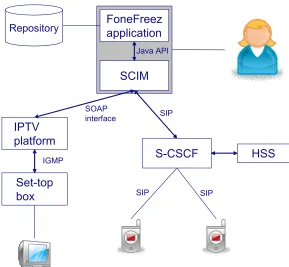
The two different services, IP television and IP telephony, can be used stand alone, without the FoneFreez application. The Service Capability Interaction Manager (SCIM) provides the interaction between the television and telephone service and decides on which events to take action. In this implementation all components reside in the same realm; the TNO’s research realm. It is also possible that they are located in different realms, this is taken into account at the design of the implementation of the project.
The IP telephony services architecture is based on the IMS architecture. The Serving-CSCF (S-Serving-CSCF) functions as the SIP server and the HSS stores the user profiles. The SIP protocol is used to communicate between the telephones, the S-CSCF and the SCIM. Because the SCIM is part of the IMS architecture, it is commonly located in the same realm as the IP telephony service.
Wendy Ooms, Master Thesis 4 - Case description
The two functional entities, the FoneFreez application server and the SCIM, are in this case combined in one physical device. Next to the application server a repository resides. In this repository the combinations of the ID that the user has at the telephony service and the ID the user has at the television service are linked together. In this way the FoneFreez service can interrupt the correct television service when the phone is picked up.
4.2
Interaction
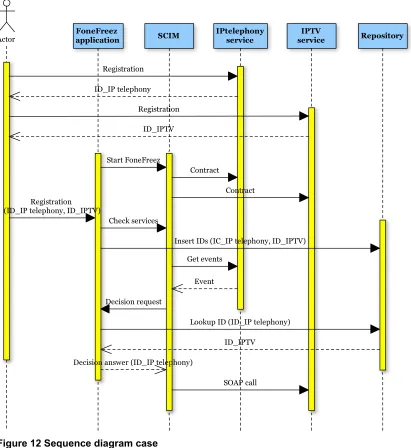
Wendy Ooms, Master Thesis 4 - Case description
Figure 12 Sequence diagram case
4.3
Business roles model
The business roles that are identified for this FoneFreez case are: - End-user
- Service provider providing IPTV
- Service provider providing IP telephony
- Application service provider providing the interaction service
Wendy Ooms, Master Thesis 4 - Case description
Service provider 1
Broker Application
service provider Service
provider 2
FoneFreez
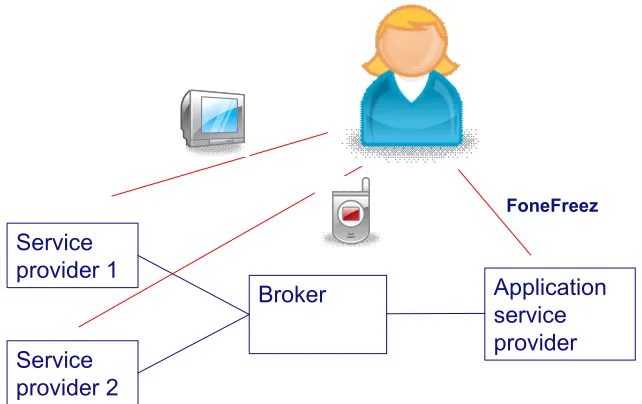
Figure 13 Business roles model
As can be seen in Figure 13, three different roles have a relationship with the end-user. The FoneFreez service is a complementary service and is not a packager for the IPTV and IP telephony service. This is why the relationships of the end-user with the service providers remain to hold after the user decides to subscribe to the FoneFreez service.
The reason why there are four different roles identified apart from the end-user, is that with three roles the possible functionalities are not decomposed sufficient. A conceivable alternative is the combination of the broker and application service provider, or the combination of one of the service providers with the broker.
In the implementation of FoneFreez the broker and application service provider are implemented in one device. This is a logical explanation if you look at the FoneFreez service with little value added on top of the interaction. When more value is added, the separation of the broker and application service provider is desirable.
In the current IMS implementations, the broker is combined with service provider. In this implementation it is possible to have a third party application service provider. Because of both implementations mentioned above, four different roles should be identified.
Wendy Ooms, Master Thesis 4 - Case description
minimum of one actor and a maximum of 4 actors (besides the end-user) are allowed in this case.
In theory the business roles could be further decomposed in smaller roles, but that is not done for this case. For the reason that it is feasible that the roles defined above are played by one actor and not more actors. How the roles are further decomposed is left to the actor implementing the role.
4.4
Implementation of business roles
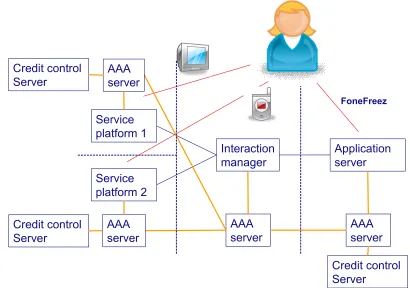
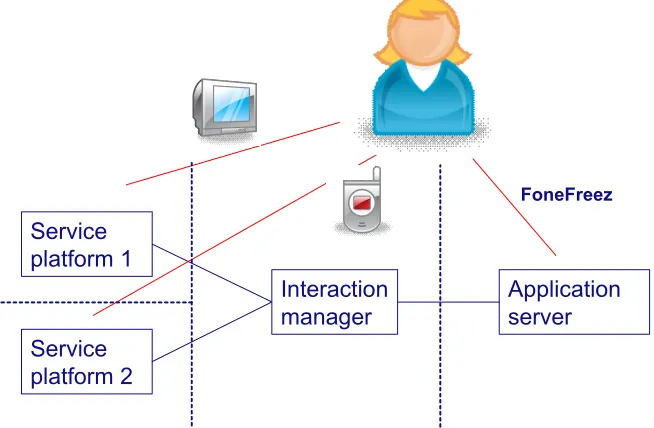
The roles are implemented with different functional entities. The application service provider is implemented by an application server functional entity. The role of the broker is implemented by an interaction manager. The service provider roles are implemented by service platforms. These service platforms consist of more functional entities like in the IP telephony situation, an S-CSCF and HSS entity, but this level of decomposition is not needed at this stage. The functional entities each in their own domain, separated by the dashed lines, are shown in Figure 14.
Service
Figure 14 Implementation of business roles
Wendy Ooms, Master Thesis 4 - Case description
and these functions cannot reside in different realms in the current IMS specification. The interaction manager, as meant in this document, is the implementation of the broker, which provides interaction between different application servers and underlying services.
4.5
Conclusion
Wendy Ooms, Master Thesis 5 - Requirements
5
Requirements
This chapter describes the requirements on the specification and the constraints which the solution has to meet. In case of multiple possible solutions the acceptance criteria are used to evaluate which solution is best [Dodd, 2003].
The method that is used to formulate the requirements is denoted as scenario-based requirement elicitation [Whittle et al, 2004]. Scenario-based requirement elicitation means to generate requirements from scenarios. The scenario is drawn up with the help of experts from different fields of work: multi-domain, IMS, security, accounting. From the scenario the requirements follow logically, for example when the scenario is: ‘the user registers with the service’, then the requirements are: ‘the user is identified at the service, is authenticated and authorized to use the service.’
First the scenario is described followed by the use-cases found in the scenario. The following sections of this chapter describe the functional and non-functional requirements. Then the constraints are given which the solution has to meet, followed by the acceptance criteria.
5.1
Scenario
This section describes one possible scenario that takes place when AAA functionality is added to the case described in the previous chapter. The scenario combines the events that can be seen from the end-user perspective and the events that take place between the other business roles.
A user registers first with an IPTV service at its cable television provider and IP telephony service at its telecom provider. The user is identified, authenticated and authorized to use both services. Accounting information about the usage of the services is maintained.
Wendy Ooms, Master Thesis 5 - Requirements
After registration the interaction service starts and the user is authenticated and authorized to use the interaction service. The interaction service is authenticated to and authorized by the broker. The broker is authenticated and authorized by the IP telephony service from the telecom provider, and authenticated and authorized by the IPTV service from the cable television provider. They authorize the broker to intervene at their services.
The user starts to watch TV. A call for the user reaches the IP telephony service. The call is identified and authenticated at the broker. The broker contacts the interaction service, which identifies the user and looks up the users TV session and authorizes the call to continue to the user. The TV session is interrupted as the user picks up the phone. The broker makes a SOAP-call for the given session of the user on the IPTV platform and is authorized to place the call. When the user hangs up, the SIP server identifies the user and contacts the broker. The broker contacts the interaction service, to find out which action to take, and is authorized by the IPTV service to place a SOAP-call on the IPTV service to resume the users session.
At the interaction service the accounting records are maintained about the frequency and duration that the service is used. The user can be billed for the usage of the service. The costs are deducted from the pre-paid account of the user. The broker can register the usage of the interaction by the IPTV service and IP telephony service. All parties maintain accounting records about the usage of the service for which they can bill each other later or agree on a flat fee.
5.2
Actors and use cases
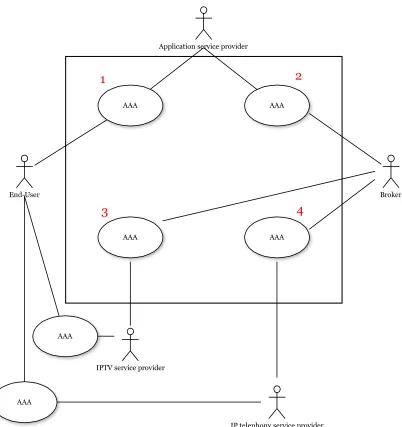
From the business roles and the scenario described above several use cases can be derived. The UML notation used for depicting the use cases in a use case diagram requires actors, which are the business roles. As described in section 4.3, in this case every business role is a different actor.
Wendy Ooms, Master Thesis 5 - Requirements
End-User
Application service provider
Broker
IP telephony service provider IPTV service provider
AAA AAA
AAA AAA
AAA
AAA
1
2
3
4
Figure 15 Actors and use cases
The numbers 1 to 4 are used at the requirements in section 5.3.
5.3
Functional requirements
This section describes the functional requirements that will be used as criteria during the specification of the AAA support for interacting services from different realms. These requirements are derived from the scenario described in section 5.1.
These requirements belong to the use case identified with number 1 in Figure 15: - Identification of the interaction service user to the interaction service
- Authentication of the interaction service user to the interaction service - Authorization of the interaction service user to the interaction service - Accounting of the usage of the interaction service per user
Wendy Ooms, Master Thesis 5 - Requirements
These requirements belong to the use case identified with number 2 in Figure 15: - Authentication of the interaction service to the interaction manager
- Authorization of the interaction service to the interaction manager
- Accounting of the usage of the interaction manager by the interaction service - Re-authentication of the interaction service to the interaction manager
These requirements belong to the use case identified with number 3 in Figure 15: - Authentication of the interaction manager to the IPTV service
- Authorization of the interaction manager for a particular user at the IPTV service - Authorization of the interaction manager for the execution of a particular event at the IPTV service
- Identification of the user at the IPTV service by the interaction manager - Accounting of the usage of the IPTV service by the interaction manager - Re-authentication of the interaction manager to the IPTV service
These requirements belong to the use case identified with number 4 in Figure 15: - Authentication of the interaction manager to the IP telephony service
- Authorization of the interaction manager for a particular user at the IP telephony service
- Authorization of the interaction manager for the execution of a particular event at the IP telephony service
- Identification of the user at the IP telephony service by the interaction manager - Accounting of the usage of the IP telephony service by the interaction manager - Re-authentication of the interaction manager to the IP telephony service
5.4
Non-functional requirements
This section describes the non-functional requirements that will be used as criteria during the specification of the AAA support for interacting services from different realms. These requirements are derived from the scenario described in section 5.1.
- Limited interactions added between realms
Wendy Ooms, Master Thesis 5 - Requirements
5.5
Constraints
This section describes the constraints that will be used as criteria for the specification of the AAA support for interacting services from different realms. These constraints must be met by the specification. When a specification does not meet one of these requirements, is it not a valid solution. These constraints are derived from interviews with experts and subsequent analysis.
- Interaction is enabled using an interaction manager
- Different realms exist for the interaction service and interaction manager and the IPTV and IP telephony service
- More than one user can be identified and use the service
- The IPTV and IP telephony service can be used stand alone, without the interaction service
- The user is billed on a prepaid basis
- Extensions to the Diameter protocol must follow the rules as defined in the Diameter base protocol ‘Approach to Extensibility’
5.6
Acceptance criteria
This section describes the acceptance criteria that are used to differentiate between the possible solutions. For each specification is measured to what extent it is compliant to the criteria described below. These criteria are derived from interviews with experts and subsequent analysis.
- Extendable, more operators and more applications can be added - Level of trust between domains
- Minimal number of components that are needed to realize the architecture - Minimal number of interactions/packets between realms
- Reuse of Diameter architecture in services that are based on IMS - Easy identity management – exchanges of identities
- No/minimal alterations to the Diameter specification
5.7
Conclusion
Wendy Ooms, Master Thesis 5 - Requirements
Wendy Ooms, Master Thesis 6 - Solution phases
6
Solution phases
To map the solutions found in literature to the FoneFreez case, different phases are distinguished. The three types of authentication: device authentication, user authentication and message authentication can be mapped on different phases.
First trust between the different parties must be established and the connections made. Authentication between the devices is done in this phase. Then the user registers itself at the FoneFreez service. This all happens in the initialization phase. In this phase it must be checked whether the user is also registered at the television and telephony provider.
The next phase is the log-on phase. When the user comes home and wants to start the service, he logs-on at the FoneFreez service. The authentication and authorization must be done for the end-user, but also between the parties for that session.
After the log-on phase, the operational phase starts. Then the actual interaction service comes into place. In this phase re-authentication is possible and on message level authentication and authorization must be done. The usage of the service by the different parties must be registered in accounting records.
This chapter describes the different phases and issues that are of importance in every phase.
6.1
Initialization phase
The initialization phase consists of trust establishment; this is especially relevant when the entities reside in different domains. The starting point is where the physical connections already exist. But before it is possible to transport information over the connections, trust must be established. Several mechanisms for the creation of the trust relationship are available: by contract or protocols that help establish trust [HP, 2002b]. In this thesis protocols for dynamic trust establishment are considered, because this improves the flexibility of the solution.
Wendy Ooms, Master Thesis 6 - Solution phases
insert entries in the database. When the user is registered at the interaction service it must be checked whether the user is also registered at the television and telephony providers. It is not desirable that the identity under which the user is known at the different parties is exchanged, so the exchange of identities must be done with respect for the privacy of the user. This management of identities is an issue during registration in the initialization phase.
The initialization phase is a one time event, which only takes place once for each user. For every user this phase must be passed through.
This section discusses how trust can be established between parties and how trust is established within Diameter. Furthermore the identity management issue is amplified, for verifying the registration of the user at the service providers.
6.1.1
Types of trust
There are different sorts of inter-realm trust: one-way trust, two-way trust and hierarchical trust.
In a one-way trust situation, a user from domain A can use the resources in domain B but not the other way around. Domain A gave its secret to domain B. For users from domain B is it not allowed to use resources from domain A, because domain B did not give its secret to domain A.
In a two-way trust situation resources can be used in both directions, because both domains know each others secret.
Wendy Ooms, Master Thesis 6 - Solution phases
Hierarchical trust is a chain of trust that is built on the hierarchical relationships. If there is two-way trust between every realm in the example, then realm B can use resources from realm D based on the hierarchy.
Trust can be transitive. When there are three parties and two of them directly trust the same party (A trusts B, B trusts C), automatically an indirect trust relationship is established between A and C. Transitivity can be the case with one-way and two-way trust situations [Gleason, 2002].
6.1.2
Ways to establish trust
Trust can be established by arranging a contract between two parties. In this contract a shared secret can be agreed on, that is used to connect the servers with. But this shared secret can also be dynamically established.
Authentication can be done at different levels. PKI and Kerberos are lower level key- or certificate-exchanging mechanisms to establish trust [Oasis, 2004]. When trust is established and a connection is setup between the two parties, authentication and authorization is needed to negotiate which rights one domain has in the other domain.
Inter-realm authentication for building trust is realized using Kerberos [RFC 1510]. Kerberos is an entity authentication protocol, most used to mutually authenticate two servers that reside in different domains. It protects authentication information from threats like eavesdropping and uses a secret key encryption mechanism [Michiels, 2003]. Kerberos is used to provide inter-realm authentication between different servers, like the application server and the interaction manager. However it cannot be used to authenticate specific events, because this is authentication on a higher level and belongs to the operational phase.
Wendy Ooms, Master Thesis 6 - Solution phases
Diameter servers. The CA exchanges keying material with which the Diameter servers can built a trust relationship.
Figure 17 Eduroam Certificate authority [Eertink et al, 2005a]
The certificate authorities are especially for Diameter and must not function as certificate authorities for other purposes like web services. As stated in the RFC of Diameter: “In general, it is expected that those root CAs will be configured so as to reflect the business relationships between the organization hosting the Diameter peer and other organizations.” It is because of security considerations that the CA is especially for Diameter, so that the Diameter peer is configured to disallow connectivity with any arbitrary peer [RFC 3588].
In Diamete
![Figure 9 Simplified IMS reference architecture [Fried et al, 2006] The Diameter protocol is used for provisioning of AAA in the IMS architecture](https://thumb-us.123doks.com/thumbv2/123dok_us/1038684.1129430/36.595.76.443.243.641/figure-simplified-reference-architecture-diameter-protocol-provisioning-architecture.webp)
![Figure 17 Eduroam Certificate authority [Eertink et al, 2005a] The certificate authorities are especially for Diameter and must not function as certificate authorities for other purposes like web services](https://thumb-us.123doks.com/thumbv2/123dok_us/1038684.1129430/55.595.124.500.124.390/certificate-authority-certificate-authorities-especially-diameter-certificate-authorities.webp)