Available online: https://edupediapublications.org/journals/index.php/IJR/ P a g e | 4847
Implementation of vehicle accident avoidance system
utilizing raspberry pi
K.R Anusha Hinduja& D. Shirisha
[1]Assistant Professor, Department of ECE, SRTIST, Hyderabad, T.S, INDIA
[2]Assistant Professor, Department of ECE, Siddhartha Institute of Science & Technology, Hyderabad, T.S, INDIA
Abstract-Vehicle collision avoidance and obstacle detection system is one of the most critical factors in the automotive field. In the present, most of the vehicles enable an alert system which acts as a safety feature for the passengers. In this work, advanced navigation system which detects and avoids the object, is used in autonomous vehicles to safely navigate through the path. This system detects the obstacle in front of the vehicle, alarms the system and moves away. Camera is used for the purpose of detecting moving or stationary objects. The ultrasonic sensor is enclosed with this system to compute the distance of real-time moving and the stationary object. The main work contributes the detection of obstacles ahead of the vehicle. The alarm is given to the system in the vehicle regarding the obstacle in front so that the system helps in collision avoidance. In this work, the distance between the vehicle and obstacle is measured by the ultrasonic sensor and object detection is done by the camera. By fusing both these sensor values the obstacle is detected and the distance is also accurately measured.
I. INTRODUCTION
With the emerging of new technologies in different field of science the human life has become more comfortable and effortless. Advancement of embedded technologies in
automotive industries makes the human life safer and convenient for living. According to a survey there about 1.3 lac deaths in India which are caused by road accidents. The obstacle detection in real time is the most versatile and challenging task for road vehicle and passenger safety. The very first obstacle detection system was developed by Delco System Operations, Goleta of California in 1988. This system was basically a safety system which detects the obstacle on rad and alerts the driver. This system was also capable of detecting the moving objects on nearby lane [1]. After this system, another object detection technique is implied in automotive that make use of infrared sensor, radar and ultrasound sensors [2]. The increasing demand of embedded technologies in automotive industry provides a better and reliable safety feature for the passenger and driver safety.
Available online: https://edupediapublications.org/journals/index.php/IJR/ P a g e | 4848
driver so that the driver may apply brakes or steer the wheels and avoid collision.
In this proposed ultrasonic sensor are planned to be implant for the detection purpose as they can detect the object very close to the vehicle and have an immediate response and generates an accurate distance between the obstacle and the vehicle. Road traffic accidents (RTAs) had become an important factor in public health and development problem in India. RTAs involve high percentage of damages in human life in various levels. Although there are various measures had been taken to reduce accidents [6]. A survey by ministry of road transport & highway in 2010 reports around 5 lakh accidents in India in which 1.3 lakh people were dead and 5.2 lakh were injured. RTAs Kill almost 1.2 million people a year and injuring or disabling between 20-50 million people around the world. This clearly shows the importance of a crash prevention and avoidance systems in today’s automotive industry. This project aims to create a low cost, retrospective solution that can be implemented in large scale to help reduce a significant number of accidents. This is by no means a fully autonomous system as it is, but an effective driver assistance system which helps the driver use an automobile in a safe way without getting into a crash situation from which the driver may find it hard to get out of. The system can also help a panicking driver to safely get out of the crash scenario. This system contains two levels of assistance, the first level being a driver alerting system followed by a controlled braking process.
II. PROPOSED SYSTEM
In the proposed work the ultrasonic sensors are planned to be used as these sensors are able to measure the distance at close distance. The ultrasonic sensors are used to detect and measure the distance with respect to moving or stationary objects. The ultrasonic sensors are implanted in such a way that they can be used to detect the obstacle present in front of the vehicle as well as obstacle present in the blind spot of the vehicle [7]. This system can be implemented in the vehicle which able to measure the distance. This system is needed to be designed especially for Indian transport scenario at mostly highway side and traffic zone area where the number of accidents has take place due to blind spot and suddenly coming of any object on road.
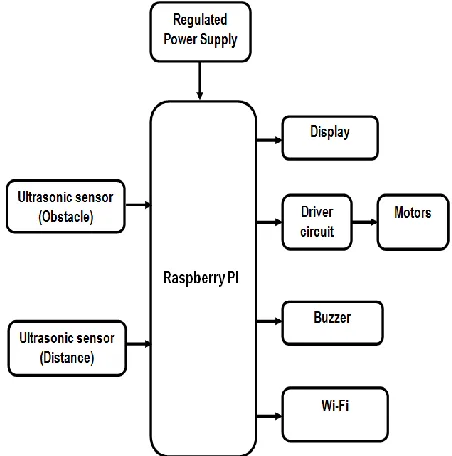
Figure 1: Proposed system block diagram
A. Raspberry Pi:
Available online: https://edupediapublications.org/journals/index.php/IJR/ P a g e | 4849
open-source Robot operating system. The board consists of Video Core IV graphics processing unit (GPU), ARMv7-compatible quad-core one, 512 MB of RAM. It has a Micro SD to boot media and for persistent storage. One powerful feature of the Raspberry Pi is the row of GPIO -General Purpose Input/output pins along the edge of the board (refer Fig.1.1). These pins are a physical interface between the Pi and the outside world. At the simplest level, these are called as switches. Seventeen of the 26 pins are GPIO pins; the others are power or ground pins.
B. Ultra sonic sensor (HC-SR04):
An Ultrasonic sensor is a device that can measure the distance to an object by using sound waves. It measures distance by sending out a sound wave at a specific frequency and listening for that sound wave to bounce back. By recording the elapsed time between the sound wave being generated and the sound wave bouncing back, it is possible to calculate the distance between the sonar sensor and the object.
C. Ultrasonic sensor (GH-311):
The GH-311 sensor detects objects by emitting a short ultrasonic burst and then listening" for the echo. Under control of a host microcontroller (trigger pulse), the sensor emits a short 40 kHz (ultrasonic) burst. This burst travels through the air, hits an object and then bounces back to the sensor. The GH-311 sensor provides an output pulse to the host that will terminate when the echo is detected; hence the width of this pulse corresponds to the distance to the target.
III. WORKING PRINCIPLE
In the proposed work the system is going to be implemented using Raspberry - pi board along with ultrasonic sensor module. Figure-1 represents the block diagram of the collision avoidance system. The system comprises of Raspberry - pi as central unit surrounded by three ultrasonic sensors, one in front of the vehicle and others are placed on the blind spot of the vehicle. The LCD display, buzzer and LED are connected with the raspberry board which shows the distance between the object and alert the driver prior collision. The control unit is the main processing unit through which all the other modules are connected. The ultrasonic sensor GH - 311 is a high range sensor which can detect the obstacle up to 8 meters. This sensor module is implemented in the front of the vehicle which serves as forward vehicle collision avoidance. The other two sensor modules HC - SR04 are used in such a way that they can detect the obstacle in blind spot of the vehicle. The sensor can detect the distance between the vehicle and the obstacle. The calculated distance can be displayed on the LCD and a buzzer is blown to alert the driver if the distance between the obstacle and vehicle crosses the minimum safe distance.
IV. RESULTS
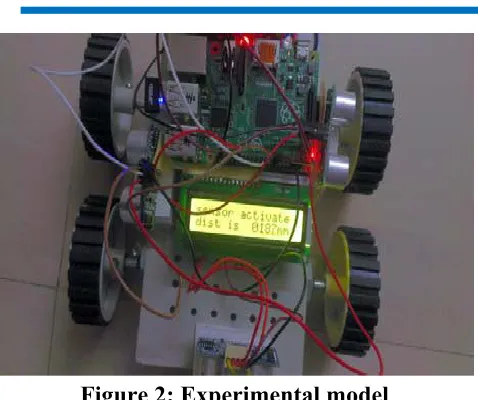
Available online: https://edupediapublications.org/journals/index.php/IJR/ P a g e | 4850 Figure 2: Experimental model
Figure-2 representing the experimental model of the proposed system model. An obstacle is placed in front of the vehicle and on left and right side.
Figure 3: Real time demonstration setup
Figure-3 represents the real time demonstration setup of proposed system model which represents the collision avoidance system. The system starts detecting the obstacle as it comes in the range of the vehicle and the measured distance is displayed on LCD display board, buzzer is blown and indication by LED.
Figure 4: Result on Raspberry Pi
The programming language used here is python which is the basic language of the Raspberry pi. Figure-14 represents that the above output is acquired while testing the demonstration model in a real time scenario. This result is shown on the terminal screen of the Raspberry pi in Figure-4.
V. CONCLUSION AND FUTURE WORK
In this paper, an effective method is proposed for the collision avoidance system of a vehicle to detect the obstacle present in front and blind spot of the vehicle. The driver is made alert via a buzzer and LED indication as the distance between vehicle and obstacle reduces and is displayed on display board. The ultrasonic sensor detects the state of the object whether it is in motion or static with respect to the vehicle. This system is useful for detecting vehicle, motorcycle, bicycle and pedestrians that pass by the lateral side of vehicle.
Available online: https://edupediapublications.org/journals/index.php/IJR/ P a g e | 4851
are beyond the range of the ultrasonic sensor module. The system will be made independent by applying the brake automatically through ABS and accidents can be avoided. However, for future work the system can found the direction and oncoming vehicles headlight intensity control. The designed system should have the good efficiency and less weight compared to the old one.
REFERENCES
[1] Jaehyun Han, Dongchul Kim, Minchae Lee
and Myoungho Sunwoo, “Enhanced Road Boundary and Obstacle detection using a Downward Looking LiDAR Sensor”, IEEE March 2012.
[2] Byoung-Suk Choi and Ju-Jang Li,
“Localization of a Mobile Robot Based on an Ultrasonic Sensor Using Dynamic Obstacles”, International Symposium on Artificial Life and Robotics, Volume 12, Issue 1-2, pp. 280-283, 2008.
[3] Wende Zhang, “LIDAR-Based Road and
Road-Edge Detection”, IEEE Intelligent Vehicles Symposium (IV), pp. 845-848, June-2010.
[4] Jiann - Der Lee and Kuo - Fang Huang, “A
Warning System for Obstacle Detection at Vehicle Lateral Blind Spot Area”, 7th Asia Modelling Symposium, pp. 154-159, 2013.
[5] Bin-Feng Lin, Yi-Ming Chan, Li-Chen Fu,
“Integrating Appearance and Edge Features for Sedan Vehicle Detection in the Blind-Spot Area”, IEEE Transactions on Intelligent Transportation System, Vol. 13, No. 2, June 2012.
[6] A.K.UPADHYAY, “Road accidents in
india 2010,” ministry of road transport and highways, 2010.
[7] C.T. Chena and Y.S. Chen, “Real-Time
Approaching Vehicle Detection in Blind Spot Area”, IEEE Conference on Intelligent Transportation System, October 2009.
Author’s Profile
K.R Anusha Hinduja she received M.TECH degree from JNTUH, India, and currently working as an Assistant Professor at “Swami ramananda thirtha Institute of Science & Technology”, Nalgonda India.
D. Shirisha was born in hyderabad, India, in 1986. She received M.Tech degrees from JNTUH, India, in 2014 and currently working as an
Assistant Professor at “Siddhartha Institute of
Science & Technology”, Ghatkesar, Hyderabad,