ISSN: 1992-8645 www.jatit.org E-ISSN: 1817-3195
NOVEL GAP ANALYSIS FRAMEWORK
FOR CLOUD HEALTH INFORMATION SYSTEMS
IRFAN SYAMSUDDIN
CAIR – Center for Applied ICT Research Department of Computer and Networking Engineering
School of Electrical Engineering State Polytechnic of Ujung Pandang, Makassar
South Sulawesi,INDONESIA
E-mail: [email protected]
ABSTRACT
This study aims to propose a novel gap analysis framework that can be used to identify any problems in Cloud Health Information Systems projects. Advance implementation of cloud computing to improve Health Information Systems needs a comprehensive gap analysis methodology considering many aspects associated with the technology. The new gap analysis is derived from two widely used methodologies namely ITPOSMO and ServQUAL. The way to integrate both techniques is discussed along with how it could be easily applied by evaluators of Cloud Health Information Systems projects.
Keywords: Cloud Computing, Information Systems Evaluation, Gap Analysis, ITPOSMO, ServQUAL,
Cloud Health Information Systems.
1. INTRODUCTION
Evaluation or assessment on information systems (IS) projects is vital to identify success and failures factors associated to the project. It is commonly referred to the last step of SDLC (System Development Life Cycle) as a critical action
commonly performed by middle and top
management within organization and or sometimes accompanied by the IS project manager.
Advancement in information systems technology can also be seen in the field of health management systems. Starting from basic digital record management and clinical information systems until recent telemedicine solutions based on cloud computing technology [1].
Nevertheless, introduction of advanced
technology to streamline health information systems does not always guarantee that the implementation will always ended up with success. In fact, many factors are responsible for making gap between what is expectated to be achieved and reality of the IS project being applied such as technical, social, human and others.
Therefore, any IS projects should undergone adequate assessment to ensure whether they already in line with the project goal or not.
Commonly the evaluation focused on efficiency, effectiveness and success rate of the project.
While some attemps have been done to develop assessment methods in terms of outcomes, some others put their efforts on defining guidelines to assist in reducing gaps between an ideal successful IS project as planned and a reality being faced at the end of the project [2].
If oversize gap between project design and reality exist, then the IS project is considered as fail. In contrast, the lesser gap found between project design and reality means the project successfully fulfills its goal.
The main aim of this paper is to introduce a novel gap analysis which is an integration of ITPOSMO methodology by Heeks [3] and service quality
assessment method called ServQUAL by
Parasuraman, et.al [4]. Both methods are presented and how they could be combined for better gap analysis is discussed.
ISSN: 1992-8645 www.jatit.org E-ISSN: 1817-3195 is presented in detail in section 4. Finally, the last
section summarizes the paper.
2. ITPOSMO METHODOLOGY
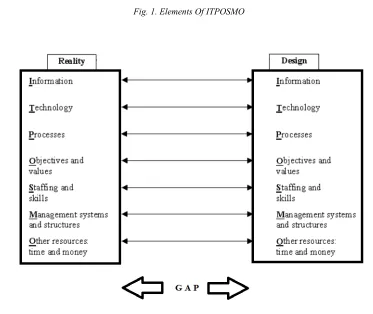
ITPOSMO which stands for (Information, Technology, Processes, Objectives and values, Staffing and skills, Management systems and structures, Other resources) is one of well known methodology to conduct gap analysis. ITPOSMO methodology was proposed by Professor Heeks from Manchester University, United Kingdom [3].
According to Heeks, after analyzing a number of case studies on the implementation of the projects of e-government, whereas some of them success while some other ended in failure, especially those in developing countries, there are three fundamental aspect of the fundamental IS to view the issue called Technical, Human, and organization.
Then, the three aspects are extended into seven specific elements that contribute mostly to the success or failure of an e-government project this later then known to be ITPOSMO gap analysis methodology [3].
As depicted in figure 2, there are seven elements of ITPOSMO that mostly contributed to the success or failure of an e-government project as follows [3]:
a. Information. The system design assumed that its creation of formal strategic information would be
value to functioning. In reality, informal
information was what decision makers valued and used.
b. Technology. This factor plays important tole in the project, comparing the requirement contained within the design of the e-government (project) application vs. the real situation.
c. Process. The system design assumed that a rational model of structured decision-making. This mismatched the dominant reality of personalized, even politicized, unstructured decision-making
d. Objectives, Values, Motivation. These are three elements that stakeholders usually need for
successful of project implementation and
application in comparison to the current real objectives and values.
e. Staffing, Skills. Both staffs and its related skill levels/types required sometimes could not be achieved which need careful consideration.
f. Management and Structures. In this factor adequate management and structures are strongly required to ensure to avoid failure.
g. Other resources. It involves time, money and other resource that might be related to the success of project implementation and operation.
Heeks’s gap analysis mentioned that failures in many e-government projects particularly in developing countries exists due to an oversize gap between project design and reality seen from seven elements of ITPOSMO [3].
In order to perform qualitative analysis within ITPOSMO methodology, a sequence of value from “0” to “10” and its corresponding means are used as depicted in the following table.
Each of the ITPOSMO elements will be valued individually. Later, all of them are sum up and the total value represents “Gap Value” between design and reality of an e-government project.
- Gap value from 57 to 70 indicates the e-government project is certainly fail
- Gap value from 43 to 56 indicates the e-government project may seriously fail.
- Gap value from 29 to 42 indicates the e-government might partially fail.
- Gap value from 15 to 28 indicates the e-government project somewhat fail.
- Gap value from 0 to 14 indicates the e-government project well success
In short, the lesser gap value the better an
e-goverment project performing according to
ITPOSMO methodology [3][5].
Although, ITPOSMO methodology was derived from e-government case studies [3] and widely used in assessing e-government success and failure levels [5], there is no significant barrier to apply it in other
Information Systems related projects and
ISSN: 1992-8645 www.jatit.org E-ISSN: 1817-3195
Fig. 1. Elements Of ITPOSMO
Fig. 2. Itposmo Method
Table I
Meaning Of Itposmo Gap Values
Gap Analysis
No Gap Middle Gap Serious Gap
[image:3.612.117.490.216.530.2]ISSN: 1992-8645 www.jatit.org E-ISSN: 1817-3195
3. SERVQUAL ANALYSIS
ServQUAL or Service Quality was originally developed by Parasuraman and other researchers in the field of marketing for measuring service quality in general [4]. ServQUAL methodology identifies basic dimensions that reflect service attributes used by consumers in evaluating the quality of service provided by service businesses.
There are five dimensions of the reference measurements taken costumer the services as follows [4]:
a) Tangibles: physically visible aspects of such equipment and personnel officer.
b) Reliability: the ability to have performance that can diandalan and accurate.
c) Responsiveness: willingness to respond to the wishes or needs to be costumers and assistance of fast service.
d) Assurance: the ability of personnel to instill trust and security to customers.
e) Empathy: the willingness of personnel to care and care for each customers.
Quality of service is measured on each dimension on top by calculating G variables that describe the difference or gap between customers' perception services provided to the customer expectations [4].
As noted in [7] ServQUAL is comprised of two matched scales of 22 items. Each describing expectations for a particular service category and perceptions of a particular service provider. The expectations are not viewed as predictions, but as desires or expected by the consumers. Both sets of items are applied by using likert scale from 1 of Strongly Disagree to 7 of Strongly Agree.
The quality of service is assessed through this ServQUAL score, called the gap score computed by taking the difference for 1 to –7 scales and then averaged over the number of items either in the total scale or for each subscale [8].
The method dimensions might be easily adapted to different service settings, in different field of study depending on the nature of inquiry. As a result of its practicality, application of the measurement approach has been identified as one of the major strengths of ServQUAL over other measuring methods.
- the reliability and validity of the scale in comparing customers’ expectations and perceptions over time;
- the ability to compare own SERVQUAL scores against competitors;
- the relative importance of the five dimensions in influencing service quality perceptions;
- the potential use of measure in segmenting customers into several perceived quality segments
- the ability to analyse on the basis of demographic, psychographic, and other profiles
- the practical implications for companies to improve the global perception of its service quality
As a quantitative methodology in gap analysis, ServQUAL has also been criticized by researchers and practitioners [9]. Despite these criticisms, other researchers such as Ladhari [10] who asserts that SERVQUAL remains a useful instrument for
service‐quality research after reviewing 30 different
applications of SERVQUAL as seen in literature
within a period of 20 years (1988‐2008).
4. CLOUD HEALTH INFORMATION
SYSTEMS
To date, Health Information Systems (HIS) has been realized as an integrated effort to collect, process, report and use health related data, information and knowledge in order to provide better health institutions management, patient data organization, policy making and decision, and other actions and research related to health services [1].
Although HIS is even considered as the foundation of advanced public health services in todays connected world, there are some issues appear in practical implementation which often covers many benefits of HIS [2]. Among them are poor data quality, incomplete, inaccurate, untimely, obsolete, and unrelated to priority tasks and functions of local health personnel. In addition, HIS developed in developing countries are often provide irrelevant information, lack of timely reporting and feedback and also duplication of data among health information systems due to inexistence of national coordination at central government level [1].
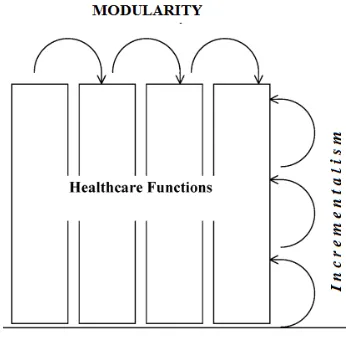
ISSN: 1992-8645 www.jatit.org E-ISSN: 1817-3195 apply modularity by means of HIS development
must be focused on single specific healthcare function at a time. At the same time, in supporting modularity steps it must be done incrementalism by means of providing stepped levels of support for a healthcare functions within any HIS projects.
[image:5.612.334.502.136.277.2]By applying modularity and incrementalism on each particular healthcare function, the project can be done as pilot and scale up by focusing in particular area first and then gradually rolling-out same HIS project to other locations [2].
Fig. 3. HIS Development Stages
Adoption of cloud computing technology is strongly considered by decision makers in order to provide better structuring and coordination of health information systems at national level as well as reducing cost of development at significant level. Using cloud approach to HIS will also reduce overlapping and extra cost since centralized HIS on the cloud provide the solution for such issues. Therefore, it is important to apply HIS development
stages by combining modularity and
incrementalism to the Cloud Health Information Systems.
Typically, cloud computing technology might be deployed in three modes (private, public and hybrid), three type of services implementation (Infrastructure, Platform and Software), and also
enables many features such as elasticity,
virtualization and reliability [11].
In this case, Cloud HIS is deployed as a private cloud in the form of Infrastructure as a Service (IaaS) over virtualized environment using Linux
operating system and open source cloud application called OwnCloud which is modified according to the requirements.
[image:5.612.106.279.234.407.2]
Fig. 4. Cloud Health Information Systems
Current Cloud HIS implementation requires a set of gap analysis tool to early indicate any possible problems that should be solved as soon as possible. In order to deal with the issue, a new gap analysis framework is proposed which is a combination of ITPOSMO methodology and ServQual analysis tool.
5. NEW GAP ANALYSIS FOR CLOUD HIS
Cloud Health Information Systems is a unique information systems designed specifically to enhance healthcare services. In addition, the nature of cloud technology that considers computing services as utility services has also added the dynamic perspective of computing utility service in comparison to traditional one.
Therefore, the need for a new model that encapsulates all of these requirements is inevitable. Our approach is to combine both ITPOSMO and ServQual to produce a novel gap analysis suitable for tackling Cloud HIS.
ITPOSMO’s seven elements are used as dimension in which gap analysis must be done for Cloud HIS. In terms of Cloud HIS which is actually a private cloud in the form of Infrastructure as a Service (IaaS) ran over virtualized open source environment, all ITPOSMO elements are strongly relevant.
ISSN: 1992-8645 www.jatit.org E-ISSN: 1817-3195
Fig. 6. Novel Gap Analysis Framework For Cloud HIS Evaluation
However, analyst in the field not satisfied with the use of scale from 0 to 10 to capture exist or not gap from each element’s perpective.
On the other hand, ServQual provides strong measurement scales as well as its definition and scope. As depicted in figure 5, there are five levels of gap that commonly exist in practice described as follows :
- Gap 1 exists when provider may have inaccurate perceptions of what user (consumers) actually expect.
- Gap 2 exists in case of inability on the provider side to translate user expectations into service quality specifications.
- Gap 3 exists ehen guidelines for service delivery do not guarantee high-quality service delivery or performance.
- Gap 4 exists in case of consumer expectations are influenced by the external communications of an organization.
- Gap 5 exists as a results of those four gaps which is the difference between user expectations and perceptions of the service actually received.
Finally a novel gap analysis is developed as an
6. SUMMARY AND FUTURE WORKS
In this paper, an attemp to develop a new gap analysis framework to deal with Cloud Health Information Systems evaluation is presented and discussed. A novel gap analysis framework is derived by combining ITPOSMO and ServQUAL. This research will be extended by involving decision makers and evaluators to use the gap analysis to evaluate an ongoing Cloud HIS.
ACKNOWLEDGEMENT
This study is financially supported by the Ministry of Research and Higher Education, Republic of Indonesia.
Submitted : January 2016, Revised : April 2016, and Accepted : May 2016
REFERENCES:
[1] T. Lippeveld, R. Sauerborn, and C. Bodart,
Design and implementation of health
information systems. Geneva: World Health Organization. 2000.
[2] R. Heeks, “Health information systems: Failure,
ISSN: 1992-8645 www.jatit.org E-ISSN: 1817-3195 [3] R. Heeks, “Most egovernment-for-development
projects fail: how can risks be reduced?. Manchester: Institute for Development Policy and Management, University of Manchester, vol 14, 2003.
[4] A. Parasuraman, V.A.Zeithaml, L.L. Berry “Servqual”. Journal of Retailing. vol.64, no. 1, pp 12-40, 1988.
[5] J. Hwang , I. Syamsuddin. “Failure of e-government implementation: A case study of
south Sulawesi”. InThird 2008 IEEE
International Conference on Convergence and Hybrid Information Technology, pp. 952-960, 2008.
[6] K. Rugchatjaroen, "Success of Electronic Government Project in Bangkok Metropolis: An ITPOSMO Approach." International Journal of Social Science and Humanity vol. 5, no. 9, 2015.
[7] W.O.Bearden, and R.G. Netemeyer, Handbook of Marketing Scales: Multi-item Measures for Marketing and Consumer Behaviour Research, (2nd edn), SAGE Publications Inc, 1999. [8] R. Arambewela and J.Hall “A comparative
analysis of international education satisfaction using SERVQUAL”. Journal of Services Research. Vol. 6, pp 141.
[9] T.P. Dyke, V.R. Prybutok, L.A. Kappelman. “Cautions on the use of the SERVQUAL measure to assess the quality of information systems services”. Decision Sciences. Vol. 30, no. 3, pp:877-891, 1999.
[10] R. Ladhari “A review of twenty years of SERVQUAL research”. International Journal of Quality and Service Sciences. Vol. 3, no ,pp. 172-198, 2009.