RAPTOR CODES FOR REAL-TIME MUD PULSE
TELEMETRY IN M/LWD SYSTEM
YU ZHANG 1, KE XIONG 2,3 , XIAOFEI DI 1, DANDAN LI 1 and ZHENGDING QIU 1
1 Institute of Information Science, Beijing Jiaotong University, Beijing 100044, China
2 School of Computer and Information Technology, Beijing Jiaotong University, Beijing, 100084, China 3 Department of Electronic Engineering, Tsinghua University, Beijing 100044, China
[email protected] , [email protected] , [email protected]
ABSTRACT
The Measurement/Logging While Drilling (M/LWD) system is a kind of sensors system which is used to help oil/gas drilling field technicians to steer well drilling. In M/LWD, several kinds of sensors are installed into drill string to measure the underground logging data during well drilling operations, and a sink within the drill string collects the logging data from the sensors and then transmits the collected data to the surface site by mud pulse telemetry. Since the drilling mud channel is an erasure channel with very limited feedback, the surface site has to protect against erasure by means of a suitable form of error control in real time. To improve the transmission efficiency of M/LWD system, this paper proposes a Raptor Codes based Transmission (RCT) scheme for reliable real-time logging data transmission in M/LWD systems, where the original logging data can be recovered at the surface site without traditional mechanisms, including erasure correction code (ECC) and Automatic Repeat Request (ARQ), which thus greatly improves the bandwidth efficiency. To further enhance the transmission performance, we introduce the Differential Pulse Code Modulation (DPCM) and short-length Raptor codes to the proposed RCT scheme. Extensive experiments performed with real logging data show that RCT scheme achieves good erasure decoding performance to provide precise enough results for drilling field technicians and also achieves good real-time performance.
Keywords: Measurement/Logging While Drilling; Short-Length Raptor Codes; Reliable Logging Data
Transmission.
1. INTRODUCTION
Measurement/Logging While Drilling (M/LWD) is a type of well logging that incorporates measurement sensors into drill string and provides real-time directional data and formation data to help with steering the drill [1]. During well drilling operations, an underground sink collects several kinds of measurement data and then transmits them to the surface site utilizing mud pulse telemetry as a transmission medium. The measurement data is very essential for field techniques to make decisions to optimize the drilling process, so how to correctly transmit the logging data from the underground sensors to the surface site became one of the key issues in M/LWD system.
Mud telemetry is a commonly used technique in oil/gas exploitation to control and transmit logging data from inside a borehole to the surface during drilling operations in M/LWD systems. The mud telemetry equipment modulates the drilling mud
circulating in the well, creating pressure pulses which are decoded at the surface into digital serial data. The surface site receives, decodes, processes, displays and stores the data for purposes of real-time or further analysis. The M/LWD system assists field technicians in realizing the interface of oil reservoir, adjusting drilling trajectory and optimizing drilling process in real time [2]. Compared with traditional logging technologies, M/LWD is able to make drilling operations more cost-efficient and available to drill wells in complex geology.
probability of drilling mud channel runs up to 5%, even although the drilling depth is less than one thousand meters. More seriously, the mud pulse conveyed in the channel usually also experiences continuous deterioration with the increment of the drilling depth [3]. When the drilling depth is over four thousand meters, the erasure probability becomes too high to deliver the real-time logging data to assists field technicians in drilling services.
As mitigation techniques for such erased logging data in mud telemetry communications, a number of methods has been studied to date: use of erasure correction coding (ECC), use of a retransmission mechanism with a request from the receiver side, such as an auto repeat request (ARQ), and use of a combination of error correction coding and retransmission request, such as hybrid ARQ. In applications in the M/LWD, sensor devices are required to reduce power consumption in order to extend the life time. Thus, retransmission mechanisms, which increase power consumption due to their sending additional data for the request, are not suitable in M/LWD. On the other hand, the use of an erasure correction code requires no retransmission since the receiver compensates the erasure packets through a decoding process. However, its design on such erasure correction codes based on the drilling mud channel state information is available at the transmitter. Unfortunately, the drilling mud channel is a time varying channel with unknown and non-uniform parameters. An optimal fixed code rate for a good state is typically unable to perform well when the channel is bad. At the other end, when the code rate is optimized for the bad state, there will typically be many unnecessary redundant bits.
So it is impractical to reliably transmit logging data in real time by using traditional ECC or ARQ mechanism. The existing M/LWD systems adopt cyclic retransmission mechanism to maintain a sufficient logging data quality at the surface receiver. But the continuous deteriorated erasure probability and very limited bandwidth (about 4~16 bit/sec) of the drilling mud channel make the existing M/LWD logging data transmission very low efficiency and very weak reliability.
To this end, this paper proposes a Raptor Codes based Transmission (RCT) scheme for reliable real-time logging data transmission in M/LWD systems, where the original logging data can be recovered at the surface site without traditional ECC and ARQ. To further improve the transmission efficiency, we introduce the Differential Pulse Code Modulation (DPCM) and short-length Raptor codes to the RCT
scheme. Experiments performed with real logging data show that our proposed RCT scheme achieves good erasure decoding performance to provide precise enough results for drilling field technicians and also achieves good real-time performance.
The rest of the paper is organized as follows. Section 2 will overview the raptor codes, where the advantages and problems on application of Raptor code in M/LWD systems will be analyzed. Section will present the proposed RCT scheme. In Section 4, we shall analyze RCT scheme and in Section 5, we will present some experiment results obtained with real logging data. Finally, Section 6 will summarize the paper with some conclusions.
2. OVERVIEW OF RAPTOR CODES
Raptor codes were designed for the adaption transmission over heavily unreliable, long-delay and characteristics continuously changed channels. It was built on Luby Transform (LT) codes [4] [5] by first applying a pre-code (for example, irregular LDPC code [6]) to the original k symbols, then applying LT code operating on the pre-code output symbols to produce potentially infinite number of output codes. Raptor codes were the first known class of fountain codes with linear time encoding and decoding. They were invented by Shokrollahi and were first published in 2004 as an extended abstract. They are considered as a significant theoretical and practical improvement over LT codes, which were the first practical class of fountain codes.
Raptor codes, as with fountain codes (or rateless codes) in general, encode a given message composed of a number of symbols, k, into a potentially limitless sequence of encoding symbols so that the knowledge of any k-element subset of the encoding symbols allows the message to be recovered with some non-zero probability. The probability that the message can be recovered increases with the number of symbols received above k becoming very close to 1, once the number of received symbols is only very slightly larger than
k. For example, with the latest generation of Raptor codes, the RaptorQ codes, the chance of decoding failure when k symbols have been received is less than 1%, and the chance of decoding failure when
k+2 symbols have been received is less than one in a million. A symbol can be any size of length, from a single byte to hundreds or thousands of bytes. The Raptor codes (n, k) can recover the original k
symbols from any set of n = k (1+ε) codes with high probability, where ε is the overhead parameter and k
Rateless codes do not assume any information about the channel and, therefore, are good matches for transmitting data over time varying channels with unknown and non-uniform parameters. So Raptor codes have a great potential to be used in M/LWD transmissions. However, in traditional Raptor code designs, the bigger the k is, the smaller the ε is. When k →∞, ε→ 0. So k is usually in excess of ten thousand [4], but the real-time requirement and typical 4~16 bit/sec bandwidth in M/LWD systems limit k less than one hundred. In this paper, short-length Raptor codes transmission scheme is designed for severe drilling mud channels.
3. RAPTOR CODES TRANSMISSION (RCT)
SCHEME
Before applying Raptor codes to M/LWD systems, some problems have to be solved. Firstly, Raptor codes rely on adding redundant information to the flow which leads low coding efficiency. Secondly, due to the real-time requirement and typical 4~16 bit/sec bandwidth in M/LWD systems, short-length Raptor codes results in an increase in ε. Both problems will degrade the real-time performance of logging data transmission. Therefore, we have to do some process to guarantee the real-time performance of logging data transmission for drilling services
A set of short-length Raptor codes (k =16 to 1024) are presented in [7]. In such codes, the pre-code LDPC adds 0.02k redundant LDPC pre-codes to each message for k =64 to 1024, and a single LDPC code for k =16, 32. Then, the transmitter which applies LT code operation to the original k codes and the accessorial LDPC codes for continuously producing Raptor codes until a 1-bit feedback is received to proceed to the next message. According to the analysis in [7], the entire message is decoded when sufficient n = k(1+ε) Raptor codes are received and in this case ε is about 0.42, 0.36, 0.29, 0.23 and 0.18 when the k is 16, 32, 64, 128 and 256, respectively. Suppose e is the erasure probability of drilling mud channel, the average number ma of sending encoding symbols is
(1
) (1
)
a
m
=
k
+
ε
−
e
. (1)To evaluate the real-time performance, we give a definition of the coding rate R as follows,
1
(
a 2)
1(1
) (
2(1
))
R
=
kh
m h
=
h
−
e
h
+
ε
(2)where h1 is the length of original symbols and h2 is the length of Raptor codes output symbols, respectively. Actually, R represents the ratio of the bit amount of original message to that of the transmitted Raptor codes for the same message. R>
1 indicates that less data are transmitted in the RCT scheme compared with original message. Otherwise, R<1 indicates that more data are transmitted in the RCT scheme compared with original message. Apparently, the bigger R is, the better the real-time performance of RCT is and the smaller R is, the worse the real-time performance of RCT is. Moreover, it can be seen that R is positive and only parameters ε and h2 can affect R.
The value of ε is determined by k according the analysis in [7]. For a fixed k, we can enhance the real-time performance of RCT by reducing the value of h2. Each output Raptor code is obtained
from a bitwise exclusive-or (XOR) of some of the input symbols, and the output Raptor code is equipped with information describing which input symbols it is the addition of. If we add this describing information as a part of the Raptor codes, then h2 will be bigger than h1 and R will be
less than 1.
So, in this paper, we adopt time-synchronization between the underground sink and the surface site to equip describing information to Raptor codes. The transmitter and the receiver have the same bipartite graph that represents the input symbols and the output Raptor codes, the receiver obtain the describing information based on the sequence of Raptor codes. In this case, h2 is equal to h1 and Eq.
(2) can be written as R= (1−e)/(1+ε). Nevertheless, the real-time performance is still not as good as expected, because when k is less than one hundred,
ε will be too high, resulting that the value of R
decrease below 0.7. To avoid this degradation, we compress the original message by DPCM to reduce the value of h2 to half of h1. More details about the
DPCM for M/LWD logging data can be found in our previous work in [8]. Compared with existing M/LWD systems, where original messages cannot be compressed due to the instability of drilling mud channel, the proposed RCT can provide reliable data transmission, so data compression can be performed on the original logging data.
As described above, by time-synchronization and DPCM, h2 is reduced to half of h1, then Eq. (2) is
extensive experiments performed with the real logging data in the Section 5 of this paper.
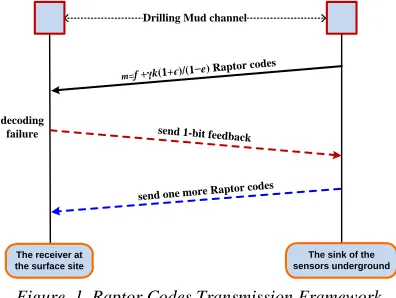
Figure. 1 shows the transmission procedure of RCT, where the dashed line represents the failure-resend process. Actually, the failure-failure-resend process is rarely occurred in RCT, which is illustrated in Section 4.
The receiver at the surface site
The sink of the sensors underground m=f +γk(1+є)/(1−e) Raptor codes
decoding
failure send 1-bit feedback
send one more Raptor codes
[image:4.612.95.293.188.337.2]Drilling Mud channel
Figure. 1. Raptor Codes Transmission Framework
4. ANALYSIS OF RCT
In Raptor codes, it is assumed that the transmitter incessantly transmits codes for the current message until the receiver sends a feedback to tell the transmitter to send the next message. But according to the drilling mud channel conditions, we can only use very limited feedback, which can be performed by changing the drilling mud pressure for a short time. When the underground sink detects the pressure change, the feedback is received successfully. In this section, a limited feedback Raptor codes Transmission Scheme are presented which adapts the drilling mud channel conditions.
As a matter of fact, the feedback could not be started frequently, because too much feedback will bring heavy overhead and affect the normal logging data transmission. Thus it is essential to reduce the amount of feedback and make it available in M/LWD system. The transmitter produces and sends m Raptor codes for a message and then proceeds to the next message, where
(1
)
m
= +
f
γ
k
+
ε
(3)and f is the number of times of decoding failure at the surface site and γ is a redundancy factor (γ ≥ 1). A decoding failure occurs when the surface receiver cannot obtain k(1+ε) Raptor codes to decode k
logging data because of erasure. When a decoding failure occurs, the surface receiver sends 1-bit feedback to transmitter and the transmitter sends one more Raptor codes to the surface receiver. The
transmitter adds 1 to f and sends one more Raptor codes next message against the deterioration of drilling mud channel. By this mechanism, the transmitter adjusts the effective coding rate according to f to maintain a sufficient high probability of decoding success at the surface receiver.
5. EXPERIMENTS AND DISCUSSION
In this section, we shall present some experimental results which were obtained with the real logging data from several wells of Northeast of China, to show the performance of the proposed RCT scheme.
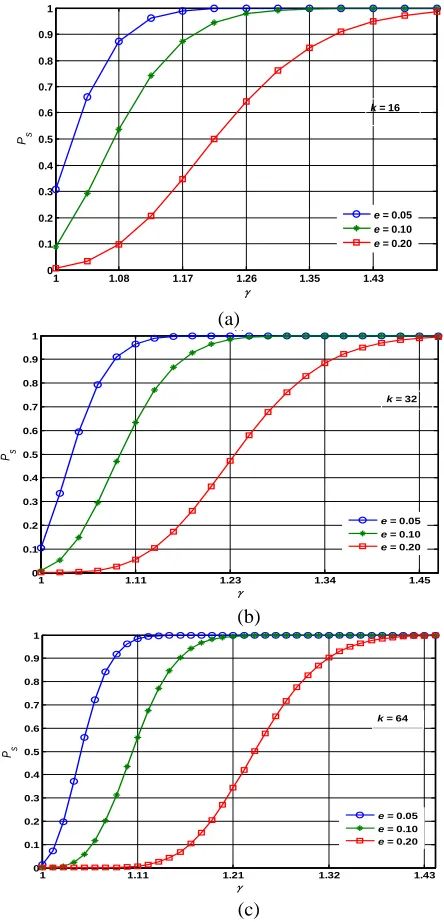
Two groups of experiments were performed with the real logging data. In the first group of experiments, we discuss the relationship of γ and Ps, where Ps is the successful decoding probability at the surface site, which is given by
(
)
(1 )
(
) ( )
,
1
m
v m v
s v k
P
C m v
e
e
ε
−
= +
=
∑
−
. (4)C(m, v) is the combination function of m and v. v is the number of Raptor codes received at surface site when successful decoding.
5.1 Ps vs. γ with different k
In this group of experiments, we discuss the performance of RCT scheme in terms of Ps versus
γ. To do so, f is fixed as 0. Moreover, k and ε are fixed in each simulation. Figure. 2 plots the Ps vs.γ,
under different e of 0.05, 0.10, 0.20, when k is 16, 32, and 64, respectively. The results in Figure. 2 are averaged over 1000 simulations.
From Figure. 2, one can see that for given k and e, the smaller γ is, the smaller Ps is and the more frequent the feedback is. Conversely, the larger γ is, the larger Ps is and the worse the real-time performance is. So we must select γ carefully to get the tradeoff between real-time performance and the amount of feedback. In this paper, we choose the value of γ which is able to make Ps larger than 0.95 to obtain the initial value of m in terms of Eq. (3) when f = 0.
5.2 R vs. e with different k
In the second group of experiments, we evaluate
R under the different value of e. As is known, the characteristics of the drilling mud channel change continuously, and the channel erasure probability e
grows when the drilling depth increases.
increases by 0.01. The underground transmitter produces and sends 500 logging data messages per 100 meters. Each message includes m Raptor codes. The values of γ, k and ε in Eq. (3) are fixed at the very beginning, and the value of f is increased with the growth of e to combat the drilling mud channel deterioration. We assume that once a decoding failure occurs, the surface receiver sends 1-bit feedback to the transmitter. Then, the transmitter will send one more Raptor codes to the receiver and adds 1 to f. We calculate the coding rate in terms of
R=k×h1/(ma×h2)=2k/m for each e.
1 1.08 1.17 1.26 1.35 1.43
0 0.1 0.2 0.3 0.4 0.5 0.6 0.7 0.8 0.9 1
γ
Ps
e = 0.05 e = 0.10 e = 0.20 k = 16
(a)
1 1.11 1.23 1.34 1.45
0 0.1 0.2 0.3 0.4 0.5 0.6 0.7 0.8 0.9 1
( )
γ
Ps
e = 0.05 e = 0.10 e = 0.20 k = 32
(b)
1 1.11 1.21 1.32 1.43
0 0.1 0.2 0.3 0.4 0.5 0.6 0.7 0.8 0.9 1
γ
Ps
e = 0.05 e = 0.10 e = 0.20 k = 64
[image:5.612.316.523.216.368.2](c)
Figure. 2 Ps Vs. Γ, Under Different Channel Erasure Probability And Code Length K, Where K = 16, 32 And
64 In (A) (B) And (C), Respectively.
Experiments are performed 1000 times and the averaged results are shown in Figure. 3, where Pf is
the decoding failure probability at the surface site. In existing M/LWD system, the transmitter has to send each logging data message at least twice against drilling mud channel erasure, so Pfis e2. The Pf increases with the growth of e clearly, so existing
logging data transmission will be invalid when e is relatively high. That is why the mud pulse telemetry always fails when the drilling well depth is large.
0.05 0.15 0.25 0.35 0.45 0.55 0.65 0.75
0.2 0.4 0.6 0.8 1 1.2
erasure probabilities e
c
odi
ng r
at
e
R
k=16 k=32 k=64
P
f = 5.64e-05
P
f = 5.82e-05
P
f = 6.05e-05
Figure. 3. R Vs. E Under Different Code Length K
In contrast, from Figure. 3, it can be seen that the proposed RCT scheme is adaptive against drilling mud channel communication deterioration and always keeps the Pf less than 10
-4
. And the Pf does not change with the increment of e. Since when the decoding failure occurs, a feedback has to be started, so it can be stated that in RCT the feedback frequency is Pf, which is also less than 10
-4
.
It also can be observed from Figure. 3 that RCT scheme can obtain higher reliability than the existing transmission method, even though the RCT scheme only sends the logging data message once, while the existing method has to send the logging data message twice at least. Therefore, in a sense, the RCT scheme will not lower the real-time performance of M/LWD as long as the amount of the data sent by RCT one time is less than the total amount of the data sent by the existing method two times. In other words, if the coding rate R is bigger than 0.5, RCT scheme can improve the real-time performance of logging data. This indicates that we can set R as 0.5 for practical application.
[image:5.612.80.302.237.698.2]6. CONCLUSIONS
To achieve real-time and reliable logging data transmission, this paper proposed a novel Raptor Codes based transmission (RCT) method over drilling mud channels. Raptor Codes is an information additive code, so in the RCT scheme the surface receiver can recover the original k
logging data as long as gets more than n correct Raptor Codes from the m Raptor codes sent by the underground transmitter. The RCT scheme can provide better real-time and reliability performance than the existing logging data transmission method. Using very limited feedback (the frequency of feedback occurrence is always less than 10-4), the surface site therefore can obtain the complete and correct logging data.
ACKNOWLEDGMENTS
This work was supported by National Natural Science Foundation of China with Grant, No. 61201203 and by China Postdoctoral Science Foundation, No. 20100480329.
REFERENCES
[1] J. Dessay, O. Torres, and S. Sharma, "Real Time Formation Characterization from Advanced Mud Gas Analyses for Improved Geological Operations Decisions", in the 73rd EAGE Conference & Exhibition Incorporating SPE EUROPEC 2011, May 2011, pp. 886-892. [2] X. P. Liu, J. Fang, and Y. H. Jin, "Application
Status and Prospect of LWD Data Transmission Technology", Well Logging Technology, Vol. 32, No. 3, June 2008, pp. 249-253.
[3] Y. Zhang, K. Xiong, D. D. Li, Z. D. Qiu and S. H. Wang, "CST: Compressive Sensing Transmission for Real Time M/LWD Communication", Procedia Engineering, Vol. 11, No. 1, Jan. 2011, pp. 540-545.
[4] A.Shokrollahi, "Raptor Codes", IEEE Transactions on Information Theory, Vol. 52, No. 6, June 2006, pp. 2551-2567.
[5] M. Luby, "LT Codes", Proceedings of the 43rd Annual IEEE Symposium on Foundations of Computer Science (FOCS’02), 2002, pp. 271-280.
[6] M. Luby, M. Mitzenmacher, A. Shokrollahi, and D. Spielman, "Improved Low-Density Parity-Check Codes Using Irregular Graphs", IEEE Transactions on Information Theory, Vol. 47, No. 2, Feb. 2001, pp. 585-598.
[7] W. Z. Zhang, S. Hranilovic, and C. Shi, "Soft-Switching Hybrid FSO/RF Links Using Short-Length Raptor Codes: Design and Implementation", IEEE Journal on selected areas in communications, Vol. 27, No. 9, Dec. 2009, pp. 1698-1708.