15
AUTOMATIC GENERATION OF BPEL PROCESSES FROM
NATURAL LANGUAGE REQUIREMENT
1DENG NA, 2LI DESHENG
1 Dr., School of Computer, Hubei University of Technology, China
2
Dr., School of Science, Anhui Science and Technology University, China
E-mail: [email protected], [email protected]
ABSTRACT
Software’s final success depends seriously on its requirement description. Nowadays, natural language is still the main description language of software requirement documents. In order to minimize the comprehension differences between users and developers about requirement, if natural language described requirement could be automatically transformed to BPEL processes, users and developers would reach a consensus rapidly and BPEL’s development would be accelerated. In this paper, we propose an automatic generation method from natural language requirement description to BPEL processes. Firstly, requirement description is restricted and formalized; then, for those sentences with the prefix [RECEIVE] and [INVOKE], the relevant web services highly semantically matched are found out from the set of WSDLs; finally, the whole corresponding BPEL process is assembled from bottom to up. We provide a prototype to indicate our method’s validity.
Keywords: Requirement Description, BPEL, Natural Language, Semantic, Web Services, WordNet
1. INTRODUCTION
Requirement description is one important step in software engineering. It records the functional and non-functional requirement software must satisfy according users’ demand. Software’s final success depends seriously on its requirement description. Whether the requirement description is clear and complete or not, whether users and developers have reached a consensus or not, whether developers would act on the requirement description or not, all of these will influence the software’s final success.
Due to different viewpoints, users and developers often have their own comprehension of the requirement. Users pay their attention on what function software can provide and which level its performance can reach; however, developers prefer to consider from the angle of technology. In most situations, users are not familiar with those professional terms and technical problems. If the comprehension difference is not solved, it will be a hidden trouble in the lifecycle of software development.
Natural language has two main disadvantages: ambiguity and inconsistency. However, nowadays most of the software requirement documents are still written by natural language. This ascribes to two reasons: one is because users and developers
nearly don’t have the capability of describing requirement formally, and the other is because natural language has abundant glossary and strong expression ability.
Web Services are contained and self-described modular applications which can be released, found and used in the Internet [1]. As the de facto standard, Business Process Execution Language (BPEL) [2] is widely used in the composition and orchestration of web services. It makes use of some structural activities and orchestrates web services into a complete and executable business flow. Since BPEL put some useful atomic services together to become a business process satisfying a specific functional requirement, in some extent, BPEL can be seen as a software application. In this paper, we only concerns about BPEL’s functional requirement.
experiments on an actual multimedia conference system indicate our method’s validity.
2. RELATED WORK
References [3, 4] work over the similarity computation of requirement description. [3] points out that computing requirement similarity is helpful for the reuse of software’s design, source code and testing cases, and it gives a framework SimReq. A similarity analysis algorithm is provided in [4], and it contains four steps: word segmentation, stop words deletion, stemming and similarity computation. On the basis of these four steps, we will add synonyms extension and modify the algorithm of similarity computation to fit our situation. With regard to BPEL’s automatic generation, [5] converts labeled finite state machine to executable BPEL and WSDL codes, and creates a tool named HUMSA. [6] makes use of model-driven approach to generate BPEL processes. [7-10] study on how to transform UML to BPEL. There are also many researches on sentences similarity [11, 12].
3. INTRODUCTION TO BPEL
BPEL is a XML-formatted business process execution language. It makes use of some kinds of BPEL elements, including basic activities (Receive, Reply, Invoke, Assign, Throw, Rethrow, Exit, Wait, Empty), structural activities (Sequence, If, While, RepeatUntil, ForEach, Pick, Flow, Scope) and some other assistant elements (elseif, else, catch, compensateHandler, faultHandlers, eventHandlers, terminationHandler, catchAll, onEvent, onAlarm, onMessage), to orchestrate web services to an executable business process.
4. RESTRICTION OF BPEL’S NATURAL LANGUAGE REQUIREMENT
Natural language uses un-structural sentences’ combination to describe things, so the logic relationships between things are implied in sentences’ semantic and it is difficult for computers to comprehend these logic relationships directly from the sentences. For example, a natural language requirement description of stop recording in our multimedia conference system is as follows:
After receiving the request of stopping recording, stop the recording. If the stopping is successful, then return a message of success; or else, return a message of error and inform the chairman for 3 times at the same time. If any mistakes happen in
the whole procedure, then return a message of error.
From above we can see that the requirement description is step by step, and this is revealed by the repositions (after, if, then, or else, at the same time). However, these simple logic relationships are hard to understand for computers. To resolve this problem, we shift the work of identifying steps to humans.
Definition 1: Operation sentence
Operation sentence is the sentence representing some operation in BPEL’s natural language requirement description, eg: receiving the request of stopping recording, stop the recording.
Definition 2: Judgment sentence
Judgment sentence is the sentence representing deciding to execute some branch according to some condition in BPEL’s natural language requirement description, eg: If the recording is successful, or else.
Definition 3: Choice introductory sentence
Choice introductory sentence is the sentence introducing a group of choice branches in the restricted BPEL’s natural language requirement description. We use “Choice” in this paper.
Definition 4: Concurrence introductory sentence
Concurrence introductory sentence is the sentence introducing a group of parallel branches in BPEL’s natural language requirement description, eg: in parallel, at the same time, simultaneously. We use “in parallel” after restriction in this paper.
Definition 5: Repeat introductory sentence
Repeat introductory sentence represents some operations are executed repeatedly. eg: for three times. We use “repeat for n times” after restriction in this paper.
Definition 6: Assistant sentence
Assistant sentences are the sentences except operation sentences, including judgment sentence,
choice introductory sentence, concurrence
introductory sentence, repeat introductory sentence and others.
We restrict BPEL’s natural language requirement description by the following rules:
17 composed by some steps, and each step is assigned a serial number.
Rule 2: Each operation sentence, judgment sentence, choice introductory sentence, concurrence introductory sentence, repeat introductory sentence is represented by a step.
Rule 3: The serial number of each branch under a choice introductory sentence is the direct sub-serial number of which of the choice introductory sentence.
Rule 4: The serial number of each branch under a concurrence introductory sentence is the direct sub-serial number of which of the concurrence introductory sentence.
Rule 5: The serial number of each branch under a repeat introductory sentence is the direct sub-serial number of which of the repeat introductory sentence.
Rule 6: Each fault handler part corresponds to some steps in the main part. If errors happen in some steps of the main part, they will be handled by fault handler part.
After these rules’ restriction, the stop recording example becomes such a form:
The main part:
1 receive the request of stopping recording 2 stop the recording
3 choice
3.1 if the stopping is successful 3.1.1 return a message of success 3.2 or else
3.2.1 in parallel
3.2.1.1 return a message of error
3.2.1.2 repeat for 3 times 3.2.1.2.1 inform the
chairman Fault handler part:
If any mistakes happen in the procedure of step 1 to step 3
1 return a message of error
We give the mapping between the sentence patterns after restriction and the requirement description after formalization, shown in Table 1:
5. FORMALIZATION OF BPEL’S NATURAL LANGUAGE REQUIREMENT
We give the mapping between the sentence patterns after restriction and the requirement description after formalization, shown as follows:
the sentence patterns after restriction
the requirement description after formalization
receive the request of X [RECEIVE]X request
if X [CONDITION]X
return X [REPLY]X
or else [ORELSE]
in parallel [FLOW]
Choice [CHOICE]
repeat for X times [REPEAT]X If any mistakes happen
in the procedure of step X to step Y
[FAULTHANDLER]X, Y
X [INVOKE]X
Definition 7: requirement description statement
After natural language described requirement is formalized, each step is defined as a requirement description statement.
Definition 8: requirement description prefix
After natural language described requirement is formalized, the part bracketed by square bracket is defined as requirement description prefix.
Definition 9: requirement description sentence
After natural language described requirement is formalized, the part not bracketed by square bracket is defined as requirement description sentence.
After formalization, the stop recording example becomes such a form:
The main part:
1 [RECEIVE]stopping recording request 2 [INVOKE]stop the recording
3 [CHOICE]
3.1 [CONDITION]the stopping is successful 3.1.1 [REPLY]a message of success 3.2 [ORELSE]
3.2.1 [FLOW] 3.2.1. 1
[REPLY]a message of error
3.2.1. 2
[REPEAT]3
3.2.1.2. 1
Fault handler part:
[FAULTHANDLER]1, 3
1 [REPLY]a message of error
6. MATCHING AND LOOKUP OF MESSAGES AND ATOMIC SERVICES
The method we adopt is: finding all the most matching message names and operation names from WSDL (Web Services Description Language) documents with formalized requirement description, and using the relevant web services’ information to replace the requirement sentences behind [RECEIVE], [REPLY], and [INVOKE].
We give an algorithm calculating the matching degree between requirement sentences described by natural language and message/operation names. Here, requirement sentences are the sentences with the prefix [RECEIVE] and [INVOKE].
Algorithm: SimilarityCalculation
Input: natural language described requirement sentence A; message/operation name B; synonyms set of WordNet C; stop words set D
Output: the matching degree ϕ
1. After restriction and formalization, A becomes
' A
2. If the prefix of A' is [RECEIVE] or
[INVOKE]
2.1 ''
A is the requirement description sentence of
' A
2.2 The set of segmented words of A'' is
A
wordset
2.3 Move stop words fromwordsetA. For any
word w inwordsetA, ifw∈D, then
{ }
= −
A A
wordset wordset w .
2.4 Extent synonyms forwordsetA. For any word
w inwordsetA, lookup synonyms( )w in C, and put
all the synonyms of w intowordsetA, that is,
( )
= +
A A
wordset wordset synonyms w .
2.5 Do Stemming forwordsetA. For any word w
inwordsetA, get the etyma of w using Porter[13],
denoted as w', and replace w in
A
wordset withw',
that is, = − + '
A A
wordset wordset w w. In this paper,
we represent w' as Porter(w).
3. The set of segmented words of
message/operation names iswordsetB
4. Calculate the matching degree of wordsetA
and wordsetB using Algorithm DicePlus.
Algorithm:DicePlus
Input:wordsetAandwordsetB
Output: the matching degreeϕ of wordsetA and
B
wordset
1. int count=0;
2. or each word w in wordsetB
2.1 if (Porter( )w ∈wordsetA||∃ ∈w' synonyms( )w
satisfying w'∈wordsetA)
2.1.1 count=count+1;
3. = 2 *
+
A B
count
wordset wordset
ϕ
7. BPEL PROCESS’S ASSEMBLY
BPEL process is a XML-formatted document, and the requirement description after restriction reveals a hiberarchy structure, so we use the idea of from bottom to up in programming to assemble BPEL process. According to steps’ serial numbers of formalized requirement sentences, we assemble BPEL’s XML snatches level by level. In more detail, firstly, BPEL’s XML snatches are generated corresponding to the lowest requirement description sentences; then, based on the prefix of the requirement description sentence in a higher leve, these XML snatches are assembled as a whole to be BPEL’s snatch of this higher level’s requirement description sentence; finally, the whole BPEL is assembled level by level in the same way.
During BPEL process’s assembly, we consider the main part and the fault handler part separately. We firstly assemble the main part’s BPEL snatch, and then assemble the corresponding snatch for each fault handler part, finally, we embed fault handler’s snatch into main part’s.
Algorithm: assembly of the main part
Input: formalized requirement description’s main part M
Output: BPEL’s XML snatch of the main part
1. Get the number of levels of the main part,
denoted as maxLevel. Initialize a empty hashtable HT, the key of which is the serial number of steps, and the value of which is BPEL’s XML snatch corresponding to the serial number.
2. Divide M into some heaps according to the
level, and each heap has the same level.
19
level level. statement(step)denotes the requirement
description sentence corresponding to step step.
prefix(statement)denotes the prefix of statement.
3. for (int level=maxLevel; i>1;i--)
3.1.Steps= steps(level)
3.1.1. forstep∈Steps, its step number is
StepID, and its requirement description sentence
denoted as statement= statement(step)
3.1.1.1prefix=prefix(statement),
sentence( )
=
sentence statement
3.1.1.1.1 if prefix=[RECEIVE],
handleReceive(statement)
3.1.1.1.2 if prefix=[INVOKE],
handleInvoke(statement)
3.1.1.1.3 if prefix=[REPLY],
handleReply(statement)
3.1.1.1.4 if prefix=[CONDITION],
handleCondition(stepID statement, )
3.1.1.1.5 if prefix=[ORELSE],
handleOrelse(stepID)
3.1.1.1.6 if prefix=[CHOICE],
handleChoice(stepID)
3.1.1.1.7 if prefix=[REPEAT],
handleRepeat(stepID statement, )
4. get all the step serial numbers stored in HT
where the level of the key is 1. Arrange these serial numbers in order as{stepID stepID1, 2...stepIDn}, then the BPEL process is:
<process> <sequence>
HT.get(
stepID
1)HT.get(
stepID
2)……
HT.get(
stepID
n)</sequence> </process>
Algorithm: handleReceive(statement)
1. sentence=sentence(statement)
2. In WSDL, find the most matching message
name inputMessageName with sentence from all
the attributes name of <portType>→<operation>→
<input>. Suppose the name attributes of
<operation>, <portType> and <output> are
operationName , portTypeName and
outputMessageName respectively.
3. BpelStr=<receive createInstance=“yes”
name=“ operationName ” operation=
“ operationName ” partnerLink=
“ operationName ” varaible=
“inputMessageName”>
4. put (StepID, BpelStr) into HT. Save the data
during this algorithm’s execution.
Algorithm: handleInvoke(statement)
1. sentence=sentence(statement)
2. In WSDL, find the most matching operation
name operationName with sentence from all the
attributes name of <portType> → <operation>.
Suppose the name attribute of <portType>
is portTypeName , the message attributes of
<operation>→<input> and <operation>→<output>
are inputMessageName and outputMessageName
respectively.
3. BpelStr=<invoke name=“operationName”
operation=“ operationName ” partnerLink=
“ operationName ” inputVariaible=
“ inputMessageName ” outputVariaible=
“outputMessageName”/>
4. put (StepID, BpelStr) into HT.
Algorithm: handleReply(statement)
1. get the data stored during the execution of
algorithm handleReceive(statement)
2. BpelStr=<reply name=“operationName”
operation=“ operationName ” partnerLink=
“ operationName ” varaible=
“outputMessageName”>
3. put (StepID, BpelStr) into HT.
Algorithm: handleCondition(stepID statement, )
1. sentence=sentence(statement)
2. get the direct sub-serial number of stepID, and
arrange them in order as
1 2
{stepID stepID, ...stepIDn}. BpelStr is set as:
<condition>sentence</condition> <sequence>
HT.get(stepID1)
HT.get(stepID2)
HT.get(stepIDn) </sequence>
3. put (StepID, BpelStr) into HT.
Algorithm: handleOrelse(stepID)
1. get the direct sub-serial number of stepID, and
arrange them in order as
1 2
{stepID stepID, ...stepIDn}. BpelStr is set as:
<else>
<sequence>
HT.get(stepID1)
HT.get(stepID2)
……
HT.get(stepIDn)
</sequence> </else>
2. put (StepID, BpelStr) into HT.
Algorithm: handleChoice(stepID)
1. get the direct sub-serial number of stepID, and
arrange them in order as
1 2
{stepID stepID, ...stepIDn}. BpelStr is set as:
<if>
HT.get(stepID1)
HT.get(stepID2)
……
HT.get(stepIDn)
</if>
2. put (StepID, BpelStr) into HT.
Algorithm: handleRepeat(stepID statement, )
1. sentence=sentence(statement)
,
sentencerepresents the times repeated, denoted as TIMES.
2. get the direct sub-serial number of stepID, and
arrange them in order as
1 2
{stepID stepID, ...stepIDn}.
3. BpelStr is set as:
<variable name=“repeat_time” type=“xsd:int”/> <sequence>
<assign> <copy>
<from>
<literal>0</literal> </from>
<to variable=“repeat_time”/> </copy>
</assign> <repeatUtil>
<condition>$repeat_time<TIMES</condit ion>
<sequence> <sequence>
HT.get(
stepID
1)HT.get(
stepID
2)……
HT.get(
stepID
n)</sequence> <assign>
<copy>
<from>$repeat_time+1</from> <to variable=”repeat_time”/> </copy>
</assign> </sequence> </repeatUtil> </sequence>
The assembly of fault handler part is similar to which of the main part. The difference only exists in step 4 in algorithm “assembly of the main part”. The BPEL’s snatch of fault handler part is as follows:
<faultHandler> <catchAll>
<sequence>
HT.get(stepID1)
HT.get(stepID2)
……
HT.get(stepIDn)
</sequence> </catchAll> </faultHandler>
Here,stepID1,stepID2……stepIDn represent the
serial numbers with level 1 of the fault handler requirement description after formalization.
8. IMPLEMENT AND ANALYSIS OF THE PROTOTYPE
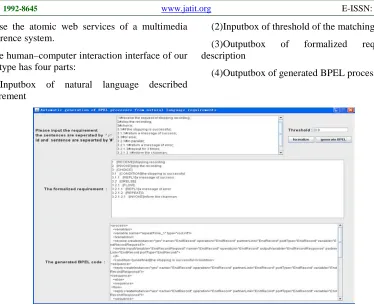
21 we use the atomic web services of a multimedia conference system.
The human–computer interaction interface of our prototype has four parts:
(1)Inputbox of natural language described requirement
(2)Inputbox of threshold of the matching degree
(3)Outputbox of formalized requirement description
[image:7.612.112.486.73.379.2](4)Outputbox of generated BPEL process
Figure 1: The Prototype Automatically Transforming Requirement Description To BPEL Process
As shown in the Figure 1, through the semantic matching lookup based on WordNet, service “EndRecord” can be found corresponding to “stop the recording” in user’s requirement. Thus this indicates the semantic matching method’s validity.
9. CONCLUSION
Requirement description has greate influence on software’s success. Natural language is still the mainstream description language of requirement document currently. The automatic generation of BPEL process from requirement can help users and developers reach a consensus in a short time, and can also quicken BPEL’s development. Our paper proposes such a generation method, which is direct and creative. We provide a prototype to indicate our method’s validity. The future research will focus on BPEL’s semantic analysis.
ACKNOWLEDGMENTS:
This work was supported by the Natural Science Foundation of Educational Government of Anhui Province of China (No. KJ2013B073), the Science and Technology Plan Project of Chuzhou City (No.201236), and the Talent Introduction Special Fund of Anhui Science and Technology University (No.ZRC2011304).
REFRENCES:
[1] Tidwell D, “Web services-The Web's Next
Revolution”, 2001,
http://www.ibm.com/developerWorks/
[2] Oasis, “Business Process Execution
Language(bpel) v2.0”,
http://docs.oasis-open.org/wsbpel/2.0/wsbpel-v2.0.pdf
[3] Muhammad Ilyas and Josef Küng, “A
Comparative Analysis of Similarity
Measurement Techniques through SimReq
Framework”, Proceedings of the 7th
International Conference on Frontiers of
Information Technology, Abbotabad, Pakistan,
2009, pp.1-6.
[4] Johan Natt Och Dag, Björn Regnell, Pär Carlshamre, et al, “Evaluating Automated Support for Requirements Similarity Analysis
in Market-driven Development”, Proceedings
of the Seventh International Workshop on Requirements Engineering: Foundation for
Software Quality, Interlaken, Switzerland,
2001.
[5] Mohanty H, Chenthati D, Vaddi S, et al, “Automatic Generation of BPEL and WSDL from FSM Models of Web Services”,
on Advanced Computing and Communications, Surathkal, 2006, pp.440-444.
[6] Li Zhang and Wei Jiang, “Transforming Business Requirements into BPEL: A
MDA-based Approach to Web Application
Development”, Proceedings of 2008 IEEE
International Workshop on Semantic
Computing and Systems, Huangshan, China,
2008, pp. 61-66.
[7] Anisha Vemulapalli and Nary Subramanian.
“Evaluating Consistency between BPEL
Specifications and Functional Requirements of Complex Computing Systems using the NFR
Approach”, Proceeding of 2010 IEEE
International Systems Conference, San Diego,
2010, pp.153-158.
[8] Anisha Vemulapalli and Nary Subramanian., “Transforming Functional Requirements from UML into BPEL to Efficiently Develop
SOA-based Systems”, Proceeding of 2009 On the
Move to Meaningful Internet Systems: OTM
2009 Workshops, Vilamoura, Portugal, 2009,
pp. 337-346.
[9] Keith Mantell, “From UML to BPEL: Model Driven Architecture in a Web Services World”, http://www.ibm.com/developerworks/webservi ces/library/ws-uml2bpel/#author1
[10]Rainer Anzböck and Schahram Dustdar, “Semi-automatic Generation of Web Services and BPEL Processes - a Model-driven
Approach”, Proceedings of the 3rd
International Conference on Business Process
Management, Nancy, France, 2006, pp.64-79.
[11]Jin Feng, Yiming Zhou and Trevor Martin., “Sentence Similarity based on Relevance”,
Proceedings of IPMU’08, Malaga, Spain,
2008, pp.832-839.
[12]Chukfong Ho, Masrah Azrifah, Azmi Murad, et al, “Word Sense Disambiguation-based
Sentence Similarity”, Proceedings of Coling
2010: Poster Volume, 2010, pp. 418–426.
[13]Porter M F, “An Algorithm for Suffix
Stripping”, Program, Vol.14, No.3, 1980,