515
A DIGITAL PREDISTORTION THEORY BASED ON
SELF-ADAPTIVE ALGORITHM
HUIFEN LIAO
Jiujiang University, Jiujiang 332005, Jiangxi, China
ABSTRACT
In this paper, the author researches the problem of the analysis and optimization of broadband digital predistortion. In the development process of mobile communication system, improving the transmission quality and spectral efficiency always acts as a main research focus. As the traditional multi-carrier modulation system has broadband linear modulating signals with high Peak-to-Average Power Ratio (PAPR), which would cause nonlinear distortion and memory effects after the amplification of RF power amplifier. In order to solve this problem, the author proposes a digital pre-distortion method based on broadband self-adaptivity, updates and optimizes the parameters of pre-distorter with improved self-adaptive algorithm. The simulation results prove that the predistorter could improve the spectrum out of band for about 12dB through the self-adaptive algorithm, which effectively compensates the nonlinear distortion and memory effects of amplifier and improves the efficiency of the digital wireless receiver.
Keywords: Broadband, Digital Pre-Distortion, Genetic Algorithm, Self-Adaptivity
1 INTRODUCTION
The rapid development of radio frequency (RF) integrated circuits and high-speed digital signal processors results to the blooming of the design and manufacture of radio frequency (RF) receivers. For RF designers, the improvement of high-speed signal processor and high-powered digital-analog/ analogue-digital converter makes higher IF digitization possible, which reduces the radio frequency (RF) part, and thus improve the overall performance of radio frequency (RF) part. In order to allow more communication channels to be put in a limited spectral range, a series of digital transmission technology with higher spectrum efficiency (such as WCDMA, OFDM) and modulation system (such as pi/4-DQPSK, MPSK, M-QAM) are proposed. However, such signals are all non-constant envelope signals, and spectrum will expand when they go through the non-linear power amplifier, resulting to the interference of adjacent channels. At the meantime, the high PAPR(Peak to Average Power Radio) of multi-carrier modulation signals put forwards high requirements for the dynamic range and linearity of the base station power amplifier: if the dynamic range of the amplifier can not meet the requirements of signal changes, the frequency spectrum would change when the signals pass through the power amplifiers due to nonlinear distortion of system, resulting to severe in-band distortion, deterioration of the
transmission system's performance, and serious degradation of the communication quality[1] [2].
While designing the RF power amplifier, class A or class AB power amplifier with power retroversion are used to control the distortion within an acceptable level, which, however, reduces the power amplifier's efficiency and increase heat loss and cost[3]. In order to improve the linearity of the amplifier on the premise of the same transmission power, researchers have put forward a series of solutions, such as the feed-forward method, the negative feedback method, the LINC method, and digital pre-distortion method[4] [5], among which the digital baseband pre-distortion technology has the advantages of simple circuit form, easy adjustment, low cost and high efficiency. And it uses the modern digital signal processing technology; therefore it has become a research hot spot.
516 prove that this algorithm could effectively improve the in-band distortion caused by the non-linearity of system and the spectrum expansion out of band[7].
2 THE PRINCIPLE OF DIGITAL PRE-DISTORTION
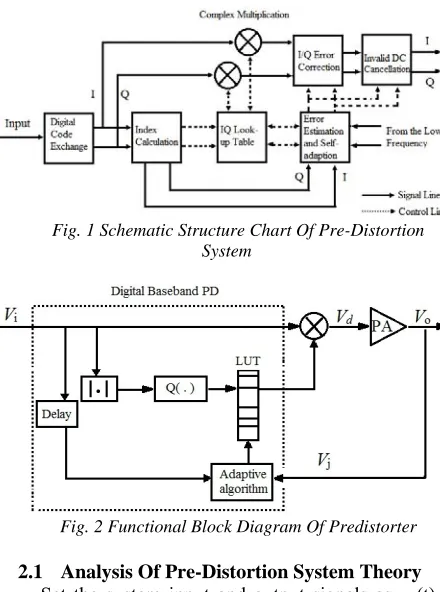
[image:2.612.81.301.384.680.2]Digital pre-distortion technology, a common linearization technique, is a new promising technology currently [8]. When the input signal passes through nonlinear devices and then returns back to the nonlinear amplifier for amplification output, adjust the pre-distortion parameters so that the cascade of the two non-linear systems act like one linear system. The nonlinear characteristics of pre-distorater are on the contrary of the power amplifiers [9]. Cascade before the nonlinear amplifier a pre-distorter with the opposite amplitude and phase characteristics, and distort the input signals on the direction that is opposite to the characteristics of power amplifier so that the input and output of amplifiers construct a linear relationship on the whole[10]. Fig. 1 shows the principle, which includes pre-distorter and power amplifier. Fig. 2 shows the pre-distorter.
Fig. 1 Schematic Structure Chart Of Pre-Distortion System
Fig. 2 Functional Block Diagram Of Predistorter
2.1 Analysis Of Pre-Distortion System Theory
Set the system input and output signals as x (t) and y (t) respectively, and the transfer characteristic function of predistorter and amplifier as FPD(t) and FPA(t). Pre-distortion linearization technique means making the input signal go through the pre-distorter
before power amplifier. Set xpd(t) as predistorter output,then xpd(t)=FPD(x(t)),y(t) = FPA(xpd(t))
y(t) = FPA(FPD(x(t))) (1) When the entire system is at the ideal linear state, the output signal should be as follows:
y(t) = G*x(t) (2) Where G is the gain of the amplifier ideal linear output, and it is a constant.
y (t) = the FPA (FPD (x (t))) (1) y (t) = G * of x (t), (2)
It can be seen from Fig. 1 that it is necessary to establish broadband nonlinear mathematical model at first in order to revise the design predistorter. The predistorter mainly aims to rectify the nonlinearity of power amplifier, and stimulating the nonlinear characteristics precisely is a crucial step to analyze the power amplifier system and design pre-distortion system. Using appropriate mathematical model at different occasions and with different power amplifier could simplify the analysis process without degrading the accuracy. Select the appropriate self-adaptive algorithms. The nonlinear characteristics of power amplifier would change due to the change of temperature, humidity, supply voltage, device aging, channel switching and other reasons, which requires the predistoter to self-adjust according to the characteristics of power amplifier and calibrate the power amplifier timely, in order to ensure the stable linear output of the system.
Assuming that the power amplifier model is a third-order power series model. Set vias the input
signal, vpas predistorter output, and v0as power amplifier output. The input and output of power amplifier are in linear relationship only when the following formula is tenable:
3 0 1 p 3 p 1 i
v =a v −a v =a v (3)
So 3 1 1
3 3
( ) ( ) 0
p p i
a a
v v v
a a
− + =
We could see the functional relationship between
p
v andvifrom the above equation. vpis the root of
cubic equation with vi as its parameter. Therefore,
we could design predistoter only if we are aware of the relationship between the characteristics of power amplifier and predistorter.
In order to avoid solving the cubic equation and reduce the complexity of this algorithm vp could be represented as the form of power amplifier in this paper.
517 3
3
3 2 5 3 7 4 9 3 3 3 12 3 37 3
p i p
i i i i i
v v a v
v a v a v a v a v
= +
= + + + + +L (4)
The power amplifier input and output are in linear relationship only when the above formula is tenable and meets the characteristics. Assume that the pre-distortion characteristic is :
3 3 p i i
v = +v b v
Then the power amplifier’s output should be: 3
1 3
3 5 7 9
1 ( 1 3 3) 3 3 3 3 3 3 3 3
o p p
i i i i i
v a v a v
a v a b a v a b v a b v a b v
= −
= + − − − −
(5)
It could be seen from the above equation that if b3 =a3/a1 , the three distortion items would
disappear completely, which would lead to higher distortion items. In this paper, the pre-distoter is equipped with higher distortion items in order to eliminate the high-level distortion items.
Generally, the wireless receiver model can be divided into memory model and memoryless model[11]. When the bandwidth of input signal is much narrower than that of the amplifier, memory effects can be ignored. But the practical multi-carrier signals all belong to broadband system and the memory effect of power amplifier is remarkable. The linear compensation effect will be poor if we adopt the traditional memoryless pre-distortion technology. Therefore, this article focuses on the digital pre-distortion of memory power amplifier model.
3 PARAMETER OPTIMIZATION OF LEAST SQUARES METHOD SELF-ADAPTIVE ALGORITHM
In the process of data processing after the initialization of look-up table, it is necessary to update the information on the look-up table in time in order to cope with the change of power amplifier’s non-linear characteristic curve caused by the change of power amplifier’s working environment. The update of look-up table shouldn’t invoke initialization sequences; it should be done with the previous algorithm in accordance with the look-up table address of corresponding input signals. The update frequency would adapt to the utilization frequency by doing so, which not only guarantees the timely update of common query values, but also avoids the unnecessary update of query values that are not commonly used[12].
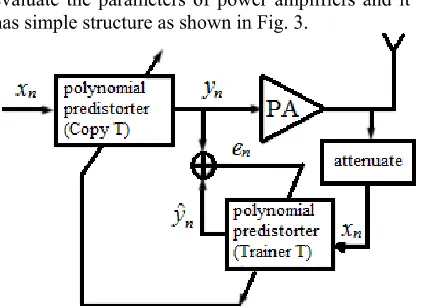
The self-adaptive structure of this predistorter adopts indirect learning structure. Its advantage lies in that it doesn't need to assume the model and
[image:3.612.317.528.100.253.2]evaluate the parameters of power amplifiers and it has simple structure as shown in Fig. 3.
Fig. 3 Structure Of Indirect Learning Pre-Distorter
In this structure, the output of power amplifier is set as the input of the training network after attenuation. Compare the inputyˆn of the training network and the power amplifier inputyˆn, the error
ˆ n n n
e =y −y would be used for the self-adaptively
of training network .If the algorithm converges, when en =0,yn = yˆn, that is to say, when the input
of trainer T and copy T are the same, the input are the same, too. zn =xn. Therefore, the output of power amplifierG z* n =G x* n,which realizes the nonlinearity of power amplifier.
In addition, The nonlinear characteristics of power amplifier would change due to the change of temperature, humidity, supply voltage, device aging, channel switching and other reasons, which requires the predistoter to self-adjust according to the characteristics of power amplifier and calibrate the power amplifier timely, in order to ensure the stable linear output of the system..
With the development of self-adaptive technology, several self-adaptive algorithms have been successfully applied to the self-adaptive compensation of pre-distorter, such as the least mean square error algorithm (LMS), normalized least mean square algorithm (NLMS), recursive least squares algorithm (RLS), etc..
518 RLS (recursive least squares) algorithm is another self-adaptive algorithm, whose update aims to realize the best match of output signal and desired signal in the least squares sense. It is characterized by rapid convergence, and it is widely used in the fields of real-time system identification and quick start channel equalization. RLS algorithm is adopted for self-adaptive iteration in this article.
The basis of the RLS algorithm is to determine the weight coefficient W which minimizes the weighted squared error accumulation and performance function of the formula (6):
2 1
2 1
( ) ( )
( ) ( ) * n
n k k
n
n k T
k
n e k
d k x k w
ζ λ
λ
−
=
−
= =
= −
∑
∑
(6)The main steps of the RLS algorithm are as follows:
1
(0) [0 0 0] (0) , is Initialization
small arithmetic number T
W C δ−I δ
= =
L :
For
Update gain vector (n) ( ) ( 1) ( ) ( 1) ( ) g( )
( ) T
X n C n X n C n x n n
n
µ
λ µ
− − =+ n=1, 2. . .
: =
1 Update weight vector
Update inverse matrix
(n)= ( 1)+g( )[ ( )- ( ) ( 1)]
( ) [ ( 1) g( ) ( ) ( 1)]
T
T
W W n n d n X n W n
C n
λ
− C n n X n C n− −
= − − −
:
:
Where λ is called the forgetting factor, and it is slightly smaller than 1, between 0.95 and 0.995. The physical meaning of λn k− factor is adding the index into all used input signals. That is to say, add larger weight to the data that is close to the current moment, and the weight of earlier data decreases gradually exponentially, in this way, the algorithm could reflect the current situation, and thus enhance the adaptability of the non-stationary signals.
4 SIMULATION EXPERIMENTS AND ANALYSIS
All the experiments are conducted on the computer with PC P4 T2310 1.86G, 2GRAM, Inte182865G graphics card in Windows XP operating system. Network simulation software mat lab is used to compare the simulation performance. The power amplifier that is recognized in this paper is Saleh model, as this model is applicable to the traveling wave tube amplifier and it has strong nonlinear characteristics. The size of the lookup table LUTs = 65. The additive white Gaussian noise
[image:4.612.313.524.95.294.2](AWGN) channel is used in the simulation. The experimental results are shown in Fig. 4, 5 and 6.
Fig. 4 Simulation Figure Of BER Curves Comparison
[image:4.612.315.536.401.577.2]It can be seen from Fig. 4 that with the increase of signal-noise-ratio, the corresponding pre-distortion system BER performance curve of the algorithm proposed in this paper decreases more rapidly than the performance curve of conventional algorithm, indicating the algorithm in this paper has better BER performance and better pre-distortion effect than the conventional algorithm.
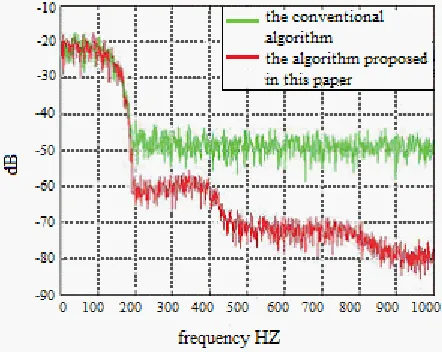
Fig. 5: The Simulation Figure Of Power Spectral Density Curve Comparison
519
5 CONCLUSIONS
The power amplifier would generate in-band and out-of-band distortion while inputting high peak-to-average power ratio (PAPR) broadband signals. In order to solve this problem, the author has proposed to adopt memory polynomial model and recursive least squares algorithm to construct digital pre-distortion system in this paper. The basic principles of self-adaptive digital pre-distortion have been analyzed and experiments have been conducted to test the validity of this algorithm. The experimental results has proved that this algorithm could effectively inhibit the proliferation of spectrum out of band, and has reduced inband distortion without changing the output power as well as has increased the linear output of power amplifier, and at the meantime has realized the linearization of broadband memory high-power amplifier.
REFERENCES:
[1] R. Vullings, B. de Vries, J.W.M.Bergmans, An Adaptive Kalman Filter for ECG Signal Enhancement, IEEE Transactions on Biomedical Engineering, Vol. 56, No. 3, pp. 1094~1103, 2011.
[2] Ai B, Yang Z X, Pan C Y, Zhang T T, and Ge J H., Effects of PAPR reduction on HPA predistortion, IEEE Trans. On Consumer Electronics, Vol. 51, No. 4, pp. 1143~1147, 2005.
[3] R. Bai, M.Singhal, DOA: DSR over AODV Routing for Mobile Ad Hoc Networks, IEEE Transactions on Mobile Computing, Vol. 5, No. 10, pp. 1403~1416, 2006.
[4] N. C. V. N. Pereira, R. M. de Moraes, LatinCon05 - Comparative Analysis of AODV Route Recovery Mechanisms in Wireless Ad Hoc Networks, IEEE (Revista IEEE America Latina) Latin America Transactions, Vol. 8, No.4, pp. 385~393, 2010.
[5] M. Iqbal, X.Wang, S. Li, et.al, QoS scheme for multimedia multicast communications over wireless mesh networks, IET Communications, Vol. 4, No.1, pp. 1312~1324, 2010.
[6] Simon G. Hill, Nobuo Tanaka, Hiroyuki Iwamoto, Local sensing/control or global error sensing/control in structural acoustics: A comparison of two techniques influence over sound power, AA: Applied Acoustics, Vol. 71,
No. 10, pp. 965 ~ 978, 2010.
[7] Till Raitor, Wolfgang Neise, Sound generation in centrifugal compressors, JSV: Journal of Sound and Vibration, Vol. 314, No.3-5, pp. 738-756, 2008.
[8] Fuhong Zhang, Rulong Chu, Qinghao Kong, Research of Memory Power Amplifier Linearization based on Digital Predistortion Techniques, CS: Computer Simulation, Vol. 2, No. 1, 2009.
[9] Yutaka Ohta, Takashi Goto, Eisuke Outa, Unsteady Behavior and Control of Diffuser Leading-Edge Vortex in a Centrifugal Compressor, ASME Conference Proceedings, pp.1805-1813, 2010.
[10] Neda Daei, Hossein M. Shirazi, Reza Askari, Mehdi Ghanavati, Service Robot Navigation Based on Q-Learning and Fuzzy Logic, IJREA: International Journal of Robots, Vol. 1, No. 2, pp: 1~9, 2011.
[11] L E Akyildiz, Jiang Xie and S. Mohanty, A Survey of Mobility Management in Next-generation All IP-based Wireless System, IEEE Wireless Communications, Vol.11, no.4, pp.16~28, 2004.
[12] Nicolas Montavont and Thomas Noel, Handover Management for Mobile Nodes in IPv6 Networks, IEEE Communications Magazine, No. 40, pp. 38~43, 2002.