© 2016, IRJET | Impact Factor value: 4.45 | ISO 9001:2008 Certified Journal
| Page 913
Performance evaluation on optimizing headway distance for
connectivity in VANETS
Parul Sharma
1, Simranjit Kaur
2, Sourabh Mahajan
31
Simranjit Kaur, S.S.C.E.T, Badhani
2Sourabh Mahajan, S.S.C.E.T, Badhani
3
Asst. Professor, Dept. of Electronics and Communication, S.S.C.E.T, Pathankot
---***---Abstract -
VANET became mostly synonymous with themore generic term inter-vehicle communication (IVC), although the focus remains on the aspect of spontaneous networking, much less on the use of infrastructure like Road Side Units (RSUs) or cellular networks. The distribution of vehicles in a single lane has been taken into account that consecutive vehicles have to maintain a minimum safe distance between them. Although minimum headway distance based VANETS has shown better results than other techniques but still suffers from abnormal environmental conditions. The proposed technique has utilized dynamic communication and dynamic path selection using artificial bee colony algorithm to enhance the results of VANETS. The comparative analysis clearly indicates that the proposed technique outperforms over the available methods.
Key words: Road side units, Genetic algorithm, Dynamic
path, VANETS, Artificial Bee colony optimization,
1. INTRODUCTION
VANET is the subclass of Mobile ad hoc networks (MANET). It deploys the concept of continuously varying vehicular motion. The main principle on the basis of which VANET functions is autonomous decentralization for mobility-adaptive operation. Such a wireless network is self-organizing and does not necessarily depend on a pre-existing infrastructure. All nodes participate in routing for sending data in peer-to-peer way but each of them is selected dynamically at a time, as per the network connectivity. As a result, the vehicular environment tends to create distinct opportunities: the direct communication amongst vehicles or infrastructure gives rise to an entire new paradigm for vehicle safety applications and non safety applications for boosting road and vehicle efficiency. Besides road safety enhancements, the advent of VANET also opens up opportunities for many VANET-related applications like internet access from a car that bears great potential in enhancing travelling comfort. VANET may not depend on fixed infrastructures and their nodes can formnetworks on the fly for a variety of environments. In recent years,VANET
has gained much attention due to its probable contribution towards effective solutions for dealing with traffic related problems and saving the lives of pedestrians, drivers and passengers on the road. It transforms every partaking vehicle into a wireless node so that each of them can connect within 100 to 300 meters range for exchanging data. As a result, a mobile network of an extensive range is formed, wherein nodes keep dropping out of the network as they move out of the signal range. Due to this mobile nature, VANET are vulnerable to erratic physical threats that trigger probable vulnerabilities for promising attackers.
2. VANETS APPLICATIONS
VANET communication facilitates development of several applications for sending different types of information to travelers. These applications range from entertainment and commercial applications for passengers, to road safety applications for the drivers by utilizing different assisting technologies.
1. Active Road Safety Applications
According to Elbatt et al (2006) and Xu et al (2007), these applications ensure safety of travellers by offering services such as collision avoidance and lane change warning through DSRC (Hartenstein &
Laberteaux2008
). These applications utilize wireless technologies to enable V2I and V2V communication for facilitating smart driving and saving human lives. Based on the safety services provided, applications are divided into the following categories.© 2016, IRJET | Impact Factor value: 4.45 | ISO 9001:2008 Certified Journal
| Page 914
b) Public safety:This helps the emergency teams in reachingthe desired spot of accident by reducing their travel time. The applications in this category run by sending alert messages to vehicles on the same route for clearing the road for the emergency vehicle (Figure 1.8) and turning all lights green the moment an emergency vehicular node comes at a traffic signal. They also aim to send warning messages if a life-threatening event happens, furthermore, they alert vehicles to avert potential accidents due to foggy weather or other reasons.
c) Sign extension: The application notifies negligent drivers about the road signs for preventing accidents. These applications send alert messages to vehicles approaching a specific zone with specific driving requirements (like a hospital zone), a curve area to pass it safely, a parking area for conveying the minimum height and a bridge to know about its height, work zone to save the life of workers, etc.
d) Traffic signals: Communication from the traffic light can be created with the technologies of VANET. A slow or motionless vehicle broadcasts alert messages to its neighborhood with the help of Slow/Stop vehicle advisor (SVA). Congested road notification (CRN) detects and notifies about road congestions which can be used for alternate route and journey planning. The toll collection is yet another application for vehicle toll collection at the toll booths without stopping the vehicles.
2. Comfort and Commercial Applications: These are
non-safety applications that are designed to ensure travelling ease and traffic efficiency. They provide services such as toll collection, finding a location like nearest fuel station or restaurant, trafficoptimization and weather information and entertainment such as playinggames on the internet.
a) Vehicle diagnostics and maintenance:It notifies vehicles about safety defects so that timely maintenance can be provided. The application sends safety recalls notice and repair instructions.
b) Weather conditions: The vehicle can use its built-in sensors via wiper movement, grip control or outside thermometer to gain knowledge about weather conditions. If this acquired information is not available/ reliable, weather information can be updated by an application via DSRC.
3. STANDARD FOR VANETS
IEEE 802.11 is the most extensively used wireless communication standard in local area networks. Established on Carrier sense multiple access/ Collision avoidance (CSMA/CA), this standard is implemented in all variants such as 802.11a/b/g. For vehicular environments IEEE is focusing on 802.11p that is being established on the 802.11 Enhanced distributed channel access (EDCA) standards.
IEEE 802.11p
The WAVE architecture employs an amended form of IEEE 802.11a, which is termed as IEEE 802.11p for standardizing its Medium access control (MAC) layer. This version defines interface functions regulated by 802.11 MAC including the WAVE signaling technique. In general, it describes the MAC operations and also specifications of V2I or V2V communication, which includes message delivery in an ad-hoc manner, mobile environment, low latency and interaction in a licensed range. The standard utilizes CSMA/CA as the principal medium access strategy and offers an exchange range of 1 km via Orthogonal frequency division multiplexing (OFDM) technique that was added to 802.11a amendment. OFDM splits the signal into many narrowband channels to offer a payload of varying Mbps, ranging from 3 to 27 in 10MHz channels. Since 2004, the focus of DSRC has been drifted to the standard group of 802.11. Although the DSRC standard follows the Wi-Fi architecture, it is not adequate to support high-speed moving vehicles and simplified communication mechanisms in a vehicular cluster or group. Therefore, IEEE shifted its focus on WAVE, the core of DSRC. WAVE defines a new standard for VANET communication and is a legal amendment to the IEEE 802.11p. With the suitable equipment viz, OBU present in the vehicles and infrastructure based RSU, WAVE facilitates instant and stable connection as well as transmission of real time traffic information to ensure safety and traffic efficiency.
4. Related work
© 2016, IRJET | Impact Factor value: 4.45 | ISO 9001:2008 Certified Journal
| Page 915
collect and distribute safety information to massively reducethe number of accidents by warning drivers about the danger before they actually face it. The standardization work and researches related to vehicular networks and discuss the challenges facing future vehicular networks. Toor, Yasser, et al. (2008) [3]shows a comprehensive survey of the state-of-the-art for vehicle ad hoc networks. It analyzes their advantages and shortcomings and provides our suggestions for a better approach. We also describe the different methods used to simulate and evaluate the proposed solutions. Harri, Leung et al. (2010) [6] represents mobile ad-hoc networks that consist of buses moving in urban area, and examine the implications for transport-related services. Buses have a unique set of behaviour characteristics, such as fixed routes, schedules, bus stops, specific priorities, etc which gives rise to distinct impact on node connectivity in the communication network.Jin, Wen-Long et al. (2010) [7] discuss the impacts on connectivity of road-side stations and different distribution patterns of vehicles. Given continuous traffic conditions, the connectivity model could be helpful for designing routing protocols in VANETS and implementing vehicle-infrastructure integration systems. H. Yong et al. (2011) [11] has proposed a distributed key management framework based on group signature to provision privacy in vehicular ad hoc networks (VANETs). Distributed key management is expected to facilitate the revocation of malicious vehicles, maintenance of the system, and heterogeneous security policies, compared with the centralized key management assumed by the existing group signature schemes.Cenerario et al. (2011) [12]has discussed dissemination protocol has described that vehicles can use to share information by using vehicle-to-vehicle communications. The dissemination approach considers the relevance of the data, represented by what we call encounter probability, to decide when a reinfusion is needed. Lu, Rongxing et al. (2012) [13] has discussed about prime target of the quality of privacy in vehicular ad hoc networks (VANETs), location privacy is imperative for VANETs to fully flourish. Although frequent pseudonym changing provides a promising solution for location privacy in VANETs, if the pseudonyms are changed in an improper time or location, such a solution may become invalid. Toutouh et al. (2012) [14]paper deals with the optimal parameter setting of the optimized link state routing (OLSR), which is a well-known mobile ad hoc network routing protocol, by defining an optimizationproblem. This way, a series of representative metaheuristic algorithms are studied in this paper to find automatically optimal configurations of this routing protocol. In addition, a set of realistic VANET scenarios have
been defined to accurately evaluate the performance of the network under our automatic OLSR.
5. Gaps in literature
1. The effect of safe distance between cars on congested traffic phase is ignored in existing literature.
2.
The use of dynamic communication range in VANETs is also ignored.
3. The effect of abnormal environment condition is also ignored by existing researchers in VANETS.
6. Results
A. RESULTS METHODOLOGY 1. Deploy VANETS.
2. Here after deploying VANETs, connectivity path is defined.
3. In this step, Genetic Algorithm based on Dynamic Communication based headway distance has been evaluated.
4. In this step, Dynamic path selection on the basis of genetic algorithm is applied.
5. Connectivity probability is evaluated 6. Evaluate results.
Fig 2: Proposed Methodology Start
Deploy VANETS
Define connectivity path
Evaluate Genetic Algorithm based Dynamic Communication based headway distance
Apply Dynamic path selection
Evaluate connectivity probability
© 2016, IRJET | Impact Factor value: 4.45 | ISO 9001:2008 Certified Journal
| Page 916
B. PERFORMANCE ANALYSISThis paper has designed and implemented the proposed technique in MATLAB tool u2013a. The evaluation of proposed technique is done on the basis of following metrics i.e. time to live and pit time. In order to implement the proposed algorithm, design and implementation has been done.. These parameters are standard values used as benchmark for VANETS. In order to implement the proposed algorithm, design and implementation have been done.
1. Time To Live
This shows value in an Internet Protocol (IP) packet that tells a network router whether or not the packet has been in the network too long and should be discarded. Table 1 shows the comparative research of the Time to live, where it represents various numbers of nodes according to these nodes different values of TTL taken in existing and proposed technique respectively.
Table1. Time to Live
Time To Live1
S.NO Existing Result Proposed Result
1 0.9258 0.9167
2 2.4996 2.6046
3 3.4916 3.5455
4 4.4451 4.5893
5 5.3806 5.1221
6 6.3110 5.9362
7 7.2259 6.9030
8 8.1242 7.8392
9 9.0236 8.4173
10 9.9118 9.2987
11 10.7893 10.1739
12 11.6726 11.0898
13 12.5449 11.9108
14 13.4148 12.7241
15 14.2844 13.2339
Fig 3: Packet delivery ratio
The above fig.3 represents the comparison of TTL between existing and also the proposed technique where serial no represents the number of nodes and value represents the TTL. Here, green line shows the proposed technique and blue line shows the existing one. In our case the proposed TTL are comparatively lower than the existing one.
2. Pit Time
It shows the comparative research of the PIT Time, where table 2 represents various numbers of nodes according to these nodes different values of PIT Time taken in existing and proposed technique respectively.
Table2. Pit Time
PIT Time 1
S.NO Existing Result Proposed Result
1 0.9429 0.8638
2 1.7568 1.2551
3 2.5664 1.7535
4 3.3748 2.5738
5 4.1878 3.1430
6 5.0060 3.9402
7 5.8251 4.6591
8 6.6364 5.0321
9 7.4456 5.8149
10 8.2695 6.4915
11 9.0774 7.3033
12 9.8953 7.9281
© 2016, IRJET | Impact Factor value: 4.45 | ISO 9001:2008 Certified Journal
| Page 917
14 11.5168 9.0502
15 12.3303 9.4800
Fig 4: Pit Time
The above fig.4 represents the comparison of PIT Time between existing and also the proposed technique where serial no represents the number of nodes and value represents the PIT Time. Here, green line shows the proposed technique and blue line shows the existing one. In our case the proposed overhead are comparatively lower than the existing one.
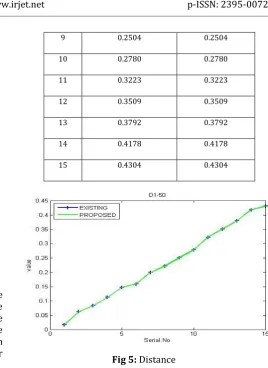
3. Distance
It shows the comparative research of the Distance, where it represents various numbers of nodes according to these nodes different values of Distance taken in existing and proposed technique respectively. As the table 3 shows that our proposed Distance is equal to the existing one.
Table3. Distance
D1-50
S.NO Existing Result Proposed Result
1 0.0171 0.0171
2 0.0623 0.0623
3 0.0830 0.0830
4 0.1120 0.1120
5 0.1468 0.1468
6 0.1589 0.1589
7 0.1988 0.1988
8 0.2215 0.2215
9 0.2504 0.2504
10 0.2780 0.2780
11 0.3223 0.3223
12 0.3509 0.3509
13 0.3792 0.3792
14 0.4178 0.4178
15 0.4304 0.4304
[image:5.595.284.553.67.436.2]Fig 5: Distance
Fig 5 shows the comparison of Distance between existing and also the proposed technique where serial no represents the number of nodes and value represents the Distance. Here, green line shows the proposed technique and blue cross shows the existing one. In our case the proposed Distance is equal to the existing one.
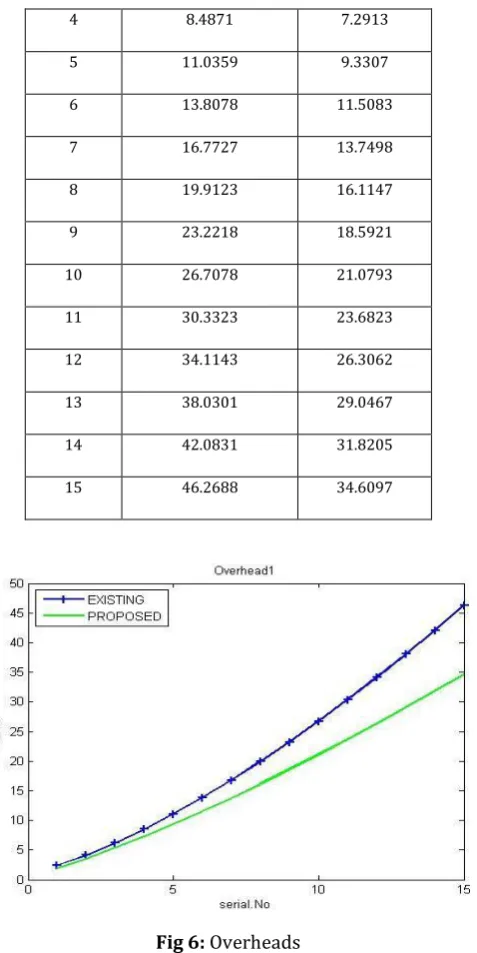
4. Overhead
Overhead is any combination of excess or indirect computation time, memory, bandwidth, along with other resources that have to attain a specialized goal. It represents various numbers of nodes according to these nodes different values of Overhead taken in existing and proposed technique respectively. As the table 4 shows that our proposed overheads is comparatively lower than the existing one.
Table4. Overhead
Overhead1
Serial. No Existing Result Proposed Result
1 2.4082 1.9295
2 4.1357 3.5332
© 2016, IRJET | Impact Factor value: 4.45 | ISO 9001:2008 Certified Journal
| Page 918
4 8.4871 7.2913
5 11.0359 9.3307
6 13.8078 11.5083
7 16.7727 13.7498
8 19.9123 16.1147
9 23.2218 18.5921
10 26.7078 21.0793
11 30.3323 23.6823
12 34.1143 26.3062
13 38.0301 29.0467
14 42.0831 31.8205
15 46.2688 34.6097
Fig 6: Overheads
Fig 6 shows the comparison of Overhead between existing and also the proposed technique where serial no represents the number of nodes and value represents the number of packets. Here, green line shows the proposed technique and blue line shows the existing one. In our case the proposed overhead are comparatively lower than the existing one.
7. CONCLUSIONS
Vehicular ad hoc networks (VANETS) have been envisioned to play an important role in the future wireless communication service market for safety communications as well as for information and entertainment applications. The distribution of vehicles in a single lane has been taken into account that consecutive
vehicles have to maintain a minimum safe distance between them. The proposed technique is designed and implemented in the MATLAB 2013a by using wireless communication and data analysis toolbox. This paper has proposed the proposed technique has utilized dynamic communication and dynamic path selection using artificial bee colony algorithm to enhance the results of VANETs further. The comparative analysis clearly indicates that the proposed technique outperforms over the available methods. This work has not considered the effect of node failure, so in near future we will use different failover technique to improve the results further.
REFERENCES
[1] Wisitpongphan, Nawaporn, et al. "Routing in sparse vehicular ad hoc
wireless networks." IEEE journal on Selected Areas in Communications 25.8 (2007): 1538-1556.
[2] Abdalla, Ghassan MT, Mosa Ali Abu-Rgheff, and Sidi Mohammed Senouci. "Current trends in vehicular ad hoc networks." Proceedings of UBIROADS workshop. 2007. [3] Toor, Yasser, et al. "Vehicle ad hoc networks:
applications and related technical issues." IEEE communications surveys & tutorials 10.3 (2008): 74-88. [4] Härri, Jerome, et al. "Vehicular mobility simulation with Vanet
MobiSim." Simulation (2009).
[5] Buchenscheit, Andreas, et al. "A VANET-based emergency vehicle warning system." 2009 IEEE Vehicular Networking Conference (VNC). IEEE, 2009.
[6] Leung, Kin K. "IMPACT OF TRANSPORT MODELS ON CONNECTIVITY OF VEHICULAR AD-HOC NETWORKS." July 11-15, 2010
[7] Jin, Wen-Long, and Bruce Wang. "Connectivity of vehicular ad hoc networks with continuous node distribution patterns." University of California Transportation Center (2010). [8] Kesting, Arne, Martin Treiber, and Dirk Helbing. "Connectivity
statistics of store and forward intervehicle communication." IEEE Transactions on Intelligent Transportation Systems 11.1 (2010): 172-181.
[9] Martinez, Francisco J., Chai Keong Toh, Juan‐Carlos Cano, Carlos T. Calafate, and Pietro Manzoni. "A survey and comparative study of simulators for vehicular ad hoc networks (VANETs)." Wireless Communications and Mobile Computing 11, no. 7 (2011): 813-828.
[10]Saleet, Hanan, Rami Langar, Kshirasagar Naik, Raouf Boutaba, Amiya Nayak, and Nishith Goel. "Intersection-based geographical routing protocol for VANETs: a proposal and analysis." Vehicular Technology, IEEE Transactions on 60, no. 9 (2011): 4560-4574.
[11]Hao, Yong, Yu Cheng, Chi Zhou, and Wei Song. "A distributed key management framework with cooperative message authentication in VANETs."Selected Areas in Communications, IEEE Journal on 29, no. 3 (2011): 616-629.
[12]Cenerario, Nicolas, Thierry Delot, and Sergio Ilarri. "A content-based dissemination protocol for VANETs: Exploiting the encounter probability."Intelligent Transportation Systems, IEEE Transactions on 12, no. 3 (2011): 771-782
.
[image:6.595.47.286.95.572.2]© 2016, IRJET | Impact Factor value: 4.45 | ISO 9001:2008 Certified Journal
| Page 919
effective strategy for location privacy in vanets." VehicularTechnology, IEEE Transactions on 61, no. 1 (2012): 86-96. [14]Toutouh, Jamal, José García-Nieto, and Enrique Alba.
"Intelligent OLSR routing protocol optimization for VANETs." Vehicular Technology, IEEE Transactions on 61, no. 4 (2012): 1884-1894.
[15]Al-Rabayah, Mohammad, and Robert Malaney. "A new scalable hybrid routing protocol for VANETs." Vehicular Technology, IEEE Transactions on 61, no. 6 (2012): 2625-2635
[16]Lu, Rongxing, Xiaodong Lin, Xiaohui Liang, and Xuemin Shen. "A dynamic privacy-preserving key management scheme for location-based services in vanets." Intelligent Transportation Systems, IEEE Transactions on 13, no. 1 (2012): 127-139. [17]Cheng L, Panichpapiboon S. Effects of intervehicle spacing
distributions on connectivity of VANET: a case study from measured highway traffic. IEEE CommunMag 2012;50(10):90– 7.
[18]Dang, Duc Ngoc Minh, Choong Seon Hong, Sungwon Lee, and Eui-Nam Huh. "An efficient and reliable MAC in VANETs." Communications Letters, IEEE 18, no. 4 (2014): 616-619.
[19]Shen, Xia, Xiang Cheng, Liuqing Yang, Rongqing Zhang, and Bingli Jiao. "Data dissemination in VANETs: A scheduling approach." Intelligent Transportation Systems, IEEE Transactions on 15, no. 5 (2014): 2213-2223.
[20]Feng, Cheng, Zhijun Li, Shouxu Jiang, and Rui Zhang. "Data Aggregation and Routing Guidance with QoS Guarantee in VANETs." International Journal of Distributed Sensor Networks 2014 (2014).
[21]Mittal, Narendra Mohan, and Savita Choudhary. "Comparative Study of Simulators for Vehicular Ad-hoc Networks (VANETs)." International Journal of Emerging Technology and Advanced Engineering (ISSN 2250-2459, ISO 9001: 2008 Certified Journal, Volume 4, Issue 4 (2014).
[22]Chen, Chen, Yanan Jin, Qingqi Pei, and Ning Zhang. "A connectivity-aware intersection-based routing in VANETs." EURASIP Journal on Wireless Communications and Networking 2014, no. 1 (2014): 1-16.
[23]Molina-Gil, Jezabel, Pino Gil, and Cándido Caballero-Gil. "Aggregation and probabilistic verification for data authentication in VANETs."Information Sciences 262 (2014): 172-189.
[24]Da Cunha, Felipe Domingos, et al. Data communication in VANETs: a survey, challenges and applications. Diss. INRIA Saclay; INRIA, 2014
.
[25]Jia, Dongyao, Kejie Lu, and Jianping Wang. "On the network connectivity of platoon-based vehicular cyber-physical systems." Transportation Research Part C: Emerging Technologies 40 (2014): 215-230.
[26]Kakkasageri, M. S., and S. S. Manvi. "Information management in vehicular ad hoc networks: A review." Journal of Network and Computer Applications 39 (2014): 334-350.
[27]Shalini, J. Beautlin, and A. Pravin. "Road Safety Based Model By Broadcasting Communication in VANET’s."vol. 5 (1) , 2014, 516-520
[28]El-atty, Saied M. Abd, and Konstantinos Lizos. "Interoperability Framework for Vehicular Connectivity in Advanced Heterogeneous Vehicular Network." International Journal of Computer Network and Information Security 6.4 (2014): 1. [29]Abuelenin, Sherif M., and Adel Y. Abul-Magd. "Effect of
minimum headway distance on connectivity of VANETs." AEU-International Journal of Electronics and Communications 69, no. 5 (2015): 867-871.