Distributed Representations of Words to Guide
Bootstrapped Entity Classifiers
Sonal Gupta
Department of Computer Science Stanford University
Christopher D. Manning
Department of Computer Science Stanford University
Abstract
Bootstrapped classifiers iteratively generalize from a few seed examples or prototypes to other examples of target labels. However, sparseness of language and limited supervi-sion make the task difficult. We address this problem by using distributed vector represen-tations of words to aid the generalization. We use the word vectors to expand entity sets used for training classifiers in a bootstrapped pattern-based entity extraction system. Our experiments show that the classifiers trained with the expanded sets perform better on en-tity extraction from four online forums, with 30% F1 improvement on one forum. The
re-sults suggest that distributed representations can provide good directions for generalization in a bootstrapping system.
1 Introduction
Bootstrapped or distantly-supervised learning is a form of semi-supervised learning, in which supervi-sion is provided by seed examples. Supervised ma-chine learning systems, on the other hand, require hand-labeling sufficient data to train a model, which can be costly and time consuming. Bootstrapped information extraction (IE) has become even more pertinent with the ever-growing amount of data cou-pled with the emergence of open IE systems (Carl-son et al., 2010; Fader et al., 2011) and shared tasks like TAC-KBP.1
Limited supervision provided in bootstrapped systems, though an attractive quality, is also one of
1http://www.nist.gov/tac/2014/KBP
its main challenges. When seed sets are small, noisy, or do not cover the label space, the bootstrapped classifiers do not generalize well.
We use a major guiding inspiration of deep learn-ing: we can learn a lot about syntactic and semantic similarities between words in an unsupervised fash-ion and capture this informatfash-ion in word vectors. This distributed representation can inform an induc-tive bias to generalize in a bootstrapping system.
In this paper, we present a simple approach of us-ing the distributed vector representations of words to expand training data for entity classifiers in a boot-strapped system (see Algorithm 1). To improve the step of learning an entity classifier, we first learn vector representation of entities using the continu-ous bag of words model (Mikolov et al., 2013a). We then usekNN to expand the training set of the clas-sifier by adding unlabeled entities close to seed en-tities in the training set. The key insight is to use the word vector similarity indirectly by enhancing training data for the entity classifier. We do not di-rectly label the unlabeled entities using the similar-ity between word vectors, which we show extracts many noisy entities. We show that classifiers trained with expanded sets of entities perform better on ex-tracting drug-and-treatment entities from four online health forums from MedHelp.2
2 Related Work
Bootstrapping has many variants, such as self-training, co-training, and label propaga-tion. Yarowsky’s style of self-training
algo-2http://www.medhelp.org
rithms (Yarowsky, 1995) have been shown to be successful at bootstrapping (Collins and Singer, 1999). Co-training (Blum and Mitchell, 1998) and its boostrapped adaptation (Collins and Singer, 1999) require disjoint views of the features of the data. Whitney and Sarkar (2012) proposed a modified Yarowsky algorithm that used label propagation on graphs, inspired by Subramanya et al. (2010) algorithm that used a large labeled data for domain adaptation.
In this paper, we use the setting of bootstrapped pattern-based entity extraction (Riloff, 1996; Thelen and Riloff, 2002). This can be viewed as a form of the Yarowsky algorithm, with pattern learning as an additional step. Pattern based approaches have been widely used for IE (Chiticariu et al., 2013; Fader et al., 2011; Etzioni et al., 2005). Patterns are useful in two ways: they are good features, and they identify promising candidate entities. Recently, Gupta and Manning (2014) improved pattern scoring (Step 2 in Algorithm 1) using predicted labels of unlabeled entities. For entity scoring (Step 3), they used an average of feature values to predict the scores. We use the same framework but focus on improving the entity classifiers.
In most IE systems, including ours, word classes or word vectors are used as features in a classi-fier (Haghighi and Klein, 2006; Ratinov and Roth, 2009).
To the best of our knowledge, our work is the first to use distributed representations of words to im-prove a bootstrapped system by expanding the train-ing set.
3 Background
In a bootstrapped pattern-based entity learning sys-tem, seed dictionaries and/or patterns provide weak supervision to label data. The system iteratively learns new entities belonging to a specific label from unlabeled text (Riloff, 1996; Collins and Singer, 1999) using patterns, such as lexico-syntactic sur-face word patterns (Hearst, 1992) and dependency tree patterns (Yangarber et al., 2000). We use lexico-syntactic surface word patterns to extract entities from unlabeled text starting with seed dictionaries for multiple classes. Algorithm 1 gives an overview. In this paper, we focus on improving the entity
clas-sifier (Step 3) by expanding its training data using distributed vector representations of words.
Algorithm 1Bootstrapped Pattern-based Entity
Ex-traction
Given: TextD, labelsL, seed entitiesEl∀l∈L whilenot-terminating-condition (e.g. precision is high)do
forl∈Ldo
1. LabelDwithEl
2. Create patterns around labeled entities. Learn good patterns and use them to extract candidate entitiesCl.
3. Learn an entity classifier and classifyCl.
Add new classified entities toEl.
Labeling known entities: The text is labeled using
the label dictionaries, starting with the seed dictio-naries in the first iteration.
Creating and Learning Patterns: Patterns are then
created using the context around the labeled entities to create candidate patterns for label l. Candidate patterns are scored using a pattern scoring measure and the top ones are added to the list of learned pat-terns for labell. In our experiments, we use a widely used pattern scoring measure, RlogF (Riloff, 1996; Thelen and Riloff, 2002). Top ranked patterns with scores above a certain threshold are used to extract candidate entitiesClfrom text.
Learning entities: An entity classifier predicts the labels of Cl and adds the newly classified entities
to label l’s dictionary, El. We discard common
words, negative entities, and those containing non-alphanumeric characters from the set.
in the seed dictionaries, word classes computed us-ing the Brown clusterus-ing algorithm (Brown et al., 1992; Liang, 2005), and pattern TF-IDF score. The last feature gives higher scores to entities that are ex-tracted by many learned patterns and have low fre-quency in the dataset. In our experiments, we call this classifier asNotExpanded.
4 Approach
The lack of labeled data to train a good entity classi-fier is one of the challenges in bootstrapped learning. We use distributed representations of words, in the form of word vectors, to guide the entity classifier by expanding its training set. As explained in the pre-vious section, we train a one-vs-all entity classifier in each iteration of the bootstrapped entity extrac-tion for each label. We use unlabeled entities that are similar to the seed entities of the label as positive ex-amples, and use unlabeled entities that are similar to seed entities of other labels as negative examples.3
To compute similarity of an unlabeled entity to the positive entities, we findkmost similar positive entities, measured by cosine similarity between the word vectors, and average the scores. Similarly, we compute similarity of the unlabeled entity to the neg-ative entities. If the entity’s positive similarity score is above a given threshold θ and is higher than its negative similarity score, it is added to the training set with positive label. We expand the negative enti-ties similarly.4
An alternative to our approach is to directly la-bel the entities using the vector similarities. Our ex-perimental results suggest that even though exploit-ing similarities between word vectors is useful for guiding the classifier by expanding the training set, it is not robust enough to use for labeling entities directly. For example, for our development dataset, whenθwas set as 0.4, 16 out of 41 unlabeled entities that were expanded into the training set as positive
3We take the cautious approach of finding similar entities only to the seed entities and not the learned entities. The algo-rithm can be modified to find similar entities to learned entities as well. Cautious approaches have been shown to be better for bootstrapped learning (Abney, 2004).
4We tried expanding just the positive entities and just the negative entities. Their relative performance, though higher than the baselines, varied between the datasets. Thus, for con-ciseness, we present results only for expanding both positives and negatives.
entities were false positives.5 Thus, labeling entities
solely based on similarity scores resulted in lower performance. A classifier, on the other hand, can use other sources of information as features to predict an entity’s label.
We compute the distributed vector representations using the continuous bag-of-words model (Mikolov et al., 2013a; Mikolov et al., 2013b) implemented in the word2vec toolkit.6 We train 200-dimensional
vector representations on a combined dataset of a 2014 Wikipedia dump (1.6 billion tokens), a sam-ple of 50 million tweets from Twitter (200 mil-lion tokens), and an in-domain dataset of all Med-Help forums (400 million tokens). We removed words that occurred less than 20 times, resulting in a vocabulary of 89k words. We call this dataset Wiki+Twit+MedHelp. We used the parameters sug-gested in Pennington et al. (2014): negative sam-pling with 10 samples and a window size of 10. We ran the model for 3 iterations.
5 Experimental Setup
We present results on the same experimental setup, dataset, and seed lists as used in Gupta and Manning (2014). The task is to extract drug-and-treatment (DT) entities in sentences from four forums on the MedHelp user health discussion website: 1. Asthma, 2. Acne, 3. Adult Type II Diabetes (called Dia-betes), and 4. Ear Nose & Throat (called ENT). A DT entity is defined as a pharmaceutical drug, or any treatment or intervention mentioned that may help a symptom or a condition. The output of all systems were judged by the authors, following the guidelines in (Gupta and Manning, 2014). We used Asthma as the development forum for parameter and threshold tuning. We used thresholdθas 0.4 and usek (num-ber of nearest neighbors) as 2 when expanding the seed sets.
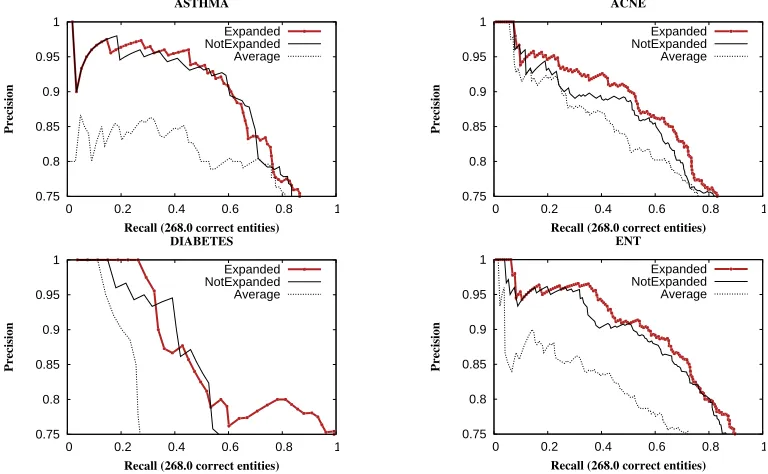
We evaluate systems by their precision and recall. Precision is defined as the fraction of correct enti-ties among the entienti-ties extracted. Similar to (Gupta and Manning, 2014), we present the precision and recall curves for precision above 75% to compare systems when they extract entities with reasonably
5Increasingθextracted far fewer entities.θ= 0.5extracted only 5 entities, all true positives, andθ= 0.6extracted none.
Forum Expanded Expanded-M NotExpanded Average Asthma 77.01 75.68 74.48 65.42
Acne 73.84 75.41 71.65 65.05 Diabetes 82.37 44.25 48.75 21.82
[image:4.612.160.458.60.129.2]ENT 80.66 80.04 77.02 59.50
Table 1: Area under Precision-Recall curve for all the systems. Expanded is our system when word vectors are learned using the Wiki+Twit+MedHelp data and Expanded-M is when word vectors are learning using the MedHelp data.
0.75 0.8 0.85 0.9 0.95 1
0 0.2 0.4 0.6 0.8 1
Precision
Recall (268.0 correct entities) ASTHMA
Expanded NotExpanded Average
0.75 0.8 0.85 0.9 0.95 1
0 0.2 0.4 0.6 0.8 1
Precision
Recall (268.0 correct entities) ACNE
Expanded NotExpanded Average
0.75 0.8 0.85 0.9 0.95 1
0 0.2 0.4 0.6 0.8 1
Precision
Recall (268.0 correct entities) DIABETES
Expanded NotExpanded Average
0.75 0.8 0.85 0.9 0.95 1
0 0.2 0.4 0.6 0.8 1
Precision
Recall (268.0 correct entities) ENT
Expanded NotExpanded Average
Figure 1: Precision vs. Recall curves of our system and the baselines for the four forums.
high precision. Recall is defined as the fraction of correct entities among the total unique correct enti-ties pooled from all systems.7 We calculate the area
under the precision-recall curves (AUC-PR) to com-pare the systems.
We call our systemExpandedin the experiments. To compare the effects of word vectors learned us-ing different types of datasets, we also study our sys-tem when the word vectors are learned using just the in-domain MedHelp data, called Expanded-M. We compare against two baselines:NotExpandedas ex-plained in Section 3, andAverage, in which we av-erage the feature values, similar to (Gupta and
Man-7Note that calculating lower precisions or true recall is very hard to compute. Our dataset is unlabeled and manually label-ing all entities is expensive. Poollabel-ing is a common evaluation strategy in such situations (such as, TAC-KBP shared task).
ning, 2014).
6 Results and Discussion
Table 1 shows AUC-PR of various systems and Fig-ure 1 shows the precision-recall curves. Our sys-temsExpanded andExpanded-M, which used simi-lar entities for training, improved the scores for all four forums. We believe the improvement for the Diabetes forum was much higher than other forums because the baseline’s performance on the forum de-graded quickly in later iterations (see the figure), and improving the classifier helped in adding more cor-rect entities. Additionally, Diabetes DT entities are more lifestyle-based and hence occur frequently in web text, making the word vectors trained using the Wiki+Twit+MedHelp dataset better suited.
[image:4.612.92.476.193.430.2]Positives Negatives Asthma pranayama, sterilizing, expectorants, inhalable, sanitizers, ayurvedic
block, yougurt,medcine, exertion, hate, virally
Diabetes quinoa, vinegars, vegat-ables, threadmill, pos-silbe, asanas, omegas
[image:5.612.73.298.59.171.2]nicely, chiropracter, ex-hales, paralytic, metabo-lize, fluffy
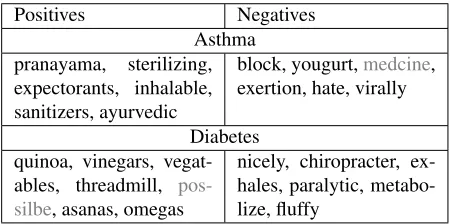
Table 2: Examples of unlabeled entities that were expanded into the training sets. Gray colored entities were judged by the authors as falsely labeled.
using a large corpus perform better than those trained using the smaller in-domain corpus. For the Acne forum, where brand name DT entities are more frequent, the entities expanded by MedHelp vectors had fewer false positives than those expanded by Wiki+Twit+MedHelp.
Table 2 shows some examples of unlabeled enti-ties that were included as positive/negative entienti-ties in the entity classifiers. Even though some entities were included in the training data with wrong labels, overall the classifiers benefited from the expansion.
7 Conclusion
We improve entity classifiers in bootstrapped en-tity extraction systems by enhancing the training set using unsupervised distributed representations of words. The classifiers learned using the expanded seed sets extract entities with better F1 score. This
supports our hypothesis that generalizing labels to entities that are similar according to unsupervised methods of word vector learning is effective in im-proving entity classifiers, notwithstanding that the label generalization is quite noisy.
References
S. Abney. 2004. Understanding the Yarowsky algorithm.
Computational Linguistics, 30:365–395.
A. Blum and T. Mitchell. 1998. Combining labeled and unlabeled data with co-training. InConference on Learning Theory (COLT).
P. F. Brown, V. J. D. Pietra, P. V. deSouza, J. C. Lai, and R. L. Mercer. 1992. Class-based n-gram models of natural language. Computational Linguistics, 18:467– 479.
A. Carlson, J. Betteridge, R. C. Wang, Jr. E. R. Hruschka, and T. M. Mitchell. 2010. Coupled semi-supervised learning for information extraction. InWeb Search and Data Mining (WSDM), pages 101–110.
L. Chiticariu, Y. Li, and F. R. Reiss. 2013. Rule-based information extraction is dead! long live rule-based information extraction systems! InEmpirical Meth-ods in Natural Language Processing (EMNLP), pages 827–832.
M. Collins and Y. Singer. 1999. Unsupervised models for named entity classification. InEmpirical Methods in Natural Language Processing (EMNLP).
O. Etzioni, M. Cafarella, D. Downey, A. Popescu, T. Shaked, S. Soderland, D. S. Weld, and A. Yates. 2005. Unsupervised named-entity extraction from the web: An experimental study. Artificial Intelligence, 165(1):91–134.
A. Fader, S. Soderland, and O. Etzioni. 2011. Identifying relations for open information extraction. InEmpirical Methods in Natural Language Processing (EMNLP). S. Gupta and C. D. Manning. 2014. Improved pattern
learning for bootstrapped entity extraction. In Compu-tational Natural Language Learning (CoNLL). A. Haghighi and D. Klein. 2006. Prototype-driven
learn-ing for sequence models. InNorth American Associ-ation for ComputAssoci-ational Linguistics (NAACL), pages 320–327.
M. A. Hearst. 1992. Automatic acquisition of hyponyms from large text corpora. InInterational Conference on Computational linguistics, pages 539–545.
P. Liang. 2005. Semi-supervised learning for natural language. Master’s thesis, Massachusetts Institute of Technology.
T. Mikolov, K. Chen, G. Corrado, and J. Dean. 2013a. Efficient estimation of word representations in vector space. Technical Report 1301.3781, arXiv.
T. Mikolov, I. Sutskever, K. Chen, G. Corrado, and J. Dean. 2013b. Distributed representations of words and phrases and their compositionality. In Advances in Neural Information Processing Systems (NIPS). J. Pennington, R. Socher, and C. D. Manning. 2014.
Glove: Global vectors for word representation. In
Empirical Methods in Natural Language Processing (EMNLP).
L. Ratinov and D. Roth. 2009. Design challenges and misconceptions in named entity recognition. In Com-putational Natural Language Learning (CoNLL). E. Riloff. 1996. Automatically generating extraction
A. Subramanya, S. Petrov, and F. Pereira. 2010. Effi-cient graph-based semi-supervised learning of struc-tured tagging models. InEmpirical Methods in Natu-ral Language Processing (EMNLP).
M. Thelen and E. Riloff. 2002. A bootstrapping method for learning semantic lexicons using extraction pattern contexts. InEmpirical Methods in Natural Language Processing (EMNLP), pages 214–221.
M. Whitney and A. Sarkar. 2012. Bootstrapping via graph propagation. InAssociation for Computational Linguistics (ACL).
R. Yangarber, R. Grishman, and P. Tapanainen. 2000. Automatic acquisition of domain knowledge for in-formation extraction. In International Conference on Computational Linguistics (COLING), pages 940– 946.