
Applications in Resource-Constrained Environments
Sean Reilly
A thesis submitted to the University of Dublin, Trinity College
in fulllment of the requirements for the degree of
Doctor of Philosophy (Computer Science)
I declare that this thesis has not been submitted as an exercise for a degree at this or any other
university and it is entirely my own work.
I agree to deposit this thesis in the University's open access institutional repository or allow the
library to do so on my behalf, subject to Irish Copyright Legislation and Trinity College Library
conditions of use and acknowledgement.
Sean Reilly
Acknowledgements
Firstly, I would like to thank my supervisor Dr. Mads Haahr for his guidance and encouragement. I have learned a great deal from working with him and appreciate the enormous contribution he has made to my academic development.
I would also like to thank my colleagues and friends in the Distributed Systems Group for making it a pleasure to be part of this unique research environment.
Thank you to all my friends for their help and encouragement along the way and for making my time as a student as fullling and rewarding as it was.
Finally, I would like to especially thank my parents and family for their constant support for all of my academic endeavours over the years. Without you this simply would not have been possible.
Sean Reilly
Summary
The ubiquitous computing vision which began with Weiser and its evolution since predicts large quantities of sensors, actuators and computational devices embedded in our environment enabling advanced applications which increase the ambient intelligence of the environment. As the prevalence of these devices increase, this vision is moving closer to reality. The large quantities of sensors have the potential to enable a range of sensor-rich applications in diverse domains such as healthcare, computer augmented sports, intelligent homes and smart oces. Within this class of sensor-rich applications are two subsets, sensor monitoring applications and sensor-driven applications. Sensor monitoring applications are applications that monitor sensors and transmit data to an external sink. The second sub-set of these sensor-rich applications which we call sensor-driven applications, i.e. applications that change their behaviour in response to sensor input, will provide the main instantiation of the ubiquitous computing vision. Sensor driven applications have two dening characteristics. Firstly they have multiple sensors and secondly they need to combine the data from these multiple sensors in order to drive the behaviour of the application.
There are a large amount of challenges in pervasive computing, ranging from privacy, trust, hetero-geneous devices and real-time applications to resource usage, routing, reliability and fault tolerance. In this thesis we focus on programming challenges which must be overcome when developing ubiqui-tous computing applications. Despite the fact that there are so many dierent types of applications a large amount of these applications share a common challenge, which is the need to deal with multiple sensor streams. Two challenges related to dealing with multiple sensor streams which we address in this thesis are the complexity of combining multiple sensor streams and the challenge of dealing with large quantities of continuous data. As the number of sensors in the system increases the developer must nd a way to combine the various streams of sensor data in order to perform meaningful multi-sensor data fusion and drive the behavior of the application. The continuous nature of multi-sensor data also provides challenges to the developer.
streams are a rst class type to large middleware systems devoted to the manipulation of streams. These large systems are used to perform continuous queries over streams of data in an analogous way to traditional database queries. Stream processing provides facilities for dealing with large quantities of sensor data and performing queries and operations across this data. However despite providing abstractions which could prove benecial to developers stream processing has largely not yet been adopted by ubiquitous computing developers.
Both of these solutions to the challenges of developing applications in the domain of sensor-driven applications have their own individual merits. Event based programming is a well proven tool of developers of ubiquitous computing applications while stream processing has specialised abstractions for combining streams and handling continuous data. In this thesis we propose a novel model that combines elements from stream processing with event based programming in order to make it more suitable for developing sensor-driven applications.
This thesis provides a set of abstractions which are used to extend event based programming to make it more suitable for developing sensor-driven applications. The combined model, Architecture for fusing events using streams and execution policies (AESOP) makes it easier for programmers to combine sensor streams by providing multi-event handlers and execution policies. AESOP also provides event streams which are abstractions that reduce the burden on the developer caused by programming with continuous data. The large range of ubiquitous computing platforms places ad-ditional challenges on any abstractions that aim to be applicable in the domain. As a large number of these platforms are constrained any general solution must also be suitable for resource-constrained platforms. The AESOP extensions are also designed to be useful with any underlying event model, be it peer-to-peer, implicit or mediator.
• Sean Reilly, Mads Haahr, "Extending the event-based programming model to support
sensor-driven ubiquitous computing applications", Pervasive Computing and Communications, IEEE International Conference on, pp. 1-6, 2009 IEEE International Conference on Pervasive Com-puting and Communications, 2009.
• Sean Reilly, "Multi-Event Handlers for sensor-driven ubiquitous computing applications",
Per-vasive Computing and Communications, IEEE International Conference on, pp. 1-2, 2009 IEEE International Conference on Pervasive Computing and Communications, 2009.
• Reilly, S., Barron, P., Cahill, V., Moran, K., and Haahr, M. (2009). A General-Purpose
Contents
Acknowledgements iii
Abstract iii
Publications Related to this Ph.D. vi
List of Tables xi
List of Figures xii
List of Listings xiv
Chapter 1 Introduction 1
1.1 Ubiquitous Computing and Sensor-Driven Applications . . . 1
1.2 Event-Based Programming . . . 2
1.3 Stream Processing . . . 3
1.4 This Thesis . . . 4
1.5 Document Roadmap . . . 5
Chapter 2 Sensor-Driven Applications 7 2.1 Example Applications . . . 7
2.1.1 Squash Training Application . . . 7
2.1.2 Elderly Patient Fall Detection . . . 8
2.1.3 Car Skid Control Application . . . 8
2.1.4 User Interface for Smartphone . . . 9
2.2 Application Characteristics . . . 10
2.2.1 Multiple Sensors . . . 10
2.2.2 Combination of Sensor Data . . . 10
2.2.3 Asynchronicity . . . 10
2.2.4 Access to Historical Data . . . 11
2.3 Programming Abstraction Support . . . 11
2.3.1 Functional Requirements . . . 12
Chapter 3 State of the Art 16
3.1 Review Methodology and Work Selection Criteria . . . 16
3.2 Simple Event-Based Systems . . . 17
3.2.1 JavaBeans Event Model . . . 17
3.2.2 STEAM . . . 18
3.3 Event Systems with support for Composite Events . . . 20
3.3.1 Cambridge Event Architecture . . . 20
3.3.2 Composite Event Detection as a Generic Middleware Extension . . . 22
3.4 Complex Event Processing Systems . . . 24
3.4.1 SASE . . . 24
3.4.2 Cayuga . . . 26
3.5 Stream Processing . . . 28
3.5.1 Aurora . . . 29
3.5.2 STREAM . . . 32
3.6 Stream and Event Processing Systems . . . 34
3.6.1 MavEStream . . . 35
3.7 Sensor Database . . . 38
3.7.1 TinyDB . . . 38
3.7.2 SINA . . . 41
3.8 Summary . . . 43
Chapter 4 The AESOP Model 45 4.1 Requirements . . . 46
4.2 Overview of the AESOP Architecture . . . 46
4.2.1 AESOP and the Host Event System . . . 46
4.2.2 Feature Preservation . . . 47
4.2.3 Interaction between AESOP and the Application . . . 48
4.2.4 Interaction Between the AESOP Abstractions . . . 48
4.3 Event Streams . . . 49
4.3.1 Event Stream Windows . . . 50
4.3.2 Windowing Mechanisms . . . 50
4.3.3 Window Membership . . . 52
4.3.4 Instantiation Considerations . . . 52
4.3.5 Event Streams in Example Application . . . 53
4.4 Multi-Event Handlers . . . 53
4.4.1 Instantiation Considerations . . . 54
4.4.2 Multi-Event Handler in Example Application . . . 55
4.5.2 Execution Policy in Example Application . . . 57
4.6 Composition of Multi-Event Handlers . . . 58
4.7 Summary . . . 59
Chapter 5 Implementation 60 5.1 Implementation Considerations . . . 60
5.1.1 Choice of Host Event System . . . 61
5.1.2 Window Mechanisms . . . 62
5.1.3 Window Membership Expressions . . . 62
5.1.4 Execution Policy Specication . . . 63
5.1.5 Programming Language . . . 63
5.2 Instantiations . . . 64
5.3 C-AESOP . . . 64
5.3.1 C-AESOP Requirements . . . 64
5.3.2 STEAM . . . 65
5.3.3 C-AESOP Time Model . . . 65
5.3.4 Programming Language . . . 66
5.3.5 Event Streams in C-AESOP . . . 66
5.3.6 Multi-Event Handlers in C-AESOP . . . 68
5.3.7 Execution Policies in C-AESOP . . . 69
5.4 J-AESOP . . . 70
5.4.1 J-AESOP Requirements . . . 70
5.4.2 J-AESOP Event Model . . . 71
5.4.3 The J-AESOP Time Model . . . 72
5.4.4 Programming Language . . . 72
5.4.5 The AESOP to Java Mapping . . . 72
5.4.6 The MultiEventHandler Class . . . 73
5.4.7 Example Multi-Event Handler . . . 74
5.4.8 Execution Policy . . . 75
5.4.9 The EventStream Class . . . 75
5.4.10 Composition . . . 75
5.5 Summary . . . 76
Chapter 6 Evaluation 77 6.1 Evaluation Strategy . . . 77
6.2 Squash Training Application . . . 79
6.2.1 Squash . . . 79
6.2.2 Sensor-Augmented Squash Training . . . 80
6.3 Viking Ghost Hunt . . . 87
6.3.1 Location-Aware Games . . . 87
6.3.2 The Game . . . 87
6.3.3 The Android Platform . . . 88
6.3.4 System Design . . . 88
6.4 Performance . . . 92
6.4.1 C-AESOP Resource Usage . . . 92
6.4.2 J-AESOP Resource Usage . . . 95
6.5 Functional Support for Sensor-Driven Applications . . . 97
6.5.1 Sensor-Augmented Squash Training . . . 97
6.5.2 Viking Ghost Hunt . . . 99
6.5.3 Discussion . . . 100
6.6 Generality . . . 100
6.6.1 Event Models . . . 100
6.6.2 Programming Languages . . . 101
6.6.3 Applications . . . 101
6.6.4 Platform Generality . . . 102
6.7 Summary . . . 103
Chapter 7 Conclusion 104 7.1 Achievements . . . 104
7.2 Perspective . . . 105
7.3 Future Work . . . 106
7.3.1 Timing Schemes for Composing Multi-Event Handlers . . . 106
7.3.2 Sharing of Event Streams . . . 106
Bibliography 107
Appendix A Results of Experiments 117
Appendix B Additional Source Code 120
List of Tables
2.1 Requirements of Middleware to Support Sensor-Driven Applications . . . 15
3.1 Summary of State of the Art . . . 43
6.1 STEAM and C-AESOP RAM Usage . . . 94
6.2 J-AESOP Resource Usage . . . 96
A.1 CPU Utilisation C-AESOP . . . 117
A.2 Steam CPU Utilisation . . . 118
A.3 Custom Event System Performance . . . 118
List of Figures
2.1 The sensor-driven application platform spectrum . . . 14
3.1 The Java Beans Event Model [103] . . . 18
3.2 Composite Event Detection in CEA [16] . . . 21
3.3 Illustration of distributed composite event detection [114] . . . 22
3.4 Interface with the host event-model [114] . . . 23
3.5 The SASE architecture [54] . . . 25
3.6 The CAYUGA system architecture [20] . . . 27
3.7 Aurora system model [1] . . . 29
3.8 The Aurora system architecture [1] . . . 31
3.9 MavEStream Architecture [78] . . . 35
3.10 MavEStream four-stage integration model [78] . . . 36
3.11 A query and results propogating through a TinyDB network [95] . . . 39
4.1 Placement of the AESOP Architecture . . . 47
4.2 AESOP Architecture Overview . . . 48
4.3 Event Stream Showing Window . . . 49
4.4 Event Streams and Sliding Windows . . . 50
4.5 Tumbling Windows . . . 51
4.6 The AESOP Model, Multiple Events with Execution Policy . . . 54
4.7 Composition of Multi-Event Handlers . . . 58
6.1 Start of Squash Swing . . . 81
6.2 Ball Contact . . . 82
6.3 End of Squash Swing . . . 83
6.4 Prototype Augmented Squash Racket . . . 84
6.5 Squash Training Application . . . 85
6.6 VGH system design . . . 89
6.7 Viking Ghost Hunt: Ghost View Mode . . . 90
6.8 C-AESOP v STEAM Performance . . . 94
List of Listings
4.1 Pseudo-code for Multi-Event Handler in Fall Detection Application . . . 55
4.2 Pseudo-code for Execution Policy in Fall Detection Application . . . 56
5.1 Example Main Function in C-AESOP . . . 66
5.2 Example Multi-Event Handler in C-AESOP . . . 67
5.3 Example Execution Policy in C-AESOP . . . 68
5.4 The Multi-Event Handler class . . . 72
5.5 Multi-Event Handler for Fall Detection Application in J-AESOP . . . 73
5.6 Example Execution Policy from Fall Detection Application . . . 74
B.1 The Fall Detection Example Application in C-AESOP . . . 120
Chapter 1
Introduction
The ubiquitous computing vision initially proposed by Weiser [136] and developed since is one in which many sensors, actuators and computational devices are distributed all around us in the environment in which we live. This vision is becoming ever close to reality with many people possessing multiple computational consumer devices, e.g., desktop computers, mobile phones [106] and in-car computers but also with advances in wireless sensor networks and embedded devices [132]. Developing ubiquitous computing applications for these devices, however, has numerous dierences to developing traditional desktop applications. For example, problems of mobility, heterogeneous devices, privacy and sensing the environment are all much more acute and complex in ubiquitous computing applications. In this thesis we propose abstractions that are suitable for combining and analysing multiple sensor streams and in doing so make it easier to develop applications which use multiple sensors. The abstractions are presented as generic extensions to event based systems. We present two implementations of the abstractions which we use in our evaluation of the abstractions.
This introductory chapter motivates the body of work presented in the thesis and provides back-ground information in event-based programming and stream processing which is required to under-stand the thesis. The chapter also summarises the contribution of the thesis and presents a document roadmap.
1.1 Ubiquitous Computing and Sensor-Driven Applications
Despite the fact that ubiquitous computing now is driven by a large number of dierent approaches and is used to describe a broad variety of applications, one characteristic which is common to a large amount of these applications is that of having one or more sensors and needing to combine the streams of data from these sensors in order to react and respond to their environment. We use the term sensor-rich applications to describe the class of applications that have multiple sensors. We dene sensor-driven applications as a sub-class of sensor-rich applications. Sensor-driven applications have two main dening characteristics: they have multiple sensors, and they change their behaviour primarily in response to their sensor inputs. This in contrast to applications which might perform some monitoring tasks using sensors without any combination or analysis. An example of a sensor-driven application would be a pool monitoring system such as Poseidon [75] which uses multiple sensors to detect incapacitated swimmers and alert lifeguards to their whereabouts. Sensor-driven applications are a very signicant sub-set of all ubiquitous computing applications.
1.2 Event-Based Programming
so can put the processor in idle mode between events. For example, the leading embedded operating system TinyOS [59] for Berkeley motes uses an event-based model. For these reasons the paradigm of event-based programming is particularly well suited to, and has been extensively used in, the development of ubiquitous computing applications [61].
There are a large variety of dierent event-based systems [112, 52, 103, 129, 99, 101, 110, 92], some designed for use on one machine and others distributed across many. There are also many types of event models including peer-to-peer [104], mediator [52] and implicit event models [15, 101]. There is a history of extending these event models and systems to make them better for dealing with a particular problem or for working in a particular domain. For example, scalability is a major concern in distributed systems and several extensions to the event-model have been proposed improve the scalability of applications that use event-based communication. Propagating events to all nodes in a large distributed system severely hampers the scalability of the system. To this end work like the ECO [110] model and Cambridge Event Model [112] introduce mechanisms to limit the distribution of irrelevant or unneeded events. In the ECO model the mechanisms are called notify constraints and in the Cambridge Event Model these are referred to as lters. This is just one example of a group of extensions to the core event model designed to make it more suitable for dealing with a particular challenge or application domain.
1.3 Stream Processing
Stream Processing as a research discipline has its origins in stream processing languages such as Lucid [11] from the late 1970s. In stream processing languages, streams are a rst order data type. These languages are usually dataow languages, i.e., systems in which the movement of data around the system causes the program to execute. For example, in Lucid the expressiona+b=cwill wait until
it has a value fora and for b and then evaluate the value for c. Stream processing languages have
found favour with functional programming researchers because of their strong semantics and formal underpinnings. They have also been used in hardware design languages and other elds.
Streams, or more specically data streams are time ordered sequences of data tuples. There is a strict time ordering on the elements of the data stream. Each individual tuple in a data stream contains some stream specic information, but can also contain additional information such as a timestamp which can be used in the processing of the stream.
relational databases systems are insucient for the task. Attempts have been made to extend rela-tional databases to make them more suitable, for example by designing in-memory databases where the entire database resides in main memory to speed up the operations, however these eorts have largely failed due to the large volumes of data and it became clear that a new approach was required. This research has progressed to the development of data stream management systems (DSMS) which are specically designed to deal with continuous streams of data. These DSMSs usually provide the facility to answer long running continuous queries (CQs) over some combination of input streams. Large amount of research in current DSMSs is focused on dealing with bursty, or infrequent streams, quality of service (QoS), calculating approximate results to queries, windowing mechanisms, load shedding [82, 14, 98, 91] and scheduling [12, 24, 125].
The dataow model is ideal for working with streams of data because in essence the arrival of data is what drives the ow of the application. This is similar in a large number of respects to event-driven systems where the arrival of events causes the execution of handlers and drives the execution of the application.
1.4 This Thesis
The research hypothesis of this work is that there exists abstractions which simplify the design and implementation of sensor-driven applications and that the abstractions presented in chapter 4 of this thesis are such abstractions.
It is clear that event-based programming is a useful paradigm for developing ubiquitous computing applications. However, developing applications with multiple sensor streams is still non-trivial for the programmer. Combining and analysing continuous streams of sensor data requires data structures and algorithms that are not common in typical desktop or server applications. Stream processing, on the other hand, has abstractions for dealing with and combining streams and handling continuous data. However, it has very low uptake among application developers in general and among ubiquitous computing application developers in particular. This thesis aims to combine the best of both worlds by marrying concepts from stream processing with the preferred development techniques for ubiquitous computing. The approach is to extend the event-based programming model with abstractions from the domain of stream processing to make it more suitable for developing sensor-driven ubiquitous computing applications.
The main contributions of this thesis are:
1. Generic extension to event-based programming to support the development of sensor-driven applications
2. Design and implementation of C-AESOP
3. Design and implementation of J-AESOP
5. Design and implementation of the Viking Ghost Hunt Application
The rst contribution is the AESOP abstractions themselves. These abstractions are presented in Chapter 3. They are a generic extension to event based programming and the most important of all the contributions. Contributions 2 and 3 relate to the implementation of the AESOP abstractions. It is highly illustrative to see how the abstractions can be implemented and to see how a host event system can be extended with the AESOP abstractions. The fourth and fth contribution show applications that have been developed using the AESOP abstractions. These applications show how the abstractions can be used and are used to evaluate the usefulness of the AESOP abstractions in the development of sensor-driven applications.
The research questions which motivated the work in this thesis are:
1. Can we devise a set of abstractions that would be useful for developing sensor-driven applica-tions?
2. How should we implement these abstractions?
3. Do the AESOP abstractions help in the creation of sensor-driven applications?
The research questions are directly related to the contributions of this thesis. The rst research question Can we devise a set of abstractions that would be useful for developing sensor-driven appli-cations? is directly addressed by the rst contribution which is a Generic extension to event-based programming to support the development of sensor-driven applications. The second and third contri-butions which detail the C-AESOP and J-AESOP design and implementation are directly related to the second research questions which asks how the abstractions proposed as an answer to question one might be implemented. Finally the fourth and fth contributions which provide example applications developed using the abstractions are used to answer the third research question and to show that indeed the abstractions are useful for the development of sensor driven applications.
The extension, called Architecture for fusing Events using Streams and Execution Policies (AE-SOP), provides abstractions for combining sensor data from multiple continuous sensors. The support provided by these abstractions for developing sensor-driven applications is evaluated. The evaluation is carried out by creating two instantiations of the AESOP model. These instantiations are then used to develop two sensor-driven applications. These applications and the two instantiations are then analysed and the degree of support oered by the AESOP model in the development of sensor-driven applications is evaluated. The resource usage of the instantiations are also quantied and shown to be acceptable for the development of sensor-driven applications.
1.5 Document Roadmap
The structure of this thesis is as follows.
Chapter 3 presents a survey of the state of the art of abstractions used to develop sensor-rich applications.
Chapter 4 presents the proposed extensions to event-based programming, called AESOP. Chapter 5 describes two instantiations of the model. C-AESOP is written in C on the Gumstix platform while J-AESOP is written in Java on the Android platform.
Chapter 6 evaluates the model by examining the generality of the extensions and the suitability of the model for writing sensor-driven applications.
Chapter 2
Sensor-Driven Applications
The purpose of this chapter is to derive the requirements for abstractions that support sensor-driven applications. This chapter presents four example sensor-driven applications from four separate appli-cation domains within the greater eld of ubiquitous computing. The qualities of these appliappli-cations are analysed to reveal the common characteristics of sensor-driven applications. These characteristics are then used to synthesise the requirements for middleware to support sensor-driven applications. There are seven requirements of sensor-driven applications and we divide these requirements into functional requirements and general middleware requirements.
2.1 Example Applications
In order to focus our discussion of sensor-driven applications, we present here four example application from dierent application domains. The applications presented serve as examples when discussing sensor-driven applications in the remainder of the thesis, and two of the applications are implemented as demonstrator applications and used as the basis for our evaluation in chapter 6.
2.1.1 Squash Training Application
by a technician. Squash courts are also situated indoors which aids development and testing of the application. Furthermore considerable squash expertise and numerous athletes were available locally by virtue of the author's contacts in the Dublin University Squash Rackets Club.
Squash is a racket sport played between two competing athletes. In the sport of squash the swing of the athlete is of vital importance. Athletes and trainers are interested in several characteristics of the swing and the stance of the athlete as they make contact with the ball. Accelerometers and orientation sensors placed on the athlete's racket could be used to detect the moment of contact with the ball and the orientation of the racket on impact. They could also be used to detect the start and end of the athlete's swing. Force sensors in the athlete's shoes could detect the stance of the athlete. The balance and movement of the athlete is of vital importance as they strike the ball. The proposed application could analyse the movement and swing of the athlete and could oer advice to the athlete and coach on strategies for improving the swing.
2.1.2 Elderly Patient Fall Detection
Much consideration has been given to how ubiquitous computing can help cater for the needs of sick and elderly people [84, 135, 134, 107, 81]. This research eld has become known as ubiquitous healthcare or pervasive healthcare. Assisted living is a domain which has the goals of allowing elderly and disabled patients to live on their own in their own home. This has several important advantages such as reducing the need for expensive hospitalisation, reducing the chances that the patient will contract a secondary infection in hospital and supporting the independence of the patient by allowing them to be in control of their own condition. The following example ubiquitous computing application is used to support a patient in their day to day life in and around their own home.
An elderly person lives alone and is concerned that they might fall and be unable to contact emergency services or friends for help. An automatic fall monitoring system is proposed to detect a potential fall and alert the relevant people. The system needs to distinguish between resting (such as sitting and lying down) and a more violent fall. It uses multiple accelerometers distributed around the patient's body, one on the hip, on the wrist and embedded in the patient's shoe. The system operates by detecting if the patient's posture has changed from being upright to horizontal, when this is detected it then performs more complex analysis over the historical accelerometer data from the three sensors to determine if the change was caused by a fall or the patient making a voluntary movement. If a fall is detected the application alerts the patient and unless the alert is cancelled, calls for help.
2.1.3 Car Skid Control Application
high speed; Dynamic Stability Control which uses a multitude of sensors monitoring wheel rotation, steering angle, lateral forces, pressure and yaw to detect anomalies in the motion of the car and then initiates actions to correct these anomalies; and Active Safety system which uses sensors distributed around the car to detect the direction and force of impacts and uses this information to control airbags, active headrests and seat belt systems.
We propose an example application that is a skid control and recovery system designed for an automobile. The system has multiple sensors detecting the rate of turn of each of the cars wheels. It also has a momentum sensor which is a combination of several other sensors and also an accelerometer sensor. A skid is detected from analysing the rate of turn of all the wheels. When a skid is detected, analysis is performed using the momentum of the car, the accelerometer data and wheel turn rate for the period up to and including the skid and the best corrective action is calculated in order to take the car out of the skid and regain control of the car.
2.1.4 User Interface for Smartphone
Phones are increasing in capabilities both in terms of additional GPS, accelerometers and other sensors, as well as processing and graphics power. The iPhone [65], HTC G1 [38] and Nokia N96 [109] all support accelerometers and increased processing power in comparison to older models. The features available and the availability of a marketplace and central distribution system has led to a large amount of applications being developed for these devices. For example, the iPhone app store has had over two billion applications downloaded as of September 2009 [64] and has over one hundred thousand applications available as of November 2009 [63]. The largest category of applications available on the iPhone app store is in the game category. Clearly there is a large interest in developing and playing games for smartphones, however developing user interfaces with these sensors is not trivial as developers generally do not have the expertise to deal with sensors and programming in the physical world. One category of games which are well placed to utilise the advanced sensor functionality of the smartphones are location-aware games. Location-aware games are games in which the location of the player is used as an integral part of the game play, implying that the player can move around while playing the game. With the integration of GPS in most of the new smart phones the scene is set for location-aware games which allow the phone to be used in a non-traditional manner as the interface to the game.
2.2 Application Characteristics
When we consider the sensor-driven applications described in section 2.1 a number of characteristics related to the use of sensors which are common to all of the applications become apparent.
2.2.1 Multiple Sensors
Of the four applications it is clear that all posses multiple sensors. The squash application has four distinct sensors: an accelerometer, an orientation sensor and two separate force sensors. The automatic skid control application has six separate sensors: four wheel turn sensors, one momentum sensor and an accelerometer. The fall detection system has three separate accelerometer sensors and the user interface for a smartphone has three separate sensors: a magnetometer, an accelerometer and a GPS sensor. From this brief analysis of the sensor units in the example applications it is clear that a common characteristic of sensor-driven applications is the presence of multiple sensors.
2.2.2 Combination of Sensor Data
In section 1.1 we dened sensor-driven applications as applications which did not just store or forward sensor data but used this sensor data to drive the behaviour of the application. As observed in section 2.1 each sensor-driven application has multiple sensors. Therefore it follows that the sensor streams from the multiple sensors must be combined or merged in order to drive the behaviour of the application. By combined, we mean the information must be used together to calculate an output relevant to the application. Analysing two of the example applications, the automatic skid control application needs to combine the data from six separate sensors in order to decide what action, if any, to take to regain control of the automobile. The squash application needs to combine sensor data from four separate sensors to advise the athlete on how to improve their swing. All of the examples given in section 2.1 have the characteristic that the behaviour of the application relies on the output from multiple sensors and that the application must combine this sensor data.
2.2.3 Asynchronicity
2.2.4 Access to Historical Data
Each of the applications described in section 2.1 must not just detect some event in the environment, they must also then analyse the historical data before the event and use this data to drive the behaviour of the application. This analysis uses the historical data, possibly in conjunction with the present data, to determine the correct course of action. In the car skid example, the application must rst detect that a skid is occurring and once this event has been observed must use the historical data from sensors, such as the accelerometer, to determine what corrective action must be taken in order to regain control of the vehicle. In the fall detection example, the system must rst detect that a possible fall event has occurred and must then analyse the sensor data from the period leading up to the possible fall event to detect if it was a violent fall and determine if the patient might be in danger.
2.3 Programming Abstraction Support
Abstractions are a vital part of software development. For example, the abstraction of a function in the C programming language, while being basic, is very useful. The developer can divide the application into modules and does not need to worry about the mechanics of how the function is implemented e.g., the state of the calling program or variable management on the stack. This allows the developer to use the abstraction of a function to write better more manageable code, which can be re-used easier. This process of abstraction is evident in many branches of computer science. Programming languages have numerous abstractions, from types and functions in languages such as C [118] to objects and interfaces in modern Object-Orientated programming languages such as Java [10]. Abstraction is also prevalent in the operating system community, e.g., inter-process communication in the form of semaphores and pipes [130], and in the distributed systems community, e.g., Remote Procedure Call [102] and Distributed Shared Memory [25]. Abstraction is also an important aspect of middleware. Middlewares provide useful abstractions that reduce the burden on the programmer by providing a range of functional and/or non-functional features. These abstractions form the core of the middleware and are the manner in which we access its features. For example, in a broker-based event middleware the abstractions of an event and a broker are the core concepts that programmers use when accessing the services of the middleware and good abstractions are among the main reasons for using the middleware. By using these abstractions, the developer benets from all the non-functional and functional features associated with the middleware.
Developing sensor-driven applications present additional challenges when compared to developing applications that are not sensor-driven. The manner in which we aim to address these challenges is by proposing a set of additional abstractions that extend event-based programming and which can simplify the task.
section 2.2. The requirements are numbered and divided into two categories: functional requirements (denoted by an F prex) and general middleware requirements (denoted by an M prex).
2.3.1 Functional Requirements
In section 2.2 we discussed the common characteristics of sensor-driven applications. In this section we will dene requirements for abstractions to support sensor-driven applications that have these characteristics. Any set of abstractions aimed at supporting sensor-driven applications should satisfy all of these requirements.
F1: Combination of Sensor Data
The presence of multiple sensors, and the need to combine information from these sensors, were noted in section 2.2 as two characteristics of sensor-driven applications. Therefore the ability to combine sensor data from multiple sensors is a requirement of middleware to support sensor-driven applications.
F2: Continuous Sensor Data
In section 2.2 we noted that sensor-driven applications need to analyse historical sensor data at points of interest to the application. As the sensors used in sensor-driven applications can be continuous and potentially provide a never ending stream of sensor readings the processing of this historical data is not trivial. A requirement therefore of middleware to support sensor-driven applications is abstractions to support the analysis of continuous sensor data.
F3: Analysis of continuous sensor data from multiple sensors
From section 2.2 it is clear that sensor-driven applications need to both analyse continuous sensor data and combine readings from multiple sensor streams at the same time. The ability to analyse continuous sensor data from multiple sensors is therefore a requirement of any middleware designed to support sensor-driven applications.
2.3.2 General Middleware Requirements
When proposing an abstraction as a solution to a range of problems, it is important to know how widely applicable it is. When discussing the generality of a particular abstraction for developing sensor-driven applications we are interested in the abstraction's generality in a number of dierent dimensions.
M1: Event Model Generality
applications so any abstraction proposed as a general abstraction for developing sensor-driven appli-cations should be compatible with the event-based approach. It should also be compatible with the full range of dierent event systems and event models used in ubiquitous computing applications.
M2: Language Generality
All programming abstractions must map to a specic language in order to be implementable. However it is important that the abstractions are mappable to a large number of dierent languages in order to be generally useful. Generally speaking, it is desirable that the abstractions should be implementable in as wide a range of programming languages as possible. This allows the abstractions to be used in as many dierent applications as possible. If the abstraction is not mappable to a wide range of languages, the choice of programming language restricts what abstractions can be used and vice-versa. Abstractions intended to be generally applicable in ubiquitous computing applications should map to all languages used to develop ubiquitous computing applications.
M3: Generality across Application Domains
In section 1.1 we noted that there are a large range of ubiquitous computing applications and in section 2.1 we presented four example sensor-driven applications from four dierent application domains. Any abstraction proposed as a general abstraction for use in ubiquitous computing applications must be general across a range of application domains. When proposing a set of abstractions as a general solution for use in the development of sensor-driven applications the abstractions must be applicable in the majority of application domains.
M4: Platform Generality
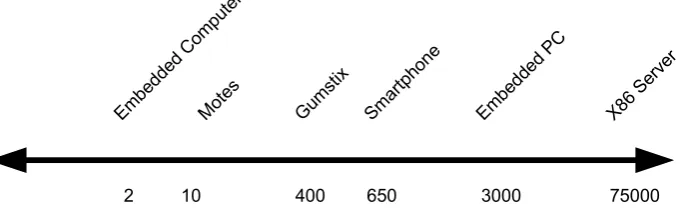
Sensor-driven applications are implemented on a range of dierent platforms. This can be seen in the example applications in section 2.1. The fall-detection system could be implemented on a mote [133] platform. The motes would provide good support for communication and power eciency while remaining small enough to be worn on the body of the patient for a long period of time. The squash application could be implemented on the Gumstix [70] platform. This would provide enough processing power for the analysis of the squash swing, while also remaining small and light enough to be embedded in the squash racket. The mobile game application could be implemented on the HTC G1 [38] smartphone platform. The HTC G1 comes has three accelerometers, 3 magnetometers and a GPS sensor and has the processing capabilities to support a game. The skid-detection and recovery application could be implemented on an embedded x86 personal computer. The automobile is large enough to easily carry an embedded personal computer and it could also easily supply enough electrical power.
Embe
dded
PC
Mot es
Gums tix Embe
dde
d Co
mput er
X86 Serve
r
Smart
phone
Millions of Instructions per Second of Node
75000
400 650 3000
[image:28.595.135.477.224.330.2]10 2
Figure 2.1: The sensor-driven application platform spectrum
conguration of the HiFi system [37].
Abstractions designed to be useful in the majority of ubiquitous computing systems must be suit-able for use on the range of platforms on which ubiquitous computing applications are run. Some abstractions, while being useful and general, incur a signicant run time cost and therefore are not suitable for certain platforms. As we can see from gure 2.1 a large amount of sensor-driven ap-plications are implemented on resource-constrained platforms, e.g., mobile phones and embedded computers. Therefore any abstraction aimed at being a general abstraction for use in ubiquitous computing applications must be suitable for use on resource-constrained platforms.
2.4 Conclusion
Functional Requirements F1: Combination of Sensor Data F2: Continuous Sensor Data
F3: Analysis of Continuous Sensor Data from Multiple Sensors General Middleware Requirements
M1: Event Model Generality M2: Programming Language Generality M3: Application Generality M4: Platform Generality
Table 2.1: Requirements of Middleware to Support Sensor-Driven Applications
Chapter 3
State of the Art
Chapter 1 introduced event-based programming and stream processing as two techniques for building ubiquitous computing applications and stream-based applications respectively. As stated in section 1.4 we aim to combine the two approaches by taking suitable abstractions from the domain of stream processing and using them to extend event-based programming. Chapter 2 discussed sensor-driven applications and derived a set of requirements for abstractions aimed at supporting them. In this chapter we review the state of the art in abstractions used to develop sensor-rich applications. By reviewing existing abstractions used to develop sensor-rich applications we aim to analyse these ab-stractions and using the requirements derived in section 2.3 determine how well they support the development of sensor-driven ubiquitous computing applications.
3.1 Review Methodology and Work Selection Criteria
In section 2.3 we discussed characteristics of programming abstractions which are desirable for sup-porting sensor-driven ubiquitous computing applications and derived a set of requirements for such abstractions. We use these requirements to analyse the state of the art for abstractions used to de-velop sensor-rich applications. Although the work in question may not have been designed with these features in mind it is still a worthwhile exercise to review the projects in this manner to understand how useful the abstractions provided are for implementing sensor-driven applications.
processing and we review this work in section 3.6. Finally we discuss the sensor database abstraction, an alternative approach to combining sensor readings which is popular in wireless sensor networks, in section 3.7.
There are clearly a large quantity of projects that can be reviewed with this format, far too many to t in this thesis. Therefore to reduce the amount of projects to be reviewed we review the two most inuential and relevant projects from each eld.
3.2 Simple Event-Based Systems
Event-based programming is a very large and mature research eld in computer science, and there are many signicant pieces of work [112, 15, 92, 104, 129, 99, 101, 40, 19, 119, 52, 57]. As stated in section 1.2 event-based programming is a natural t for dealing with sensor data as each datum can be modelled and communicated as an event. Event-based programming is also a very common programming paradigm in the eld of ubiquitous computing. In addition to the basic event-based functionality most event-based systems provide additional functionality to improve their performance in a particular scenario or to make them more suitable for a particular domain. When analysing simple event-based systems we limit our discussion to event-based systems that have no explicit mechanism for creating complex events, i.e., events which are formed from the combination of one or more events.
3.2.1 JavaBeans Event Model
Java is a popular object-oriented programming language developed by Sun Microsystems. JavaBeans is a component model for Java and denes its own event model [103]. The event model is designed for small centralised systems such as window toolkits but can be used in a distributed fashion by utilising the Java Remote Method Invocation (RMI) system.
Events are one of the core features of the JavaBeans architecture. They are one of the mechanisms used to allow components of the architecture communicate with each other. JavaBeans are used in a wide variety of applications from applets to desktop applications. Figure 3.1 shows an overview of the JavaBeans event model. In the event model, event notications are communicated from event sources to event listeners by invocation of methods on the listener objects. Listeners wishing to register their interest in events must implement the EventListener interface. State associated with an event notication is encapsulated in an event object that inherits from java.util.EventObject and is passed as the sole argument to the event method. Event sources must provide methods by which event listeners can register and de-register themselves as listeners for particular events.
Figure 3.1: The Java Beans Event Model [103]
Discussion
The JavaBeans event model is a simple event model designed for small-scale applications that are not distributed. The synchronous nature of the event delivery mechanism coupled with the fact that event sources must call the handler function of all the event listeners in sequence means that even if RMI is used event sources must wait until the event is delivered before they can proceed with their own execution and notifying the remaining listeners which incurs signicant performance penalties for event sources with multiple consumers. Anonymity between event source and listener is not provided by the model. Even when adaptors are used a reference to the adaptor is used as the destination of the event, and the event listener must still know the identity of the event source and register directly with it.
The JavaBeans event model provides no means to combine multiple sensor streams. Any combi-nation of multiple events would need to be done in an ad-hoc manner perhaps by a number of event listeners updating a shared data structure. There is no in built mechanism in the JavaBeans event model for dealing with historical events or continuous event streams.
3.2.2 STEAM
including indoor and outdoor smart environments, augmented reality systems and trac management scenarios [100]. STEAM is designed with the notion that mobile devices are generally more interested in events which occur in closer proximity to the producer and that certain events can be ltered in this manner. It extends the standard event model with the notion of proximity ltering which restricts event delivery within a geographical space. STEAM is designed for use in mobile ad-hoc networks although it can be used with standard infrastructure-based networks also.
Event Model
STEAM uses an implicit event model [101], meaning that event consumers subscribe to event subjects and not with a mediator or with another node. This is in contrast to peer-to-peer and mediator-based models. The implicit event model is preferred in this instance because in a mobile ad-hoc network one cannot always assume the presence of delivery services in the network (e.g., a message broker) and so each node must be able to receive and deliver its own messages.
Events in STEAM contain a subject and a content. The subject denotes the name of the event that has occurred, e.g., a door opening event, and the content contains a list of attributes that refer to properties of the particular instance of the event, e.g., the location of the door and the time of the event. STEAM producers and consumers must agree a priori on denitions of events and schemas for event attributes. Sensor data can easily be encapsulated in a STEAM event where the event subject relates to what sensor produced the data and the content carries the sensor data.
Events in STEAM are not timestamped and the STEAM event model does not explicitly deal with the timing of events. Out of order events are handled when they arrive at the consumer and no attempt is made to re-transmit events that have not been delivered to a consumer.
Discussion
The STEAM event middleware provides an event system to facilitate event-based programming. It is specically designed for the mobile ad-hoc domain. A signicant subset of ubiquitous applications have mobility as a main concern and the ad-hoc communication paradigm is suited to addressing these issues. Therefore STEAM would seem to be suitable to address this subset of ubiquitous computing applications. STEAM has been implemented on a range of platforms including severely resource constrained platforms.
3.3
Event Systems with support for Composite Events
Composite events are events that are composed from two or more other events. There are many event systems which support composite events [123, 86, 114, 97, 16, 89, 124]. We have selected the Cambridge Event Architecture [16] and Composite Event Detection as a Generic Middleware Extension [114] as the two projects to review from this body of work. We have selected these projects because they have a representative set of functionality and have similar goals to this thesis in that they intend to create a generic middleware extension for use with a wide range of host middlewares.
3.3.1 Cambridge Event Architecture
Bacon et al. [16] propose an event architecture called the Cambridge Event Architecture (CEA) which is intended as an extension to any synchronous object-oriented middleware to support asynchronous operation. It is intended for a wide range of application domains including healthcare, location-aware systems and network-monitoring systems. CEA supports asynchronous operation of applications by using events, event classes and event occurrences as object instances [16]. CEA uses a publish-register-notify paradigm with event object classes and also supports source-side ltering based on parameterisable templates. Event objects publish their interfaces specied in Interface Denition Language (IDL) including the events they will notify. CEA also supports access control through the use of the OASIS service [58].
Event Mediators
CEA contains the abstraction of event mediators. Event mediators are intermediaries between pro-ducers of events and their consumers. The event source noties the mediator which then noties the consumers. They can be used to implement a range of functionality, e.g., providing a higher level interface to event consumers than might be provided by a more primitive event source. They can also be used to add event ltering capabilities or to support disconnected operation of mobile devices.
Event Composition
The CEA also supports a composite event service and provides composition operators and a language for specifying composite events. Figure 3.2 shows the composite event service in CEA. CEA also uses stream semantics to model incoming events. Five operators are dened for specifying composite events: WITHOUT, SEQUENCE, OR, AND and FIRST. Unfortunately very little detail about the composite event system is available, e.g., relating to time model or composition operators.
Historical Events
Figure 3.2: Composite Event Detection in CEA [16]
Discussion
CEA is an eective way of adding asynchronous communication capabilities to an otherwise syn-chronous system. Event mediators allow additional functionality to be incorporated in the event services and it is easy to imagine a range of additional services being implemented in this manner including event ltering. The system also supports composition of events which should allow it to be used to develop more sophisticated event-based applications.
Very little information on the composition of events is provided. The time model for the event system is not available and this would be useful in conjunction with knowledge of the event composition language in determining how expressive the event composition system is. The composition operators are limited and no scope is available for implementing additional operators or for custom operators.
Historical data is accessed using a traditional database-style approach. This approach is only suitable for an event system with a very low event rate. A moderate rate of events would quickly exhaust the database storage space and the process of storing events and then querying the system would signicantly increase the processing time for applications which relied on this data. This method of historical data access would be insucient for implementing a stream processing style application in which a stream of events needed to be monitored and analysed.
With respect to sensor-driven applications, the event composition ability of the architecture could support limited sensor-driven applications, however more sophisticated sensor-driven applications might prove dicult to implement because of the lack of expressiveness in the event composition language. There is limited support for accessing historical events and as noted earlier any more than a moderate event stream would create diculties for the application. It does not appear to be possible to perform custom analysis outside of the limited set of operators provided by the event composition language. The inclusion of event composition features and access to historical data, however limited, shows that the authors consider this functionality to be a useful addition to event-based systems.
Figure 3.3: Illustration of distributed composite event detection [114]
capabilities would imply that sucient storage space is available to store a reasonable number of events. The object oriented nature of the system does not lend itself it to implementation on severely resource-constrained platforms at the lower end of the sensor-driven application spectrum.
3.3.2 Composite Event Detection as a Generic Middleware Extension
Pietzuch et al. [114, 113] propose a generic extension that supports composite event detection. The extension relies on a minimum set of requirements of a distributed event system and provides support for composite event detection. The work is motivated by the fact that in a large scale distributed event-based system, event sinks performing composite event detection can quickly become overwhelmed by primitive events and would benet by receiving higher level events. Distributing composite event detectors in the network near the source of the events would result in a reduction of events being propagated to the event and would reduce bandwidth congestion in the network around the event sink node. This is shown in gure 3.3.
Requirements
The extension relies on a minimum set of requirements from the event system to be extended. The underlying publish/subscribe system must be able to allow subscriptions to events, publish notica-tions of events and relay events from event source to the event consumer. The relanotica-tionship with the host event system is shown in gure 3.4. The event system must also support a particular time model and event model. In the extension each event has an associated timestamp. There is a partial order on all timestamps in the system. This is extended using a tie-breaker convention so that there is a total ordering on all events in the system. The prerequisites that the event model relies on are that each event has a timestamp and that each event can be consistently ordered for each subscriber (e.g., by timestamp, source IP address and local event generation count).
the Java Messaging Service (JMS) [131] and the Hermes event system [112].
Figure 3.4: Interface with the host event-model [114]
Composite Event Language
The extension provides a custom language for specifying event patterns. The evaluation of event patterns uses nite state automata extended to deal with the temporal aspect of the events. The core language supports expressions similar to regular expressions and support operators such as sequence and iteration. The language also species a timing operator which matches if the corresponding event combination occurs within the timing interval. The language is designed to be decomposable into sub-expressions to facilitate distribution throughout the network.
Discussion
This system is reasonably general and can be used with a large amount of existing event models. While it makes certain demands of the underlying event model and time model, these demands are not overly restrictive. The extension does specify a custom composite event detection language for specifying composite events. This custom language is not very accessible or intuitive to end users or developers and instead is designed to be eciently implemented. The authors have recognised this shortcoming and have specied providing support in other languages as future work [114].
This system is designed with large scale systems in mind, however there appears to be no reason why it could not provide composite event detection support for a large range of ubiquitous computing applications, when coupled with the appropriate event system.
The work supports composite event detection and with appropriately modelled sensor data could be used to combine multiple sensor streams, and indeed this is specied in a scenario by the authors [113]. The system provides limited support for analysing historical sensor data when detecting composite events and provides no ability to perform analysis on the sensor stream once a composite event is detected.
The extension has not been implemented on resource-constrained systems, however it appears likely that the extension would be suitable for all but the lower end of the spectrum of resource-constrained platforms used in ubiquitous computing systems.
3.4 Complex Event Processing Systems
The event systems and architectures we have reviewed thus far have been mainly concerned with the creation of event-based applications and the programming of systems using them. These systems have been implemented in traditional programming languages and typically take the approach of allowing events to be used as a programming abstraction. Event processing systems are a class of event systems designed to analyse large quantities of existing events. They are analogous to databases in traditional applications. They generally take the approach that there is a large volume of events which must be processed to extract meaningful higher level events. They provide a system which can be programmed using a custom declarative language to perform analysis on a collection of events. Complex event processing systems support a large class of applications usually ones in the business application space, e.g., warehouse stock monitoring and automated stock trading.
There are a large number of event processing systems available both in research and in industry. We have chosen two systems SASE and Cayuga as being representative of the feature set available and analyse them in this review.
3.4.1 SASE
Figure 3.5: The SASE architecture [54]
electronic health record systems, etc. [137]. The system architecture is shown in gure 3.5. The system is designed for high-performance event stream processing. Two specic challenges it addresses are high volume streams and ecient extraction of events from large sliding windows.
Data Model
In SASE each event in an input event stream represents an atomic occurrence of interest at an instant in time. Events have a type which describes the set of attributes that a particular event must contain. Each event in the system has a timestamp and timestamps are considered to be monotonically increasing, which gives rise to a total order of events. Input events in SASE are simple events while output events can be more complicated, however the eventual aim of the authors is to enable input event streams to support the same range of events as output event streams which would allow queries to be composable.
Queries
Sliding Windows
SASE provides time based sliding windows over event streams. These sliding windows allow event pattern recognition to occur over a xed time period. This could be used in sensor-driven applications to detect event patterns in a relevant time period over a sensor stream.
Discussion
SASE provides powerful event pattern detection. The sliding window support allows the event pattern to be specied over a time period and can be used to detect complex events. Tuple-based sliding win-dows, i.e.,windows who's membership is dened by being a xed number of tuples, are not supported, however, and the event patterns are limited to being matched across one time-based sliding window. This limits the exibility of the patterns that can be detected, e.g. we cannot store the previous 200 events from a high frequency event source with 5 events from a less frequent source, we can only store the events that have happened in a xed time period.
SASE does not provide the extensibility of user-dened functions. This means that system is limited to detecting event patterns and cannot perform any processing on the event streams once it has detected that a complex event has occurred. This severely limits the usefulness of the system for implementing sensor-driven applications as performing custom analysis of event data across event streams is impossible with the system.
In terms of resource usage SASE lies between the more resource-hungry stream processing systems and the lower level event systems. It has not been designed for or implemented on resource-constrained platforms and it is dicult to see how the SASE+ language and the SASE system could be imple-mented eectively on such a platform.
3.4.2 Cayuga
Figure 3.6: The CAYUGA system architecture [20]
Event and Time Model
In Cayuga an event stream is a possibly innite set of event tuples. These event tuples have a set of attributes, a start time of the event and an end time of the event. It is assumed that each event stream has a xed schema and that events arrive in temporal order. Event streams can contain events with non-zero duration, overlapping events and simultaneous events.
Operators
The Cayuga Event Language (CEL) is based on the Cayuga algebra. CEL is a mapping of this query algebra into a SQLlike syntax. Each query in CEL is in the form of SELECT FROM -PUBLISH. The SELECT clause in CEL is similar to the SELECT clause from SQL and is used to specify the attribute names in the output schema as well as aggregate computation. The PUBLISH clause allows the output stream to be named. The FROM expression forms the core of the query and is formed from a combination of one or more from three operators; FILTER, NEXT and FOLD. Each of these operators produce an output stream from one or two input streams. The FILTER operator selects those tuples from its input stream that satises the supplied predicate and allows these tuples to proceed. The NEXT operator takes two input streams. It evaluates a predicate based on the rst stream, and if it is true combines this tuple with the next tuple from the second stream that satises a second predicate. The FOLD operator is the most complicated of the three, it acts like an iterative version of NEXT and takes three predicates. The rst predicate species the condition for choosing input events in the next iteration, the second predicate species the stopping condition for the iteration and the third predicate species the aggregate computation between iteration steps.
The Cayuga system allows resubscription of events allowing queries to view the output of other queries as their inputs. This allows for complex queries to be built from simple ones and greatly increases the expressiveness of the system.
Discussion
The Cayuga system uses events which is a highly popular mechanism for developing ubiquitous com-puting applications. The events in the system are also useful for modelling sensor data. Cayuga can perform state-full queries over event streams. Cayuga uses a custom query language which is limited in its expressiveness. Cayuga scales very well to a large volume of concurrent queries and subscriptions, however the trade o that is made to support this scalability is limited expressiveness of the language and a restriction in what can be performed with the system. In terms of application support the operators in CEL limit the applications to simple event-monitoring applications, where a pattern of events must be detected. In terms of sensor-driven applications this falls short of what is required.
Cayuga provides support in CEL for combining multiple event streams and therefore is useful for combining sensor data. In terms of historical sensor data Cayuga is more limited. The Dur construct can be used to scope a query for a particular length of time and implements a time-based sliding window. However as with the SASE system in section 3.4.1 limiting the system to time-based sliding windows severely restricts the usefulness of the system as does the fact that only one window is permitted for the entire query, i.e.,you can not specify individual windows for each stream.
Cayuga while being able to detect event patterns in event streams does not support analysis over these event streams once the event has been detected. This limits the system to once which simply detects composite events.
The CAYUGA system has not been designed with resource-constrained platforms in mind, and it is dicult to see how the system could be implemented on such platforms.
3.5 Stream Processing
Figure 3.7: Aurora system model [1]
with the Data Stream Management System (DSMS). These continuous queries are then evaluated over some window of incoming streaming data and possibly traditional relational tables and the results are then presented to the user. A large variety of additional features are also available to the user such as query optimisation, quality of service guarantees and partial results of queries. There are a large number of stream processing projects [1, 82, 12, 13, 93, 31, 32, 33, 85]. We have chosen Aurora and STREAMS as the two projects to review from this body of work as they are highly inuential and implement a representative range of the abstractions from the domain.
3.5.1 Aurora
Aurora [1, 2, 120, 23] is a data stream processing system aimed at supporting real-time applications on data streams, from sensors or other sources. It is specically aimed at applications which monitor continuous streams of data. The Aurora system model is shown in gure 3.7. Aurora supports continuous queries specied by a system administrator using a graphical user interface. The authors of Aurora have identied ve features that distinguish it from other DSMS, they are workow orientation, a novel collection of operators, a focus on ecient scheduling, a focus on maximising quality of service, and a novel optimization structure [120]. Aurora was extended by combining it with the Medusa [120] system to create Borealis [6, 17] which is a distributed stream processing system. However the core abstractions were not signicantly changed with this extension so here we review the original Aurora system.
Stream Model and Operators
Streams in Aurora are modelled as an append-only sequence of tuples with uniform type (schema). Each tuple has application specic data elds. Each tuple also has a timestamp which species its time of origin in the Aurora network.
Aurora supports a set of 8 operators; Filter, Map, Union, BSort, Aggregate, Join and Resample. These operators take one or more streams of data and output a new stream of data, potentially preserving features of the incoming stream such as timestamp and other attributes or potentially creating entirely new output tuples.
The Filter operator acts in a similar manner to a case statement in a procedural language such as C. A number of predicates and output streams are specied in the operator and when an input tuple arrives in the operator it is outputted on the rst stream whose predicate it matches in the order in which it is specied. Output tuples have the same schema and values as input tuples including timestamp and QoS.
Map is a generalized projection operator whose output tuple values are functions over tuples on the input streams. It can have a dierent schema and values to those of the input stream, but timestamps are preserved in the corresponding output tuples.
Union is used to merge two or more input streams into a single output stream. Union outputs all the input tuples it processes therefore all output tuples will have the same schema and values as the input streams.
The remaining operators are order-sensitive and can only be guaranteed to execute in nite buer space and nite time if they can assume a particular ordering of their input streams. This is commu-nicated to the operator using order specication arguments.
BSort is an approximate sort operator that operates on a subset of a datastream. It maintains a buer of the subset and always outputs the smallest value from the buer on the output stream.
Join is a binary join operator that combines a sub sequence of two streams using a predicate over pairs of tuples from the two input streams.
Resample is an operator which can interpolate between tuples using some user-dened interpolation function.
Aggregate applies window functions to sliding windows over its input streams. A window function is either a SQL-style aggregate operation e.g., Avg or a Postgres-style user-dened function. The use of custom user-dened functions is claimed to allow the operator set to be Turing complete [1].
Windows
Figure 3.8: The Aurora system architecture [1]
between adjoining windows. This eectively partitions the input stream into disjoint windows. This could be used for example to calculate daily stock indexes or other calculations over xed windows. Latch resembles Tumble but can also maintain internal state between calculations. This feature can be used for example to maintain a history of maximum or average values. Finally Resample produces a partially synthetic stream by interpolating between the actual input stream readings [23].
Discussion
custom operator extensions Aurora facilitates the analysis of continuous sensor data from multiple sensors, which essentially allow the developer to extend the Aurora system as much as they desire. In general Aurora provides good support for programming with sensor streams. It provides a small set of operators however for applications wishing to do more than ba
![Figure 3.1: The Java Beans Event Model [103]](https://thumb-us.123doks.com/thumbv2/123dok_us/1039492.619498/32.595.110.523.101.406/figure-the-java-beans-event-model.webp)
![Figure 3.2: Composite Event Detection in CEA [16]](https://thumb-us.123doks.com/thumbv2/123dok_us/1039492.619498/35.595.100.554.82.284/figure-composite-event-detection-in-cea.webp)
![Figure 3.4: Interface with the host event-model [114]](https://thumb-us.123doks.com/thumbv2/123dok_us/1039492.619498/37.595.107.533.106.399/figure-interface-with-the-host-event-model.webp)
![Figure 3.5: The SASE architecture [54]](https://thumb-us.123doks.com/thumbv2/123dok_us/1039492.619498/39.595.117.531.86.289/figure-the-sase-architecture.webp)
![Figure 3.8: The Aurora system architecture [1]](https://thumb-us.123doks.com/thumbv2/123dok_us/1039492.619498/45.595.105.535.74.428/figure-the-aurora-system-architecture.webp)
![Figure 3.9: MavEStream Architecture [78]](https://thumb-us.123doks.com/thumbv2/123dok_us/1039492.619498/49.595.111.519.305.666/figure-mavestream-architecture.webp)
![Figure 3.10: MavEStream four-stage integration model [78]](https://thumb-us.123doks.com/thumbv2/123dok_us/1039492.619498/50.595.147.488.179.507/figure-mavestream-four-stage-integration-model.webp)
![Figure 3.11: A query and results propogating through a TinyDB network [95]](https://thumb-us.123doks.com/thumbv2/123dok_us/1039492.619498/53.595.222.424.89.329/figure-query-results-propogating-tinydb-network.webp)

