Abstract—This paper provides a comparative study to evaluate the effectiveness of machine learning techniques in predicting fuel cell performance. Several methods applied in fuel cell prognostics are selected, including a neural network, an adaptive neuro-fuzzy inference system, and a particle filtering approach. Test data from a fuel cell system is used for the evaluation. From the results, the advantages and disadvantages of these approaches are compared, which can provide a general framework for the selection of the necessary algorithms for fuel cell prognostics under different conditions.
Key Words—Fuel cell, prognostics, machine learning technique, neural network, adaptive neuro-fuzzy inference system, particle filtering approach.
I. INTRODUCTION
s potential initiatives that could serve as alternative energy sources, hydrogen and fuel cells, especially the polymer electrolyte membrane (PEM) fuel cells, have received much attention in the last few decades, due to the characteristics such as zero-emissions and high efficiency. With its rapid development, PEM fuel cells have already been applied in many applications including stationary power station, automotive, and consumer devices.
However, the reliability and durability of fuel cells are still two major barriers for the further application. Recently, a series of research has been devoted to the fault detection and isolation of fuel cells [1-9]. The techniques involved in these studies can be loosely divided into two groups, model-based and data-driven approaches. Regarding the model-based methodologies, fuel cell faults can be detected and isolated by comparing the residuals between model outputs and actual measurements. While the data-driven approaches apply signal processing techniques directly to the sensor measurements, and features expressing the fuel cell performance will be extracted and classified to identify the fuel cell faults.
Manuscript received December 07, 2015. This work was supported by the UK Engineering and Physical Sciences Research Council under Grant EP/K02101X/.
Dr Lei Mao is with the Department of Aeronautical and Automotive Engineering, Loughborough University, Loughborough, UK, LE11 3TU (corresponding author to provide e-mail: l.mao@ lboro.ac.uk).
Dr Lisa Jackson is with the Department of Aeronautical and Automotive Engineering, Loughborough University, Loughborough, UK, LE11 3TU.
Besides understanding the current state of fuel cells by performing fuel cell fault diagnostics, it is also important to predict the future performance of fuel cells so that effective maintenance strategies can be designed. However, only limited research has been performed in this field [10-15]. Moreover, most research of fuel cell prognostics are based on the data-driven approaches, as it is difficult to develop a reliable fuel cell model including complete failure modes effects due to the complexity. With this regards, machine learning techniques are suitable for fuel cell prognostics as training is involved to match inputs and output of the system. Although the performance of several machine learning techniques have been utilized to predict the fuel cell performance, it is still difficult to make a definitive conclusion about the proper selection of an algorithm for fuel cell prognostics, as different test data from various fuel cell systems are used in these analyses. Therefore, it is necessary to perform a comparative study to investigate the performance of these techniques using the same fuel cell test data.
This paper presents a systematic study to compare the performance of three different fuel cell prognostic techniques, and provide a guideline for selecting an appropriate algorithm based on the findings. Section 2 describes three different prognostic algorithms, including a neural network, an adaptive neuro-fuzzy inference system (ANFIS), and a particle filtering approach. In section 3, these three methods are applied to the same test data from a fuel cell system, to train and predict the fuel cell performance. Prediction results are compared in section 4, and advantages and disadvantages of each algorithm are summarized based on the comparison results. Conclusions and advice are given in section 5.
II. DESCRIPTIONOFPROGNOSTICALGORITHMS In this study, the fuel cell performance is expressed by its voltage, thus the prediction of fuel cell future performance becomes predicting the fuel cell voltage at further time steps using measurements from the past and current time steps. Based on previous studies, the inputs and outputs to train the model are usually the sensor measurements and fuel cell voltage, respectively. With the trained model, the fuel cell voltage can be predicted using the sensor measurements. In this section, three different machine learning techniques which have already been applied in fuel cell prognostics will be described.
Comparative Study on Prediction of Fuel
Cell Performance using Machine Learning
Approaches
Lei Mao*,
Member, IAENG,
Lisa Jackson
2.1 Neural network (NN)
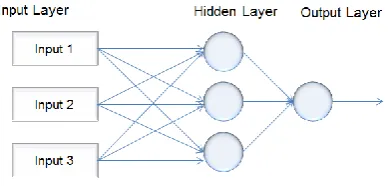
[image:2.595.312.547.46.223.2]Neural network (NN) is a model simulating biological neural networks, and can be used to estimate the unknown functions with a large number of inputs and outputs. In the field of fuel cell systems, NN has been proved to be an effective tool for fuel cell fault diagnostics [8], but its performance for predicting fuel cell performance still needs further investigation. NN consists of a series of interconnected neurons exchanging information between each other, these neuros are linked using weights which can be tuned during the training process. The structure of NN used in this study is depicted in Figure 1, which consists of 3 layers, including input layer, hidden layer and output layer.
Figure 1 General Structure of neural network
In this study, a neural network toolbox (ntstool) in MATLAB is used to predict the fuel cell performance. Two different neural networks are generated, the first one is the feed forward neural network, which predict the output y(t) using the previous values of x(t) by determining the unknown function with the training data, this can be expressed as:
1,…, ) (1)
where x(t-1), …, x(t-d) are the sensor measurements at previous time steps.
The second is the nonlinear autoregressive neural network predicting the model output y(t) using values of x(t) and previous values of y, which can be written as
, … , , 1,…, ) (2)
2.2 Adaptive neuro-fuzzy inference system (ANFIS)
Recently, ANFIS is proposed to further improve the performance of NN and incorporate advantages of fuzzy inference system, and it has been applied for fuel cell prognostics in several previous studies [10-12]. Similar to NN, ANFIS is the multilayer feed-forward network mapping relations between inputs and outputs through the training process. However, membership functions and rules are used to connect different layers in the ANFIS.
A typical ANFIS can be shown in Figure 2, which includes five layers. Layer 1 is the fuzzification layer which performs fuzzification to the incoming inputs. For example, two inputs ( , ) and 4 membership functions ( , , , ) are applied in Figure 2, then 16 rules ( ) can be formulated (if-then rule), and the output from layer 1 can be written as in Eq. (3),
Figure 2 A typical ANFIS
(3)
Where is the fuzzy rule associated with input and fuzzy rule, is the output at layer 1, , and are the parameters in the membership function, which will be adjusted during the training phase.
In layer 2, the firing strength of the fuzzy rule will be generated, with output from layer 2, which is described in Eq. (4)
(4) where is the firing strength of the rule.
Layer 3 is usually defined as the normalization layer, where the neurons at this layer receive inputs from all neuros at layer 2 and calculate the normalized firing strength, which can be expressed as in Eq. (5)
(5)
Layer 4 is called the defuzzification layer, each neuro at this layer receives outputs from layer 3 as well as the original inputs of the system ( , ) for the calculation, with output
calculated by Eq. (6)
(6)
Where , and are consequent parameters of the fuzzy rule, which will be updated during the training process.
With outputs from layer 4, the system output can be calculated with Eq. (7)
(7)
2.3 Particle filtering (PF)
In the last few years, PF has been proposed to predict the fuel cell performance in some research [13-15]. The particle filtering approach uses the Monte-Carlo technique to solve the nonlinear Bayesian tracking problem, which can be defined using a state model and an observation model, which are written in Eqs. (8) and (9), respectively.
[image:2.595.64.260.216.309.2]Where is the system state at time k, is the system output at time k, and are the independent noises from state and observation models.
The objective of Bayesian tracking is to determine the probability distribution function of the state at time k with the probability density function , which can be obtained by applying the following equations recursively.
(10)
(11)
With the particle filtering approach, an appropriate solution can be obtained with the following steps:
a) Generate N particles based on the initial state distribution , which is available from prior knowledge ; b) Calculate the next state particles with the state model in Eq.(8);
c) Predict and update the state using Eqs. (10-11) with new sensor measurements at time k, ;
d) Calculate the particle weights, which show the degree of matching between prediction and measurements;
e) Re-sample the particles by duplicating the particles with higher weights and eliminating particles with lower weights;
f) Repeat steps from b) to e);
In the next section, the performance of these three machine learning algorithms will be studied using the test data from a fuel cell system. Two criteria are designed to evaluate their performance, including prediction accuracy and computation cost. Moreover, a guideline for selecting the most appropriate algorithm for fuel cell prognostics will be suggested based on the comparison results.
III. PERFORMANCE OF SELECTED ALGORITHMS IN PREDICTING FUEL CELL PERFORMANCE
In this section, the above three prognostic techniques will be applied to the same test data from a fuel cell system, which is from the IEEE 2014 data challenge and can be accessed on
their website
(http://eng.fclab.fr/ieee-phm-2014-data-challenge/).
3.1 Performance of NN
As described in 2.1, two kinds of NNs are used in this study, including the feedforward NN and autoregressive NN, the difference in these NNs is that one extra input (fuel cell voltage at previous time steps) is used in the autoregressive NN.
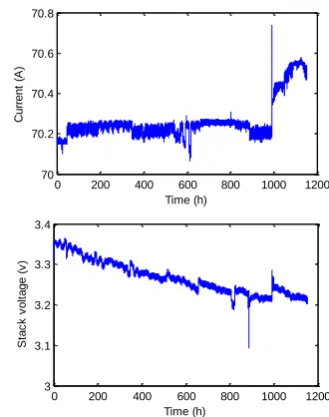
[image:3.595.337.502.52.261.2]In the tests from the IEEE 2014 data challenge, the fuel cell stack is used, which contains 5 fuel cells. During the stack operation, several measurements are collected, including stack voltage, temperature, flow rate and pressure at inlet and outlet of the stack. It should be noted that in the test, fuel cell faults are not observed, and load current and stack voltage during the test are depicted in Figure 3.
Figure 3 Load current and Stack voltage of the fuel cell system
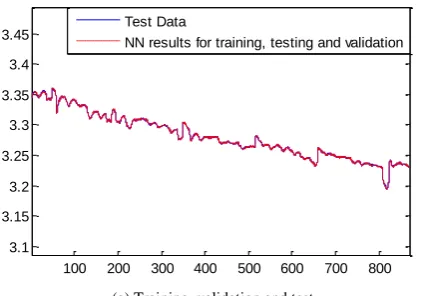
Three sensor measurements, including cathode outlet temperature, cathode inlet and outlet flows, are selected as inputs to the feedforward NN, and the stack voltage is the output from the NN. The selection is made on the basis of providing reliable performance with minimum sensor numbers. In the analysis, one hidden layer with 20 neurons is used in the NN. Figure 4(a) depicts the training, validation and testing of the fuel cell voltage using 3 selected sensors, the training data is 70% of test data, while validation and testing data each takes 15% of the test data are selected randomly from the voltage measurement, while Figure 4(b) shows the performance of the trained NN with another set of voltage measurements.
(a) Training, validation and test
(b) Further test
0 200 400 600 800 1000 1200 70
70.2 70.4 70.6 70.8
Time (h)
C
u
rr
e
n
t
(A
)
0 200 400 600 800 1000 1200 3
3.1 3.2 3.3 3.4
Time (h)
S
ta
c
k
v
o
lt
a
g
e
(
v
Figure 4 The performance of feedforward NN at training, validation and testing (top) and further test (bottom) phases
From Figure 4(a) it can be seen that the feedforward NN can learn and predict the stack voltage with good quality, except the voltage drop at around 800h. The reason is that the voltage drop does not represent the stack performance degradation, as it is due to the test being stopped or load disconnection. Moreover, Figure 4(b) illustrates that with the trained NN, the actual stack voltage degradation can be predicted with reasonable accuracy, except the voltage part between 850h and 1000h, which is due to the voltage drop at about 870h, which is caused by the load disconnection and not the actual performance degradation.
[image:4.595.53.292.313.447.2]However, this can be resolved by adding an extra input with the previous stack voltages, which is shown in Figure 5. It can be seen that 4 inputs are used, including the NN output from the previous step, and a 3-layer structure (input layer, hidden layer, and output layer) is selected in the autoregressive NN.
Figure 5 Structure of autoregressive NN
Figure 6(a) shows the performance of the autoregressive NN in training, testing and validating the stack voltage. The stack voltage measurements for training, testing and validating are 70%, 15% and 15% of the total test data, and selected randomly from the test data. It can be seen that with the involvement of the previous stack voltages, the autoregressive NN can be trained successfully to represent the stack performance. Results depicted in Figure 6(b) demonstrate that with the train autoregressive NN, the stack voltage can be predicted with good quality.
(a) Training, validation and test
(b) Further test
Figure 6 The performance of feedforward NN at training, validation and testing (top) and further test (bottom) phases
3.2 Performance of ANFIS
In the study, the ANFIS with the structure shown in Figure 2 is used for the analysis. The test data is divided into two parts, the first 2/3rd of the stack voltages is used to train the ANFIS model, while the last 1/3rd of the test data is employed to validate the performance of the trained ANFIS. Similar to analysis in section 3.1, three selected sensor measurements are used as inputs while the stack voltage is the output from the ANFIS, the result is depicted in Figure 7.
Figure 7 Performance of ANFIS in training and predicting the stack voltage (the vertical dashed line separate the training and validation data)
It can be found from the results that the ANFIS can provide better predictions to those from the feedforward NN. However, the two points at about 800h and 900h, which represent the change of system loading conditions, cannot be simulated.
3.3 Performance of PF
As described in section 2.3, the state model and observation model should be defined to express the evolution of system state and output. In this study, stack voltage is used to represent the fuel cell stack state, as the stack voltage is measured during the test, it is not necessary to build the observation model, and the actual stack voltage is used directly in the analysis. Moreover, as the fuel cell faults are not observed in the test, the linear state model is defined as follows:
100 200 300 400 500 600 700 800
3.1 3.15 3.2 3.25 3.3 3.35 3.4
3.45 Test Data
NN results for training, testing and validation
900 950 1000 1050 1100
3.18 3.2 3.22 3.24 3.26 3.28
Test Data
[image:4.595.316.544.379.530.2] [image:4.595.62.276.594.742.2]
(12)
Where A, B and C can be determined with the training data.
When performing the prediction, a series of particles is generated based on the initial system state, herein the particles are generated with normalized distribution centered on the initial stack voltage with a range of v. In this analysis, 300 samples are used, which is determined by evaluating prediction performance of various numbers of particles.
As a re-sampling process is included in PF analysis, the particle weights should be calculated in each step to evaluate the degree of matching between simulation and actual measurement, which can be obtained with the following equation:
(13)
Where is the weight of particle i, R is the noise co-variance of the measurement (0.01 in this case), is the stack voltage predicted using particle i, and is the actual voltage measurement.
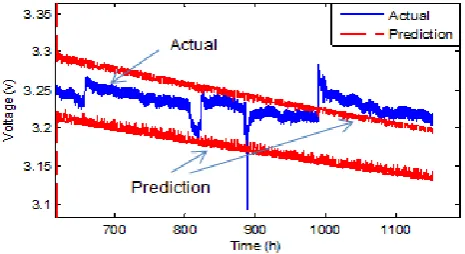
[image:5.595.63.296.451.578.2]Similar to ANFIS, the first 2/3rds of the test data is used to determine the coefficients in Eq.(12), while the last 1/3rd is used to validate the PF performance, the prediction result is depicted in Figure 8, where the lower and upper bounds of the predictions are used.
Figure 8 Performance of PF in predicting the stack voltage
From Figure 8 it can be observed that with the linear state model shown in Eq.(12), the stack voltage can be predicted with good quality without the change in the loading condition. However, the sudden increase of stack voltage at around 1000h due to the variation of load current cannot be predicted well, because this effect is not observed in the training phase, thus cannot be expressed using the current state model. A more complex state model is currently under investigation to express the variation of stack voltage due to the change of operation condition.
IV. PERFORMANCE COMPARISON
Given the results, the performance of the three machine
learning techniques can be compared. In this study, two criteria are defined to compare the performance of the three algorithms, including the computation time and prediction accuracy, where the prediction accuracy is determined using the average error between the prediction and actual measurement. These results are listed in Table 1. It should be noted that as a range is provided from the PF, two average prediction errors can be calculated for the upper and lower predictions, and mean value from these average prediction errors is used herein.
TABLE 1COMPARISON OF FUEL CELL VOLTAGE PREDICTION ALGORITHMS
Algorithm Computation time (s) Average prediction error (v)
Feedforward NN 435.46 2.2e-3
Autoregressive NN 1177.24 6.2928e-6
ANFIS 107.78 2.714e-4
PF 7653 0.0271
It should be mentioned that as lower and upper bounds are used to predict the fuel cell performance in PF, the range of average prediction error should be used. Based on the results in Table 1, the advantages and disadvantages of each algorithm can be obtained.
- Feedforward NN can give reasonable prediction performance, but the voltage drop due to the load disconnection and does not represent the actual performance degradation cannot be learned and predicted;
- Autoregressive NN provides the best prediction results among the investigated algorithms, but it is computational expensive;
- ANFIS is the most computational efficient and can give reliable prediction about the fuel cell performance, but similar to the feedforward NN, stack voltages which do not represent the real fuel cell performance cannot be predicted;
- In the current case, PF provides the worst prediction, moreover, it takes the most computation time, as generating and evolving particles are time-consuming;
From these findings, it can be seen that in the current case, ANFIS is the optimal method for the fuel cell performance prediction, as it can provide the prediction with good quality using the most efficient computation cost. However, in the cases where fuel cell faults are observed during the system operation, as the variation of fuel cell voltage due to fuel cell fault, especially multiple faults, cannot be easily learned using NN or ANFIS, PF should be selected as it can provide the range of predictions, which may cover the effects due to fuel cell faults.
V. CONCLUSIONS
In the paper, a comparison study is applied to investigate the fuel cell performance prediction. Three algorithms are used, including neural network (NN), adaptive neuro-fuzzy inference system (ANFIS), and particle filtering (PF), as they have already been applied in previous studies to predict fuel cell performance, and same test data from fuel cell system is applied for the comparison.
performance of these algorithms, including the mean prediction error and computation cost. Based on the comparison results, ANFIS provides the best performance in terms of the two criteria, but when facing more complex situations, such as the existence of multiple fuel cell faults during system operation, PF should be selected to provide the prediction with a confidence interval. This will be validated in further work by using test data from the fuel cell system which has faults.
ACKNOWLEDGEMENT
This work is supported by grant EP/K02101X/1 for Loughborough University, Department of Aeronautical and Automotive Engineering from the UK Engineering and Physical Sciences Research Council (EPSRC).
REFERENCE
[1] Giurgea, S., Tirnovan, R., Hissel, D., Outbib, R. An analysis of fluidic voltage statistical correlation for a diagnosis of PEM fuel cell flooding. International Journal of Hydrogen Energy, 2013, 38(11), 4689-4696. [2] Kamal, M.M., Yu, D. Model-based fault detection for proton exchange
membrane fuel cell systems. International Journal of Engineering, Science and Technology, 2011, 3(9), 1-15.
[3] Li, Z., Outbib, R., Hissel, D., Giurgea, S. Data-driven diagnosis of PEM fuel cell: A comparative study. Control Engineering Practice, 2014, 28, 1-12.
[4] Onanena, R., Oukhellou, L., Come E.E., Jemei, S., Candusso, D., Hissel, D., Aknin, P. Fuel cell health monitoring using self organizing maps. Chemical Engineering Transactions, 2013, 33, 1021-1026. [5] Petrone, R., Zheng, Z., Hissel, D., Pera, M.C., Pianese, C., Sorrentino,
M., Becherif, M., Yousfi-Steiner, N. A review on model-based diagnosis methodologies for PEMFCs. International Journal of Hydrogen Energy, 2013, 38(17), 7077-7091.
[6] Placca, L., Kouta, R. Fault tree analysis for PEM fuel cell degradation process modelling. International Journal of Hydrogen Energy, 2011, 36(19), 12393-12405.
[7] Riascos, L.A.M., Simoes, M.G., Miyagi, P.E. On-line fault diagnostic system for proton-exchange membrane fuel cells. Journal of Power Sources, 2008, 175(1), 419-429.
[8] Steiner, N.Y., Hissel, D., Mocoteguy, Ph., Candusso, D. Diagnosis of polymer electrolyte fuel cells failure modes (flooding & drying out) by neural networks modeling. International Journal of Hydrogen Energy, 2011, 36(4), 3067-3075.
[9] Zheng, Z., Petrone, R., Pera, M.C., Hissel, D., Becherif, M., Steiner, N.Y., Sorrentino, M. A review on non-model based diagnosis methodologies for PEM fuel cell stacks and systems. International Journal of Hydrogen Energy, 2013, 38(21), 8914-8926.
[10] Vural, Y., Ingham, D.B., Pourkashanian, M. Performance prediction of a proton exchange membrane fuel cell using the ANFIS model. International Journal of Hydrogen Energy, 2009, 34(22), 9181-9187. [11] Becker, S., Karri, V. Predictive models for PEM-electrolyzer
performance using adaptive neuro-fuzzy inference systems. International Journal of Hydrogen Energy, 2010, 35(18), 9963-9972. [12] Silva, R.E., Gouriveau, R., Jemei, S., Hissel, D., Boulon, L., Agbossou,
K., Steiner, N.Y. Proton exchange membrane fuel cell degradation prediction based on Adaptive Neuro-Fuzzy Inference Systems. International Journal of Hydrogen Energy, 2014, 39(21), 1-17. [13] Jouin, M., Gouriveau, R., Hissel, D., Pera, M.C., Zerhouni, N.
Prognostics of PEM fuel cell in a particle filtering framework. International Journal of Hydrogen Energy, 2014, 39(1), 481-494. [14] Jouin, M., Gouriveau, R., Hissel, D., Pera, M.C., Zerhouni, N.
Prognostics of proton exchange membrane fuel cell stack in a particle filter framework including characterization disturbances and voltage recovery. IEEE International Conference on Prognostics and Health Management,Spokane, USA, 22-25 June, 2014.