Neural Network-based Word Alignment through Score Aggregation
Jo¨el Legrand1,2,† and Michael Auli3 and Ronan Collobert3 1Idiap Research Institute, Martigny, Switzerland
2Ecole Polytechnique F´ed´erale de Lausanne (EPFL), Lausanne, Switzerland
3Facebook AI Research, Menlo Park
Abstract
We present a simple neural network for word alignment that builds source and tar-get word window representations to com-pute alignment scores for sentence pairs. To enable unsupervised training, we use an aggregation operation that summarizes the alignment scores for a given target word. A soft-margin objective increases scores for true target words while de-creasing scores for target words that are not present. Compared to the popular Fast Align model, our approach improves alignment accuracy by 7 AER on English-Czech, by 6 AER on Romanian-English and by 1.7 AER on English-French align-ment.
1 Introduction
Word alignment is the task of finding the cor-respondence between source and target words in a pair of sentences that are translations of each other. Generative models for this task (Brown et al., 1990; Och and Ney, 2003; Vogel et al., 1996) still form the basis for many machine translation systems (Koehn et al., 2003; Chiang, 2007).
Recent neural approaches include Yang et al. (2013) who introduce a feed-forward network-based model trained on alignments that were gen-erated by a traditional generative model. This treats potentially erroneous alignments as super-vision. Tamura et al. (2014) sidesteps this issue by negative sampling to train a recurrent-neural net-work on unlabeled data. They optimize a global loss that requires an expensive beam search to ap-proximate the sum over all alignments.
†This work was conducted while the first author did an
internship at Facebook AI Research.
In this paper we introduce a word alignment model that is simpler in structure and which re-lies on a more tractable training procedure. Our model is a neural network that extracts context in-formation from source and target sentences and then computes simple dot products to estimate alignment links. Our objective function is word-factored and does not require the expensive com-putation associated with global loss functions. The model can be easily trained on unlabeled data via a novel but simpleaggregation operationwhich has been successfully applied in the computer vision literature (Pinheiro and Collobert, 2015). The ag-gregation combines the scores of all source words for a particular target word and promotes source words which are likely to be aligned with a given target word according to the knowledge the model has learned so far. At test time, the aggregation op-eration is removed and source words are aligned to target words by choosing the highest scoring can-didates (§2,§3).
We evaluate several forms for our aggregation operation such as computing the sum, max and LogSumExp over alignment scores. Results on English-French, English-Romanian, and Czech-English alignment show that our model signif-icantly outperforms Fast Align, a popular log-linear reparameterization of IBM Model 2 (Dyer et al., 2013;§4).
2 Aggregation Model
In the following, we consider a target-source sen-tence pair (e,f), with e = (e1, . . . , e|e|) and
f = (f1, . . . , f|f|). Words are represented by fj andei, which are indices in source and target
dictionaries. For simplicity, we assume here that word indices are the only feature fed to our archi-tecture. Given a source wordfj and a target word
ei, our architecture embeds a window (of sizedfwin
Target:
de emb
e1 e2
... . . . e|e|
... nete
demb
Dot Product
Source:
f1
f2
...
.. .
f|f|
netf
demb
dfemb
... s(i,j)
|e|
|f|
Aggr
[image:2.595.80.525.65.290.2]|e|
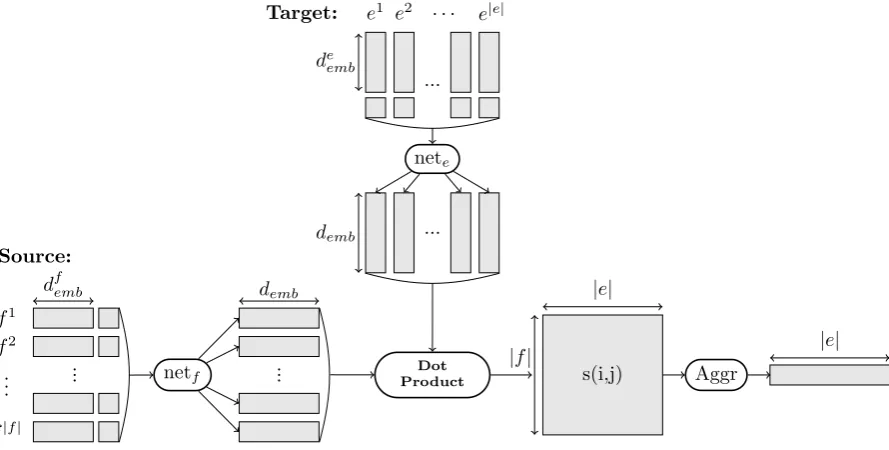
Figure 1: Illustration of the model. The two networks neteand netf compute representations for source
and target words. The score of an alignment link is a simple dot product between those source and target word representations. The aggregation operation summarizes the alignment scores for each target word.
and de
win, respectively) centered around each of
these words into ademb-dimensional vector space.
The embedding operation is performed with two distinct neural networks:
nete([e]d
e win
i )∈Rdemb
and
netf([f] dfwin
j )∈Rdemb,
where we denote the window operator as
[x]di = (xi−d/2, . . . , xi+d/2).
The matching score between a source wordfj and
a target wordeiis then given by the dot-product:
s(i, j) =nete([e]d
e win
i )·netf([f]d
f win
j ). (1)
Ifeiis aligned tofai, the scores(i, ai)should be
high, while scoress(i, j)∀j6=aishould be low.
2.1 Unsupervised Training
In this paper, we consider an unsupervised setup where the alignment is not known at training time. We thus cannot minimize or maximize matching scores (1) in a direct manner. Instead, given a tar-get wordei we consider the aggregated matching
scores over the source sentence:
saggr(i,f) =
|f|
Aggr j=1
s(i, j), (2)
where Aggr is an aggregation operator (§2.2). Consider a matching (positive) sentence pair
(e+,f) and a negative sentence pair (e−,f).
Given a word at index i+ in the positive target
sentence, we want to maximize the aggregated scoresaggr(i+,f) (1 ≤ i+ ≤ |e+|) because we
know it should be aligned to at least one source word.1 Conversely, given a word at index i− in
the negative target sentence, we want to minimize
saggr(i−,f)(1≤i− ≤ |e−|) because it is unlikely
that the source sentence can explain the negative target word. Following these principles, we con-sider a simple soft-margin loss:
L(e+,e−,f) =
|e+| X
i+=1
log(1 +e−saggr(i+,f))
+
|e−| X
i−=1
log(1 +e+saggr(i−,f)).
(3)
Training is achieved by minimizing (3) and by sampling over triplets(e+,e−,f)from the
train-ing data.
1We discuss how we handle unaligned target words in
2.2 Choosing the Aggregation
The aggregation operation (2) is only present dur-ing traindur-ing and acts as a filter which aims to ex-plain a given target wordeiby one or more source
words. If we had the word alignments, then we would sum over the source wordsfj aligned with
ei. However, in our setup alignments are not
avail-able at training time, so we must rely on what the model has learned so far to filter the source words. We consider the following strategies:
• Sum: ignore the knowledge learned so far, and assign the same weight to all source wordsfjto explainei.2In this case, we have
saggr(i,f) =
|f|
X
j=1
s(i, j).
• Max: encourage the best aligned source word fj, according to what the model has
learned so far. In this case, the aggregation is written as:
saggr(i,f) =
|f|
max
j=1 s(i, j).
• LSE: give similar weights to source words with similar scores. This can be achieved with a LogSumExp aggregation operation (also called LogAdd), and is defined as:
saggr(i,f) = 1
r log
|f|
X
j=1
er s(i, j)
, (4)
where r is a positive scalar (to be chosen)
controlling the smoothness of the aggrega-tion. For smallr, the aggregation is
equiva-lent to a sum, and for larger, the aggregation
acts as a max.
2.3 Decoding
At test time, we align each target word ei with
the source wordfj for which the matching score
s(i, j)in (1) is highest.3 However, not every target word is aligned, so we consider only alignments with a matching score above a threshold:
s(i, j)> µ−(ei) +α σ−(ei), (5)
2This can be seen by observing that the gradients for all
source words are the same.
3This may result in a source word being aligned to
multi-ple target words.
whereαis a tunable hyper-parameter, and
µ−(ei) = E
{e˜k=ei∈e˜,f˜j−∈˜f−}
s(k, j−)
is the expectation over all training sentencese˜
con-taining the wordei, and all wordsf˜j−belonging to
a corresponding negative source sentence˜f−, and σ−(ei)is the respective variance.
3 Neural Network Architecture
Our model consists of two convolutional neural networks nete and netf as shown in (1). Both of
them take the same form, so we detail only the tar-get architecture.
3.1 Word embeddings The discrete features [e]dewin
i are embedded into
a de
emb-dimensional vector space via a
lookup-table operation as first introduced in Bengio et al. (2000):
xei =LTWe([e]d e win
i )
= (LTWe(ei−de
win/2), . . . , LTWe(ei+dewin/2)),
where the lookup-table operation applied at index
kreturns the kthcolumn of the parameter matrix
We:
LTWe(k) =W•e, k.
The matrix We is of size |Ve| ×de
emb, whereVe
is the target vocabulary, anddeembis the word
em-bedding size for the target words. 3.2 Convolutional layers
The word embeddings output by the lookup-table are concatenated and fed through two successive 1-D convolution layers. The convolutions use a step size of one and extract context features for each word. The kernel sizeske
1 andke2 determine
the size of the windowdewin = k1e+k2e−1over
which features will be extracted by nete. In order
to obtain windows centered around each word, we add(ke1+ke2)/2−1padding words at the beginning
and at the end of each sentence.
The first layer cnne applies the linear
transfor-mationMe,1exactlyk2etimes to consecutive spans
of sizeke1to thedewin words in a given window:
cnne(xei) =Me,1
LTWe([e]k e
1 i−a)
...
LTWe([e]k e
1 i+a)
where a = bk2e
2c, Me,1 ∈ Rd e
hu×(deembk1e) is a matrix of parameters, and de
hu is the number of
hidden units (hu). The outputs of the first layer cnne are concatenated to form a matrix of size ke
2dehuwhich is fed to the second layer:
nete(xei) =Me,2 tanh(cnne(xei)) (6)
whereMe,2 ∈Rdemb×(ke2 dehu)is a matrix of
pa-rameters, and thetanh(·)operation is applied
el-ement wise. The parametersWe,Me,1 andMe,2
are trained by stochastic gradient descent to mini-mize the loss (3) introduced in§2.1.
3.3 Additional Features
In addition to the raw word indices, we consider two additional discrete features which were han-dled in the same way as word features by introduc-ing an additional lookup-table for each of them. The output of all lookup-tables was concatenated, and fed to the two-layer neural network architec-ture (6).
Distance to the diagonal. This feature can be computed for a target wordei and a source word
fj:
diag(i, j) =
|ei|−|jf| ,
This feature allows the model to learn that aligned sentence pairs use roughly the same word order and that alignment links remain close to the di-agonal. We use this feature only for the source network because it encodes relative position infor-mation which only needs to be encoded once. If we would use absolute position instead, then we would need to encode this information both on the source and the target side.
Part-of-speech Words pairs that are good transla-tions of each other are likely to carry the same part of speech in both languages (Melamed, 1995). We therefore add the part-of-speech information to the model.
Char n-gram. We consider unigram character position features. LetKbe the maximum size for
a word in a dictionary. We denote the dictionary of characters asC. Every character is represented
by its indexc(with1 < c < |C|). We associate every charactercat positionkwith a vector at
po-sition((k−1)∗ |C|) +cin a lookup-table. For a
given word, we extract all unigram character po-sition embeddings, and average them to obtain a character embedding for a given word.
4 Experiments
4.1 Datasets
We use the English-French Hansards corpus as distributed by the NAACL 2003 shared task (Mi-halcea and Pedersen, 2003). This dataset con-tains 1.1M sentence pairs and the test and vali-dation sets contain 447 and 37 examples respec-tively. We also evaluate on the Romanian-English dataset of the ACL 2005 shared task (Martin et al., 2005) comprising 48K sentence pairs for training, 248 for testing and 17 for validation. For English-Czech experiments, we use the WMT news com-mentary corpus for training (150K sentence pairs) and a set of 515 sentences for testing (Bojar and Prokopov´a, 2006).
4.2 Evaluation
Our models are evaluated in terms of precision, re-call, F-measure and Alignment Error Rate (AER). We train models in each language direction and then symmetrize the resulting alignments using either theintersection or thegrow-diag-final-and
heuristic (Och and Ney, 2003; Koehn et al., 2003). We validated the choice of symmetrization heuris-tic on each language pair and chose the best one for each model considering the two aforemen-tioned types as well asgrow-diag-finaland grow-diag.
Additionally, we train phrase-based machine translation models with our alignments using the popular Moses toolkit (Koehn et al., 2007). For English-French, we train on the news commentary corpus v10, for English-Czech we used news com-mentary corpus v11, and for Romanian-English we used the Europarl corpus v8. We tuned our models on the WMT2015 test set for English-Czech as well as for Romanian-English; for English-French we tuned on the WMT2014 test set. Final results are reported on the WMT2016 test set for English-Czech as well as Romanian-English, and for English-French we report results on the WMT2015 test set (as there is no track for this language-pair in 2016).
We compare our model to Fast Align, a popu-lar log-linear reparameterization of IBM Model 2 (Dyer et al., 2013).
4.3 Setup
The kernel sizes of the target network nete(·)are
set toke1 = ke2 = 3for all language pairs. The
tokf1 =kf2 = 3for Romanian-English as well as English-Czech; and for English-French we used
kf1 =kf2 = 1.
The number of hidden units are de hu = d
f hu = 256anddembis set to 256, The sourceVf and
tar-getVe dictionaries consist of the 30K most
com-mon words for English, French and Romanian, and 80K for Czech. All other words are mapped to a uniqueUNKtoken. The word embedding sizes
de
embandd f
emb, as well as the char-n-gram
embed-ding size is128. For LSE, we setr= 1in (4).
We initialize the word embeddings with a sim-ple PCA computed over the matrix of word co-occurrence counts (Lebret and Collobert, 2014). The co-occurrence counts were computed over the common crawl corpus provided by WMT16. For part of speech tagging we used the Stanford parser on English-French data, and MarMoT (Mueller et al., 2013) for Romanian-English as well as English-Czech.
We trained 4 systems for the ensembles, each using a different random seed to vary the weight initialization as well as the shuffling of the training set. We averaged the alignment scores predicted by each system before decoding. The alignment threshold variablesµ−(ei)andσ−(ei)for
decod-ing (§2.3) were estimated on 1000 random training sentences, using 100 negative sentences for each of them. Words not appearing in this training sub-set were assignedµ−(ei) =σ−(ei) = 0.
For systems wherede
win >1anddfwin >1, we
saw a tendency of aligning frequent words regard-less on if they appeared in the center of the context window or not. For instance, a common mistake would be to align ”thecatsat”, with ”PADDING
lechat”. To prevent such behavior, we occasion-ally replaced the center word in a target window by a random word during training. We do this for every second training example on average and we tuned this rate on the validation set.
4.4 Results
We first explore different choices for the aggre-gation operator (§2.2), followed by an ablation to investigate the impact of the different additional features (§3.3). Next we compare to the Fast
Align baseline. Finally, we evaluate our align-ments within a full translation system for all lan-guage pairs.
[image:5.595.331.499.225.361.2]4.4.1 Aggregation operation
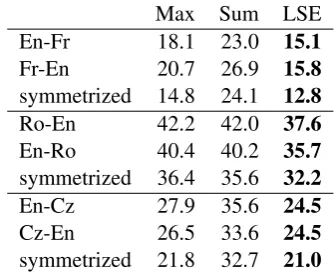
Table 1 shows that the LogSumExp (LSE) aggre-gator performs best on all datasets for every direc-tion as well as in the symmetrized setting using the grow-diag-final heuristic. All results are based on a single model trained with the ’distance to the di-agonal’ feature detailed above.4 We therefore use LSE for the remaining experiments.
Max Sum LSE
En-Fr 18.1 23.0 15.1
Fr-En 20.7 26.9 15.8
symmetrized 14.8 24.1 12.8
Ro-En 42.2 42.0 37.6
En-Ro 40.4 40.2 35.7
symmetrized 36.4 35.6 32.2
En-Cz 27.9 35.6 24.5
Cz-En 26.5 33.6 24.5
symmetrized 21.8 32.7 21.0
Table 1: Alignment error rates for different aggre-gation operations in each language direction and withgrow-diag-final-andsymmetrization.
4.4.2 Additional features
Table 2 shows the effect of the different input fea-tures. Both POS and the distance to the diago-nal feature significantly improve accuracy. Po-sition information via the ’distance to the diago-nal’ feature is helpful for all language pairs, and POS information is more effective for Romanian-English and Romanian-English-Czech which involve mor-phologically rich languages. We use the POS and ’distance to the diagonal feature’ for the remaining experiments.
4.4.3 Comparison with the baseline
English-French Romanian-English English-Czech
En-Fr Fr-En sym Ro-En En-Ro sym En-Cz Cz-En sym
words 22.2 24.2 15.7 47.0 45.5 40.3 36.9 36.3 29.5
+ POS 20.9 23.9 15.3 45.3 42.9 36.9 35.6 33.7 28.2
+ diag 15.1 15.8 12.8 37.6 35.7 32.2 24.8 24.5 21.0
[image:6.595.95.508.63.145.2]+ POS + diag 13.2 12.1 10.2 33.1 32.2 27.8 24.6 22.9 19.9
Table 2: Alignment error rates using different input features in each language direction and with grow-diag-final-andsymmetrization.
P R F1 AER
English-French
Baseline 49.6 89.8 63.9 16.7
NNSA 64.7 80.7 71.8 13.2
+ ensemble 61.5 85.8 71.6 11.6
French-English
Baseline 52.9 88.4 66.2 16.2
NNSA 61.7 86.3 72.0 12.1
+ ensemble 62.6 86.7 72.7 11.6
symmetrized
Baseline (inter) 69.6 84.0 76.1 11.4
NNSA (gdfa) 60.4 88.5 71.8 10.2
+ ensemble 59.3 89.9 71.4 9.7
Table 3: English-French results on the test set in terms of precision (P), recall (R), F-score (F1) and AER; ensemble denotes a combination of four sys-tems and we use theintersection(inter) and grow-diag-final-andsymmetrization (gdfa) heuristics.
affects accuracy, both for the baseline and NNSA. On Romanian-English (Table 4) our model out-performs the baseline in both directions as well. Adding ensembles further improves accuracy and leads to a significant improvement of 6 AER over the best symmetrized baseline result (from 32 to 26).
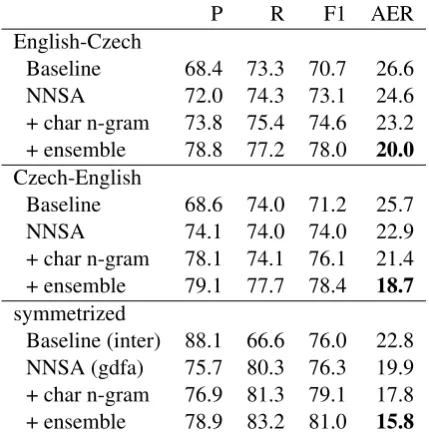
On English-Czech (Table 5) our model outper-forms the baseline in both directions as well. We added the character feature to better deal with the morphologically rich nature of Czech and the fea-ture reduced AER by 2.1 in the symmetrized set-ting. An ensemble improved accuracy further and led to a 7 AER improvement over the best sym-metrized baseline result (from 22.8 to 15.8).
4We use kernel sizeske
1 =ke2 = 3andk1f =k
f
2 = 1for
all language pairs in this experiment.
P R F1 AER
Romanian-English
Baseline 70.0 61.0 65.2 34.8
NNSA 75.1 65.2 69.8 30.2
+ ensemble 75.8 62.8 68.7 31.3
English-Romanian
Baseline 71.3 60.8 65.6 34.4
NNSA 78.1 61.7 69.0 31.1
+ ensemble 78.4 63.2 70.0 30.0
symmetrized
Baseline (gdfa) 69.5 66.5 68.0 32.0
NNSA (gdfa) 74.1 71.8 73.0 27.0
+ ensemble 73.0 74.5 73.7 26.0
Table 4: Romanian-English results (cf. Table 3).
4.4.4 BLEU evaluation
Table 6 presents the BLEU evaluation of our align-ments. For each language-pair, we select the best alignment model reported in Tables 3, 4 and 5, and align the training data. We use the alignments to run the standard phrase-based training pipeline us-ing those alignments. Our BLEU results show the average BLEU score and standard deviation for five runs of minimum error rate training (MERT; Och 2003).
Our alignments achieve slightly better results for Romanian-English as well as English-Czech while performing on par with Fast Align on English-French translation.
5 Analysis
P R F1 AER English-Czech
Baseline 68.4 73.3 70.7 26.6
NNSA 72.0 74.3 73.1 24.6
+ char n-gram 73.8 75.4 74.6 23.2
+ ensemble 78.8 77.2 78.0 20.0
Czech-English
Baseline 68.6 74.0 71.2 25.7
NNSA 74.1 74.0 74.0 22.9
+ char n-gram 78.1 74.1 76.1 21.4
+ ensemble 79.1 77.7 78.4 18.7
symmetrized
Baseline (inter) 88.1 66.6 76.0 22.8
NNSA (gdfa) 75.7 80.3 76.3 19.9
+ char n-gram 76.9 81.3 79.1 17.8
+ ensemble 78.9 83.2 81.0 15.8
Table 5: Czech-English results (cf. Table 3).
Baseline NNSA
French-English 25.4±0.1 25.5±0.1
Romanian-English 21.3±0.1 21.6±0.1
[image:7.595.74.289.62.281.2]Czech-English 17.2±0.1 17.6±0.1
Table 6: Average BLEU score and standard devia-tion for five runs of MERT.
We then analyze the relation between source and target representations: given a source win-dow we compute the alignment scores for all tar-get sentences in the training corpus. Table 8 shows for two source windows which target words have the largest alignment scores. The example ”in working together” is particularly interesting since the aligned target words collabore, coordon´es, andconcert´esmeancollaborate,coordinated, and
concerted, which all carry the same meaning as the source window phrase.
6 Conclusion
In this paper, we present a simple neural network alignment model trained on unlabeled data. Our model computes alignment scores as dot prod-ucts between representations of windows around source and target words. We apply an aggrega-tion operaaggrega-tion borrowed from the computer vi-sion literature to make unsupervised training pos-sible. The aggregation operation acts as a filter over alignment scores and allows us to determine which source words explain a given target word.
the voting process in working together the voting area for working together the voting power with working together
the voting rules from working together the voting system about working together the voting patterns by working together
the voting ballots and working together their voting patterns while working together
Table 7: Analysis of source window represen-tations. Each column shows a window over the source sentence followed by several close neigh-bors in terms of Euclidean distance (among the 30 nearest).
the voting process in working together
vote travaill´e
voteraient travailleront
votent collaboration
voter travaillant
votant oeuvrant
scrutin concerts
suffrage coordon´es
proc´edure concert
investiture collabore
´elections coop´eration
Table 8: Analysis of source and target represen-tations. Each column shows a source window and the target words which are most aligned according to our model.
We improve over Fast Align, a popular log-linear reparameterization of IBM Model 2 (Dyer et al., 2013) by up to 6 AER on Romanian-English, 7 AER on English-Czech data and 1.7 AER on English-French alignment. Furthermore, we evaluated our model as part of a full machine translation pipeline and showed that our align-ments are better or on par compared to Fast Align in terms of BLEU.
References
Yoshua Bengio, R´ejean Ducharme, and Pascal Vincent. A Neural Probabilistic Language Model. InNIPS, 2000.
[image:7.595.320.513.259.412.2]Pietra, Vincent J. Della Pietra, Frederick Je-linek, John D. Lafferty, Robert L. Mercer, and Paul S. Roossin. A Statistical Approach to Ma-chine Translation. Computational Linguistics, 1990.
David Chiang. Hierarchical Phrase-Based Trans-lation. Computational Linguistics, 2007. Chris Dyer, Victor Chahuneau, and Noah A.
Smith. A simple, fast, and effective reparame-terization of IBM Model 2. InProc. of NAACL, 2013.
Philipp Koehn, Franz J. Och, and Daniel Marcu. Statistical Phrase-based Translation. InProc. of NAACL, 2003.
Philipp Koehn, Hieu Hoang, Alexandra Birch, Chris Callison-Burch, Marcello Federico, Nicola Bertoldi, Brooke Cowan, Wade Shen, Christine Moran, Richard Zens, Chris Dyer, Ondˇrej Bojar, Alexandra Constantin, and Evan Herbst. Moses: Open source toolkit for statisti-cal machine translation. In Proceedings of the 45th Annual Meeting of the ACL on Interactive Poster and Demonstration Sessions, ACL ’07, 2007.
R´emi Lebret and Ronan Collobert. Word Em-beddings through Hellinger PCA. In Proc. of EACL, 2014.
Joel Martin, Rada Mihalcea, and Ted Pedersen. Word Alignment For Languages With Scarce Resources. InProc. of WPT, 2005.
Dan I. Melamed. Automatic evaluation and uni-form filter cascades for inducing n-best transla-tion lexicons. InThird Workshop on Very Large Corpora, 1995.
Rada Mihalcea and Ted Pedersen. An Evaluation Exercise for Word Alignment. InProc. of WPT, 2003.
Thomas Mueller, Helmut Schmid, and Hinrich Sch¨utze. Efficient higher-order CRFs for mor-phological tagging. InProceedings of the 2013 Conference on Empirical Methods in Natural Language Processing, 2013.
Franz J. Och and Hermann Ney. A Systematic Comparison of Various Statistical Alignment Models. Computational Linguistics, 2003. Franz Josef Och. Minimum error rate training in
statistical machine translation. InProc of ACL, 2003.
Pedro O. Pinheiro and Ronan Collobert. From Image-level to Pixel-level Labeling with Con-volutional Networks. InProc. of CVPR, 2015. Akihiro Tamura, Taro Watanabe, and Eiichiro
Sumita. Recurrent Neural Networks for Word Alignment Model. InProc. of ACL, 2014. Stephan Vogel, Hermann Ney, and Christoph
Till-mann. HMM-Based Word Alignment in Statis-tical Translation. InProc. of COLING, 1996. Nan Yang, Shujie Liu, Mu Li, Ming Zhou, and
Nenghai Yu. Word Alignment Modeling with Context Dependent Deep Neural Network. In