Forced Derivation Tree based Model Training to
Statistical Machine Translation
Nan Duan Microsoft Research Asia
Mu Li
Microsoft Research Asia
Ming Zhou Microsoft Research Asia
Abstract
Aforced derivation tree(FDT) of a sentence pair{f, e} denotes a derivation tree that can translatef into its accurate target translation
e. In this paper, we present an approach that leverages structured knowledge contained in FDTs to train component models for statistical machine translation (SMT) systems. We first describe how to generate different FDTs for each sentence pair in training corpus, and then present how to infer the optimal FDTs based on their derivation and alignment qualities. As the first step in this line of research, we verify the effectiveness of our approach in a BTG-based phrasal system, and propose four FDT-based component models. Experiments are carried out on large scale English-to-Japanese and Chinese-to-English translation tasks, and significant improvements are reported on both translation quality and alignment quality.
1 Introduction
Most of today’s SMT systems depends heavily on parallel corpora aligned at the word-level to train their different component models. However, such annotations do have their drawbacks in training.
On one hand, word links predicted by automatic aligners such as GIZA++ (Och and Ney, 2004) often contain errors. This problem gets even worse on lan-guage pairs that differ substantially in word orders, such as English and Japanese/Korean/German. The descent of the word alignment quality will lead to inaccurate component models straightforwardly.
On the other hand, several component models are designed to supervise the decoding procedures,
which usually rely on training examples extracted from word-aligned sentence pairs, such as distortion models (Tillman, 2004; Xiong et al., 2006; Galley and Manning, 2008) and sequence models (Banchs et al., 2005; Quirk and Menezes, 2006; Vaswani et al., 2011). Ideally, training examples of models are expected to match most of the situations that could be met in decoding procedures. But actually, plain structures of word alignments are too coarse to pro-vide enough knowledge to ensure this expectation.
This paper presents an FDT-based model training approach to SMT systems by leveraging structured knowledge contained in FDTs. An FDT of a sen-tence pair{f, e} denotes a derivation tree that can translatef into its accurate target translatione. The principle advantage of this work is two-fold. First, using alignments induced from the 1-best FDTs of all sentence pairs, the overall alignment quality of training corpus can be improved. Second, compar-ing to word alignments, FDTs can provide richer structured knowledge for various component models to extract training instances. Our FDT-based mod-el training approach performs via three steps: (1)
generation, where an FDT spacecomposed of dif-ferent FDTs is generated for each sentence pair in training corpus by the forced decoding technique; (2)inference, where the optimal FDTs are extract-ed from the FDT space of each sentence pair basextract-ed on both derivation and alignment qualities measured by amemory-based re-ranking model; (3)training, where various component models are trained based on the optimal FDTs extracted in the inference step. Our FDT-based model training approach can be adapted to SMT systems with arbitrary paradigms.
As the first step in this line of research, our approach is verified in a phrase-based SMT system on both English-to-Japanese and Chinese-to-English transla-tion tasks . Significant improvements are reported on both translation quality (up to 1.31 BLEU) and word alignment quality (up to 3.15 F-score).
2 Forced Derivation Tree for SMT
A forced derivation tree (FDT) of a sentence pair
{f, e}can be defined as a pairG =<D,A>:
• Ddenotes a derivation that can translatef into eaccurately, using a set of translation rules.
• Adenotes a set of word links(i, j) indicating thatei ∈ealigns tofj ∈f.
In this section, we first describe how to gener-ate FDTs for each sentence pair in training corpus, which is denoted as the generation step, and then present how to select the optimal FDT for each sen-tence pair, which is denoted as the inference step. We leave a real application of FDTs to the model training in a phrase-based SMT system in Section 3.
2.1 Generation
We first describe how to generate multiple FDTs for each sentence pair in training corpusCbased on the forced decoding (FD) technique, which performs via the following four steps:
1. Train component models needed for a specific SMT paradigmMbased on training corpusC;
2. Perform MERT on the development data set to obtain a set of optimized feature weights;
3. For each{f, e} ∈ C, translatefinto accuratee based onM, component models trained in step 1, and feature weights optimized in step 2;
4. For each {f, e} ∈ C, output the hypergraph (Huang and Chiang, 2005) H(f, e) generated in step 3 as itsFDT space.
In step 3: (1) all partial hypotheses that do not match any sequence inewill be discarded; (2) derivations covering identical source and target words but with different alignments will be kept as different partial candidates, as they can produce different FDTs for
the same sentence pair. For each{f, e}, the proba-bility of eachG ∈ H(f, e)is computed as:
p(G|H(f, e)) = ∑ exp{ψ(G)}
G′∈H(f,e)exp{ψ(G′)} (1)
whereψ(G)is the FD model score assigned toG. For each sentence pair, different alignment candi-dates can be induced from its different forced deriva-tion trees generated in the generaderiva-tion step, because FD can use phrase pairs with different internal word links extracted from other sentence pairs to recon-struct the given sentence pair, which could lead to better word alignment candidates.
2.2 Inference
Given an FDT spaceH(f, e), we propose a memory-based re-ranking model (MRM), which selects the best FDTGˆas follows:
ˆ
G = argmax
G∈H(f,e)
exp{∑iλihi(G)} ∑
G′∈H(f,e)exp{∑iλihi(G′)}
= argmax
G∈H(f,e)
∑
i
λihi(G) (2)
wherehi(G)is feature function andλi is its feature
weight. Here,memorymeans the whole translation history that happened in the generation step will be used as the evidence to help us compute features.
From the definition we can see that the quality of an FDT directly relates to two aspects: its derivation
Dand alignmentsA. So two kinds of features are used to measure the overall quality of each FDT.
(I) The features in the first category measure the derivation quality of each FDT, including:
• h(¯e|f¯), source-to-target translation probability of a translation ruler ={f ,¯e¯}.
h(¯e|f¯) =
∑
{f,e}∈CfracH(f,e)( ¯f ,¯e)
∑ {f,e}∈C
∑
¯
e′fracH(f,e)( ¯f ,¯e′)
(3)
fracH(f,e)( ¯f ,¯e)denotes the fractional count of rused in generatingH(f, e):
fracH(f,e)( ¯f ,¯e) = ∑
G∈H(f,e)
1r(G)p(G|H(f, e))
1r(G) is an indicator function that equals 1
fracH(f,e)( ¯f ,¯e)when the size ofH(f, e)is too large to enumerate all FDTs:
pH(f,e)(r) =
ω(r)O(head(r))∏v∈tail(r)I(v)
Z(f)
whereω(r) is the weight of translation ruler in the FDT spaceH(f, e),Zis a normalization factor that equals to the inside probability of the root node in H(f, e), I(v) and O(v) are the standard inside and outside probabilities of a nodevinH(f, e),head(r)andtail(r)are the head node and a set of tail nodes of a translation rulerinH(f, e)respectively.
• h( ¯f|¯e), target-to-source translation probability of a translation ruler={f ,¯e¯}.
h( ¯f|e¯) =
∑
{f,e}∈CfracH(f,e)( ¯f ,¯e)
∑ {f,e}∈C
∑
¯
f′fracH(f,e)( ¯f′,e¯)
(4)
• h#(r), smoothed usage count for translation
ruler ={f ,¯e¯}in the whole generation step.
h#(r) =
1
1 +e{−
∑
{f,e}∈CfracH(f,e)( ¯f ,e¯)}
(5)
In this paper, the sigmoid function is used to make sure that the feature values of different translation rules are in a proper value range.
• hr(G), number of translation rules used inG.
• hd(G), structure-based score of G. For FDTs
generated by phrase-based paradigms, it can be computed by distortion models; while for FDTs generated by syntax-based paradigms, it can be computed by either parsing models or syntactic LMs (Charniak et al., 2003).
The overfitting issue in the generation step can be alleviated by leveraging memory-based features in the inference step. h#(r) is used to penalize those
long translation rules which tend to occur in only a few training sentences and are used few times in FD, hr(G)adjust our MRM to prefer FDTs consisting of
more translation rules,hd(G)is used to select FDTs
with better parse tree-like structures, which can be induced from their derivations directly.
(II) The features in the second category measure the alignment quality of each FDT, including:
• word pair translation probabilities trained from IBM models (Brown et al., 1993);
• log-likelihood ratio (Moore, 2005);
• conditional link probability (Moore, 2005);
• count of unlinked words;
• counts of inversion and concatenation.
Many alignment-inspired features can be used in MRM. This paper only uses those commonly-used ones that have already been proved useful in many previous work (Moore, 2005; Moore et al., 2006; Fraser and Marcu, 2006; Liu et al., 2010).
Following the common practice in SMT research, the MERT algorithm (Och, 2003) is used to tune fea-ture weights in MRM. Due to the fact that all FDTs of each sentence pair share identical translation, we cannot use BLEU as the error criterion any more. Instead, alignment F-score is used as the alterna-tive. We will show in Section 5 that after the in-ference step, alignment quality can be improved by replacing original alignments of each sentence pair with alignments induced from its 1-best FDT. Future work could experiment with other error criterions, such as reordering-based loss functions (Birch et al., 2010; Talbot et al., 2011; Birch and Osborne, 2011) or span F1 (DeNero and Uszkoreit, 2011).
3 Training in Phrase-based SMT
As the first step in this line of research, we explore the usage of FDT-based model training method in a phrase-based SMT system (Xiong et al., 2006), which employs Bracketing Transduction Grammar (BTG) (Wu, 1997) to parse parallel sentences. The reason of choosing this system is due to the promi-nent advantages of BTG, such as the simplicity of the grammar and the good coverage of syntactic di-versities between different language pairs. We first describe more details of FDTs under BTG. Then, four FDT-based component models are presented.
3.1 BTG-based FDT
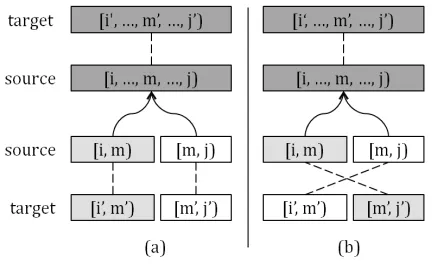
Given a sentence pair f = {f0, ..., fJ} and e =
{e0, ..., eI} in training corpus, its FDT G
Figure 1: S = {f[¯i,j),e[¯i′,j′),A¯, m, m′,R}is denoted by the dark-shaded rectangle pair. It can be split into two child translation states,Sl, which is denoted by the
light-shaded rectangle pair, andSr, which is denoted by the
white rectangle pair. Dash lines within rectangle pairs denote their internal alignments and solid lines with rows denote BTG rules. (a) uses[·]to combine two translation states, while (b) uses⟨·⟩. BothSlandSrbelong toT ∪N.
• eachterminal translation state S ∈ T is a 3-tuple{f¯[i,j),¯e[i′,j′),A}¯ , in whichf¯[i,j)denotes the word sequence that covers the source span
[i, j)off,e¯[i′,j′) denotes the target translation
off¯[i,j), which is the word sequence that covers the target span[i′, j′)ofeat the same time,A¯is a set of word links that alignsf¯[i,j)ande¯[i′,j′).
• eachnon-terminal translation stateS ∈ N is a 5-tuple{f¯[i,j),e¯[i′,j′),A¯, m, m′,R}1. The first 3 elements have the same meanings as in T, whilemandm′denote two split points that di-videSinto two child translation states,Sl and
Sr,Rdenotes a BTG rule, which is either a[·]
operation or a⟨·⟩operation2. The relationship betweenSl,SrandSis illustrated in Figure 1.
All terminal translation states of the sentence pair
{f, e}are disjoint but coverf[0,J+1) ande[0,I+1)at
the same time, where J = |f| and I = |e|, and all non-terminal translation states correspond to the partial decoding states generated during decoding.
3.2 FDT-based Translation Model
First, an FDT-based translation model (FDT-TM) is presented for our BTG-based system.
1
We sometimes omitm,m′andRfor a simplicity reason.
2
A[·]operation combines the translations of two consecu-tive source spans[i, m)and[m, j)in a monotonic way; while a⟨·⟩operation combines them in an inverted way.
Given sentence pairs in training corpus with their corresponding FDT spaces, we train FDT-TM in t-wo different ways: (1) The first only uses the 1-best FDT of each sentence pair. Based on each align-mentAinduced from each 1-best FDTG, all possi-ble bilingual phrases are extracted. Then, the max-imum likelihood estimation (MLE) is used to com-pute probabilities and generate an FDT-TM. (2) The second uses the n-best FDTs of each sentence pair, which is motivated by several studies (Venugopal et al., 2008; Liu et al., 2009). For each sentence pair
{f, e}, we first induce n alignments {A1, ...,An}
from the topnFDTsΩ = {G1, ...,Gn} ⊂ H(f, e).
EachAk is annotated with the posterior probability
of its corresponding FDTGkas follows:
p(Ak|Gk) =
exp{∑iλihi(Gk)} ∑
Gk′∈Ωexp{ ∑
iλihi(Gk′)}
(6)
where ∑iλihi(Gk) is the model score assigned to
Gk by MRM. Then, all possible bilingual phrases
are extracted from the expanded training corpus built using n-best alignments for each sentence pair. The count of each phrase pair is now computed as the sum of posterior probabilities, instead of the sum of absolute frequencies. Last, MLE is used to compute probabilities and generate an FDT-TM.
3.3 FDT-based Distortion Model
In Xiong’s BTG system, training instances of the distortion model (DM) are pruned based on heuris-tic rules, aiming to keep the training size acceptable. But this will cause the examples remained cannot cover all reordering cases that could be met in real decoding procedures. To overcome this drawback, we propose an FDT-based DM (FDT-DM).
Given the 1-best FDTGof a sentence pair{f, e}, all non-terminal translation states {S1, ...,SK} are
first extracted. For each Sk, we split it into two
child translation states Skl andSkr. A training
in-stance can be then obtained, using the BTG opera-tionR ∈ Skas its class label and boundary words of
two translation blocks ( ¯fSkl,e¯Skl) and ( ¯fSkr,e¯Skr)
contained in Skl and Skr as its features. Last, the
Figure 2: An example of extracting training instances from an FDT, where solid lines with rows denote BTG operations and dash lines denote alignments. Two in-stances can be extracted from this FDT, where 0 and 1 denote a[·]operation and a⟨·⟩operation respectively. In DM training, the number (0 or 1) in each instance is used as a label, while boundary words are extracted from each instance’s two phrase pairs and used as lexical features.
3.4 FDT-based Source Language Model
We next propose an FDT-based source language model (FDT-SLM).
Given the 1-best FDTGof a sentence pair{f, e}, we first extract a reordered source word sequence f′ ={f0′, ..., fJ′}fromG, based on the order of ter-minal translation states inGwhich covers the target translationefrom left to right. This procedure can be illustrated by Algorithm 1. Then, all reordered source sentences of training corpus are used to train a source LM. During decoding, each time when a new hypothesis is generated, we obtain its reordered source word sequence as well, compute a LM score based on FDT-SLM and use it as a new feature:
hSLM(f′) = J ∏
k=1
p(fk′|fk′−n+1, ..., fk′−1) (7)
3.5 FDT-based Rule Sequence Model
The last contribution in this section is an FDT-based rule sequence model (FDT-RSM).
Given the 1-best FDTGof a sentence pair{f, e}, we first extract a sequence of translation rule appli-cations {r1, ..., rK} based on Algorithm 2, where
Algorithm 1:Sequence Extraction in FDT-SLM
1 letf′ =∅;
2 letS¯={S1′, ...,SK′}represents an ordered
sequence of terminal translation states whose target phrases coverefrom left to right orderly; 3 foreachS ∈S¯in the left-to-right orderdo 4 extractf¯[i,j)fromS;
5 appendf¯[i,j)tof′;
6 append a blank space tof′;
7 end
8 returnf′as a reordered source word sequence.
rk= ( ¯f[i,j),e¯[i′,j′))denotes thekthphrase pair.
Fig-ure 3 gives an example of extracting a rule sequence from an FDT. An FDT-RSM is trained based on all rule sequences extracted from training corpus. Dur-ing decodDur-ing, each time when a new hypothesis is generated, we compute an FDT-RSM score based on its rule sequence and use it as a new feature:
hRSM(f, e) = K ∏
k=1
p(rk|rk−n+1, ..., rk−1) (8)
Algorithm 2:Sequence Extraction in FDT-RSM
1 letr′ =∅;
2 letS¯={S1′, ...,SK′}represents an ordered
sequence of terminal translation states whose target phrases coverefrom left to right orderly; 3 foreachS ∈S¯in the left-to-right orderdo 4 extract a phrase pair( ¯f[i,j),e¯[i′,j′))fromS; 5 addrk = ( ¯f[i,j),e¯[i′,j′))tor′;
6 end
7 returnr′as a rule sequence.
The main difference between FDT-SLM and FDT-RSM is that the former is trained based on monolingual n-grams; while the latter is trained based on bilingual phrases. Although these two models are trained and computed in an LM style, they are used as reordering features, because they help SMT decoder find better decoding sequences.
Figure 3: An example of extracting a rule sequence from an FDT. In order to generate the correct target translation, the desired rule sequence should ber2⇒r3⇒r1.
4 Related Work
4.1 Forced Decoding/Alignment
Schwartz (2008) used forced decoding to leverage multilingual corpus to improve translation quality; Shen et al. (2008) used forced alignment to train a better phrase segmentation model; Wuebker et al. (2010) used forced alignment to re-estimate trans-lation probabilities using a leaving-one-out strategy. We consider the usage of FD in Section 2.1 to be a direct extension of these approaches, but one that generates FDTs for parallel data rather than focusing on phrase segmentation or probability estimation.
4.2 Pre-reordering
Pre-reordering (PRO) techniques (Collins et al., 2005; Xu et al., 2009; Genzel et al., 2010; Lee et al., 2010) used features from syntactic parse trees to reorder source sentences at training and transla-tion time. A parser is often indispensable to provide syntactic information for such methods. Recently, DeNero and Uszkoreit (2011) proposed an approach that induced parse trees automatically from word-aligned training corpus to perform PRO for a phrase-based SMT system, instead of relying on treebanks. First, binary parse trees are induced from word-aligned training corpus. Based on them, a monolin-gual parsing model and a tree reordering model are trained to pre-reorder source words into the target-language-like order. Their work is distinct from ours
because it focused on inducing sentence structures for the PRO task, but mirrors ours in demonstrating that there is a potential role for structure-based train-ing corpus in SMT model traintrain-ing.
4.3 Distortion Models
Lexicalized distortion models (Tillman, 2004; Zens and Ney, 2006; Xiong et al., 2006; Galley and Man-ning, 2008;) are widely used in phrase-based SMT systems. Training instances of these models are ex-tracted from word-aligned sentence pairs. Due to ef-ficiency reasons, only parts of all instances are kept and used in DM training, which cannot cover all pos-sible reordering situations that could be met in de-coding. In FDT-DM, by contrast, training instances are extracted from FDTs. Such instances take both local and global reordering cases into consideration.
4.4 Sequence Models
Feng et al. (2010) proposed an SLM in a phrase-based SMT system. They used it as a reordering feature in the sense that it helped the decoder to find correct decoding sequences. The difference between their model and our FDT-SLM is that, in their work, the reordered source sequences are extracted based on word alignments only; while in our FDT-SLM, such sequences are obtained based on FDTs.
Quirk and Menezes (2006) proposed a Minimal Translation Unit (MTU) -based sequence model and used it in their treelet system; Vaswani et al. (2011) proposed a rule Markov model to capture dependen-cies between minimal rules for a top-down tree-to-string system. The key difference between FDT-RSM and previous work is that the rule sequences are extracted from FDTs, and no parser is needed.
5 Experiments
5.1 Data and Metric
Experiments are carried out on English-to-Japanese (E-J) and Chinese-to-English (C-E) MT tasks.
(test-2) respectively. In all evaluation data sets, each source sentence has only one reference translation.
For C-E task, bilingual data used contains 0.5M sentence pairs with high translation quality, includ-ing LDC2003E07, LDC2003E14, LDC2005T06, LDC2005T10, LDC2005E83, LDC2006E26, LD-C2006E34, LDC2006E85 and LDC2006E92. A 5-gram LM is trained on the Xinhua portion of LDC English Gigaword Version 3.0. NIST 2004 (MT04) data set is used as dev set, and evaluation results are measured on NIST 2005 (MT05) and NIST 2008 (MT08) data sets. In all evaluation data sets, each source sentence has four reference translations.
Default word alignments for both SMT tasks are performed by GIZA++ with theintersect-diag-grow
refinement. Translation quality is measured in terms ofcase-insensitive BLEU(Papineni et al., 2002) and reported in percentage numbers.
5.2 Baseline System
The phrase-based SMT system proposed by Xiong et al. (2006) is used as the baseline system, with a MaxEnt principle-based lexicalized reordering mod-el integrated, which is used to handle reorderings in decoding. The maximum lengths for the source and target phrases are 5 and 7 on E-J task, and 3 and 5 on C-E task. The beam size is set to 20.
5.3 Translation Quality on E-J Task
We first evaluate the effectiveness of our FDT-based model training approach on E-J translation task, and present evaluation results in Table 1, in whichBTG
denotes the performance of the baseline system.
FDT-TM denotes the improved system that uses FDT-TM proposed in Section 3.2 instead of original phrase table. As described in Section 3.2, we tried different sizes of n-best FDTs to induce alignments for phrase extraction and found the optimal choice is 5. Besides, in order to make full use of the train-ing corpus, for those sentence pairs that are failed in FD, we just use their original word alignments to ex-tract bilingual phrases. We can see from Table 1 that FDT-TM outperforms the BTG system significantly.
FDT-DM denotes the improved system that us-es FDT-DM proposed in Section 3.3 instead of o-riginal distortion model. Comparing to baseline D-M which has length limitation on training instances, training examples of FDT-DM are extracted from
1-best FDTs without any restriction. This makes our new DM can cover both local and global reordering situations that might be met in decoding procedures. We can see from Table 1 that using FDT-DM, sig-nificant improvements can be achieved.
FDT-SLMdenotes the improved system that uses FDT-SLM proposed in Section 3.4 as an addition-al feature, in which the maximum n-gram order is 4. However, from Table 1 we notice that with FDT-SLM integrated, only 0.2 BLEU improvements can be obtained. We analyze decoding-logs and find that the reordered source sequences of n-best translation-s are very translation-similar, which, we think, can explain why improvements of using this model are so limited.
FDT-RSM denotes the improved system that us-es FDT-RSM proposed in Section 3.5 as an addi-tional feature. The maximum order of this model is 3. From Table 1 we can see that FDT-RSM out-performs BTG significantly, with up to 0.48 BLEU improvements. Comparing to FDT-SLM, FDT-RSM performs slightly better as well. We think it is due to the fact that bilingual phrases can provide more discriminative power than monolingual n-grams do. Last, all these four FDT-based models (FDT-TM, FDT-DM, FDT-SLM and FDT-RSM) are put togeth-er to form an improved system that is denoted as
FDT-ALL. It can provide an averaged 1.2 BLEU im-provements on these three evaluation data sets.
BLEU dev test-1 test-2
BTG 20.60 20.27 13.15
FDT-TM 21.21 20.71(+0.44) 13.98(+0.83)
FDT-DM 21.13 20.79(+0.52) 14.25(+1.10)
FDT-SLM 20.84 20.50(+0.23) 13.36(+0.21) FDT-RSM 21.07 20.75(+0.48) 13.59(+0.44) FDT-ALL 21.83 21.34(+1.07) 14.46(+1.31)
[image:7.612.313.549.454.577.2]PRO 21.89 21.81 14.69
Table 1: FDT-based model training on E-J task.
5.4 Translation Quality on C-E Task
We then evaluate the effectiveness of our FDT-based model training approach on C-E translation task, and present evaluation results in Table 2, from which we can see significant improvements as well.
BLEU MT03 MT05 MT08
BTG 38.73 38.01 23.78
FDT-TM 39.14 38.31(+0.30) 24.30(+0.52)
FDT-DM 39.27 38.56(+0.55) 24.50(+0.72)
FDT-SLM 38.97 38.22(+0.21) 24.04(+0.26)
FDT-RSM 39.06 38.33(+0.32) 24.13(+0.35)
FDT-ALL 39.59 38.72(+0.71) 24.67(+0.89)
Table 2: FDT-based model training on C-E task
Comparing to numbers in Table 1, the gains com-ing from the first two FDT-based models become s-mall on C-E task. This might be due to the fact that the word alignment quality in C-E task is more reli-able than that in E-J task for TM and DM training.
5.5 Effect on Alignment Quality
We compare the qualities of alignments predicted by GIZA++ and alignments induced from 1-best FDTs. For E-J task, 575 English-Japanese sentence pairs are manually annotated with word alignments. 382 sentence pairs are used as the dev set, and the other 193 sentence pairs are used as the test set. For C-E task, 491 Chinese-English sentence pairs are manu-ally annotated with word alignments. 250 sentence pairs are used as the dev set, and the other 241 sen-tence pairs are used as the test set. Both Japanese and Chinese sentences are adapted to our own word segmentation standards respectively. Table 3 shows the comparison results. Comparing to C-E language pair (S-V-O), E-J language pair (S-O-V) has much lower F-scores, due to its very different word order.
F-score from GIZA++ from 1-best FDTs
devEJ 54.75% 57.93%(+3.18%)
testEJ 55.32% 58.47%(+3.15%)
devCE 81.32% 83.37%(+2.05%)
[image:8.612.72.307.144.249.2]testCE 80.61% 82.51%(+1.90%)
Table 3: Comparison of alignment qualities predicted by GIZA++ and induced from 1-best FDTs.
From Table 3 we can see that the F-score im-proves on all language pairs when using alignments induced from 1-best FDTs, rather than GIZA++.
5.6 Effect on Classification Accuracy
In the BTG system, the MaxEnt model is used as a binary classifier to predict reordering operations of neighbor translation blocks. As the baseline DM and our FDT-DM have different mechanisms on training instance extraction procedures, we compare the clas-sification accuracies of these two DMs in Table 4 to show the effect of different training instances. The MaxEnt toolkit (Zhang, 2004) is used to optimize feature weights using the l-BFGS method (Byrd et al., 1995). We set the iteration number to 200 and Gaussian prior to 1 for avoiding overfitting. Table 4 shows that when using training instances extract-ed from FDTs, classification accuracy of reorderings improves on both E-J and C-E tasks. This is because FDTs can provide more deterministic and structured knowledge for training instance extraction, which can cover both local and global reordering cases.
baseline DM FDT-based DM
E-J 93.67% 95.60%(+1.93%)
[image:8.612.331.521.367.412.2]C-E 95.85% 97.52%(+1.67%)
Table 4: Comparison of classification accuracies of DMs based on instances extracted by different mechanisms.
6 Conclusions
References
Peter Brown, Stephen Pietra, Vincent Pietra, and Robert Mercer. 1993. The Mathematics of Statistical Ma-chine Translation: Parameter Estimation, Computa-tional Linguistics.
Rafael Banchs, Josep Crego, Adri‘a Gispert, Patrik Lam-bert, and Jos Mario. 2005. Statistical Machine Trans-lation of Euparl Data by using Bilingual N-grams, In Proceedings of the ACL Workshop on Building and Using Parallel Texts.
Alexandra Birch, Phil Blunsom, and Miles Osborne. 2010.Metrics for MT evaluation: Evaluating reorder-ing, Machine Translation.
Alexandra Birch and Miles Osborne. 2011. Reordering metrics for MT, In Proceedings of the Association for Computational Linguistics.
Richard Byrd, Peihuang Lu, Jorge Nocedal, and Ciyou Zhu. 1995. A limited memory algorithm for bound constrained optimization, SIAM Journal of Science and Statistical Computing.
Eugene Charniak, Kevin Knight, and Kenji Yamada. 2003. Syntax-based Language Models for Statistical Machine Translation, MT Summit.
Michael Collins, Philipp Koehn, and Ivona Kucerova. 2005. Clause Restructuring for Statistical Machine Translation, In Proceedings of the Association for Computational Linguistics.
John DeNero and Jakob Uszkoreit. 2011. Inducing Sen-tence Structure from Parallel Corpora for Reordering, In Proceedings of the Conference on Empirical Meth-ods in Natural Language Processing.
Minwei Feng, Arne Mauser, and Hermann Ney. 2010. A Source-side Decoding Sequence Model for Statistical Machine Translation, In Proceedings of the Confer-ence of the Association for Machine Translation. Alexander Fraser and Daniel Marcu. 2006.
Semi-Supervised Training for Statistical Word Alignment, In Proceedings of the International Conference on Com-putational Linguistics and Annual Meeting of the As-sociation for Computational Linguistics.
Dmitriy Genzel. 2010. Automatically learning source-side reordering rules for large scale machine transla-tion, In Proceedings of the Conference on Computa-tional Linguistics.
Liang Huang and David Chiang. 2005. Better k-best Parsing, In Proceedings of International Conference on Parsing Technologies,.
Young-Suk Lee, Bing Zhao, and Xiaoqiang Luo. 2010. Constituent Reordering and Syntax Models for English-to-Japanese Statistical Machine Translation, In Proceedings of the Conference on Computational Linguistics.
Yang Liu, Tian Xia, Xinyan Xiao, and Qun Liu. 2009. Weighted Alignment Matrices for Statistical Ma-chine Translation, In Proceedings of the Conference on Em-pirical Methods in Natural Language Processing. Yang Liu, Qun Liu, and Shouxun Lin. 2010.
Discrimi-native Word Alignment by Linear Modeling, Compu-tational Linguistics.
Robert Moore. 2005. A Discriminative Framework for Bilingual Word Alignment, In Proceedings of Human Language Technology Conference and Conference on Empirical Methods in Natural Language Processing. Robert Moore, Wen-tau Yih, and Andreas Bode. 2006.
Improved Discriminative Bilingual Word Alignmen-t, In Proceedings of the International Conference on Computational Linguistics and Annual Meeting of the Association for Computational Linguistics.
Haitao Mi, Liang Huang, and Qun Liu. 2008. Forest-based Translation, In Proceedings of the Association for Computational Linguistics.
Galley Michel and Christopher D. Manning. 2008. A Simple and Effective Hierarchical Phrase Reordering Model, In Proceedings of the Conference on Empirical Methods in Natural Language Processing.
Franz Och. 2003. Minimum Error Rate Training in S-tatistical Machine Translation, In Proceedings of the Association for Computational Linguistics.
Franz Och and Hermann Ney. 2004. The Alignment Template Approach to Statistical Machine Translation, Computational Linguistics.
Kishore Papineni, Salim Roukos, Todd Ward, and Wei-jing Zhu. 2002. BLEU: a method for automatic eval-uation of machine translation, In Proceedings of the Association for Computational Linguistics.
Chris Quirk and Arul Menezes. 2006.Do we need phras-es? Challenging the conventional wisdom in Statisti-cal Machine Translation, In Proceedings of the North American Chapter of the Association for Computa-tional Linguistics.
Lane Schwartz. 2008.Multi-Source Translation Method-s, In Proceedings of the Conference of the Association for Machine Translation.
Wade Shen, Brian Delaney, Tim Anderson, and Ray Sly-h. 2008. The MIT-LL/AFRL IWSLT-2008 MT System, International Workshop on Spoken Language Transla-tion.
David Talbot, Hideto Kazawa, Hiroshi Ichikawa, Ja-son Katz-Brown, Masakazu Seno, and Franz Och. 2011. A lightweight evaluation framework for ma-chine translation reordering, In Proceedings of the Sixth Workshop on Statistical Machine Translation. Ashish Vaswani, Haitao Mi, Liang Huang, and David
Ashish Venugopal, Andreas Zollmann, Noah Smith, and Stephan Vogel. 2008. Wider Pipelines: N-best Align-ments and Parses in MT Training, In Proceedings of the Conference of the Association for Machine Trans-lation.
Joern Wuebker, Arne Mauser, and Hermann Ney. 2010. Training Phrase Translation Models with Leaving-One-Out, In Proceedings of the Association for Com-putational Linguistics.
Dekai Wu. 1997. Stochastic Inversion Transduction Grammars and Bilingual Parsing of Parallel Corpora, Computational Linguistics.
Deyi Xiong, Qun Liu, and Shouxun Lin. 2006. Max-imum entropy based phrase reordering model for s-tatistical machine translation, In Proceedings of the Association for Computational Linguistics.
Peng Xu, Jaeho Kang, Michael Ringgaard, and Franz Och. 2009. Using a Dependency Parser to Improve SMT for Subject-Object-Verb Languages, In Proceed-ings of the North American Chapter of the Association for Computational Linguistics.
Richard Zens and Hermann Ney. 2006. Discriminative Reordering Models for Statistical Machine Transla-tion, In Proceedings of the Workshop on Statistical Machine Translation.