Framework for eGovernment Systems. Proceedings of the Information Communication and Society, ICS 2006 Symposium,.
Link to Leeds Beckett Repository record: http://eprints.leedsbeckett.ac.uk/783/
Document Version: Article
The aim of the Leeds Beckett Repository is to provide open access to our research, as required by funder policies and permitted by publishers and copyright law.
The Leeds Beckett repository holds a wide range of publications, each of which has been checked for copyright and the relevant embargo period has been applied by the Research Services team.
We operate on a standard take-down policy. If you are the author or publisher of an output and you would like it removed from the repository, please contact us and we will investigate on a case-by-case basis.
The Development of an Evaluation Framework for eGovernment Systems
Abstract
This paper is a positioning paper which outlines a proposal for engaging in the evaluation of eGovernment systems. The primary purpose of our proposed research is to develop, apply, test, and disseminate an evaluation framework which can support continuous, adaptable, and reflective evaluation of eGovernment systems. The theoretical bases for the methodology will be the Information Systems (IS), Soft Systems Methodology, SSM (Checkland and Scholes, 1990) which provides the platform for the analyses of the ‘soft’ aspects (e.g. human, political, cultural and organisational factors) and the Hard Systems Methodology (HSM) which provides methods and tools for quantitative measures and analyses of the system. A further three interrelated bases are: Reflective Practice, Organisational Learning (OL), and Information and Knowledge Management (IKM). Some of the key underlying principles to a successful evaluation framework are good data collection and analyses methods, an evaluative reflective practice approach which entails the complete process of identification and analysis of strengths and problems, followed by rigorous testing, implementation, and revision of solutions. Such a cycle encourages organisational learning and promotes continuous improvement to both the evaluation framework and system. Additionally, it aims to cultivate an organisational culture that supports evaluation through reflection, continuous learning, and knowledge management which facilitates knowledge creation, capture, sharing, application and dissemination.
1. Introduction
In the white paper entitled, Modernising Government (HM Treasury, 1999), the stated vision of the UK Government is to deliver policies, programmes, and services to enhance the quality of life through modernisation. It is a means to achieving better responsiveness to the users, and world class public services where users have the choice to decide for themselves how, when and where to access such services. Several of the suggested delivery channels for its integrated public services are the use of single gateways, the internet, digital TV, or even public places. In order to deliver public services that will meet the needs of the main stakeholders (e.g. citizens, and businesses), a genuine partnership between the service providers and these stakeholders has to be carefully considered. There is a genuine need for a shift from a traditional provider-oriented service delivery to a more customer-focussed type of service delivery. Also, a shift from internal efficiency to external efficiency, and departmentalisation to a seamless organisation.
According to Irani and colleagues (2005a), typical Information System (IS) evaluation methods such as Return of Investment, Net Present Value, Cost Benefit Analysis merely provide quantitative measures to evaluate the hard perspectives of systems (e.g. performance, efficiency, and effectiveness). However, in recent years, there is a paradigm shift from product and process orientated economy to a knowledge-based one. With the emerging concept of knowledge as one of the organisational intangible assets, knowledge management (KM) will be an additional dimension to the evaluation of eGovernment systems. Also, Irani (Brunel University, 2005) suggests that it is imperative to address the human, organisation as well as the technology issues during the process of evaluating of eGovernment systems.
As mentioned in our previous paper (Orange, et. al, 2006), our proposed evaluation framework will give rise to the challenge of interweaving several areas of research namely Information Systems (IS) which includes Soft Systems Methodology (SSM), and Hard Systems Methodology (HSM); Information and Knowledge Management (KM), Reflective Practice, and Organisational Learning (OL) in combination with more traditional business (e.g. UML) and financial (e.g. NPV, DCF, ROI) modelling techniques. The framework will be supported by a knowledge base using database and inference rules, web and other appropriate technologies to ensure access to and dissemination of evaluation outcomes. The novelty of this approach lies in the potential to add rigour and coherence to the evaluation life cycle when diverse research methodologies, and disparate tools as well as techniques are employed. A collaborative inquiry methodology where project stakeholders (users and system developers) will assume a participatory action research role by being co-evaluation partners will be implemented. The framework will provide a mechanism for learning from experiences, both positive and negative (EC, 2005). Importantly, the other additional benefit of the proposed integrated framework will be the development of evaluation techniques, paradigms, and matrices and the establishment of evaluation criteria which are easy to use and can be standardized across projects in addition to being transferable to other social contexts.
2.
eGovernment and Evaluation‘eGovernment is the use of technology to enhance the access to and delivery of government services to benefit citizens, business partners, and employees. It has the power to create a new mode of public service where all public organisations deliver a modernised, integrated, and seamless service for their citizens’ (Silcock, 2001). In order to reap the full benefits of this innovation, profound changes have to be made to the way government works (Blair, 2000). However, such a level of change cannot be achieved by technology alone viewing the fact that technology has to be developed and operate within an environmental context that clearly has tremendous impact on it (Avison and Fitzgerald, 2003). Inevitably, such a profound change is always going to be difficult to evaluate due to its increasingly dynamic and complex multi-dimensions involving the organisational, social, political, cultural, and technical factors. Undeniably, local authorities and government agencies need to evaluate the effects or the success of this newly implemented
Burke, Alan Leeds Metropolitan University
Elliman, Tony Brunel University [email protected] Kor, Ah-Lian
Leeds Metropolitan University [email protected]
Orange, Graham Leeds Metropolitan University
technology due to the hefty investment Government has put into it. According to the Committee of Public Accounts (CPA, 2002), all government departments currently have underway 100 major IT projects with a total value of £10 billion. This investment is part of the government’s strategy to provide high quality and a full range public services for all, shaped by individuals and communities to meet their needs, delivering value for money and visible results (ODPM, 2006b). Also, it is intended to enable departments to improve their operational efficiency by replacing labour intensive processes with eGovernment systems (CPA, 2002). The Gershon Report (Gershon, 2004) identifies several areas (e.g. procurement, support services, productive time, transactions) of potential efficiency gains in the central government departments. Through the Spending Review 2004 (HM Treasury, 2004), the outcome of the report is translated into an annual efficiency target of 2.5% over the next three financial years across the public sector (from 2004/05 to 2007/08) which amounts to at least £6.45 billion per annum by 2007/08 (ODPM, 2004). In the ODPM guide (2004), efficiency gains are categorised into cashable (e.g. reduction of costs) and non-cashable gains (e.g. improved outputs or quality of services) which are both expressed in Pounds Sterling. It is a statutory requirement that all local authorities self-assess their efficiency gains, and in the month of April, electronically submit a copy of an Annual Efficiency Statement to the ODPM (I&DeA, 2006). Some of the guidance notes produced to support the efficiency agenda relate to efficiency matters (I&DeA, 2005), asset management and flexible working (OGC, 2005a), measurement of productive time (OGC, 2005b), technical efficiency (ODPM, 2005a), and delivering efficiency in local services (ODPM, 2004; 2005b). However, these guidance notes are still incomplete leaving many issues open, particularly, in relation to how the efficiency gains are calculated (Leicestershire County Council, 2005). As a matter of fact, through the Efficiency Measurement Taskforce, ODPM (2005a) is still in the midst of developing the methodology for identifying gains in respect of revenue and capital spend. Further guidance is promised to be published in due course and supplementary information is posted on the Electronic Service Delivery Toolkit (esd-toolkit, 2006) in the form of FAQs. The esd-toolkit is an on-line resource that is owned and managed by the local government with support from I&DeA (2005), which enables local authorities to measure, report, and record their progress in delivering processes electronically. This toolkit has the potential to play a much bigger role in the government’s efficiency agenda particularly on process improvement (I&DeA, 2005) through re-engineering and optimisation of business process maps (ODPM, 2005b).
Following the discussion above, we would like to highlight several timely and hard pressed issues concerning the evaluation of eGovernment systems. Firstly, in order to ensure the success of such systems, there is an urgent need for a continuous, rigorous, and reflective form of evaluation. System evaluation is often addressed as part of the System Development Life Cycle (SDLC) but very rarely viewed as a post-implementation activity. In this proposed research, we are adopting the suggestion put forth by Irani and Love (2001) and are re-thinking the evaluation process for eGovernment systems, making it a life cycle process, known as the Systems Evaluation Life Cycle (SELC) which will be further discussed in the later part of this paper. This will provide decision makers (e.g. politicians, project managers, system developers, etc…) the golden opportunity for reflective learning rather than a process that stigmatises failure (Irani and Love, 2001).
Secondly, quantitative measures derived from ETN guidance notes (ODPM, 2005a) are predominantly utilised for the calculation of efficiency gains in the implementation of eGovernment systems. Such measures are known as ‘hard’ evaluation, which typically assesses tangible benefits based on accounting or financial instruments such as Return on Investment, Net Present Value, and Cost Benefit Analysis, etc. (Farbey at. al, 1995; Irani, et. al, 2005a). This type of evaluation is not easy viewing the fact that UK local agencies have to refer to the ETN guidance notes (ODPM, 2005a) and supplementary notes in the esd-toolkit to help them compute such cashable efficiency gains. Currently, many existing individual IS evaluation techniques and tools available for eGovernment systems tends to have either a ‘hard’ (e.g. evaluation study conducted by the Australian Government Information Management Office, AGIMO 2004a, 2004b, 2004c) or ‘soft’ (includes organisational, social, political, or cultural factors) orientation. In order to determine the actual benefits or success of an eGovernment system, it is highly essential to have a holistic evaluation of the system in its operational setting which takes into consideration the impact of these contextual factors. However, most evaluation processes are rendered inefficient or ineffective due to the many difficulties encountered in measuring the tangible as well as intangible benefits and costs of IS (Irani and Love, 2001).
methodology (includes methods, procedures, and techniques) to support the evaluation of eGovernment systems, and at the same time, are adaptable to its multi-users’ evaluation needs.
3.
Knowledge Management and EvaluationViewing the fact that the evaluation of IS (including eGovernment systems) is a knowledge intensive task (Irani, at. al, 2005b), the network for eGovernment Integration and Systems Evaluation (eGISE) has identified Knowledge Management (KM) as a particular interest within this area. KM which is one of the proposed bases of our CARE portal, relates to knowledge capture, creation, sharing, application, and dissemination. Some of the typical methods for sharing eGovernment related knowledge are through: collaborative projects (e.g. Local eGovernment Portal at http://www.localegov.gov.uk and Government Connect at http://www.govconnect.gov.uk/ccm/portal/); FAQs (e.g. esd-toolkit, 2006; Local eGovernment at http://www.locale govnp.org/default.asp?sID=1106853641943 and Planning Portal at http://www.planningportal.gov.uk/england/govern ment/en/1030953172298.html); repositories or libraries of tools and documents (e.g. IDABC in http://europa.eu.int/idabc /en/chapter/140; a Product Catalogue created by the local eGovernment National Projects Programme at http:// catalogue.localegovnp.org.uk/pp/publication/results.asp?InitialLetter=A; and Planning Portal in http://www.planning port al.gov.uk/england/government/en/1018433960408.html); best practice or successful case studies (e.g. Planning Portal at http://www.planningportal.gov.uk/england/government/en/1115313953280.html; AGIMO at http://www.agimo.gov.au/ practice/km_case_studies); and finally, forums for sustainable communities with a common vision and goals (e.g. esd-toolkit, 2006). We propose to exploit some of these KM techniques to help support and improve activities within the evaluation life cycle. Also, the innovative utility of ontology and semantic web technology to represent and process information (e.g. documents, objects in repositories, etc…) in CARE portal will facilitate semantic queries which will result in a more meaningful search for relevant information. Additionally, the Knowledge Management System (KMS) in CARE portal will contain an intelligent knowledge base (database and inference rules which support some form of reasoning mechanism) for eGovernment evaluation best practice. It will be different from typical repositories which are mere centralised storages or databases, and also, it will be developed in accordance to the renown Europe’s Information Society (EIS, 2005) eGovernment Good Practice Framework. The KMS will include negative experiences, and pitfalls (a suggestion put forth by the EC, 2005), which till date, is an unprecedented feature in a community web portal. Furthermore, the development and implementation of the proposed feedback mechanism in CARE portal will be based on lessons learnt from developing COLA, a Cross Organisational Learning Approach (product of a previous EPSRC funded project, B-Hive – Building a High Value Construction Environment with grant no: EPSRC GR/L02654/01(P)). Further details of COLA are available in these papers (Orange at. al, 1998, 1999a, 1999b, 2000; Page et. al, 2000), or at the URL address http://csrc.lse.ac.uk/b-hive/default.htm. This approach aims to engage the organisation in rigorous and continuous evaluative reflective practice which will result in both single and double loop organisational learning.
In summary, the development and implementation of our CARE framework and its web portal will give rise to the challenge of interweaving very diverse areas of research namely: Knowledge Base; Knowledge Integration (involving the use of multiple ontologies, multiple databases, Semantic Web); Reverse Engineering; Information Systems (IS) which includes Soft Systems Methodology (SSM), and Hard Systems Methodology (HSM); Information and Knowledge Management (IKM); Reflective Practice (Keating, et. al, 1996); and finally, Organisational Learning (OL). To reiterate, the novel outcome of our proposed research project will be an implemented and tested ontology-based one-stop shop facility which supports UK local agencies in their holistic evaluation of eGovernment systems. It will exploit the utility of KM techniques and strategies to support evaluation related activities, as well as ontology and semantic web for the representation and processing of information. Additionally, intelligent knowledge bases will be employed for the storage and reasoning about relevant information, and lastly, a feedback mechanism which facilitates rigorous single and double organisational learning through reflective practice. In this proposed research project, we will also implement a novel collaborative inquiry methodology where the project stakeholders (users, system developers, etc…) will assume a participatory action research role by being our co-evaluation partners.
4.
Aims and ObjectivesThe primary aim of this proposed research is to develop, implement, evaluate, and disseminate a rigorous, holistic yet flexible framework for eGovernment systems evaluation (Orange, et. al, 2006). The evaluation framework (CARE) will provide evaluation methodologies, an intelligent knowledge base for best practice, negative experiences and pitfalls relating to the evaluation of eGovernment systems. The CARE framework will also provide a feedback mechanism which will facilitate organisational learning through reflective practice ensuring that the outcomes of evaluation are available to other eGovernment projects. The objectives of this proposed research are (Orange, et. al, 2006) are:
a. To create a profile of eGovernment project structures, their stakeholders and evaluation needs; and in particular to identify the structural, social and cultural barriers to reflective and cross-departmental learning in relation to IT projects within the UK local authority context.
b. To evaluate the SELC within at least one ongoing eGovernment project.
c. To re-evaluate the KM Life Cycle and concepts behind COLA within the UK local authority context; and devise an equivalent evaluation framework for reflective learning applicable to these authorities. In particular this framework will:
a. Support the full Knowledge Management Life Cycle from initial knowledge capture through to appropriate dissemination throughout the organisation.
c.
Mechanisms or procedures to implement an evaluative reflective inquiry cycle (in REM), to deliver an audit trail of evaluative thinking and to promote organisational learning.d.
Design and implement a web-based portal to support the above framework.e. Evaluate the proposed framework within at least one ongoing eGovernment project. f. Promote awareness and dissemination of the proposed framework.
5.
The CARE Evaluation FrameworkAs mentioned in our previous paper (Orange, et. al, 2006), the key deliverable from this project will be the CARE framework and its supporting software tools, with the potential to support UK agencies in the evaluation of eGovernment systems at various stages in their lifecycle. As mentioned earlier, the novelty of our approach lies in the potential to add rigour and coherence to the evaluation life cycle without prescribing a narrow set of tools and techniques that must be employed. The portfolio of techniques available will include both ‘hard’ approaches – to address financial and technical issues – and ‘soft’ approaches – to address social, political, cultural, and organisational issues. This will provide flexibility and consistency across projects and social contexts. Also, the cycle encourages organisational learning which will focus on mechanisms for learning from experiences, both positive and negative (EC, 2005) and promotes continuous improvement to both the framework and system. Additionally, it aims to cultivate an organisational culture that supports evaluation through reflection, continuous learning, and pro-active knowledge management. It will also be supported by a knowledge base using databases and inference rules, web and other appropriate technologies to ensure access and dissemination of the evaluation outcomes. To reiterate, developing this framework will give rise to the challenge of interweaving several areas of know-how; namely Information Systems (IS) which includes Soft Systems Methodology (SSM), and Hard Systems Methodology (HSM); Information and Knowledge Management (IKM), Reflective Practice and Organisational Learning (OL). There will be the need to combine more traditional business system modelling (Avison and Fitzgerald, 2003) and financial modelling (e.g. NPV, DCF, ROI) techniques. Although there is an extensive literature on evaluation techniques (Irani and Love, 2001) creating the proposed integrated framework will have the side effect of presenting several of them within an easy to use and standardized context. In the next two ensuing sections, we will discuss various methodologies (eGovernment Systems Evaluation Methodology, and research methodology which subsumes our proposed Integrated Methodology) that support the CARE framework.
6.
eGovernment Systems Evaluation Methodology 6.1. Systems Evaluation Life Cycle (SELC)Environment eGovernment Systems
Planning Development Operation/use
Dissemination System (wider context)
Evaluation Findings
(iv)
Feedback on relevance and use of application findings
(v)
Pre-analysis (i) Framework
Application System
Framework Development
System
Develop Framework (ii) Data collection and analysis on framework use followed by revision
(vi) Disseminate Developed Framework
(vii)
Feedback on Framework in-use
(viii)
Action Research role on framework application
Reflective research role on
theory-in-use Reflective and action role
on applying evaluation findings to system-in-use
and future systems
Apply Developed Framework
Note: The roman numerals indicate the order of events
Figure 1: The proposed Systems Evaluation Life Cycle (SELC)
In Figure 1, the eight phases in our proposed Systems Evaluation Life Cycle (SELC) are:
i.
Pre-analysis stageii.
Develop evaluation frameworkiii. Apply developed framework on eGovernment Systems (in planning, developing, or operational stage)
iv.
Analyse evaluation findings on eGovernment systemsv.
Feed evaluation findings back into the eGovernment systems (for enhancement purposes) vi. Data collection and analysis on evaluation framework use followed by revision (if necessary) vii. Disseminate developed evaluation framework (in a wider context)viii. Feedback on framework use (for revision purposes)
The pre-analysis, data collection and analysis stages will be further discussed in Section 7of this paper. It should be noted that phases (ii) to (vi) could be reiterated before proceeding to phases (vii) and (viii).
6.2.
Adapted Reflective Evaluation Methodology, REM (Burke, et. al, 2005)It is vital to conduct a continuous reflective evaluation on eGovernment systems to ensure their successful implementation. In Figure 2, we propose to use the elaborated form of the Reflective Evaluative Methodology, REM (Burke, et. al, 2005) which is founded on the typical feedback and control loop model (Schon, 1983; Argyris and Schon, 1987, 1996), as well as reflective inquiry (Keating et. al, 1996). This methodology will address the address the three widely known socio-technical dimensions of the system being organisation, people and technology. It is noted that in Figure 2, the people, technology, business operations and processes, products and services subsystems subsume the organisation system. Relevant evaluation data from all the systems which are collected will be fed into the Reflective Evaluation system which consists ideal standards where the observed standards will be measured against. Subsequently, the results of such comparison will be fed back into the relevant system to effect necessary changes.
6.2.1 Organisation
Organisational Leadership and Strategic Management
In this proposed research, the visions, goals, and eGovernment strategies of the central government as well as the relevant local government authorities will be examined. This will be followed by the investigation of the implementation of the eGovernment initiatives at the organisational level; level of organisational commitment; communication of eGovernment related objectives, goals and targets to staff and stakeholders (e.g. citizens, businesses, suppliers, etc…); management and allocation of eGovernment related budgets and funds.
Organisational Structural Change
When there is an organisational structural change, there ought to be reduced bureaucracy, increased flexibility and efficiency as well as more opportunity for client-provider (e.g. citizen-government in a government agency) interaction. Such a change is necessary to accommodate continuous business transformations, clients’ expectations, enhanced services delivery, and well integrated traditional and IT processes as well as operations.
Organisational Knowledge
Knowledge Management encompasses knowledge creation, sharing, and utilisation. It is intended that the manner Knowledge Management practice and theories are implemented in the organisation (in the context of eGovernment) be investigated in this proposed research. Tsoukas and Mylonopoulos (2004) view organisational knowledge as work (called working knowledge) which is shaped by organisational strategies and incentives. However, we will adopt a broader perspective of organisational knowledge which includes rules (propositional knowledge), declarative knowledge, and narratives (e.g. communal traditions, discursive and intuitive practice). The latter consists of procedures or problem solving skills which can be represented in the form of stories, anecdotes, and examples (Tsoukas, 2005). According to Tsoukas and Vladimirov (2005), the informal memory system consists of individual experiences, narratives, self interpreted procedures, and accumulated experience which will be institutionalized (catalogued) when there is continual sustenance.
Central Government
(EGovernment Initiatives)
Reflective Evaluation
Comparison of output and ideal standards (If there is more than one loop then the output will be
the input of the next cycle)
Comparison of state of present and previous subgoals (if we adopt the evolutionary model of business solution process where changes occur incrementally)
Organisation
Vision, Goals, Business Models of Excellence, Business Strategies, Continuous Improvement, Management of Resources, KM, Technological Support,
Formal and Informal Organisational Structures, Structural Change, Platform
People
Social Interaction, Social Network, Cognitive, Affect, Awareness, Commitment, Culture,
Group Dynamics
Technology
Roadmap Efficiency and deficiency,
Performance, Effectiveness, Cost and Benefit Analysis Other organisation/s
Operations and Processes
Business Process Design Model, Examples of operations: Customer Service Operations Corporate Operations Payment Operations Transaction Operations
Products and Services
Usability, Quality, Queries
Clients
(Citizens, Businesses) Vision, Policies, Agenda,
Laws, Legislations, Modernization, Innovation,
Note: The double headed arrows represent the two-way interaction between the subsystems while the single headed arrows depict the direction of flow for the inputs, outputs, as well as influence.
Figure 2: An adapted REM methodology (Burke, et. al, 2005) for the evaluation of eGovernment systems
Organisational Culture
Here, organisational culture (Wikipedia, 2006a) is seen as values, norms, beliefs, morals, customs, practice, business principles, traditions, behavioural patterns and psychology (e.g. emotion, attitude, affect, motivation, sense of belonging, self realisation, shared goals and identity, etc…). In order to facilitate a successful implementation of eGovernment initiative it is imperative to cultivate a positive and strong organisational culture built on eGovernment excellence and innovation.
It is important to identify organisational best practice through initiatives such as models of excellence, IIP (Investors In People), communities of practice (Brown and Duguid, 1991) which entails sharing of good practice and the mechanism for knowledge sharing. The means of establishing cultural models will be through the standard culture surveys or snowball interview techniques. The results will be indicators of the organisational climate where good climate will support knowledge sharing.
6.2.2 People
This facet will address the social network that exists within the organisation, and the organisation as part of a bigger social system. According to Davenport and Prusak (1998), such a web of social relations in the organisation preserves informal (or social) knowledge which cannot be codified nor structured. When such type of knowledge is shared among individuals, it will enhance individual’s capability and thus benefit the organisation as a whole.
Krebs (2005) is a pioneer of Social Network Analysis (SNA) methodology which maps and measures interactions in the form of relationships, social ties or flows between individuals, groups, organisations, computers, or other information/knowledge processing entities. The SNA provides both a visual and a mathematical analysis of human relationships. When we view the organisation as part of a bigger social ecosystem, it involves users and business clients which are outside of the organisation. If this methodology is adapted for these groups of people then it will be known as the Organisational Network Analysis (ONA).
IBM utilised the SNA to improve knowledge creation and sharing (Cross, et. al, 2002). SNA allows managers to visualize and understand the myriad of relationships that can either facilitate or impede knowledge creation and sharing. The network will help an employee locate the person (group) with the right knowledge in a timely manner. SNA consists of a set of a set of tools for mapping important knowledge relationships between people and department and is particularly useful for collaboration, knowledge creation and transfer in the organisational setting. There are two types of structures in an organisation. One is of an informal structure while the other is a formal hierarchical structure which is based on the roles and job specifications drawn for each employee in the organisation. However, there is a recent shift from the hierarchical to a lesser one which is more organic and with more network-like structures. In order to manage and exploit the utility of such a structure, it is necessary to gain an insight on how these structures function, and grow.
It is suggested that some of the issues to be addressed in an SNA (Cross, et. al, 2002) are:
•
How does information flow within the organisation?• To whom do people turn for advice?
• Have subgroups emerged that are not sharing what they know effectively as they should?
• Are there any peripheral people in the network?
• Are there any bottlenecks in the network?
• Is the network responsive and robust?
• Are the managers accessible? Are they knowledgeable about the daily routine of the subordinates? Are they responsive when important decisions are to be made?
IBM (Cross at. al., 2002) recommended a list of things to look for in an SNA:
• Bottlenecks (central nodes in a network that provide the only connection between its subnetworks)
• Number of links (insufficient or excessive links between departments that must coordinate effectively)
• Average distance (degrees of separation connecting all pairs of nodes in the group)
• Isolation (the peripherals that are remote within the group)
•
Organisational subgroups or cliques (can develop their own subcultures and negative attitudes towards other groups)face-to-face or mediated ones? Also there is a need to analyse the manner of relationship and flow, the group dynamics, societal norms, type of collaboration, dialogue and discussion. Such analyses will be anchored on the Theory of Structuration (Giddens, 1984). We also propose to look at the social cognition aspect of the social network where cognitive processes involved in social interactions will be investigated.
6.2.3 Technology
Here we view an eGovernment technology roadmap as a well documented time-based plan which outlines the phases of conceptualisation and design, development, and implementation of an eGovernment system. Such plans will have additional details about technical specifications, allocation of resources, and also required human expertise. The criteria for a broad and general evaluation of the system will be drawn against this roadmap. The results in such type of evaluation will provide the investigators an overview of the milestones attained which could provide an insight to its overall success.
However, in order to have a more wholesome feedback on the implementation of eGovernment systems, it is necessary to investigate further both their ‘soft’ and ‘hard’ perspectives (Checkland and Scholes, 1990). The former has mostly been discussed in previous subsections 6.2.1 and 6.2.2. As for the latter, we shall review several dimensions: performance, efficiency and deficiencies, effectiveness, and cost and benefit analysis.
Undeniably, the implementation of eGovernment systems will invoke the emergence of new operations, processes, and products. In order to maximise the organisational overall performance, these organisational entities, together with people, ought to be aligned. It is imperative for people to be trained, processes to be re-engineered, and business operations transformed to accommodate this innovative eGovernment technology. Thus it is our interest to investigate the impact of such technology on the aforementioned organisational entities. Lastly, users will interact with the eGovernment systems. If an organisation operational model is customer focused then great effort will be invested in the design of the user interface. We intend to utilise cognitive engineering and HCI techniques to evaluate its usability.
7.
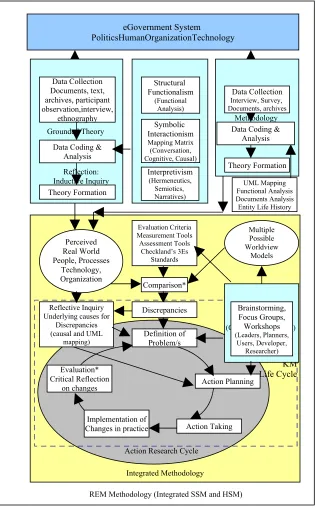
Research MethodologyThe nature of knowledge, and how it is managed, has occupied researchers for a long time. It is a complex human activity which cannot be reduced to formulaic and quantifiable processes. Thus, any research strategy must adopt a qualitative, interpretivist stance if it is to yield deep insight into the essential human activity of an eGovernment system. This proposed research, will adopt the interpretivist approach in the evaluation of eGovernment systems because it focuses on an intensive study of real world instances of eGovernment phenomena with the aim of producing understanding of the context of the eGovernment system (e.g. politics, human, organisation), and the processes whereby the eGovernment system influences the context and vice versa (Walsham, 1993). Our proposed integrated methodology which includes research methodology, SSM, HSM, and KM life cycle is illustrated in Figure 3 which also expounds on the data collection and analysis as well as feedback phases of the SELC depicted in Figure 1.
7.1. Research Design
7.2. Data Collection and Analysis
[image:10.595.146.462.204.714.2]There will be two phases of data collection and analysis. The first will utilise pre-analysis techniques which will be used to conduct needs and requirements analyses prior to the development of the proposed evaluation framework (knowledge flow (i) in Figure 1). Unstructured data concerning issues (e.g. organisational, social, political, cultural, or technological) and problems relating to the implemented eGovernment system will be collected through questionnaires, interviews, external and participant observations, text, documents, and archives analysis, triangulating data to enhance the reliability, validity, and quality of data collected. The data collection method for the second phase will be the same as for the first phase. However in this phase data is collected when the developed methodology is applied to evaluate the eGovernment system (knowledge flow (iv), (v), and (vi) in Figure 1). Data collected will relate to both ‘hard’ and ‘soft’ issues of the eGovernment system and at the same time provide feedback on the evaluation framework itself and its usage (e.g. problems, emerging issues, etc.).
Figure 3: Proposed Integrated Methodology (Research Methodology, SSM, HSM, KM Life Cycle)
Qualitative data collected will be coded using open, axial, and selective coding methods. Some of the data analysis will be based on the Grounded Theory where general features of data will be abstracted inductively to form theories which consist of process-oriented descriptions (concepts, classes, propositions or relationships) and explanation for the emerged phenomena in the evaluation of eGovernment systems. As shown in Figure 3, data relating to ‘soft’ aspects of the system will be analysed utilising
Integrated Methodology
UML Mapping Functional Analysis Documents Analysis Entity Life History
KM Life Cycle
REM Methodology (Integrated SSM and HSM)
COLA Methodology (Collaborative Inquiry) Brainstorming, Focus Groups, Workshops (Leaders, Planners, Users, Developer, Researcher) Comparison* Evaluation Criteria Measurement Tools Assessment Tools Checkland’s 3Es Standards Multiple Possible Worldview Models Reflective Inquiry Underlying causes for
Discrepancies (causal and UML
mapping) Perceived Real World People, Processes Technology, Organization Definition of Problem/s Discrepancies eGovernment System PoliticsHumanOrganizationTechnology Grounded Theory Theory Formation Reflection: Inductive Inquiry Data Coding &
Analysis Data Collection Documents, text, archives, participant observation,interview, ethnography Social Paradigm Structural Functionalism (Functional Analysis) Symbolic Interactionism Mapping Matrix (Conversation, Cognitive, Causal) Interpretivism (Hermeneutics, Semiotics, Narratives) Hard System Methodology (Positivism) Theory Formation Data Coding &
Analysis Data Collection Interview, Survey, Documents, archives Action Taking Action Planning Evaluation* Critical Reflection on changes Implementation of Changes in practice
social research paradigms (e.g. structural functionalism, symbolic interactionism, and interpretivism). Also, there will be the application of content, hermeneutics, and semiotics analysis approaches with focus on narratives and metaphors, for the purpose of studying shared language used in the communication between individuals or groups within the organisation. As for data relating to the ‘hard’ aspects of the system, it is intend to conduct quantitative and statistical methods (e.g. Cost Effectiveness Analysis, Return on Investment, etc.) to assess the performance, efficiency, and effectiveness of the system. This will be followed by applying problem structuring techniques to the system (e.g. functional analysis, UML, Conversation, Causal mapping, etc.) to provide an overview visual depiction of the whole system (depicted in Figure 3).
7.3. Research Participants
The research will be undertaken by two academic institutions, Leeds Metropolitan University and Brunel University who both have appropriate methodological knowledge and expertise and systems and financial modelling skills; Cap Gemini Ernst and Young who will bring KM and OL expertise and ‘hard’ systems modelling approaches (e.g. UML); two local authorities, Sheffield and Leeds, who will provide case projects for evaluation and will also provide systems and financial modelling expertise.
8. Conclusion
We have established a clear need for a better framework for learning through experience and continuous improvement in the eGovernment sector. The proposed CARE project will develop an appropriate integrated framework (ISD, SSM, HSM, IKM, OL, Reflective Practice, Research Methodology, and COLA Methodology) with IT support, to fill this need within the public sector. In the first instance the local authorities participating in the research will gain an immediate benefit by improved evaluation of their selected eGovernment systems. They will also have gained knowledge and expertise to improve their evaluation of other eGovernment initiatives. In the longer term, through dissemination activities, the evaluation framework will be available to other local authorities and government agencies in general. Even if not directly transferable to national level or across Europe the project will have produced a foundation of knowledge that can be adapted to these wider public sector contexts (Orange, et. al, 2006).
Acknowledgement
The collaboration and planning to develop this project proposal was undertaken within the Network for eGovernment Integration and Systems Evaluation (eGISE). This is a research network funded by the Engineering and Physical Sciences Research Council in the UK (grant GR/T27020/01).
References
AGIMO. (2004a). Australian Government Information Management Office: E-government Benefits Study., Retrieval date: [12th May, 2006], URL
address: [http://www.agimo. gov.au/government /benefits_study].
AGIMO. (2004b). Australian Government Information Management Office: Improving Value for Money – The ICT Investment Framework, Retrieval date: [12th May, 2006], URL address: [http://www.agimo.gov.au/government/the _ict_investment_framework].
AGIMO. (2004c). Australian Government Information Management Office: Demand and Value Assessment, Retrieval date: [12th May, 2006], URL
address: [http:// www.agimo.gov.au/government /damvam].
Argyris, C., and Schön, D. (1987). What is an Organisation that it may Learn? In Paton, R., Brown, S., Spear, R., Chapman, J., Floyd, M., and Hamwee, J. (eds.). Organisations: Cases, Issues, Concepts.
Argyris, C., and Schon, D. A. (1996). Organisational Learning II: Theory, Method and Practice, Addison Wesley Publishing.
Avison, D., and Fitzgerald. (2003). Information Systems Development: Methodologies, Techniques, and Tools. London: McGraw-Hill Publishing Company.
Batista, L, and Kawalek, P. (2004). Translating Customer-Focused Strategic Issues into Operational Processes through CRM– A Public Sector Approach. In Traunmuller, R. (ed.). Electronic Government, Proceedings of the Third International Conference, EGOV 2004, Zaragoza, Spain, pp.128-133.
Bennett, S., McRobb, S., and Farmer, R. (2002). Object-Oriented Systems Analysis and Design Using UML. London: McGraw-Hill. Bignell, V., Fortune, J. (1983). Understanding System Failures. Manchester University Press.
Bignell, V., Fortune, J., Watson, L., and Robson, J. (1993). Systems Paradigms: Studying Systems Failures. The Open University Press.
Blair, T. (2000). Foreword: E-Government – Electronic Government Services for the 21st Century. Retrieval date: [21st February, 2006], URL
address: [http://www.strategy.gov.uk/downloads/su/delivery/ indexFrame.htm].
Blumer, Herbert.(1969). Symbolic Interactionism: Perspective and Method. Englewood Cliffs, NJ: Prentice-Hall.
Bonifacio, M., and Zini, C. (2005). To Shape Practice Act on Theory. Journal of Knowledge Management, Vol.3(1), pp.11-22.
Brown, J. S., and Duguid, P. (1991). Organisational Learning and Communities of Practice: Towards a Unified View of Working, Learning, and Innovation, Organisational Science, 2, pp.40-57.
Brown, J. S., Collins, A., and Duguid, P. (1989). Situated Learning and the Culture of Learning, Educational Researcher, Vol. 18(1).
Brunel University (2005). Brunel University Spearheads E-Government Research Think-Tank. Retrieval Date:03rdJanuary, 2006. URL address:
[http://www.brunel.ac.uk/news/pressoffice/ pressreleases/cdata/august/fuse+e+gov+think+tank/].
Burke A. (2005), A Proposed Framework for Conducting Evaluation and Reflective Practice Activities in Information Systems Development Projects, 9th UK Systems Society Annual Conference, Managing Complexity: The contribution of Systems Thinking and Practice, 5th – 7th September, St. Anne’s College Oxford.
Burke, A., Elliman, T., Orange, G., and Zairi, M. (2005). A Role for Knowledge Management Methods in E-Government Systems Evaluation: The Reflective Evaluation Method (REM). Proceedings of eGovernment Workshop, September 13, 2005, Brunel University, West London, UK.
Checkland, P., and Scholes, J. (1990). Soft Systems Methodology in Action. Chichester: John Wiley. Checkland, P., and Scholes, J. (2001). A 30-year Retrospective. Chichester: John Wiley.
Collins, M. H. (1990). Artificial Experts: Social Knowledge and, Intelligent Machines, Cambridge, Massachusettes: The MIT Press.
Committee of Public Accounts, CPA. (2002). Improving Public Services Through eGovernment. House of Commons (HC) Report No: 54, Retrieval Date: [01st April, 2006], URL address: [http://www.publications.parliament.uk/pa/cm200102 /cmselect/cmpubacc/845/84503.htm].
Croasdell, A. (2005). A framework to Assess the Success of E-Government Initiatives, Final Year Report, Leeds University, Leeds, UK.
Cross, R., Parker, A., and Borgatti, S. P. (2002). A Bird’s Eye View: Using Social Network Analysis to Improve Knowledge Creation and Sharing. IBM Institute for Business Value. Retrieval Date: [03rd January, 2006], URL address:
[http://www-1.ibm.com/services/us/imc/pdf/g510-1669-00-a-birds-eye-view-using-social-network-analysis.p df].
Cross, R., Parker, A., Prusak, L., and Borgatti, S. P. (2001). Knowing What We Know: Supporting Knowledge Creation and Sharing in Social Networks. Organisational Dynamics, Vol. 30(2), pp. 100-120.
Curtis, G., and Cobham, D. (2005). Business Information Systems :Analysis, Design and Practice. Harlow: Financial Times Prentice Hall. Davenport, T., and Prusak, I. (1998). Working Knowledge. Boston, Massachusettes: Harvard Business School Press.
dex_en.htm].
DTI. (2005). Knowledge Transfer Partnerships: Awards 2004. Retrieval date: [13th February, 2006], URL address: [http://www.ktponline.org.uk/shared/awards_post.pdf].
EC. (2005). European Commission Information Society and Media Directorate General: Signposts towards eGovernment 2010, Retrieval date: [12th
May, 2006], URL address: [http://europa.eu.int /information_society/activities/egovernment_research/doc/minconf2005/signposts2005.pdf].
Elliman, T., and Hayman, A. (1999). A Comment on Kidd’s Characterisation of Knowledge Workers. Cognition, Technology and Worker, Vol. 1(3), pp.162-168.
esd-toolkit. (2006). Electronic Service Delivery Toolkit. Retrieval Date: [01st , April, 2006], URL Address: [http://www.esd.org.uk /esdtoolkit/].
Europe’s Information Society, EIS. (2005). Project of the Month July 2005: Good Practice Framework for eGovernment, Retrieval Date: [12th ,May,
2006], URL address: [http://europa.eu.int/information _society/activities/ egovernment_research/projects/projects_of_month/200507/in
Farbey, B., Land, F., Targett, D. (1995). A Taxonomy of Information Systems Application: The Benefits Evaluation Ladder, European Journal of Information Systems, Vo. 4, pp.41-50.
Foley, P. (2005). The Real Benefits, Beneficiaries and Value of EGovernment, Public Money and Management, January.
Gershon, P. (2004). Gershon Report: Releasing Resources to the Front Line – Independent Review of Public Sector Efficiency. Retrieval Date: [01st,
April, 2006], URL Address: [http://www.hm-treasury.gov.uk/media/B2C/11/efficiency_re view120704.pdf]. Giddens, A. (1984). The Constitution of Society. Cambridge: Polity.
Giddens, A. (1991). Modernity and Self Identity. Cambridge: Polity.
Giddens, A. (1996). The Constitution of Society: Outline of the Theory of Structuration. University of California Press.
Goh, L. S. (2005). Harnessing Knowledge for Innovation: An Integrated Management Framework. Journal of Knowledge Management, Vol.9(4), pp.6-18.
HM Treasury. (1999). Modernising Government. Retrieval Date: [23rd, August, 2006], URL Address:
[http://www.archive.official-documents.co.uk/document/cm43/4310/4310-00.htm].
HM Treasury. (2004). Spending Review 2004: Meeting Regional Priorities: Response to the Regional Emphasis Documents. Retrieval Date: [01st,
April, 2006], URL Address: [http://www.hm-treasury.gov.uk/media/2AO/31/sr04_regprio rities_220704.pdf].
I&DeA. (2005). Efficiency Matters: The Annual Efficiency Statement and the Bigger Picture. Retrieval Date: [01st, April, 2006], URL Address:
[http://www.idea-knowledge.gov.uk /idk/aio/664218].
I&DeA. (2006). Annual Efficiency Statement. Retrieval Date: [01st , April, 2006], URL Address: [http://www.idea-knowledge.gov.uk/idk
/core/page.do?pageId=973218].
Irani, Z., and Love, P. E. D. (2001). Editorial - Information Systems Evaluation: Past, Present and Future. European Journal of Information Systems, Vol. 10, pp.183-188.
Irani, Z., Love, P. E. D., Elliman, T., Jones, S., and Themistocleous, M. (2005a). Evaluating EGovernment: Learning from the Experience of Two UK Local Authorities, Information Systems Journal, Vol. 15, Blackwell Publishing Ltd., pp.61-82.
Irani, Z., Sharif, A. M., and Love, P. E. D. (2005b). Linking Knowledge Transformation to Information Systems Evaluation. European Journal of Information System, Vol. 14, pp.213-228.
Keating, C., Robinson T., and Clemson, B. (1996). Reflective Inquiry: A Method for Organisational Learning, The Learning Organisation, Vol. 3(4), pp. 35-43.
Kendall, K. E., and Kendal, J. E. (2005). Systems Analysis and Design. Upper Saddle River, N.J.: Prentice Hall.
King, S., and Johnson, O. A. (2004b). Modelling Process Variety and Best Practice in Local E-Government, University of Leeds, Leeds, UK. Kliskewski, R. (2001). Infrastructure for an Government Process Portal. In Remenyi, D., Bannister, F. (ed.). European Conference on e-Government, MCIL, Reading, UK, pp.233-245.
Krebs, V. (2005). An Introduction to Social Network Analysis. Retrieval date: [3rd, January, 2006]. URL address: [http://www.orgnet.com/sna.html].
Leicestershire County Council. (2005). General Introduction to the Annual Efficiency Statement. Retrieval Date: [01st, April, 2006]. URL Address:
[http://www.leics.gov.uk/index /your_council/improving_services/general_introduction_to_the_annual_efficiency_statement.htm].
Leonard, D., and McAdam, R., (2000). Grounded Theory Methodology and Practitioner Reflexivity in TQM Research. International Journal of Quality & Reliability Management, Vol. 28(2), pp. 180-194.
Maciaszek, L. A. (2001). Requirements Analysis and System Design: Developing Information Systems with UML. Addison Wesley.
Mitre (2005). A Survey of Cognitive Engineering Methods and Uses. Retrieval date: [3rd,January,2006], URL address:
[http://mentalmodels.mitre.org/cog_eng/].
Neff, D., and Kvandal, S. (2001). Connecting Citizens to Government Online. San Diego Business Journal, April, Vol. 22(23), p.14. Nonaka, I., and Takeuchi, H. (1995). The Knowledge-Creating Company. New York: Oxford University Press.
ODPM. (2004). Delivering Efficiency in Local Services: Information for Leaders and Chief Executives. Retrieval Date: [01st , April, 2006], URL
Address: [http://www.idea-knowledge.gov.uk/idk /aio/420798].
ODPM. (2005a). Efficiency Technical Note (ETN) for Local Government. Retrieval Date: [01st, April, 2006], URL Address:
[http://www.odpm.gov.uk/pub/532/Efficiency technicalnoteforlocalgovernmentPDF336kb_id1135532.pdf].
ODPM. (2005b). Delivering Efficiency in Local Services: Further Guidance for Local Authorities. Retrieval Date: [01st, April, 2006], URL Address:
[http://www.odpm.gov.uk/ pub/531/DeliveringefficiencyinlocalservicesfurtherguidancePDF1129kb_id1135531.pdf]
ODPM (2006a). About ODPM – Overview. Retrieval date: [13th ,February, 2006], URL address: [http://www.odpm. gov.uk/index.asp?
ODPM. (2006b). ODPM Evidence and Innovation Strategy 2005-08: Consultation Paper. Retrieval date: [01st, April, 2006], URL Address:
[http://www.odpm.gov.uk/pub/401/ ODPMEvidenceInnovationStrategy200508Consultationpaper_id1164401.pdf].
ODPM. (2006c). About the Local Government Efficiency Agenda. Retrieval Date: [01st April, 2006], URL Address:
[http://www.odpm.gov.uk/index.asp?id=1163865].
OECD (2001). Citizens as Partners: Information, Consultation and Public Participation in Policy-Making, pp.9-12.
OGC. (2005a). Flexible Working in Central Government: Leveraging the Benefits. Retrieval Date: [01st, April, 2006], URL Address:
[http://www.ogc.gov.uk/embedded_object. asp?docid=1003714].
OGC. (2005b). Productive Time: Efficiency Programme – Measurement Guidance. Retrieval Date: [01st, April, 2006], URL Address: [http://www.hm-treasury.gov.uk/media/FE9 /DC/productive _time010405.pdf].
Orange, G., Boam, J., and Burke, A. (1998). A Networked System to Facilitate Organisational Learning within the Construction Industry, NETIES 98, Leeds Metropolitan University.
Orange, G., Cushman, M., and Burke, A. (1999a). COLA: A Cross Organisational Learning Approach Within U.K. Industry, NETIES 99, March 1999, Krems Austria.
Orange, G., Burke, A., and Cushman, M. (1999b). An Approach to Support Reflection and Organisation Learning within the UK Construction Industry. Paper presented to BITWorld'99: Business Information Technology Management: The Global Imperative, Cape Town, South Africa, 30 June - 2 July 1999.
Orange, G., Burke, A., and Boam, J. (2000). Organisational Learning in the UK Construction Industry: A Knowledge Management Approach, The Proceedings of ECIS 2000, Vienna, Austria, July2000.
Orange, G., Burke, A., Elliman, T., and Kor, A. L. (2006). CARE: An Integrated Framework to Support Continuous, Adaptable, Reflective Evaluation of eGovernment Systems. Proceedings of the European and Mediterranean Conference on Information Systems (EMCIS), 6th – 7th July,
2006, Costa Blanca, Alicante, Spain.
Orlikowski, W. J. (1996). Improvising Organisational Transformation over Time: A Situated Change Perspective, Information Systems Research, Vol.7(1), pp.63-92.
Patching, D. (1990). Practical Soft Systems Analysis. FT: Prentice Hall.
Proceedings of the 4th International Conference on Networking Entities. NETTIES ’99, Donau-Universität, Krems, Austria, 18-19 March 1999. Schon, D. A. (1983). The Reflective Practitioner. San Francisco: Jossey Bass.
Schon, D. A. (1991). The Reflective Practitioner: How Professionals Think in Action, Ashgate. Silcock, R. (2001). What is eGovernment? Parliamentary Affairs, Vol.54, pp.88-101.
Silk, D. (1990). Managing Information Systems Benefits for the 1990s. Journal of Information Technology, Vol. 5(4).
Strauss, A., and Corbin, J. (1990). Basics of Qualitative Research: Grounded Theory Procedures and Techniques. London: Sage. Tsoukas, H. (2005). Complex Knowledge: Studies in Organisational Epistemology. Oxford University Press.
Tsoukas, H., and Mylonopoulos, N. (2004). Introduction: Knowledge Construction and Creation in Organisations. British Journal of Management, Vol. 15., pp.1-18.
Tsoukas, H., and Vladimirou, E. (2005). What is Organisational Knowledge? Journal of Management Studies, Vol. 38.
UK Government (1999). Modernising Government: Presented by the Prime Minister and the Minister for the Cabinet Office by Command of Her Majesty. Retrieval date: [12thDecember,2005], URL address: [http://www.archive.official-documents.co.uk/ document/cm43/4310/4310.htm].
Walsham, G. (1993). Interpreting Information Systems in Organizations, Chichester:Wiley.
Wikipedia (2006a). Organisational Culture. Retrieval date: [3rd, January, 2006], URL address: [http://en.wikipedia.org /wiki/Organisational_culture].
Wikipedia (2006b). Business Operations. Retrieval date: [3rd, January, 2006], URL address: [http://en.wikipedia.org /wiki/Business_operations].
Wikipedia (2006c). Business Process. Retrieval date: [3rd, January, 2006], URL address: [http://en.wikipedia.org /wiki/Business_process].