The Effect of Temporal-based Term Selection for Text Classification
Fumiyo Fukumoto1, Shogo Ushiyama2, Yoshimi Suzuki1 and Suguru Matsuyoshi1 1Interdisciplinary Graduate School of Medicine and Engineering, University of Yamanashi
2Faculty of Engineering, University of Yamanashi
Kofu, 400-8511, JAPAN
{fukumoto, t08kg006, ysuzuki, sugurum}@yamanashi.ac.jp
Abstract
This paper addresses the text classification problem that training data may derive from a different time period from the test data. We present a method of temporal-based term selection for timeline adaptation. We selected two types of informative terms ac-cording to corpus statistics. One is tempo-ral independent terms that are salient re-gardless of the timeline. Another is tem-poral dependent terms which are impor-tant for a specific period of time. For tem-poral dependent terms extracted from the training documents, we applied weight-ing function that weights terms accord-ing to the temporal distance between ing and test data in the process of train-ing classifiers. The results ustrain-ing Mainichi Japanese newspaper documents showed improvement over the three baselines.
1 Introduction
Text classification supports and improves several tasks such as automated topic tagging, building topic directory, spam filtering, creating digital li-braries, sentiment analysis in user reviews, Infor-mation Retrieval, and even helping users to inter-act with search engines (Mourao et al., 2008). A growing number of machine learning techniques have been applied to text classification (Xue et al., 2008; Gopal and Yang, 2010). The common ap-proach is the use of term selection. Each document is represented using a vector of selected terms (Yang and Pedersen, 1997; Hassan et al., 2007). Then, they used training documents with category label to train classifiers. Once category models are trained, each document of the test data is classi-fied by using these models. Terms in the docu-ments may be considered more important to build the classification model according to the timelines,
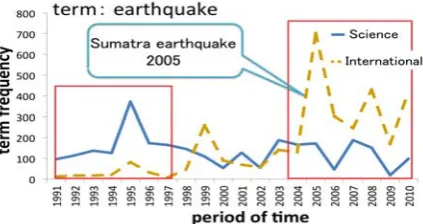
while the majority of supervised classification methods consider that each term provides equally information regardless to a period. For instance, as shown in Figure 1, the term “earthquake” ap-peared more frequently in the category “Science” than “International” early in 1995. However, it ap-peared frequently in the category “International” than “Science” since Sumatra earthquake occurred just off the southern coast of Sumatra, Indonesia in 2005. Similarly, the term “Alcindo” frequently ap-peared in the documents tagged “Sports” in 1994, since Alcindo is a Brazilian soccer player and he was one of the most loved players in 1994. The term did not appear more frequently in the “Sports” category since he retired in 1997. These observations show that salient terms in the training data, are not salient in the test data when training data may derive from a different time period from the test data.
In this paper, we present a method for text clas-sification concerned with the impact that the varia-tion of the strength of term-class relavaria-tionship over time. We selected two types of informative terms according to corpus statistics. One is temporal in-dependent terms that are salient regardless of the timeline. Another is temporal dependent terms which are salient for a specific period of time. For temporal dependent terms extracted from the training documents, we applied weighting func-tion that weights terms according to the temporal distance between training and test data in the pro-cess of training classifiers.
Figure 1: “earthquake” appeared in “Science” and “International” categories
temporal weighting weights training instances ac-cording to the temporal distance between training and test instances. The difference is that we ap-plied the function to only dependent terms while a method of Salles weights all terms in the train-ing documents. Because as illustrated in Figure 1, “earthquake” that are salient for a specific period of time and terms such as “Science” which are im-portant regardless of the timeline in “Science” do-main are both included in the training documents. These terms appearing in the training documents are equally weighted, which affect classification accuracy.
The remainder of the paper is organized as fol-lows: Section 2 describes related work. Section 3 briefly reviews temporally-aware algorithm. Sec-tion 4 presents our framework. Finally, we re-port experiments and conclude our discussion with some directions for further work.
2 Related Work
The analysis of temporal aspects for text classifi-cation is a practical problem attracting more and more attention. Mourao et al. have shown evi-dence that time is an important factor in text clas-sification (Mourao et al., 2008). More specifi-cally, they selected training documents that are closer in time to the test document. They re-ported that the method has attained at 89.8% ac-curacy for ACM, and 87.6% for Medline. Co-hen et al. attempted to extract context including phrases that is exploited towards better classifi-cation models (Cohen and Singer, 1999). Kim et al. focused on Web documents and presented a classification method using the knowledge ac-quisition method, Multiple Classification Ripple Down Rules (MCRDR). It enables domain users to elicit their domain knowledge incrementally and
revise their knowledge base. They may then re-classify documents according to context changes (Kim et al., 2004). These techniques can be clas-sified into adaptive document classification (Yang and Lin, 1999; Dumais and Chen, 2000; Liu and Lu, 2002; Rocha et al., 2008) where temporal as-pects are considered to classification.
Several authors have attempted to capture con-cept or topic drift dealing with temporal effects in classification (Kelly et al., 1999; Lazarescu et al., 2004; Folino et al., 2007; Ross et al., 2012). The earliest known approach is the work of (Klinken-berg and Joachims, 2000). They attempted to handle concept changes with SVM. They used ξα-estimates to select the window size so that the estimated generalization error on new exam-ples is minimized. The result which was tested on the TREC shows that the algorithm achieves a low error rate and selects appropriate window sizes. Scholz et al. proposed a method called knowledge-based sampling strategy (KBS) to train a classifier ensemble from data streams. They used two types of data sets, 2,608 documents of the data set of the TREC, and the satellite im-age dataset from the UCI library to evaluate their method. They showed that the algorithm out-performed leaning algorithms without consider-ing concept drift (Scholz and Klinkenberg, 2007). He et al. attempted to find bursts, periods of el-evated occurrence of events as a dynamic phe-nomenon instead of focusing on arrival rates (He and Parker, 2010). They used Moving Aver-age Convergence/Divergence (MACD) histogram which was used in technical stock market analysis (Murphy, 1999) to detect bursts. They tested their method using MeSH terms and reported that the model works well for tracking topic bursts.
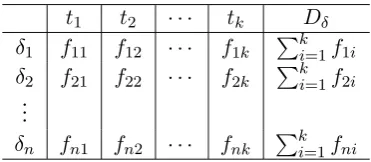
us-Table 1: Temporal distances against terms
t1 t2 · · · tk Dδ
δ1 f11 f12 · · · f1k
k
i=1f1i
δ2 f21 f22 · · · f2k
k
i=1f2i
.. .
δn fn1 fn2 · · · fnk
k
i=1fni
ing a mixture of two Gaussians. They applied TWF to every training document. However, it is often the case that terms with salient for a specific period of time and important terms regardless of the timeline are both included in the training doc-uments. We focus on the issue, and present an al-gorithm which weights only to the salient terms in a specific period of time.
3 Temporal Weighting Function
In this section, we briefly review Temporal Weighting Function (TWF) proposed by Salles et al. (Salles et al., 2010). TWF is based on the temporal distance between training and test docu-ments creation times (Salles et al., 2010). Given a test document to be classified, the TWF sets higher weights to training documents that are more simi-lar to the test document. The weights refer to the strength of term-class relationships. It is defined asdominance(t, c) = Ntc
cNtc whereNtc refers
to the number of documents in classcthat contain termt. When the dominance dominance(t, c) is larger than a certain threshold value α1, the term is judged to have a high degree of exclusivity with some class.
We note that TWF sets higher weights to train-ing documents that temporally close to the test document. LetSt ={δ ←pn−pr | ∀rpn∈St,r}
be a set of temporal distances that occur on the stability periods of termt. Here,pnbe the time of
creation concerning to a training document. Sta-bility periods of term t, referred to as St,r is the
largest continuous period of time, starting from the reference time pointprin which the test document
was created and growing both to the past and the future. For instance, ifSt,ris{1999, 2000,2001},
andpr= 2000, thenS
t={-1,0,1}.
Finally, the function is determined considering the stability period of each term as a random vari-able where the occurrence of each possible
tem-1We empirically set alpha = 50% in the experiment.
poral distance in its stability period is an event. The frequencies of the temporal distancesδ1toδn
for terms t1 totk are shown in Table 1. The
ran-dom variable Dδ related to the occurrences ofδ,
which represents the distribution of each δi over
all terms t, is lognormally distributed if InDδ is
normally distributed. Here, InDδ refers to
log-normal distribution Dδ where Dδ stands for the
distribution of temporal distanceδi for the termti
over all terms t. A 3-parameter Gaussian
func-tion, F = aie
−(x−2cbi2)2
i is used to estimate the
re-lationship between temporal distance and tempo-ral weight, where the parameteraiis the height of
the curve’s peak,biis the position of the center of
the peak, and ci controls the width of the curve.
These parameters are estimated by using a Maxi-mum Likelihood method.
4 Framework of the System
The method for temporal-based classification con-sists of three steps: selection of temporal indepen-dent/dependent terms, temporal weighting for de-pendent terms, and text classification.
4.1 Independent and dependent term selection
The first step is to select a set of indepen-dent/dependent terms from the training data. The selection is based on the use of feature selection technique. We tested different feature selection techniques, χ2 statistics, mutual information, and information gain (Yang and Pedersen, 1997; For-man, 2003). In this paper, we report onlyχ2 statis-tics that optimized global F-score in classification. χ2 is given by:
χ2(t, C) = n×(ad−bc)
2
(a+c)×(b+d)×(a+b)×(c+d)(1).
Using the two-way contingency table of a term t and a category C, ais the number of documents ofCcontaining the termt,bis the number of doc-uments of other class (notC) containingt,cis the number of documents ofCnot containing the term t, anddis the number of documents of other class not containing t. nis the total number of docu-ments.
Independent terms are salient across the full temporal range of training documents. For each category Ci (1 < i ≤ n), where n is the
…....
…....
1991
Category 1 1991Category 2 1991Category n
1991 Sports
1992 Sports
1993 Sports
Term selection in 1991 year
Term selection of Sports category
Figure 2: Term selection per year versus category
the same category across the full temporal range, and created a set. The number of sets equals to the number of categories. In contrast, dependent terms refer to a term that is salient for a specific period of time.
As illustrated in Figure 2, we selected depen-dent terms by using two methods: selection per year, and category. The former is applied to the sets of documents with different categories in the same year as illustrated in the top of Figure 2. For each category in a specific yearyj (yj in Figure 2
refers to 1991), we collected all documents tagged in the categoryCi within the yearyj, and created
a set. The number of sets equals to the number of categories in the training documents. In con-trast, term selection per category is applied to the sets of documents with different years in the same category shown in the bottom of Figure 2. For a specific categoryCi(Cirefers to “Sports” in
Fig-ure 2), we collected all documents in the same year, and created a set. Thus, the number of sets equals to the number of different years in the train-ing documents.
4.2 Temporal weighting
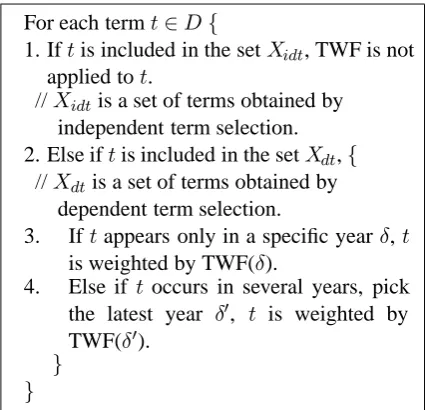
We appliedχ2statistics and selected terms whose χ2 value is larger than a certain threshold value. The procedure for temporal weighting of the se-lected termtin the training documentDis shown in Figure 3. For each termtin the training docu-mentD, iftis included in a set obtained by depen-dent term selection, tis weighted by TWF, as the termtis salient for a specific yearδ. As shown in 4 of Figure 3, iftoccurs in several years, we pick up the latest yearδandtis weighted by TWF(δ). Becauseδ is close to the year that the test docu-ment was created, and it can be considered to be reliable for accurate classification. Xdt in Figure
For each termt∈D{
1. Iftis included in the setXidt, TWF is not
applied tot.
//Xidtis a set of terms obtained by
independent term selection. 2. Else iftis included in the setXdt,{
//Xdtis a set of terms obtained by
dependent term selection.
3. Iftappears only in a specific yearδ,t is weighted by TWF(δ).
4. Else if t occurs in several years, pick the latest year δ, t is weighted by TWF(δ).
} }
Figure 3: Temporal weighting procedure
3 refers to a set of terms obtained by term selec-tion per year (Year), or term selecselec-tion per category (Cat).
4.3 Classification based on kNN
Similar to Salles’s experiments (Salles et al., 2010), we tested Rocchio, kNN and NB with the TWF. As a result, we used kNN in the exper-iment because the result obtained by kNN was the best among them. Each training document is represented using a vector of selected indepen-dent/dependent terms. Given a test document, the system finds the k nearest neighbors among the training documents, and uses the categories of the k neighbors to weight the category candi-dates. The similarity score between training, and test documents collected from 1994 is illustrated in Figure 4.
Figure 4: The similarity between training and test documents
document. The category with the highest score of the vote is assigned to the test document.
5 Experiments
We had an experiment to evaluate our method. We collected Mainichi Japanese newspaper from 1991 to 2010 and used them in the experiments2. Mainichi newspaper documents are classified into sixteen categories. Of these, we used six cate-gories, “Sports”, “Home”, “Science”, “Economy”, “Arts”, and “International”, each of which has more than 250 documents for each year. All Japanese documents were tagged by using a mor-phological analyzer Chasen (Matsumoto et al., 2000). We used nouns as independent/dependent term selection.
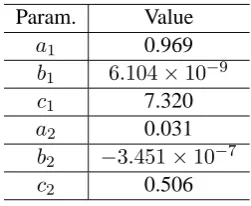
We divided all the documents into two sets: one is to estimate the number of selected terms weighted by χ2 statistics, 3 parameters Gaussian function, and the number of k in kNN. Another is a test data. We used the estimated parameters to classify test documents. Table 2 shows the size of data used in the experiments. ”Doc” refers to the number of documents per category. As shown in Table 2, we used three types of test data to ex-amine the effect of the method against the differ-ence of period between the training and test data. As a result of parameter estimation, we used the number of 10,000 terms as independent terms and 3,000 for dependent terms. The estimated parame-ters used in a Gaussian function are shown in Table 3. The number of k in kNN was set to 12.
We evaluated text classification performance by F-score. To examine the effect of dependent term selection, we setXdtin Figure 3 to three types of
terms, i.e., Year, Cat, and Year ∪ Cat, and
com-2http://ndk.co.jp/english/index.html
Table 2: Data used in the experiments
Parameter estimation
Period Training Test Doc Total Doc Total 1991 - 2000 80 4,800 50 3,000
2001 – – 500 3,000
2010 – – 500 3,000
Training and Test
Period Training Test Doc Total Doc Total 1991 - 2000 120 7,200 50 3,000
2001 – – 500 3,000
2010 – – 500 3,000
Table 3: Estimated parameters
Param. Value
a1 0.969
b1 6.104×10⁻⁹
c1 7.320
a2 0.031
b2 −3.451×10⁻⁷
c2 0.506
pared these results. Table 4 shows the results ob-tained by using three types of terms. “Cat” and “Year” refer to the results obtained by term selec-tion per category, and year, respectively. “Cat ∪ Year” refers to the results obtained by both selec-tion methods. “Macro Avg.” in Table 4 indicates macro-averaged F-score. “∗” in Table 4 shows that “Cat” shows statistical significance t-test com-pared with the∗marked method.
As shown in Table 4, there is no significant dif-ference among three selection methods, especially when the test and training documents are the same time period, i.e., 1991 - 2000. When the test data is derived from 2001 and 2010, the macro-averaged F-score obtained by “Cat” is statistically signif-icant compared with “Year” in some categories. These observations indicate that term selection per category is the best among other methods. Then, we used term selection per category as a depen-dent term selection.
Table 4: Classification Results
1991 - 2000 Test Data
Category Cat Year Cat∪Year Arts 0.813 0.819 0.814 International 0.836 0.833 0.835 Economy 0.802 0.802 0.801 Home 0.747 0.751 0.751 Science 0.807 0.806 0.809 Sports 0.920 0.921 0.920 Macro Avg. 0.821 0.822 0.822
2001 Test Data
Category Cat Year Cat∪Year Arts 0.799 0.791∗ 0.800 International 0.801 0.801 0.803 Economy 0.792 0.789 0.791 Home 0.745 0.740 0.744 Science 0.714 0.713 0.715 Sports 0.897 0.892∗ 0.898 Macro Avg. 0.791 0.788∗ 0.792
2010 Test Data
Category Cat Year Cat∪Year Arts 0.330 0.323∗ 0.322∗ International 0.718 0.714 0.718 Economy 0.694 0.698 0.695 Home 0.494 0.501 0.490 Science 0.495 0.496 0.496 Sports 0.862 0.865 0.863 Macro Avg. 0.598 0.600 0.597
* denotes statistical significance t-test, P-value≤0.05
(Salles et al., 2010), i.e., the method applies TWF to each document. In SVM and kNN, we used the result of a simple χ2 statistics. We used SVM-Light package for training and testing (Joachims, 1998)3. We used linear kernel and set all parame-ters to their default values. The results are shown in Table 5. “∗” in Table 5 shows that TTS is statistical significance t-test compared with the ∗ marked methods. For instance, the performance of “Cat” in category “Arts” by using 1991-2000 test data shows significantly better to the results obtained by both kNN and Salles et al. methods.
As can be seen from Table 5 that macro-averaged F-score obtained by TTS was better to those obtained by kNN and Salles’s methods in
3http://svmlight.joachims.org
Table 5: Comparative results
1991 - 2000 Test Data
Category kNN Salles SVM TTS Arts 0.785∗ 0.795∗ 0.801 0.813 International 0.811∗ 0.810∗ 0.837 0.836 Economy 0.796 0.799 0.800 0.802 Home 0.715∗ 0.721∗ 0.740 0.747 Science 0.803 0.807 0.809 0.807 Sports 0.885∗ 0.890∗ 0.892∗ 0.920 Macro Avg. 0.799∗ 0.804∗ 0.812 0.821
2001 Test Data
Category kNN Salles SVM TTS Arts 0.765∗ 0.764∗ 0.780∗ 0.799 International 0.780∗ 0.783∗ 0.802 0.801 Economy 0.797 0.805 0.809 0.792 Home 0.717∗ 0.722∗ 0.728∗ 0.745 Science 0.720 0.720 0.723 0.714 Sports 0.867∗ 0.862∗ 0.870∗ 0.897 Macro Avg. 0.774∗ 0.776∗ 0.785 0.791
2010 Test Data
Category kNN Salles SVM TTS Arts 0.339 0.310∗ 0.340 0.330 International 0.688∗ 0.685∗ 0.687∗ 0.718 Economy 0.688 0.676∗ 0.689 0.694 Home 0.482∗ 0.477∗ 0.483∗ 0.494 Science 0.490 0.478 0.492 0.494 Sports 0.851∗ 0.850∗ 0.851∗ 0.862 Macro Avg. 0.589∗ 0.579∗ 0.590∗ 0.598
* denotes statistical significance t-test, P-value≤0.05
Table 6: Sample results of term selection
Sports International
ind. dep. (2000) ind. dep. (1997)
baseball Sydney president Tupac Amaru
win Toyota premier Lima
game HP army Kinshirou
competition hung-up power residence championship Paku government Hirose
entry admission talk Huot
tournament game election MRTA
player Mita UN Topac
defeat Miyawaki politics impression pro ticket military employment
title ready nation earth
finals Seagirls democracy election league award minister supplement first game Gaillard North Korea Eastern Europe Olympic attackers chair bankruptcy
1991 - 2000 and 2001. However, when we used 2010 test data, the result obtained by TTS is sta-tistically significant compared with SVM. The ob-servation shows that our method is effective when testing on data far from the training data.
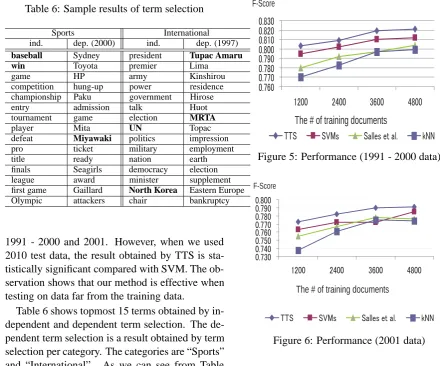
Table 6 shows topmost 15 terms obtained by in-dependent and in-dependent term selection. The de-pendent term selection is a result obtained by term selection per category. The categories are “Sports” and “International”. As we can see from Table 6 that independent terms such as “baseball” and “win” are salient terms of the category “Sports” re-gardless to a time period. In contrast, “Miyawaki” listed in the dependent terms, is a snowboard player and he was on his first world championship title in Jan. 1998. The term often appeared in the documents from 1998 to 2000. Similarly, in the category “International”, terms such as “UN” and “North Korea” often appeared in documents re-gardless of the timeline, while “Tupac Amaru” and “MRTA” frequently appeared in a specific year, 1997. Because in this year, Tupac Amaru Revolu-tionary Movement (MRTA) rebels were all killed when Peruvian troops stormed the Japanese am-bassador’s home where they held 72 hostages for more than four months. These observations sup-port our basic assumption: there are two types of salient terms, i.e., terms that are salient for a spe-cific period, and terms that are important regard-less of the timeline.
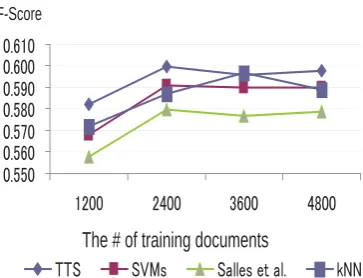
We recall that the overall performance obtained by four methods including our method drops when we used 2010 test data, while the performance of our method was still better than other methods in
㻜㻚㻣㻢㻜 㻜㻚㻣㻣㻜 㻜㻚㻣㻤㻜 㻜㻚㻣㻥㻜 㻜㻚㻤㻜㻜 㻜㻚㻤㻝㻜 㻜㻚㻤㻞㻜 㻜㻚㻤㻟㻜
㻝㻞㻜㻜 㻞㻠㻜㻜 㻟㻢㻜㻜 㻠㻤㻜㻜
㼀㼀㻿 㻿㼂㻹㼟 㻿㼍㼘㼘㼑㼟㻌㼑㼠㻌㼍㼘㻚 㼗㻺㻺
F-Score
The # of training documents
Figure 5: Performance (1991 - 2000 data)
㻜㻚㻣㻟㻜 㻜㻚㻣㻠㻜 㻜㻚㻣㻡㻜 㻜㻚㻣㻢㻜 㻜㻚㻣㻣㻜 㻜㻚㻣㻤㻜 㻜㻚㻣㻥㻜 㻜㻚㻤㻜㻜
㻝㻞㻜㻜 㻞㻠㻜㻜 㻟㻢㻜㻜 㻠㻤㻜㻜
㼀㼀㻿 㻿㼂㻹㼟 㻿㼍㼘㼘㼑㼟㻌㼑㼠㻌㼍㼘㻚 㼗㻺㻺
F-Score
The # of training documents
Figure 6: Performance (2001 data)
Table 5. We note that we used surface informa-tion, i.e., noun words in documents as a feature of a vector. Therefore, the method ignores the sense of terms such as synonyms and antonyms. The earliest known technique for smoothing the term distributions through the use of latent classes is the Probabilistic Latent Semantic Analysis (PLSA) (Hofmann, 1999), and it has been shown to im-prove the performance of a number of informa-tion access including text classificainforma-tion (Xue et al., 2008). It is definitely worth trying with our method to achieve classification accuracy from different period of training and test data as high as that from the same time period of these data.
㻜㻚㻡㻡㻜 㻜㻚㻡㻢㻜 㻜㻚㻡㻣㻜 㻜㻚㻡㻤㻜 㻜㻚㻡㻥㻜 㻜㻚㻢㻜㻜 㻜㻚㻢㻝㻜
㻝㻞㻜㻜 㻞㻠㻜㻜 㻟㻢㻜㻜 㻠㻤㻜㻜
㼀㼀㻿 㻿㼂㻹㼟 㻿㼍㼘㼘㼑㼟㻌㼑㼠㻌㼍㼘㻚 㼗㻺㻺 F-Score
The # of training documents
Figure 7: Performance (2010 data)
4,800 training documents and 1,200 documents were 0.821 and 0.804, respectively, and the perfor-mance was 1.7% decrease when the training data was reduced. However, those obtained by kNN and Salles et al. methods were 2.3% and 2.9% decreases, respectively. The behavior was similar when we used 2001 and 2010 test data. These ob-servations support the effectiveness of our method.
6 Conclusion
We have developed an approach for text classifi-cation concerned with the impact that the varia-tion of the strength of term-class relavaria-tionship over time. We proposed a method of temporal-based term selection for timeline adaptation. The sults showed that our method achieved better re-sults than the baselines, kNN and Salles’s methods in all of the three types of test data, 1991 - 2000, 2001, and 2010 test data. The result obtained by our method was statistically significant than SVM when the test data (2010) was far from the train-ing data (1991 - 2000), while there was no sig-nificant difference between SVM and our method when the period of test data is close to the training data. Moreover, we found that the method is ef-fective for a small number of training documents.
There are a number of interesting directions for future work. We should be able to obtain further advantages in efficacy in our approach by smooth-ing the term distributions through the use of la-tent classes in the PLSA (Hofmann, 1999; Xue et al., 2008). We used Japanese newspaper doc-uments in the experiments. For quantitative eval-uation, we need to apply our method to other data such as ACM-DL and a large, heterogeneous col-lection of web content. Temporal weighting func-tion we used needs tagged corpora with long
pe-riods of time. The quantity of the training doc-uments affects its performance. However, docu-ments are annotated by hand, and manual anno-tation of documents is extremely expensive and time-consuming. In the future, we will try to ex-tend the framework by using unsupervised meth-ods e.g. Latent Dirichlet Allocation (LDA) (Blei et al., 2003; Wang and McCallum, 2006).
ACKNOWLEDGEMENTS
The authors would like to thank the referees for their valuable comments on the earlier version of this paper. This work was supposed by the Grant-in-aid for the Japan Society for the Promotion of Science (No. 25330255, 26330247).
References
D. M. Blei, A. Y. Ng, and M. I. Jordan. 2003. Latent Dirichlet Allocation. Machine Learning, 3:993–
1022.
W. W. Cohen and Y. Singer. 1999. Context-sensitive Learning Methods for Text Categorization. ACM
Transactions of Information Systems, 17(2):141–
173.
S. Dumais and H. Chen. 2000. Hierarchical Classifi-cation of Web Contents. In Proc. of the 23rd
An-nual International ACM SIGIR Conference on Re-search and Development in Information Retrieval,
pages 256–263.
G. Folino, C. Pizzuti, and G. Spezzano. 2007. An Adaptive Distributed Ensemble Approach to Mine Concept-drifting Data Streams. In Proc. of the 19th
IEEE International Conference on Tools with Artifi-cial Intelligence, pages 183–188.
G. Forman. 2003. An Extensive Empirical Study of Feature Selection Metrics for Text Classification.
Machine Learning Research, 3:1289–1305.
S. Gopal and Y. Yang. 2010. Multilabel Classification with Meta-level Features. In Proc. of the 33rd
An-nual International ACM SIGIR Conference on Re-search and Development in Information Retrieval,
pages 315–322.
S. Hassan, R. Mihalcea, and C. Nanea. 2007. Random-Walk Term Weighting for Improved Text Classifica-tion. In Proc. of the IEEE International Conference
on Semantic Computing, pages 242–249.
D. He and D. S. Parker. 2010. Topic Dynamics: An Alternative Model of Bursts in Streams of Topics. In Proc. of the 16th ACM SIGKDD Conference on
Knowledge discovery and Data Mining, pages 443–
T. Hofmann. 1999. Probabilistic Latent Semantic In-dexing. In Proc. of the 22nd Annual International
ACM SIGIR Conference on Research and Develop-ment in Information Retrieval, pages 35–44.
T. Joachims. 1998. SVM Light Support Vector Ma-chine. In Dept. of Computer Science Cornell
Uni-versity.
M. G. Kelly, D. J. Hand, and N. M. Adams. 1999. The Impact of Changing Populations on Classifier Performance. In Proc. of the fifth ACM SIGKDD
International Conference on Knowledge Discovery and Data Mining, pages 367–371.
Y. S. Kim, S. S. Park, E. Deards, and B. H. Kang. 2004. Adaptive Web Document Classification with MCRDR. In Proc. of 2004 International
Confer-ence on Information Technology: Coding and Com-puting, pages 476–480.
R. Klinkenberg and T. Joachims. 2000. Detecting Concept Drift with Support Vector Machines. In
Proc. of the 17th International Conference on Ma-chine Learning, pages 487–494.
M. M. Lazarescu, S. Venkatesh, and H. H. Bui. 2004. Using Multiple Windows to Track Concept Drift.
Intelligent Data Analysis, 8(1):29–59.
R. L. Liu and Y. L. Lu. 2002. Incremental Con-text Mining for Adaptive Document Classification. In Proc. of the eighth ACM SIGKDD International
Conference on Knowledge Discovery and Data Min-ing, pages 599–604.
Y. Matsumoto, A. Kitauchi, T. Yamashita, Y. Hirano, Y. Matsuda, K. Takaoka, and M. Asahara. 2000.
Japanese Morphological Analysis System Chasen Version 2.2.1. In Naist Technical Report.
F. Mourao, L. Rocha, R. Araujo, T. Couto,
M. Goncalves, and W. M. Jr. 2008. Understanding Temporal Aspects in Document Classification. In
Proc. of the 1st ACM International Conference on Web Search and Data Mining, pages 159–169.
J. Murphy. 1999. Technical Analysis of the Financial
Markets. Prentice Hall.
L. Rocha, F. Mourao, A. Pereira, M. A. Goncalves, and W. M. Jr. 2008. Exploiting Temporal Contexts in Text Classification. In Proc. of the 17th ACM
Conference on Information and Knowledge Man-agement, pages 26–30.
G. J. Ross, N. M. Adams, D. K. Tasoulis, and D. J. Hand. 2012. Exponentially Weighted Moving Av-erage Charts for Detecting Concept Drift. Pattern
Recognition Letters, 33(2):191–198.
T. Salles, L. Rocha, and G. L. Pappa. 2010. Temporally-aware Algorithms for Document Clas-sification. In Proc. of the 33rd Annual International
ACM SIGIR Conference on Research and Develop-ment in Information Retrieval, pages 307–314.
M. Scholz and R. Klinkenberg. 2007. Boosting Clas-sifiers for Drifting Concepts. Intelligent Data
Anal-ysis, 11(1):3–28.
X. Wang and A. McCallum. 2006. Topic over Time: A Non-Markov Continuous-Time Model of Topic Trends. In Proc. of the 12th ACM SIGKDD
Inter-national Conference on Knowledge Discovery and Data Mining, pages 424–433.
G. R. Xue, W. Dai, Q. Yang, and Y. Yu. 2008. Topic-bridged PLSA for Cross-Domain Text Classifica-tion. In Proc. of the 31st Annual International ACM
SIGIR Conference on Research and Development in Information Retrieval, pages 627–634.
Y. Yang and X. Lin. 1999. A Re-examination of Text Categorization Methods. In Proc. of the 22nd
An-nual International ACM SIGIR Conference on Re-search and Development in Information Retrieval,
pages 42–49.
Y. Yang and J. O. Pedersen. 1997. A Comparative Study on Feature Selection in Text Categorization. In Proc. of the 14th International Conference on