Enhanced by Japanese Clause Structure Estimation
Satoshi Kamatani, Kentaro Furihata, and Tetsuro Chino
Corporate Research & Development Center, Toshiba Corporation 1, Komukai Toshiba-cho, Saiwai-ku, Kawasaki, 212-8582, Japan
e-mail: [email protected]
Abstract. For applications of the natural language processing, such as spoken translation, it is the most important characteristic to accept various inputs. We analyze a speech input as a sequence of speech fragment and achieve high acceptability. But it is difficult to determine whether each fragment/unit should be interpreted separately or not. This sort of problem is shared by several applications. We regard a clause and dependency structures as one of the clue to solve this type of problem. Because, even in a spoken language domain, a clause represents a syntactic unit and a dependency represents a semantic unit. In this paper, we describe the dependency analysis method on the syntax forest structure enhanced by Japanese clause structure estimation. It also contributes to improve on translation in manual evaluation from 77.8% up to 78.8%.
1 Introduction
It is the most important characteristic for applications of the natural language processing, such as a spoken language translation (SLT), to accept various inputs. Its capability is directly reflected on availability. We design a SLT system based on this concept. Our SLT system can be divided into two parts. The one is a robust spoken language analysis part, and the other is a rule based machine translation (RBMT) part. The RBMT technology has been successful in commercial business with its ease of maintenance of translation quality and coverage. In contract, it rest on reliable analysis methods. So we proposed a robust parsing method for spoken language [5]. In our proposal, we treat input-utterances as a sequence of fragmental phrases to achieve high acceptability. Then our robust grammar and parser unifies fragmental phrases in several candidates of coherent syntactic units, and enumerates all possible combinations as interpretations. Each interpretation is tested according to syntactic/semantic preferences and the optimum interpretation is to be translated.
But it is difficult to determine whether each fragment should be treated separately or not. This sort of problem is common to all spoken language applications. One key technique is that how to associate each fragment with a suitable unit for a practical application. We regard a clause and dependency structure as one of a clue, since a clause and its dependency represents a syntactic/semantic unit even for a spoken language. In this paper, we propose new analysis method that estimates clause structures and evaluates validities combined with dependency preferences. Our method is designed to work on such a syntax forest like structure. It allows to evaluate all candidates efficiently and to choose totally optimum one.
2 The forest driven spoken language translation
2.1 Overview of our translation process
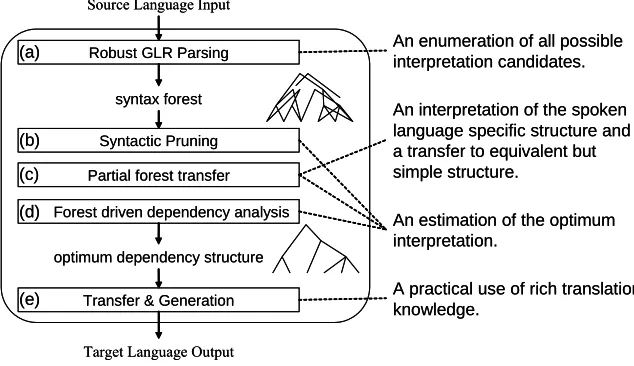
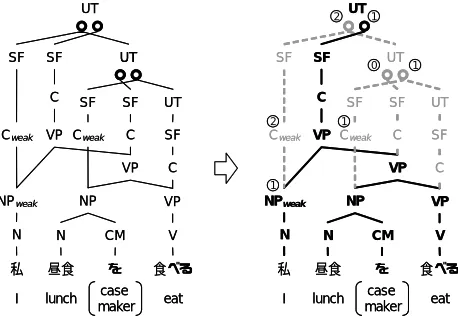
(a) Select vertices with the highest likelihood in each packed sub forest as preferred vertices stepwise top-down manner.
(b) Extract a well-formed structure consists of only preferred vertices.
Here, we calculate dependency likelihood based on co-occurrence probabilitiesp h,rel,m . Where h is a head word, mis a modifier word and relis relationship between h and m. We consider 9 Japanese
case markers {ga, wo, ni, de, kara, yori, he, made, no} as a relationship “rel”. This co-occurrence
probability is leaned from newspaper articles for 7 years by the EM-algorithm based method proposed by Torisawa[12]. But each probability is so small and it has no sense to distinguish a small difference. Therefore, we round a co-occurrence probability down to integer valuesEp.
)) , , ( (log )
, ,
(hrelm INT 10 p hrelm
Ep = (1)
where INT is the function to round down to integer. On the other hand, the co-occurrences that denote
extremely small probabilities must not be a big clue to the structure decisions. But they are more significant than zero-probability one. So, we define dependency likelihood Sdwith the average (1b) of
p
E for all triples;
) ) , , ( exp( 1
1 )
, , (
b p
d
m rel h E m
rel h S
µ − +
= (2)
3 Dependency analysis with clause structure estimation
Clause candidates are derived with our grammar, but they are not syntactically discriminated to ensure robustness. And each dependency evaluation is mainly led by a local preference. They are disadvantage for dependency analysis. Besides, it is not necessarily good to determine strictly. In this section, we propose new forest dependency analysis enhanced by estimated clause candidates.
3.1 Detection of clause and its type
Especially in Japanese, it is comparatively easy to estimate the clause boundary and its type by referring local morphological patterns [10]. And Japanese clause types and their characteristics on dependency have been well-studied. Minami [8] distinguished types of dependent clauses according to differences of clause boundaries, and associated each clause type with a degree of independence.
Table 1. Samples of clause detection rules
Feature name Pattern Penalty
cp_ga -1=*&0.pos="conjunctive particle"&0.surface="が" cm_ga;-0.9 cm_ga -1.pos="noun"&0.pos="case maker"&0.surface="が" cm_ga;-1.0
detect a candidate of a clause. It is described in the extended regular expression. The pattern expressed in the rule(1) says that POS of noticed morpheme is conjunctive particle, a stem is , and an arbitrary morpheme exists at the previous of the noticed morpheme. A dependency control consists of a condition to fire and a penalty when the proceeding condition is fired. The rule (1) is fired if it conflicts with feature cm ga and assigns penalty points -0.9.
Each rule is also defined whether they are active or not in modifier and modified vertices. This activation information depends on only types of the clause. For a following experiment, we used types of clauses listed in [8], and developed 51 rules by hand. Here, we have to notice that penalties in each rule were experimentally adjusted.
3.2 The enhanced dependency analysis procedure
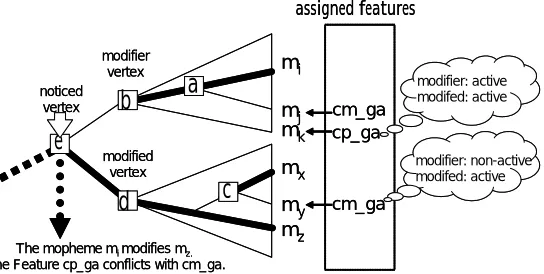
We describe a detail of dependency analysis method enhanced by detected clause candidates. The pruning procedure works along the extended forest driven dependency analysis and prunes semantically ill structures as follows. Now, we use a syntax forest described partially in Figure 4 as a conceptual diagram. In this figure, a head word inheritance is represented as a arc. The bold arc denotes a head arc. The other thin arc denotes to be a non-head arc and a modification.
1. Estimate clause candidates with detection rules, and assign features. 2. Estimate the optimum dependency sets of all parses in the forest.
A) Put a likelihood calculated by the equation (1) for all vertices.
B) For each modified vertex, collect features with following conditions in a span of inputted morphemes dominated by the vertex.
The features are assigned for the head morpheme of the vertex. The features are defined that they are active in a modified vertex.
C) For each modifier vertex, assemble features with following conditions in a span of inputted morphemes dominated by the vertex.
The features are assigned for the head morpheme of the vertex.
The features are assigned for the morpheme appeared after the head morpheme of the vertex. The features are assigned for the morpheme appeared before the head morpheme of the vertex and defined that they are active in a modifier vertex.
D) For each feature assigned for modified vertices, evaluate conditions in detection rules and find the first satisfied condition.
E) If the satisfied condition is found, assign the penalty defined in the rule to the vertex and note the vertex where the morpheme which assigned the feature are unified to the head morpheme of vertex.
F) At each vertex, sum up penalty and likelihood as the score.
G) Aggregate the possible maximum score for each sub-structure by bottom up manner. 3. Extract semantically preferred forest.
A) Select vertices with the highest likelihood in each packed sub forest as preferred vertices stepwise top-down manner from root of the forest. If the punished vertex is noted, the vertex is pruned from the preferred structure.
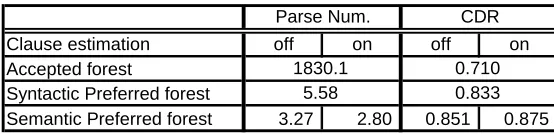
Table 2. Reduction of the parse number and Improvement of CDR.
Clause estimation off on off on
Accepted forest
Syntactic Preferred forest
Semantic Preferred forest 3.27 2.80 0.851 0.875
Parse Num. CDR
1830.1 5.58
0.710 0.833
Table 3. Translation accuracy
System Accuracy NIST
Commercial MT 56.7% 3.24
without clause estimation 77.8% 3.44 with clause estimation 78.8% 3.64
Table 2 shows the average number of syntax trees in syntax forests at each step. In this table, “Accepted Forest” is for the forest after step (a) in Figure 1, “Syntactic Preferred Forest” is one for after step (b), and “Semantic Preferred Forest” is one for after step (d). And Table 2 also shows the average of CDR for each step. To discuss the significance statistically, we assessed t-test (level of significance R = .05), and verified a significant difference. Those results lead that our method efficiently eliminates ill-syntactical structure and ill-dependency, without losing a valid interpretation.
4.2 Effectiveness on the translation
We evaluated all of 702 utterances translated by three systems, the forest driven SLT system 1) without the estimation of clause structure, 2) with the estimation of clause structure, and 3) a commercial translation system developed for written languages. The third system is the source of transfer rules used at the step (e) in Figure 1. Each translated utterance is examined by three tester, and we determine whether a translation is correct or not by majority.
Table 3 shows the evaluation of translations. In this table, the NIST [2] scores are also shown for reference. It shows an improved accuracy rate for translation treated with the clause estimation. Using the clause estimation, translation results of 21 utterances are changed, of which 9 utterances are newly judged correct translation, and of which 10 utterances are improved quality of translations. Worsened 2 utterances are caused by lack of transfer rules. Therefore, the analysis process enhanced by our method contributes to improvements.
5 Related works
to prepare rich translation patterns.
On the other hand, the other way to choose the optimum structure from a forest structure is to use a probabilistic GLR (PGLR) parsing method [4]. But, it is difficult to prepare corpora enough to learn statistical models about specific phenomena of spoken language. And statistic based methods also have a difficulty of a maintenance by hands.
Our method estimates clause structures with the robust grammar and surface patterns of an utterance, without strict assumption. And it unifies preferences of clause structures and dependencies. That ensures to incorporate a statistical method with a human controllable method. Then the system can choose the optimum interpretations from all possible candidates.
6 Conclusion and future works
We proposed the forest driven dependency analysis enhanced by the estimation of Japanese clause structures. It enables to effectively integrate local preference of clause structures, syntactic preference, and semantic preference. It helps us to choose the totally preferable structure from a syntax forest efficiently. The result was our forest driven SLT system successfully improved quality of translations.
For the further improvement, we have to study on combination with machine learning. Using a machine learning method, we plan to find a clause candidate and syntactic/semantic behaviors. Especially, it is necessary to refine penalties which are experimentally assigned by hand. In addition, while we focused Japanese clause structures in this paper, it is possible to use key idea of our method for other languages by using chunk.
References
1. Tetsuro Chino and Satoshi Kamatani. Partial forest transfer for spoken language translation. In Proceedings of RANLP’05, pages 157-161, 2005.
2. G. Doddington. Automatic evaluation of machine translation quality using n-gram co-occurrence statistics. In
Proceedings of ARPA Workshop on Human Language Technology, 2002.
3. Osamu Furuse, Setsuo Yamada, and Kazuhide Yamamoto. Splitting long or illformed input for robust spoken-language translation. In Proceedings of COLINGACL’98, pages 421-427, 1998.
4. Kentaro Inui, Virach Sornlertlamvanich, Hozumi Tanaka, and Takenobu Tokunaga. New formalization of probabilistic glr parsing. In International Workshop on Parsing Technologies, pages 123.134, 1997.
5. Satoshi Kamatani, Tetsuro Chino, and Kazuhiro Kimura. Syntax forest based syntactic and dependency analysis towards robus spoken language processing. In Proceedings of PACLING’05, pages 192-199, 2005.
6. Alon Lavie, Donna Gates, Noah Coccaro, and Lori Levin. Input segmentation of spontaneous speech in janus: A speech-to-speech translation system. In Proceedings of 12th ECAI, pages 86-99, 1996.
7. Takashi Masuoka and Yukinori Takubo. Kiso Nihongo Bunpou . Kaitei-ban .Kuroshio-Shuppan, 1992. (in Japanese).
8. Fujio Minami. Gendai Nihongo-no Kouzou. Taishukan-Shoten, 1974. (in Japanese).
9. Yoon-Hyung Roh, Young-Ae Seo, Ki-Young Lee, and Sung-Kwon Choi. Long sentence partitioning using structure analysis for machine translation. In Proceedings of NLPRS2001, pages 646-652, 2001.
10. Katsuya Takanashi, Takehiko Maruyama, Kiyotaka Uchimoto, and Hitoshi Isahara. Identification of “sentences” in spontaneous Japanese detection and modification of clause boundaries. In Proceedings of ISCA & IEEE Workshop on Spontaneous Speech Processing and Recognition, pages 182-186, 2003.
11. Masaru Tomita. Generalized LR Parsing. Kluwer Academic Publishers, Norwel, Massachusetts, 1991.
12. Kentaro Torisawa. An supervised method for canonicalization of Japanese postpositions. In Proceedings of NLPRS2001, pages 211-218, 2001.
13. Yujie Zhang and Kazuhiko Ozeki. The application of decision trees to segmentation of long Japanese sentences.