DOI: 10.1534/genetics.108.099101
Mcm10 Mediates the Interaction Between DNA Replication
and Silencing Machineries
Ivan Liachko and Bik K. Tye
1Department of Molecular Biology and Genetics, Cornell University, Ithaca, New York 14853
Manuscript received November 25, 2008 Accepted for publication December 1, 2008
ABSTRACT
The connection between DNA replication and heterochromatic silencing in yeast has been a topic of investigation for.20 years. While early studies showed that silencing requires passage through S phase and implicated several DNA replication factors in silencing, later works showed that silent chromatin could form without DNA replication. In this study we show that members of the replicative helicase (Mcm3 and Mcm7) play a role in silencing and physically interact with the essential silencing factor, Sir2, even in the absence of DNA replication. Another replication factor, Mcm10, mediates the interaction between these replication and silencing proteins via a short C-terminal domain. Mutations in this region of Mcm10 disrupt the interaction between Sir2 and several of the Mcm2–7 proteins. While such mutations caused silencing defects, they did not cause DNA replication defects or affect the association of Sir2 with chromatin. Our findings suggest that Mcm10 is required for the coupling of the replication and silencing machineries to silence chromatin in a context outside of DNA replication beyond the recruitment and spreading of Sir2 on chromatin.
L
ARGE regions of eukaryotic genomes are packaged into transcriptionally silent heterochromatin. Yeast heterochromatic silencing is established and maintained by the action of a group of factors called silent information regulators (SIRs) (Rusche et al.2003). Sir2, Sir3, and Sir4 are recruited to chromatin and spread bidirectionally in a stepwise fashion until encountering a boundary element (Hoppeet al.2002;
Rusche et al. 2002; Thon et al. 2002). The silencing
activity of these proteins is attributed to the histone deacetylase function of Sir2, although Sir3 and Sir4 are also required for silencing (Imaiet al.2000). Silencing
in the budding yeast Saccharomyces cerevisiae is largely limited to telomeres, the silent mating type loci, and rDNA. In telomeres the SIRs are recruited to chromatin by Rap1 (Kyrionet al. 1993; Morettiet al. 1994). In
the silent mating type loci (HML and HMR) the binding and spreading of SIRs is initiated by the combined action of the origin recognition complex (ORC), Rap1, and Abf1 binding to DNA elements termed silencers (Rusche et al. 2003). Once formed,
this transcriptionally silent epigenetic structure can be stably inherited for up to 40 generations (Pillus and
Rine1989).
An early study in the cell-cycle regulation of silent chromatin showed that passage through S phase was required for the establishment of silencing (Millerand
Nasmyth 1984), suggesting that DNA replication is
involved in silencing. Indeed, several members of the replication machinery, such as ORC, Mcm10, Mcm5, Cdc7, Abf1, and PCNA have since been implicated in silencing and chromatin structure (Axelrodand Rine
1991; McNally and Rine 1991; Bell et al. 1993;
Ehrenhofer-Murray et al. 1999; Zhang et al. 2000;
Burkeet al. 2001; Christensen and Tye2003; Dziak et al. 2003; Liachko and Tye2005). However, several
studies have shown that DNA replication is not required for the establishment of silencing (Kirchmaier and
Rine 2001; Li et al. 2001; Lau et al. 2002; Martins
-Tayloret al.2004). A more recent study showed that
recruitment of Sir proteins to chromatin is a necessary but not the final step for the establishment of silencing, which may be completed as late as M phase (Kirchmaier
and Rine2006).
One key component of DNA replication machinery is the prereplication complex (pre-RC), which assembles on replication origins in late M/early G1phases of the cell cycle prior to the initiation of DNA replication at the beginning of S phase. The pre-RC consists of a large number of proteins such as Orc1–6, Cdc6, Cdt1, and the replicative helicase Mcm2–7 complex (Forsburg
2004). The Mcm2–7 complex consists of sixminic hro-mosome maintenance (MCM) proteins (Tye 1999;
Forsburg 2004). One distinct characteristic of the
MCM2–7 family is a conserved domain known as the MCM box, which spans200 residues near the center of the protein (Tyeand Sawyer 2000). The MCM box
includes two ATPase motifs, the Walker A motif and the Walker B motif, as well as an arginine-finger motif. In
1Corresponding author: 325 Biotechnology Bldg., Cornell University,
Ithaca, NY 14853. E-mail: [email protected]
addition to these features, all six of the MCM2–7 proteins, with the exception of Mcm3, have zinc binding motifs near the N-terminal regions, and some have nuclearlocalizationsignal (NLS) sequences and sites of phosphorylation by cyclin dependent kinases (CDKs) (Ishimi1997; Leeand Hurwitz2000). The MCM2–7
proteins are highly abundant proteins (estimated at .30,000 copies per cell inS. cerevisiae) whose levels are stable during the cell cycle (Lei et al.1996; Forsburg
2004). InS. cerevisiae, MCM complexes outnumber the
400 DNA replication origins by a factor of 75. The reason for this vast overabundance is unclear and only a small subset of the MCM2–7 proteins is associated with chromatin even during the G1–S transition, when their chromatin association is at its peak. Interestingly, re-ducing the levels of the MCM2–7 proteins causes defects in genetic stability, suggesting that the extra protein molecules are necessary for a function that is yet unknown (Leiet al.1996; Lianget al.1999).
Mcm10 is an essential factor (Merchantet al.1997)
that is closely associated with the Mcm2–7 complex, although it is not part of the same protein family. Much like the MCM2–7 proteins, it is highly abundant in the cell (Kawasakiet al.2000). Mcm10 stabilizes the Pola–
primase complex (Ricke and Bielinsky 2004; Yang et al.2005; Rickeand Bielinsky2006) and is important
for mediating interactions between other replication proteins (Lee et al. 2003; Das-Bradoo et al. 2006).
Temperature sensitive mutations in MCM10, mcm10-1 (P269L), and mcm10-43 (C320Y), cause multiple de-fects, including loss of interactions with other proteins, defects in plasmid replication, and pausing of replica-tion forks at semi-permissive temperature (Merchant et al. 1997; Homesley et al. 2000). At restrictive
temperature,mcm10 cells arrest at the end of S phase with aberrant DNA structures (Merchantet al.1997;
Kawasaki et al. 2000). Recently, Mcm10 has been
implicated to function in chromatin structure in yeast as well asDrosophila melanogaster(Christensenand Tye
2003; Douglaset al.2005; Liachkoand Tye2005). In
Drosophila, Mcm10 interacts with HP-1, an important heterochromatin protein (Christensen and Tye
2003), while in yeast Mcm10 interacts with Sir2 (D oug-las et al.2005; Liachko and Tye2005). In addition,
genetic experiments suggest that the silencing function of Mcm10 is separate from its replication function (Douglaset al.2005; Liachkoand Tye2005).
In this study we show that several members of the MCM2–7 complex play a role in heterochromatic silencing. In addition, they physically interact with Sir2, even in the absence of DNA replication. Mcm10 is required for the interactions between Sir2 and MCM2–7. We have localized the Mcm10 domain re-sponsible for the interaction with Sir2 to a 53-amino-acid domain in the C terminus of Mcm10. Mutations in this region inhibit Mcm10–Sir2 interactions as well as the interaction of Sir2 with members of the MCM2–7
family. These mutants also exhibit defects in silencing, but not in DNA replication. Interestingly,mcm2–7and mcm10mutations that have a significant effect on both DNA replication and silencing do not affect the associ-ation of Sir2 with chromatin. Our findings show that MCM2–7 proteins have a silencing function which requires a coupling of the replication and silencing machineries via Mcm10.
MATERIALS AND METHODS
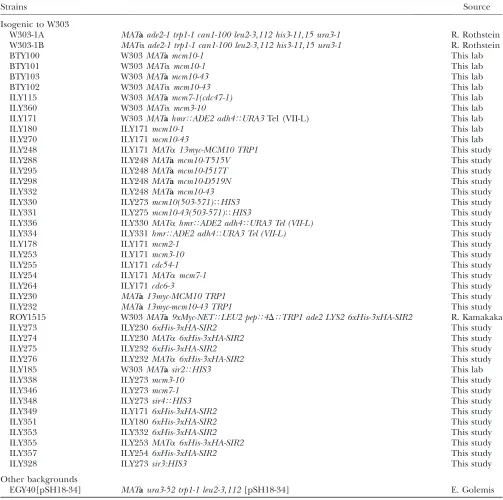
Strains and plasmids:Strains used in this study are listed in Table 1. All strains are isogenic derivatives of W303-1A, unless otherwise indicated. All procedures were performed accord-ing to standard yeast methodology (Sherman1991). Strains
carrying silencing reporters were made by crossing strain YB541 or YB697 to the appropriate mutant strain and selecting desired segregants by their conditional phenotypes and/or auxotrophy. Genotypes were confirmed by PCR or by plasmid complementation where applicable.
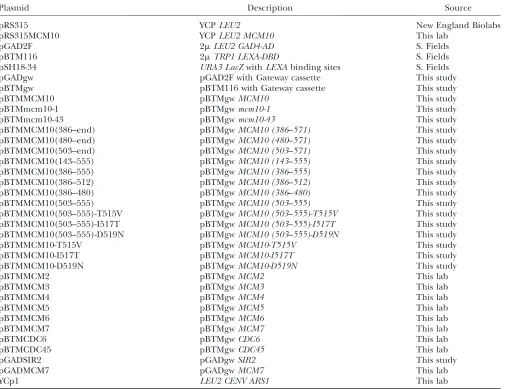
Plasmids used in this study are listed in Table 2. Plasmids used for the expression of two-hybrid fusions were constructed by the Gateway system (Invitrogen). Gateway cassettes were ligated into plasmids pBTM116 and pGAD2F, creating pBTMgw and pGADgw, respectively. pDONR201 entry clones containingMCM10andSIRsready for N-terminal fusions were constructed according to Invitrogen instructions and se-quenced. LR recombination reactions (Invitrogen) were set up between pGBT9gw, pGADgw, pBTMgw, and each of the aforementioned entry clones. These are recombination reac-tions that replace the Gateway cassette in the relevant vector with the gene from the entry clone. The full-length pBTM–
MCM10was described in (Merchantet al.1997). All yeast
transformations were carried out using standard lithium acetate protocols (Orr-Weaveret al.1981; Sherman1991).
Point mutations were introduced using a fusion-PCR (Hortonet al.1989) mutagenesis method. The DNA region
to be mutagenized was PCR amplified in two separate frag-ments that overlap by 50–60 bp. The overlap primers con-tained the desired mutation. After the initial PCR, the two fragments were purified separately and used together in another PCR reaction without any template DNA or primers. The overlapping regions in the two DNA fragments acted as primers for each other and PCR produced a final molecule that contained the entire gene fragment including the mutation of interest. This fragment was then cloned into the relevant vector.
To create the strains with tagged proteins, theSIR2-3HA
and MCM10-13MYC alleles were crossed out of strains WCY15, WCY39 (this lab), and ROY1515 (R. Kamakaka). These were then crossed to make strains that have both alleles. C-terminal mutations were introduced into these strains by standard homologous gene replacement method-ology (Orr-Weaveret al.1981). The last 68 amino acids from
the C terminus ofMCM10were deleted and replaced with
HIS3through one-step gene replacement with a PCR product containing the HIS3 gene flanked by appropriateMCM10
homology regions.
Silencing assays: Yeast strains bearing the URA3reporter were grown overnight in appropriate dropout media. Tenfold serial dilutions were setup in sterile 96-well plates and a constant volume of each dilution was spotted onto the appropriate plate using a multichannel pipettor. 5-FOA was used at a concentration of 1 mg/ml. For experiments using the
media (YPD) plates, grown at 30°for 2–3 days, then placed at 4°for 3 days for further color development.
Yeast two-hybrid: pGAD2F and pBTM116 constructs were transformed into the two-hybrid strain EGY40 carrying the pSH18-34 reporter plasmid (Fields and Song1989).
Inter-actions were assessed by the appearance of blue colonies on plates containing X-gal (Sigma). Ten microliters of a relevant saturated culture were spotted onto X-gal plates and photo-graphed after 2–4 days of growth at 30°.
Minichromosome maintenance assays: Minichromosome maintenance (MCM) assays were performed exactly as de-scribed in (Donatoet al.2006) using the plasmid YCp1.
Chromatin immunoprecipitation:Chromatin immunopre-cipitation (ChIP) experiments were performed as previously described (Goldfarband Alani2004) using exponentially
growing cultures at 30°. Cultures of appropriate cells were grown to log phase and then the cells were lysed in buffer containing 50 mmHEPES, 1 mmEDTA, 140 mmNaCl, 1%
Triton X-100, 0.1% NaDOC, and a mix of protease inhibitors as described. Five micrograms of commercially available anti-HA antibody were used for each immunoprecipitation (Roche 12CA5 no. 11583816001). Protein G agarose beads (Roche no. 1719416) were used. The immunoprecipitated DNA was analyzed with real-time PCR using SYBR Green PCR TABLE 1
Strains used in this study
Strains Source
Isogenic to W303
W303-1A MATaade2-1 trp1-1 can1-100 leu2-3,112 his3-11,15 ura3-1 R. Rothstein W303-1B MATaade2-1 trp1-1 can1-100 leu2-3,112 his3-11,15 ura3-1 R. Rothstein
BTY100 W303MATamcm10-1 This lab
BTY101 W303MATamcm10-1 This lab
BTY103 W303MATamcm10-43 This lab
BTY102 W303MATamcm10-43 This lab
ILY115 W303MATamcm7-1(cdc47-1) This lab
ILY360 W303MATamcm3-10 This lab
ILY171 W303MATahmrTADE2 adh4TURA3Tel (VII-L) This lab
ILY180 ILY171mcm10-1 This lab
ILY270 ILY171mcm10-43 This lab
ILY248 ILY171MATa13myc-MCM10 TRP1 This study
ILY288 ILY248MATamcm10-T515V This study
ILY295 ILY248MATamcm10-I517T This study
ILY298 ILY248MATamcm10-D519N This study
ILY332 ILY248MATamcm10-43 This study
ILY330 ILY273mcm10(503-571)THIS3 This study
ILY331 ILY275mcm10-43(503-571)THIS3 This study
ILY336 ILY330MATahmrTADE2 adh4TURA3 Tel (VII-L) This study ILY334 ILY331hmrTADE2 adh4TURA3 Tel (VII-L) This study
ILY178 ILY171mcm2-1 This study
ILY253 ILY171mcm3-10 This study
ILY255 ILY171cdc54-1 This study
ILY254 ILY171MATamcm7-1 This study
ILY264 ILY171cdc6-3 This study
ILY230 MATa13myc-MCM10 TRP1 This study
ILY232 MATa13myc-mcm10-43 TRP1 This study
ROY1515 W303MATa9xMyc-NETTLEU2 pepT4DTTRP1 ade2 LYS2 6xHis-3xHA-SIR2 R. Kamakaka
ILY273 ILY2306xHis-3xHA-SIR2 This study
ILY274 ILY230MATa6xHis-3xHA-SIR2 This study
ILY275 ILY2326xHis-3xHA-SIR2 This study
ILY276 ILY232MATa6xHis-3xHA-SIR2 This study
ILY185 W303MATasir2THIS3 This lab
ILY338 ILY273mcm3-10 This study
ILY346 ILY273mcm7-1 This study
ILY348 ILY273sir4THIS3 This study
ILY349 ILY1716xHis-3xHA-SIR2 This study
ILY351 ILY1806xHis-3xHA-SIR2 This study
ILY353 ILY3326xHis-3xHA-SIR2 This study
ILY355 ILY253MATa6xHis-3xHA-SIR2 This study
ILY357 ILY2546xHis-3xHA-SIR2 This study
ILY328 ILY273sir3:HIS3 This study
Other backgrounds
master mix from Applied Biosciences (4309155) on the DNA Engine cycler (PTC-200) with Opticon Detector (CFD-3200) from MJ Research, according to the manufacturer’s instructions.
Co-immunoprecipitation: Co-immunoprecipitation (Co-IP) experiments were performed using the same protocol as ChIP with the following differences. For experiments using DNAseI, the lysis buffer was changed to contain no EDTA, which was replaced with 5 mmMgCl2. Cells were arrested in G
2/M phase using 15 mg/ml of nocodazole. The DNAseI used was from Invitrogen (no. 18068-015), and the samples were digested for 20 min at 37°with 20 units/ml of the enzyme. After the lysates were incubated with the beads and the beads were washed (same as ChIP protocol), the beads were boiled in SDS buffer containing DTT (New England Biolabs no. B7703S) for at least 1 hr and the samples were analyzed by Western blot according to standard protocols. Input lanes contained 1ml of cell extract. Antibodies used to probe Western blots were commercial [anti-myc from Santa Cruz (9E10), anti-HA from Roche (12CA5)], from this lab (anti-LexA and anti-Mcm3), or were generously provided by other labs (anti-actin from A. Bretscher, anti-Stu2 from T. Huffaker).
Fluorescence-activated cell sorting: For fluorescence-activated cell sorting (FACS) analysis, 1-ml aliquots of growing yeast cells were spun down and fixed using cold 70% EtOH. The cells were then rinsed twice with 1 ml of 50 mmNaCitrate. The
cells were then sonicated briefly (3 times for 5 sec) at setting 4 on the VirSonic Ultrasonic Cell Disrupter 100 (SP Industries). Twelve microliters of 10 mg/ml RNAse A (QIAGEN no. 1007885) were added and the cells were incubated at 42°for 1 hr. Proteinase K (0.5 mg) was added and the sample was incubated for 1 hr at 42°. One microliter of 1 mmSYTOX Green
(Invitrogen Molecular Probes no. S7020) was added for each 1 ml of cell suspension before processing the samples. The analysis was performed at The Biomedical Sciences Flow Cytometry Core Laboratory at Cornell University.
RESULTS
Pre-RC components play a role in heterochromatic silencing: Several previously identified pre-RC mutants were tested for silencing defects. Interestingly, almost all TABLE 2
Plasmids used in this study
Plasmid Description Source
pRS315 YCPLEU2 New England Biolabs
pRS315MCM10 YCPLEU2 MCM10 This lab
pGAD2F 2mLEU2 GAD4-AD S. Fields
pBTM116 2mTRP1 LEXA-DBD S. Fields
pSH18-34 URA3 LacZwithLEXAbinding sites S. Fields
pGADgw pGAD2F with Gateway cassette This study
pBTMgw pBTM116 with Gateway cassette This study
pBTMMCM10 pBTMgwMCM10 This study
pBTMmcm10-1 pBTMgwmcm10-1 This study
pBTMmcm10-43 pBTMgwmcm10-43 This study
pBTMMCM10(386–end) pBTMgwMCM10 (386–571) This study
pBTMMCM10(480–end) pBTMgwMCM10 (480–571) This study
pBTMMCM10(503–end) pBTMgwMCM10 (503–571) This study
pBTMMCM10(143–555) pBTMgwMCM10 (143–555) This study
pBTMMCM10(386–555) pBTMgwMCM10 (386–555) This study
pBTMMCM10(386–512) pBTMgwMCM10 (386–512) This study
pBTMMCM10(386–480) pBTMgwMCM10 (386–480) This study
pBTMMCM10(503–555) pBTMgwMCM10 (503–555) This study
pBTMMCM10(503–555)-T515V pBTMgwMCM10 (503–555)-T515V This study pBTMMCM10(503–555)-I517T pBTMgwMCM10 (503–555)-I517T This study pBTMMCM10(503–555)-D519N pBTMgwMCM10 (503–555)-D519N This study
pBTMMCM10-T515V pBTMgwMCM10-T515V This study
pBTMMCM10-I517T pBTMgwMCM10-I517T This study
pBTMMCM10-D519N pBTMgwMCM10-D519N This study
pBTMMCM2 pBTMgwMCM2 This lab
pBTMMCM3 pBTMgwMCM3 This lab
pBTMMCM4 pBTMgwMCM4 This lab
pBTMMCM5 pBTMgwMCM5 This lab
pBTMMCM6 pBTMgwMCM6 This lab
pBTMMCM7 pBTMgwMCM7 This lab
pBTMCDC6 pBTMgwCDC6 This lab
pBTMCDC45 pBTMgwCDC45 This lab
pGADSIR2 pGADgwSIR2 This study
pGADMCM7 pGADgwMCM7 This lab
replication mutants tested exhibited some level of silencing defect both at the telomere (Figure 1A) as well as at theHMR(Figure 1B). This observation raised the possibility that some pre-RC proteins may interact with silencing factors. Indeed, when tested in a two-hybrid system using LexA binding domain (BTM) and Gal4 activation domain (GAD) fusion proteins, several baitBTM–MCMprotein constructs showed an interac-tion with the preyGAD–SIR2(Figure 1C), but not with the emptyGADvector. The most obviousSIR2-interactor in this experiment wasMCM7, whereasMCM3,MCM5, and MCM6 constructs showed weaker interaction sig-nals. In addition, Mcm10 has been previously shown to interact with Sir2 (Douglaset al. 2005; Liachko and
Tye 2005). Plasmids expressing mutant versions of
Mcm10 (mcm10-43), Mcm3 (mcm3-10), and Mcm7 (mcm7-1) failed to activate theLacZreporter indicating that their interaction with GAD–SIR2 was abolished (Figure 1D). These findings are interesting because they suggest a greater interaction between silencing and replication than previously described.
Mcm10 and Mcm3 interact with Sir2 in G2phase in a
DNA-independent manner:Mcm10, Mcm3, and Mcm7 are all DNA replication proteins. Therefore, it is
impor-tant to examine whether their interaction with Sir2 is restricted within the context of DNA replication. Since the process of DNA replication is limited to S phase, this question can be addressed by performing Co-IP experi-ments on cells arrested in the G2/M phase of the cell cycle. Yeast cells expressing 3HA-tagged Sir2, and 13myc-tagged Mcm10, or Mcm10-43 proteins were arrested at the beginning of M phase using nocodazole, a microtubule inhibitor. Their FACS profiles showed strong arrest phenotypes (Figure 2A). These arrested cultures were subsequently used for Co-IPs. Immuno-precipitation either without anti-HA antibody or using an untagged Sir2 strain (data not shown) did not precipitate any assayed proteins. However, both Mcm3 and 13myc–Mcm10 were precipitated by the anti-HA antibody in a SIR2–3HAcell extract. In all cases, Sir2– 3HA failed to pull down either actin or a microtubule associated protein Stu2. There was no detectable change in the Mcm3/Sir2 interaction or in the Mcm10/Sir2 interaction between asynchronous and G2/M arrested cells (Figure 2A). In both cases, Mcm10-43 mutant protein failed to interact with Sir2 and inhibited the ability of Mcm3 to interact with Sir2 as well. To test whether the Sir2/Mcm interaction is DNA dependent, Figure 1.—Pre-RC proteins
play a role in silencing. (A) Si-lencing reporter strains bearing conditional alleles of pre-RC proteins were plated at 30° on media containing or lacking 5-FOA, a chemical that kills cells expressing URA3. Strains used were ILY171 [wild type (WT)], ILY270 (mcm10-43), ILY178 ( mcm2-1), ILY253 (mcm3-10), ILY255 (mcm4-1, or cdc54-1), ILY254 (mcm7-1), and ILY264 (cdc6-3). Silencing defects are indicated by lack of growth on 5-FOA media. Several of the mutant strains show telomeric silencing defects. (B) The effect of mcm mutants on
HMRsilencing was assayed using strains bearing anhmrTADE2 re-porter (ILY171, ILY270, ILY253, and ILY254). When theHMR lo-cus is silenced, hmrTADE2 cells
form pink colonies, the white color of the mutant strain indi-cates a derepression of theHMR
locus (left). No effect was observed on the color of control mutant strains BTY103, ILY115, and ILY360 (right). (C) Yeast two-hybrid experiments were con-ducted usingBTMbait constructs containing pre-RC genes and prey constructs expressing eitherGAD–
SIR2 or GAD (empty vector).
MCM3andMCM7constructs showed strong activation of theLacZreporter (indicated in blue) withGAD–SIR2whileMCM5and
we performed Co-IPs using extracts that were treated with DNAseI (Figure 2B). Our results showed no difference in interaction between DNAseI treated and untreated samples. To exclude the possibility that the Sir2–MCM interaction is protected by silent chromatin, we performed a similar experiment in a sir3D back-ground strain and observed no effect of DNAse on the interaction between Mcm10 and Sir2 (Figure 2C). These findings correlate with the two-hybrid results and support the hypothesis that DNA replication proteins, in this case Mcm10 and Mcm3, play a role in silencing that may not be restricted to S phase.
A 53-amino-acid domain in the C terminus of Mcm10 is necessary and sufficient for the interaction of Mcm10 with Sir2, Mcm3, and Mcm7: The Mcm10-43 and Mcm10-1 mutant proteins are temperature labile proteins (Ricke and Bielinsky 2004; Sawyer et al.
2004) each containing a single-amino-acid change that affects the overall structure of Mcm10 and destroys its interaction with Sir2. Previous work showed that Mcm10 interacts with Sir2 and that this interaction depends on the C terminus of Mcm10 (Douglas et al. 2005;
Liachkoand Tye2005). To isolate the domain that is
responsible for the Mcm10/Sir2 interaction, bait plas-mids expressing fragments of the C terminus ofMCM10 were coexpressed with aSIR2prey construct in a yeast two-hybrid system. The BTM–MCM10 truncation con-structs were designed by using a comparative genomic approach to identify conserved regions within the C terminus (data not shown). All BTM constructs ex-pressed robustly in vivo as shown by Western blots (Figure 3B). Several BTM–MCM10 truncation con-structs interacted with GAD–SIR2, but some did not (Figure 3A). The pattern of interactions indicated that a region between amino acids Ser503 and Lys555 of Mcm10 was necessary for the interaction with Sir2. The expression of the bait plasmid bearing this 53-amino-acid fragment resulted in an interaction with GAD–SIR2in the two-hybrid system (Figure 3A). None of the truncation constructs activated the two-hybrid reporter when coexpressed with an emptyGADplasmid, suggesting that amino acids 503–555 of Mcm10 are necessary and sufficient for the interaction with Sir2.
To further characterize the Sir2-interaction domain of Mcm10 we used a computational approach to identify potential secondary structures within this region. Sec-Figure2.—Sir2’s interaction with Mcm3 and
ondary structure prediction (http://www.compbio. dundee.ac.uk/www-jpred/) suggested that there was an amphipathic helical region between amino acids Thr515 and Tyr523 of Mcm10 (data not shown). To test whether this region was necessary for the Sir2/Mcm10 interaction, site-directed mutagenesis was used to in-troduce one of three mutations (T515V, I517T, and D519N) into this helical domain. Two of these mutations (I517TandD519N) abolished the interaction between Mcm10 and Sir2 in two-hybrid assays (Figure 3C). In addition, deletion of the last 68 amino acids of Mcm10 [mcm10(1–502)] also disrupted the Mcm10/Sir2 inter-action. These mutations did not cause the destabiliza-tion of the bait proteins (Figure 3D), suggesting that the loss of interaction was due to the effect of the mutations on the structure of Mcm10. In addition, The D519N mutant, as well as the truncation removing the interact-ing domain (1–502) abolished the interaction ofBTM– MCM10withGAD–MCM3andGAD–MCM7(Figure 3C).
Mcm10 mediates the interaction between MCM2-7
and SIR2: The disruption of Mcm10’s interaction with Sir2 as well as with Mcm3 and Mcm7 by the mcm10-D519Nmutation (Figure 3C) suggests that Mcm10 may mediate the interactions between the MCM2–7 complex
and Sir2. This possibility is further supported by our Co-IP results, which showed that the Sir2/Mcm3 interac-tion is disrupted inmcm10-43background (Figure 2A). To test this hypothesis, interaction studies were per-formed using strains bearing different mcm mutant alleles. In a strain bearing the mcm10-43 allele or the mcm10(1–502) allele, Sir2 was not able to efficiently coprecipitate Mcm10 or Mcm3 (Figure 4A). However, some Sir2/Mcm3 interaction remained in mcm10(1– 502) background, suggesting that mcm10-43 has a greater effect on the Sir/MCM2–7 interactions than mcm10(1–502). These Co-IP results support the two-hybrid data showing that mutant Mcm10 proteins are not able to interact with Sir2 (Douglas et al. 2005;
Liachkoand Tye2005). To test whether Mcm10 is also
required for the Sir2/Mcm7 interaction, yeast two-hybrid experiments were performed in amcm10-1strain background. WhileBTM–MCM7is able to interact with GAD–SIR2 in a wild-type strain background, this in-teraction disappears in a mcm10mutant strain (Figure 4B). This finding supports the hypothesis that Mcm10 mediates the interaction between MCMs and Sir2.
While Mcm10 is required for the interaction of Mcm3 and Mcm7 with Sir2, it is also possible that Mcm3 and
Figure 3.—Amino acids
Mcm7 are required for the interaction of Mcm10 with Sir2. To test this possibility, Co-IPs were performed in strains bearing mutant mcm3 or mcm7 alleles (Figure 4C). Bothmcm3-10andmcm7-1mutations abolished the interaction between Mcm3 and Sir2, suggesting that Mcm3 and Mcm7 may interact with Sir2 as a complex. However, these mutations had no effect on the Mcm10/ Sir2 interaction supporting the hypothesis that Mcm10 acts as a bridge between the MCMs and the SIRs.
Mutations in the Sir2 interacting domain of Mcm10 cause defects in silencing, but not replication:To test what effect the mcm10 C-terminal mutations have on silencing and replication, these mutations were intro-duced into the genome of a strain bearing a telomeric silencing reporter. BothT515VandI517Tmutations did not confer a measurable silencing defect, whileD519N
conferred a slight defect that could be complemented by a wild-type copy ofMCM10(Figure 5A). This defect was relatively weak compared to the defect conferred by the temperature-sensitivemcm10-1ormcm10-43alleles. In addition, anmcm10(1–502) mutant strain bearing a deletion of the C-terminal 68 amino acids ofMCM10was viable, which is consistent with previous results showing that this region is not essential for growth (Douglas et al. 2005). This truncation allele conferred a slight silencing defect (Figure 5A). This defect was very similar to that caused by the mcm10-D519Nallele, suggesting that theD519Nmutation has a significant effect on the structure of the C terminus of Mcm10 since its pheno-type resembles a deletion of the C terminus. Deletion of the C-terminal fragment in a mcm10-43 background increased the silencing defect indicating thatmcm10-43 retains some silencing function that is mediated by the C-terminal domain.
Expression plasmids bearing differentMCM10alleles were transformed into a silencing reporter strain bearing the temperature-sensitive mcm10-1 mutation (Figure 5B). Plasmids expressing MCM10, mcm10-T515V, andmcm10-I517Tfully complemented both the temperature sensitivity ofmcm10-1as well as its silencing defect. Plasmids expressing mcm10-D519N and mcm10(1–502)complemented the temperature sensitiv-ity, but did not fully complement the silencing defect. These results further corroborate the silencing phe-notypes observed in Figure 5A. Expression of the mcm10(503–555) domain did not complement the si-lencing defect nor the temperature sensitivity of the mcm10-1 strain. This suggests that although this short domain of Mcm10 is necessary and sufficient for the interaction of Mcm10 with Sir2, it is not sufficient to restore silencing or replication functions of Mcm10.
We have previously shown that second site suppres-sors of the conditional lethality of mcm10-1 do not suppress the silencing defect caused by this mutation (Liachko and Tye 2005). This phenotype-specific
suppression suggests that the replication function of Mcm10 can be modulated independently of its silencing function. Since the C-terminal mutations in Mcm10 cause silencing defects, we assayed them for replication defects as well. To test the effect of C-terminal Mcm10 mutations on DNA replication, minichromosome main-tenance assays were performed. These assays are used to measure the loss of an ARS-bearing plasmid, indicative of a defect in replication (Maineet al. 1984; Donato et al.2006). Despite the fact that the mutation in mcm10-D519N caused a silencing defect, it did not cause a measurable minichromosome maintenance defect (Fig-ure 5C). Furthermore, deletion of the last 68 amino acids from the C terminus of Mcm10 in either wild-type or mcm10-43backgrounds did not increase minichro-mosome loss (Figure 5C). These findings suggest that the replication function ofMCM10is separate from its silencing function.
Figure4.—Mcm10 mediates Sir2’s interaction with Mcm3
and Mcm7. (A) Co-IP experiments were performed on strains ILY273 (first four lanes), ILY275 (fifth and sixth lanes), and ILY330 (the two rightmost lanes). The Western blot was probed with anti-myc and anti-Mcm3 antibodies. (B) The two-hybrid reporter plasmid pSH18-34 was transformed into strains W303-1A (WT), BTY100 (mcm10-1), and ILY185 (sir2D). Two-hybrid bait and prey constructs bearing SIR2,
Mcm10 does not regulate the association of Sirs with silent chromatin:Previous work has shown that Mcm10 plays a role in the maintenance of silent heterochroma-tin; however, very little is known about the mechanism through which this occurs (Liachko and Tye 2005).
One possibility is that Mcm10 may have an effect on the association of Sir proteins with chromatin. A defect in such a function could lead to a gradual dissociation of the Sirs from the silent regions without necessarily affecting the initial establishment of silencing. To test this possibility, ChIP experiments were conducted to measure the association of Sir2 with silenced regions of the genome in mcm mutant strains (Figure 6). ChIP experiments were performed onSIR2(untagged) and SIR2–3HA strains using the anti-HA antibody and the precipitated DNA was analyzed by real-time PCR.
Our results show that Sir2–3HA readily associates with silent regionsHMR-EandHML-E, but not with a control gene region GPX1. No DNA was precipitated from a strain bearing an untaggedSIR2allele. A control strain
bearing the deletion of SIR4abolished the interaction of Sir2–3HA with chromatin as previously shown (Fig-ure 6A) (Rusche et al.2002). We have observed
pre-viously thatmcm10-1andmcm10-43mutations cause the derepression of theHMRandHMLloci (Liachkoand
Tye2005). Strains bearingmcm3-10andmcm7-1alleles
also show similar defects in silencing (Figure 1). However, neither mcm10-43nor mcm3-10strains had a measurable effect on the association of Sir2 with these regions. We have also tested the effect ofmcmalleles on the association of Sir2 with silencing reporters used in Figure 1. We did not detect a significant difference in Sir2’s association with the telomericURA3reporter nor the hmrTADE2 reporter (Figure 6B). These results
suggest that Mcm10 does not regulate the association of Sir2 with silent chromatin.
In addition, neither mcm10 nor mcm3 mutations affected the association of Sir2 with a1 or a2 genes (Figure 6). These genes reside within theHMloci and are silenced by the spreading of the Sir2–4 proteins Figure5.—C-terminal mutants ofMCM10exhibit silencing, but not replication defects. (A) Serial dilutions ofmcm10mutant
from theHMRandHMLsilencers (Ruscheet al.2002,
2003). Our finding suggests thatmcmmutations do not affect the spreading of Sir proteins after the initial binding to theHMRandHMLsilencers.
DISCUSSION
We have used several assays to demonstrate that novel protein–protein interactions between components of the replication fork complex (Mcm3 and Mcm7) and the Sir2 histone deacetylase are essential for silencing (Figure 1C). This study is the first direct evidence that members of the replicative helicase physically interact with the chromatin silencing machinery. This interac-tion is not affected by DNAse treatment and persists in the G2/M phases of the cell cycle (Figure 2), suggesting the possibility that it takes place outside of the context of DNA replication. The mutant allelemcm7-1disrupts the interaction between Sir2 and Mcm3 (Figure 4C), but
not between Sir2 and Mcm10. This finding suggests that Mcm3 and Mcm7 act in a complex, possibly in a fashion similar to their action in DNA replication. In addition, silencing assays performed on mutants of these genes showed defects in telomeric as well asHMR silencing (Figure 1, A and B). Together these results implicate members of the pre-RC in transcriptional silencing. It is not yet known by what mechanism these proteins influence the formation of silent chromatin, but it has become clear that Mcm10 mediates these interactions. The net outcome of a failure to mediate these inter-actions is that the silencing machinery that is recruited to chromatin no longer efficiently silences chromatin.
Previously, Mcm10, an essential protein involved in both the initiation and elongation of DNA replication (Merchantet al.1997; Kawasakiet al.2000; Rickeand
Bielinsky 2004) has been implicated in the
mainte-nance of silencing (Douglaset al.2005; Liachkoand
Tye2005). Here we show that this protein interacts with
several members of the silencing machinery and is required for the interaction between Sir2 and Mcm3 and Mcm7 (Figures 2A and 4). Careful dissection of this interaction has isolated a short region at the C terminus of the Mcm10 protein that is both necessary and sufficient for the interaction with Sir2 (Figure 3A). Mutations in this region abolish not only the interaction of Mcm10 with Sir2, but also with several previously characterized interacting partners of Mcm10 involved in DNA replication (Figure 3C). However, only the mutants that abolish interactions between Mcm10 as well as the other replication factors are able to confer a silencing defect (Figures 3C and 5). This observation suggests that the function of Mcm10 in silencing may be as a mediator between these other factors.
It is also notable that C-terminal mcm10 mutations confer much weaker silencing defects thanmcm10-1and mcm10-43mutations despite the fact that both types of mutations disrupt interactions with Sir2. In addition, mutating the C terminus of mcm10-43 increases its already significant silencing defect (Figure 5A). One explanation is that the C terminus is only partially responsible for mediating these interactions and other parts of Mcm10 also contribute. This idea is supported by the observation that in Co-IP experiments C-terminal mutants disrupt the Sir2/Mcm10 interaction, but retain some of the Sir2/Mcm3 interaction (Figure 4A). It is unlikely that an overall conformational change of Mcm10-43p is the whole explanation for the disruption of Mcm10’s interactions with Sir2 and Mcm3 (Figure 1) because a mutation in the C terminus exacerbated this phenotype (Figure 5A). A more plausible explanation for these observations is that Mcm10’s function in silencing is more complex, possibly involving numerous interactions with yet unidentified proteins. The C-terminal domain could regulate some aspects of this function, whereas other aspects could be regulated by another part of the protein, so mutating both regions of Figure 6.—Mcm10 does not regulate the association of
Sir2 with chromatin. (A) DNA obtained by anti-HA ChIP from strains ILY230 (untagged), ILY273 (WT), ILY275 (mcm10-43), ILY253 (mcm3-10), and ILY348 (sir4D) was analyzed by quan-titative real-time PCR. The bars show relative enrichment of IP samples over 10% input controls. The sites probed were the silencers HMR-E, HML-E, the nearby genes a1and a2, and theGPX1gene region as a negative control. (B) A similar ChIP experiment using strains bearing telVIITURA3 and
Mcm10 has a cumulative effect on silencing. Recent studies suggest that Mcm10 may function as a ring complex of six subunits (Cooket al.2003; Okorokov et al.2007). It is conceivable that individual subunits of the Mcm10 complex may interact with a different set of interactors.
Several models have been proposed for the mecha-nism of Mcm10 function in silent chromatin structure on the basis of previous findings (Liachko and Tye
2005). One model suggested that Mcm10 may be part of silent chromatin itself. However, a recent study showed that Mcm10 is only associated with chromatin during S phase (Ricke and Bielinsky 2004), making
this model unlikely since silent chromatin must persist throughout most of the cell cycle. Another model suggested that Mcm10 may regulate the association of Sir2 with chromatin. However, results of this study have shown that this is not the case (Figure 6). Another hypothesis suggested that Mcm10 regulates the transi-tion from initial binding of Sir proteins to their spreading along the chromatin. We have shown that mcmmutations did not have an effect on the association of Sir2 with HMR-E and HML-E silencers, nor with mating type genes a1 and a2 (Figure 6A), which are silenced by the spreading of Sir proteins (Ruscheet al.
2002, 2003). Neither did these mutations affect the chromatin association of Sir2 with telomeric or HMR -based reporter genes, which are also silenced by the spreading of the Sirs and silent chromatin (Figure 6B). Since spreading of the Sirs requires the Sir2 deacetylase activity (Rusche et al.2002), this result also rules out
Mcm10 playing a role in the activation of Sir2. While it may seem counterintuitive that silencing can be dis-rupted without affecting Sir association, these findings are consistent with a recent study showing that the association of Sir proteins with silent regions are uncoupled from transcriptional silencing at these regions (Kirchmaierand Rine2006).
The findings that Mcm10 interacts with chromatin only during S phase, but can interact with Sir2 in other
phases of the cell cycle, imply that the Mcm10/Sir2 interaction occurs away from the chromatin. A consis-tent model is that Mcm10 stabilizes the complex formation between Sir2 and additional factors that modify Sir2 in such a way as to make it more competent for silencing (Figure 7). If Mcm10 or other MCMs are defective, unmodified or improperly associated, then Sir2 will be incorporated into heterochromatin and silencing will be reduced. One potential player in such a mechanism may be the Cdc7-Dbf4 kinase which has also been implicated in silencing (Axelrodand Rine1991;
Rehman et al. 2006). In Schizosaccharomyces pombe the
homolog of Cdc7-Dbf4 has been shown to phosphory-late the homolog of HP-1 in a DNA replication-independent manner (Bailis et al. 2003). Cdc7-Dbf4
is also able to phosphorylate the Mcm2–7 complex, in a Mcm10-dependent manner (Lee et al. 2003). Since
Mcm10 has been shown to physically interact with both HP-1 and Mcm proteins (Merchantet al. 1997;
Christensenand Tye2003), it is conceivable that in
budding yeast Mcm10 is required for Cdc7-Dbf4 to phosphorylate one of the SIRs, in lieu of HP-1, which is not found in budding yeast. This model is also consistent with data showing that Mcm10 is required to maintain an interaction between Cdc17 and Pol12, and that mainte-nance of this complex is necessary for Pol12 phosphor-ylation (Ricke and Bielinsky 2006). This idea is also
consistent with what is already known about the function of Mcm10 as a stabilizing factor for larger complexes, such as the pre-RC and the polymerase-a/primase complex.
This study raises interesting possibilities on the nature of the relationship between silencing and replication. Past studies have implicated DNA replica-tion factors in connecreplica-tion with transcripreplica-tional silenc-ing, however several other studies have shown that the process of replication is not required for silencing (Miller and Nasmyth 1984; Kirchmaier and Rine
2001; Li et al.2001; Lau et al. 2002; Martins-Taylor et al. 2004). This apparent contradiction suggests that DNA replication factors may have nonreplication func-Figure7.—Model for MCM function in
silenc-ing. (A) Mcm10 stabilizes the interactions be-tween Sir2 and Mcm2–7 proteins. This complex can be acted upon by a set of modifying factors. The modified version of Sir2 is then assembled into functional silent chromatin. (B) IfMCM10
tions. Indeed, this has been clearly demonstrated with the ORC (Bell et al. 1993; Fosset al. 1993; Micklem et al.1993; Ehrenhofer-Murrayet al.1995; Looet al.
1995; Trioloand Sternglanz1996; Dillinand Rine
1997; Foxet al.1997; Zhanget al.2002; Houet al.2005;
Hsuet al.2005). In addition, recent work has shown a
genetic interaction between Sir2 and members of the pre-RC where deletion of SIR2 rescues temperature-sensitive pre-RC mutants (Pappaset al.2004; Crampton et al.2008). This finding suggests that Sir2 plays a role in regulating replication. It is not yet known whether the interactions shown in this study are relevant for both replication and silencing. Notably, second site suppres-sors of mcm10-1 fail to rescue its silencing defect (Liachko and Tye 2005). Also, several silencing
defective mcm10 mutants do not exhibit replication defects (Figure 5). These observations, along with the finding that the Mcm–Sir2 interaction persists outside of S phase (Figure 2A) argue that Mcm10’s silencing function may be separate from its replication function. Future studies in this area should further elucidate the connec-tion between DNA replicaconnec-tion and silent chromatin.
We thank the Bretscher, Huffaker, Roberts, and Kamakaka labs for providing antibodies and strains. We also thank Amy Lyndaker for help with ChIP and Justin Donato and Tim Christensen for helpful discussions and critical reading of the manuscript. This project is supported by National Science Foundation MCB-0453773 and Na-tional Institutes of Health (NIH) GM-072557. I.L. is supported by NIH training grant 3 T32 GM-07617-25S2.
LITERATURE CITED
Axelrod, A., and J. Rine, 1991 A role forCDC7in repression of transcription at the silent mating-type locusHMRinSaccharomyces cerevisiae. Mol. Cell. Biol.11:1080–1091.
Bailis, J., P. Bernard, R. Antonelli, R. Allshireand S. Forsburg, 2003 Hsk1-Dfp1 is required for heterochromatin-mediated co-hesion at centromeres. Nat. Cell Biol.5:1111–1116.
Bell, S., R. Kobayashiand B. Stillman, 1993 Yeast origin recogni-tion complex funcrecogni-tions in transcriprecogni-tional silencing and DNA rep-lication. Science262:1844–1849.
Burke, T. W., J. G. Cook, M. Asanoand J. R. Nevins, 2001 Repli-cation factorsMCM2andORC1interact with the histone acetyl-transferaseHBO1. J. Biol. Chem.276:15397–15408.
Christensen, T. W., and B. K. Tye, 2003 DrosophilaMcm10 interacts with members of the prereplication complex and is required for proper chromosome condensation. Mol. Biol. Cell14:2206–2215. Cook, C. R., G. Kung, F. C. Peterson, B. F. Volkmanand M. Lei, 2003 A novel zinc finger is required for Mcm10 homocomplex as-sembly. J. Biol. Chem.278:36051–36058.
Crampton, A., F. Chang, D. L. Pappas, Jr., R. L. Frischand M. Weinreich, 2008 An ARS element inhibits DNA replication through aSIR2-dependent mechanism. Mol. Cell30:156–166. Das-Bradoo, S., R. M. Rickeand A.-K. Bielinsky, 2006 Interaction between PCNA and diubiquitinated Mcm10 is essential for cell growth in budding yeast. Mol. Cell. Biol.26:4806–4817. Dillin, A., and J. Rine, 1997 Separable functions ofORC5in
repli-cation initiation and silencing inSaccharomyces cerevisiae. Genetics 147:1053–1062.
Donato, J. J., S. C. C. Chungand B. K. Tye, 2006 Genome-wide hi-erarchy of replication origin usage in Saccharomyces cerevisiae. PLoS Genet.2:e141.
Douglas, N. L., S. K. Dozierand J. J. Donato, 2005 Dual roles for Mcm10 in DNA replication initiation and silencing at the mating-type loci. Mol. Biol. Rep.V32:197–204.
Dziak, R., D. Leishman, M. Radovic, B. K. Tyeand K. Yankulov, 2003 Evidence for a role of MCM (mini-chromosome maintenance)5 in transcriptional repression of sub-telomeric and Ty-proximal genes inSaccharomyces cerevisiae. J. Biol. Chem.278:27372–27381. Ehrenhofer-Murray, A. E., M. Gossen, D. T. Pak, M. R. Botchan and J. Rine, 1995 Separation of origin recognition complex func-tions by cross-species complementation. Science270:1671–1674. Ehrenhofer-Murray, A. E., R. T. Kamakakaand J. Rine, 1999 A role for the replication proteins PCNA, RF-C, Polymerase-e and Cdc45 in transcriptional silencing inSaccharomyces cerevisiae. Genetics153:1171–1182.
Fields, S., and O. Song, 1989 A novel genetic system to detect pro-tein-protein interactions. Nature340:245–246.
Forsburg, S., 2004 Eukaryotic MCM proteins: beyond replication initiation. Microbiol. Mol. Biol. Rev.68:109–131.
Foss, M., F. J. McNally, P. Laurensonand J. Rine, 1993 Origin rec-ognition complex (ORC) in transcriptional silencing and DNA replication inS. cerevisiae. Science262:1838–1844.
Fox, C. A., A. E. Ehrenhofer-Murray, S. Loo and J. Rine, 1997 The origin recognition complex,SIR1, and the S phase requirement for silencing. Science276:1547–1551.
Goldfarb, T., and E. Alani, 2004 Chromatin immunoprecipitation to investigate protein-DNA interactions during genetic recombi-nation. Methods Mol. Biol.262:223–237.
Homesley, L., M. Lei, Y. Kawasaki, S. Sawyer, T. Christensenet al., 2000 Mcm10 and the MCM2–7 complex interact to initiate DNA synthesis and to release replication factors from origins. Genes Dev.14:913–926.
Hoppe, G. J., J. C. Tanny, A. D. Rudner, S. A. Gerber, S. Danaie et al., 2002 Steps in assembly of silent chromatin in yeast: Sir3-independent binding of a Sir2/Sir4 complex to silencers and role for Sir2-dependent deacetylation. Mol. Cell. Biol.22: 4167–4180.
Horton, R. M., H. D. Hunt, S. N. Ho, J. K. Pullenand L. R. Pease, 1989 Engineering hybrid genes without the use of restriction enzymes: gene splicing by overlap extension. Gene77:61–68. Hou, Z., D. A. Bernstein, C. A. Foxand J. L. Keck, 2005 Structural
basis of the Sir1-origin recognition complex interaction in tran-scriptional silencing. Proc. Natl. Acad. Sci. USA102:8489–8494. Hsu, H.-C., B. Stillmanand R.-M. Xu, 2005 Structural basis for or-igin recognition complex 1 protein-silence information regula-tor 1 protein interaction in epigenetic silencing. Proc. Natl. Acad. Sci. USA102:8519–8524.
Imai, S., C. Armstrong, M. Kaeberlein and L. Guarente, 2000 Transcriptional silencing and longevity protein Sir2 is an NAD-dependent histone deacetylase. Nature403:795–800. Ishimi, Y., 1997 A DNA helicase activity is associated with anMCM4,
-6, and -7protein complex. J. Biol. Chem.272:24508–24513. Kawasaki, Y., S.-I. Hiragaand A. Sugino, 2000 Interactions
be-tween Mcm10p and other replication factors are required for proper initiation and elongation of chromosomal DNA replica-tion inSaccharomyces cerevisiae. Genes Cells5:975–989. Kirchmaier, A. L., and J. Rine, 2001 DNA replication-independent
silencing inS. cerevisiae. Science291:646–650.
Kirchmaier, A. L., and J. Rine, 2006 Cell cycle requirements in assem-bling silent chromatin inSaccharomyces cerevisiae. Mol. Cell. Biol.26: 852–862.
Kyrion, G., K. Liu, C. Liuand A. Lustig, 1993 RAP1and telomere structure regulate telomere position effects inSaccharomyces cere-visiae. Genes Dev.7:1146–1159.
Lau, A., H. Blitzblauand S. P. Bell, 2002 Cell-cycle control of the establishment of mating-type silencing inS. cerevisiae. Genes Dev. 16:2935–2945.
Lee, J.-K., and J. Hurwitz, 2000 Isolation and characterization of var-ious complexes of the minichromosome maintenance proteins of Schizosaccharomyces pombe.J. Biol. Chem.275:18871–18878. Lee, J.-K., Y.-S. Seoand J. Hurwitz, 2003 The Cdc23 (Mcm10)
pro-tein is required for the phosphorylation of minichromosome maintenance complex by the Dfp1-Hsk1 kinase. Proc. Natl. Acad. Sci. USA100:2334–2339.
Li, Y.-C., T.-H. Chengand M. R. Gartenberg, 2001 Establishment of transcriptional silencing in the absence of DNA replication. Science291:650–653.
Liachko, I., and B. K. Tye, 2005 Mcm10 is required for the main-tenance of transcriptional silencing inSaccharomyces cerevisiae. Ge-netics171:503–515.
Liang, D., J. Hodsonand S. Forsburg, 1999 Reduced dosage of a single fission yeast MCM protein causes genetic instability and S phase delay. J. Cell Sci.112:559–567.
Loo, S., C. Fox, J. Rine, R. Kobayashi, B. Stillmanet al., 1995 The origin recognition complex in silencing, cell cycle progression, and DNA replication. Mol. Biol. Cell6:741–756.
Maine, G. T., P. Sinhaand B.-K. Tye, 1984 Mutants ofS. cerevisiae defective in the maintenance of minichromosomes. Genetics 106:365–385.
Martins-Taylor, K., M. L. Dulaand S. G. Holmes, 2004 Hetero-chromatin spreading at yeast telomeres occurs in M phase. Genetics 168:65–75.
McNally, F. J., and J. Rine, 1991 A synthetic silencer mediates SIR-dependent functions inSaccharomyces cerevisiae. Mol. Cell. Biol. 11:5648–5659.
Merchant, A., Y. Kawasaki, Y. Chen, M. Leiand B. Tye, 1997 A le-sion in the DNA replication initiation factor Mcm10 induces pausing of elongation forks through chromosomal replication origins inSaccharomyces cerevisiae. Mol. Cell. Biol.17:3261–3271. Micklem, G., A. Rowley, J. Harwood, K. Nasmythand J. Diffley, 1993 Yeast origin recognition complex is involved in DNA rep-lication and transcriptional silencing. Nature366:87–89. Miller, A., and K. Nasmyth, 1984 Role of DNA replication in the
re-pression of silent mating type loci in yeast. Nature312:247–251. Moretti, P., K. Freeman, L. Coodlyand D. Shore, 1994 Evidence that a complex of SIR proteins interacts with the silencer and telomere-binding proteinRAP1. Genes Dev.8:2257–2269. Okorokov, A., A. Waugh, J. Hodgkinson, A. Murthy, H. Hong
et al., 2007 Hexameric ring structure of humanMCM10DNA replication factor. EMBO Rep.8:925–930.
Orr-Weaver, T., J. Szostakand R. Rothstein, 1981 Yeast transfor-mation: a model system for the study of recombination. Proc. Natl. Acad. Sci. USA78:6354–6358.
Pappas, Jr., D. L., R. Frischand M. Weinreich, 2004 The NAD1 -dependent Sir2p histone deacetylase is a negative regulator of chromosomal DNA replication. Genes Dev.18:769–781. Pillus, L., and J. Rine, 1989 Epigenetic inheritance of
transcrip-tional states inS. cerevisiae. Cell59:637–647.
Rehman, M. A., G. Fourel, A. Mathews, D. Ramdin, M. Espinosa et al., 2006 Differential requirement of DNA replication factors
for subtelomeric ACS proto-silencers inS.cerevisiae. Genetics174: 1801–1810.
Ricke, R. M., and A.-K. Bielinsky, 2004 Mcm10 regulates the stabil-ity and chromatin association of DNA Polymerase-a. Mol. Cell16: 173–185.
Ricke, R. M., and A.-K. Bielinsky, 2006 A conserved Hsp10-like do-main in Mcm10 is required to stabilize the catalytic subunit of DNA Polymerase-ain budding yeast. J. Biol. Chem.281:18414– 18425.
Rusche, L. N., A. L. Kirchmaierand J. Rine, 2002 Ordered nucle-ation and spreading of silenced chromatin inSaccharomyces cere-visiae. Mol. Biol. Cell13:2207–2222.
Rusche, L. N., A. L. Kirchmaierand J. Rine, 2003 The establish-ment, inheritance, and function of silenced chromatin in Saccha-romyces cerevisiae. Annu. Rev. Biochem.72:481–516.
Sawyer, S. L., I. H. Cheng, W. Chaiand B. K. Tye, 2004 Mcm10 and Cdc45 cooperate in origin activation inSaccharomyces cerevisiae. J. Mol. Biol.340:195–202.
Sherman, F., 1991 Getting started with yeast. Methods Enzymol. 194:3–21.
Thon, G., P. Bjerling, C. M. Bunner and J. Verhein-Hansen, 2002 Expression-state boundaries in the mating-type region of fission yeast. Genetics161:611–622.
Triolo, T., and R. Sternglanz, 1996 Role of interactions between the origin recognition complex andSIR1in transcriptional si-lencing. Nature381:251–253.
Tye, B. K., 1999 Mcm proteins in DNA replication. Annu. Rev. Bio-chem.68:649–686.
Tye, B. K., and S. Sawyer, 2000 The hexameric eukaryotic MCM helicase: building symmetry from nonidentical parts. J. Biol. Chem.275:34833–34836.
Yang, X., J. Gregan, K. Lindner, H. Young and S. E. Kearsey, 2005 Nuclear distribution and chromatin association of DNA polymerase a-primase is affected by TEV protease cleavage of Cdc23 (Mcm10) in fission yeast. BMC Mol. Biol.6:13. Zhang, Z., M. K. Hayashi, O. Merkel, B. Stillmanand R.-M. Xu,
2002 Structure and function of the BAH-containing domain of Orc1p in epigenetic silencing. EMBO J.21:4600–4611. Zhang, Z., K. Shibaharaand B. Stillman, 2000 PCNA connects
DNA replication to epigenetic inheritance in yeast. Nature 408:221–225.