c
MINING HETEROGENEOUS INFORMATION NETWORKS
BY YIZHOU SUN
DISSERTATION
Submitted in partial fulfillment of the requirements for the degree of Doctor of Philosophy in Computer Science
in the Graduate College of the
University of Illinois at Urbana-Champaign, 2012
Urbana, Illinois
Doctoral Committee:
Professor Jiawei Han, Chair & Director of Research Professor ChengXiang Zhai
Professor Dan Roth
Abstract
Real-world physical objects and abstract data entities are interconnected, forming gigantic network-s. By structuring these objects and their interactions into multiple types, such networks become semi-structured heterogeneous information networks. Most real-world applications that handle big data, including interconnected social media and social networks, scientific, engineering, or medical information systems, online e-commerce systems, and most database systems, can be structured into heterogeneous information networks. Therefore, effective analysis of large-scale heterogeneous information networks poses an interesting but critical challenge.
In my thesis, I investigate the principles and methodologies of mining heterogeneous informa-tion networks. Departing from many existing network models that view interconnected data as homogeneous graphs or networks, our semi-structured heterogeneous information network model leverages the rich semantics of typed nodes and links in a network and uncovers surprisingly rich knowledge from the network. This semi-structured heterogeneous network modeling leads to a series of new principles and powerful methodologies for mining interconnected data, including (1) ranking-based clustering, (2) meta-path-based similarity search and mining, (3) user-guided rela-tion strength-aware mining, and many other potential developments. This thesis introduces this new research frontier and points out some promising research directions.
Acknowledgments
I would like to thank all the people and agencies who give me tremendous support and help to make this thesis happen.
First of all, I am deeply grateful to my advisor, Prof. Jiawei Han, for his generous time and devotion on supervision and guidance in the past five and a half years. In many ways, Prof. Han has set up a great example for me: his keen insights and vision, his passion on research and life, his patience in guiding students, and his diligence. I always feel lucky to have Prof. Han as my advisor, for all the insightful discussions, bright ideas, earnest encouragements, and strongest supports in every means, which have turned me into a qualified and mature researcher.
I would like to thank my thesis committee members, Prof. ChengXiang Zhai, Dr. Charu Ag-garwal, and Prof. Dan Roth, for their great feedback and suggestions on my thesis. Prof. Zhai has been giving me detailed suggestions for my research since my first publication, and supporting me in many other activities, from fellowship applications to job application. I have also benefited a lot from his course on Information Retrieval. Dr. Aggarwal was my mentor when I was a research intern at IBM T. J. Waston Research center, who has given me lots of valuable suggestions in my thesis research as well as career guidance. Prof. Roth has given me lots of comments from machine learning aspect, which broaden the vision of this thesis.
I also sincerely thank Prof. Philip Yu from UIC, Prof. Xifeng Yan from UCSB, Prof. Nitesh Chawla from University of Notre Dame, and Prof. Jie Tang from Tsinghua University for their long-term collaborations. The outcome of the collaborations has made the very important pieces of this thesis.
Many thanks to my other collaborators, including Rick Barber, Cheng Chen, Hongbo Deng, Jing Gao, Manish Gupta, Jianbin Huang, Ming Ji, Hyungsul Kim, Cuiping Li, Brandon Norick, Heli Sun, Lu An Tang, Chi Wang, Tim Weninger, Tianyi Wu, Yang Yang, Zhijun Yin, Xiao Yu,
Yintao Yu, Bo Zhao, and Peixiang Zhao.
I would also like to thank other senior students or past data mining and DAIS group members, including Deng Cai, Chen Chen, Hong Cheng, Tao Cheng, Jing Gao, Ragib Hasan, Xiaolei Li, Qiaozhu Mei, Tianyi Wu, Dong Xin, Xiaoxin Yin, and Feida Zhu, who have given me a lot of help and great advices on research and/or career.
I want to thank all Data Mining group members and visitors, who have built such a great environment for research. I have benefited so much from discussions with them. Especially thanks to the seven other students that joined the group in the same year with me,, who are Bolin Ding, Xin Jin, Zhenhui Li, Xide Lin, Zhijun Yin, Bo Zhao, and Peixiang Zhao. I had so much fun with their accompany.
Thanks to all the professors and students in the DAIS group, for their valuable suggestions and interesting discussions, including Prof. Kevin Chang, Prof. Marianne Winslett, Maryam Karimzade-hgan, Rui Li, Yanen Li, Yue Lu, Qiaozhu Mei, Arash Termehchy, Duo Zhang, and Mianwei Zhou. Thanks to our extremely helpful administrative staff, Donna Coleman and Mary Beth Kelly, for their timely administrative support.
Finally and above all, I owe my deepest gratitude to my parents and my husband. I want to thank my parents for their endless and unreserved love, who have been encouraging and supporting me all the time. I want to thank my husband, Ning, for his love, understanding, patience, and support at every moment. This thesis is dedicated to them.
This thesis was supported in part by the U.S. Army Research Laboratory under Cooperative Agreement No. W911NF-09-2-0053 (NS-CTA) and W911NF-11-2-0086; MIAS, a DHS-IDS Center for Multimodal Information Access and Synthesis at UIUC; U.S. National Science Foundation grants IIS-0905215, CNS-0931975, CCF-0905014, and IIS-1017362; and U.S. Air Force Office of Scientific Research MURI award FA9550-08-1-0265.
Table of Contents
Chapter 1 Introduction . . . . 1
1.1 Motivation and Overview . . . 2
1.1.1 What Are Heterogeneous Information Networks? . . . 3
1.1.2 Why Is Mining Heterogeneous Networks a New Game?. . . 6
1.2 Thesis Organization . . . 7
Part I Ranking-Based Clustering . . . . 11
Chapter 2 Ranking-Based Clustering on Bi-Typed Networks . . . . 12
2.1 Overview . . . 12
2.2 Preliminaries . . . 14
2.3 Ranking Functions . . . 16
2.3.1 Simple Ranking. . . 16
2.3.2 Authority Ranking . . . 17
2.3.3 Alternative Ranking Functions . . . 18
2.4 From Conditional Rank Distributions to New Clustering Measures . . . 19
2.4.1 Cluster Membership for Each Target Object. . . 20
2.4.2 Parameter Estimation Using the EM Algorithm. . . 21
2.5 Cluster Centers and Distance Measure . . . 23
2.6 RankClus: Algorithm Summarization. . . 23
2.7 Experiments. . . 26
2.8 Related Work . . . 29
2.9 Discussion . . . 31
2.10 Conclusion . . . 32
Chapter 3 Ranking-Based Clustering on Star Networks. . . . 33
3.1 Overview . . . 33
3.2 Ranking Functions . . . 36
3.2.1 Simple Ranking. . . 36
3.2.2 Authority Ranking . . . 36
3.2.3 Integrating Ranking Functions with Prior Knowledge . . . 37
3.3 Framework of NetClusAlgorithm . . . 38
3.4 Generative Model for Target Objects in a Net-Cluster . . . 38
3.5 Posterior Probability for Target Objects and Attribute Objects . . . 40
3.6 Experiments. . . 42
3.7 Related Work . . . 46
3.9 Conclusion . . . 50
Part II Meta-Path-Based Similarity Search and Mining. . . . 51
Chapter 4 Meta-Path-Based Similarity Search . . . . 52
4.1 Overview . . . 52
4.2 PathSim: A Meta-Path-Based Similarity Measure . . . 54
4.2.1 Network Schema and Meta-Path . . . 54
4.2.2 Meta-Path-Based Similarity Framework . . . 56
4.2.3 PathSim: A Novel Similarity Measure . . . 57
4.3 Online Query Processing for Single Meta-Path . . . 60
4.3.1 Single Meta-Path Concatenation . . . 61
4.3.2 Baseline . . . 62
4.3.3 Co-Clustering Based Pruning . . . 63
4.4 Multiple Meta-Paths Combination . . . 68
4.5 Experiments. . . 69
4.5.1 Effectiveness . . . 70
4.5.2 Efficiency Comparison . . . 73
4.5.3 Case study on Flickr network . . . 74
4.6 Related Work . . . 74
4.7 Discussions . . . 76
4.8 Conclusion . . . 76
Chapter 5 Meta-Path-Based Relationship Prediction . . . . 78
5.1 Overview . . . 78
5.2 Meta-Path-Based Relationship Prediction Framework . . . 79
5.2.1 Meta-Path-based Topological Feature Space . . . 80
5.2.2 Supervised Relationship Prediction Framework . . . 83
5.3 Co-authorship Prediction . . . 84
5.3.1 The Co-authorship Prediction Model . . . 85
5.3.2 Experiments . . . 85
5.4 Relationship Prediction with Time . . . 89
5.4.1 Topological Features for Author Citation Relationship Prediction . . . 90
5.4.2 The Relationship Building Time Prediction Model . . . 93
5.4.3 Experiments . . . 98
5.5 Related Work . . . 103
5.6 Conclusion . . . 104
Part III User-Guided Relation Strength-Aware Mining . . . 106
Chapter 6 Relation Strength-Aware Clustering with Incomplete Attributes . . 107
6.1 Overview . . . 107
6.2 The Relation Strength-Aware Clustering Problem Definition. . . 109
6.2.1 The Clustering Problem . . . 110
6.3 The Clustering Framework. . . 112
6.3.1 Model Overview . . . 113
6.3.2 Modeling Attribute Generation . . . 114
6.3.4 The Unified Model . . . 118
6.4 The Clustering Algorithm . . . 118
6.4.1 Cluster Optimization. . . 119
6.4.2 Link Type Strength Learning . . . 121
6.4.3 Putting together: The GenClus Algorithm. . . 122
6.5 Experiments. . . 123
6.5.1 Datasets. . . 123
6.5.2 Effectiveness Study. . . 124
6.5.3 A Typical Running Case. . . 130
6.5.4 Efficiency Study . . . 130
6.6 Related Work . . . 131
6.7 Conclusion . . . 133
Chapter 7 User-Guided Clustering via Meta-Path Selection . . . 134
7.1 Overview . . . 134
7.2 The Meta-Path Selection Problem for User-Guided Clustering . . . 137
7.2.1 The Meta-Path Selection Problem . . . 138
7.2.2 User-Guided Clustering . . . 138
7.2.3 The Problem Definition . . . 138
7.3 The Probabilistic Model . . . 139
7.3.1 Modeling the Relationship Generation . . . 140
7.3.2 Modeling the Guidance from Users . . . 141
7.3.3 Modeling the Quality Weights for Meta-Path Selection . . . 142
7.3.4 The Unified Model . . . 144
7.4 The Learning Algorithm . . . 144
7.4.1 Optimize Clustering Result Given Meta-Path Weights . . . 145
7.4.2 Optimize Meta-Path Weights Given Clustering Result . . . 146
7.4.3 The PathSelClus Algorithm . . . 146
7.5 Experiments. . . 147
7.5.1 Datasets. . . 147
7.5.2 Effectiveness Study. . . 149
7.5.3 Case Study on Meta-Path Weights . . . 152
7.6 Related Work . . . 153
7.7 Discussions . . . 155
7.8 Conclusion . . . 156
Chapter 8 Conclusion and Research Frontiers. . . 157
8.1 Conclusion . . . 157
8.2 Research Frontiers . . . 159
Appendix A Proofs of Theorems. . . 163
Chapter 1
Introduction
We are living in an interconnected world. Most of data or informational objects, individual agents, groups, or components are interconnected or interact with each other, forming numerous, large, interconnected, and sophisticated networks. Without loss of generality, such interconnected net-works are calledinformation networks. Examples of information networks include social networks, the World Wide Web, research publication networks [41], biological networks [87], highway net-works [56], public health systems, electrical power grids, and so on. Clearly, information networks are ubiquitous and form a critical component of modern information infrastructure. The analysis of information networks, or their special kinds, such as social networks and the Web, has gained extremely wide attentions nowadays from researchers in computer science, social science, physics, economics, biology, and so on, with exciting discoveries and successful applications across all the disciplines.
In this thesis, we propose to model real-world systems as semi-structured heterogeneous infor-mation networks, by structuring objects and their interactions into different types, and investigate the principles and methodologies for systematically mining such networks. Departing from many existing network models that view interconnected data as homogeneous graphs or networks, our semi-structured heterogeneous information network model leverages the rich semantics of typed nodes and links in a network and uncovers surprisingly rich knowledge from the network.
In this chapter, we first introduce the motivation and overview of this study in Section1.1, and then introduce the organization of this thesis in Section1.2.
1.1
Motivation and Overview
In most of the current research on network science, social and information networks are usually assumed to be homogeneous, where nodes are objects of the same entity type (e.g., person) and links are relationships from the same relation type (e.g., friendship). Interesting results have been generated from such studies with numerous influential applications, such as the well-known PageRank algorithm [20] and community detection methods. However, most real world networks are heterogeneous, where nodes and relations are of different types. For example, in a healthcare network, nodes can be patients, doctors, medical tests, diseases, medicines, hospitals, treatments, and so on. On one hand, treating all the nodes as of the same type (e.g., homogeneous information networks) may miss important semantic information. On the other hand, treating every node as of a distinct type (e.g., labeled graph) may also lose valuable schema-level information. It is important to know that patients are of the same kind, comparing with some other kinds, such as doctors or diseases. Thus, a typed, semi-structured heterogeneous network modeling may capture essential semantics of the real world.
Typed, semi-structured heterogeneous information networks are ubiquitous. For example, the network of Facebook consists of persons as well as objects of other types, such as photos, posts, companies, movies, and so on; in addition to friendship between persons, there are relationships of other types, such as photo tagging relationships, movie liking relationships, person-post publishing relationships, person-post-person-post replying relationships, and so on. A university network may consist of several types of objects like students, professors, courses, and departments, as well as their interactions, such as teaching, course registration or departmental association relationships between objects. Similar kinds of examples are everywhere, from social media to scientific, engineering or medical systems, and to online e-commerce systems. Therefore,heterogeneous information networks are powerful and expressive representations of general real-world interactions between different kinds of network entities in diverse domains.
In this thesis, I investigate the principles and methodologies for mining heterogeneous informa-tion networks, by leveraging the semantic meaning of the types of nodes and links in a network, and propose models and algorithms that can exploit such rich semantics and solve real-world prob-lems. Heterogeneous information networks often imply rather different semantic structures from
that in homogeneous networks. Links in heterogeneous networks indicate the interactions between various types of objects in a network, which can be difficult to be expressed by traditional features. Information is propagated across various kinds of objects in a network, via various kinds of rela-tionships (i.e., heterogeneous links), carrying different semantics and having different strengths in determining the “influence” across linked objects. These principles have laid the foundation for methodologies of handling various mining tasks in heterogeneous information networks, including ranking, clustering, classification, similarity search, relationship prediction and relation strength learning. We will introduce these mining tasks and their associated new principles and methodolo-gies chapter by chapter.
1.1.1 What Are Heterogeneous Information Networks?
An information network represents an abstraction of the real world, focusing on the objects and theinteractions between the objects. It turns out that this level of abstraction has great power in not only representing and storing the essential information about the real-world, but also providing a useful tool to mine knowledge from it, by exploring the power of links. Formally, we define an information network as follows.
Definition 1.1. (Information network) An information network is defined as a directed graph G = (V,E) with an object type mapping function τ : V → A and a link type mapping function ϕ:E → R, where each object v∈ V belongs to one particular object type τ(v)∈ A, each linke∈ E belongs to a particular relationϕ(e)∈ R, and if two links belong to the same relation type, the two links share the same starting object type as well as the ending object type.
Different from the traditional network definition, we explicitly distinguish object types and relationship types in the network. Note that, if a relation exists from typeAto typeB, denoted as A R B, the inverse relationR−1 holds naturally forB R−1A. R and its inverseR−1 are usually not
equal, unless the two types are the same and R is symmetric. When the types of objects |A|>1 or the types of relations |R|> 1, the network is called heterogeneous information network; otherwise, it is a homogeneous information network.
Given a complex heterogeneous information network, it is necessary to provide its meta level (i.e., schema-level) description for better understanding the object types and link types in the
network. Therefore, we propose the concept of network schema to describe the meta structure of a network.
Definition 1.2. (Network schema) The network schema, denoted as TG = (A,R), is a meta template for a heterogeneous network G = (V,E) with the object type mapping τ : V → A and the link mapping ϕ:E → R, which is a directed graph defined over object types A, with edges as relations fromR.
The network schema of a heterogeneous information network specifies type constraints on the sets of objects and relationships between the objects. These constraints make a heterogeneous information network semi-structured, guiding the exploration of the semantics of the network. An information network following a network schema is then called a network instance of the network schema.
Heterogeneous information networks can be constructed from many interconnected, large-scale datasets, ranging from social, scientific, engineering to business applications. Here are a few exam-ples of such networks.
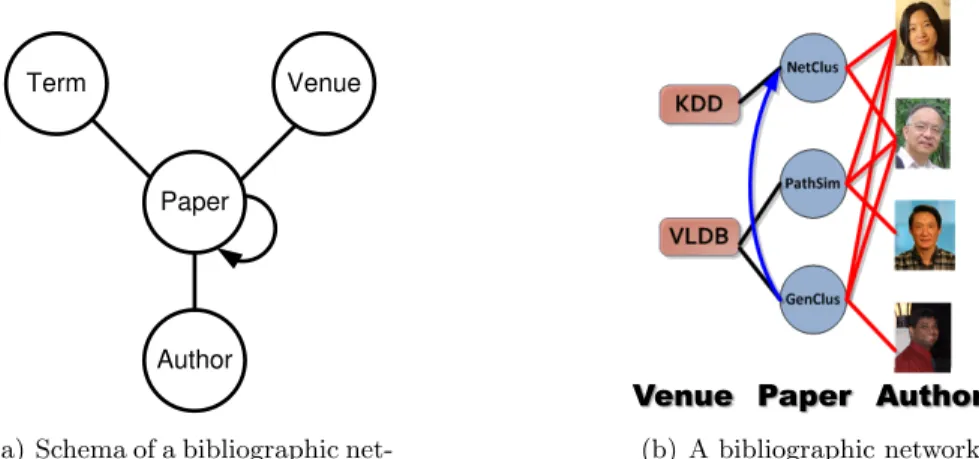
1. Bibliographic information network: A bibliographic information network, such as the com-puter science bibliographic information network derived from DBLP, is a typical heterogeneous network, containing objects in four types of entities: paper (P), venue (i.e., conference/journal) (V),author (A), andterm (T). For each paper p∈P, it has links to a set of authors, a venue, and a set of terms, belonging to a set of link types. It may also contain citation information for some papers, that is, these papers have links to a set of papers cited by the paper and links from a set of papers citing the paper.
The network schema for a bibliographic network and an instance of such a network are shown in Fig.1.1.
2. Twitter information network: Twitter as a social media can also be considered as an infor-mation network, containing objects types such asuser, tweet, hashtagandterm, and relation (or link) types such as follow between users, post between users and tweets, reply between tweets, use between tweets and terms, andcontain between tweets and hashtags.
Paper
Author
Venue Term
(a) Schema of a bibliographic net-work
Venue Paper Author
(b) A bibliographic network
Figure 1.1: A bibliographic network schema and a bibliographic network instance following the schema (only papers, venues and authors are shown).
3. Flickr information network: The photo sharing website Flickr can be viewed as an informa-tion network, containing a set of object types: image, user, tag, group, andcomment, and a set of relation types, such as upload between users and images, contain between images and tags, belong to between images and groups, post between users and comments andcomment between comments and images.
4. Healthcare information network: A healthcare system can be modeled as a healthcare information network, containing a set of object types, such asdoctor, patient, disease, treatment, and device, and a set of relation types, such asused-for between treatments and diseases,have between patients and diseases, and visit between patients and doctors.
Heterogeneous information networks can be constructed almost in any domain, such as social networks (e.g., Facebook), e-commerce (e.g., Amazon and eBay), online movie databases (e.g., IMDB), and numerous database applications. Heterogeneous information networks can also be constructed from text data, such as news collections, by entity and relationship extraction using natural language processing and other advanced techniques.
Diverse information can be associated with information networks. Attributes can be attached to the nodes or links in an information network. For example, location attributes, either categorical or numerical, are often associated with some users and tweets in a Twitter information network. Also, temporal information is often associated with nodes and links to reflect the dynamics of
an information network. For example, in a bibliographic information network, new papers and authors emerge every year, as well as their associated links. Beside the structure information of information networks, such information is also helpful or even critical in some tasks on mining information networks.
1.1.2 Why Is Mining Heterogeneous Networks a New Game?
Numerous methods have been developed for the analysis of homogeneous information networks, especially on social networks [2], such as ranking, community detection, link prediction, and influ-ence analysis. However, most of these methods cannot be directly applied to mining heterogeneous information networks. This is not only because heterogeneous links across entities of different types may carry rather different semantic meanings but also because a heterogeneous information network in general captures much richer information than its homogeneous network counterpart. A homogeneous information network is usually obtained by projection from a heterogeneous in-formation network, but with significant inin-formation loss. For example, a co-author network can be obtained by projection on co-author information from a more complete heterogeneous biblio-graphic network. However, such projection will lose valuable information on what subjects and which papers the authors were collaborating on. Moreover, with rich heterogeneous information preserved in an original heterogeneous information network, many powerful and novel data mining functions need to be developed to explore the rich information hidden in the heterogeneous links across entities.
Why is mining heterogeneous networks a new game? Clearly, information propagation across heterogeneous node and links can be very different from that across homogeneous nodes and links. Based on our research into mining heterogeneous information networks, especially our studies on ranking-based clustering [100,103], ranking-based classification [55,54], meta-path-based similar-ity search [99], relationship prediction [96, 97], relation strength learning [95, 101], and network evolution [102], we believe there are a set of new principles that may guide systematic analysis of heterogeneous information networks. We summarize these principles as follows.
1. Information propagation across heterogeneous types of nodes and links. Similar to most of the network analytic studies, links should be used for information propagation in mining
tasks. However, the new game is how to propagate information across heterogeneous types of nodes and links, in particular, how to compute ranking scores, similarity scores, and clusters, and how to make good use of class labels, across heterogeneous nodes and links. No matter how we work out new, delicate measures, definitions, and methodologies, a golden principle is that objects in the networks are interdependent, and knowledge can only be mined using the holistic information in a network.
2. Search and mining by exploring network meta structures. Different from homogeneous information networks where objects and links are being treated either as of the same type or as of un-typed nodes or links, heterogeneous information networks in our model are semi-structured and typed, that is, associated with nodes and links structured by a set of types, forming a network schema. The network schema provides a meta structure of the information network. It provides guidance of search and mining of the network and help analyze and understand the semantic meaning of the objects and relations in the network. Meta-path-based similarity search and mining introduced in this thesis has demonstrated the usefulness and the power of exploring network meta structures.
3. User-guided exploration of information networks. In a heterogeneous information net-work, there often exist numerous semantic relationships across multiple types of objects, carrying subtly different semantic meanings. A certain weighted combination of relations or meta-paths may best fit a specific application for a particular user. Therefore, it is often desirable to auto-matically select the right relation (or meta-path) combinations with appropriate weights for a particular search or mining task based on user’s guidance or feedback. User-guided or feedback-based network exploration is a useful strategy.
1.2
Thesis Organization
The first chapter introduces the overview of mining heterogeneous information networks. After that, this thesis is organized into three parts largely following the three principles, each containing two chapters that present methodologies and algorithms for mining heterogeneous information networks, organized by different mining tasks. Finally, Chapter8concludes this thesis and outlines
a few open research themes in this domain. The major contents of Chapters 2-7 are summarized as follows.
InPartI: Ranking-Based Clustering, we introduce two studies on the clustering problem, which is one of the basic mining tasks, in heterogeneous information networks, by distinguishing the information propagation across different types of links.
• Chapter2: Ranking-Based Clustering on Bi-Typed Networks. For link-based clustering of heterogeneous information networks, we need to explore links across heterogeneous types of data. We propose a ranking-based clustering approach, RankClus [100], that generates both clustering and ranking results for a target type of objects in a bi-typed network. This approach is based on the observation that ranking and clustering can mutually enhance each other because objects highly ranked in each cluster may contribute more towards unambiguous clustering, and objects more dedicated to a cluster will be more likely to be highly ranked in the same cluster. • Chapter 3: Ranking-Based Clustering on Star Networks. Later, we extend our
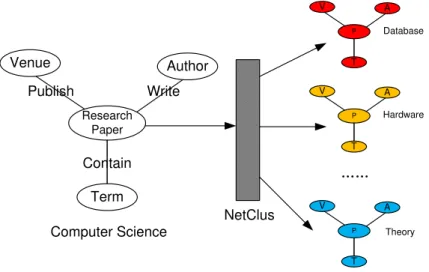
ranking-based clustering study to a more general scenario, where more types of objects exist in the network. Specially, we focus on star networks that have a center type of objects, and propose NetClus [103] that can cluster different types of objects simultaneously. A discussion will be given on how to extend ranking-based clustering to general network schemas.
InPartII: Meta-Path-Based Similarity Search and Mining, we introduce a systematic approach for dealing with general heterogeneous information networks with a specified network schema, using a meta-path-based methodology. Under this framework, similarity search and other mining tasks such as relationship prediction can be addressed by systematic exploration of the network meta structure.
• Chapter 4: Meta-Path-Based Similarity Search. Similarity search plays an important role in the analysis of networks. By considering different linkage paths (i.e., meta-path) in a network, one can derive various semantics on similarity in a heterogeneous information network. A meta-path-based similarity measure, PathSim, is introduced in [99], which aims at finding similar peer objects in the network. PathSim turns out to be more meaningful in many scenarios compared with random-walk based similarity measures.
• Chapter 5: Meta-Path-Based Relationship Prediction. Heterogeneous information net-work brings interactions among multiple types of objects and hence the possibility of predicting relationships across heterogeneous typed objects. By systematically designing meta-path-based topological features and measures in the network, supervised models can be used to learn appro-priate weights associated with different topological features in relationship prediction [96,97].
In Part III: User-Guided Relation Strength-Aware Mining, we address the issue that the het-erogeneity of relations between object types often leads to different mining results that can be chosen by users. With user guidance, the strength of each relation can be automatically learned for improved mining.
• Chapter 6: Relation Strength-Aware Clustering with Incomplete Attributes. Links in networks are frequently used to regularize the attribute-based clustering tasks, i.e., linked objects should have similar cluster labels. However, shall we trust links from different types equally? In this chapter, we propose GenClus [95] to address this problem. By specifying a set of (incomplete) attributes, the strengths of different relations in heterogeneous information networks can be automatically learned to help network clustering.
• Chapter 7: Integrating User-Guided Clustering with Meta-Path Selection. Differ-ent meta-paths in a heterogeneous information network represDiffer-ent differDiffer-ent relations and carry different semantic meanings. User guidance, such as providing a small set of training examples for some object types, can indicate user preference on the clustering results. Then a preferred meta-path or a weighted meta-path combination of multiple paths can be learned to achieve better consistency between mining results and the training examples [101].
Note that, although three parts largely correspond to the three principles mentioned in Sec-tion 1.1, to solve a mining task in heterogeneous information networks usually involves multiple principles simultaneously. For example, the first principle that “information propagation across heterogeneous types of nodes and links” is used throughout all the chapters of this thesis. The sec-ond principle “search and mining by exploring network meta structures” can further help to guide the information propagation in heterogeneous information networks, and serves as meta-features for tasks involving learning process. The third principle “user-guided exploration of information
networks” can help us select the desirable ranking function in Part I for the clustering tasks, as well as select the best meta-paths for similarity search in Chapter4.
Part I
Chapter 2
Ranking-Based Clustering on
Bi-Typed Networks
For link-based clustering of heterogeneous information networks, we need to explore links across heterogeneous types of data. In this part, we study how ranking can be computed for different types of objects using different types of links, and show how ranking and clustering mutually enhance each other and finally achieve reasonable ranking and clustering results. In this chapter, we study the problem in a special case of heterogeneous information networks, i.e., the bi-typed networks. In next chapter (Chapter 3), we will study another special but more general case, i.e., the star networks.
2.1
Overview
A great many analytical techniques have been proposed toward a better understanding of infor-mation networks, though largely on homogeneous inforinfor-mation networks, among which are two prominent ones: ranking and clustering. On one hand, ranking evaluates objects of information networks based on some ranking function that mathematically demonstrates characteristics of ob-jects. With such functions, two objects can be compared, either qualitatively or quantitatively, in a partial order. PageRank [20] and HITS [59], among others, are perhaps the most well-known ranking algorithms over information networks. On the other hand,clustering groups objects based on a certain proximity measure so that similar objects are in the same cluster, whereas dissimilar ones are in different clusters. After all, as two fundamental analytical tools, ranking and clustering can be used to show the overall views of an information network, and hence have been widely used in various applications.
Clustering and ranking are often regarded asorthogonal techniques, each applied independently to information network analysis. However, applying only one of them over an information network
often leads to incomplete, or sometimes rather biased, analytical results. For instance, ranking objects over a whole information network without considering which clusters they belong to often leads to dumb results,e.g., ranking database and computer architecture venues or authors together may not make much sense; alternatively, clustering a large number of objects (e.g., thousands of authors) into one cluster without distinction is dull as well. However, integrating two functions together may lead to more comprehensible results, as shown in Example 2.1.
Example 2.1. (Ranking without/with clustering) Consider a set of venues from two areas of (1) DB/DM (i.e., Database and Data Mining) and HW/CA (i.e., Hardware and Computer Architecture), each having 10 venues, as shown in Table 2.1. We choose top 100 authors in each area from DBLP, according to their number of publications in the selected venues. With the authority ranking function specified in Section2.3.2, our ranking-only algorithm gives top-10 ranked results in Table 2.2. Clearly, the results are rather dumb (because of the mixture of the areas) and are biased towards (i.e., ranked higher for) the HW/CA area. Moreover, such biased ranking result is caused not by the specific ranking function we chose, but by the inherent incomparability between the two areas.
Still consider the same dataset. If we cluster the venues in the DB/DM area and rank both venues and the authors relative to this cluster, the ranking results are shown in Table 2.3.
Table 2.1: A set of venues from two research areas.
DB/DM {SIGMOD, VLDB, PODS, ICDE, ICDT, KDD, ICDM, CIK-M, PAKDD, PKDD}
HW/CA {ASPLOS, ISCA, DAC, MICRO, ICCAD, HPCA, ISLPED, CODES, DATE, VTS }
This example shows that good clustering indeed enhances ranking results. Furthermore, as-signing ranks to objects often leads to better understanding of each cluster. By integrating both clustering and ranking, one can get more comprehensible results on networks. In this chapter, we introduce RankClus that integrates clustering and ranking for a special case of heterogeneous
Table 2.2: Top-10 ranked venues and authors without clustering.
Rank Venue Rank Authors
1 DAC 1 Alberto L. Sangiovanni-Vincentelli
2 ICCAD 2 Robert K. Brayton
3 DATE 3 Massoud Pedram
4 ISLPED 4 Miodrag Potkonjak
5 VTS 5 Andrew B. Kahng
6 CODES 6 Kwang-Ting Cheng
7 ISCA 7 Lawrence T. Pileggi
8 VLDB 8 David Blaauw
9 SIGMOD 9 Jason Cong
10 ICDE 10 D. F. Wong
Table 2.3: Top-10 ranked venues and authors in DB/DM cluster.
Rank Venue Rank Authors
1 VLDB 1 H. V. Jagadish
2 SIGMOD 2 Surajit Chaudhuri
3 ICDE 3 Divesh Srivastava
4 PODS 4 Michael Stonebraker
5 KDD 5 Hector Garcia-Molina
6 CIKM 6 Jeffrey F. Naughton
7 ICDM 7 David J. DeWitt
8 PAKDD 8 Jiawei Han
9 ICDT 9 Rakesh Agrawal
10 PKDD 10 Raghu Ramakrishnan
2.2
Preliminaries
For the ranking-based clustering problem on a bi-typed network, we are interested in the task of clustering one type of objects (target objects) using the other type of objects (attribute objects) and the links in the network, as well as ranking the objects in each cluster at the same time. For example, given a bi-typed bibliographic network containing venues and authors, where links exist between venues and authors, and between authors and authors, we are interested in clustering venues into different clusters representing different research areas, using the authors and links in the network. At the same time, we could answer who are the top venues and researchers in a research area.
Figure 2.1 illustrates a bi-typed bibliographic network, which contains two types of objects, venues (X) and authors (Y). Two types of links exist in this network: the author-venue publication links, with the weight indicating the number of papers an author has published in a venue, and the author-author co-authorship links, with the weight indicating the number of times two authors have collaborated. The bi-typed network can be represented by a block-wise adjacency matrix:
SIGMOD SDM ICDM KDD EDBT VLDB ICML AAAI Tom Jim Lucy Mike Jack Tracy Cindy Bob Mary Alice
Figure 2.1: A bi-typed bibliographic network.
W = WXX WXY WY X WY Y
whereWXX,WXY,WY X andWY Y each denotes a type of relation between types of the subscripts. Formally, a bi-typed information network can be defined as follows.
Definition 2.1. (Bi-typed information network) Given two types of object sets X and Y, where X = {x1, x2, . . . , xm}, and Y = {y1, y2, . . . , yn}, the graph G = (V,E) is called a bi-typed information network on types X and Y, if V =X∪Y andE ⊆ V × V.
The biggest issue in clustering target objects in a network is that unlike in traditional attribute-based dataset, the features for those objects are not explicitly given here. A straightforward way to generate clusters for target objects in a heterogeneous network is to first evaluate the similarity between target objects using a link-based approach, such as SimRank [52], and then apply graph
clustering methods [90,72] to generate clusters. However, to evaluate pair-wise similarity between objects in an information network is a space and time consuming task. Instead,RankClusexplores
rank distribution for each cluster to generate new measures for target objects, which are low-dimensional. The clusters are improved under the new measure space. More importantly, this measure can be further enhanced during the iterations of the algorithm, because better clustering leads to better ranking, and better ranking gives better ranking-based features thus better clustering results. That is, different from combining ranking and clustering in a two-stage procedure like facet ranking [31,124], the quality of clustering and ranking can be mutually enhanced in RankClus.
2.3
Ranking Functions
Ranking function is critical in our ranking-based clustering algorithms, which not only provides rank scores for objects to distinguish their importance in a cluster, but also serves as a new feature extraction tool to improve the clustering quality. Current ranking functions are mostly defined on homogeneous networks, such as PageRank [20] and HITS [59]. In this section, we introduce two ranking functions based on the bi-typed bibliographic network: Simple Ranking andAuthority Ranking. Ranking functions on more complex heterogeneous networks are discussed at the end of this section.
2.3.1 Simple Ranking
The simplest ranking of venues and authors is based on the number of publications, which is proportional to the numbers of papers accepted by a venue or published by an author.
Formally, given the bi-typed information network with types X and Y, and the adjacency matrixW, simple ranking generates the rank score of typeX and type Y as follows:
⃗ rX(x) = ∑n j=1WXY(x, j) ∑m i=1 ∑n j=1WXY(i, j) ⃗ rY(y) = ∑n i=1WXY(i, y) ∑m i=1 ∑n j=1WXY(i, j) (2.1)
The time complexity of Simple Ranking is O(|E|), where |E|is the number of links. According to simple ranking, authors publishing more papers will have higher rank score, even these papers
are all in junk venues. In fact, simple ranking evaluates importance of each object according to the number of their immediate neighbors.
2.3.2 Authority Ranking
A more useful ranking function we propose here is authority ranking, which gives an object higher rank score if it has more authority. Ranking authority merely with publication information seems impossible at the first glance, as citation information could be unavailable or incomplete (such as in the DBLP data, where there is no citation information imported from Citeseer, ACM Digital Library, or Google Scholars). However, two simple empirical rules give us the first clues.
• Rule 1: Highly ranked authors publishmany papers in highly ranked venues. • Rule 2: Highly ranked venues attract many papers from highly ranked authors.
Note that these empirical rules are domain dependent and are usually given by the domain experts who know both the field and the dataset well. From the above heuristics, we define the iterative rank score formulas for authors and venues according to each other as follows.
According to Rule 1, each author’s score is determined by the number of papers and their publication forums, ⃗rY(j) = m ∑ i=1 WY X(j, i)⃗rX(i) (2.2)
When author j publishes more papers, there are more nonzero and high weightedWY X(j, i), and when the author publishes papers in a higher ranked venuei, which means a higher⃗rX(i), the score of authorj will be higher. At the end of each step,⃗rY(j) is normalized by⃗rY(j)← ∑n⃗rY(j)
j′=1⃗rY(j′).
According to Rule 2, the score of each venue is determined by the quantity and quality of papers in the venue, which is measured by their authors’ rank scores,
⃗rX(i) = n ∑ j=1
WXY(i, j)⃗rY(j) (2.3)
When there are more papers appearing in venue i, there are more non-zero and high weighted WXY(i, j), and if the papers are published by a higher ranked authorj, which means a higher⃗rY(j), the score of venue iwill be higher. The score vector is then normalized by⃗rX(i)← ∑m⃗rX(i)
Note that the normalization will not change the ranking position of an object, but it gives a relative importance score to each object. And as shown in RankClus [100], the two formulas will converge to the primary eigenvector ofWXYWY X and WY XWXY respectively.
When considering the co-author information, the scoring function can be further refined by a third rule:
• Rule 3: The rank of an author is enhanced if he or she co-authors with many highly ranked authors. Adding this new rule, we can calculate rank scores for authors by revising Equation (2.2) as
⃗ rY(i) =α m ∑ j=1 WY X(i, j)⃗rX(j) + (1−α) n ∑ j=1 WY Y(i, j)⃗rY(j) (2.4)
where parameter α ∈ [0,1] determines how much weight to put on each factor, which can be assigned based on one’s belief or learned by some training dataset.
Similarly, we can prove that⃗rY should be the primary eigenvector ofαWY XWXY+(1−α)WY Y, and⃗rX should be the primary eigenvector of αWXY(I−(1−α)WY Y)−1WY X. Since the iterative process is a power method to calculate primary eigenvectors, the rank score will finally converge.
For authority ranking, the time complexity is O(t|E|), wheret is the iteration number and |E| is the number of links in the graph. Note that, |E|= O(d|V|) ≪ |V|2 in a sparse network, where |V| is the number of total objects in the network anddis the average link per object.
Different from simple ranking, authority ranking gives an importance measure to each object based on the whole network, rather than its immediate neighborhoods, by the score propagation over the whole network.
2.3.3 Alternative Ranking Functions
Although here we illustrate only two ranking functions, general ranking functions are not confined to them. In practice, a ranking function is not only related to the link property of an information network, but also depends on domain knowledge. For example, in many science fields, journals are given higher weights than conferences when evaluating an author. Moreover, although ranking functions in this section are defined on bi-typed networks, ranking function on heterogeneous networks with more types of objects can be similarly defined. For example, PopRank [82] is a
possible framework for general heterogeneous network, which takes into account the impact both from the same type of objects and from the other types of objects, with different impact factors for different types. When ranking objects in information networks, junk or spam entities are often ranked higher than deserved. For example, authority ranking can be spammed by some bogus venues that accept any submissions due to their large numbers of accepted papers. Techniques that can best use expert knowledge, such as TrustRank [44], can be used to semi-automatically separate reputable, good objects from spam ones. Personalized PageRank [132], that can utilize expert ranking as query and generate rank distributions with respect to such knowledge, can be another choice to integrate expert knowledge.
2.4
From Conditional Rank Distributions to New Clustering
Measures
Given a bi-typed bibliographic network, suppose that we have an initial partition on target type X (venue type) and have calculated the conditional rank scores of venues and authors for each clustered network, the next issue becomes how to use the conditional rank scores to further improve the clustering results. Intuitively, for each venue cluster, which could form a research area, the rank scores of authors conditional to this cluster (or research area) should be distinct from that of the authors in other clusters. This implies that these rank scores can be used to derive new features for objects for better clustering. Further, we treat these rank scores as from a discrete rank distribution, as they are non-negative values and summing up to 1, which indicates the subjective belief of how likely one may know an author or a venue according to their authority in each cluster.
Example 2.2. (Conditional rank distribution as cluster feature)Conditional rank distribu-tions in different clusters are distinct from each other, especially when these clusters are reasonably well partitioned. Still using the network of the two-research-area example introduced in Section2.1, we rank two hundred authors based on two venue clusters, and the two conditional rank distribu-tions are shown in Figure 2.2. From the figure, we can clearly see that DB/DM authors (with IDs from 1 to 100) rank high relative to the DB/DM venues, whereas rank extremely low relative to the HW/CA venues. A similar situation happens for the HW/CA authors (with IDs from 101 to 200).
0 20 40 60 80 100 120 140 160 180 200 0 0.005 0.01 0.015 0.02 0.025 0.03 0.035 0.04 0.045
DB/DM Authors HW/CA Authors
Rank
S
core for Authors
Author Rank on DB/DM Author Rank on HW/CA
Figure 2.2: Authors’ rank distributions over different clusters.
From Example 2.2, one can see that conditional rank distributions for attribute type in each cluster are rather different from each other, and can be used as measures to characterize each cluster. That is, for each clusterXk, the conditional rank scores ofX’s andY’s,⃗rX|Xk and ⃗rY|Xk,
can be viewed as conditional rank distributions of X and Y, which in fact are the features for cluster Xk.
2.4.1 Cluster Membership for Each Target Object
Suppose we now know the clustering results for type X, which are X1, X2, . . . , and XK, whereK is the number of clusters. Also, according to some given ranking function, we have got conditional rank distribution overY in each cluster Xk, which is⃗rY|Xk(k= 1,2, . . . , K), and conditional rank
distribution over X, which is⃗rX|Xk(k = 1,2, . . . , K). In the DBLP scenario, a cluster of venues, e.g., the DB venues, can induce a subnetwork of venues and authors in that area. Conditional rank distributions⃗rY|Xk and⃗rX|Xk are calculated on each induced subnetwork of that area. In practice,
to avoid the zero rank score for target objects X, we propagate the converged rank scores of Y, ⃗rY|Xk, for one step further to all target objects, to get a new⃗rX|Xk. For simplicity, we use pk(Y)
to denote ⃗rY|Xk and pk(X) to denote ⃗rX|Xk in the following. We use πi,k to denote xi’s cluster
membership for clusterk, which in fact is the posterior probability thatxi belongs to clusterkand satisfies∑Kk=1πi,k = 1.
According to Bayes’ rule,p(k|xi)∝p(xi|k)p(k). Since we already knowp(xi|k), the conditional rank ofxiin clusterk, the goal is thus to estimatep(k), the cluster size ofk. In the DBLP scenario, p(k) can be considered as the proportion of papers belonging to the research area that is induced
by thekth venue cluster, where each paper is represented by a link between a venue and an author. According to p(k|xi) ∝ p(xi|k)p(k), we can see that in general the higher its conditional rank in a cluster (p(xi|k)), the higher possibility an object will belong to that cluster (p(k|xi)). Since the conditional rank scores ofX objects are propagated from the conditional rank scores ofY objects, we can also see that highly ranked attribute object has more impact on determining the cluster membership of a target object.
Example 2.3. (Cluster membership as object feature) Following Example 2.2, each venue xi is represented as a two-dimensional cluster membership vector (πi,1, πi,2). We plot 20 venues
according to their cluster membership vectors in Figure 2.3, where different styles of points rep-resent different areas the venues really belong to. From the figure, we can see that the DB/DM venues (denoted as ∗) and the HW/CA venues (denoted as +) are separated clearly under the new features in terms of cluster membership vectors, which are derived according to the conditional rank distributions of venues and authors with respective to the two research areas.
0 0.1 0.2 0.3 0.4 0.5 0.6 0.7 0.8 0.9 1 0 0.1 0.2 0.3 0.4 0.5 0.6 0.7 0.8 0.9 1
Component Coefficient for DB/DM
Compo
nen
t Coefficient for HW/CA
DB/DM Venues HW/CA Venues
Figure 2.3: Venues’ scatter plot based on 2-d cluster membership.
2.4.2 Parameter Estimation Using the EM Algorithm
In order to derive the cluster membership for each target object, we need to estimate the size proportion for each clusterp(k) correctly, which can be viewed as the proportion of the links issued by the target objects belonging to cluster k. In our bi-typed bibliographic information network scenario, this is the proportion of papers belonging to the cluster.
each link between objectsxi andyj is generated with the probabilityp(xi, yj) = ∑
kpk(xi, yj)p(k), where pk(xi, yj) denotes the probability of generating such a link in cluster k. We also make an independence assumption that an attribute object yj issuing a link is independent to a target object xi accepting this link, which is pk(xi, yj) = pk(xi)pk(yj). This assumption says once an author writes a paper, he is more likely to submit it to a highly ranked venue to improve his rank; while for venues, they are more likely to accept papers coming from highly ranked authors to improve its rank as well. This idea is similar to preferential attachment [9] of link formation for homogeneous networks, but we are considering more complex rank distributions instead of degrees of objects.
Let Θ be the K-dimensional parameter vector for p(k)’s. The likelihood of observing all the links between typesX and Y under the parameter setting is then:
L(Θ|WXY) =p(WXY|Θ) = m ∏ i=1 n ∏ j=1 p(xi, yj|Θ)WXY(i,j) (2.5) where p(xi, yj|Θ) is the probability to generate link ⟨xi, yj⟩, given current parameter Θ. The goal is to find the best Θ that maximizes the likelihood. We then apply the EM algorithm [16] to solve the problem. In the E-step, we calculate the conditional distribution p(z=k|yj, xi,Θ0) based on the current value of Θ0:
p(z=k|yj, xi,Θ0)∝p(xi, yj|z=k)p(z=k|Θ0) =pk(xi)pk(yj)p0(z=k) (2.6) In the M-Step, we update Θ according to the current Θ0:
p(z=k) = ∑m i=1 ∑n j=1∑WXY(i, j)p(z=k|xi, yj,Θ0) m i=1 ∑n j=1WXY(i, j) . (2.7)
By setting Θ0= Θ, the whole process can be repeated. At each iteration, updating rules from Equations (2.6)-(2.7) are applied, and the likelihood function will converge to a local maximum.
Finally, the cluster membership for each target object xi in each cluster k, πi,k, is calculated using Bayes’ rule:
πi,k =p(z=k|xi) =
pk(xi)p(z=k) ∑K
l=1pl(xi)p(z=l)
2.5
Cluster Centers and Distance Measure
After we get the estimations for clustering memberships for each target object xi by evaluating mixture models, xi can be represented as a K dimensional vector ⃗sxi = (πi,1, πi,2, . . . , πi,K). The
centers for each cluster can thus be calculated accordingly, which is the mean of ⃗sxi for all xi in
each cluster. Next, the distance between an object and cluster D(x, Xk) is defined by 1 minus cosine similarity. The cluster label for each target object can be adjusted accordingly.
2.6
RankClus: Algorithm Summarization
To summarize, the input of RankClus is a bi-typed information network G = ⟨{X ∪Y}, W⟩,
the ranking functions for X and Y, and the cluster number K. The output is K clusters of X with conditional rank scores for each x, and conditional rank scores for eachy. The algorithm of
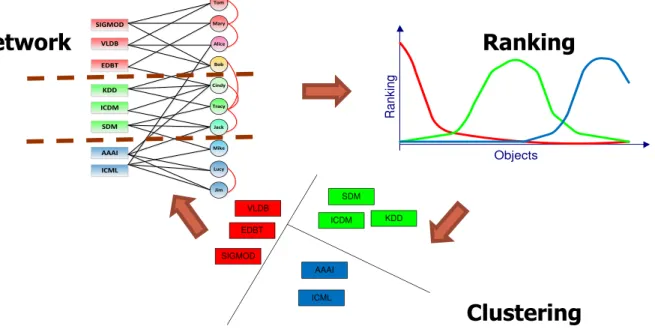
RankClus is illustrated in Figure2.4 and summarized in the following.
SIGMOD SDM ICDM KDD EDBT VLDB ICML AAAI Tom Jim Lucy Mike Jack Tracy Cindy Bob Mary Alice SIGMOD VLDB EDBT KDD ICDM SDM AAAI ICML Objects R a n ki n g
Network
Ranking
Clustering
Figure 2.4: The illustration of the RankClus algorithm.
• Step 0: Initialization.
The initial clusters for target objects are generated, by assigning each target object with a cluster label from 1 to K randomly.
• Step 1: Ranking for each cluster.
Based on current clusters, K cluster-induced networks are generated accordingly, and the con-ditional rank distributions for types Y and X are calculated. In this step, we also need to judge whether any cluster is empty, which may be caused by the improper initialization of the algorithm. When some cluster is empty, the algorithm needs to restart in order to generate K clusters.
• Step 2: Estimation of the cluster membership vectors for target objects.
In this step, we need to estimate the parameter Θ in the mixture model and get new represen-tations for each target object and centers for each target cluster: ⃗sx and ⃗sXk. In practice, the
number of iterationstfor calculating Θ only needs to be set to a small number. • Step 3: Cluster adjustment.
In this step, we calculate the distance from each object to each cluster center and assign it to the nearest cluster.
• Repeat Steps 1, 2 and 3 until clusters change only by a very small ratio ε or the number of iterations is bigger than a predefined value iterN um. In practice, we can set ε = 0, and iterN um= 20. In our experiments, the algorithm will converge in less than 5 rounds in most cases for the synthetic dataset and around 10 rounds for the DBLP dataset.
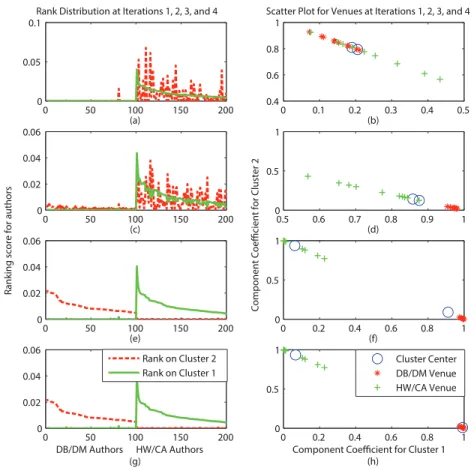
Example 2.4. (Mutual improvement of clustering and ranking) We now apply our algo-rithm to the two-research-area example. The conditional rank distributions for each cluster and cluster memberships for each venue at each iteration of the running procedure are illustrated in Figure 2.5 (a)-(h). To better explain how our algorithm works, we set an extremely bad initial clustering as the initial state. In Cluster 1, there are 14 venues, half from the DB/DM area and half from the HW/CA area. Cluster 2 contains the remaining 6 venues, which are ICDT, CIKM, PKDD, ASPLOS, ISLPED and CODES. We can see that the partition is quite unbalanced accord-ing to the size, and quite mixed accordaccord-ing to the area. Duraccord-ing the first iteration, the conditional rank distributions for two clusters are very similar to each other (Figure 2.5(a)), and venues are mixed up and biased to Cluster 2 (Figure 2.5(b)). However, we can still adjust their cluster labels according to the cluster centers, and most HW/CA venues go to Cluster 2 and most DB/DM venues
0 50 100 150 200 0
0.05 0.1
Rank Distribution at Iterations 1, 2, 3, and 4
0 0.1 0.2 0.3 0.4 0.5
0.4 0.6 0.8 1
Scatter Plot for Venues at Iterations 1, 2, 3, and 4
0 50 100 150 200 0 0.02 0.04 0.06 (a) 0.5 0.6 0.7 0.8 0.9 1 0 0.5 1 (b) 0 50 100 150 200 0 0.02 0.04 0.06 (c) 0 0.2 0.4 0.6 0.8 1 0 0.5 1 (d) 0 50 100 150 200 0 0.02 0.04 0.06
DB/DM Authors HW/CA Authors (g)
Rank
ing sc
ore for author
s (e) 0 0.2 0.4 0.6 0.8 1 0 0.5 1
Component Coefficient for Cluster 1 (h)
Comp
onent Coefficient for Cluster 2
(f) Cluster Center DB/DM Venue. HW/CA Venue Rank on Cluster 2 Rank on Cluster 1
Figure 2.5: Mutual improvement of clusters and ranking through iterations.
go to Cluster 1. At the second iteration, conditional ranking improves somewhat (shown in Figure
2.5(c)) since the clustering (Figure 2.5(b)) is enhanced, and this time clustering results (Figure
2.5(d)) are enhanced dramatically, although they are still biased to one cluster (Cluster 1). At the third iteration, ranking results are improved significantly. Clusters and ranks are further adjusted afterwards, both of which are minor refinements.
At each iteration, the time complexity of RankClus is comprised of three parts: ranking
part, mixture model estimation part, and clustering adjustment part. For ranking, if we use simple ranking, the time complexity isO(|E|). If we use authority ranking, the time complexity isO(t1|E|),
where|E|is the number of links, andt1 is the number of iterations. For mixture model estimation,
at each round, we need to calculate the conditional probability for each link in each cluster, the time complexity of which isO(K|E|). For clustering adjustment, we need to compute the distance between each object (m) and each cluster (K), and the dimension of each object isK, so the time
complexity for this part isO(mK2). So, overall, the time complexity isO(t(t1|E|+t2(K|E|)+mK2)),
where t is the number of iterations of the whole algorithm and t2 is the number of iterations of
the mixture model. If the network is a sparse network, the time is almost linear to the number of objects.
2.7
Experiments
We now show the effectiveness and efficiency of RankClus algorithm compared with other
link-based algorithms, using both synthetic and real datasets.
Case Study on the DBLP Dataset We use the DBLP dataset to generate a bi-typed informa-tion network for all the 2676 venues (conferences only) and 20,000 authors with most publicainforma-tions, from the time period of year 1998 to year 2007. Both venue-author relationships and co-author relationships are used. We set the number of clusters K = 15, and apply RankClus with the
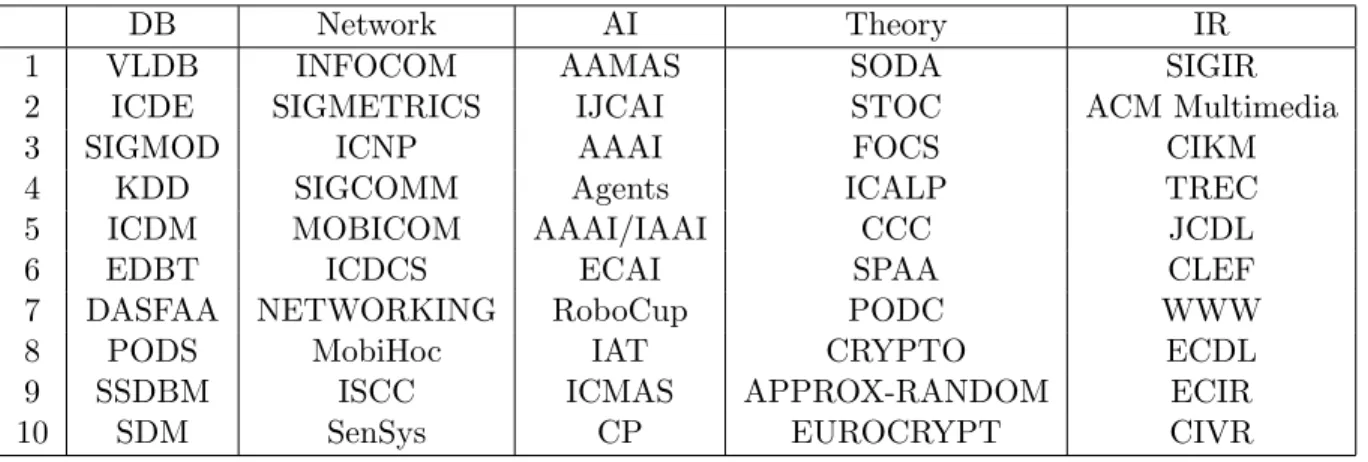
authority ranking function, withα = 0.95. We then pick 5 clusters, and show top-10 venues from each cluster according to the conditional rank scores. The results are shown in Table 2.4, where the research area labels are manually added to each cluster.
Table 2.4: Top-10 venues in 5 clusters generated by RankClus in DBLP.
DB Network AI Theory IR
1 VLDB INFOCOM AAMAS SODA SIGIR
2 ICDE SIGMETRICS IJCAI STOC ACM Multimedia
3 SIGMOD ICNP AAAI FOCS CIKM
4 KDD SIGCOMM Agents ICALP TREC
5 ICDM MOBICOM AAAI/IAAI CCC JCDL
6 EDBT ICDCS ECAI SPAA CLEF
7 DASFAA NETWORKING RoboCup PODC WWW
8 PODS MobiHoc IAT CRYPTO ECDL
9 SSDBM ISCC ICMAS APPROX-RANDOM ECIR
10 SDM SenSys CP EUROCRYPT CIVR
Please note that the clustering and ranking of venues shown in Tables 2.4 have used neither keyword nor citation information, which is the information popularly used in most bibliographic data analysis systems. It is well recognized that citation information is crucial at judging the
influence and impact of a venue or an author in a field. However, by exploring the publication entries only in the DBLP data, theRankClus algorithm can achieve comparable performance as
citation studies for clustering and ranking venues and authors. This implies that the collection of publication entries without referring to the keyword and citation information can still tell a lot about the status of venues and authors in a scientific field.
Accuracy and Efficiency Study on Synthetic Data In order to compare accuracy among different clustering algorithms, we generate synthetic bi-typed information networks, which follow the properties of real information networks similar to DBLP. In our experiments, we first fixed the scale of the network and the distribution of links, but change configurations to adjust the density within each cluster and the separateness between different clusters, to obtain 5 different networks (Dataset1 to Dataset5). We set number of clustersK = 3, number of target objects in each cluster asNx = [10,20,15], and number of attribute objects in each cluster asNy = [500,800,700], which are the same for all the 5 datasets. Then we vary the number of links in each cluster (P) and the transition matrix of the proportion of links between different clusters (T), to get the following 5 datasets.
• Dataset1: medium separated and medium density. P = [1000,1500,2000],
T = [0.8,0.05,0.15; 0.1,0.8,0.1; 0.1,0.05,0.85] • Dataset2: medium separated and low density.
P = [800,1300,1200],
T = [0.8,0.05,0.15; 0.1,0.8,0.1; 0.1,0.05,0.85] • Dataset3: medium separated and high density.
P = [2000,3000,4000],
T = [0.8,0.05,0.15; 0.1,0.8,0.1; 0.1,0.05,0.85] • Dataset4: highly separated and medium density.
P = [1000,1500,2000],
• Dataset5: poorly separated and medium density. P = [1000,1500,2000],
T = [0.7,0.15,0.15; 0.15,0.7,0.15; 0.15,0.15,0.7]
We use the Normalized Mutual Information (NMI) [94] measure to compare the clustering accuracy among different algorithms. For N objects, K clusters, and two clustering results, let n(i, j), i, j = 1,2, . . . , K, the number of objects that has the cluster labeli in the first clustering result (say generated by the algorithm) and cluster label j in the second clustering result (say the ground truth). We can then define joint distribution p(i, j) = n(Ni,j), row distribution p1(j) =
∑K
i=1p(i, j) and column distribution p2(i) =
∑K
j=1p(i, j), and NMI is defined as:
∑K i=1 ∑K j=1p(i, j) log( p(i,j) p1(j)p2(i)) √∑K j=1p1(j) logp1(j) ∑K
i=1p2(i) logp2(i)
(2.9)
We compare RankClus implemented with two ranking functions: Simple Ranking and
Au-thority Ranking, with a state-of-the-art spectral clustering algorithm, the k-way N-cut algorithm [90], implemented with two link-based similarity functions, Jaccard Coefficient and SimRank [52]. Results for accuracy is summarized in Figure2.6. From the results, we can see that, two versions ofRankClusoutperform in the first 4 datasets. RankCluswith authority ranking is even better,
since authority ranking gives a better rank distribution by utilizing the information of the whole network. Through the experiments, we observe that performance of two versions of RankClus and the N-Cut algorithm based on Jaccard coefficient are highly dependent on the data quality, in terms of cluster separateness and link density, while SimRank has a more stable performance, especially on the network that is sparse (Dataset5).
Figure 2.7summarizes the average execution time of different algorithms over 4 networks with different sizes. We can see that compared with the time-consuming SimRank algorithm,RankClus
Figure 2.6: Accuracy comparison with baselines in terms of NMI. Dataset1: medium separated and medium density; Dataset2: medium separated and low density; Dataset3: medium separated and high density; Dataset4: highly separated and medium density; and Dataset5: poorly separated and medium density.
45*10000 45*2000 45*4000 45*8000 1 2 3 4 5 6 7 8 Network Scale Ti me (s) RankClus−Simple RankClus−Authority NCut-Jaccard NCut-SimRank(1 iteration)
Figure 2.7: Efficiency comparison with baselines in terms of execution time.
2.8
Related Work
In information network analysis, two most important ranking algorithms are PageRank [20] and HITS [59], both of which are successfully applied to the Internet search. PageRank is a link analysis algorithm that assigns a numerical weight to each object of the information network, with the purpose of “measuring” its relative importance within the object set. On the other hand, HITS ranks objects based on two scores: authority andhub. Authority estimates the value of the content of the object, whereas hub measures the value of its links to other objects. Both PageRank and HITS are evaluating the static quality of objects in information network, which is similar to the intrinsic meaning of our ranking methods. However, both PageRank and HITS are designed on the network of web pages, which is a directed homogeneous network, and the weight of the edge is binary. PopRank [82] aims at ranking popularity of web objects. They have considered the role difference of different web pages, and thus turn web pages into a heterogeneous network. They
trained the propagation factor between different types of objects according to partial ranks given by experts. Different from their setting, we will calculate the rank for each type of objects separately (i.e., we do not compare ranks of two objects belonging to different types), rather than consider them in a unified framework. J. E. Hirsch [46] proposed h index originally in the area of physics for characterizing the scientific output of a researcher, which is defined as the number of papers with citation number higher or equal to h. Extensions work [92] shows that it also can work well in computer science area. However, h-index will assign an integer valueh to papers, authors, and publication forums, while our work requires that rank sores can be viewed as a rank distribution and thus can serve as a good measure for clustering. What is more, since there are only very limited citation information in DBLP, ranking methods demanding citation cannot work in such kind of data. Instead of proposing a totally new strategy for ranking, we aim at finding empirical rules in the specific area of DBLP data set, and providing ranking function based on these rules, which works well for the specific case. The real novelty lies in our framework is that it tightly integrates ranking and clustering and thus offers informative summary for heterogeneous network such as the DBLP data.
Clustering is another way to summarize information network and discover the underlying struc-tures, which partitions the objects of an information network into subsets (clusters) so that objects in each subset share some common trait. In clustering, proximity between objects is often defined for the purpose of grouping “similar” objects into one cluster, while partitioning dissimilar ones far apart. Spectral graph clustering [90,72,28] is state-of-the-art method to do clustering on the homogeneous network. However for heterogeneous network, adjacency matrix of the same type objects does not explicitly exist. Therefore, similarity extraction methods such as SimRank [52] should be applied first, which is an iterative PageRank-like method for computing structural simi-larity between objects. However, the time cost for SimRank is very high, and other methods such as LinkClus [119] have addressed this issue. Without calculating the pairwise similarity between two objects of the same type,RankClus uses conditional ranking as the measure of clusters, and
only needs to calculate the distances between each object and the cluster center.
In web search, there exists an idea of facet ranking [124,31], which clusters the returned results for each query into different categories, to help users to better retrieve the relevant documents. A
commercial website that illustrates the idea is “vivisimo.com1.” It may seem that facet ranking also integrates ranking with clustering, however, our work is of totally di�