THE NOVEL IMAGE DIFFUSION ALGORITHM BASED ON
THE PSEUDO RANDOM BLOCK
1
ZONGYING LI
1
School of Logistics, Linyi University, Shandong, Linyi, China 276005
E-mail: [email protected]
ABSTRACT
In this article, we firstly introduce a novel image diffusion algorithm, which is based on the two pseudo random image block, and then we encrypt the digital image with it. The large number of simulations is carried on, and the simulation results show that the proposed algorithm is a very efficient diffusion algorithm.
Keywords: Tent Map, Pseudo Random Distance Sequence, Histogram, Entropy.
1. INTRODUCTION
With the rapid development of information technology, internet has become an important part of our daily lives. Under these circumstances, the Cryptographic schemes are therefore critical for secure multimedia content storage and distribution over open networks. At present, many researchers dedicated to the study of image encryption and obtained a lot of very meaningful results [1,2,3,4], however, these classic traditional image encryption algorithm may still need improvement.
In the following sections, we present a whole novel digital image encryption algorithm, and the experimental results and analysis have both shown that the algorithm is a very efficient digital image encryption algorithm.
2. PAPER PREPARATION
The Tent Chaotic System. The tent map [5] is one of the simplest and most widely studied nonlinear dynamical systems capable of exhibiting chaotic system which can be written as:
(
)
( )
1
1
nn
x
+= − +
a
a abs x
(1)
When
a
∈
( )
0,1
andx
∈
( )
0,1
, the system dynamic shape is very complex, the system is a chaotic, and the form ofa
∈
(
0.99,1
)
is a more complex systems dynamics.We can get a chaotic sequence
{
1, , ,
2 100}
C
=
c c
c
through iterating Eq.1 enoughrounds, and for
∀ ∈
i
{
1,2, ,100
}
, let0
10000*
imod
i
t
=
c
S
,whereS
0∈
Z
and thesymbol
a
means that getting the smallest integerwhich is not smaller than
a
, then the new integralsequence
{
2}
1
, , ,
100T
=
t t
t
is generated, and wename it the pseudo random distance sequence.
The Distance Between Two Block Matrix.
Suppose
A
andB
are squares with the sizeof
N
×
N
, and represent the gray value matrix on the image block, we define the following expression as the distance between two block matrixes.( )1,1 ( )1,1
,
A B
A B
Index
Index
d
N
−
=
(2)Where
Index
A( )1,1,
Index
B( )1,1 mean the index of the first element of matrixA
andB
.The Pixel Gray Value Diffusion Equation.
When we encrypt the digital image, we introduce the spread of pixel gray value transformation in order to make the statistical histogram of the encrypted image become more uniform. And the expression is given as follow:
(
)
( , )
( , ), ( , )
A x y
=
bitxor A x y B x y
(3)
where
A x y
( , )
means the gray value of thepixel at the grid
( , )
x y
in the blockA
, and( , )
B x y
ISSN: 1992-8645 www.jatit.org E-ISSN: 1817-3195 grid
( , )
x y
in the blockB
. We name Eq.3. as thediffusion equation based on the pseudo random block, obviously, it's a reversible transformation.
The Encryption Algorithm Steps. The integrated image encryption scheme which is based on the pseudo random block consists of the following three steps of operations:
Step1 Select the key: Tent map include the initial value
x
0 , the controlling parametera
. Theparameter of the pseudo random distance sequence
0
S
. The size of image block isN
and the imageiteration rounds is
k
.Step2 For every image pixel block, the previously Eq.3. is used to build a newly image with the corresponding image block.
Step3 Repeat Step2 for
k
rounds to satisfy the requirement of security. Finally we can get the encrypted image.(a) (b)
[image:2.612.113.511.240.627.2]
(c) (d)
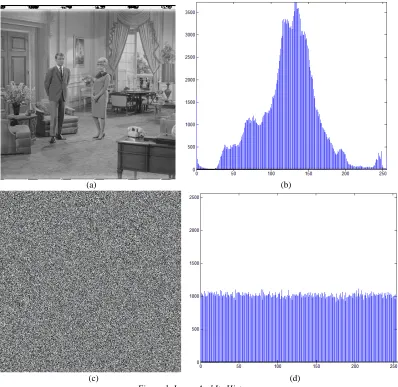
Figure 1. Image And Its Histogram.
where
m
is the total number of symbols;( )
ip m
represents the probability of occurrence ofsymbol
m
i. For a random source emitting 256 symbols, its entropy isH m
( )
=
8
.3. THE EXPERIMENTAL RESULTS
ANALYSIS
investigate the quality of encryption,which are based on the proposed image encryption scheme.
In this paper, we take image Couple of size
512 512
×
and 256 gray levels as the experimentalimage. The simulation results and performance analysis of the proposed image encryption scheme are provided in the following section.
The Histogram Analysis. As we all known, statistical analysis has been performed on the proposed image encryption algorithm, which demonstrates its superior confusion and diffusion properties to strongly resist statistical attacks.
Histograms[6,7,8,9,10] of encrypted images: one typical example among them is shown in Figure1.; one can see that the histogram of the encrypted image for Couple image is fairly uniform and is significantly different from that of the original image.
The Information Entropy Analysis.
Entropy[3,9] is a statistical measure of randomness which can be used to characterize the texture of the input image. Entropy is defined as:
( )
1( )
2( )
0
1
log
m i
i i
H m
p m
p m
−=
= ∑
(4)
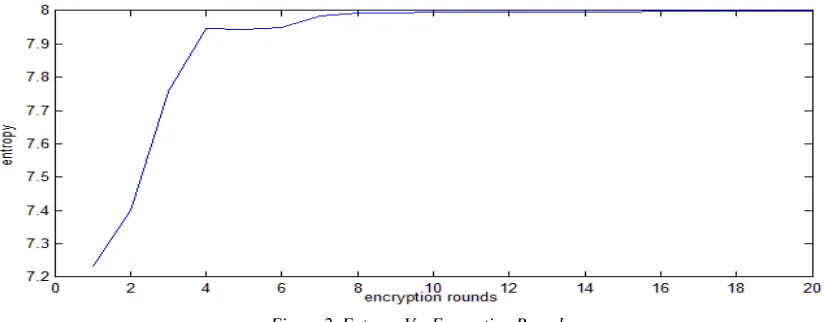
[image:3.612.104.516.339.500.2]The entropy of the original image selected in the paper is 7.23297, Figure2 indicates the various values of the entropies about the different encryption rounds. It is not difficult to find that the entropy of the encrypted image which is very close to the maximum value on the random gray image,when encryption rounds is more than 4, which means that the cipher-images are close to a random source , therefore, the proposed algorithm in the paper is secure against the entropy attack.
Figure 2. Entropy Vs. Encryption Rounds.
The Key Sensitivity Test. We perform this test on the
512 512
×
Couple image. First of all, 5 sub-keys, namely,0 x
Key
,Key
a,Key
S0 ,Key
Nand
Key
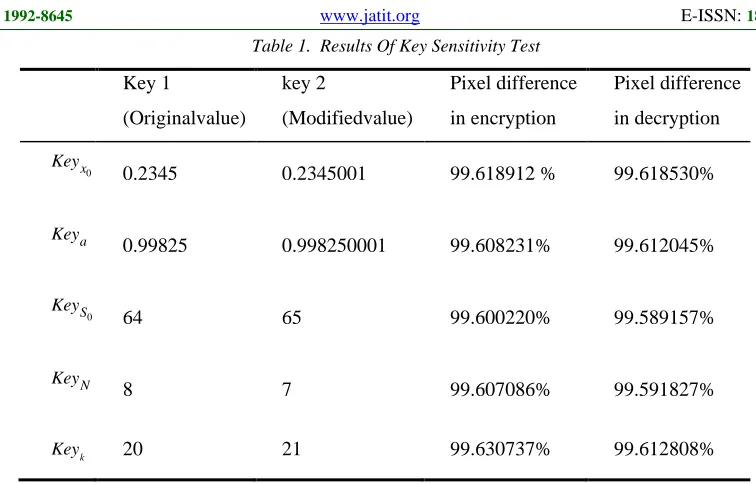
k are chosen. The encryption is then carried out to obtain the cipher image. Then one sub-key is changed and the encryption is performed again with all other sub-key remain unchanged. The pixel gray scale values of the two cipher images are then compared.In addition, testing with slightly different encryption keys, decryption using keys with only one sub-key changed is also performed. Figure3. shows the experimental results. As observed from the figure, the decrypted image is totally different from the plain one even when there is only one sub-key changed in the decryption sub-key. Similar results for other sub-keys
0 x
Key
,Key
a,0 S
Key
,Key
NISSN: 1992-8645 www.jatit.org E-ISSN: 1817-3195
(a) (b) (c) (d)
(e) (f)
(g) (h)
Figure3. Key sensitivity test: (a) Plain image; (b) Cipher image
(
0
0.2345
x
Key = ,Keya =0.99825,
0
64
S
Key = ,KeyN =8 , 20
k
Key = ); (c) correct decrypted image; (d) decrypted image(
0 0.23450001 x
Key = ,Keya =0.99825,
0 64 S
Table 1. Results Of Key Sensitivity Test
Key 1
(Originalvalue)
key 2
(Modifiedvalue)
Pixel difference
in encryption
Pixel difference
in decryption
0 x
Key
0.2345 0.2345001 99.618912 % 99.618530%
a
Key
0.99825 0.998250001 99.608231% 99.612045%
0 S
Key
64 65 99.600220% 99.589157%
N
Key
8 7 99.607086% 99.591827%
k
Key 20 21 99.630737% 99.612808%
4. CONCLUSIONS
In this paper, we proposed an efficient diffusion approach to address the efficiency problem in image encryption. In the approach, we firstly create one pseudo random distance sequence through the tent map, then make use of it and dot bitxor operation in the diffusion process to encrypt image. At last a large number of simulation experiments are carried on, and the experimental results show that the proposed algorithm is a very efficient diffusion algorithm, which has excellent potential for practical image encryption applications.
REFERENCES
[1] K.R.Castleman. Digital Image Processing. Prentice Hall, Inc, (1996)
[2] R.C.Gonzalez and R.E.Woods. Digital Image Processing (3nd Edition). Prentice Hall, (2008) [3] R.C.Gonzalez, R.E.Woods and S. L. Eddins.
Digital Image Processing Using MATLAB. Electronic Industry Press,( 2004)
[4] G. R. Chen and X. F. Wang. Dynamical Systems Chaos Theory, Methods and Applications. Shanghai Jiaotong University Press, pp. 80-105, (2006).(in Chinese)
[5]
http://wenku.baidu.com/view/7c6f4a000740be1 e650e9a75.html
[6] D. X. Qi, J. C. Zou and X. Y. Han. A New Class of Scrambling Transformation and Its Application in the Image Information Covering. Science in China(Series E), vol. 43(3), pp. 304-312,( 2000)
[7] Abir Awad and Dounia Awad. Efficient Image Chaotic Encryption Algorithm With No Propagation Error. ETRI Journal. vol. 32(5), pp. 774-783,( 2010)
[8] L. H. Zhang, X. F. Liao and X. B. Wang. An image encryption approach based on chaotic maps. Chaos, Solitons & Fractals. vol. 24, pp. 759-765, (2005)
[9] Kamlesh Gupta, Sanjay Silakari. New Approach for Fast Color Image Encryption Using Chaotic Map. Journal of Information Security, vol. 2, pp.139-150,(2011)