Journal of Theoretical and Applied Information Technology 10th February 2013. Vol. 48 No.1
© 2005 - 2013 JATIT & LLS. All rights reserved.
ISSN: 1992-8645 www.jatit.org E-ISSN: 1817-3195
MODELING USER INTERESTS USING TOPIC MODEL
1 QINJIAO MAO, BOQIN FENG, 2 SHANLIANG PAN
1 The School of Electronic and Information Engineering, Xi’an Jiaotong University, 710049,China 2 College of Information Science and Engineering, Ningbo Univertisy, 315211,China
E-mail: [email protected] , [email protected], [email protected]
ABSTRACT
In recommender systems, modeling user interest is a basic step to understand user's personal features. Traditional methods mostly just use the items that the target users navigated as their interests, which makes the inherent information unclear to the system and thus the recommendations are not intelligent enough. In this paper, we investigate the utility of topic model called LDA for the task of modeling user interests which are assumed as the latent variables behind user activities in the systems. By using such a probabilistic model on the generation of user profiles, the relationships amongst user、item and interest are constructed. Each user can be considered as a generation of the model. Based on this user interest model, we propose three item ranking methods for personalized recommendation. In order to get a better model for each algorithm, we use a simple automatic parameter turning way to select the model parameters. After carefully selecting the parameters, our methods can all receive encouraging results for recommender systems.
Keywords: Topic Model, User Interest, Recommender System, Collaborative Filtering
1. INTRODUCTION
When people are surfing on the internet, one of the first things they may do is to identify what kinds of links or web pages they are interested in, which means they are willing to click or navigate. We believe that there are such things called user interests which guide the user activities. As in the real world, people all keep distinct user interests which guide them to seek personalized information different from each other. A page they navigate may contain something related to their interests they want to get. Users keep the topic they follow in mind and this information plays a role in the assessment of whether an item is relevant to their interests. Since users on the web are suffering from information overload, catching user interests is very helpful to improve user experiences in nowadays web.
Recommender systems are becoming increasingly popular thanks to their utilities on providing people with recommendations of items they might be interested in and thus purchase or take a deep look at[1]. The systems learn users' preferences and recommend products they are expected to find from the large scale of all available goods. Therefore the objective of the system is to provide people with personalized experience to match their needs as the system is just designed only for the target user.
Journal of Theoretical and Applied Information Technology 10th February 2013. Vol. 48 No.1
© 2005 - 2013 JATIT & LLS. All rights reserved.
ISSN: 1992-8645 www.jatit.org E-ISSN: 1817-3195 distribution for topics. Though all of these models
take the temporal data into consideration, timestamps are all connected to the documents, that is, one timestamp for each document since they are models for text analytics.
In fact, user interests can be regarded as topics to some extent. Topics can be used to present user interests very well. A web user profiling and clustering framework based on LDA-based topic modeling with an analogy to document analysis in which documents and words represent users and their actions was proposed by Hiroshi Fujimoto et al.[7] While most of the existing works are focus on information retrieving[8] or querying[9, 10], they can not easily be adapted directly on some of the recommender systems. In this paper, we present a user interests modeling method using LDA without considering the text of the items since lots of items in the web like movies or music can not be described well in texts. [8]Based on the interests we infer from this model, we propose three kinds of recommendation methods called pure-LDA, LDA-knn, and LDA-tran. Such a user interests modeling method is different from the traditional content-based interest modeling in that they are defined as mixture of items. It can be used quite exactly for recommender systems, and the utility for personalized recommendation will be discussed in our paper.
2. USERS, ITEMS AND INTERESTS
In a recommender system, a user is commonly described by the items they navigate or like. Items can be all kinds of web objects we may deal with, for example, web pages, movies, songs or goods. The system keeps user’s activities on items, and takes advantage of them to figure out the preference on the remains ones they have not visited. A user may keep several interests in mind, and each interest has lots of items related to it in the system. A user usually only needs a tiny fraction of the items based on their interests on certain times instead of the all items under that interest all the time. So, a good recommender system is to provide users with the right item at the right time. Existing recommender systems are mostly aiming at providing users only the right item without considering the time factor. Somehow this hinders them from being a good recommender system.
Therefore, interests can be regarded as latent factors in recommender systems. Interests carried by the user determine which items the user wants to get. Unfortunately, it is hard for user to describe or provide what their interests are. Even though a user
may tell what kind of things he/she interested in, making a recommendation is still difficult. The causes of this problem are manifold. First, the interests described by users themselves are always arbitrary. Therefore one interest may be described differently by different users, while different interests may be described as one thing. Second, even user interests are reliable to get, recommender system need to cnstruct the relationship between items and interests, and then decide which items are fit for? their interests amongst the large scale of candidates. Ignoring the time information, user-item dataset has the same form as word-document co occurrence matrix, with each user being a document, each item being a word, and a user visiting on an item being a document contains a word.
3. TOPIC MODEL FOR USER INTERESTS
In this paper, we build user interests using topic model called Latent Dirichlet Allocation(LDA). Since we are intending to model user interests, we will unify the concepts of topic and interest and use interest for both of them most of the time. Under the context of recommender system, we map the objects 'user, item, interest' we deal with to the objects 'document, word, topic' in the orignal topic model respectively. So, similarly, we can define the generative process about users and their item profiles. In the generative process, a multinomial
distribution
θ
j over interests is randomly sampledfrom the Dirichlet distribution with parameter
α
for each user
u
j , then an interestz
is sampledfrom the distribution
θ
j , and an item is generatedrandomly from the interest distribution on items with parameter
ϕ
which is a sample of a Dirichletdistribution with paremeter
β
.The graphical model representation for the model is given in Figure 1, and a brief notation about the symbols used in this paper is summarized in Table1.
Journal of Theoretical and Applied Information Technology 10th February 2013. Vol. 48 No.1
© 2005 - 2013 JATIT & LLS. All rights reserved.
ISSN: 1992-8645 www.jatit.org E-ISSN: 1817-3195
I T φ β α θ z N M
Figure1:Graphical Representation For LDA
Table1:List Of Notations Used In This Paper
Symbol Description
T
Number of user interestsM
Number of usersN
Number of unique itemsi
θ
The multinomial distribution of interests to useri
z
ϕ
The multinomial distribution of words to interestz
dz
m
The number of tokens in documentd
assigned to interestz
zw
n
The number of tokens of wordw
assigned to interestz
,
α β
The parameters of thecorresponding distributions
4. RECOMMENDATION ON USER
INTERESTS MODEL
4.1. Ranking Items Based on User Profile
In recommender systems, users' activities are collected to construct user profiles. Based on users’ past navigated items, we can infer their related interest distribution. Personalization that takes advantage of the interest distribution of the user can
be derived as follows. For a user
u
j with theinterest distribution of
θ
j , which is derived fromthe LDA-based model, we calculate the probability of the item
I
i that the user may choose as follow:1 1
( | ) ( | ) ( | )
T T
i j j i jt ti
t t
P I u P z t u P I z t θ ϕ
= =
=
∑
= × = =∑
×It follows the generation process of the topic model on user profile, and it makes a simple assumption that the user’s interests are depended on
the past navigation information. Thus the items are ranked according to the probabilities and we call this method "pure-LDA" recommendation.
4.2. Ranking Items Based on User Similarity
The ranking method we proposed in 4.1 will suffer the problem of cold start. A new user with few items known by the system will make the topic distribution over fitted by the little information about the user. The user may start using the system for tiny times and has no clear or explicit intent except several clicks on some items. The information we have about the target user is insufficient. So, it is dogmatic to simply take these items as the user's preference. So, we propose another way of item ranking to do the recommendation. We learn the idea from collaborative intelligence that we find similar user to the target user based on the topic model and then make a recommendation based on the similar user. The most similar users to the target user are the ones who have the maximum conditional probability of the item set of the target user, given
the candidate users. Given a target user
u
j who hasvisited the items j
u
I
, we calculate the probabilityof generating j
u
I
under the condition of the existingknown users
u
i by1
1
(
|
)
( |
)
(
|
)
( |
)
j u j
u j
u j
u i I I i
T
I I j
t
T
I I jt ti
t
P I
u
P I u
P z
t u
P I z
t
θ
ϕ
∈ ∈ = ∈ == ∏
= ∏
=
×
=
= ∏
×
∑
∑
We select a user set
S
j ,|
S
j|
=
K
for userj
u
in which the usersu
∈
S
j have the largest(
| )
j
u
P I
u
. Then we calculate thepreference on unknown items
I
i for useru
jaccording to ( | ) ( | )
i j
i j u S i i
P I u =
∑
∈ P I u .The probability
P I u
( |
i i)
is calculated in thesame way with "pure-LDA" in 4.1. We call the recommendation based on this ranking method "LDA-KNN".
4.3. Ranking Items Based on Item Transition
item transition. Transition is one relationship between items, indicates the probability that one item will be visited after another. Thought the transition is calculated by the usage data, it inherits similarities or associations between items. Transitions from item
I
1toI
2 can be expressed bya conditional distribution of accessing
I
2 whenhaving the clue of
I
1. In our generative model,items are generated randomly by the topic distribution. It seems like each item is generated independently and has no connection to other ones. While in fact, we can get the associative relationships on items according to the model we infer. Assuming that each item is only decided by one interest, we can get the postorir distribution
1
(
|
)
P z
=
j I
from the model. Then theconditional distribution of
I
2 underI
1 can becalculated by:
2 1 2 1
1
(
|
)
(
|
) (
|
)
T
j
P I
I
P I
z
j P z
j I
=
=
∑
=
=
Here, the posterior distribution is calculated by:
1 1
1
( ,
)
(
|
)
( , )
z
P I z
j
P z
j I
P I z
=
=
=
∑
Based on the item relationships we get, we calculate the preference on unknown items for user
j
u
by summing up all the probabilities that can be transformed from the items that the user has ever visited:( |
)
( | )
i u j
j I I i
P I u
=
∑
∈P I I
We call the recommendation based on this ranking method "LDA-tran".
4.4. Parameter Tuning Method
In each algorithm we proposed so far, the recommendation results are sensitive to the parameters
α β
, ,
T
we use to estimate the model. It's hard to find global optimum parameters. We need to tune the parameters in order to maximize the recommendation precision S@K. We use a simple random searching method called Automatic Parameter Tuner (APT) to find the relative better solution to the model.The basic idea is to randomly change one of these parameters, check if the result gets better under the new parameter value, and then decide if
keep the value or not. In detail, this works as follows:
Randomly select a number
i
from{1, 2, 3}
anddraw a new parameter value for the
i
th parameter. If the new parameter makes the result better than the old one, we assign the new value to the parameter. Loop this process until the result is good enough.When dealing with LDA-knn, we add the parameter K into the tuning method, which makes
i
selected from{1, 2, 3, 4}
.5. EXPERIMENTS
5.1. Evaluation Protocol
In order to examine the effectiveness of our models, we conducted an experiment on the real world dataset call MovieLens. The data set was collected from the GroupLens research site. It contains 943 users, 1682 items and a total of 100,000 rating data. Each user has no less than 20 ratings. The data is randomly divided into a training set and a test set with exactly 10 ratings per user in the test set. After the division, each user has at least ten ratings as his profile for training. The experiments were implemented using a modified version of the "Matlab Topic Modeling Toolbox 1.4", provided by Mark Steyvers and Tom Griffiths.
5.2. Evaluation Metrics
For the performance measures, we use the metric
@
s
k
which is defined as:1
@
1( ( , )
)
Q
i i
i
s
k
r u I
k
Q
=
∑
≤
Here,
Q
is the number of user-item pairs weused in the test set,
r u I
( , )
i i is the ranking of itemi
I
for useru
iand1()
is an indicator functionwhich returns
1
when its argument is true and 0otherwise.
r u I
( , )
i i is corresponding the descentorder of
P I u
( |
i j)
.The metric
s
@
k
only considers the number ofitems that returned in the recommended lists without considering the order of the items. For a more exhaustive analysis, we employ another metric called the mean reciprocal rank (
MRR
):1
1
( , )
Q
i i i
MRR
Q
r u I
Journal of Theoretical and Applied Information Technology 10th February 2013. Vol. 48 No.1
© 2005 - 2013 JATIT & LLS. All rights reserved.
ISSN: 1992-8645 www.jatit.org E-ISSN: 1817-3195 We are hoping the items in the test set with
smaller
r u I
( , )
i i that can be recommended in thehead of the lists, such that the bigger
s
@
k
orMRR
's value is, the better the algorithms performance.5.3. Experimental Results
In this section, we focus on how the evaluation measures evolve with the parameters. Based on the two metrics, our experiments are done in either higher
s
@
k
targeted or higherMRR
targeted. The two targeted APTs receive results a little different. In order to tune parameters to have a better result for recommendation, we iteratively choosing a new value for the randomly selected parameter to see if it improvess
@
k
of the recommendation or not to decide if parameter will be kept or replaced by the new value. By doing this with many different initial values and keep the iteration until the metric stop changing for a relative long time, we record the best results. And this process is done similar with the objective of higherMRR
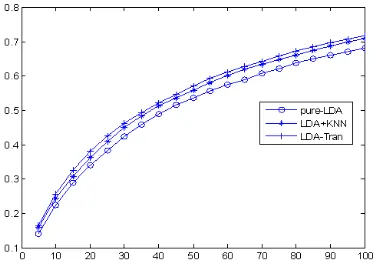
.Figure 2
s
@
k
Of Top-K Recommendation Using LDA With HigherIn Figure 1, we present the results of recommendation precision
s
@
k
based on thetopic models with higher
s
@
k
targeted and thecorresponding parameters and
MRR
s are listed in Table 2. As we can see that the performance of Pure-LDA is relative worse that the other two methods, and LDA-tran is the best one of the three. By choosing parameters with higherMRR
s, we get the corresponding parameters andMRR
s listed in Table 3 ands
@
k
in Figure 3.Table 2: Corresponding Parameters And
MRR
S For Recommendation Using LDA WithHigher
s
@
k
Targeted.Method
α
β
T
K
MRR
PureLDA 1.0707 0.0145 15 -- 0.1060
LDAKNN 0.1667 0.0096 70 14 0.1121
[image:5.612.308.526.252.513.2]LDAtran 0.1667 0.0118 96 -- 0.1148
Table 3: Corresponding Parameters And
MRR
S For Recommendation Using LDA With HigherMRR
Targeted.Method
α
β
T
K
MRR
PureLDA 0.8922 0.0142 22 -- 0.1085
LDAKNN 0.1667 0.0096 70 14 0.1164
[image:5.612.108.295.390.524.2]LDAtran 0.1667 0.0085 70 -- 0.1187
Figure 3:
s
@
k
Of Top-K Recommendation Using LDAWith Higher
MRR
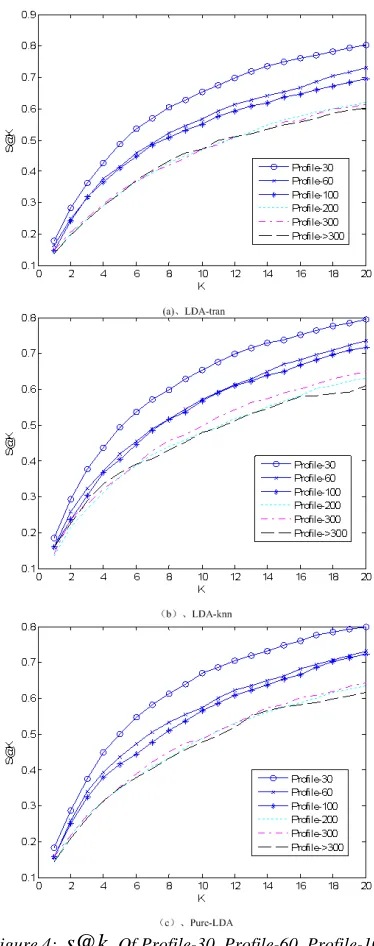
systems, setting a time window to limit the user profile may be helpful in making the prediction.
Figure 4:
s
@
k
Of Profile-30, Profile-60, Profile-100, Profile-200, Profile-300, Profile>300.6. CONCLUSION
In this paper, we view user interests as latent variables hidden in the recommender system based on topic model. User interests are represented by multinomial distributions on items, and users are modeled as multinomial distributions on interests. Using Gibbs sampling methods, user interests are inferred from a generative model according the
training data. We examine the model effectiveness in recommender systems by three ranking methods on the model and discuss the results. Comparing to the previous works, topic model used in this paper can build the relationships on user, item and user interest which are different from the traditional way and quite helpful to construct algorithms to make recommendations. In this paper, we propose three kinds of methods to rank items for users. The experiments on the data of recommender system show the effectiveness of these algorithms qualitatively and quantitatively. Though our model seems quite effective in recommendations, our methods still have some shortages. In our methods, we made an assumption that user interest keep still during the whole period, thus the model does not consider the temporal information.
As in real world, user's personal preference in their interests also changes during the time, that is, the user profiles are changing too. This problem may be the work we will deal with in the following work.
ACKNOWLEDGMENTS:
This work is supported by the National Natural Science Foundation of China (No.61202181,
No.61173040) , Ningbo Natural Science
Foundation (No.2012A610066) , Zhejiang Provincial Natural Science Foundation (No.LY12F02020).
REFRENCES:
[1] C. N. Ziegler, G. Lausen and L. Schmidt-Thieme, "Taxonomy-driven computation of product recommendations," in Proceedings of the thirteenth ACM international conference on Information and knowledge management, 2004, pp. 406--415.
[2] D. M. Blei, A. Y. Ng and M. I. Jordan, "Latent dirichlet allocation," The Journal of Machine Learning Research, vol. 3, pp. 993--1022, 2003. [3] D. M. Blei and J. D. Lafferty, "A correlated
topic model of science," The Annals of Applied Statistics, vol. 1, pp. 17--35, 2007.
[4] D. M. Blei and J. D. Lafferty, "Dynamic topic models," in Proceedings of the 23rd international conference on Machine learning,ICML '06, New York, NY, USA, 2006, pp. 113--120.
Journal of Theoretical and Applied Information Technology 10th February 2013. Vol. 48 No.1
© 2005 - 2013 JATIT & LLS. All rights reserved.
ISSN: 1992-8645 www.jatit.org E-ISSN: 1817-3195
Artifical intelligence,IJCAI'07, San Francisco, CA, USA, 2007, pp. 2909--2914.
[6] X. Wang and A. McCallum, "Topics over time: a non-Markov continuous-time model of topical trends," in Proceedings of the 12th ACM SIGKDD international conference on Knowledge discovery and data mining, New York, NY, USA, 2006, pp. 424--433.
[7] H. Fujimoto, M. Etoh, A. Kinno, and Y. Akinaga, "Web user profiling on proxy logs and its evaluation in personalization," Web Technologies and Applications, pp. 107--118, 2011.
[8] J. Y. Kim, K. Collins-Thompson, P. N. Bennett, and S. T. Dumais, "Characterizing web content, user interests, and search behavior by reading level and topic," in WSDM '12, New York, NY, USA, 2012, pp. 213--222.
[9] L. Li, G. Xu, Z. Yang, P. Dolog, Y. Zhang, and M. Kitsuregawa, "An efficient approach to suggesting topically related web queries using hidden topic model," World Wide Web, pp. 1-25, 2012.
[10] M. J. Carman, F. Crestani, M. Harvey, and M. Baillie, "Towards query log based personalization using topic models," in