Munich Personal RePEc Archive
Flexicurity in EU Countries
Neacsu, Madalina and Baldan, Cristina
University of Pitesti
27 May 2008
FLEXICURITY IN EU COUNTRIES
With a view to reaching the objectives of the Strategy of Lisbon for more and better jobs, new forms of flexibility and security are needed for both physical persons and companies and for the states members and EU as well.
EU citizens agree to the need of adaptation and change:
- 76% Europeans agree to the fact that having the same job during their whole lives is no longer of present interest
-76% think that being able to change your job easily is actually a very strong point nowadays in finding a job
- 72% believe that to encourage creating new jobs, contracts should be more flexible - 88% citizens think that continuous professional training improves the perspectives of getting a job.
The European Council demanded the states members:
- to develop more systematically ampler political strategies within national reform programmes with a view to improving the adaptability of both workers and enterprises, to ensure EU citizens of a high security level of occupation, that is, the possibility to easily find a job in any stage of thier active life and to have perspectives of career development in a changing economic environment,
- to consider the possibility of developing a set of common principles concerning flexicurity, a useful means to create open and reactive labour markets, as well as more productive.
Flexicurity can be defined as an integrated strategy of simultaneous consolidation between flexibility and security on the labour market.
Flexibility concerns successful longlife changes (“transitions“): from school to work, from a job to another, from unemployment or disposal to work and from work to retirement.
This does not confine to companies’ greater freedom of employing or dismissing and does not involve the caducity of long term contracts. This refers to workers’ progress towards better jobs, all the information and data were taken from COM(2007) final 359 - “Towards common principles of flexicurity: More and better jobs through flexibility and security“ ”ascendent mobillity” and optimum development of talent. Flexibility is also about flexible work organization, so as to respond promptly and efficiently to new demands and competences of productivity and to ease reconciliation between professional life and private life responsibilities.
professional training opportunities for all workers, especially for those having a lower qualification level and for the older ones.
Thus, enterprises and workers can benefit from both flexibility and security, as well, for example, as a consequence to better organization of work, to ascendent mobillity as a result to improved competences, to investment in professional training which have a good outcome for enterprises, helping workers to adapt and accept the change.
Flexicurity consists of:
The Commission and the member states have reached an agreement based on experience and analytical proofs, according to which, flexicurity policies can be outlined and applied through for political forms:
– Flexible and secure contractual provisions (out of the employer’s perspective, the emplyee’s perspective, working class people’s perspective and of the people who belong to the excluded categories), through a form of work legislation, collective contracts and modern organization of work;
- Comprising longlife learning strategies to ensure adaptability and the capability to workers’ professional insertion, especially for the most vulnerable categories;
- Active and efficient labour market policies which help people to handle rapid changes, they help to decrease unemployment periods and ease transitions to new jobs;
– Up-to-date social security systems which ensure adequate financial support, encourage occupation on the labour market and ease mobillity on the respective labour market. This includes stipulations concerning a wide range social security(unemployment aid, pensions and medical assistance)helping people to reconcile work and personal and family responsibilities.
Flexicurity common principles:
(1) Flexicurity implies flexible and secure contractual stipulations (out of the employer’s and employee’s perspectives, of the working people’s perspective and of those belonging to the excluded categories), comprising longlife learning strategies, active and efficient policies in the labour market field and modern social security systems. Its objective is to strengthen the concept of putting into practice the strategy of increase and jobs and the social European model, ensuring in this way new types of flexibility and security to increse adaptability, labour force occupation and social cohesion.
(2) Flexicurity implies a balance between the rights and the responsibilities for the employers, the employees, those who are in search for a job, and the public authorities.
(3) Flexicurity should be adapted to the circumstances, to the labour market and to the specific labour relations of the member states. Flexicurity does not refer only to one unique model of the labour market or to an unique strategy of politics.
belong at present to the excluded categories – including those who do not have a job, among who the predominant in numbers are women, young people and migrants – need easy ways of access to a job and a starting basis to allow the progress towards stable contractual stipulations.
(5)Internally (within society), as well as externally(from one society to another) flexicurity should be promoted. A sufficient flexibility concerning the employment and the disposal should be accompanied by secure transitions from one job to another. Ascendent mobility must be eased, as well as the mobillity between unemployment or inactivity and work. The quality working places with a capable leading team, a good work organization and a continuous actualisation of the competences represent objectives of the flexicurity. Social protection must encourage and not block mobility.
(6) Flexicurity must encourage the equality of chances by promoting the equal access to the quality working places for men and women and by offering the possibility to reconciliate proffessional life with family life, and it must also ensure equal chances for migrants, young workers, persons with disabilities and older persons.
(7) Flexicurity provides a trusting climate between the public authorities and the social partners, all of them being prepared to take responsability for changes and to initiate balanced packages of politics.
(8) Flexicurity politics imply budgetary costs and they should be applied, so as to contribute to the supporting of the budgetary politics.
These common principles should constitute an useful reference for the realization of some labour markets more open and more active and for the creation of more productive working places. All these should support the member states in establishing and implementation of the flexicurity strategies who fully take into consideration the specific challenges, opportunities and circumstancies, as well as the active participation of social partners.
Ways of approaching flexicurity
1. solving contractual segmentation
- is interesting for the states where the main challenge is the segmentation of the labour market, which contains working persons and persons from excluded categories,
- is interested in a more even distribution of the flexibility and security in work, by offering ways of access on the labour market for the new comers and by promoting their evolution to more advantageous contractual conditions.
frequently have successive short term contracts during a long period before obtaining a long term contract. Instead of playing the role of a starting point, these contracts risk to become traps for workers. In these states, the security tends to lay more on the protection of the working place than on the social labour conscriptions. As a consequence, the unemployment conscriptions are diminished, and social assistance systems are weakly developed.
At present, the social administrations and the public services working for the occupation of the labour places need a consolidation at an institutional level to be able to support unemployed people by a good management and active efficient politics in the field of labour market.
The benefits of the citizens and of the society will increase if an efficient starting basis will be created, which will allow the workers to enter and evolve on the labour market and to obtain an ascendent mobillity.
2. developing flexicurity in a factory and ensuring security of the transition
- is interesting for the states whose labour markets do not register considerable fluctuations,
- it supposes the increase of the investments dedicated to the growth of the chances of employment to allow workers in factories to permanently renew their skills and thus to be better prepared to handle the technological or organisational changes,
- it surpasses a certain job and a certain employee, by creating some systems to ensure safe and succsessful transitions from one job to another, in case of reorganization of the company unemployment of the staff.
In the states where this procedure is used, the predominant are the big companies which offer high levels of job security. Workers are deeply attached to the employing company, and the labour market is characterized by a low dynamism. In the past years, this tradition has been threatened, because reorganization of the companies and subcontractions are more and more frequent. The social security systems from these states are largely well developed, and the labour conscriptions are adequate.
But the challenge remains the mixture between some sufficient conscriptions with strong measures of stimulation of the workers to make them accept a job. The expenses concerning the active politics in the field of labour market have often strongly increased, but programs are not always efficient, especially concerning reintegration in a working place of long term unemployed persons.
An increased mobillity of the workers between companies would lead to development of the benefits of citizens and society. Workers would be more motivated to assume the risks associated to transfers from one job to another, in the case where conscriptions would be sufficicient during the transition periods, and the perspectives of finding new and better jobs would be real.
- is interesting for the states which confront with big differences concerning competences and perspectives of employment of people,
- it tends to create some possibilities of employment for persons with a low level of qualification and the development of those competences which allow them to keep their jobs.
In these states, the rate of the occupations of the jobs tends to be high, but there are differences between categories of persons regarding this aspect. An encouragement is imposed for the ascending mobillity. The contractual stipulations tend to be sufficiently flexible, but, in some cases, they should offer an increased protection to the more vulnerable groups from the labour market. Some groups (women, single mothers, migrants, persons with disabilities, young and old workers) are exposed to the risk of being excluded from the labour market. This situation may lead to a growth of the number of persons who benefit from permanent conscriptions and it could increase poverty rates.
Active politics in the field of labour market forsee strong measures to stimulate workers to accept a job, but efforts are necessary to ensure the progress regarding levels of competence.
The benefits of the citizens and of the society will increase due to the growth of the social mobillity of people with a low level of qualification, by training them to exercise different proffessions which offer them new perspectives.
4. growth of the chances of people who receive conscriptions and of workers informally employed.
- it is interesting for the states which met with recent and important economic reprganization, which resulted in an increased number of people who receive conscriptions on a long term and who have low chances to re-enter on the labour market. - it tries to increase the chances of the persons who receive conscriptions and the transition from informal jobs to formal ones, by creating some active efficient politics in the field of labour market and by longlife learning systems associated with an adequate level of the unemplyment conscriptions.
In these states, traditional companies, often industrial, were forced to let go to a large number of employees. Unemployed workers receive conscriptions which are often conceived as ″conscriptions of getting out of the labour market” and not as ″transition indemnities to a new job”. Investments in active politics from the field of labour market are limited, and chances to find new jobs are low.
Differences between men and women are persistant. Tendencies to rely on informal economics are registered. Due to professional training inefficience, workers with a low level of qualification and young unexperienced young people have difficulties in adapting to the demands of the labour market.
Citizens’ and of society’s benefits will increase by creating new opportunities for unemployed people and by integrating informal economic activities in the field of formal economy.
These modalities have been elaborated on the basis of the member states situation and on the report of the group of experts in the field of flexicurity (May 2007).
Flexicurity paradox in Baltic States
The flexicurity concept as policy options is not very easy to implement in transition economies. Most of these economies benefited from a strong labour protection and generous social benefit systems during planned economies. Opening up of the national economies to the global competition has focused domestic enterprises to adjust their inputs, including labour to market demand. Within the structural adjustment package, introducing employment flexibility and lowering social protection was in most cases offered as sole alternative to transform labour markets to a new market conditions. As result the low administrative capacity of labour market institutions and weakness of trade unions combined with poor law enforcement have contributed to actually high labour market flexibility and job insecurity felt by workers. It is important to understand that in order to converge with western economies these countries should keep relatively liberal economic policy, which means flexible labour market with strict monetary and fiscal policy. According to optimistic estimations it will take at least 15-25 years in order to achieve real convergence.
Our overview of some flexicurity indicators, like workers protection, trade union influence and job flows and workers flow sell us the following story.
Labour markets are highly flexible in the term of labour market flows and especially in the terms of job flows. We had data about Lithuania and Estonia only, but these data show us that job creation and destruction rates are much higher than comparable numbers in older members stats and even higher than in US, which is considered to be economy with very high labour market flexibility.
From a social cohesion perspective, then we should admit that Baltic States have very long way to go. Estonia has highest Gini coefficient in EU, in Latvia and Lithuania situation is quite similar. Estonia as a extreme example of liberal market oriented economic policy, lowered it personal income tax rate from 26 (2004) per cent to 23 (2006) per cent. This is flat tax; so lowering flat tax rate will probably not help to lower Gini coefficient.
Increasing social disparities, high gender wage gap, low-income levels are keywords characterising social situation. Social policy systems as such are in place, but the general income level is very low. For instance in Estonia minimum wages is 34% of average wage, it is somewhat higher in Latvia and highest in Lithuania (around 40%). General low-income level and particularity low minimum wages are weak incentives for people searching a job. Kuddo et al (2002) calculated the replacement rates of the subsistence benefits and family benefits for different family types in 2000. The replacement ratio to average net wages1 was 33% for a single person2, 27% for couple, 39% for a couple with two children and 48% for the single parent with 1 child. These numbers do not decrease over time. When calculating them relative to minimum wage instead, it turns out that these are 100% for the single parent with one child and 85% for the couple with two children. This shows that the incentive to take up a job with minimum wage is low for these family types. (Kuddo et al 2002)
Family support to especially young people exists also, and often parents support their children also after graduation, and their first work years. But as young people try to move to live separately from their families as soon as there are financial possibilities, these family support and social links are weakening. We can see the same tendencies all over the developed countries, especially the northern and central European countries, less in South-Europe. As Baltic States belong culturally to German or Scandinavian area it is inevitable that these kinds of family ties are loosing their importance.
If we want to have more flexicurity, we will need mainly two things: time and active policy from Government. Time means that there are certain time periods we have to consider, while nominal and real convergences of Baltic economies will take place. It is very difficult in low-income country to explain to simple worker that in order to make labour market more flexible we need to have more part time work, while his/her intention is to do more overtime work and earn more income. Almost 50% of part time workers in Estonia are involuntary part time workers.
However there are aspects, which could be implemented now. As we learned from previous parts labour policy is not sufficiently financed by the state. More active labour market policy is needed. During last two years the tendencies have been positive in this development. Mostly thanks to European Union financial aid the share of labour market expenditures increased from 0,19% in 2002 to 0,32% in 2004 in Estonia. These are significant changes, but compared with EU average levels the gap is still very big.
1
Relative to 66,7% of the average wage of the production worker
Active labour market measures are still underdeveloped; the same is true if we look on-job-training practices. Firms’ interest is not sufficient to provide intra-firm training. Our surveys in Estonia have showed that only large companies provide enough training for their employees. The majority of firms in Estonian and also in Latvia are still micro firms, with less than 10 employees. In such circumstances only way to implement instruments of life long learning is state labour (training) policy. Today the share of active labour market policies has grown in all three Baltic States due to EU support. Unfortunately small countries often face a shortage of competent people and companies who may use rights away extra financial sources. This is the old problem of administrative capacity of public sector to absorb and implement addition funds from EU. One very important issue stressed in flexicurity strategies is mutual trust. Both employers and employees should trust each other and they should realise that it is possible to implement measures, which increase flexicurity as it happened both in Denmark and the Netherlands. 3If we look briefly to the situation in Baltic States, then again we should admit that the situation is unsatisfactory. If less than 20% of the workers belong to trade unions and collective agreement coverage is less than 30%, then it is very difficult to talk about partnership, mutual understanding and mutual trust. There are sectors where collective bargaining is relatively well developed, education, health care in some cases transportation, mining etc, but these are exceptions not rules. There are sectors were trade unions not exists at all in Estonia for example, and these are not small sectors: construction and banking, unions have marginal role in trade sector.
Policy implications
As it was mentioned by Wilthagen (2004) that .” the main message of the flexibility concept is that in modern labour markets labour flexibility should (also) be defined in terms of security as well as the security should also) be defined in terms of flexibility. Puts differently, flexibility and security are not incompatible but should rather be seen as two sides of the same coin as the mutual preconditions…”
The conclusions from this statement could be that flexible labour markets need more security, but different type of security, compared with what they have today and visa
versa. (Wilthagen, 2004).
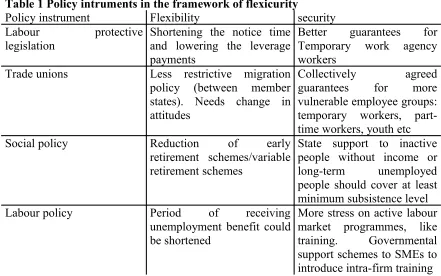
If we think about policy options then we can say that every policy option or institutional tool could be treated from two sides, flexibility and security. One possibility to present this is to use simple matrix format where we link the tool and the two aspects of flexicurity (see table 1).
If we think about last two-policy instruments, presented in table, then these are also very relevant in the context of Baltic States. For instance early retirement scheme has increasing popularity in Estonia. In old member states this problem is even bigger. In
3
many new member states the state social benefits are very low, not guaranteeing even minimum level of subsistence. Social assistance benefits in Estonia are mean tested and made in 2004 about 7% of average wage (see appendix for details). This is not sufficient support to cover elementary expenditures.
[image:10.612.85.526.255.531.2]Several aspects mentioned in the table are unequally developed in new member states. For instance the temporary agency work is widespread in Latvia, while in Estonia we do not have much evidence about that, yet. But there are definitely different aspects which could be considered, and therefore this table could be treated as simply an example how it is possible to implement policy instruments to develop flexicurity of labour market. Maybe there are common problems and solutions similar in all member states, but rather we believe that such instruments and policy options should be country specific.
Table 1 Policy intruments in the framework of flexicurity
Policy instrument Flexibility security Labour protective
legislation
Shortening the notice time and lowering the leverage payments
Better guarantees for Temporary work agency workers
Trade unions Less restrictive migration policy (between member states). Needs change in attitudes
Collectively agreed guarantees for more vulnerable employee groups: temporary workers, part-time workers, youth etc Social policy Reduction of early
retirement schemes/variable retirement schemes
State support to inactive people without income or long-term unemployed people should cover at least minimum subsistence level Labour policy Period of receiving
unemployment benefit could be shortened
More stress on active labour market programmes, like training. Governmental support schemes to SMEs to introduce intra-firm training
In Romania I will mention some of the modifications made from a normative point of view and which were a consequence to the harmonization of Romanian laws with the European laws:
- Introduction of the guarantee fund of wage debts(law 200/2006)
- Establishing a general field of general information and consultation of the employees (Law 467/2006)
- Organization of activities of health and security labour (Law 319/2006
- Dettaching employees in transnational conscriptions on Roamanian territory(Law 344/2006, Government’s Decision 104/2007)
- Protection of the employed persons in case of transfers of companies, of the company’s unit or only of a part of it(Law 67/2006)
Some representatives of the labour Inspection claim that applying the minimum wage system, as it is mentioned in the collective labour contract at a national level, is a direct consequence to having joined the European Union.
As known, the wage system is not this year innovation, it is also mentioned in the collective labour contract of the past years.
Forcing employees to respect this system(and we mainly think of the superior level of this one) is only now intervening as a consequence to the fact that European Union is attentively monitoring aspects concerning labour relations.
If we take into consideration all the aspetcs mentioned above, we can notice that labour relations have become stricter, by imposing some additional obligations to the employees, who come on the basis of an already restrictive labour code. Romanian employers must shortly handle additional costs generated by the increase of wages, and ensuring conformity, in the conditions where competitivity is tested on an extended European labour market.
With this image of actual Romanian labour market, public debates launched at the European Community level, and which have as purpose the updating of labour legislation and flexibility of the labour market, are not yet of great interest in Romania, and, they have good reasons for this, as it is about a method that partially contradicts the new institutional system.
In fact, the European Community is more and more concerned with a low level of competitivity and a decreasing in the rhythm of economic growth.
Aware of the essential role of human ressources during these processes, European leaders encourage the members of the community to find solutions.