ISSN(Online): 2320-9801 ISSN (Print): 2320-9798
I
nternational
J
ournal of
I
nnovative
R
esearch in
C
omputer
and
C
ommunication
E
ngineering
(An ISO 3297: 2007 Certified Organization)
Vol. 3, Issue 5, May 2015
An Enhanced Data Gathering Protocol for
Wireless Sensor Network with Sink Mobility
Varshitha K, Madesha M
4th Sem M.Tech, Dept. of CS&E, Sahyadri College of Engineering and Management, Adyar, Mangalore, India
Assistant Professor, Dept. of CS&E, Sahyadri College of Engineering and Management, Adyar, Mangalore, India
ABSTRACT:In Wireless Sensor Network, sensor nodes have limited battery lifetime so energy consumption is one of the main issue in WSN. An energy efficient approach for data gathering can be achieved in WSN by using sink mobility. Currently researches focus on predicting mobile sink moving path in advance to obtain enhanced network. In many applications movement of mobile sink based on pre-calculated path is not applicable. In this paper an efficient data gathering protocol, Sinktrail and Sinktrail-S has been proposed when mobile sink’s further location cannot be scheduled in advance. Sinktrail allows sufficient flexibility in the movement of mobile sinks to dynamically adapt to various terrestrial changes and without requirements of GPS devices or predefined landmark, Sinktrail establishes a logical coordinate system for routing and forwarding data packets, making it suitable for diverse application scenarios.
KEYWORDS: WSN- Wireless Sensor Nodes, mobile sink, data gathering, routing, logical coordinates.
I. INTRODUCTION
ISSN(Online): 2320-9801 ISSN (Print): 2320-9798
I
nternational
J
ournal of
I
nnovative
R
esearch in
C
omputer
and
C
ommunication
E
ngineering
(An ISO 3297: 2007 Certified Organization)
Vol. 3, Issue 5, May 2015
Fig.1 A photograph showing a farmland of irregular shapes . A mobile sink’s movement is constraint in such environment [1]
For effective movement of the mobile sink in the network, path should be determined on which the mobile sink can move. Many algorithms are provided by using the predefined path such as AODV, geographical routing etc. But the problem in geographical routing is that, it assumes that the path is predefined in advance.
Currently researches focuses on predicting mobile sink moving path in advance to obtain enhanced network. Movement of mobile sink based on pre-calculated path is not applicable for some events. Therefore energy consumption would be reduced if the sensor would define the path of mobile sink movement. SinkTrail, efficient data gathering protocol is used in sensor network where the sink moves continuously in the network, in relatively low speed and gather the data. At some point control messages are transmitted around network will low speed. This position is called as “footprints”. Considering these footprints as virtual landmark, sensor node can identify its track count distance. Sensor node’s coordinate in logical coordinate space developed by the mobile sink can be represented by combining the track count distance [1]. Considering the destination coordinate and its own coordinate, sensor node can select the next hop with enhanced network. This protocol allows adaptable movement of mobile sink, finds efficient path without using a predefined path as well as reduces the energy consumption.
II. RELATED WORK
ISSN(Online): 2320-9801 ISSN (Print): 2320-9798
I
nternational
J
ournal of
I
nnovative
R
esearch in
C
omputer
and
C
ommunication
E
ngineering
(An ISO 3297: 2007 Certified Organization)
Vol. 3, Issue 5, May 2015
based on priority then, cluster heads time to live will be reduced and the nodes in these clusters will be finished. To overcome this, LEACH chooses nodes with high power as cluster head. Compression of data takes place when it needs to be transferred from cluster head to base station, so LEACH uses local data fusion. Directed Diffusion Approach [13, 14] in this approach to identify the information, receivers and resources use some attributes. This approach was developed to find a multi way route to transmit information between source and sink. Each task is given a value and every value is set of attribute value pair. EEMC [15] (An energy efficient multi level clustering) in this approach for cluster formulation sending and receiving of the data is done by sink node. A cluster consist of nodes in them and among them cluster head is selected. At every step cluster head is elected depending on residual energy and also distance very efficiently. VLEACH [16] is a new version of LEACH which reduces energy consumption. During this approach Vice cluster head is selected by using this cluster nodes will always reach sink. This solves problem of electing new cluster head each time the cluster head dies. Two-Tier Data Dissemination (TTDD) [17] is been developed by existing idea of virtual backbone also known as virtual grid. In this approach mobile sink sends information to the nearest grid points along the flooding and data will be sent back to the sink using reverse path. As a result, control overhead which are formed during sink movement are limited to the grid cell where sink is located. SEAD (Scalable energy efficient asynchronous dissemination) [18] protocol assigns some nodes as access nodes and this protocol depends on these access nodes to control traffic. Mobile sink selects one among neighbor nodes as path nodes. This protocol generates an energy efficient dissemination tree from source to other path nodes. Using this tree Data is transmitted and then path nodes send them to sink.
III.PROPOSED ALGORITHM
Consider a network which contains sensor nodes in it. These sensor nodes are connected with each other with links that are needed for communication. These sensor nodes are active when data gathering process begins. For data gathering mobile sink such as robots which are external devices are sent into the network, mobile sink is used to gather the data can be recharged whenever needed. The data gathering starts when mobile sink enters the network and terminates whenever enough data is collected or there is no more data left. Sinktrail[1] is used for data gathering process. Mobile sink moves in very low speed. It stops at some place for some time. That point is known as track point and transmit messages to the network, these messages are known as track messages. These messages contain <track no, track count>. Fig.2 represents the architecture of system.
Fig.2 System Architecture
ISSN(Online): 2320-9801 ISSN (Print): 2320-9798
I
nternational
J
ournal of
I
nnovative
R
esearch in
C
omputer
and
C
ommunication
E
ngineering
(An ISO 3297: 2007 Certified Organization)
Vol. 3, Issue 5, May 2015
A. Logical Coordinate Space Construction:
Every sensor node consists of its own track references. In this phase sensor nodes update their respective track references. Initially, all sensor nodes track references are initialized to [-1, -1…….,-1]. Special variable α is used to track latest message track number. After mobile sink enters the field the track message, <track no, track count> is set to <1,0>. The track messages are transmitted to all sensor nodes by mobile sink. Using this track message, track reference of sensor nodes are updated [1]. These tack reference are used as logical coordinates of all sensor nodes and sink node in network. Sink trail facilitates flexible construction of logical coordinate space.
B. Destination Identification:
Sinktrail allows a mobile sink to stop at convenient locations according to current field situation [1].The places at which mobile sink stops are known as track point, are footprints left by the mobile sink. Footprints provide information for tracing the current location of mobile sink.
C. Greedy Data Forwarding:
As soon as mobile sink moves and stops at a point known as track point, track reference are exchanged with neighbor node. Data is sent directly to mobile sink if mobile sink is within the range or find neighbor node close to destination. Then all the data is forwarded to that neighbor node which performs data gathering [1].
IV. SIMULATION RESULTS
The simulation studies consist of a network with 30 nodes and sink is been selected as shown in Fig.3. The proposed data gathering protocol is implemented using NS-2. The simulation results shows sink sending its track messages to entire network, energy consumption and throughput.
Fig.3 Node creation and sink selection
Nodes receive the track messages from the sink node as shown in Fig.4. Then all nodes collect their neighbour information. Nodes update their track location information by means of track references.
.
ISSN(Online): 2320-9801 ISSN (Print): 2320-9798
I
nternational
J
ournal of
I
nnovative
R
esearch in
C
omputer
and
C
ommunication
E
ngineering
(An ISO 3297: 2007 Certified Organization)
Vol. 3, Issue 5, May 2015
A. Energy Consumption
The Fig.5 shows energy consumption of Sinktrail and Sinktrail-S. It shows that the energy consumed by the Sinktrail protocol which is minimized when compared to the energy consumed using Sinktrail-S protocol . Thus the energy of node and network gets improved.
Fig.5 Energy consumption
B. Throughput
Throughput is the number of useful bits per unit of time forwarded by the network from a certain source address to a certain destination ,prohibit protocol overhead, and excluding retransmitted data packets. The Fig.6 shows throughput of Sinktrail and Sinktrail-S
Fig.6 Throughput
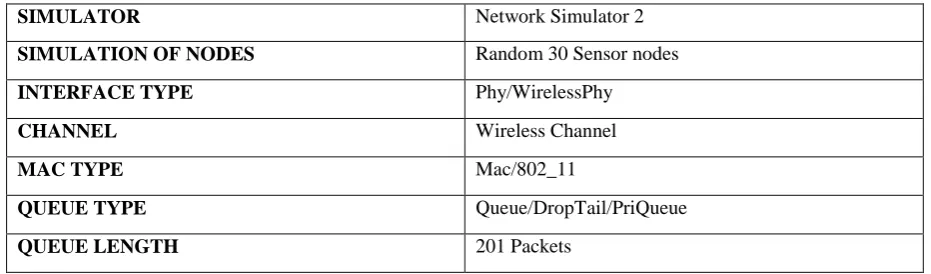
C. Simulation table
The following Table I describes simulation model.
TABLE I Simulation of NS2
SIMULATOR Network Simulator 2
SIMULATION OF NODES Random 30 Sensor nodes
INTERFACE TYPE Phy/WirelessPhy
CHANNEL Wireless Channel
MAC TYPE Mac/802_11
QUEUE TYPE Queue/DropTail/PriQueue
ISSN(Online): 2320-9801 ISSN (Print): 2320-9798
I
nternational
J
ournal of
I
nnovative
R
esearch in
C
omputer
and
C
ommunication
E
ngineering
(An ISO 3297: 2007 Certified Organization)
Vol. 3, Issue 5, May 2015
ANTENNA TYPE Omni Antenna
PROPAGATION TYPE TwoRay Ground
SIZE OF PACKET Five hundred and twelve
PROTOCOL AODV
TRAFFIC TCP
V. CONCLUSION
In this paper Sinktrail protocol is proposed which provides an energy efficient data gathering. The main aim of protocol depends on how to transmit data through a shorter path and to gather data efficiently in network. Sinktrail uses logical coordinates to identify the distance and establishes data reporting path by greedily selecting the shortest path to the destination. Sinktrail [1]. adapts different moving patterns. Algorithms are proposed for identifying sink movement and also for track reference update. Sinktrail also considers geographical routing without using GPS or landmarks installed.
ACKNOWLEDGMENT
We express sincere gratitude to Management and staff of Sahyadri College of Engineering and management, Mangalore for providing platform to conduct research and experimentation.
REFERENCES
1. Xinxin Liu, Han Zhao, Xin Yang, and Xiaolin Li, “SinkTrail: A Proactive Data Reporting Protocol for Wireless Sensor Networks, “IEEETrans.Computers, vol 62, no.1, pp.151-162, Jan 2013.
2. K.Seada, M. Zuniga, A.Helmy, and B.Krishnamachari, “Energy Efficient Forwarding Strategies for Geographic Routing in Lossy Wireless Sensor Networks,” in ACM SenSys, 2004.
3. R. Shah, S. Roy, S. Jain and W. Brunette, "Data MULEs: modeling a three-tier architecture for sparse sensor networks," Elsevier Ad HocNetworks Journal, vol. 1, pp. 215-233, Sept. 2003
4. D. Jea, A. A. Somasundara and M. B. Srivastava, "Multiple controlled mobile elements (data mules) for data collection in sensor networks, "IEEE/ACM DCOSS, June 2005.
5. R. Pon, M. A. Batalin, J. Gordon, A. Kansal, D. Liu, M. Rahimi, L.Shirachi, Y. Yu, M. Hansen, W. J. Kaiser, M. Srivastava, G. Sukhatme and D. Estrin, "Networked infomechanical systems: a mobile embedded networked sensor platform," ACM/IEEE IPSN, 2005.
6. M. Ma and Y. Yang, "Data gathering i n wireless sensor networks with mobile collectors,"IEEE IPDPS, 2008.
7. M. Zhao, M. Ma and Y. Yang,"Mobile data gathering with space-division multiple access in wireless sensor networks," IEEE INFOCOM, 2008.
8. S.Basagni, A.Carosi, E.Melachrinoudis, C.Petrioli, and Z.M.Wang, “Controlled Sink Mobility for Prolonging Wireless Sensor Networks Lifetime,” ACM Wireless Networks, vol. 14, pp. 831-858, 2008.
9. Miao Zhao, Student Member, IEEE, Ming Ma, and Yuanyuan Yang, “Efficient Data Gathering with Mobile Collectors and Space-Division Multiple Access Technique in Wireless Sensor Networks”
IEEE vol. 60, no. 3, March 2011.
10. X. Hu, Y. Liu, M.J. Lee and T.N. Saadawi, “A novel route update design for wireless sensor networks, ACM Mobile Computing and Communications Review 8(1) (2004) 18–26.
11. S. Madden, M. J. Franklin, J. M. Hellerstein and W. Hong, “TAG: A Tiny AGregation Service for Ad-Hoc Sensor Networks,”
Proceedings of the 5th Symposium on Operating Systems Design and Implementation, Boston, 9-11 December 2002, pp. 131-146. 12. C. Schurgers and M. B. Srivastava, “Energy Efficient Routing in Wireless Sensor Networks,” Proceeding of IEEE Military
Communications Conference, Vol. 1, 2001, pp. 357-361.
13. C. Intanagonwiwat, R. Govindan and D. Estrin, “Directed Diffusion: A Scalableand Robust Communication Para- digm for Sensor Networks,” Proceedings of Sixth Annual International Conference on Mobile Computing and Net- working(MobiCom2000), Boston, August 2000, pp. 56-67.
14. J. Heidemann and F. Silva, C. Intanagonwiwat, R. Govindan, D. Estrin and D. Ganesan, “Building
Efficient Wireless Sensor Networks with Low-Level Naming,” Proceedings of the Eighteenth ACM Symposium on Operating Systems Principles, Vol. 35, No. 5, 2001, pp. 146-159.
ISSN(Online): 2320-9801 ISSN (Print): 2320-9798
I
nternational
J
ournal of
I
nnovative
R
esearch in
C
omputer
and
C
ommunication
E
ngineering
(An ISO 3297: 2007 Certified Organization)
Vol. 3, Issue 5, May 2015
16. M. B. Yassein, A. Al-zou'bi, Y. Khamayseh and W. Mardini, “Improvement on LEACH Protocol of Wireless Sensor Network (VLEACH),” International Journal of Digital Content Technology and Its Applications, Vol. 3, No. 2, 2009, pp. 132-136.
17. F. Ye, H. Luo, J. Cheng, S. Lu and L. Zhang, A two-tier data dissemination model for large scale wireless sensor networks, in:Proceedings of the 8th ACM Annual International Conference onMobile Computing and Networking, MobiCom 2002, Atlanta, GA(September 23–28, 2002), pp. 148–159.
18. H.S. Kim, T.F. Abdelzaher and W.H. Kwon, Minimum energy asynchronous dissemination to mobile sinks in wireless sensor networks, in: Proceedings of the First International Conference on
Embedded Networked Sensor Systems, SenSys 2003, Los Angeles,CA (November 5–7, 2003), pp.193–204.
BIOGRAPHY
Varshitha K is currently pursuing her master’s degree (M.Tech) in Computer Science and Engineering at Sahyadri College of Engineering and Management, Mangalore, India. She completed her B.E degree (2009-2013) in Information Science and Engineering at P A College of Engineering, Mangalore, India. Her areas of interest are Networking, Database Management.