R E S E A R C H
Open Access
The impact mechanism of rural land
circulation on promoting rural revitalization
based on wireless network development
Ai-min Zheng
1and Zhong Li
2*Abstract
The objective and accurate evaluation of land value is one of the biggest interest issues that farmers are concerned about in the transfer of rural land, and it is one of the influencing factors that influence the country’s rural rejuvenation strategy recommendation. Considering the nonlinear characteristics of various policy and social issues, such as the nature of land and market chaos in the process of rural land circulation, neural networks are introduced to study rural land evaluation based on the development of wireless
networks, and the mechanism of influence of promotion of rural regeneration is explored. After analyzing the structure and flow of the neural network, the related equations of the BP neural network are updated, and the introduction of a genetic algorithm to establish a hybrid model is proposed to promote the effective evaluation of the complexity problem by the BP neural network algorithm and improve the prediction accuracy. After simulation experiments show that this study can provide a fair evaluation of the value of rural land transfer, and it has positive significance for promoting the development strategy of rural rejuvenation.
Keywords: Wireless network, Land circulation, Rural rejuvenation, Research
1 Introduction
The state has a strict scope for the collective use of rural land [1]. Rural land transfer refers to the circu-lation of collective construction land, which mainly includes farmer’s own housing land, land used by rural self-owned enterprises, and land occupied by rural public places and facilities [2]. Land transfer is a method of land use permitted by national laws. It must be subject to scope and conditional restrictions in order to lease and resell rural collective land. There are many details of the transfer of land in rural areas and the sale of land in cities [3]. The same is true whether the land in the cities or in the country-side is a commodity with circulation value. However, the fact that the land has an immovable position also allows the land circulation to not circulate the land itself. It is actually the change of ownership of the land within a certain period of time. Domestic land
transfer and foreign land resale are two different con-cepts. This is because foreign land is privately owned and domestic land is owned by rural collectives. The impact of the transfer of collectively owned land in China is more complicated than the impact of land transfer abroad. However, in land transfer, the evalu-ation of land prices is the most critical economic issue affecting land circulation [4]. Under this back-ground, the influencing factors of the valuation of rural collective land are studied. Starting from the ac-tual situation in rural China, it is a subject worthy of advancing to use artificial intelligence algorithm to es-tablish a scientific and objective land evaluation index system. Taking into account the nonlinear characteris-tics of various policy and social issues, such as the nature of land and market chaos in the process of rural land transfer, neural networks are introduced to study rural land evaluation based on the development of wireless networks. The mechanisms that influence the promotion of rural revitalization are explored [5].
* Correspondence:[email protected]
2School of Economics and Management, Shaoyang University, Shaoyang, Hunan, China
Full list of author information is available at the end of the article
2 State of the art
The neural network simulates the human brain’s ner-vous system and stores and processes information. It has the function of simplifying, summarizing, and simulating human brain information [6]. The neural network learns human behaviors such as learning, memory, inference, and calculation of knowledge. The abstract mathematical model can reflect human un-derstanding of abstract learning and cognitive pro-cesses and has played an important role in artificial intelligence research in recent years [7]. The neural network uses a large number of neuron nodes to re-flect the structure and function of the human brain, and uses an induction learning method. A large-scale example is used to repeated studies. In the internal process of constant adaptation, the weights of the in-terconnected neurons are corrected so that the mu-tual structure and connection weights of the neural networks are distributed stably. The whole process is the learning process of human knowledge acquisition [8]. The neural network can change the method of neural learning and dynamically respond and process external input information through its own neurons, which has the characteristics of storage and applica-tion experience knowledge. It is also possible to recognize and remember the characteristics of certain things, and then to distinguish the things based on the stored memory when they encounter the informa-tion again later [9]. The neural network uses the sys-tem error squared sum as an objective function, which causes the convergence speed to be affected and local minima may occur. The inaccuracy of the prediction of the data model with large gaps in the numerical value relationship has affected the popularization and application in practice. Until the 1980s, after these deficiencies were overcome by scholars, many research results of neural networks were widely used in industrial control, economic re-search, and engineering construction. The biggest ad-vantages of neural networks are adaptive, nonlinear, and the ability to learn and rectify errors [10].
BP neural network is the main mathematical model for optimization of common neural network models. According to statistical data, it can be seen that 90% of neural network models are now using BP neural networks. It is a multi-layer forward neural network based on error backpropagation algorithm. It can pro-vide a simple nonlinear modeling method for complex systems. It can achieve arbitrary nonlinear mapping near any degree of accuracy [11]. It can autonomously change the internal network through learning. The connection values are actively adapted to the changes of the system, and have better fault tolerance and ro-bustness. The multi-input and output structural
model can better use multi-variable system states. To improve the performance level of BP neural network, the flow of the algorithm can be optimized, the con-vergence period can be used, and the algorithm struc-ture can be updated to improve the evaluation accuracy. Therefore, this paper proposes an algorithm optimization and improvement of the mathematical model, and carries out practical verification in the land evaluation of rural land circulation to examine the improvement of the post-scientific nature of the neural network and the improvement of prediction accuracy [12].
3 Methodology
3.1 BP neural network
BP neural network is information feed-forward lay-ered neural network. Backward propagation of errors is the most special place for the algorithm. There is also two-way communication in learning. Neural net-work structure is divided into input layer, output layer, and hidden layer. The hidden layer here may be one layer or n layers. Each layer will forward link through the connection weight between nodes. After a BP neural network enters a signal, the signal is transmitted to the hidden layer. After the excitation function is calculated, the information is passed to the output layer and becomes the output signal. The training algorithm of BP neural network is character-ized by two-way propagation. The input layer enters the hidden layer and then the output layer outputs the result. This is the forward state in the two-way propagation. When the hidden layer receives an error between the signal and the output signal, and the error exceeds the desired range, the system corrects the weights and thresholds of the neurons at each layer based on this error, so that each layer becomes more adaptable to promote system performance. This reflects the state of backpropagation. A node in the network corresponds to a single neuron, and there is no intersection between the neurons in different layers. The input of neural nodes at each level only comes from the upper layer that is associated with it. The output of each layer of neurons only has influ-ence on the next layer of neural nodes. In practical applications, only one layer of the hidden layer can meet the needs of use. When the hidden layer reaches three layers, it can reflect the mapping of any continuous function. The BP network model structure is shown in Fig. 1.
BP neural network is a kind of algorithm learning process with teacher guidance. Learning mainly has the following steps: (1) initialize setting weights w
and θ. It is clear that the connection weight of all neurons between the input layer and the hidden layer
is wij. The neuron connection weight from the hidden
layer to the output layer iswjk. The hidden layer threshold is
designated θj. It is assumed that the threshold θk of
the output layer neuron is a small value in the range [0,1]. (2) Determine the input vector xi= (x1,x2,⋯,
xm) of the input value. Calculate the matching
ex-pected output vector Yi∧¼ ðY1 ∧
;Y2 ∧
;⋯;Yn ∧
Þ. The value of the xi input vector is input to the neuron node of
the input layer. According to the conditional formula
xi j¼ fð
Pn
i¼0Wijxi−θjÞ ðj¼1;2;⋯;uÞ , the
positive-oriented flow calculation is performed, or the counter-oriented flow calculation is performed ac-cording to yk ¼ fðP
k¼0 n
Vjkxj−θkÞ ðk¼1;2;⋯;nÞ. (3)
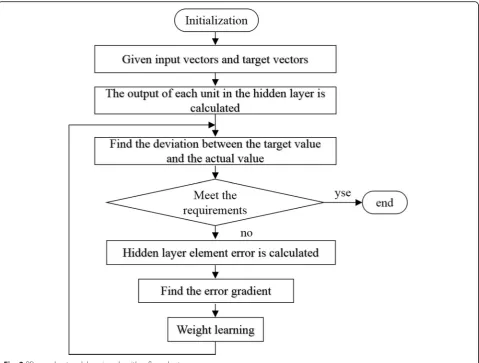
Calculate the error between the output layer neuron output value and the expected output value. If the error result meets expectations, the training is com-pleted. If the difference is too large, it will enter the reverse calculation of the model calculation again. Fi-nally, after repeated calculations of the correction function, the weights satisfying the requirements are obtained, the calculation of the model ends, and the signal output is performed. The BP neural network learning algorithm flow is shown in Fig. 2.
3.2 BP neural network optimization
By improving the parameter values of the BP neural network, the defects that may be encountered in
neural network learning can be overcome. The optimization method for the network is to adjust the maximum weight value to accommodate the decrease of the error. In the network backpropagation stage, the theoretical weight value and the previous weight value are partially superimposed as the actual weight value in this study. After the last time the weight changes, you can use the momentum factor to ex-press the effect of the change and use which mo-mentum factor to adjust the algorithm based on the change. When the momentum factor mc is equal to
zero, the weights are adjusted according to the gra-dient descent method. When mc= 1, the adjustment
of the new weight value will be the same as the change value of the last weight, which will exclude the adjustment brought by the gradient descent method. After adding the momentum item into the calculation, the network weight value is in the smoother range at the bottom of the error surface.
∇f(w(n)) will become very small, so w(n+ 1)≈w(n). In order to prevent w(n+ 1) = 0 from appearing and help the network to jump out of the local minimum, the weight adjustment formula is optimized as for-mula (1).
∇wðnþ1Þ ¼mc½wðnÞ−wðn−1Þ−ð1−mcÞη∇fðwðnÞÞ ð1Þ
Among them, n is the training times, mc is the
mo-mentum coefficient, ηB is the learning rate, and mc∈
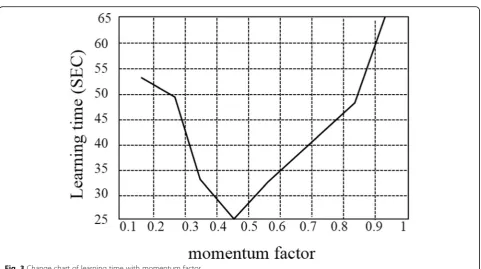
[0, 1] is set. When the error accuracy is assumed to be 0.0008, an extra-kinetic energy method is used to calculate the non-fitting linear function, the learning rate is set at random, and the average of 30 calcula-tions is taken. Thus, the curve between the kinetic energy coefficient and the learning time is obtained, as shown in Fig.3. It can be seen in the figure that after the introduction of the momentum item, the speed of net-work learning has been improved. This adjustment method can effectively avoid the occurrence of local mini-mum values of the network and reduce the recurrence of errors.
The learning process of neural networks is the key to solving the problems of fixed learning rate and frequent adjustment of weights. In order to overcome effectively the learning rate is too small, the algorithm convergence speed is too slow, the learning rate cannot reach the goal, the learning rate formula is optimized to help the network to reduce the correction, and to avoid the weight value exceeds the optimal value of the gradient.
The learning rate optimization formula is shown in for-mula (2).
ηð Þ ¼n aηðn−1Þ aηðn−1Þ
E nð Þ <E nð −1Þ E nð Þ>cE nð −1Þ
w nð Þ ¼w nð −1Þ−ηð Þ n ∂E nð Þ ∂W nð Þ
ð2Þ
Here,η(n) is the learning rate atNiterations, andE(n) and E(n+ 1) are the values of the two previous error functions. The constants a= (2,1), b= (1,0), c= [1,1.2]. When E(n) <E(n+ 1), it means that the error is decreas-ing. This is because the learning rate will increase to a time of the past, and the convergence speed will in-crease. WhenE(n) <E(n+ 1), it indicates that the error is increasing. At this time, the weights are in an over-adjusted state in the iteration, and it is necessary to reduce the learning rate to the original b times in order to avoid crossing this gradient direction, resulting in local optimal weights. In order to reduce the error of
Fig. 2BP neural network learning algorithm flow chart
the BP neural network in training, the value of the directivity function indicating the search direction can be continuously reduced. This situation will cause the network convergence speed to drop, and the results of local minima search will not meet the need. A conjugate gradient algorithm is introduced at this time to provide a direction vector for the search. This algorithm uses the error function of the weight set-ting range as a function of the secondary line, and can be calculated at a time to obtain an accurate ap-proximation. The implementation process is to first set the objective function = minE(w) w∈R. When the minimum value of the error function is searched in the gradient direction, formula (3) can be obtained and the network can be corrected accordingly.
EðwðnÞ þηndðnÞÞ ¼ minEðwðnþ1ÞÞ wðnþ1Þ ¼wðnÞ þηndðnÞ
dðnÞ ¼−gðnÞ þβndðn−1Þ;dð0Þ ¼−gðoÞ
ð3Þ
In order to solve the application of BP neural net-work, since it is not easy to determine the network structure, and it can easily lead to local minimum and other deficiencies, genetic algorithm is intro-duced to optimize it and improve the performance of the neural network. Genetic algorithm has a great advantage in global search. Based on the population, it uses individual fitness as a criterion to evaluate
subsequent heritage operations. Not only is the glo-bal search capability good, but in the presence of mutation operators, the local search ability is also improved. The main form of genetic algorithm optimization for neural networks is: the first is to optimize the topological structure between the vari-ous layers in the neural network and varivari-ous param-eters of the neuron. In order to solve the problem that the hidden layer and the number of nodes in the neural network cannot be accurately determined, the genetic algorithm is used to optimize the top-ology structure before optimizing the network pa-rameters. If the neural network structure is clear, use genetic algorithms to update the neural network thresholds and weights. And the number of neural nodes in the audit network, the number of hidden layers in the network is calculated.
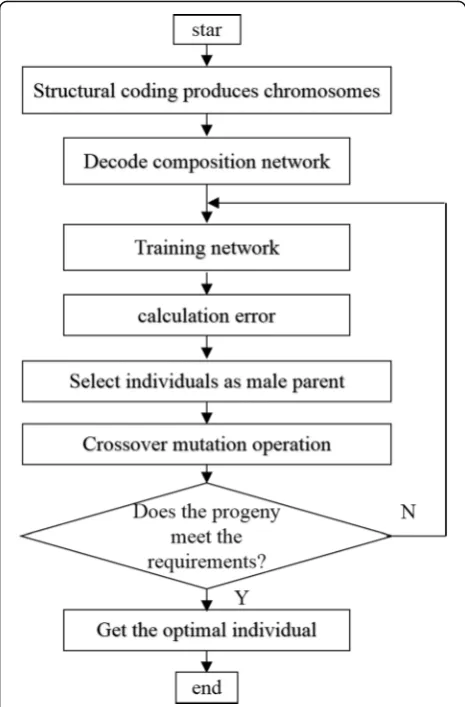
The algorithm steps for optimizing the structure of the BP neural network using the genetic algorithm are as follows: first, the encoding and decoding are preprocessed. After determining the number of hid-den layers and the number of nodes in the network, randomly generated chromosomes are decoded to form a corresponding neural network. The neural net-work is configured with an initial weight of 1 for learning and training. The difference between the ex-pected network output value and the actual output value for each code is calculated, and the individuals
with the smallest error are set as the first-generation parent. The above steps are repeated until the best individual is found. The individual’s corresponding network is the optimal neural network structure. The combination of BP neural network and genetic algo-rithm can effectively improve the speed of conver-gence, reduce errors and improve accuracy, and can effectively reduce the situation into the local mini-mum, so that the algorithm model gives a more
scientific and optimal prediction results. The algo-rithm flow chart of the genetic algoalgo-rithm introduced BP neural network is shown in Fig. 4.
4 Result analysis and discussion
In order to verify the research on the land evaluation of farmland transfer based on BP neural network pro-posed in this paper, the land transfer related data of M province from 2010 to 2017 was selected to conduct simulation experiments. The collected sample data is normalized before the model is built. The maximum and minimum normalization method is used here. Through this method, the data is transformed linearly and the data is mapped to the 0–1 range. From the neural network’s characteristic of acquiring knowledge through learning, the collected sample data is divided into test sets and training sets. The database from 2010 to 2015 was used as training data. The data from 2016 to 2017 is used as test data to evaluate the accuracy of the neural network. The MATLAB toolbox is used. The experimental process includes three parts: neural model design, neural network training, and evaluation network simulation. The model design is first performed. The relevant parameter design is the transfer function of the hidden layer and the output layer uses the tansig func-tion, the training function is the purelin funcfunc-tion, the real interval is set to 12, the network learning rate is 0.002, and the maximum training frequency is 230 times. The target error is 0.75*10(−10). In order to avoid overfitting in the experiment, the network model’s pre-diction ability is reduced and the generalization ability is not good. Three times cross validation are used, that is, all the prediction results are the average values after cross-validation.
The parameter determination process of the BP net-work is a process of repeated learning accumulation. In the BP network model, the effect of a separate in-dependent variable on the in-dependent variable depends not only on the size of this independent variable but also on the values of other independent variables. Therefore, in the experiment, the trained network was used to predict the 2016 and 2017 data. The experi-mental results are shown in Table 1 below. From the data in the table, it can be seen that the relative error
Fig. 4Intelligent diagnosis flow chart of short children based onBP and genetic algorithm
Table 1Comparison between predicted and actual values
Particular year
Predicted value (%) Real value (%) Relative error
Managers’ proportion
The proportion of researchers
Managers’ proportion
The proportion of researchers
Managers’ proportion
The proportion of researchers
2016 3.35 62.21 3.31 61.79 0.56 0.04
2017 3.22 64.34 3.42 64.05 0.61 0.52
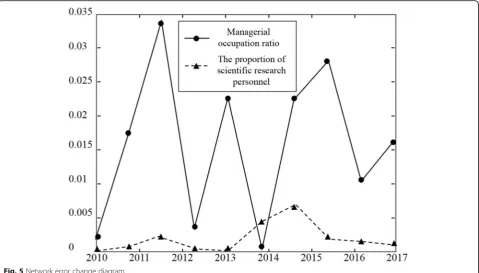
is less than 1%, which proves that the neural network evaluation and prediction system constructed in this paper has a very good accuracy. Figure 5 shows the variation of the BP neural network error.
Figure 6 shows the BP neural network model constructed in this paper. The total number of ex-periment iterations was 69, and the best number of iterations was 63. At the 61st time, the best cross-validation was MSE = 0.22171.
5 Conclusion
The BP neural network has many advantages such as qualitative accuracy, high efficiency, and strong ability to deal with nonlinear problems. As an important representative of high-efficiency mathematical models, this model has made positive contributions to the management of all aspects of human society. There-fore, the use of BP neural network mathematical model is proposed to study land value evaluation of rural land circulation. After an in-depth analysis of the BP neural network structure, randomly determin-ing weights and thresholds for the network will result in overfitting. Human factors affect the number of nodes, and it will lead to network learning time is too long, the number of iterations is too much, and the learning rate is not strong. Other targeted optimization is conducted to improve the accuracy and efficiency of the BP neural network prediction model. The weights and other parameters are im-proved, and the structure of the BP neural network is optimized. The network learning rate formula is im-proved to help the network reduce the amount of correction and overcome the slow convergence of the algorithm. A genetic algorithm is introduced to deter-mine the network structure. After improving the performance of the neural network and other im-provements, the optimized BP neural network is sim-ulated. From the verification results, the construction
Fig. 5Network error change diagram
of the evaluation model based on BP neural network is successful and can lay a good foundation for the promotion of rural revitalization. However, there are still some areas that can be improved in this study. The next step can be to conduct in-depth research on improving the prediction accuracy of neural models.
Abbreviations
BP:Backpropagation neural network; Tansig: Tan-sigmoid
Funding
The study was supported by“Hunan Natural Science Foundation Project (Grant No. 2018JJ2368),” “Hunan provincial decision consultation project (Grant No. 16JCC055),”and“Hunan provincial Education Department Project (Grant No. 15A174&16C1465)”.
Author’s contribution
A Z has made great contributions to the development of wireless network in rural land. Z L has done a lot of research and made great contribution to rural land circulation in promoting rural revitalization. All authors read and approved the final manuscript
Author’s information
A Z, Master of Business Administration, Associate professor, Graduated from Guangxi University in 2007, working in Shaoyang University. His research interests include regional economics and rural land issues. Z L, Doctor of management, Professor, Graduated from Central South University in 2014, working in Shaoyang University. Her research interests include regional economics and rural land issues.
Competing interest
The author declare that they have no competing interests.
Publisher’s Note
Springer Nature remains neutral with regard to jurisdictional claims in published maps and institutional affiliations.
Author details
1College of Accounting, Shaoyang University, Shaoyang, Hunan, China. 2School of Economics and Management, Shaoyang University, Shaoyang, Hunan, China.
Received: 12 November 2018 Accepted: 11 January 2019
Reference
1. Jiao J, Li Y, Wu B. Research on acoustic signal recognition method for pipeline leakage with BP neural network[J]. Chin. J. Sci. Instrum. (11), 2588-2596 (2016).
2. H. Gao, M. Colliery, Research on reliability of coal mine support based on BP artificial neural network. Jiangxi Coal Science & Technology37(4), 18–92 (2017)
3. H. Ji, Z.Y. Li, Research and simulation of SVPWM algorithm based on BP neural network. Key Eng. Mater.693, 1391–1396 (2016)
4. W.R. Yang, C. Chi, X.R. Yang, Research on vibration isolation effect of porous media shock absorber based on BP neural network. Journal of Magnetic Materials & Devices724(18), 26–12 (2016)
5. X. Yu, S. Xiong, Y. He, et al., Research on campus traffic congestion detection using BP neural network and Markov model. Journal of Information Security & Applications31(C), 54–60 (2016)
6. D.U. Guanzhou, G. Wei, Z. Gao, Research on power consumption prediction of public buildings based on BP neural network. Engineering Economy 29(16), 37 (2017)
7. Y. Tian, C. Zhang, X. Mao, et al., Research on abnormal behavior of power consumption based on BP neural network with PCA. Journal of Chongqing University of Technology41(9), 34–346 (2017)
8. Z. Zhang, Research and application of capability evaluation model based on BP neural network educational technology—Taking the problem-based
learning teaching process learning as an example. Journal of Computational & Theoretical Nanoscience13(9), 6210–6217 (2016)
9. Bo Y. The comprehensive regionalization function partition method research based on BP Neural Network[J]. Territory & Nat. Resour. Stud. (01), 68-69 (2016).
10. C. Qiu, J. Shan, Research on intrusion detection algorithm based on BP neural network. International Journal of Security & Its Applications9(4), 247– 258 (2016)
11. M. Kumar, Y. Mao, Y. Wang, et al., Fuzzy theoretic approach to signals and systems: static systems. Inf. Sci.418-419, 668–702 (2017)
12. W. Zhang, K. Thurow, R. Stoll, A context-aware mhealth system for online physiological monitoring in remote healthcare. International Journal of Computers Communications & Control11(1), 142–156 (2016)