PTS based MIMO-OFDM System using Space
Frequency Block Coding Technique
Dinesh Kumar Niranjan, Sandeep Shukla, Jitendra Kumar Mishra
M. Tech Scholar, Department of Electronics and Communication, Patel Institute of Engineering & Science, Bhopal, India
Assistant Professor,Department of Electronics and Communication, Patel Institute of Engineering & Science, Bhopal, India
Associate Professor & HOD,Department of Electronics and Communication, Patel Institute of Engineering & Science, Bhopal, India
Department of Electronics and Communication, Patel Institute of Engineering & Science, Bhopal, India
ABSTRACT: In this paper, the review of the multiple input multiple output using space time block code on WiMAX (IEEE 802.16) system. The Worldwide Interoperability for Microwaves Access technology which can offer high speed voice, image, and video and data service up to base on standard 802-16 wireless MAN is configured in the same way as a traditional cellular network. The range of WiMAX makes the system very attractive for users, but there will be slightly higher BER at low SNR.
KEYWORDS: WiMAX, OFDM, RAYLEIGH CHANNEL, MIMO-OFDM, BER I. INTRODUCTION
The growth in the use of the information networks lead to the need for new communication networks with higher data rates. The telecommunication industry is also going to change, with a demand for a greater range of services, such as video conferences, or applications with multimedia contents, wireless communication has permeated nearly all acts of human life.
Because of the characteristics of WiMAX system itself, and the problems of OFDM system which is sensitive to the timing and the frequency compensation. The OFDM system of the WiMAX adopts abruptly deliver mode, reliability, good efficiency and High data rate is achieved between the transmitter and the receiver if they are ideally synchronized. However, there usually exists a small timing and frequency offset whose exists will dramatically degrade the performance of the whole OFDM systems. Hence, before signals can be demodulated, OFDM symbols have to be time-synchronized and carrier frequency offset compensated. This puts forward very high request to the mode piece of the synchronization system. In order to realize the synchronization, it must adopt synchronization algorithm of smaller calculation quantity. In the meantime, it should have higher examination of the first moment. Characteristics of WiMAX simulation model as shown in Table I.
Table 1: Key Characteristics of WiMAX(IEEE 802.16) Standard [3] Characteristic Description
Physical layer Direct Sequence Spread Spectrum (DSSS), Frequency Hopping Spread Spectrum (FHSS), Orthogonal Frequency Division Multiplexing (OFDM).
Standard 802.16e
Frequency band s 2.4 GHz, 3.5GHz, 5GHz
Topology Mesh,
Modulation scheme
BPSK, QPSK,QAM Data rates 5.5 to 70 Mbps
Features of WiMAX[3]
o Interoperability: The IEEE 802.16 standard is internationally accepted and the standard is maintained and certified by WiMAX forum covers fixed, portable and mobile deployments.
o Long Range: It covers up to 30 miles but in practice, it covers only 6 miles.
o QoS: QoS of WiMAX media access control (MAC) is designed to support a large number of users, with multiple connections per terminal.
o Mobility: WiMAX offers immense mobility especially IEEE 802.16e-2005.
This paper is organized as follows: In section II, the orthogonal frequency division multiplexing system and peak average peak ratio is formulated. Multiple input multiple outputs OFDM system is introduced in section III. In sectionIV discuss about IEEE 802.16 reference model. In section V explain the space time block code and simulation result. Finally, the conclusions are given in section VI.
II.ORTHOGONALFREQUENCYDIVISIONMULTIPLEXING
The OFDM (Orthogonal Frequency Division Multiplexing) is a wide band wireless digital communication technique that is based on block modulation, with the wireless multimedia application becoming more and more popular, the required bit rate are achieved due to OFDM multicarrier transmission for video communication, very high bit rate/high-speed communication is required.
)
1
...(
...
)...
(
)
(
~
t
jy
t
x
S
)
2
.(
...
1
1 0 ) ( 2
N k t T k j k Se
A
N
Where
A
k is the complex data of thek
th subcarriers and T is the OFDM symbol period [6]. Low let us discuss some advantages of OFDM: It has maximum spectral efficiency according to Nyquist rate. It controls overlapping of bands in channels. Its implementation technique is easier because it uses IFFTs. It has perfect synchronization of transmitter and receiver. It is well suited for high bit rate applications. In OFDM system timing recovery is very straight forward. In this system effects of delay spread can be easily compensated using cyclic prefix. It uses efficient bandwidth range. OFDM also has some disadvantages. The main disadvantage of multicarrier modulation is that it exhibits a high peak to average power ratio. Because of high PAPR two problems occur which are: Problem 1- It increased the complexity of A/D and D/A converters and problem 2– It reduced the efficiency of RF power amplifier .The other disadvantages are OFDM system is very sensitive for frequency errors, it causes carrier offset problem. It needed higher input back off factor before the peaks in the signal experience significant distortion.The PAPR of the discrete time base band OFDM signal is defined as the ratio of the maximum peak power divided by the average power of the OFDM signal [6].
)
3
...(
...
)
(
|
|
max
)
(
2 n av n na
P
a
a
PAPR
)
4
...(
|}...
|
{
1
)
(
2 1 0 n N n nav
E
a
N
a
P
Where E {.} denotes the expected value.
The PAPR (in dB) of the OFDM signal can be defined as
)
5
...(
}...
{
log
10
10 avg peakP
P
PAPR
Where, is the average power consumed by each frame, and is the maximum of power for one OFDM frame. When BPSK modulation is used on each sub carrier, binary block coding can be directly implemented before modulation. If the power in each sub carrier is normalized to 1 W, is N W.
III.MIMO-OFDM
Multiple-Input Multiple-Output uses multiple antennas at both sides which provides transmit diversity and receiver diversity. It’s applicable in every kind of networks like PAN, LAN, WLAN, WAN, MAN. MIMO system can be applied in different ways to receive either a diversity gain, capacity gain or to overcome signal fading.
Furthermore, although MIMOs can potentially be combined with any modulation or multiple access technique, recent research suggests that the implementation of MIMO aided OFDM is more efficient, as a benefit of the straight forward matrix algebra invoked for processing the MIMO OFDM signals. MIMO OFDM, which is claimed to be invented by Airgo Networks, has formed the foundation of all candidate standards proposed for IEEE 802.11n. In recent years, this topic has attracted substantial research efforts, addressing numerous aspects, such as system capacity, space/time/frequency coding, Peak-to- Average Power Ratio (PAPR) control, channel estimation, receiver design, etc. Recently, Paulrajet al. and Stuberet al provided compelling overviews of MIMO-OFDM Communications. Furthermore, Nortel Networks has developed a MIMO OFDM prototype,which demonstrates the superiority of MIMO OFDM over today’s networks in terms of the achievable data rate.
IV.IEEE802.16 REFERENCE MODEL
In figure 1, there are four types of sub layer are used in IEEE 802.16 reference model.
Convergence Sub layer (CS)
MAC common part sub layer
Security sub layer
Physical sub layer
In convergence sub layer classification of the higher-layer protocol PDU into the appropriate connection- Suppression of payload header Information- Delivery of the resulting CS PDU to the MAC SAP associated with the service flow for transport to the peer MAC SAP- Receipt of the CS PDU from the peer MAC SAP- Rebuilding of any suppressed pay load header information [7].MAC common part sub layer (MAC CPS) classification of the system access- Bandwidth request/allocation- Connection establishment/maintenance- Quality of service - Power saving mechanisms and handover mechanismSecurity sub layer classification of the authentication- Secure key exchange and encryption.
The IEEE 802.16 group has introduced new standard under the rules of WiMAX forum and named it IEEE 802.16e in December 2005. 802.16e was the updated version of IEEE 802.16-2004 which established the basis for first fixed WiMAX solution. IEEE 802.16e was addressing the wireless MANs. There were some challenges for mobile wireless environment. Mobile devices receive signal which vary over shorter distances and can be affected by serious errors so there must be some protocols to deal this issue.
There must be a control of Peak to Average Power Ratio (PAPR) in wireless environment.The Mobile WiMAX must be working on a licensed bands rather than unlicensed bands. The main purpose of this standard was to provide platform for interoperability between vendors. WiMAX forum works similarly to Wi-Fi forum which provide standard to business organizations and manufacturers to recommend standards of equipment interoperability.
V. SPACE TIME BLOCK CODE
)
9
...(
...
)
(
2 1 1*,1 1(1) 1,2 1*(2)2 , 1 2
1 , 1
1
s
h
n
h
n
s
)
10
....(
...
)
(
2 2 1,1 1*(2) 1*,2 1(1)2 , 1 2
1 , 1
2
s
h
n
h
n
s
coding scheme represents a different time instant, while the columns represent the transmitted symbol through each different antenna. In this case, the first and second row represents the transmission at the first and second time instant respectively.
The reception and decoding of the signal depends on thee number of receive antennas available. Before the received signals are sent to the decoder, they are combined as follows
VI. PTS TECHNIQUE
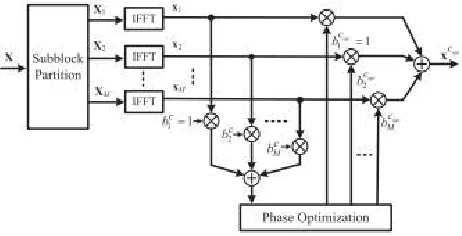
In the PTS scheme, the conventional PTS scheme is applied to each transmitting antenna in SFBC MIMO-OFDM systems. The data block Xi of (1) is first partitioned evenly into Mb disjoint sub blocks, denoted as
We observe that only the peak power of each candidate signal is necessary to find the optimal signals in (8). In [13], an algorithm was presented to select samples for estimating the peak power of the candidate signals in the conventional PTS scheme. Based on the concept in [13], a cost function is defined for antenna.
Figure 3: Comparison of PAPR reduction performance of various PTS schemes V. CONCLUSION
WiMAX-OFDM in the 3.5 GHz band is of practical interest due to the potential for large-scale WiMAX deployment Communication system can operate with a lower transmit power, transmit over longer distances, tolerate more interference, use smaller antennas and transmit at a higher data rate. These properties make the code energy efficient. Hence, new codes were sought that would allow for easier decoding and encoding. The task of the decoder and encoder easier is using a code with mostly high-weight code words. Error detection and correction techniques are essential for reliable communication over a noisy channel.
for example for Eb/N0 equals to 10 db the BER improves by a factor of 10. Hence, MRC schemes provide very good Sresults; this is also an agreement with theoretical results. However, in MRC scheme, to receive better signal quality more than two receivers may require. To counteract this Alamouti proposed a scheme in which more than one transmitter can be used to transmit signals, as signal generated from these antenna‘s will travel different path, hence may provide better quality signal at the receiver. As this scheme is somewhat compromising scheme, therefore results may not be up to the level of MRC. However, this scheme is very simple and has potential to combat with fading of the channel.
The STBC coding method leads to reduce BER as compare to convolution coding method. Although coding is a simple, having good PAPR reduction performance and blessed with unique advantage of error correction, but finding the best suited coding technique and the optimal coding rate is very iterative process.
REFRENCES
[1] Kumar, “Introduction to Broadband Wireless Networks” in Mobile Broadcasting with WiMAX: Principles, Technology and Applications, New York, USA: Focal Press, 2008, pp. 24-50.
[2] C. Eklund, R. B. Marks, K. L. Stanwood and S. Wang, “IEEE Standard 802.16: a Technical Overview of the WirelessMAN Air Interface for Broadband Wireless Access,” IEEE Commun. Mag., vol. 40, pp. 98-100, Jun 2002.
[3] R. Prasad, “Introduction” in OFDM for Wireless Communications Systems, London, United Kingdom: Artech House, 2004, pp. 11-14.
[4] G. Tsoulos, “Theory and Practice of MIMO Wireless Communication Systems,” in MIMO System Technology for wireless Communications, USA: CRC press, 2006, pp. 30-33.
[5] S. J. Vaughan-Nichols, “Mobile WiMAX: The Next Wireless Battleground,” in IEEE Comp. Soc. Mag. vol. 41, Jun. 2008,pp. 16-18.
[6] NuaymiLoutfi, WiMAX Technology for Broadband Wireless Access, Wiley, Londan 2007.
[7] L. Koffman and V Roman, “Bradband wireless access solution based in IEEE 802.16,” IEEE communication Magazine, vol. 40, pp 4, Apr. 2004pp 96-103.
[8] Mohamed A. Mohamed,Mohamed S. Abo-El-Seoud and Heba M. Abd-El-Atty,Performance Simulation of IEEE 802.16e WiMAX Physical Layer (2010).
![Table 1: Key Characteristics of WiMAX(IEEE 802.16) Standard [3]](https://thumb-us.123doks.com/thumbv2/123dok_us/1612688.1199954/2.595.172.424.334.484/table-key-characteristics-wimax-ieee-standard.webp)