A Unified Lexical Processing Framework Based on the Margin
Infused Relaxed Algorithm. A Case Study on the Romanian Language
Tiberiu Boroș
Research Institute for Artificial Intelligence, “Mihai Drăgănescu”, Romanian Academy
[email protected]
Abstract
General natural language processing and text-to-speech applications require certain (lexical level) processing steps in order to solve some frequent tasks such as lemmatization, syllabification, lexical stress prediction and phonetic transcription. These steps usually require knowledge of the word’s lexical composition (derivative morphology, inflectional affixes, etc.). For known words all applications use lexicons, but there are always out-of-vocabulary (OOV) words that impede the performance of NLP and speech synthesis applications. In such cases, either rule based or data-driven techniques are used to automatically process these OOV words and generate the desired results. In this paper we describe how the above mentioned tasks can be achieved using a Perceptron with the Margin Infused Relaxed Algorithm (MIRA) and sequence labeling.
1
Introduction
Natural Language Processing (NLP) applications and Text-to-Speech (TTS) synthesis systems require a set of pre-processing steps that include tasks such as lemmatization, syllabification, lexical stress prediction and phonetic transcription. Because these all these tasks require knowledge of the word composition (derivative morphology, inflectional affixes, part of speech, etc.) we will refer to them as lexical processing steps.
This paper presents a unified lexical processing framework based on the Margin Infused Relaxed Algorithm (MIRA) (Crammer and Singer, 2003) designed to solve the basic text-preprocessing tasks involved in both
text-to-speech (TTS) synthesis and general NLP applications. Assuming that all existing systems use lexicons for known words, we focused our research in handling the difficult problems generated by presence of out-of vocabulary (OOV) or previously unseen in the training data words that negatively impact the performance of the above mentioned tasks. Our current research is focused on the Romanian language, but the methods presented here are data-driven and with proper lexicons and feature templates, they can be used for other (Latin based) languages as well. We show how we achieved state-of-the-art results on Romanian by using the MIRA framework.
2
Lexical processing with MIRA
There are various methods proposed in the literature for each of the previously mentioned lexical subtasks. For each of them, we will offer a short literature review of available methods and we will compare our results with the current state-of-art systems.
The previously proposed methods vary from rule-based to data-driven and different authors employ different classifiers (in data-driven approaches), such as Maximum Entropy Classifiers, Classification and Regression Trees, Support Vector Machines (SVM), Structured SVMs, Conditional Random Fields, etc. While these are all powerful methodologies, we chose the Perceptron classifier with the MIRA update learning as our sequence labeling classifier because of its robustness and its ability to obtain highly accurate results that compare to the ones obtained using CRFs. All the lexical processing methods that we propose, share the following similarities:
- All of them are reformulated as sequence labeling tasks;
- We use the same classifier for all our tasks (MIRA);
N1O1N1C1O1N1C1O1N1C1C2. Determining where
the junctures appear inside the word is easily attained by looking for tag sequences that are unacceptable inside the same syllable such as: Ci
-Oj, Ni-N1, Ci-Nj, Ni-Oj etc. (for whatever indexes
i and j). By doing so, we obtain the break sequence: N1-O1N1C1-O1N1C1-O1N1C1C2, and
with a 1-1 correspondence between tags and letters, we get the sequence “a-ver-tis-ment”, which is the correct syllabification of the word.
After iterating through several feature sets we selected the one that yielded the highest results: (l-2,l-1,l), (l-3,l-2,l-1,l), (l-4,l-3,l-2,l-1,l), (l,l1,l2),
(l,l1,l2,l3), (l,l1,l2,l3,l4), (l-1,l,l1), (l-2,l-1,l,l1,l2), where
l is used to mark the current letter and li is used to
denote the letter at relative distance i from the current one.
3.2
Experiments and resultsTo test this approach we used a training corpus consisting of 600K syllabified words, compiled from the Romanian Academy Explanatory Dictionary. Using 10-fold validation we obtained and accuracy of 99.01% on OOV words. To our knowledge, the best performing system for Romanian syllabification is presented in Ungurean et al. (2011). In their approach, they use Katz-Backoff for determining the most probable n-gram letter split sequence using the output of a stochastic search algorithm. Their method obtained a maximum accuracy of
97.04% using a window of 5 letter n-grams.
4
Lemmatization
Lemmatization is the process of determining a word’s canonical form from its inflectional form. It is a technique useful in various natural language processing applications such as data-mining and document classification. Lemmatization is related to the technique called stemming, which is the process of extracting the longest common subsequence between word forms.
In the case of English, the lemmatization process is fairly simple, but for highly inflectional languages, such as Romanian, this process poses a series of challenges. There are several approaches to this task, with a trend toward rule-based transformations applied to the sequence of characters. The best-performing Romanian lemmatizer 1 (to the best of our knowledge) is implemented after the
1
http://ws.racai.ro:9191
methodology proposed in Ion (2007). The method builds a lookup table storing for each POS tag (named CTAG), the transformations required for word form to canonical form conversion. When the method has to predict the lemma for a previously unseen word with an associated CTAG (supplied by the POS tagging process), it searches the lookup table for the transformation rules of the CTAG and applies all of them to the unseen word, thus obtaining a set of candidate lemmas from which it probabilistically chooses the most likely one.
4.1
Lemmatization with MIRAIn order to use the MIRA framework, we had to reformulate lemmatization as a sequence labeling task. Our labels are designed to encode the following transformations:
- ‘*’ – means leave current letter unchanged
- ‘_nil_’ – means that the current letter must
be removed from the word’s lemma - ‘_r(<character sequence>) –means that
the current letter has to be replaced with the character sequence in brackets (<character sequence>).
To exemplify, we will use the 2nd person, plural verb “îmbrăcați” (English “dressed”), which has the canonical form “îmbrăca” (“to
dress”). The letter tag sequence is shown in Table 1.
î m b r ă c a ț i * * * * * * * _nil_ _nil_
Table 1 - Lemmatization example for word "îmbrăcați"
In order to reduce our lemmatization model size, we converted every word’s MSD from our training set into a CTAG, based on the above mentioned methodology. This reduced our model size about 5 times.
The context used by the labeler is composed of both lexical and morpho-syntactic features (CTAGs): (l-2,l-1,l,C), (l-3,l-2,l-1,l,C), (l-4,l-3,l-2,l -1,l,C), (l,l1,l2,C), (l,l1,l2,l3,C), (l,l1,l2,l3,l4,C), (l -1,l,l1,C), (l-2,l-1,l,l1,l2,C), where l is used to mark
the current letter, li is used to denote the letter at
relative distance i from the current one and C is used to denote the word form’s CTAG.
4.2
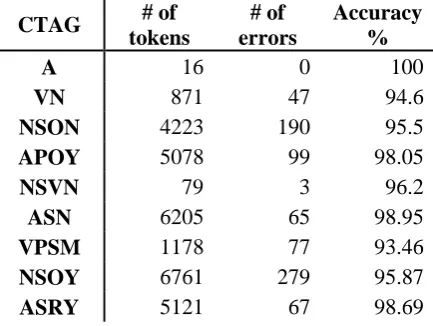
Experimental resultsUsing a training corpus composed of 1M words we withheld 10% for each individual CTAG as the test set. The results of our experiments are shown in Table 1. The overall accuracy of 94%
which is 12% higher than the results presented in Ion (2007).
In Table 1, all CTAGS beginning with an “N” are nouns, “A” are adjectives and “V” are verbs. The best result (100%) is for invariant adjectives (“A”) for which the lemma is the word form. This behavior is preserved for all CTAGs for which lemma is equal to the word form: NSRN (noun, singular, nominative/accusative, non-definite form) with 99.5%, ASN (adjective, singular, non-definite form) with 98.95%, etc. At the opposite pole we find words with CTAGs that are harder to lemmatize: NPN (noun, plural, non-definite form) with 81.51% or NPOY (noun, plural, dative/genitive, definite form) with 83.01% due to their root alternation when going from singular (the number of the lemma) to plural, e.g. for “stadioanelor” (NPOY, English
“to the stadiums”) lemma is “stadion” (English
“stadium”) where in bold we have the inflectional ending corresponding to the CTAG NPOY and in italic we have the root of the word.
CTAG # of
tokens
# of errors
Accuracy %
A 16 0 100
VN 871 47 94.6
NSON 4223 190 95.5
APOY 5078 99 98.05
NSVN 79 3 96.2
ASN 6205 65 98.95
VPSM 1178 77 93.46
NSOY 6761 279 95.87
ASRY 5121 67 98.69
NP 263 35 86.69
NPRY 6443 884 86.28
VG 2973 118 96.03
NN 263 3 98.86
VPSF 748 15 97.99
APN 6062 127 97.9
NSN 2591 6 99.77
V2 8195 664 91.9
NPOY 6427 1092 83.01
V3 7312 629 91.4
ASON 3030 43 98.58
VPPM 797 58 92.72
NSRY 6701 104 98.45
VPPF 747 15 97.99
V1 6180 455 92.64
APRY 5119 95 98.14
NSRN 4244 19 99.55
ASOY 5122 59 98.85
NPN 6615 1223 81.51
NPVY 28 3 89.29
NSVY 2225 31 98.61
ASVY 626 12 98.08
AN 106 6 94.34
Overall 112349 6523 94.19
Table 2 - Lemmatization results
5
Phonetic transcription
Phonetic transcription (PT; also referred to as grapheme-to-phoneme (G2P) or letter-to-sound (L2S)) can be formalized as finding a relation between letters and corresponding phonemes, which is not a straightforward task and may pose some challenges for languages such as English. For Romanian, phonetic transcription rules are relatively simple compared to English or French (Burileanu, 1999), but there are several exceptions that need to be managed. For the purpose of language independence, data-driven methods are preferable as they only require words and their phonetic transcription equivalents for training, which are easier to obtain than wide coverage set of phonetic transcription rules.
than by inflectional ones, especially for nouns and verbs. Since the vast majority of derivational affixes change the grammatical category of a word, we were motivated to split our training data into 5 categories: nouns (N), verbs (V), adjectives (A), adverbs (R) and mixed (M). This is where the main difference between our approach and other methods can be seen:
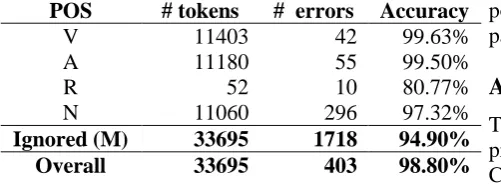
splitting the training data based on the part-of-speech increases the overall accuracy by 3.9%
(see Table 3).
POS # tokens # errors Accuracy
V 11403 42 99.63% A 11180 55 99.50%
R 52 10 80.77%
N 11060 296 97.32%
Ignored (M) 33695 1718 94.90%
Overall 33695 403 98.80%
Table 4 - Lexical stress accuracy
When predicting the primary lexical stress position for a given word, a model is chosen based on the POS tag of the given word. If the POS is different from the first four categories or if it is unknown (if there is no context available), the system uses the mixed model, which is a model created by training on the entire lexicon regardless of the POS.
The lexical feature templates we used for lexical stress prediction are identical to the ones we used for lemmatization.
7
Conclusions
In this paper we addressed the task of lexical processing for OOV words, which are one of the main sources of errors in both speech synthesis and natural language processing applications. We presented a unified data-driven framework that is designed to accurately handle the lemmatization, syllabification, phonetic transcription and lexical stress prediction of OOV words. Although, our main focus was on Romanian, the advantage of using data-driven methods is that with proper training lexicons and, in some cases, with minor adjustments, they can be applied to any other language.
Our results are better than state-of-the-art results cited for Romanian in the case of syllabification (99% vs. 97%) and lemmatization (94% vs. 82%), and only slightly worse for phonetic transcription (96.3% vs. 97%) and lexical stress prediction (98.8% vs. 99%), which
can be explained by the fact that we did not incorporate any explicit knowledge of Romanian into our algorithms. In this context, we should emphasize that we successfully employed the MIRA framework described in this paper (without any modifications) to do phonetic transcription for English, French, German and Dutch and lemmatization for Serbian with very good results.
The methods we presented are already implemented in a natural language pre-processing tool written entirely in JAVA for portability and available as an open-source package.
Acknowledgments
References
Bartlett, S., Kondrak, G., & Cherry, C. 2008. Automatic syllabification with structured SVMs for letter-to-phoneme conversion. Proceedings of ACL-08: HLT, 568-576.
Black, A. W., Lenzo, K., & Pagel, V. 1998. Issues in building general letter to sound rules. In The Third ESCA/COCOSDA Workshop (ETRW) on Speech Synthesis.
Burileanu, D., Sima, M., & Neagu, A. 1999. A phonetic converter for speech synthesis in Romanian. In Proc. of the XIVth International Congress on Phonetic Sciences ICPhS’99 (pp. 503-506).
Crammer, K. and Singer, Y. 2003. Ultraconservative online algorithms for multiclass problems. The Journal of Machine Learning Research, 3:951–991.
Daelemans, W., Van Den Bosch, A., & Weijters, T. 1997. IGTree: Using trees for compression and classification in lazy learning algorithms. Artificial Intelligence Review, 11(1), 407-423.
Demberg, V., Schmid, H., & Mohler, G. 2007. Phonological constraints and morphological preprocessing for grapheme-to-phoneme conversion. In Annual Meeting-Association for Computational Linguistics (Vol. 45, No. 1, p. 96).
Franzén, V., & Horne, M. 2009. Word stress in Romanian. Lund Working Papers in Linguistics, 46, 75-91.
Ion, R. 2007. Word Sense Disambiguation Methods Applied to English and Romanian. PhD thesis (in Romanian). Romanian Academy, Bucharest.
Jiampojamarn, S., Cherry, C., & Kondrak, G. 2008. Joint processing and discriminative training for letter-to-phoneme conversion. Proceedings of ACL-08: HLT, 905-913.
Kahn, D. 1976. Syllable-based generalizations in English phonology (Vol. 156). Bloomington: Indiana University Linguistics Club.
Lafferty, J., McCallum, A., & Pereira, F. C. 2001. Conditional random fields: Probabilistic models for segmenting and labeling sequence data.
Oancea, E., & Badulescu, A. 2002. Stressed syllable determination for Romanian words within speech synthesis applications. International Journal of Speech Technology, 5(3), 237-246.
Stan, A., Yamagishi, J., King, S., & Aylett, M. 2011. The Romanian Speech Synthesis (RSS) corpus: building a high quality HMM-based speech synthesis system using a high sampling rate.
Speech Communication, 53(3), 442-450.
Tufiş, D. 1999. Tiered tagging and combined language models classifiers. Text, Speech and Dialogue (pp. 843-843). Springer Berlin/Heidelberg.
Ungurean, C., Burileanu, D., Popescu, V. and Derviş, A. 2011. Hybrid Syllabification and Letter-To-Phone Conversion For TTS Synthesis. In U.P.B. Sci. Bull., Series C, Vol. 73, Iss. 3, 2011, ISSN 1454-234x