Principles for annotating and reasoning with spatial information
Paul C. Mor˘arescu
University of Texas at Dallas Richardson TX 75080 [email protected]
Abstract
In this paper we present the first phase of the ongoing SpaceBank project that attempts to create a linguistic resource for annotating and reasoning with spatial information from text. SpaceBank is the spatial counterpart of TimeBank, an electronic resource for temporal semantics and reasoning. The paper focuses on building an ontology of lexicalized spatial concepts. The textual occurrences of the concepts in this ontology will be annotated using the SpaceML language, briefly described here. SpaceBank is designed to be integrated with TimeBank, for a spatio-temporal model of the textual information.
1.
Introduction
Most entities, relations, events or situtations that populate any fragment of text or speech are related to time and space. Most mental and computational world models include, or are based on, a spatio-temporal component. Therefore, cap-turing the spatial and temporal information is a key step in building such models from text, in content-based text pro-cessing tasks such as Information Extraction or Question Answering. The temporal aspect of the problem has re-ceived much attention from the NLP community in recent years, one notable result being the creation of TimeBank (Hobbs and Pan 2004). TimeBank is an integrated elec-tronic resource based on the DAML-Time temporal ontol-ogy and a linguistic corpus. The occurrences of the on-tology concepts as parts of larger events in the corpus are annotated using a specification language called TimeML. This resource is currently used in temporal inference tasks. In contrast, the spatial aspect of the problem has received much less attention. There are multiple projects and re-sources which consider this domain among other domains. They are surveyed in section 2 of this paper. Their value and limitations for the spatial content-based text process-ing are the object of Section 2, and Section 3.1 shows that the spatial domain still needs an integrated resource similar to TimeBank. This paper attempts to fill that niche by intro-ducing SpaceBank, which is also designed to integrate with TimeBank for a spatio-temporal model of the world. Sec-tions 3.2 and 3.3 describe the construction of a spatial on-tology. Section 4 gives a brief specification of the SpaceML language, and Section 5 draws the conclusions.
2.
Previous work
This section surveys the existing research tasks and re-sources that are relevant to this paper. They are grouped in three categories: hierarchies, ontologies and linguistic corpora. The first two attempt to organize the spatial con-cepts that populate certain areas of human cognition. The third attempts to annotate the occurrence of such concepts in texts.
2.1. Hierarchies of Spatial Concepts
A hierarchy covers a certain subdomain of language or cog-nition. For example, Named Entity Recognition (NER) sys-tems such as (Bikel et al.1999) recognize locations, among
other named entities. All kinds of locations are tagged sim-ply as LOCATION. Only a few NER systems are able to distinguish subclasses of locations such as cities and coun-tries. These systems are based on Extended Named Entity
Hierarchies, which function as shallow ontologies.
Geo-graphical Information Systems1(GIS) need to recognize a
large variety of geographical and geopolitical units. Most units form a hierarchy of containment, which is a funda-mental spatial relation.
2.2. Spatial Ontologies
OpenCyc2 is a large-scale ontology that includes the
spa-tial domain, represented by complex hierarchies of spaspa-tial
relations3, movements4, geographical entities5, paths and traversals6and transportation7.
Smaller ontologies covering the spatial domain, among other domains, include the Basic Formal Ontology (BFO, (Grenon and Smith 2004)), the Suggested Upper Merged Ontology (SUMO, (Nills and Pease 2001) and the Region Connection Calculus (RCC, (Cohn et al.1999)).
A comprehensive and general ontology is WordNet (Fell-baum 1998), which groups semantically synonymous words in sets called synsets and organizes them according to the ISA (hypernymy) and other semantic relations. Sig-nificant parts of WordNet’s hierarchies are made of spatial concepts. WordNet is the base of our ontology, as shown in Section 3.3.
2.3. Spatial Linguistic Corpora
PropBank (Kingsbury et al.2001) annotates predicates and their arguments, which designate the objects of predicates and the modifiers of the entire predication. The locative modifiers represent the spatial information that apply to the predication. PropBank does not distinguish subclasses of locative modifiers, and it is thus of limited use to a study of the spatial domain of English. However, there are many shallow semantic parsers trained on PropBank, and one of
1
http://www.geo.ed.ac.uk/home/giswww.html
2
http://www.opencyc.org/
3
http://www.cyc.com/cycdoc/vocab/spatial-vocab.html
4http://www.cyc.com/cycdoc/vocab/movement-vocab.html 5
http://www.cyc.com/cycdoc/vocab/geography-vocab.html
6http://www.cyc.com/cycdoc/vocab/path-traversal-vocab.html 7
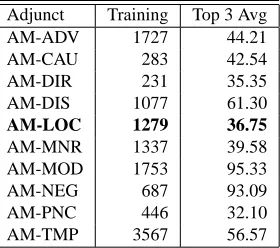
their most difficult tasks is recognizing locative adjuncts,
as shown in Table 18. This motivates the search for new
ideas in the spatial domain, that are relevant at this level of linguistic representation.
Adjunct Training Top 3 Avg
AM-ADV 1727 44.21
AM-CAU 283 42.54
AM-DIR 231 35.35
AM-DIS 1077 61.30
AM-LOC 1279 36.75
AM-MNR 1337 39.58
AM-MOD 1753 95.33
AM-NEG 687 93.09
AM-PNC 446 32.10
AM-TMP 3567 56.57
Table 1: CoNLL 2004: top 3 systems’ average performace in recognizing adjuncts in PropBank
The PropBank annotations of locative adjuncts are
illus-trated in the sentences9in Figure 1.
[The size and pace of disbursements]Arg1 willArgM−M OD
accelerateREL furtherArg2−M N R [under the Brady
Plan]ArgM−LOC, which promises larger and earlier
dis-bursements to approved countries.
[Which flights]Arg1stopREL[in Minneapolis?]ArgM−LOC
HereArgM−LOC sheArg0deliversREL, [especially during her
enthusiastically awful rendition of the “Candy Man,” which she sings while prancing around in a little cotton candy pink angora sweater that couldn’t be more perfect.]ArgM−T M P
Figure 1: Examples of PropBank annotations of locative adjuncts
The linguistic expressions annotated as locative adjuncts in the first and the third example above are not really locatives. In the first example, the expression under the Brady Plan is synonymous to the expression according to the Brady
Plan, which clearly is not a locative, despite using the un-der preposition. This serves as a simple example of spatial
vocabulary borrowed by non-spatial domains. In the third example, the word here in the expression Here she delivers, is not a locative either. Therefore, PropBank annotations of locative adjuncts may be too shallow to be included in a study of the spatial language.
The Automatic Content Extraction 10 (ACE-2004,2005)
evaluations annotate the text occurrences of three types of spatial relations (Located, Near and Part-whole). These are relations between pairs of entities (e.g., a
GeoPoliti-cal Entity and an ORGanization), and thus differ from the
relations between locative adjuncts and their predications in PropBank. Figure 2 presents an example annotation for
each of the three relation types mentioned.11
Our analysis indicates that the ACE annotation does not suffer from the problems reported above for PropBank.
8http://www.lsi.upc.edu/˜srlconll/st04/slides/intro.pdf 9
http://www.cs.rochester.edu/˜gildea/Verbs/
10
http://www.itl.nist.gov/iad/894.01/tests/ace/
11
Examples are taken from ACE-2004 data. The labels indicate entity types, as follows: PER: person, FAC: facility, and WEA: weapon
TheyP ER left [the Al-Rashid hotel, where foreign visitors stay
in Baghdad]F AC
HummerP ERovertook Austrian David Kriner who placed
sec-ond in the ski jumpP ERafter about one kilometer.
[A mixture of gunpowder and ammoniaW EA]W EA, the same
materials used to make the bomb which killed around 211 peo-ple in september 1999 in Moscow and other areas of Russia
Figure 2: Examples of ACE annotations of PHYS-ical re-lations
That is, the information annotated as locative is indeed locative. However, the ACE corpus has its own limitations with respect to the spatial language. The most important limitation is that only three types of spatial relations are annotated, and even they are restricted to few classes of ar-guments.
We built a simple recognizer for all ACE relations, based on 13 features an the J48 classifier in WEKA, which was em-pirically observed to obtain good results on this problem, compared to other algorithms implemented in the same data mining library. Table 2 shows the results obtained by this classifier on detection and classification of spatial relations.
Relation Training P R F
PHYS Located 1019 0.779 0.946 0.854
PHYS Near 136 0.222 0.029 0.052
PHYS Part-Whole 514 0.811 0.869 0.839
Table 2: Performace in recognizing ACE spatial relations
The explanation for the large drop in performance ob-served for the PHYS Near relation is given by the
con-fusion matrix presented in Table 3 12. Most instances
of the PHYS Near relation are misclassified either as PHYS Located or PHYS Part-Whole.
Relation Training a b c
PHYS Located (a) 1019 894 6 0
PHYS Near (b) 136 42 4 76
PHYS Part-Whole (c) 514 9 6 487
Table 3: Confusion matrix for ACE spatial relations
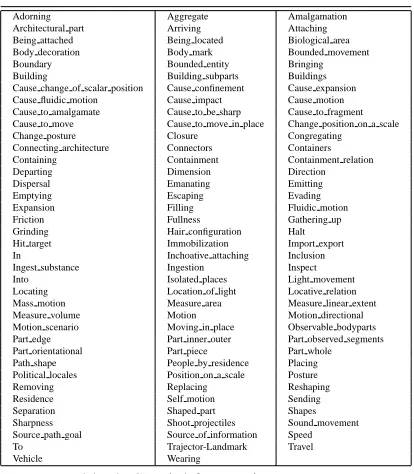
FrameNet (Backer et al.2003) annotates semantic frames (Filmore 1985), which represent events or situations. Each frame contains several frame elements, which encode the participants and the properties of the event or state defined by the frame. FrameNet annotates spatial information both in the form of frames and in the form of frame elements. Table 4 lists the 112 frames, out of the 609, that we consider relevant for the spatial linguistic domain.
Figure 3 illustrates the FrameNet annotation of the
Empty-ing, DepartEmpty-ing, and Attaching frames. In these examples,
each annotated instance of a spatial frame has at least two conveyors of spatial information: the verb and one spatial frame element. The two entities which serve as arguments to the spatial relation are not necessarily among the frame
12
which make them difficult to discriminate based on surface features alone.
These resources also have important (and sometimes inher-ent) limitations in the spatial domain: (1) None of them is dedicated to spatial language, thus none can be expected to be either optimal or comprehensive in this area; (2) They are difficult to integrate, since each is underlied by a dif-ferent theory and operates at a difdif-ferent linguistic level; (3) Typical ontologies mentioned in the previous section orga-nize concepts to allow logical inference, but they do not offer an annotated corpus for training. Linguistic corpora have the opposite problem.
The spatial domain needs a resource that combines an on-tology and an annotated corpus. This is the main purpose of SpaceBank.. It is also designed to be integrated with Time-Bank, to produce a spatio-temporal world representation which combines the features of both components. To this end, SpaceBank uses the same linguistic corpus as Time-Bank. The specification language, named SpaceML, is de-signed as an extension to TimeML. The spatial ontology, called DAML-Space, follows the steps of DAML-Time. Among the problems that the design of a spatial ontology must solve, we mention the potential difference between the
ontological type of an entity (e.g., ORGANIZATION) and its
spatial function (e.g., DESTINATION, such as Oracle in the sentence Bill Gates visited Oracle today.). There is a many-to-many mapping between concepts and spatial functions. As a real world example to illustrate the spatial concepts in a text that would need to be included in a spatial on-tology, we take the first sentence of an Associated Press newswire article from Oct 20, 2005: Hurricane Wilma’s
outer edge battered Cancun’s white-sand beaches Thurs-day as officials ordered hotel guests to evacuate, tourists jockeyed for spots on the last flights out, and tens of thou-sands of people fled from Honduras to the Florida Keys.
There are several spatial concepts and relations in this sen-tence: (1) A special part-whole relation between Hurricane Wilma and its outer edge, invoked by the genitive construc-tion. The relation is special because the edge is not a real
part of the hurricane, but rather a property.; (2) A
typi-cal part-whole relation between the city of Cancun and its beaches, invoked by the genitive; (3) A destination rela-tion between Hurricane’s edge and the beaches, invoked by the semantic frame (i.e., Cause harm) of the verb batter. Note that the beaches are the Victim frame element, thus there are frame elements that have a spatial function which is not their main function (and, consequently, they are not listed in Table 5); (4) An origin relation between the hotel and the guests’ evacuation, invoked by the semantic frame (i.e., Escaping) of the verb evacuate. The hotel is the
Un-desirable location frame element, whose main function is
spatial, and thus it is listed in Table 5; (5) A destination re-lation between tourists and the spots in the last flights out, invoked by the verb jockey (note that the spots is a spatial metaphor for airplane seats and flights out also invokes a spatial relation of origin between the flights and the city; (6) An origin relation betwen tens of thousands of people and Honduras, and a destination relation between the same
people and Florida Keys, both relations invoked by the verb flee. Since Honduras is a different location from Cancun,
establishing a causal link between the Hurricane’s presence in the latter location and tourists’ fleeing the former loca-tion is a matter of extralinguistic spatial knowledge about the proximity of the two locations and the typical size of a Hurricane.
3.2. Primitives for a Spatial Ontology
(Gambarotto 2003) notes that identifying the ontological primitives of the spatial domain assumes the isolation of the basic objects of the geometry of our perception of the world. Note that the argument operates with the geometry of our perception, rather than the geometry of the world itself. This fact is the object of a general agreement in the cognitive literature, which uses the terms
psychologi-cal space or mental space to designate the space we are
talking or writing about, as opposed to the physical space we know from Geometry or Physics. Summarizing another general agreement in cognition, (Levinson 1996) states that the main difference between the mental space and the phys-ical space is that the former is relative, whereas the latter is absolute. The relative space is anchored in the places occupied by physical objects around us and the relations between them. The linguistic counterparts of these cogni-tive arguments come from (Svorou 1994) and (Vandeloise 1991), among others. Svorou notes that we reason and talk about space in ways that reveal our beliefs rather than our
scientific knowledge on the subject. Vandeloise argues for
the inadequacy of both the geometric models and the logic models for the semantics of spatial prepositions in French. To isolate the basic objects of the geometry of our percep-tion, and thus to identify the ontological primitives, cross-linguistic studies propose three ontological topics, or types of concepts: (1) Topology, which refers to inclusion and contact; (2) Orientation; and (3) Distance. The ontological problem is to choose the primitive concepts, or objects, that populate these topics. At this point, we distinguish between primitives that are abstract concepts such as points or
vec-tors, which make use of our knowledge in the Euclidean
ge-ometry to code both the orientation and the distance in the relative space, and regions of space corresponding to phys-ical objects. (Setzer 2001) mentioned temporal ontologies based on points only, as well as temporal ontologies based on intervals only. Each has advantages and drawbacks. A particular approach is to use the intervals defined in (Allen 1983) for the temporal domain. (Gambarotto 2003) notes that using Allen’s relations requires the approximation of physical objects by parallelepipedic shapes.
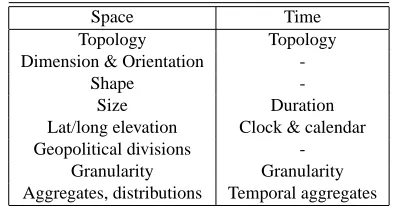
Hobbs 14 proposes an extended list of spatial ontological
topics, which are listed in Table 6 next to their temporal counterparts.
The topology includes points, arcs, surfaces, volumes, con-nectedness and boundaries. The dimension and orientation include direction, path, conversions between different co-ordinate systems and the frame of reference. The Shape includes various 2D and 3D shapes, and the symmetry. The subtopics of size include length, area, volume, precise and uncertain measures. The geopolitical divisions were those occurring in FrameNet and ACE corpora, including coun-try, state, county, city and continent. The granularity is a
14
Space Time
Topology Topology
Dimension & Orientation
-Shape
-Size Duration
Lat/long elevation Clock & calendar Geopolitical divisions
-Granularity Granularity Aggregates, distributions Temporal aggregates
Table 6: Topics in the spatial and temporal ontologies
design feature that allows a concept like a city to be treated either as a point, space or volume. This flexibility must be provided by the design of the entire ontology.
3.3. Our Lexicalized Spatial Ontology
Our main purpose in building a new spatial ontology is to facilitate the automatic recognition of spatial concepts and relations in newswire text, and to enable the automatic logic inference in the spatial domain. As such, we focus on lex-icalized concepts that have clearly identifiable spatial
char-acteristics15, rather than abstract concepts that attempt to
organize the entire spatial domain. For these reasons, rather than taking the rationalistic top-down way of fixing some primitives and then trying to fit all the textual spatial items into their bounds, we decided to follow a more empirical path. Namely, we start with a comprehensive semantic re-source for English and then follow the bottom-up path to the primitives. As such, we decided to start the ontology construction from WordNet.
We identified the WordNet synsets corresponding to the nominal topics and concepts proposed by Hobbs. From these starting points, we explored the WordNet noun hier-archy both top-down and bottom-up. The bottom-up search
always stops at the{entity}synset, which is the root of the
hierarchy. The top-down search, which is initiated from every synset that we reach during the search, follows only the hyponymy and instance links that lead to spatial synsets and stops when it reaches a synset that has only spatial hy-ponyms and instances. Figure 5 illustrates the part of the top level ontology that subsumes the physical object hier-archy. The entire nominal ontology has 11,452 word-sense pairs, which represent 7.9% of the 145,104 nominal word-sense pairs in WordNet 2.1. We computed the polysemy frequencies to evaluate the need for Word Sense Disam-biguation when recognizing in text concepts from our on-tology. Table 7 presents the results. The average polysemy is 1.68, which is larger than 1.23, the average polysemy of the entire WordNet nominal hierarchy. The spatial lan-guage is ambiguous, therefore Word Sense Disambiguation is required.
P 1 2 3 4 5 6 7 8 11 28
F 3932 1750 726 244 79 40 16 10 1 1
Table 7: Polysemy in the nominal spatial ontology. P = polysemy, F = frequency
15
(Bierwisch-96) classifies concepts, their properties and their relations in four categories, according to their degree of spatiality: strictly spatial, intrinsically spatial, extrinsically spatial and aspatial. He also shows that space enters language through semantics, rather than through morphology or syntax, even in highly inflected lan-guages.
4.
The SpaceML annotation language
The SpaceML specificaction language has four major data structures which mirror the TimeML structures as illus-trated in Table 8 SpaceML uses the event structure defined
TimeML SpaceML
EVENT EVENT
TIMEX3 SPACEX
SIGNAL SIGNALS
LINK LINKS
Table 8: The major data structures in TimeML and
SpaceML
in TimeML. SPACEX is used to mark up explicit spatial expressions such as geopolitical entities, postal addresses, latitude and longitude and distances. The spatial expres-sions may be (a) Fully specified, such as 2601 North Floyd
Rd, Richardson, TX 75080; (b) Underspecified expressions,
such as the next block; and (c) Directions, Paths, Shapes and Orientations, e.g., towards the White House. The at-tributes of the SPACEX tag mirror those of TIMEX3. The SIGNALS tag annotates sections of text, typically function words, that indicate how spatial objects are to be related to each other. SIGNALS marks up several types of indicators: (1) Prepositions that have spatial meanings (among others): on, in, at, to, between, above, in front of and outside of. (2) Nominalizations such as entrance,
trans-portation and connection; (3) Motion verbs such as exit, advance and move; and (4) Dimensional adjectives such
as high, short and thick, as well as their nominalizations:
height, shortness and thickness.
The LINKS tag encodes spatial relations, which can relate two events, two entities or an event to an entity. Entities may or may not be locative. The LINKS tag does not in-clude subordinate and aspectual links as does the tempo-ral LINK tag, but it accounts for the frame of reference, which is the origin of the coordinate system in which the spatial relation is to be interpreted. Specifying the frame of reference disambiguates expressions like on the left
side-walk, in front of the tree, and behind the door. We
distin-guish frames of reference centered on a person (usually the speaker), the earth (invoked by expressinons such as the
northwest corner), and on the carrier or thedriving force
in case of a motion event. Besides the frame of reference, the LINKS tag marks up the class of spatial relation, e.g.
location, part-whole, near and containment.
5.
Conclusions and Future Work
Figure 5: The top level of the nominal ontology (the physical entities). The numbers refer to WordNet senses.
6.
References
James F. Allen. 1983 Maintaining Knowledge about Temporal Intervals. ACM Comm. 832-843
Collin F. Backer, Charles J. Fillmore and Beau Cronin. 2003. The Structure of the Framenet Database. In International Journal
of Lexicography, Volume 16.3: 281-296..
Manfred Bierwisch. 1996. How Much Space Gets into Lan-guage? In (Bloom et al. 1996).
Daniel M. Bikel and Richard L. Schwartz and Ralph M. Weischedel. 1999. An Algorithm that Learns What’s in a Name. In Machine Learning, Vol.34, No.1-3:211-231. Paul Bloom, Mary A. Peterson, Lynn Nadel, and Merrill Garrett
(Eds.). 1996. Language and Space. MIT Press, 1999. Anthony G. Cohn and Brandon Bennett and John Gooday and
Nicholas Mark Gotts. 1997. Qualitative Spatial Representa-tion and Reasoning with the Region ConnecRepresenta-tion Calculus. In
GeoInformatica, Vol.1, No.3:275-316, 1997.
Christiane Fellbaum. 1999. WordNet - An Electronic Lexical Database. MIT Press, 1998.
Charles J. Fillmore. 1985. Frames and the semantics of under-standing. In Quaderni di Semantica, Vol. 6.2: 222-254, 1985. Christian Freksa, Christopher Habel, Karl F. Wender (Eds.). 1998.
Spatial Cognition. Springer Verlag, 1998.
Pierre Gambarotto and Philippe Muller. 2003. Ontological Prob-lems for the Semantics of Spatial Expressions in Natural Lan-guage. In (van der Zee 2003)
Pierre Grenon and Barry Smith. 2004. SNAP and SPAN: Towards Dynamic Spatial Ontology. In Spatial Cognition and
Compu-tation, 4(1), 6910, 2004.
Jerry R. Hobbs, and Feng Pan. 2004. An Ontology of Time for the Semantic Web. In ACM Transactions on Asian Language
Information Processing, Vol. 3, No. 1, March 2004.
Paul Kingsbury, Martha Palmer, and Mitch Marcus. 2002. Adding Semantic Annotation to the Penn TreeBank. In
Pro-ceedings of the Human Language Technology Conference,
2002.
Stephen C. Levinson. 1996. Frames of Reference and Molyneux’s Question: Crosslinguistic Evidence. In (Bloom et al. 1996).
Niles, I., and Pease, A. 2001. Towards a Standard Upper Ontol-ogy. In Proceedings of the 2nd International Conference on
Formal Ontology in Information Systems (FOIS-2001), Chris
Welty and Barry Smith, (Eds.), Ogunquit, Maine, October 17-19, 2001., 2002.
James Pustejovsky, Robert Ingria, Roser Saur, Jos Castao, Jessica Littman, Robert Gaizauskas, Andrea Setzer, Graham Katz and Inderjeet Mani. 2005. The Specification Language TimeML. The Language of Time - a Reader, Oxford University Press, 2005
Andrea Setzer. 2001. Temporal Information in Newswire Arti-cles: an Annotation Scheme and Corpus Study. PhD Thesis, University of Sheffield, 2001.
Soteria Svorou. 1994. The Grammar of Space. 1994. John Ben-jamins Publishing Co., 1993.
Claude Vandeloise. 1991. Spatial Prepositions. The University of Chicago Press, 1991.