Cryptanalysis of Nonlinear Stream Cipher Cryptosystem
based on Improved Particle Swarm Optimization
Salim A. Abbas Al-Ageelee,
PhD Dept.of ComputerScience &Al-Mustansiriya University
Riyam N. J. Kadhum
Dept.of ComputerScience & Al-Mustansiriya University
ABSTRACT
Stream cipher is one of the hard electronic cipher systems because of high security and difficulty in breaking it. In this paper the proposed cryptanalysis system based on a Particle Swarm Optimization (PSO) with suggestions for improving the achievement of PSO, by using Simulated Annealing (SA) that is the first part of this paper. The second part represented by a comparison study for the cryptanalysis results obtained by the Improved PSO (IPSO) with classical PSO and Genetic Algorithm (GA).The cryptanalysis process include finding the initial state of the attacked stream cipher cryptosystem using ciphertext only attack.
Keywords
Stream Cipher System, Cryptanalysis, Particle Swarm Optimization, Genetic Algorithms, Simulated Annealing, Improved Particle Swarm Optimization..
1.
INTRODUCTION
Cryptanalysis is the science of recovering the plaintext of a message without access to the key. It is a method of transforming cipher text into a plaintext without knowing the key or algorithm [1].
However the cryptanalysis of stream ciphers through soft computing techniques as Particle Swarm Optimization (PSOs), Genetic Algorithms (GAs) is still an emerging issue. GA is based on the evolutionary ideas of Natural selection and genetics [2]. GA is a good condidate for the optimal solutions to optimization and search problems. The algorithm has been successfully applied to Vertex-Cover problem [3], Maximum-Clique problem [4], Regression testing [5], N-puzzle problem [6], Traveling Salesman Problem [7].
PSO was originally developed by a social-psychologist J. Kennedy and an electrical engineer R.Eberhart in 1995 and emerged from earlier experiments with algorithms that modeled the “flocking behavior” seen in many species of birds. Where birds are attracted to a roosting area in simulations they would begin by flying around with no particular destination and in spontaneously formed flocks until one of the birds flew over the roosting area [8]. PSO has been an increasingly hot topic in the area of computational intelligence. It is yet another optimization algorithm that falls under the soft computing umbrella that covers genetic and evolutionary computing algorithms as well [9]. There are many researches has been written on using soft computing techniques to cryptanalysis different types of encryption systems some of these: A.J.Clark, in his Thesis uses various optimization heuristics in the fields of automated cryptanalysis and automated cryptographic function generation[10], M.F. Uddin in his paper focused on using of PSO in cryptanalysis of simple substitution ciphers using
optimization approach such as GAs is considered to improve the cryptanalysis problem[12], S. M. Hameed in her work used PSO to cryptanalysis transposition cipher, PSO used ciphertext only attack to recover the secret [13], H.A.M Al_Sharifi,in his research focused on using of PSO algorithm to cryptanalysis stream cipher using plaintext attack choosing one Linear Feedback Shift Register (LFSR) [14], B.N. Ferriman, in his Thesis focused on the RC4 algorithm and present a new approach for cryptanalysis of the cipher by attacking RC4s state register[15], Ali A. Abd in his research is considered a new approach to cryptanalysis stream cipher systems based on GA [16]. The present work explores the related work done and applicability of GAs and PSOs in a field of cryptanalysis.
In this paper the proposed technique employed for the purpose of Cryptanalysis
To apply ciphertext only attack to cryptanalysis the Geffe system as a case study of stream cipher cryptosystem. This technique exploites hybridization between PSO and SA. The rest of this paper has been organized as follows: Section 2 presents a brief overview of soft computing techniques. Section 3 presents designing cryptanalysis systems for stream cipher. Section 4 presents a comparison result of cryptanalysis system between GA, PSO and IPSO. The last section explains the conclusion.
2.
SOFT COMPUTING TECHNIQUES
2.1 Genetic Algorithm
GAs is the search heuristic that mimics the process of natural evolution [2]. It is based on the Darwin’s principle of Natural selection. According to this theory the chromosomes with the best fitness function should survive and create new offspring (survival of the fittest). GAs gives useful solution to optimization and search problem. It is a rapidly growing area of Artificial Intelligence. The GAs starts with the population which is nothing but chromosomes which can be decimal or binary or even hexadecimal. The GAs operator is applied to population in order to optimize the results [17]. The new population is formed from the old population with better fitness value. The population can be crafted using the operators: Population size, Fitness Function, Selection, Crossover, Mutation. [18, 19, 20].
2.2 Particle Swarm Optimization
correct their positions and velocities by using the received information [21].
2.2.1 Basic Elements of the PSO Technique
[22,23].
The basic elements of PSO technique are briefly stated and defined as Follows:
1-Particle, Xi: It is a candidate solution represented by an
m-dimensional vector, where m is the number of optimized parameters.
2- Population, pop(t) : It is a set of n particles at time i, i.e. pop(i) = [Xi1, ..., Xin]T. The number of particles in population
would be between 20 to 30.
3- Swarm: It is an unsystematic moving particles population, which Band together and at the same time every particle moves in a Unorganized direction.
4- Particle velocity, Vi: It is the speed of the moving particles which can be characterized by k-dimensional vector.
5- Inertia weight, wi: It is a control factor used to control the effect of the preceding velocities on the present velocity. 6- Individual best, pi: it is the composition of the particle fitness value at the present position to the best fitness value it has ever reached.
7-Global best, pjg: It is the best location obtained in all individual locations.
8-Stopping criteria: it is the terms which finish search process.
2.2.2 PSO Methods
There are several methods of PSO depending on the shape of Updated velocity equation of the particle those are:
Original PSO : Basic algorithm introduced to calculate the velocity and position of each particle and it is used to find the Optimal solution. velocity of individual particles updated as follows: Vij+1=Vij+c1r1( Pij - Xij) +c2r2 ( Pgj- Xij) (1)
j=1,…,n with the
position calculated as follows: Xij+1=Xij+Vij+1
(2) j=1….,n Where:
Xij: Particle position
Vij: Particle velocity
Pij: Best position found by jth particle
Pgj: Best position found by swarm
c1 and c2 : are the cognitive (individual) and social, (group)
learning, rates, respectively, The values of c1 and c2 are
usually assumed to be 2.
r1 and r2 : are uniformly distributed random numbers in the
range 0 and 1.
Inertia Weighted PSO : The inertia weighted PSO is added to decrease the velocity. Its value varies from 0.9 to 0.4. The value of the jth particle velocity can be formilated as:
Vjj+1 = wi vji + c1 r1 (pji – xji) + c2r2 (pjg – xji)
J=1,…,n (3)
Then the value of the inertia weight can be calculated :
wi = Wmax - (Wmax – Wmin/imax) * i (4)
where:
Wmaxis the initial value of the weight.
Wmin : is the final value of the inertia weight.
imax : is the maximum number of iterations. In this work, Inertia Weighted PSO type is used.
2.3 Simulated Annealing
Simulated annealing is based on the concept of annealing. In physics, the tern annealing describes the process of slowly cooling a heated metal in order to attain a “minimum energy state”. A heated metal is said to be in a state of “high energy”.. The technique merges hill-climbing with the probabilistic acceptance of non-improving moves. The search starts at some initial state S = S0. There is a control parameter T known as the temperature. This starts ‘high’ at T0 and is gradually lowered. At each temperature, a number of moves to new states are attempted. A candidate state is randomly selected from the neighborhood of the current state. The change in value of the cost function is calculated. If it improves the value of cost function, then a move to that state is taken; if not, then it is taken with some probability. Probabilistic acceptance is determined by generating a random value in the range (0, 1) and performing the indicated comparison. The algorithm is discussed below [24].
2.3.1 Basic Simulated Annealing
According to statistical thermodynamics, Pα, the probability of a physical system being in state α with energy Eα at temperature T satisfies the Boltzmann distribution. where kB is the Boltzmann’s constant, T is the absolute temperature, and Z is the partition function, defined by:
Pα = 1/Z e (-Eα / kB) T (5)
Z=∑βe- (EB /Kb) T (6)
the summation being taken over all states β with energy Eβ at temperature T. At high T , the Boltzmann distribution exhibits uniform preference for all the states, regardless of the energy. When T approaches zero, only the states with minimum energy have nonzero probability of occurrence. In SA, the constant kB is omitted. At high T , the system ignores small changes in the energy and approaches thermal equilibrium rapidly, that is, it performs a coarse search of the space of global states and finds a good minimum. As T is lowered, the system responds to small changes in the energy, and performs a fine search in the neighborhood of the already determined minimum and finds a better minimum. At T = 0, any change in the system states does not lead to an increase in the energy, and thus, the system must reach equilibrium if T = 0. When performing SA, theoretically a global minimum is guaranteed to be reached with high probability. The artificial thermal noise is gradually decreased in time. T is a control parameter called computational temperature, which controls the magnitude of the perturbations of the
energy function E(x). The probability of a state change is
determined by the Boltzmann distribution of the energy difference of the two states:
P = e−(ΔE / T) (7)
accepting a worse solution. The algorithm of simulated annealing as following:[24].
1. Initialize the system configuration. Randomize x(0).
2. Initialize T with a large value. 3. Repeat:
a. Repeat:
i. Apply random perturbations to the state x = x + Δx.
ii. Evaluate ΔE(x) = E(x + Δx) − E(x):
if ΔE(x) < 0, keep the new state;
otherwise, accept the new state with probability P = e−ΔE /T .
until the number of accepted transitions is below a threshold level.
b. Set T = T − ΔT .
until T is small enough.
3.
DESIGNING CRYPTANALYSIS
SYSTEMS FOR STREAM CIPHER
In this work the soft computing techniques used as GA and PSO and proposed technique IPSO which could be implemented and applied easily to solve various optimization problems. These techniques employed for the purpose of Cryptanalysis. We suggest main steps to designing cryptanalysis systems for stream cipher, we select the Geffe generator to be attacked .these steps of the analysis and procedure can be summarized as follows:Step1: select ciphertext (Ci).
Step2: generate the key stream (Ki) from Geffe generator system.
Step3: calculate the plainrtext(Pi) as follows: Ci XOR Ki=Pi .
Step4: design fitness function depending on the probability of numbers of 0's in Pi
Step5: apply soft computing techniques.
Step6: repeat step2 until stopping criteria satisfied.
3.1 Fitness Function Calculation
The main goal of cryptanalysis is to get the key in order to obtain the plaintext. Cryptanalysis stream cipher should get the correct key to decrypt the ciphertext. Using soft computing techniques to cryptanalysis stream cipher needs fitness to determine the best new generation. In this work, new fitness function based on xoring between Cn and Kn. Cryptanalysis of stream cipher based on statistical model is used to find the Linear Feedback Shift Regester (LFSRi) part of the key, i.e., the initial of the LFSRi, i €{1, …, s}. Where: Cn:cipher text digits.
Kn:the output key of Geffe generator
N: ciphertext length
Let n0 be the number of 0's in Pi ,then:
Fitness = P(0) = n0 / N (8) Here, the
best fitness >= 0.60, this rate considered the threshold in our work, it change according to different plaintext size.
We will attack the Geffe generator, nonlinear combining function which it consist of 3 LFSR in different Length:3,5,7. The algebraic normal form is:
ƒ (x1, x2, x3) = x1x2 XOR x2x3 XOR x3.
(9)
Here, the number of ciphertext symbols is determined to perform a ciphertext-only attack on the Geffe Cipher using the correlation attack. Our conclusion from the analysis is that the pseudonoise generator's output sequence and the sequences generated by the linear feedback shift registers (LFSR) should be uncorrelated. This leads to constraints for the nonlinear combining function to be used.
3.2 Using Genetic Algorithm (GA) to
cryptanalysis stream cipher systems
GA has been successfully applied to numerous applications in the field of search and optimization. It is recursive procedure that consists of a fixed population size of chromosomes. These chromosomes are created randomly or heuristically which represent the initial population. The population evolves by applying three basic operations: selection crossover and mutation with probability For the Initial Population, the cryptanalysis process begins with randomly generated numbers between {0, 1} as the key size for n chromosomes and sorting these numbers in ascending order. The sequence of these numbers represents the candidate keys (chromosomes). Each chromosome represents the candidate key which it uses to decrypt the ciphertext and then calculate the fitness value to determine the best chromosome (candidate key).3.3 Using PSO algorithm to cryptanalysis
stream Cipher
In Evaluation For the initial population, the cryptanalysis process begins with randomly generated numbers between {-1, 1} as the key size for n particles .The sequence of these numbers represents the candidate keys (particles). Randomly generates Velocity for each particle which it's bounded to some minimum and maximum values [Vmax, Vmin] where Vmin= -Vmax and it uses to reinforces the local search reconnoitering of the problem space. Each particle represents the candidate key and use to decrypt the ciphertext and then calculate the fitness value to determine the best particle (key). For the evaluation process, the fitness value for each particle (candidate key) must be calculated for each generation. Table 2 shows the most parameters of PSO that preferred to be used to decrypt stream cipher.
3.4 Using IPSO algorithm to cryptanalysis
stream Cipher
In IPSO the proposed cryptanalysis system used to apply ciphertext only attack to cryptanalysis the Geffe system using soft computing techniques exploded a hybridization between PSO and Simulated Annealing (SA).(see Fig.1) shows the Flow Chart of proposed system . In IPSO we will use the same parameters of classical PSO as mentioned in Table 2. The following Table 3 shows the parameters used in IPSO.
4.
COMPARISON RESULTS OF
CRYPTANALYSIS SYSTEM
BETWEEN GA, PSO AND IPSO.
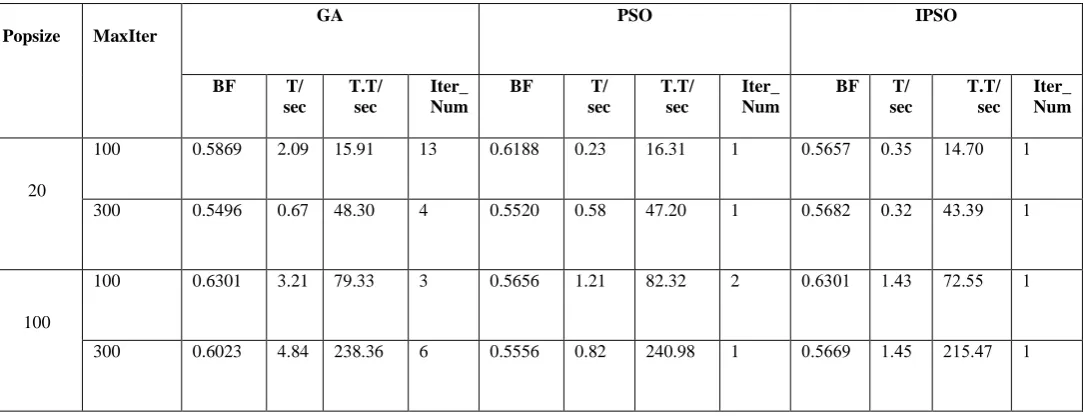
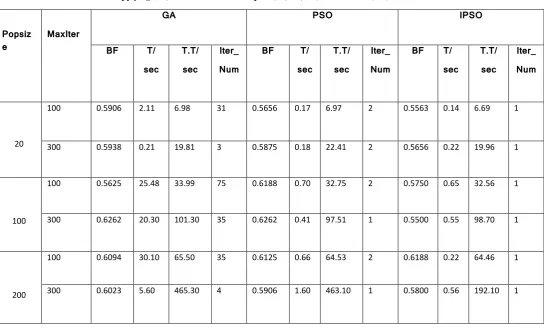
The following Tables 4,5, and 6 shows the results of applying proposed cryptanalysis system GA , PSO and IPSO ForPopsize(20,100,200) and Maxiter(100,300) For TxtLen=100,40,10 characters ,The following notations are used:
Popsize = Population size. MaxIter= Maximum Iteration. BF=Best Fitness.
T/sec=Time/second. T.T/sec=Total Time/second. Iter_Num= Iteration_Number.
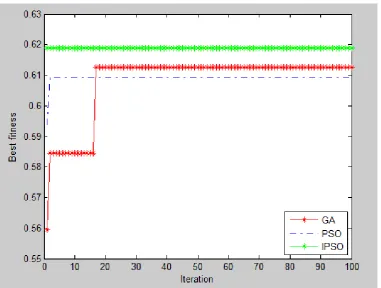
Fig. 2 shows the comparison between GA , PSO and IPSO in cryptanalysis system for Popsize =100 and MaxIter=100 for TxtLen=100 (see Figure 2).
Table 5 shows the results of GA For Popsize(20,100,200) and Maxiter (100,300) For TxtLen=40 characters.(see Table 5). Fig. 3 Shows the comparison between GA, PSO and IPSO in cryptanalysis system for Popsize =200 and MaxIter=100 for TxtLen=40 (see Fig. 3).
Table 6 shows the results of GA,PSO and IPSO For Popsize(20,100,200) and Maxiter(100,300) For TxtLen=10 characters (see Table 6).
Fig. 4 Shows the comparison between GA, PSO and IPSO in cryptanalysis system for Popsize =20and MaxIter=300 for TxtLen=10.
(see Fig. 4).
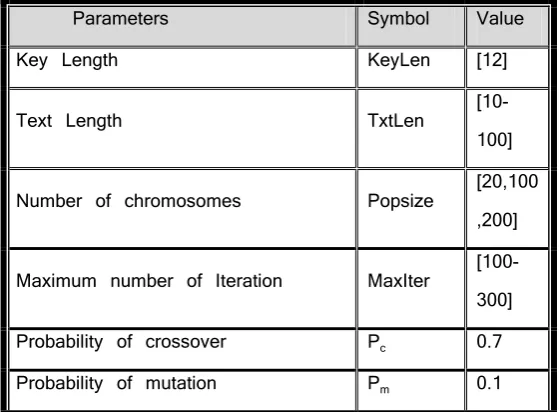
Table 1 : GA parameters to attack stream cipher.
Parameters Symbol Value
Key Length KeyLen [12]
Text Length TxtLen
[10-100]
Number of chromosomes Popsize [20,100
,200]
Maximum number of Iteration MaxIter
[100-300]
Probability of crossover Pc 0.7
Probability of mutation Pm 0.1
Table 2 : PSO parameters to attack stream cipher.
Parameters Symbol Value
Number of particles in the swarm Popsize [20-200]
Length of text TxtLen [10-100]
The maximum number of Iteration MaxIter [100-300]
The maximum of velocity Vmax 4
The minimum of velocity Vmin -Vmax
Inertia Weight W [0.4-
0.9]
Acceleration parameter C1,C2 [0.5-2]
Random number between [0,1] r1,r2 [0-1]
Table 3: IPSO parameters to attack stream cipher
Parameters Symbol Value
Number of particles in the swarm Popsize [20-200]
Number of Key KeyLen [12]
Length of text TxtLen [10-100]
The maximum number of Iteration MaxIter [100-300]
The maximum of velocity Vmax 4
The minimum of velocity Vmin -Vmax
Inertia Weight W [0.4- 0.9]
Acceleration parameter C1,C2 [0.5-2]
Random number between [0,1] r1,r2 [0-1]
Initial temperature T 0.1
Table 4: results of applying GA , PSO and IPSO for Popsize(20,100,200) and MaxIter(100,300) for TxtLen=100 characters.
IPSO PSO
GA MaxIter
Popsize
Iter_ Num T.T/
sec T/
sec BF Iter_
Num T.T/
sec T/
sec BF
Iter_ Num T.T/
sec T/
sec BF
1 17.41 1..0
1.0504 1
16.31 0.23
0.6188 13
15.91 2.09 0.5869
100 20
1 7...4 1..0
1.05.0 1
47.20 0.58
0.5520 4
48.30 0.67 0.5496
300
1 40.00 1.7.
1.5.11 2
82.32 1.21
0.5656 3
79.33 3.21 0.6301
100 100
1 010.74 1.70
1.0554 1
240.98 0.82
0.5556 6
238.36 4.84
1 177.1. 0..4 1.0454 2 160.47 3.29 0.5850 3 163.88 4.86 0.6048 100 200 1 70..11 0..1 1.0.14 1 460.32 1.58 0.5760 4 476.26 5.62 0.5694 300
Table 5: results of applying GA, PSO and IPSO for Popsize(20,100,200) and MaxIter(100) for TxtLen=40 characters.
IPSO PSO
GA MaxIter
Popsiz
e Iter_
Num T.T/ sec T/ sec BF Iter_ Num T.T/ sec T/ sec BF Iter_ Num T.T/ sec T/ sec BF 1 .6.6 4610 4655.0 2 6.97 0.17 0.5656 31 6.98 2.11 0.5906 100
20 300 0.5938 0.21 19.81 3 0.5875 0.18 22.41 2 465.5. 4600 1666. 1
1 0065. 46.5 465554 2 32.75 0.70 0.6188 75 33.99 25.48 0.5625 100
100 300 0.6262 20.30 101.30 35 0.6262 0.41 97.51 1 465544 4655 67654 1
1 .060. 4600 46.177 2 64.53 0.66 0.6125 35 65.50 30.10 0.6094 100
200 300 0.6023 5.60 465.30 4 0.5906 1.60 463.10 1 465744 465. 160614 1
Table 6: results of applying GA, PSO andIPSO for Popsize (20,100,200) and MaxIter (100,300) for TxtLen=10 characters.
1 11796 .760
.751.. 2
50.47 0.3
5 0.6625 51
82.10 13.92
0.6625 300
end
Select the best Fitness and solution
F(x)<gbesti gbesti=x
F(x)<pbesti pbest
i=x
Start
input{ciphertext,parameters: Geffe,PSO,SA}
Initialize all particle with random position(x) and velocity(v)
Initialize of PSO population
For each particle: i=1,..,popsize: calculate fi(x)
Calculate fitness f
i(x)
Evolution of PSO population to obtain v',x'
Calculate fi (x')
Fi (x') < (x)
x=x',v=v'
Delta=(x'-x / x)
P=exp(-Delta/T)
Rand <= P
Yes
No
Yes
No
Yes
Yes
Fig. 2 Comparison between GA, PSO and IPSO in cryptanalysis system for Popsize =100 and MaxIter=100 for TxtLen=100.
Fig.4 Comparison between GA, PSO and IPSO in cryptanalysis system for Popsize =20 and MaxIter=100 for TxtLen=10.
5.
CONCLUSIONS
1-The cryptanalysis system using GA, PSO and IPSO can find the optimal solution for text till lengths with 10 characters as shown in Tables 6.
2-As shown in Tables 4, 5 and 6 the results of applying GA, PSO and IPSO to cryptanalysis stream cipher, we notice that 3 iterations are enough to find the best solution for the PSO and IPSO but this number of iterations are not enough for GA to find the best solution.
3-The performance of GA is less than the performance of the other two techniques in cryptanalysis stream cipher in the term time as shown in Tables 4, 5 and 6.
4-As shown in Table 4 we conclude that the best results of GA, PSO and IPSO in TxtLen=100 characters are obtained in Popsize=100 and MaxIter=100.
5-As shown in Table 5 the best results of GA, PSO and IPSO in TxtLen=40 characters are obtained in Popsize=200 and MaxIter=100.
6-As shown in Table 6 we conclude that the best results of GA , PSO and IPSO in TxtLen=10 characters are obtained in Popsize=20 and MaxIter=100.
7-From a sequent 4,5 and 6 ,we conclude that Popsize=200 and MaxIter=100 is enough to find the optimal key for the three techniques.
8-The time consuming in cryptanalysis of stream cipher systems based on GA and PSO are less than IPSO for most cases.
6.
REFERENCES
[1] Schneier, B.1996, Applied Cryptography, Second Edition: Protocols, Algorithms andSource Code in C.
[2] Holland,J.H.1992,Adaptation in Natural andArtificial Systems.
[3] M.Milanovic,"Solving the generalised vertexcover problem by Genetic Algorithm ", Computing and Informatics,2010.
[4] Bazgan,C.,Luchian,H.1995. A geneticAlgorithm for maximal Clique Problem. Inproceeding of the International Conference in Ales,France.
[5] H.Bhasin,Manoj,"Regression testing using Coupling and Genetic Algorithms", InternationalJournal of Computer Science and Information Technologies,2012.
[6] H.Bhasin,N.Singla,"Genetic based algorithm forN-Puzzle problem", International Journal of Computer Application,2012.
[7] Y.Liao et al,"Evolutionary algorithm toTraveling Salesman Problems", Computer &Mathematics with Applications,2012.
[8] Papoulis, A. “Probability Random Variables,and Stochastic Process”, McGraw-Hill College,October, 2001.
[9] Parsopoulos K. E. and Vrahatis M.N., “Recent Approaches to Global optimization Problemsthrough Particle SwarmOptimization”, Kluwer Academic Publishers, Netherlands, Natural Computing 1, pp 235–306, 2002. [10] A.J.Clark," Optimisation Heuristics for Cryptology",
Information Security ResearchCentre Faculty of Information TechnologyQueensland University of Technology, 1998.
[11] M. F Uddin and Amr M. Youssef," Cryptanalysis of Simple Substitution Ciphers Using Particle Swarm Optimization". IEEE,Congress on Evolutionary Computation,Canada,2006. [12] Rajaa R.Yako," Decrypting A Class Of Stream Cipher
Using Ciphertext Only, ComparativeStudy", Master Thesis, Higher Academy for Scientific and Humanistic Studies, Departmentof Computer Science,2007.
[14] Hussein Ali Mohammed Al_Sharifi ," Cryptanalysis of Stream Cipher System Using Particle Swarm Optimization Algorithm ".Journal of Kerbala University , Vol. 8 No.4 Scientific , 2010.
[15] Benjamin Nicholas Ferriman," Cryptanalysis of the RC4 Stream Cipher using EvolutionaryComputation Methods",Master Thesis, University of Guelph, Guelph, Canada,2013.
[16] Ali A. Abd , Hameed A. Younis, and Wasan S.Awad," Attacking of stream Cipher Systems Using a Genetic Algorithm". Journal of Univesity of Thi-Qar, ISSN: 66291818,Vol. 8, Issue. 3, 2013.
[17] Goldberg,D.E.1989. Genetic Algorithm insearch, optimization and machine learning.
[18] Goldberg,D.E et al.2000. BayesuanOptimization Algorithm, population sizing and time to convergence, University of Illinois,USA.
[19] Melanie,M.1996. An introduction to a GeneticAlgorithm:MIT press paperback edition.
[20] Bhasin,H.2015.Algorithms: Design andAnalaysis.
[21] Singiresu S. Rao "Engineering Optimization Theory and Practice" Book, by John Wiley & Sons, Inc.2009.
[22] James Kennedy and Russell Eberhart "Particle Swarm Optimization", Book, IEEE 1995.
[23] James Kennedy "The Particle Swarm: Social Adaptation of Knowledge" IEEE, 1997.