Energy Optimization in Wireless Rechargeable Sensor
Networks
Areeba Rahman1, Bakhtawar1, Nageen Saleem1, Fahad Ahmad1, Muhammad Rizwan1
Department of Computer Science Kinnaird College for Women
Pakistan.
DOI: 10.29322/IJSRP.9.04.2019.p8860
http://dx.doi.org/10.29322/IJSRP.9.04.2019.p8860
Abstract—Wireless sensor network is made up to detection stations. Wireless sensor networks give flexibility of communication in real world. From multiple nodes data is forwarded and connected with different networks via gateway. It improves the work performance in the field of industry and daily life. Charging duration of wireless rechargeable sensor networks (WRSN) is nothing less than a challenge. If we overcome this problem, these WRSNs would be acceptable at high rate worldwide. The problem that often comes while charging the wireless networks is the prior knowledge of the whole network and the power levels of each node. We are proposing a scalable solution where we don’t need any prior knowledge of the network. We are using fuzzy inference system where we don’t need to explore the full network as this is time consuming. An unmanned device will be used for this purpose that transfer the power wirelessly to the nodes and extends the wireless network’s life. Fuzzy inference system is simple and flexible. Moreover, it covers wide range of operating situations.
INTRODUCTION
A wireless sensor network (WSN) is a network consisting of partially distributed self-governing devices using sensors to guide the physical or environmental circumstances. A WSN system integrates a gateway that gives wireless connectivity back to the wired world and distributed nodes (see Figure 1). The wireless protocol that you are selected depends upon your application needs. Some of the valuable standards have 2.4 GHz radios based on either IEEE 802.15.4 or IEEE 802.11 (Wi-Fi) standards or proprietary radios, which are usually 900 MHz
Figure 1
With the development in fame of Wireless Sensor Networks (WSN), the essentials for appropriate systems swing out to be increasingly distinct. We can recover low cost sensors with sensor nodes when their power is getting low. But it’s not a good approach. Because replacing through sensor nodes is dangerous and costly. However idea of charging the nodes is fine and demanding at the same time. The parameters that we used are capacity of nodes, voltage and distance. [2].
There are many methods to negotiate with increasing the life of a WSN (Wireless Sensor Networks) like communication protocols, smarter energy management, energy harvesting, reclamation and replacement. But we are going ahead to use a machine. That we can say will be unmanned and will fly. It is basically a vehicle type hardware that helps to charge WRSN. This has advantages, for example, the ability to reach areas that are difficult to get to but since it will fly so it needs more energy. Here is another solution with Mobile Charging Robot used for charging but it creates a problem of optimal path for the whole network as they can be large too. Also it needs a preceding knowledge of full network. Whereas in our proposed solution we don’t need any preceding knowledge nor the power levels of nodes in the network and this is a best approach so far by using an algorithm and fuzzy system. This is a tractable solution also. Hence it reduces the computational cost, because of the reduction of data collection.
WSN nodes are locally configured in some network topology. The line topology is also proper equally when we use a UAV as the MCR, which has ability to rapidly cross the area. This layout is also very practical and used to cover, operate, or maintain line based systems such as power lines, oil lines, and bridges.
.
We assume the definition of WRSN life as the time a percentage of the network dies.
The main problem that we discuss in this paper is the stopping point in an exploration path, and the amount of power to charge every node. The problem is following: we have given a set of sensor nodes on a line graph with each node at an unknown power level, and a UAV as an MCR with limited power. We are trying to increase the life of the WRSN as close to optimal as it is possible. The network dies once k nodes reach zero residual energy. There is no knowledge of the exact power level of any node prior to the UAV visiting the node, making it only possible to distinguish the nodes that need to be charged after they are visited. On the other hand, we consider the nodes have a known discharge rate and a known power level at a previous time instance. The network size is such a way that if the UAV visits the entire network, it will only be able to charge a single node. The UAV can charge one node at a time, but may be possible to charge several nodes in a single round-trip. It needs to determine the farthest point. One of the key challenges connects with charging WRSN is deciding which node to charge if not all nodes can be charged. Deciding the power level of nodes in a WRSN is very important to completely charge the network. Charging and exploring a WRSN is based on the effectively collected power information, at the time of exploration. It enables the conservation of power and scalability of efficient WRSN charging.
RELATED WORK
Work done in past days holding to WRSN have different aspects. Some code the power replacement using different techniques. While other work addresses different network types. Some author’s code scalability of WRSN, others address the levels of power knowledge needed through charging algorithm. We now discuss these efforts and how they associate to our work.
Firstly, Replacement of sensor nodes in WRSNs is studied extensively. There are different power replacements techniques are presented in literature. Energy harvesting techniques are discussed to recharge WRSN using solar cells, wind, vibration, temperature
difference, human blood pressure. Since all distant sources for power replacement are temporary. It is uncertain and hard to control energy harvesting. An inevitable source for energy replacement is presented, a battery-based power source. There are different methods to charge wireless nodes using radio frequency (RF) harvester and strong coupled magnetic resonance (SCMR). It is discussed that both are energy distant sources and devoted energy sources can be used to replace the wireless nodes using RF harvester. Since in our work, we used the unmanned aerial robot for wireless power transfer, so to come through the energy risks and limitations, and diminishing energy efficiency transfer with increasing distance in RF harvester technique, we choose the SCMR technique.
Nonmoving charging stations with partly coverage area is used to increase the lifetime of nonmoving sensor based WRSN where a single MCR or many MCRs are used to charge all nodes of the network periodically. In our work, we presented a single MCR to charge as we do not need to travel each node or visiting the whole network exhaustively.
Secondly, to optimize an expanding network, scalability of the network is also very important to detect, as defined in. An optimal solution is presented for optimal moving progress of MCR. Scalability in WRSN has been addressed using various MCR units for charging, by defining their synchronization and recharging activities. Using minimal number of MCR units with effective charging quality decreased an NP-Hard problem to a vehicular routing problem because of distance constraints. To modify scalability, an estimation algorithm is presented to cut off linear constraint, in a MCR is used to charge another MCR. Various nodes are charged at a same time. In our work, we presented a solution with a single MCR for a large area tied WRSN.
When WRSNs size is increased, it is impossible to pile up the cost of power information. A power observance protocol is defined to solve this problem, however various MCR units are used and prior knowledge of nodes also needed. Most charging solutions needs full knowledge of all sensor nodes’ power levels. Full knowledge is also necessary when addressing the charging problem as an optimization problem, where the ratio between the MCR leisure times over cycle time is increased. While sensor nodes are less energy exacting, most of the energy is swelled by the transceivers, and more power can be saved by decreasing energy information organization. This needs for energy information in moving limits the scalability of WRSN. We try to code WRSN scalability by destructing the need for a priori energy information.
Most of the solutions for WRSN need full knowledge of power levels. In an incomplete knowledge adaptive approach, power level information from negotiate of a subset of nodes was used to increase the lifetime of a WRSN. They choose a single MCR that update its path based on the energy redundant rate of the selected sight, consider they indicate the activity of nodes in their neighborhood. While this approach needs less information, it still requires a priori knowledge. Zero knowledge-based algorithms using several MCR units were existing for charging WRSN. The authors examine different charging algorithms, two of which were zero knowledge algorithms: (1) centralized charging (CC) and (2) distributed charging (DC). In both DC and CC, the MCR cautiously visits all the nodes in its denominating or discussing region, respectively. They reported that the no knowledge algorithms had lower performance when analyzing to other full or incomplete knowledge based progress when assuming network life. In this work, we present both a no-knowledge and a full-knowledge based progress using a single MCR. We did not examine our work to other zero-based knowledge approaches, since we use a single MCR while others use several. We also did not compare our work to other single MCR algorithms, since they need full sensor nodes’ power knowledge. A full-knowledge progress imagine a priori knowledge of all sensor nodes’ power levels, while a no-knowledge progress needs only the discharge rates and power levels at the last time of network skiing. Our no-knowledge progress renders close to the full-knowledge of network progress.
ANFIS DEFINED
The proposed architecture is to keep all the nodes in the network alive and moderate. Fuzzy logic is one of the
most efficient qualitative computer methods initially developed in the 1960s by Dr. Lotfi Zadeh of the University of California in Berkeley. It is a computer approach based on “degrees of truth, “i.e. membership, rather than the usual” true or false” logic (1 or 0), on which the modern computer is based.
An Adaptive Neuro fuzzy Inference System (ANFIS) is an Artificial Neural Network (ANN) approach that is functionally equivalent to a first-order Sugeno-style Fuzzy Inference System (FIS). Before using fuzzy logic, Boolean values have been used to represent the input feature, whereas in ANFIS, membership functions have been used. As in the car speed case
Slow medium fast ... ... output 0 0 1 C 1 0 0 A
These are Boolean values to represent the speed of car, but with membership functions it will look like this
μslow μmedium μfast output
0 0.25 0.75 C 0.9 0.1 0 A
The adaptive fuzzy rule based system is used to keep the wireless sensor network in moderate condition so that all nodes in the network remain active. Figuring out the problem area the expert system is meant to establish to define certain inputs as per the factors of sensor nodes. The fuzzy based solution analysis the condition of nodes and network and using the Sugeno model of ANFIS. The fuzzy expert system detect the node first that needs charging by the health of the node.
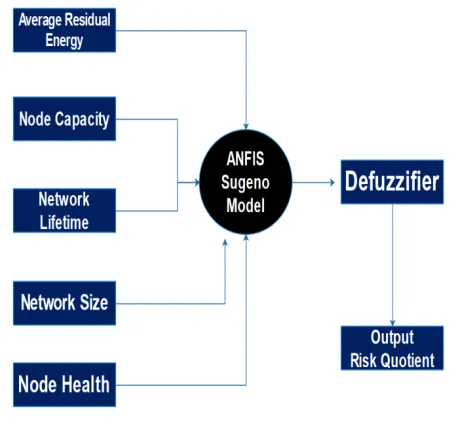
An architecture of energy optimization in wireless sensor networks is proposed by the input values on sensing nodes. There are various parameters that are responsible for the energy loss and with some other symptoms charging of network nodes can be optimized. Figure 2 shows the diagrammatical representation of wireless sensor network symptoms taken as inputs and their linkage with the ANFIS Sugeno model that produces the analytical risk quotient of node as output.
level of nodes in a sensor network. Following are some rules summed up:
Figure 2
• If average residual energy = low and node capacity = small and network lifetime = low and network size = large and node health = weak then node condition = Weak
• If average residual energy = low and node capacity = medium and network lifetime = medium and network size = medium and node health = medium then node condition = Moderate
• If average residual energy = medium and node capacity = medium and network lifetime = medium and network size = small and node health = normal then node condition = Moderate
• If average residual energy = medium and node capacity = High and network lifetime = High and network size = small and node health = good then node condition = Active
• If average residual energy = high and node capacity = small and network lifetime = medium
and network size = medium and node health = good then node condition = Active
• If average residual energy = medium and node capacity = small and network lifetime = low and network size = large and node health = weak then node condition = Weak
• If average residual energy = medium and node capacity = medium and network lifetime = high and network size = small and node health = good then node condition = Active.
• If node capacity = small and network lifetime = low and network size = large and node health = normal then node condition = Weak
• If average residual energy = low and node capacity = small and network lifetime = low and network size = large and node health = weak then node condition = Weak
• If average residual energy = high and node capacity = small and network lifetime = low and network size = large and node health = weak then node condition = Weak
• If average residual energy = medium and node capacity = small and network lifetime = medium and network size = normal and node health = good then node condition = Active
PROPOSED SYSTEM
Charging the wireless network is nothing less than a challenge. There are several techniques to charge the wireless sensor network like communication protocols, energy harvesting, and periodic recharging etc. All of the techniques requires prior knowledge of the whole network before recharge them. Prior knowledge needs more cost and it takes extra time. We proposed a solution that saves the cost and it doesn’t require any prior knowledge before charging.
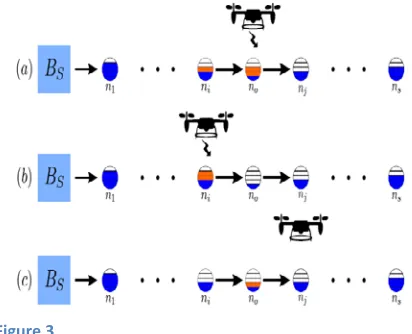
Our device will start exploring the network with zero knowledge, at first it charge only one node. After exploring the whole network, it can charge multiple nodes at a time. After simulations, it can be found that any node in weak condition is charged at the top priority when the device completes its roundtrip as shown in the figure 3.
Figure 3
These are the nodes with energy levels. The general problem that is usually faced is the stopping point of the device. This can be overcome by the simulations. In this way it can easily identify which nodes to charge. The blue color indicates residual energy and orange indicates energy transmitted by the device. It can be done on a limited network but if the network limit or size exceeds then the limited size then a strategy of lithium ion batteries are used. Basically sensor nodes have same power capacity. We can assume that all nodes starts from the same power level. The main idea is to keep the network and nodes alive and in moderate condition so that the network doesn’t die.
SIMULATION BASED RESULT AND DISCUSSION
A. Fuzzy Inference System using Sugeno Model
In fuzzy inference system, Sugeno model is developed by defining average residual energy, node capacity, network lifetime, network size and node health as inputs and Node condition risk quotient as output as shown in figure 4.
Figure 4
B. Membership Function Plot:
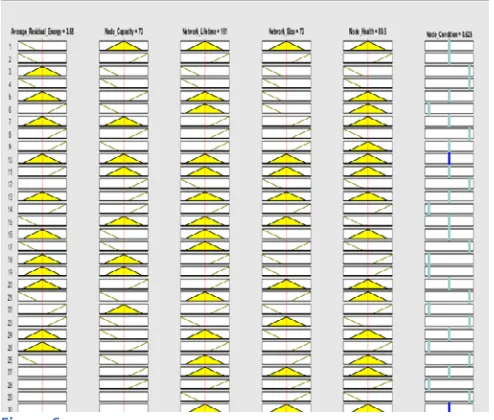
The major symptoms are taken as inputs and then according to the suitable ranges membership functions have been define that determines the condition of node ( Weak, Moderate, High) as shown in the figure 5.
Figure 5
C. Rule Viewer:
On the basis of the if-then rules defined, a set of values are obtained and processed using rule viewer. The Rule Viewer presents the on sight view of the fuzzy inference
system‟s process. The Rule Viewer also depicts how the
[image:5.612.315.568.321.480.2]Figure 6
D. NFIS Training and Testing performance
70% of the processed data is used for training while 30% of the same data is utilized for testing purpose that represents the following data.
Figure 7
Figure 8
F. Surface Viewer for Node Condition:
After training and testing of the processed data, a 3-D surface plot is obtained as shown in Figure with any two input variables on the horizontal & vertical axis and the output variable on the third axis. The surface viewer provides the facility of examining it at different angles for any further corrections.
Figure 9
G. Neuro fuzzy Inference system model:
[image:6.612.315.565.195.343.2]After the training of the system is completed using NFIS, the final neuro-fuzzy inference system model is obtained as shown in figure , indicating the five inputs and output as per their different combinations.
[image:6.612.44.288.388.573.2]CONCLUSION
In this paper we presented adaptive neuro fuzzy inference system to recharge the wireless sensor networks with a vehicle (mobile charging bot). This approach doesn’t need any prior knowledge of the network that reduces the complexity and cost. The charging problem is no more a challenge by disjointing path planning. It enables the scalability in the charging procedure. The proposed solution is adjustable with the wireless sensor networks protocols. Through simulations we showed that minimal charging level of each node keep the network alive and in moderate condition. The research work is under consideration to cope with larger distances and different parameters.
REFRENCES
1. Tong, B.; Li, Z.; Wang, G.; Zhang, W. On-Demand Node Reclamation and Replacement for Guaranteed Area Coverage in Long-Lived Sensor Networks.
Germany, 2009; pp. 148–166.
2. Elkin, C.; Kumarasiri, R.; Rawat, D.B.; Devabhaktuni, V. Localization in wireless sensor networks: A Dumpster-Shafer evidence theoretical approach. Ad Hoc New. 2017, 54, 30–41.
3. Peng, Y.; Li, Z.; Ciao, D.; Zhang, W. I2C: A holistic
approach to prolong the sensor network lifetime. In Proceedings of the 2013 IEEE INFOCOM, Turin, Italy, 14–19 April 2013; pp. 2670–2678.
4. Hsu, C.C.; Kul, M.S.; Wang, S.C.; Chou, C.F. Joint Design of Asynchronous Sleep-Wake Scheduling and Opportunistic Routing in Wireless Sensor Networks. IEEE Trans. Compute. 2014, 63, 1840–1846.
5. He, Y.; Cheng, X.; Peng, W.; Stuber, G.L. A survey of energy harvesting communications: Models and offline optimal policies. IEEE Commun. Mag. 2015, 53, 79–85.
6. Tong, B.; Wang, G.; Zhang, W.; Wang, C. Node Reclamation and Replacement for Long-Lived Sensor Networks. IEEE Trans. Parallel Distrib. Syst. 2011, 22, 1550–1563.
7. Xie, L.; Shi, Y.; Hou, Y.T.; Sherali, H.D. Making Sensor Networks Immortal: An Energy-Renewal Approach with Wireless Power Transfer. IEEE/ACM Trans. Netw. 2012, 20, 1748–1761.
8. Detweiler, C.; Eiskamp, M.; Griffin, B.; Johnson, J.; Leng, J.; Mittleider, A.; Basha, E. Unmanned Aerial Vehicle-Based Wireless Charging of Sensor Networks.