PERFORMANCE EVALUATION OF MOBILE ADHOC
NETWORKS USING GENETIC ALGORITHM
1PUSHPAVALLI M, 2 NATARAJAN A M 1
Assistanat Professor, Department of Electronics & Communication Engineering, Bannari Amman Institute of Technology,Sathyamangalam, TN-638401,India,
2
Professor, Department of Computer Science & Engineering , Bannari Amman Institute of Technology,Sathyamangalam,TN-638401,India,
1
[email protected], 2 [email protected]
ABSTRACT
Now- a-days finding a path from source to destination for practical multimedia applications by satisfying QoS requirement is a biggest challenge. Achieving quality of service in a mobile adhoc network is a NP complete problem due to its dynamic nature of the network and limited resources availability. In this paper we propose a new qos module which uses genetic algorithm based approach to find an optimal path from source to the destination. An optimal path is selected by a suitable encoding scheme where the possible paths are in the form of strings. Analysis is done for a proactive protocol(OLSR) and for a reactive protocol(AODV) and the comparison between them was given as OLSRGA and AODVGA. To achieve QoS (Quality of Service) in the network we have taken link state information such as delay and bandwidth in the network.
Keywords : QoS, Genetic Algorithm, MANET,OLSRGA,AODVGA
1. INTRODUCTION
Emerging of Mobile adhoc
networks(MANETs) with infrastructureless
network which has dynamically varying
topology has brought a vast progress and growth in the field of wireless and multimedia applications. Due to dynamic nature of the network, MANET must be able to provide the required quality of service for the delivery of real time communications such as audio and video that poses a number of different technical challenges and new definitions[1]. However, ad
hoc networks present unique advanced
challenges, including the design of protocols for mobility management, effective routing, data transport, security, power management, and quality-of-service (QoS) provisioning. Once these problems are solved, the practical use of MANETs will be realizable. The overall design of a solution for all of these problems is currently too complex and the problem is considered as a NP complete problem. Thus to achieve proper QoS routing, an optimal path is to be found between the source and destination. However finding an optimal path in a network to support QoS is not easy because it has been proven to be an NP-complete problem [2].
In this paper we have taken link state informations such as delay and bandwidth
constraints of the network as metric
measurements to achieve QoS. In our proposed work a genetic algorithm approach is used to find out a broken link in the path by finding out the unfeasible path and repairing them to find out a feasible path. An optimal path is selected in terms of a string structure, where each element represent a path between each pairs of nodes and a new technique is formed by using the past solutions as the initial data for new searches. Thus an encoding scheme is used to increase the quality of solutions and the rate of convergence by performing crossover and mutation function on the initial population. Analysis is done for a proactive and reactive protocol and it is compared with respect to QOS.
2. EVOLUTION FLOW OF GENETIC ALGORITHM
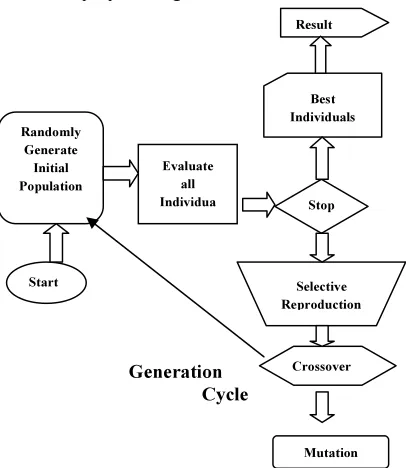
first guessing the possible solutions and then uses the fittest solution to create a new generation which should be better than previous generation by applying GA operators like
crossover and mutations on previous
generation.[3][4][5][6].Genetic Algorithms are a particular class of evolutionary algorithms that use techniques inspired by evolutionary biology such as inheritance, mutation, selection and recombination. The idea of natural evolution is used in proposed algorithm.
[image:2.595.77.280.249.483.2]Generation Cycle
Fig 1 Evolution Flow of Genetic Algorithm
First guessing the all possible solutions and then combine the fittest solutions to create a new generation of solution which will be better than the previous generation and will give the better fitness value.
3. PROPOSED WORK
The proposed method consists in looking for the optimal path from source to destination of the network by taking into account an evaluation criterion to find broken links in the path and replacing it by taking alternate route. A genetic algorithm approach is used to find out optimal path. Metric measurements like bandwidth of the network and delay of the network is also calculated for optimal path selection.
3.1. Operators of Genetic Algorithm:
Algorithm starts with a set of solutions called population. New population is formed by taking
solutions from one population. The new one is the children and the one which gives the children will be called as parent. Thus at each and every step, an individual is selected from the current population randomly to produce the children for next generation. Solutions are the string of bits with fixed length called as chromosomes. We hope that the new population will be better than the old one.
Solutions which are selected to form next generation (children) which can also be called as offspring are selected according to their fitness value. Strings with higher fitness values have higher probability of contributing an offspring. Genetic operators such as crossover and mutation are applied to parents to produce offsprings. Over successive generations, the population “evolves” towards an optimal solution.
3.2. Proposed GA to find optimal path selection in MANETs (GAOPS)
Topology of any multihop networks can be defined as a directed graph representation assuming that the network is directed and it does not contain parallel links [ 7].
Let G = (N,A) W[ ] where, N = Set of nodes in the network N=1,2,………n. A= Set of links (arcs or edges)
{(i,j),(k,l),…..(s,t)}connecting m pairs of nodes in
the network.
W = Weight on the edges
Source node and destination node are denoted by S and D, respectively. Ii,j is denoted as a link connection indicator, which provides the link information from node i to node j . This indicator indicates whether the link is included in routing process or not(chromosome mapping).
p1 p2 p3 p4 p5 p6 ………… …… p28
……. …… ……
Start Randomly
Generate Initial Population
Evaluate all
Individua Stop
Best Individuals
Selective Reproduction
Crossover
7 3 2 1 8 . … … 9
(1-3-2-7) (1-8-6-5-9-4-7)
Fig. 2 --- 10 node network model
Routing Table entry at source node :
Route Number Possible route
1 1-10-7 2 1-3-2-7
3 1-8-6-5-7 etc.,
For example a path between node 1 and node 7 can have the combinations as 1-10-7, 1-3-2-7, 1-8-6-5-7, 1-8-3-2-7 etc., which are called as possible routes. A routing algorithm selects one of the possible routes for the routing process. A routing table is created to do the routing, there about 14 possible routes for each and every path. All possible routing pairs can be searched in advance and it can be arranged in the routing table in order of length. In proposed GA each route is identified by a route number, which is the row number of the routing table. A string is a route number of all the paths and its length is N(N-1)/2. The combination of route number’s in a string is varied to generate various combinations of chromosomes.
ALGORITHM:
Generate random population of n chromosomes
(strings):
This is done by an encoding scheme. A routing path is encoded by a string of positive integers that represents the IDs of the node.
locus of the string = order of the node First locus = source node
Last locus = destination node
Three steps are followed in selecting initial population:
1. Repeat the process until destination is
reached
2. Select node N from the list of n nodes 3. Don’t select already selected nodes (avoiding looping)
Pseudo code: no.of nodes n, length of the path l,
output O with t th initial chromosome
initialization i=0; for i= 1 to n Ot[i] i ;
for i = 1 to [n/2] repeat
j random[1,n]; until (j = l); Output Ot ;
end From the example of fig 2
Node ID
1 2 3 4 5 6 7 8 9 10
Path
3.3. Fitness Function:
Our aim is to find out optimal path to satisfy QoS routing in MANET using GA. The QoS metrics are taken as delay, bandwidth,
throughput and link quality(node pair
connectivity index). Thus it can be classified as multiple objective optimization problem. In our work each and every objective function is assigned a weight and the all of them are combined to form a single objective function to do this weight sum approach is used.
Weighted sum F = x1.F1 + x2. F2 + x3.F3
Where F1,F2 and F3 are the objective functions that describe delay, bandwidth, node connectivity. The values of x1,x2 and x3 are set
as 10-2,10-3 and 10-3 respectively. Based on their
equal importance towards the overall QoS routing performance these coefficients are taken.
If bandwidth < BQoS F2 is set a high
value 1000 which leads to a high weighted sum function F. Hence it is assumed that the node does not have proper bandwidth to transmit a date. A link breaking can be occurred in the connectivity pair , hence such type of nodes are eliminated. If Bandwidth > BQoS , then F2 = 0. Then the function F will be depending on F1 and F3. If all the node pairs that make up the route produce a node connectivity pair to zero means it shows that particular route has a strongest connection. Thus the chromosome which has a low weight will have a strong fitness value.
3.4. Crossover:
The crossover operates by exchanging sub routes between the route. Both the routes that are selected for crossover should have same source node and destination node. The crossover operation for QoS routing problem is done by exchanging each partial route of two chosen
7
3
2
1
8
4
10
5
9
chromosomes in such a manner that the offsprings produced by the crossover represent a single route.In proposed work potential crossing site is used. A set of pair of nodes which are commonly included in the two chosen chromosomes but without positional consistency. Such pairs are called are called potential crossing site. In below fig 3 we have two crossing sites (3,2) and (5,6).
Pseudo code: I1, I2 –input chromosomes, O1, O2- output chromosomes
L1, L2 – length of chromosome I1, I2 , Pc – potential crossing, Rc –ramdom cross site
for all(i,j) {
If (I1[i] = I2 [j]) { Pc[t] = (i,j);} }
Rc = choose_rand(Pc);
O1 = I1[1:Rc(1)] // I2[Rc(2) + 1 : L2];
O1 = I2[1:Rc(2)] // I1[Rc(1) + 1 : L1];
S 1 2 4 5 6 7 D
Crossing site (3,2)
Fig 3 crossover with crossing points
3.5. Mutation :
Mutation takes place by flipping of one of the genes of the chromosomes. That is Randomly interchange (flips) the bit of offspring if they improve the solution either decreasing total cost or increasing fitness value. It leads to a generation of alternate node from the mutation node to destination node. In our proposed method a topological intelligent database is introduced for this purpose.
Procedure :
First, a node is randomly selected from the chosen chromosome which is called as mutation point. One of the nodes, which is randomly connected directly to the mutation point is chosen as the first node.
New Route
Fig 4. Mutation Process
We delete the nodes that are placed in an upper partial route. This is to form a database which doesn’t included the same node twice in
the new routing path. The upper
partial route indicates the
surviving portion of the previous route after mutation. It is the partial chromosome stretching from the first gene to the intermediate gene at the mutation point.
S 1 2 3 5 8 6 7 D
S 2 3 5 8 6 7 D
S 2 4 8 D S 1 3 5 D S 1 2 4 D
S
Mutatio
Mutation Point 2
1 3 5 6
7
4 8
D S
1
3 5
6
7
D 8
4 2
S
2
4 6
D
1 5
7 3
S 1
3 5
7
D 6
Pseudo code:
I - input chromosomes, O - output chromosomes, T- topological information database
Rc –ramdom choose ,D - destination
Initially delete the nodes of upper partial route (T, I, Rc)
O = I[1:Rc]; While(1) {
O[Rc+1] = Chose random delete(T,O,[Rc]); if (O[Rc+1]) == D
{ break;}
Rc++; }
4. PERFORMANCE EVALUATION OF GA
The performance of GA depends in choosing of the probabilities of crossover and mutation. The crossover probability Pc is taken as 0.70 and the mutation probability Pm is taken as 0.50. This is done for a population size of 50. 1000 Maximum generation is made and as a termination condition 100 generations with same fitness is taken.
2
3 1
1 6 2
[image:5.595.326.515.540.619.2]2 5
Fig 5. As An Example , A Graph With Six Nodes And 10 Edges Are Taken For The Analysis Of GA
Operators.
Initial Populations: All Possible Solutions
Table 1
The chromosomes which have the low weight have the high fitness value.
Table 2
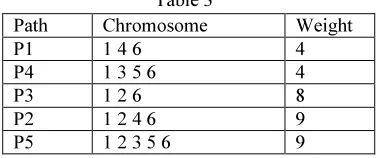
By performing the process of selection and sorting parent chromosomes are find out.
Table 3
After performing binary encoding the weights, crossover function are generated and is performed on the parent node. 0 represents no link and it is used only for the comparison purpose [8].
5. SIMULATION RESULTS
To run our simulation we have taken two protocols namely : OLSR(proactive protocol) and AODV(reactive protocol) . OLSR protocol
Path Weight Encoding Crossover
function P1
P4
2 2 0 1 2 1
0010 0010
0000
0010 0010
0001
0010 0010
0000
P3 P2
2 6 0 2 5 2
0010 0110
0000
0010 0101
0010
0001 0101
0000
P5 2 4 2 1 0010 0100
0010 0001
0010 0100
0010 0001
Path Chromosome Weight
P1 1 4 6 4
P2 1 2 4 6 9
P3 1 2 6 8
P4 1 3 5 6 4
P5 1 2 3 5 6 9
P6 1 2 3 5 4 6 13
Path Chromosome Weight
P1 1 4 6 4
P4 1 3 5 6 4
P3 1 2 6 8
P2 1 2 4 6 9
P5 1 2 3 5 6 9
1 3
2
4
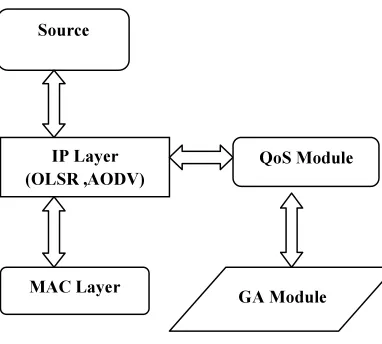
uses multipoint relays(MPR). MPR is a node that is selected which can cover all nodes that are two hop away. AODV uses route discovery phase and route maintenance phase. When a source node wants to pass a data to the destination with QoS requirements it starts with the route discovery phase. Once the route is discovered the data transmission takes place. During the data transmission it is also important to maintain the path to the destination. This is done by route maintenance. The overview module of OLSR using GA module (OLSRGA) and AODV using GA module (AODVGA) is given below.
[image:6.595.314.516.191.376.2]
Fig 6 Qos Model Using GA
Whenever there is a need to find a new set of route to the destination, GA module is always the initiator to find the set and it provides new set of routes to QoS module (fig .6 ) and it is stored in the buffer of QoS Module, and if there is no any other node that is present within the neighbor , then the path from the buffer is followed. For the sake of efficiency, at some periodic time, route from buffer is again evaluated by GA module. To manage modularity concepts, the QoS routing module only has a minimum knowledge of the internals of the GA module and MPR sets (in OLSR) ,formation of routing table (in AODV)are found in the form of simplified individuals (paths).As new sets of routes are exchanged with the QoS routing module is done through the buffer.
5.1. Scenario setup for MANET:
NS - 2.34 [9] is used to do the simulation with AODV and OLSR protocols. 50 nodes are placed randomly in the rectangular area of 1500M x 1500 M. Nodes can move randomly
[image:6.595.108.299.283.455.2]according to random way point mobility model with a speed of 10m/s,20m/s and 30m/s. The pause time is taken as 5s, 10s and 15s. The QoS parameters like delay , throughput and packet delivery ratio are analyzed here.
Fig 7. Simulation For 50 Nodes
The below fig 8 shows the effect of number of nodes vs delay. The inference of the graph is when number of nodes is less, the delay is less when the nodes are more the delay is also more but comparatively protocols using GA concepts has less delay.
Fig.8 Number Of Nodes Vs Delay(10 M/S)
Source
IP Layer (OLSR ,AODV)
MAC Layer
QoS Module
[image:6.595.315.554.489.652.2]Fig.9 Number Of Nodes Vs Delay(M/S)
The above fig 9 shows the effect of number of nodes vs delay for a mobility of 20m/s. The inference of the graph is compared to previous graph this graph has more delay value, this one occurs, as the speed of the nodes are increased congestion takes place in the network. Common links are used for the transmission thus sharing
the bandwidth of the network. According to our
[image:7.595.86.530.95.303.2]proposed scheme non intercepting path can be found with higher path preference probability. Thus, delay decreases as the number of nodes increases. Similar thing happens if we apply a speed of 30 m/s.
Fig.10 Mobility Vs Throughput
fig 9 shows that as the speed of the network
increases the throughput decreases. Our
proposed method for AODVGA has high throughput than the others. Next OLSRGA has high throughput. Thus we can say that reactive
protocol with our proposed method has high throughput than the proactive protocol.
Fig.11 No. Of Nodes Vs Packet Deliveryratio(PDR)
Form the fig 10 shows the packet delivery ratio for all the protocols. Comparatively AODVGA and OLSRGA gives better results in increase in mobility of the network.
6. CONCLUSION AND FUTURE WORK
In this paper , we have proposed a QoS module with respect to genetic algorithm for mobile adhoc networks to support multimedia applications. An optimal path was found out from source node to destination node using GA module, which provides QoS guarantees in terms of better packet delivery ratio, less delay and better throughput. In our analysis we have taken one reactive protocol and one proactive protocol for comparison of the performance. We have found that our proposed method works well for reactive protocol than for proactive protocol. In future, we have palnned to work with real time multimedia data against various proposed QoS algorithm for mobile adhoc networks using various mobility models.
REFERENCES
[1] Crawley, E.; Nair, R.; Rajagopalan, B. & ndick, H. (1998). “A Framework for QoS
Based outing in the Internet”, RFC 2386,
August 1998, RFC Editor, USA.
[2] Salman Yussof and Ong Hang See ,” Finding Multi- Constrained path Using Genetic Algorithm”, proceedings of the 2007 IEEE
international conference on
Telecommunications and Malaysia
[image:7.595.87.302.501.655.2]Communications ,14-17 May 2007, Vol .1,pp 1-6 Penang,Malaysia
[3]. Masaharu Munetomo, Yoshiaki Takai, Yoshiharu Sato: An Adaptive Network Routing Algorithm Employing Path Genetic Operators, Proceedings of the
Seventh International Conference on
Genetic Algorithms, pp.643- 649 (1997). [4] Uma, G.V. and M.R. Masillamani:
Application of genetic algorithm in mobile ad hoc network, Asia J. Inform. Technol. 2006, 5: 1009-1016.
[5] Gajendra Singh Chandel,Ravindra Gupta “Implementation of Shortest Path in Packet
Switching Network Using Genetic
Algorithm” IJARCSSE Volume 2, Issue 2, February 2012.
[6] David Montana and Jason Redi: Optimizing Parameters of a Mobile Ad Hoc Network Protocol with a Genetic Algorithm, in GECCO ’05, Proceedings of conference on Genetic and evolutionary computation 2005, 1993- 1998.
[7] Chang Wook Ahn,R.S.Ramakrishna,” A genetic
algorithm for shortest path routing problem and the sizing of populationa,IEEE transactions on Evolutionary Computation,v.6 n.6,p.566 – 579, December 2002. [8] www.geneticprogramming.com
[9] www.isi.edu/nsnam/ns/
[10]http://people
.brunel.ac.uk/~mastjjb/jeb/info.html [11] Gen,M., Cheng, R,: Evolutionary Network
Design: Hybrid Genetic Algorithms
Approach. International journal of
Computational Intelligence and