Relation Extraction:
Perspective from Convolutional Neural Networks
Thien Huu Nguyen
Computer Science Department New York University New York, NY 10003 USA
Ralph Grishman
Computer Science Department New York University New York, NY 10003 USA [email protected]
Abstract
Up to now, relation extraction systems have made extensive use of features generated by linguistic analysis modules. Errors in these features lead to errors of relation detection and classification. In this work, we depart from these traditional approaches with complicated feature engineering by introducing a convolu-tional neural network for relation extraction that automatically learns features from sen-tences and minimizes the dependence on ex-ternal toolkits and resources. Our model takes advantages of multiple window sizes for fil-ters and pre-trained word embeddings as an initializer on a non-static architecture to im-prove the performance. We emphasize the re-lation extraction problem with an unbalanced corpus. The experimental results show that our system significantly outperforms not only the best baseline systems for relation extrac-tion but also the state-of-the-art systems for relation classification.
1 Introduction
Learning to extract semantic relations between en-tity pairs from text plays a vital role in information extraction, knowledge base population and question answering, to name a few. The relation extraction (RE) task can be divided into two steps: detecting if a relation utterance corresponding to some entity mention pair of interest in the same sentence rep-resents some relation and classifying the detected relation mentions into some predefined classes. If we only need to categorize the given relation men-tions that are known to express some expected rela-tion (perfect detecrela-tion), we are left with therelation
classification (RC) task. One variation of relation classification is that one might have non-relation ex-amples in the dataset but the number of those is com-parable to the number of the other examples. The non-relation examples, therefore, can be treated as a usual relation class. Relation extraction, on the other hand, often comes with a tremendously unbalanced dataset where the number of the non-relation exam-ples far exceeds the others, making relation extrac-tion more challenging but more practical than rela-tion classificarela-tion. Our present work focuses on the relation extraction task with an unbalanced corpus.
In the last decade, the relation extraction litera-ture has been dominated by two methods, distin-guished by the nature of the relation representa-tion: the feature-based method (Kambhatla, 2004; Boschee et al., 2005; Zhou et al., 2005; Grishman et al., 2005; Jiang and Zhai, 2007; Chan and Roth, 2010; Sun et al., 2011; Nguyen and Grishman, 2014) and the kernel-based method (Zelenko et al., 2003; Culotta and Sorensen, 2004; Bunescu and Mooney, 2005a; Bunescu and Mooney, 2005b; Zhang et al., 2006; Zhou et al., 2007; Qian et al., 2008; Nguyen et al., 2009; Sun and Han, 2014). The common char-acteristic of these methods is the leverage of a large body of linguistic analysis and knowledge resources to transform relation mentions into some rich rep-resentation to be used by some statistical classifier such as Support Vector Machines (SVM) or Max-imum Entropy (MaxEnt). The linguistic analysis pipeline which is hand-designed itself includes to-kenization, part of speech tagging, chunking, name tagging as well as parsing, often performed by ex-isting natural language processing (NLP) modules.
While these methods allow the RE systems to inherit the knowledge discovered by the NLP community for the pre-processing tasks, they might be subject to the error propagation introduced by the imper-fect quality of the supervised NLP toolkits. For in-stance, all the tasks mentioned in the pipeline above are known to suffer from a performance loss when they are applied to out-of-domain data (Blitzer et al., 2006; Daum´e III, 2007; McClosky et al., 2010), causing the collapse of the RE systems based on them. In this paper, we target an independent RE system that both avoids complicated feature engi-neering and minimizes the reliance on the super-vised NLP modules for features, potentially allevi-ating the error propagation and advancing our per-formance in this area.
To be concrete, our relation extraction system is provided only with raw sentences marked with the positions of the two entities of interest1. The only elements we can derive from this structure are the words, the n-grams and their positions in the sentences, suggesting a paradigm in which re-lation mentions are represented by features that de-pend on these elements. Eventually, word embed-dings that are capable of capturing latent seman-tic and syntacseman-tic properties of words (Bengio et al., 2001; Mnih and Hinton, 2007; Collobert and We-ston, 2008; Mnih and Hinton, 2009; Turian et al., 2010; Mikolov et al., 2013) and convolutional neural networks (CNNs) that are able to recognize specific classes of n-gram and induce more abstract repre-sentations (Kalchbrenner et al., 2014) are a natural combination one should apply to obtain more effec-tive representations for RE in this setting.
Convolutional neural networks (dating back to the 1980s) are a type of feed-forward artificial neural networks whose layers are formed by a convolution operation followed by a pooling operation (LeCun et al., 1988; Kalchbrenner et al., 2014). Recently, with the emerging interests of the community in deep learning, CNNs have been revived and effectively applied in various NLP tasks, including semantic parsing (Yih et al., 2014), search query retrieval (Shen et al., 2014), sentence modeling and
clas-1For evaluation purpose, we assume the positions of the two
entities of interest in the sentence like most previous studies in this area (listed above). These are the only external features we need to achieve an end-to-end relation extractor.
sification (Kalchbrenner et al., 2014; Kim, 2014), name tagging and semantic role labeling (Collobert et al., 2011). For relation classification and extrac-tion, there are two very recent works on CNNs for relation classification (Liu et al., 2013)2 and (Zeng et al., 2014); however, to the best of our knowledge, there has been no work on employing CNNs for re-lation extraction so far. This paper is the first attempt to fill in that gap and serves as a baseline for future research in this area.
Our convolutional neural network is built upon that of Kalchbrenner et al. (2014) and Kim (2014) which are originally proposed for sentence classifi-cation and modeling. We adapt the network for re-lation extraction by introducing the position embed-dings to encode the relative distances of the words in the sentence to the two entities of interest. Com-pared to the models in Liu et al. (2013) and Zeng et al. (2014) for relation classification that apply a single window size, our model for relation extrac-tion incorporates various window sizes for convolu-tional filters, allowing the network to capture wider ranges ofn-grams to be helpful for relation extrac-tion. In addition, rather than initializing the word embeddings randomly as do Liu et al. (2013) and fixing the randomly generated position embeddings during training as do Zeng et al. (2014), we use pre-trained word embeddings for initialization and op-timize both word embeddings and position embed-dings as model parameters. More importantly, rather than using exterior features (either from human an-notation or other pre-processing modules) to enrich the representation as do Liu et al. (2013) and Zeng et al. (2014), our model (adapted for RC where entity heads are given) avoids usage of manual linguistic resources and supervised NLP toolkits constructed externally, utilizing word embeddings that can be trained automatically in an unsupervised framework as the only external resource for the whole system.
We explore different model architectures system-atically and demonstrate that the best model perfor-mance is achieved when multiple window sizes are implemented and the word embeddings, once initial-ized by some “universal” embeddings, are allowed to vary during the optimization process to reach an
2The title of the paper (Liu et al., 2013) on relation
effective state for relation extraction. We evaluate our models on both relation classification and re-lation extraction tasks. For rere-lation classification, experiments show that our model (without any ex-ternal features and resources) outperforms the state-of-the-art models whether the external features are included in these models or not. For relation extrac-tion, our model is significantly better than the base-line models that use the words and the embeddings themselves as the features. In the following, we dis-cuss related work in Section 2 and present our model in Section 3. We detail an extensive evaluation in Section 4 and finally conclude in Section 5.
2 Related Work
As our present work focuses on the supervised framework for relation extraction, we concentrate on the supervised systems in this section. Besides the supervised systems (either feature-based or kernel-based) mentioned above, some recent systems have employed thedistant supervision(DS) approach for relation extraction. This approach is essentially sim-ilar to the traditional systems in representing relation mentions but attempts to generate training data au-tomatically by leveraging large knowledge bases of facts and corpus (Mintz et al., 2009; Riedel et al., 2010; Hoffmann et al., 2011; Surdeanu et al., 2012). Regarding neural networks, their first application to NLP is language modeling which has been use-ful to learn distributed representations (embeddings) for words (Bengio et al., 2001; Mnih and Hinton, 2007; Collobert and Weston, 2008; Mnih and Hin-ton, 2009; Turian et al., 2010; Mikolov et al., 2013). These word embeddings have opened a new direc-tion for many other NLP tasks grounded on neu-ral networks. Some of them are mentioned above. Other than that, a class of recursive neural networks (RNNs) and neural tensor networks are proposed for paraphrase detection (Socher et al., 2011), parsing (Socher et al., 2013a), sentiment analysis (Socher et al., 2013b), knowledge base completion (Socher et al., 2013c), question answering (Mohit et al., 2014) etc. Among these RNN systems, the study that is most related to our relation extraction problem is Socher et al. (2012) that learns compositional vector representations for phrases and sentences through syntactic parse trees and applies these represen-tations for relation classification. However, this
method inherently requires syntactic parse trees in contrast to our target of avoiding use of any external features and resources for RC.
3 Convolutional Neural Network for Relation Extraction
Our convolutional neural network for relation ex-traction consists of four main layers: (i) the look-up tables to encode words in sentences by real-valued vectors, (ii) the convolutional layer to recognizen -grams, (iii) the pooling layer to determine the most relevant features and (iv) a logistic regression layer (a fully connected neural network with a softmax at the end) to perform classification (Collobert et al., 2011; Kim, 2014; Kalchbrenner et al., 2014). Fig-ure 1 gives an overview of the network.
3.1 Word Representation
The input to the CNN for relation extraction consists of sentences marked with the two entity mentions of interest. As CNNs can only work with fixed length inputs, we compute the maximal separation between entity mentions linked by a relation and choose an input width greater than this distance. We insure that every input (relation mention) has this length by trimming longer sentences and padding shorter sentences with a special token.
Letn be the length of the relation mentions and x = [x1, x2, . . . , xn] be some relation mention
wherexi is thei-th word in the mention. Also, let xi1 andxi2 be the two heads of the two entity
men-tions of interest . Before entering the network, each wordxiis first transformed into a vectoreiby
look-ing up the word embeddlook-ing tableWthat can be ini-tialized either by a random process or by some pre-trained word embeddings. Besides, in order to em-bed the positions of the two entity heads as well as the other words in the relation mention into the rep-resentation, for each wordxi, its relative distances to
the two entity headsi−i1andi−i2are also mapped into real-value vectorsdi1 anddi2respectively using
a position embedding tableD(initialized randomly) (Collobert et al., 2011; Liu et al., 2013; Zeng et al., 2014). Note that the relative distances only range from −n+ 1 to n−1 so the position embedding matrixDhas size(2n−1)×md(mdis a
In the morning, the <e1>President</e1> traveled to <e2>Detroit</e2>
in the morning
,
the president traveled to detroit entity 1
entity 2
input sentence with marked entities
word embedding matrix
position embeddings matrix
table look-up
Convolutional layer with multiple window sizes for filters
Max pooling Fully connected layer with dropout and softmax output Look-up tables
Figure 1: Convolutional Neural Network for Relation Extraction.
ei and the position embeddingsd1 andd2 are con-catenated into a single vectorxi = [ei, di1, di2]>to
represent the wordxi. As a result, the original
sen-tence x can now be viewed as a matrix x of size (me+ 2md)×nwheremeis the dimensionality of
the word embedding vectors.
x= [x1,x2, . . . ,xn]
3.2 Convolution
In the next step, the matrix x representing the in-put relation mention is fed into the convolutional layer to extract higher level features. Given a widow size w, a filter is seen as a weight matrix
f = [f1,f2, . . . ,fw] (fi is a column vector of size me+ 2md). The core of this layer is obtained from
the application of the convolutional operator on the two matricesx and f to produce a score sequence
s= [s1, s2, . . . , sn−w+1]:
si=g( wX−1
j=0
f>
j+1x>j+i+b)
where b is a bias term and g is some non-linear function. This process can then be replicated for var-ious filters with different window sizes to increase then-gram coverage of the model.
For relation extraction, we call the n-grams ac-companied with relative positions of its words the augmentedn-grams. It is instructive to think about the filterf as representing some hidden class of the augmentedn-grams and the scoressi as measuring
the possibility the augmentedn-gram at position i belongs to the corresponding hidden class (although these scores are not probabilities at all). The trained weights of the filterfwould then amount to a feature detector that learns to recognize the hidden class of the augmentedn-grams (Kalchbrenner et al., 2014).
3.3 Pooling
The rationale of the pooling layer is to further ab-stract the features generated from the convolutional layer by aggregating the scores for each filter to in-troduce the invariance to the absolute positions but preserve the relative positions of the n-grams be-tween themselves and the entity heads at the same time. The popular aggregating function is max as it bears responsibility for identifying the most im-portant or relevant features from the score sequence. Concretely, for each filterf, its score sequence sis passed through themaxfunction to produce a single number:pf = max{s} = max{s1, s2, . . . sn−w+1} which can be interpreted as estimating the possibil-ity some augmentedn-gram of the hidden class off
appears in the context.
3.4 Regularization and Classification
In the final step, the pooling scores for every filter are concatenated into a single feature vector z = [p1, p2, . . . , pm] to represent the relation mention.
Here, m is the number of filters in the model and pi is the pooling score of the i-th filter. Before
regularization by randomly setting to zero a propor-tionρof the elements of the feature vector3zto pro-duce the vector zd. The dropout vector zd is then
fed into a fully connected layer of standard neural networks followed by a softmax layer in the end to perform classification. The fully connected layer in-duces a weight matrix Cas model parameters. At test time, the unseen relation mentions are scored using the feature vectors that are not dropped out. We also rescale the weights whosel2-norms exceed a hyperparameter as Kim (2014).
Overall, the parameters for the presented CNN are: the word embedding matrix W, the posi-tion embedding matrix D, the m filter matrices, the weight matrix Cfor the fully connected layer. The gradients are computed using back-propagation while training is done via stochastic gradient descent with shuffled mini-batches and the AdaDelta update rule (Zeiler, 2012; Kim, 2014).
4 Experiments
4.1 Hyperparameters and Resources
For all the experiments below, we use: tanh for the non-linear function, 150 filters for each window size in the model and position embedding vectors with dimensionality of md = 504. Regarding the
other parameters, we use the same values as do Kim (2014), i.e, the dropout rateρ= 0.5, the mini-batch size of 50, the hyperparameter for thel2of 3.
Finally, we utilize the pre-trained word embed-dingsword2vecfrom Mikolov et al. (2013) which have dimensionality ofme= 300and are trained on
100 billion words of Google News using the contin-uous bag-of-words architecture. These embeddings are publicly available here5. Vectors for the words not included in the pre-trained embeddings are ini-tialized randomly. Besides the word embeddings
word2vec, the model does not use any other NLP toolkits or resources.
4.2 Datasets
We evaluate our models on two datasets: the SemEval-2010 Task 8 dataset (Hendrickx et al., 2010) for relation classification and the ACE 2005
3Following the Bernoulli distribution
4These values produce the best performance during our
ex-perimental process.
5https://code.google.com/p/word2vec/
dataset for relation extraction.
ACE 2005 (87,512) SemEval 2010 (10,717)
Relation % Relation %
ORG-AFF 2.8 Cause-Effect 12.4 PER-SOC 1.2 Component-Whole 11.7 ART 1.0 Entity-Destination 10.6 PART-WHOLE 1.4 Entity-Origin 9.1 GEN-AFF 1.1 Product-Producer 8.8 PHYS 2.1 Member-Collection 8.6
Other 90.4 Message-Topic 8.4 Content-Container 6.8 Instrument-Agency 6.2
[image:5.612.313.540.80.230.2]Other 17.4
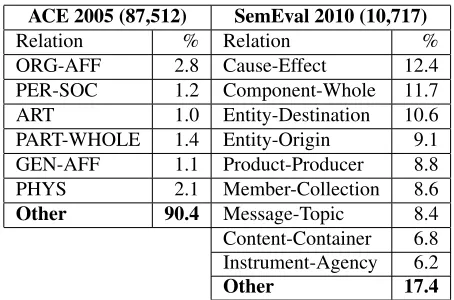
Table 1: ACE 2005 and SemEval 2010 Relation Class Distributions
The SemEval dataset can be downloaded here6 and contains 10,717 annotated examples, including 8,000 examples for training and 2,717 examples for testing. Each example is a sentence annotated for a pair of entities of interest and the corresponding relation class for this entity pair. There are 9 ordered relationships (with two directions) and an undirected Other class, resulting in 19 classes. A pair is counted as correct if the order of the entities in the relationship is correct. For the ACE 2005 dataset, documents are annotated for 6 major relation classes and 7 entity types. In order to generate the non-relation examples or the examples for theOther class, we collect every pair of entity mentions within a single sentence and not included in the annotated relation set. To reduce the noise, we truncate the generated dataset by removing all the examples whose distances between the two entity heads are greater than 15. This results in a considerably unbalanced dataset of 8,365 positive examples of the 6 annotated relation classes and 79,147 negative examples of the class Other. The distributions of the relation classes on the two datasets are shown in Table 1. As we can see, the ACE dataset is much more biased toward the Otherclass than the SemEval dataset and thus more appropriate for relation extraction experiments.
4.3 Evaluation of Model Architectures
We investigate the effectiveness of different win-dow sizes of filters by running the proposed CNN
nonstatic.rand static.word2vec nonstatic.word2vec
# window sizes P R F P R F P R F
[image:6.612.110.505.59.174.2]1 2 69.56 41.64 52.04 74.66 41.03 52.90 72.74 49.49 58.87 2 3 68.47 42.73 52.57 74.19 42.16 53.73 72.50 50.75 59.66 3 4 68.17 43.39 52.94 73.60 41.90 53.35 72.56 49.81 58.97 4 5 66.83 43.46 52.55 73.52 42.60 53.89 71.70 51.08 59.57 5 4-5 66.18 46.12 54.25 72.69 45.23 55.71 71.88 52.36 60.50 6 3-4-5 67.54 45.73 54.43 71.99 46.85 56.73 71.21 53.24 60.86 7 2-3-4-5 66.42 47.20 55.12 72.60 46.77 56.85 71.25 53.91 61.32
Table 2: System Performance on various window size combinations and architectures model on window sizes of 2, 3, 4 and 5. To
un-derstand the behavior of the model on multiple dow sizes, we further test it on the following win-dow size combinations: (4,5), (3,4,5) and (2,3,4,5). In each of these window size configurations, we evaluate the system on three different scenarios: (i) the word embeddings and the position embed-dings are randomly initialized and optimized dur-ing the traindur-ing process (denoted bynonstatic.rand), (ii) the word embeddings are initialized by the pre-trained word embeddings; the position embeddings are initialized randomly and the two embeddings are kept unchanged during the training (denoted by static.word2vec), (iii) the two embeddings are ini-tialized as in case (ii) but they are optimized as model parameters when the model is trained (de-noted by nonstatic.word2vec). These experiments are carried out for relation extraction on the ACE 2005 dataset via 5-fold cross validation. Table 2 presents the system performance on Precision (P), Recall (R) and F1 score (F).
The key observations from the table are7:
(i) From rows 1, 2, 3, 4, we see that evaluating window sizes individually is quite intricate. It is un-clear which window size is the best size for CNNs on relation extraction. For instance, on the non-static.rand mode, the window size 4 seems to out-perform the others while on the other modes, the window sizes 3 and 5 turn out to be better. Besides, the performance gaps between the window sizes are small, making it hard to draw a conclusive judge-ment. In any case, the window size 2 seems to be the worst, suggesting that the 2-grams might be less informative than the others on representing relation mentions for CNNs on this dataset.
7The statements at points (ii) and (iii) are significant at
con-fidence levels≥95%.
(ii)While the results on evaluating single window sizes are hard to analyze, the results for multiple window sizes are quite clear and conclusive. Mov-ing from sMov-ingle window sizes of 2, 3, 4 or 5 (rows 1, 2, 3 and 4 respectively) to the configuration with two window sizes 4 and 5 (row 5) gives us consistent im-provements on all the model architectures. The per-formance is then consistently enhanced when more window sizes are included, resulting in the best per-formance when all the window sizes 2, 3, 4 and 5 are employed. This demonstrates the advantages of the models with multiple window sizes over the single window size models in Liu et al. (2013) and Zeng et al. (2014).
(iii)Regarding different model architectures, the picture is even clearer. No matter which window size configuration is applied, we constantly see the nonstatic.word2vec architecture performs most ef-fectively, followed by the static.word2vect setting which is in turn followed by the nonstatic.rand model. This suggests the undeniable benefits of initializing the word embeddings by some “univer-sal” pre-trained values and updating the embeddings to reflex RE specific embeddings when training the models (Collobert et al., 2011; Kim, 2014). For the next experiments, we always use all the window sizes 2, 3, 4 and 5 with the nonstatic.word2vec ar-chitecture.
4.4 Relation Extraction Experiment
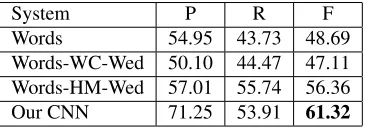
in-clude: the heads of the two entity mentions; the words in the context before mention 1; after men-tion 2 and between two menmen-tions; the bigrams, the word sequences between two entities, the order of two mentions, the number of words between two mentions (Zhou et al., 2005; Jiang and Zhai, 2007; Sun et al., 2011). The feature-based system using this feature set is called Words. Armed with the word embeddings, one can further introduce these embeddings into the head words or the words in the context as additional features (Nguyen and Grish-man, 2014). We call the systemWordsaugmented with the embeddings for the two heads Words-HM-WedandWordsaugmented with the embeddings for words in the contexts Words-WC-Wed. We apply the MaxEnt framework with L2 regularization in the Mallet toolkit8 to train these feature-based models (as (Jiang and Zhai, 2007; Sun et al., 2011; Nguyen and Grishman, 2014)). Table 3 shows the perfor-mance of the three baseline systems and our pro-posed CNN via 5-fold cross validation on the ACE 2005 dataset.
System P R F
[image:7.612.95.278.367.432.2]Words 54.95 43.73 48.69 Words-WC-Wed 50.10 44.47 47.11 Words-HM-Wed 57.01 55.74 56.36 Our CNN 71.25 53.91 61.32
Table 3: Performance of Relation Extraction Systems The first observation is that adding the word em-beddings to the words in the context hurt the per-formance of the feature-based systems while aug-menting the heads of the entities with word embed-dings significantly improves the feature-based sys-tems. This is consistent with the results reported by Nguyen and Grishman (2014) and demonstrates that the ability to wisely pick the words for embed-dings and avoid embedembed-dings on specific locations is crucial to the feature-based systems. More im-portantly, our proposed CNN significantly outper-forms all the baseline models at the confidence lev-els≥95%, an improvement of 4.96% over the best feature-based systemWords-HM-Wed(Nguyen and Grishman, 2014). This result indicates that CNNs are a better way to employ word embeddings for re-lation extraction.
8http://mallet.cs.umass.edu/
Remember that although the traditional systems can achieve a performance greater than 72% on the ACE dataset (Qian et al., 2008; Sun et al., 2011), they come at the expense of elaborate feature en-gineering as well as much more expensive feature extraction. In particular, the feature extractors of these feature-based systems require: (i) the perfect entity and mention type information hand-labeled laboriously by human annotators; (ii) the extensive usage of the existing supervised NLP toolkits and resources (constituent and dependency parsers, dic-tionaries, gazetteers etc) which might be unavail-able for various domains in reality. The absence of the perfect (hand-annotated) entity and mention type information (i.e point (i) above) greatly impairs these feature-based systems’ performance. For in-stance, both Plank and Moschitti (2013) and Nguyen and Grishman (2014) report a performance less than 60% on the ACE 2005 dataset when the perfect entity type and mention type features are not em-ployed although the other features with extensive feature engineering (i.e point (ii) above) are still included. As a result, in a more realistic setting where hand-annotated features are prohibitive, the proposed CNN requires much less feature engineer-ing and resources but still performs better than the traditional feature-based systems.
4.5 Relation Classification Experiment
In order to further verify the effectiveness of the sys-tem, we test the system on the relation classifica-tion task with the SemEval 2010 dataset and com-pare the results with the state-of-the-art systems in this area. Table 4 describes the performance of var-ious traditional systems that are based on classifiers such as MaxEnt and SVM with series of supervised and manual features9(Hendrickx et al., 2010) as well as the more recent systems based on convolutional neural networks (Zeng et al., 2014) (O-CNN), cursive neural networks (RNN), matrix-vector re-cursive neural networks (MVRNN) (Socher et al., 2012) or log-quadratic factor-based compositional embedding model (FCM) (Yu et al., 2014)10.
As we can see, among the systemsnot using any
9i.e the features extracted from supervised pre-processing
NLP modules and manual resources
10These are the macro-averaged F1-scores, computed by the
Classifier Feature Sets F SVM POS, WordNet, morphological
features, thesauri, Google n -grams
77.6
MaxEnt POS, WordNet, morphological features, noun compound sys-tem, thesauri, Googlen-grams
77.6
SVM POS, WordNet, prefixes and other morphological fea-tures, dependency parse, Levin classes, PropBank, FrameNet, NomLex-Plus, Google n-grams, paraphrases, TextRunner
82.2
RNN - 74.8
RNN POS, name tagging, WordNet 77.6
MVRNN - 79.1
MVRNN POS, name tagging, WordNet 82.4
O-CNN - 78.9
O-CNN WordNet 82.7
FCM - 80.6
FCM dependency parse, name
tag-ging 83.0
[image:8.612.327.527.56.216.2]Our CNN - 82.8
Table 4: Performance of Relation Classification Systems
supervised and manual features(i.e, POS, WordNet, name tagging, dependency parse, patterns etc), our system significantly outperforms the state-of-the-art system FCM (80.6%) (Yu et al., 2014) with an im-provement of 2.2%. More interestingly, even with-out supervised and manual features, our system can still work comparably to the other systems utilizing these features as the vital components. For instance, the supervised features (dependency parse and name tagging) are crucial to FCM (Yu et al., 2014) to sig-nificantly improve its performance. We attribute our performance advantage over the closely-related sys-tem O-CNN (Zeng et al., 2014) to the multiple win-dow sizes, the optimization of the position embed-dings during training and possibly the superiority of the embeddingsword2vecwe use.
4.6 Impact of Unbalanced Dataset
Shifting from relation classification to relation ex-traction with an unbalanced corpus, we witness a large performance gap as described above. In this section, we study the impact of the unbalanced cor-pus on the performance of relation extractors for both convolutional neural networks and traditional feature-based approaches (Words and
Words-HM-0 Words-HM-0.5 1 1.5 2 2.5 3 50
60 70 80
1 + log10(#positive
#negative)
F-measure Words
Words-HM-Wed Our CNN
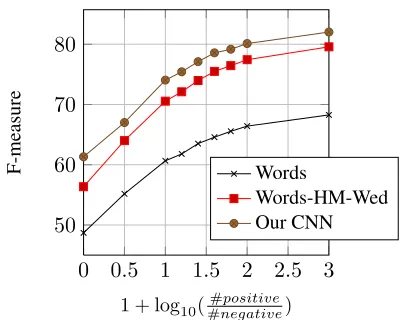
Figure 2: F measures vs positive/negative ratios Wed). In particular, we vary the ratio of positive (true relations) and negative (the classOther) examples in the ACE 2005 dataset and see how the system per-formance responds to this variation. Figure 2 shows the curves. This is a 5-fold cross validation experi-ment and all the comparisons are significant at con-fidence levels≥95%.
From the figure, we see that all the models im-prove constantly with the increase of the ratio of the positive and negative examples. The performance peaks with an improvement of about 20% for all models when the number of examples of the class Otheris small relative to the others. In other words, the systems attain their best performance when rela-tion extracrela-tion is reduced to the relarela-tion classifica-tion problem, suggesting that relaclassifica-tion extracclassifica-tion is much more challenging than relation classification. Finally, for all the ratio values, we consistently see that the convolutional neural network is superior to the others, once again confirming its advantages.
5 Conclusion
[image:8.612.78.297.57.353.2]References
Yoshua Bengio, R´ejean Ducharme, and Pascal Vincent. 2001. A Neural Probabilistic Language Model. In Advances in Neural Information Processing Systems 13 (NIPS’00), pages 932938, MIT Press, 2001. John Blitzer, Ryan McDonald, and Fernando Pereira.
2006. Domain Adaptation with Structural Correspon-dence Learning. In Proceedings of the 2006 Confer-ence on Empirical Methods in Natural Language Pro-cessing, Sydney, Australia.
Elizabeth Boschee, Ralph Weischedel, and Alex Zama-nian. 2005. Automatic Information Extraction. In Proceedings of the International Conference on Intel-ligence Analysis.
Razvan C. Bunescu and Raymond J. Mooney. 2005a. A Shortest Path Dependency Kenrel for Relation Extrac-tion. In Proceedings of HLT/EMNLP.
Razvan C. Bunescu and Raymond J. Mooney. 2005b. Subsequence Kernels for Relation Extraction. In Pro-ceedings of NIPS.
Yee S. Chan and Dan Roth. 2010. Exploiting Back-ground Knowledge for Relation Extraction. In Pro-ceedings of the 23rd International Conference on Computational Linguistics (Coling 2010), pages 152-160, Beijing, China, August.
Ronan Collobert and Jason Weston. 2008. A Unied Architecture for Natural Language Processing: Deep Neural Networks with Multitask Learning. In Interna-tional Conference on Machine Learning, ICML, 2008. Ronan Collobert, Jason Weston, L´eon Bottou, Michael Karlen, Koray Kavukcuoglu and Pavel Kuksa. 2011. Natural Language Processing (Almost) from Scratch. Journal of Machine Learning Research 12:24932537. Aron Culotta and Jeffrey Sorensen. 2004. Dependency
Tree Kernels for Relation Extraction. In Proceedings of ACL 2004.
Hal Daum´e III. 2007. Frustratingly Easy Domain Adap-tation. In Proceedings of the ACL, pages 256-263, Prague, Czech Republic, June 2007.
Ralph Grishman, David Westbrook and Adam Meyers. 2005. NYUs English ACE 2005 System Description. ACE 2005 Evaluation Workshop.
Jing Jiang and ChengXiang Zhai. 2007. A Systematic Exploration of the Feature Space for Relation Extrac-tion. In Proceedings of the Human Language Technol-ogy Conference of the North American Chapter of the Association for Computational Linguistics (NAACL-HLT’07), pages 113-120, 2007.
Iris Hendrickx, Su Nam Kim, Zornitsa Kozareva, Preslav Nakov, Diarmuid ´O S´eaghdha, Sebastian Pad´o, Marco Pennacchiotti, Lorenza Romano, Stan Szpakowicz 2010. SemEval-2010 Task 8: Multi-Way Classifica-tion of Semantic RelaClassifica-tions Between Pairs of Nominals.
In Proceedings of the 5th International Workshop on Semantic Evaluation, SemEval 2010.
Geoffrey E. Hinton, Nitish Srivastava, Alex Krizhevsky, Ilya Sutskever, and Ruslan Salakhutdinov. 2012. Improving Neural Networks by Preventing Co-Adaptation of Feature Detectors. CoRR, abs/1207.0580.
Raphael Hoffmann, Congle Zhang, Xiao Ling, Luke Zettlemoyer, and Daniel Weld. 2011. Knowledge-based Weak Supervision for Information Extraction of Overlapping Relations. In Proceedings of ACL 2011. Nal Kalchbrenner, Edward Grefenstette and Phil
Blun-som. 2014.A Convolutional Neural Network for Mod-elling Sentences. In Proceedings of ACL 2014. Nanda Kambhatla. 2004. Combining Lexical, Syntactic,
and Semantic Features with Maximum Entropy Models for Information Extraction. In Proceedings of ACL 2004.
Yoon Kim. 2014. Convolutional Neural Networks for Sentence Classification. In Proceedings of EMNLP 2014.
Yann LeCun, L´eon Bottou, Yoshua Bengio and Patrick Haffner. 1988. Gradient-based learning applied to document recognition. In Proceedings of the IEEE, 86(11):22782324, November, 1988.
ChunYang Liu, WenBo Sun, WenHan Chao, and WanX-iang Che. 2013. Convolution Neural Network for Re-lation Extraction. In Proceedings of 9th International Conference on Advanced Data Mining and Applica-tions, Part II (ADMA 2013), Hangzhou, China, De-cember, 2013.
David McClosky, Eugene Charniak, and Mark Johnson. 2010. Automatic Domain Adaptation for Parsing. In Proceedings of Human Language Technology Confer-ence of the North American Chapter of the Associa-tion for ComputaAssocia-tional Linguistics, pages 28-36, Los Angeles, California, June 2010.
Tomas Mikolov, Ilya Sutskever, Kai Chen, Greg Corrado, and Jeffrey Dean. 2013. Distributed Representations of Words and Phrases and their Compositionality. In Proceedings of NIPS, 2013.
Mike Mintz, Steven Bills, Rion Snow, and Daniel Juraf-sky. 2009. Distant Supervision for Relation Extrac-tion without Labeled Data. In Proceedings of ACL, 2009.
Andriy Mnih and Geoffrey Hinton. 2007. Three new Graphical Models for Statistical Language Modelling. In Proceedings of ICML’07, pages 641-648, Corvallis, OR, 2007.
Andriy Mnih and Geoffrey Hinton. 2009. A Scalable Hierarchical Distributed Language Model. In NIPS, page 1081-1088.
Network for Factoid Question Answering over Para-graphs. In Proceedings of EMNLP 2014.
Thien Huu Nguyen and Ralph Grishman. 2014. Employ-ing Word Representations and Regularization for Do-main Adaptation of Relation Extraction. In Proceed-ings of ACL 2014, pages 68-74, Baltimore, Maryland, USA.
Truc-Vien T. Nguyen, Alessandro Moschitti, and Giuseppe Riccardi. 2009. Convolution Kernels on Constituent, Dependency and Sequential Structures for Relation Extraction. In Proceedings of EMNLP 09, pages 1378-1387, Stroudsburg, PA, USA.
Barbara Plank and Alessandro Moschitti. 2013. Embed-ding Semantic Similarity in Tree Kernels for Domain Adaptation of Relation Extraction. In Proceedings of the ACL 2013, pages 1498-1507, Sofia, Bulgaria. Longhua Qian, Guodong Zhou, Qiaoming Zhu and Peide
Qian. 2008. Exploiting Constituent Dependencies for Tree Kernel-based Semantic Relation Extraction. In Proceedings of COLING, pages 697-704, Manchester. Sebastian Riedel, Limin Yao, and Andrew McCallum. 2010. Modeling Relations and their Mentions without Labeled Text. In Proceedings of ECML PKDD, 2010. Yelong Shen, Xiaodong He, Jianfeng Gao, Li Deng and
Gr´egoire Mesnil. 2014. Learning Semantic Represen-tations Using Convolutional Neural Networks for Web Search. In Proceedings of WWW 2014.
Richard Socher, Eric H. Huang, Jeffrey Pennington, An-drew Y. Ng, and Christopher D. Manning. 2011. Dy-namic Pooling and Unfolding Recursive Autoencoders for Paraphrase Detection. In Proceedings of NIPS 2011.
Richard Socher, Brody Huval, Christopher D. Manning and Andrew Y. Ng. 2012. Semantic Compositionality through Recursive Matrix-Vector Spaces. In Proceed-ings of EMNLP 2012.
Richard Socher, John Bauer, Christopher D. Manning and Andrew Y. Ng. 2013. Parsing with Compositional Vector Grammars. In Proceedings of ACL 2013. Richard Socher, Alex Perelygin, Jean Wu, Jason Chuang,
Chris Manning, Andrew Ng and Chris Potts. 2013. Recursive Deep Models for Semantic Compositional-ity Over a Sentiment Treebank. In Proceedings of EMNLP 2013.
Richard Socher, Danqi Chen, Christopher D. Manning, Andrew Y. Ng. 2013. Reasoning With Neural Tensor Networks for Knowledge Base Completion. In Pro-ceedings of NIPS 2013.
Ang Sun, Ralph Grishman, and Satoshi Sekine. 2011. Semi-supervised Relation Extraction with Large-scale Word Clustering. In Proceedings of ACL-HLT, pages 521-529, Portland, Oregon, USA.
Le Sun and Xianpei Han 2014. A Feature-Enriched Tree Kernel for Relation Extraction. In Proceedings of ACL 2014, pages 61-67, Baltimore, Maryland, USA. Mihai Surdeanu, Julie Tibshirani, Ramesh Nallapati and
Christopher D. Manning 2012. instance Multi-label Learning for Relation Extraction. In Proceed-ings of EMNLP-CoNLL 2012.
Joseph Turian, Lev Ratinov, and Yoshua Bengio. 2010. Word representations: A simple and general method for semi-supervised learning. In Proceedings of the 48th Annual Meeting of the Association for Computa-tional Linguistics (ACL’10), pages 384-394, Uppsala, Sweden, July, 2010.
Wen-tau Yih, Xiaodong He, and Christopher Meek. 2014. Semantic Parsing for Single-Relation Question Answering. In Proceddings of ACL 2014.
Mo Yu, Matthew R. Gormley, and Mark Dredze. 2014. Factor-based Compositional Embedding Models. In the NIPS Learning Semantics Workshop 2014. Matthew D. Zeiler. 2012. ADADELTA: An Adaptive
Learning Rate Method. CoRR, abs/1212.5701. Dmitry Zelenko, Chinatsu Aone, and Anthony
Richardella. 2003. Kernel Methods for Relation Extraction. Journal of Machine Learning Research, 3:10831106.
Daojian Zeng, Kang Liu, Siwei Lai, Guangyou Zhou and Jun Zhao. 2014. Relation Classification via Convolu-tional Deep Neural Network. In Proceedings of COL-ING 2014.
Min Zhang, Jie Zhang, Jian Su, and GuoDong Zhou. 2006. A Composite Kernel to Extract Relations be-tween Entities with both Flat and Structured Features. In Proceedings of COLING-ACL-06, pages 825-832, Sydney.
Guodong Zhou, Jian Su, Jie Zhang, and Min Zhang. 2005. Exploring various Knowledge in Relation Ex-traction. In Proceedings of ACL’05, pages 427-434, Ann Arbor, USA, 2005.