© 2016. Talluri. Sunil Kumar, T.V.Rajinikanth & B. Eswara Reddy. This is a research/review paper, distributed under the terms of the Creative Commons Attribution-Noncommercial 3.0 Unported License http://creativecommons.org/licenses/by-nc/3.0/), permitting all non-commercial use, distribution, and reproduction inany medium, provided the original work is properly cited.
Image Information Retrieval based on Edge Responses, Shape
and Texture Features using Datamining Techniques
By Talluri. Sunil Kumar, T.V.Rajinikanth & B. Eswara Reddy
VN Vignana Jyothi Institute of Engineering and Technology
Abstract-
The present paper proposes a new technique that extracts significant structural, texture and
local edge features from images. The local features are extracted by a steady local edge response
that can sustain the presence of noise, illumination changes. The local edge response image is
converted in to a ternary pattern image based on a local threshold. The structural features are
derived by extracting shapes in the form of textons. The texture features are derived by constructing
grey level co-occurrence matrix (GLCM) on the derived texton image. A new variant of K-means
clustering scheme is proposed for clustering of images. The proposed method is compared with
various methods of image retrieval based on data mining techniques.
Keywords:
local binary pattern, local directional pattern, textons, GLCM features.
GJCST-F Classification: I.3.3,
ImageInformationRetrievalbasedonEdgeResponses,ShapeandTextureFeaturesusingDataminingTechniques
Strictly as per the compliance and regulations of:
Online ISSN: 0975-4172& Print ISSN: 0975-4350
Publisher: Global Journals Inc. (USA)
Type: Double Blind Peer Reviewed International Research JournalVolume 16 Issue 3 Version 1.0 Year 2016
Graphics & Vision
Talluri. Sunil Kumarα, T.V.Rajinikanth, σ & B. Eswara Reddyρ
Abstract- The present paper proposes a new technique that extracts significant structural, t from images. The local features are extracted by a steady local illumination chang converted in to a ternary pattern image based on a local threshold. The structural features are derived by extracting shapes in the form of textons. The texture features are derived by constructing grey level co-occurrence matrix (GLCM) on the derived texton image. A new variant of K-means clustering scheme is proposed for clustering of images. The proposed method is compared with various methods of image retrieval based on data mining techniques. The experimental results on Wang dataset shows the efficacy of the proposed method over the other methods.
local binary pattern, local directional pattern, textons, GLCM features.
I.
I
ntroductionhe volume of digital images produced in the world wide has increased dramatically over the past 10 decades and the World Wide Web plays a vital role in this upsurge. This has created the availability of huge digital image databases or libraries. The handling and accessing of these data base images by human annotations is impractical and it has led to the automatic search mechanisms and it has created a demand for content based image retrieval (CBIR) models. CBIR is defined as a process that searches and retrieves images from a large database. The retrieval operation is performed on the basis of derived image features such as color, texture and shape. A good literature survey was conducted on CBIR and is available in [1-4]. The
color is one of the significant feature of the CBIR and
one of the simple color based CBIR is the color histogram [5].The retrieval performance of this generally limited due to its low discrimination power mainly on immense data. To improve this various color descriptors
are proposed in the literature using neural networks
[6], DCT-domain vector quantization [7], supervised
learning [8] and color edge co-occurrence histograms [9].
The natural images are visualized by their rich content of texture mosaic and color. The texture descriptors are based on grey scale variation and they can also integrate with color component of image retrieval (IR). It is very difficult to give unique definition to texture and it is one of the significant and salient features for CBIR. The texture based image retrieval is reported in the literature based on the characteristics of images in different orientations [10, 11, 12, 13, 14, 15]. Extraction of texture features on wavelets [16], wavelet transform based texture features [16] and correlagrams [17] are also proposed for efficient IR. The performance of the correlograms [17] is further improved using genetic algorithms (GA) [18]. The integrated methods that combine the color histograms with texture features [19, 20] and correlograms with rotated wavelets [21] attained a good IR rate. Recently, the research focuses on CBIR systems that is fetching the exact cluster of relevant images and reducing the elapsed time of the system. For this purpose, various data mining techniques have been developed to improve the performance of CBIR system. Clustering is one of the vital techniques of data mining for quick retrieval of information from the large data repositories. Clustering is an unsupervised process, thus the evolution of clustering algorithm is important due to the extraction of hidden patterns [22, 23]. There are many applications in the real-world with clustering like credit card, mark analysis, web data categorization, image analysis, text mining, pattern recognition, market data analysis, weather report analysis [24].Data clustering explicitly divides the data into a set of k user specified number of groups by trying to minimize intra-cluster variance and maximize inter-cluster variance in an iterative manner [25, 26]. Various methods are proposed in the literature to improve the performance of the data clusters [27, 28, 29] in various applications. K-means [30] is one of the popular and efficient clustering algorithms. Later various variations to k-means algorithm are proposed to improve the efficiency [31, 32, 33].
A content-based image retrieval method using adaptive classification and cluster-merging is proposed for image retrieval to find multiple clusters of a complex
T
Global Journal of Computer Science and Technology Volume XVI Issue III Version I
1 Year 2016 ( ) F
Image Information Retrieval based on Edge
Responses, Shape and Texture Features using
Datamining Techniques
Keywords:
Authorα:VNR Vignana Jyothi Institute of Engineering and Technology, Hyderabad, Telangana, India. e-mail: [email protected],
Authorσ: SNIST, Hyderabad, Telangana India. e-mail: [email protected]
Author ρ: Professor in CSE and Principal, JNTU-A College of
Engineering, Kalikiri, Chittoor Dist, Andhra. Pradesh, India. e-mail: [email protected]
image query [34]. This method [34] achieves the same retrieval quality, under linear transformations, regardless of the shapes of clusters of a query. A cluster-based image retrieval system by unsupervised learning (CLUE), is proposed for improving user interaction with image retrieval systems by fully exploiting the similarity information [35]. The CLUE retrieves image clusters by applying a graph-theoretic clustering algorithm and it is dynamic in nature. The CLUE retrieves image clusters instead of a set of ordered images. The principle of unsupervised hierarchical clustering is also used in CBIR [36]. The modified fuzzy c-means (MFCM) cluste- ring scheme introduced fuzzy weights and it reduced the time of clustering and also used for image retrieval [37, 66]. A content-based parallel image retrieval system to achieve high responding ability is proposed and it is based on cluster architectures [38]. It has several retrie- val servers to supply the service of content-based image retrieval. Many researchers used k-means clustering with variations and achieved a good image retrieval rate [39, 40, 41,42]. K-means clustering technique is helpful to reduce the elapsed time of the system.
The rest of the paper organized as follows: The proposed method, local directional pattern (LDP),k-means and query matching are given in Section 2. Experimental results and discussions are summarized in section 3. Based on above work, conclusions are made in section 4.
II.
P
roposedM
ethodThe present paper initially converts the color image into grey level image using HSV quantization. The present paper derives integrated features that significantly holds edge, shape and texture features, for this initially edge responses are obtained then shape features in the form of textons are evaluated. Then GLCM features are obtained. Images are clustered based on the two point perimeter K-means (TPP-KM) clustering scheme. A similarity measure in the form of Euclidian distance is used to retrieve the top most similarity images.
a) Algorithm for feature extraction
The features are extracted based on the following steps
Step 1: The color image is converted in to grey level
images using HSV color space.
Step 2: Conversion of edge response image in to
ternary pattern image. This is derived based on two sub steps 2(a) and 2 (b).
Step 2 a): The local features in the form of edge
responses in eight directions are obtained on the grey level image based on local direction pattern (LDP) coded image.
The formation process of LDP is explained below.
The LDP is an eight bit binary code that
describes the relative edge value of a pixel in different
directions [43]. The present paper evaluates edge responses in eight directions on a central pixel of a 3 x 3 neighborhood using Kirsch masks [68].Out of eight
(mi/i=0, 1 ….7) only the k-most significant edges are
given a value 1 and the remaining are set to zero. The
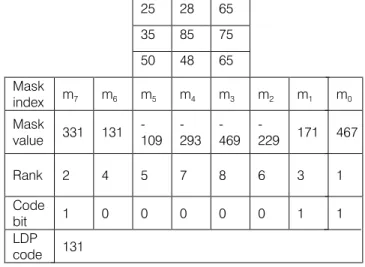
three greatest responses, i.e. k=3 are considered in the present paper. The reason for this is the occurrence of corner or edge indicates a huge edge response value in a particular direction. The LDP code generation on a 3x3 neighborhood is shown below in Figure 1. The advantage of LDP over Local binary pattern (LBP) is, LDP can sustain the noise. And this is shown Figure 2. The Figure 2(b) corresponds to the noisy or fluctuated neighborhood of Figure 2(a). In this case the LBP code changes drastically whereas the LDP retains the same value.
Figure 2:Stability of LDP vs. LBP (a) Original image (b)
Image with noise
Step 2b): Conversion of LDP coded image in to ternary
form, based on a threshold. This mechanism simplifies the extraction of textons that represent shape of the texture in the next step. This also makes the present process to be resistant to lighting effects, noise and
25 28 65 35 85 75 50 48 65 Mask index m7 m6 m5 m4 m3 m2 m1 m0 Mask value 331 131 -109 -293 -469 -229 171 467 Rank 2 4 5 7 8 6 3 1 Code bit 1 0 0 0 0 0 1 1 LDP code 131
Figure 1:Transformation of LDP code for K=3
85 32 26 53 50 10 LBP=00111000 60 38 48 LDP=00010011 (a) 85 32 26 49 50 10 60 38 48 LBP=00101000 (b) LDP=00010011
other illumination changes. For this the neighborhood
pixel (pi) values of LDP coded image are compared with
‘l’. The
central pixel (Pc) using a lag limit value
Global Journal of Computer Science and Technology Volume XVI Issue III Version I
2 Year 2016 ( ) F
neighborhood values are assigned one of the ternary values Ti. (Equation 1). 𝐿𝐿𝐿𝐿𝑇𝑇𝑇𝑇(𝑇𝑇𝑖𝑖) = �2 𝑇𝑇𝑖𝑖 ≥(𝑇𝑇𝑐𝑐+𝑙𝑙) 1 |𝑇𝑇𝑖𝑖− 𝑇𝑇𝑐𝑐| <𝑙𝑙 0 𝑇𝑇𝑖𝑖 ≤(𝑇𝑇𝑐𝑐− 𝑙𝑙) (1)
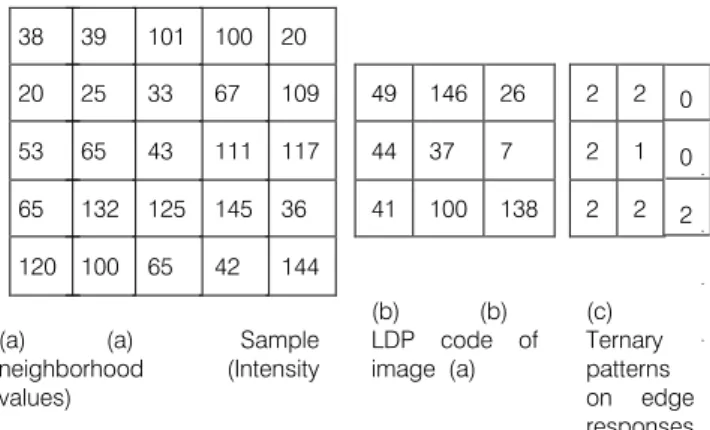
The process of generation of this is illustrated in Figure 3 with l=3. The proposed edge responses
generate a total of 0 to K*(P-1) codes and this is
considered as the main disadvantage. Here k is the number of greatest edge responses considered and p is
the number of neighboring pixels.This is not considered
as the disadvantage in the present paper, since we are not deriving LDP coded image and we are only deriving ternary patterns out of the LDP coded image. Further it is more convenient to derive shape feature (in the next
step) on local ternary patterns (0 or 1 or 2)derived from
edge responses. 38 39 101 100 20 20 25 33 67 109 49 146 26 2 2 0 53 65 43 111 117 44 37 7 2 1 0 65 132 125 145 36 41 100 138 2 2 2 120 100 65 42 144
(a) (a) Sample
neighborhood (Intensity values) (b) (b) LDP code of image (a) (c) Ternary patterns on edge responses Figure
3:Transformation of local edge responses image
into ternary pattern image
Step 3: Derivation of local shape features in the form of
textons on the ternary image. The method of deriving textons on ternary image is given in Figure 4. The basic unit of an image is pixels and its intensity and experime-nts based on this have not resulted any satisfactory results. In order to progress the performance the pattern and shape based methods are employed. A pattern and
shape consists of group or set of neighboringpixels with
similar intensity levels. One of such popular measure is “texton” proposed by Julesz [44]. Textons are defined as emergent patterns or blobs. These “textons” share a common property all over the image. The methods based on LBP and textons are very useful for texture analysis and classification [45, 46, 47] face recognition [48], age classification [49, 50, 51, 52], image retrieval [15] etc. Variousarray grammar models are proposed in the literature to represent patterns and shapes [53, 54]. Based on textons one can say whether texture is fine or coarse or in any other form. Textons can be derived on a
2x 2 or on a 3x3 or on any neighborhood window. The
present paper utilized all texton patterns that forms only with two and four pixels on a 2×2 grid. This derives seven textons on a 2 x 2 grid. The derivation of texton
image with the above 7 local shape features (textons) is shown below Figure 4.
3 1 1 2 1 3 3 1 1 2 1 3 3 1 1 2 1 3 3 2 3 2 3 1 3 2 3 2 3 1 3 2 0 2 3 1 1 2 4 2 4 2 1 2 4 2 4 2 1 2 0 2 0 2 1 3 1 3 2 1 1 3 1 3 2 1 1 0 0 3 2 0 2 2 2 1 3 2 2 2 2 1 3 2 2 2 2 1 3 0 2 2 3 1 3 1 2 2 3 1 3 1 2 2 0 1 3 0 (a) (b) (c)
Figure 4:Transformation of Texton process: a) Original
image (b) Textons identification (c) Texton image Derivation of GLCM features. GLCM features are computed on the derived texton matrix.
The present paper evaluated four Haralick features [55] for effective image retrieval and they are listed below. The features homogeneity, energy,
contrast and correlation are evaluated with an angle of
0o, 45o, 90oand 135oand the average value of this are
considered as texture feature.
Homogeniety or Angular Second Moment (ASM):
ASM= ∑ ∑G−1{P(i, j)}2
j=0 G−1
i=0 (2)
ASM is a measure of homogeneity of an image. A homogeneous scene will contain only a few grey levels, giving a GLCM with only a few but relatively high values of P (i, j ). Thus, the sum of squares will be high. Energy : Energy =
( )
2 , ,∑
ijPi j (3) Contrast : Contrast=∑G−1n2 n=0 �∑ ∑Gi=1 Gj=1P(i, j)�, |i−j| = n (4) This measure of contrast or local intensity variation will favor contributions from P (i, j) away from the diagonal, i.e. i ! = j.Correlation :
Correlation = ∑ ∑ {iXj }XP(i,j)−�µxXµy�
σxXσy G−1
j=0 G−1
i=0 (5)
Correlation is a measure of grey level linear dependence between the pixels at the specified positions relative to each other.
b) Clustering method
One of the commonly used and simplest algorithm for clustering is the means algorithm. K-means is one of the fundamental algorithms of clustering and it employs the square error criterion. The numbers of partitions are to be defined in K-means initially. The cluster centers are randomly initialized for
Global Journal of Computer Science and Technology Volume XVI Issue III Version I
3 Year 2016 ( ) F
Image Information Retrieval based on Edge Responses, Shape and Texture Features Using Datamining Techniques
predefined number of clusters. If the initial number of clusters is not properly chosen then the output of algorithm may converge to false cluster locations and completely different clustering result [58, 59]. This measure is often called the squared-error distortion [60,
61] and this type of clustering falls into the general category of variance-based clustering [62, 63].
The present paper outlined a new variation to
the existing K-means algorithm to reduce the number of iterations and to increase the overall retrieval rate. This new variation of K-means scheme is denoted as two
point perimeter –K-means (TPP-KM) clustering scheme.
The present scheme selects two points instead of one point in K-means and also a perimeter is also evaluated and the similarity is evaluated by using Euclidean distance.
c) Query matching and performance measure
The present retrieval model selects 20 top images from the database images that are matching with query image. This is accomplished by measuring the distance between the query image and database images. The present paper used Euclidean distance as the distance measure and as given below
𝐿𝐿𝑖𝑖𝐷𝐷𝐷𝐷𝐷𝐷(𝑇𝑇𝑛𝑛,𝐼𝐼𝑛𝑛) = �∑𝑖𝑖,𝑗𝑗=1�𝑓𝑓𝑖𝑖(𝑇𝑇𝑛𝑛)− 𝑓𝑓𝑗𝑗(𝐼𝐼𝑛𝑛)�2�
1/2 (6) The database image is used as the query image in our experiments. If the retrieved image belongs to the same category as that of query image we say that the system has suitably identified the predictable image otherwise the system fail to find the image. The performance of the present model is evaluated in terms of precision, recall rate and F-Measure as given in
equation 7, 8and 9. 𝑇𝑇𝑃𝑃𝑃𝑃𝑐𝑐𝑖𝑖𝐷𝐷𝑖𝑖𝑃𝑃𝑛𝑛𝑇𝑇= 𝑁𝑁𝑁𝑁𝑁𝑁𝑁𝑁𝑃𝑃𝑃𝑃 𝑃𝑃𝑓𝑓𝑃𝑃𝑃𝑃𝑙𝑙𝑃𝑃𝑟𝑟𝑟𝑟𝑛𝑛𝐷𝐷 𝑖𝑖𝑁𝑁𝑟𝑟𝑖𝑖𝑃𝑃𝐷𝐷 𝑃𝑃𝑃𝑃𝐷𝐷𝑃𝑃𝑖𝑖𝑃𝑃𝑟𝑟𝑃𝑃𝑟𝑟 (𝐼𝐼𝑅𝑅𝑅𝑅) 𝑁𝑁𝑁𝑁𝑁𝑁𝑁𝑁𝑃𝑃𝑃𝑃 𝑃𝑃𝑓𝑓𝑃𝑃𝑃𝑃𝐷𝐷𝑃𝑃𝑖𝑖𝑃𝑃𝑟𝑟𝑃𝑃𝑟𝑟 𝑖𝑖𝑁𝑁𝑟𝑟𝑖𝑖𝑃𝑃𝐷𝐷(𝐼𝐼𝑁𝑁𝑅𝑅) (7) 𝑅𝑅𝑃𝑃𝑐𝑐𝑟𝑟𝑙𝑙𝑙𝑙𝑅𝑅= 𝑁𝑁𝑁𝑁𝑁𝑁𝑁𝑁𝑃𝑃𝑃𝑃 𝑃𝑃𝑓𝑓𝑃𝑃𝑃𝑃𝑙𝑙𝑃𝑃𝑟𝑟𝑟𝑟𝑛𝑛𝐷𝐷 𝑖𝑖𝑁𝑁𝑟𝑟𝑖𝑖𝑃𝑃𝐷𝐷 𝑃𝑃𝑃𝑃𝐷𝐷𝑃𝑃𝑖𝑖𝑃𝑃𝑟𝑟𝑃𝑃𝑟𝑟 (𝐼𝐼𝑅𝑅𝑅𝑅) 𝑇𝑇𝑃𝑃𝐷𝐷𝑟𝑟𝑙𝑙𝑛𝑛𝑁𝑁𝑁𝑁𝑁𝑁𝑃𝑃𝑃𝑃 𝑃𝑃𝑓𝑓𝑃𝑃𝑃𝑃𝑙𝑙𝑃𝑃𝑟𝑟𝑟𝑟𝑛𝑛𝐷𝐷 𝑖𝑖𝑁𝑁𝑟𝑟𝑖𝑖𝑃𝑃𝐷𝐷 𝑖𝑖𝑛𝑛𝐷𝐷ℎ𝑃𝑃𝑟𝑟𝑟𝑟𝐷𝐷𝑟𝑟𝑁𝑁𝑟𝑟𝐷𝐷𝑃𝑃 (𝐼𝐼𝑇𝑇𝑅𝑅) (8) The algorithms that improve precession may degrade recall and vice versa. The present paper also evaluates another parameter called F-measure that is
basedon both precession and recall.
𝐹𝐹 − 𝑀𝑀𝑃𝑃𝑟𝑟𝐷𝐷𝑁𝑁𝑃𝑃𝑃𝑃= 2∗(𝑝𝑝𝑃𝑃𝑃𝑃𝑐𝑐𝑖𝑖𝐷𝐷𝑖𝑖𝑃𝑃𝑛𝑛(𝑝𝑝𝑃𝑃𝑃𝑃𝑐𝑐𝑖𝑖𝐷𝐷𝑖𝑖𝑃𝑃𝑛𝑛 ∗𝑃𝑃𝑃𝑃𝑐𝑐 𝑟𝑟𝑙𝑙𝑙𝑙+𝑃𝑃𝑃𝑃𝑐𝑐𝑟𝑟𝑙𝑙𝑙𝑙 (9)))
III.
R
esults andD
iscussionIn order to efficiently investigate the performance of the present retrieval model, we have considered the Wang database [64]. Wang is a subset
of Corel stock photo database of 1000 images. These
images are grouped into 10 classes, each class contains 100 images. Within this database, it is known whether any two images are of the same class.
Classification of the images in the database into 10
classes makes the evaluation of the system easy. The
hefty size of each class and the heterogeneous image class contents made Wang data base as one of the
popular database for image retrieval.The present paper
considered 7-classes of images and 100 images per
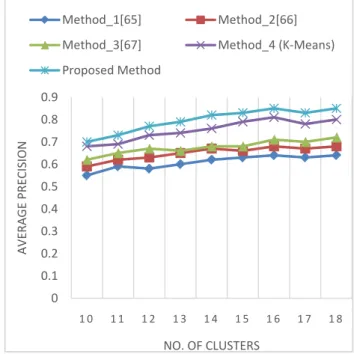
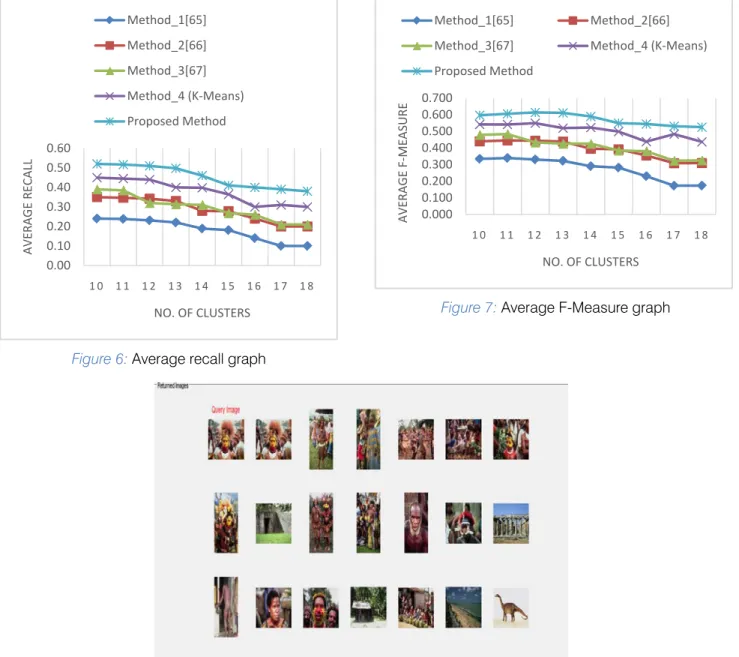
each class. For a query image the relevant images are assumed to be the remaining 99 images of the same class. The images from all other classes are treated as irrelevant images. The retrieval performance of the proposed method is judged in terms of precession, recall and F-measure. The proposed clustering method derived integrated novel features from edge responses, shapes in the form of textons and statistical parameters in the form of texture features (GLCM features). The average retrieval performance of the proposed method is compared with CBIR methods using data mining techniques [65, 66, 67] and the proposed method with K-means clustering method. The proposed method outperformed all the other methods in terms of precession, recall and F-measure and this is shown in
the Figure 5, 6 and Figure 7. In the method [65] the
features are extracted by GLCM features. In the existing method [67] fuzzy C-means clustering scheme is used with GLCM features and the method [66] used both color and statistical features with portioned clustering scheme. The advantage of the proposed method is the derivation of significant and powerful local features.
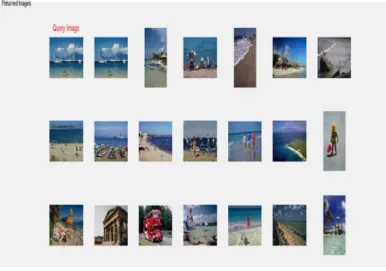
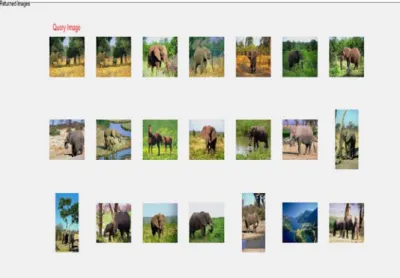
Figure 8 shows seven examples of retrieval images, i.e.
one image from each class, by the proposed method with 20-top most retrieved image.
Figure 5:Average precision graph
0 0.1 0.2 0.3 0.4 0.5 0.6 0.7 0.8 0.9 1 0 1 1 1 2 1 3 1 4 1 5 1 6 1 7 1 8 AV ER AG E P RE CISIO N NO. OF CLUSTERS Method_1[65] Method_2[66] Method_3[67] Method_4 (K-Means) Proposed Method
Global Journal of Computer Science and Technology Volume XVI Issue III Version I
4 Year 2016 ( ) F
Figure 7: Average F-Measure graph
Figure 8(a):Retrieved African images
0.000 0.100 0.200 0.300 0.400 0.500 0.600 0.700 1 0 1 1 1 2 1 3 1 4 1 5 1 6 1 7 1 8 AV ER AG E F -ME AS UR E NO. OF CLUSTERS Method_1[65] Method_2[66] Method_3[67] Method_4 (K-Means) Proposed Method
Figure 8(b):Retrieved monuments
Global Journal of Computer Science and Technology Volume XVI Issue III Version I
5 Year 2016 ( ) F
Figure 6:Average recall graph
0.00 0.10 0.20 0.30 0.40 0.50 0.60 1 0 1 1 1 2 1 3 1 4 1 5 1 6 1 7 1 8 AV ER AG E R EC AL L NO. OF CLUSTERS Method_1[65] Method_2[66] Method_3[67] Method_4 (K-Means) Proposed Method
Image Information Retrieval based on Edge Responses, Shape and Texture Features Using Datamining Techniques
Figure 8(c):Retrieved beach sand images
Figure 8(d): Retrieved busses
Figure 8(e):Retrieved dinosaurs
Global Journal of Computer Science and Technology Volume XVI Issue III Version I
6 Year 2016 ( ) F
Figure 8 (f) :Retrieved elephant’s images
Figure 8(g):Retrieved flower images
R
eferencesR
éférencesR
eferenciasGlobal Journal of Computer Science and Technology Volume XVI Issue III Version I
7 Year 2016 ( ) F
Image Information Retrieval based on Edge Responses, Shape and Texture Features Using Datamining Techniques
The present paper proposed a CBIR method using a data mining algorithm. The proposed method used a simple clustering scheme and achieved high retrieval rate when compared with the other existing methods because the proposed method extracted powerful and significant local features derived from edge responses, shape and textural properties. As with many other clustering algorithms, a limitation with our algorithm is that it requires the number of clusters to be known in prior. The advantage of edge responses is it can sustain with non-monotonic illumination variation and random noise. The shape features derived from textons are rotationally invariant. The texture features in the form of GLCM features with the help of clustering scheme retrieved the images in an accurate manner. The proposed method is experimented with one of the popular and heterogeneous dataset “Wang” and the experimental results indicates the superiority of the present method over the other existing methods.
1. Z. Lei, L. Fuzong, Z. Bo, “A CBIR method based on color-spatial feature, in: TENCON”, Proceedi- ngs of the IEEE Region 10 Conference, 1999, pp. 166–169. 2. H.B. Kekre, S.D. Thepade, “Color traits transfer to
grayscale images “, in: IEEE Int. Conference on Emerging Trends in Engineering and Technology, ICETET, 2008.
3. C.M. Pun, C.F. Wong, “Fast and robust, color feature extraction for content-based image retrieval”, Int. J. Adv. Comput. Technol. 3 (6) (2011). 4. A.Vadivel, S. Sural, A.K. Majumdar, “Human color
perception in the HSV space and its application in histogram generation for image Retrieval”,in: Proc. SPIE, Color Imaging X: Processing, Hardcopy, and Applications, 2005, pp. 598–609.
5. L. Cinque, G. Ciocca, S. Levialdi, A. Pellicano, R. Schettini, “Colour-based image retrieval using spatial-chromatic histogram”, Image Vis. Comput. 19 (2001), pp: 979–986.
Global Journal of Computer Science and Technology Volume XVI Issue III Version I
8 Year 2016 ( ) F
6. S. Jeong, C.S. Won, R.M. Gray, “Image retrieval using color histograms generated by Gauss mixture vector quantization”, Computer Vision Image Understanding, Vol-94, iss-1-3, june-2004, pp:44-66.
7. J. Yue, Z. Li, L. Liu, Z. Fu, “Content-based image retrieval using color and texture fused features” , Math. Comput. Modelling 54 (2011), pp: 1121–1127. 8. C.H. Lin, R.T. Chen, Y.K. Chan, “A smart content-based image retrieval system content-based on color and texture feature “, Image Vis. Comput. 27 (6) (2009) pp: 658–665.
9. J.Luo, D.Crandail, “Color object detection using spatial–color joint probability function”, IEEE transitions on Image Processing, 15 (6), (2006), 1443-1453.
10. Pentland, R.W. Picard, S. Sclaroff, Photobook: “Content-based manipulation of image databa-ses”, Int. J. Comput. Vis. 18 (1996), pp: 233–254. 11. J. Wu, Z. Wei, Y. Chang, “Color and texture feature
for content based image retrieval” , Int. J. Digit. Content Technol. Appl. 4 (3) (2010).
12. B.S. Manjunathi, W.Y. Ma, “Texture features for browsing and retrieval of image data”, IEEE Trans. Pattern Anal. Mach. Intell. 8 (8) (1996), pp: 837–842. 13. Gorti S Murty, V. Vijaya Kumar, A. Obulesu, “Age
classification based on simple LBP transitions”, International journal of computer science and engineering (IJCSE), Vol.5, No. 10, OCT-2013, pp.885-893.
14. A Obulesu, J S Kiran, VV Kumar, “Facial image retrieval based on local and regional features”, IEEE- 2015 International Conference on Applied and Theoretical Computing and Communication Technology (iCATccT), 2931 Oct. 2015, Pp:841 -846
15. V. Vijaya Kumar, A. Srinivasa Rao, YK Sundara Krishna, “Dual Transition Uniform LBP Matrix for Efficient Image Retrieval”, I.J. Image, Graphics and Signal Processing, 2015, 8, 50-57.
16. M. Kokare, P.K Biswas, B.N Chatterji, “Texture image retrieval using rotated wavelet filters”, J. Pattern Recognition. Lett. 28 (2007) 1240-1249. 17. H. A. Moghaddam, T.T hajoie, A.H. Rouhi, “A new
algorithm for image indexing and retrieval using wavelet correlograms”, Int. Conf. Image Process., K.N. Toosi Univ. of Technl., Tehran, Iran, 2(2003) 497-500.
18. M.T. saadatmand, H.A. Moghaddam, “Enhanced wavelet correlogram methods for image indexing and retrieval”, IEEE Int.Conf. Image Procc., K.N. Toosi Univ. of Technol. Tehran, Iran (2005) 541-544. 19. L. Birgale, M. Kokare, D. Doye, “Color and texture
features for content based image retrieval”, Int. Conf. Comput. Grafics. Image Visual., Wash., USA (2006) 146-149.
20. M. Subramanyam, A.B. Gonde, R.P. Maheshwari, “Color and texture features for image indexing and retrieval”, IEEE Int. Adv. Comput. Conf. Patial., Ind, (2009).
21. M. Subramnyam, R.P. Maheshwari, R. Balasubramanian, “A correlogram algorithm for image indexing and retrieval using wavelet and rotated wavelet filters”, Int. J. SignalImag. Syst.Eng. 4(1), (2011), 27-34.
22. Alsabti, K., Ranka, S. & Singh, V. (1998 March). “An Efficient K-means Clustering Algorithm”, Proc. First Workshop High Performance Data Mining.
23. Karaa, W. B. A., Ashour, A. S., Sassi, D. B., Roy, P., Kausar, N., &Dey, N. (2016). “MEDLINE Text Mining: An Enhancement Genetic Algorithm Based Approach for Document Clustering”, In Applications of Intelligent Optimization in Biology and Medicine (pp. 267-287). Springer International Publishing. 24. Karâa, W. B. A. (Ed.). (2015). “Biomedical Image
Analysis and Mining Techniques for Improved Health Outcomes”. IGI Global.
25. Jain, A., Murty, M., & Flynn, P. (1999). “Data clustering: A review”, ACM Comput. Surv., vol. 31, no. 3, (pp. 264–323).
26. Jain, A., &Dubes, R. (1988). “Algorithms for Cluste
27. Murthy; “A New Approach to Cluster Datasets without Prior Knowledge of Number of Clusters”, JSIR Vol.74 (05), May 2015.
28. Rishi Sayal, Dr GVSR Prasad, Dr V Vijaya Kumar, “A Novel Hybrid Clustering Algorithm: Integrated Partitional and Hierarchical clustering algorithm for categorical data”-International journal of computer science and Emerging Technologies”, (IJCSET) London UK- in process of publication vol-3, no5, sept, 2012.
29. Prasad, G V S N R V; Krishna, V Venkata; Kumar, V Vijaya, Automatic “Clustering Approaches Based On Initial Seed Points”, International Journal on Computer Science and Engineering 3.12 (Dec 2011): 3800-3806.
30. J. McQueen, “Some methods for classification and analysis of multivariate observations”. In Proc. of 5th Berkeley Symposium on Mathema- tical Statistics and Probability, pp. 281-297, 1967.
31. S.A. Berrani, “Recherche approximative de plus prochesvoisinsaveccontrˆoleprobabiliste de la pr´ecision; application `a la recherchedimages” par le contenu, PHD thesis, 210 pages, 2004.
32. Rishi Sayal, Dr V Vijaya Kumar, “Innovative Modified K-Mode Clustering algorithm”, Interna- tional journal of Engineering Research and Applications (IJERA), Vol. 2, issue 4 July 2012 pp 390-398.
Global Journal of Computer Science and Technology Volume XVI Issue III Version I
9 Year 2016 ( ) F
Image Information Retrieval based on Edge Responses, Shape and Texture Features Using Datamining Techniques
33. Ch. Swetha Swapna, V. Vijaya Kumar and J.V.R. Murthy; “Improving Efficiency of K-Means Algori-thm for Large Datasets”, International Journal of Rough Sets and Data Analysis (IJRSDA) 3(2); Copyright: 2016.
34. Deok-Hwan Kim, Chin-Wan Chung, “Qcluster: Relevance Feedback Using Adaptive Clustering for Content-Based Image Retrieval”, SIGMOD 2003, June 9-12.
35. Y. Chen, J. Z. Wang, R. Krovetz, “CLUE: Cluster-Based Retrieval of Images by Unsupervised Learning”, IEEE Trans. Image Processing, vol. 14, no. 8, AUGUST 2005.
36. K. Jarrah, Sri Krishnan, Ling Gum, “Automatic Content-Based Image Retrieval Using Hierarchi- cal Clustering Algorithms”, Int. Joint Conf. on Neural Networks, July 16-21, 2006.
37. Liu Pengyu, JiaKebin, LvZhuoyi, “An Effective and Fast Retrieval Algorithm for Content-based Image Retrieval”, Congress on Image and Signal Processing, 2008.
38. Zhou Bing, Yang Xin-xin, “A Content-based Parallel Image Retrieval System”, Int. Conf. On Computer Design And Appliations, 2010.
39. Akash Saxena, Sandeep Saxena, Akanksha Saxena, “Image Retrieval using Clustering Based Algorithm”, International Journal of Latest Trends in Engineering and Technology, 2012.
40. Abduljawad A. Amory et. al., “A Content Based Image Retrieval Using K-means Algorithm”, 2012. 41. Deepika Nagthane, “Content Based Image Retrieval
Using K-means clustering technique”, Int. Jour. of CAIT, Vol. 3, Issue I June-July 2013.
42. D. Liu, K.A. Hua, K. Vu, and N. Yu, “Fast Query Point Movement Techniques for Large CBIR Systems”, IEEE Trans. on Knowledge and Data Engg., vol. 21, no. 5, MAY 2009.
43. T. Jabid, M.H. Kabir, O. Chae, “Robust facial expression recognition based on local directional pattern”, ETRJ journal 32(5)(2010), pp:784-794. 44. B. Julesz, “Textons, the elements of texture
perception, and their interactions”, Nature 290 (5802) (1981) 91–97.
45. U.S.N. Raju, K. Chandra Sekharan, V.V. Krishna, “A new method of texture classification using various wavelet transforms based on primitive patterns”, ICGST-Graphics, vision and image processing (ICGST-GVIP), Vol.8, No. 2, pp.21-27, July-2008, ISSN 1687-398X.
46. V Vijaya Kumar, U S N Raju, K Chandra Sekaran, V V Krishna, “Employing long linear patterns for texture classification relying on wavelets”, ICGST-Graphics, vision and image processing (ICGST-GVIP), Vol.8, No.5, pp. 13-21, Jan-2009, ISSN: 1687-398X.
47. P. Kiran Kumar Reddy, V. Vijaya Kumar, B. Eswar Reddy, “Texture classification based on binary
cross diagonal shape descriptor texture matrix (BCDSDTM)”, ICGST-Graphics vision and image processing, (ICGST-GVIP), Vol.14, No.1, pp. 45-51, Aug-2014.
48. K. Srinivasa Reddy, V. Venkata Krishna, V. Vijaya Kumar, “A Method for Facial Recognition Based on Local Features“, International Journal of Mathematics and Computation, ISSN 0974--570X ISSN 0974-5718, Vol.27; Issue No. 3, Year 2016, pp no. 98-109.
49. Vijaya Kumar,P. Chandra Sekhar Reddy,B. Eswara Reddy, “ New method for classification of age groups based on texture shape features”, International journal imaging and robotics, Vol. 15, No.1, 2015, ISSN: 0974-0637.
50. P.J.S. Kumar, V. Venkata Krishna ,V. Vijaya Kumar, “A dynamic transform noise Resistant uniform Local Binary Pattern (DTNR-ULBP) for Age Classification”, International Journal of Applied Engineering Research, ISSN 0973-4562 Volume 11, Number 1 (2016) pp 55-60.
51. Vijaya Kumar, Jangala. SasiKiran ,V.V. Hari Chandana, “An effective age classification using topological features based on compressed and reduced grey level model of the facial skin”, International journal of image, graphics and signal processing (IJIGSP), , Vol.6,No.1, pp.9-17,Nov-2013, ISSN: 2074-9082.
52. Vijaya Kumar, P.J.S. Kumar , Pullela S V V S R Kumar; “Age classification of facial images using third order neighbourhood Local Binary Pattern”, International Journal of Applied Engine- ering Research Volume 10, Number 15 (2015) pp 35704-35713, ISSN 0973-4562.
53. Vishnu Murthy. G, V.Vijaya Kumar, “Overwriting grammar model to represent 2D image patterns”, ICGST- Graphics vision and image processing, (ICGST-GVIP), Vol.14, No. 2, pp.1-7, Dec-2014, ISSN 1687-398X.
54. Vishnu Murthy. G, V. Vijaya Kumar, B.V. Ramana Reddy, “Employing simple connected pattern array grammar for generation and recognition of connected patterns on an image neighborhood”, ICGST-Graphics vision and image processing, (ICGST-GVIP) Vol.14, No.1, pp. 39-44, Aug-2014, ISSN: 1687-398X.
55. Haralick RM, Shanmugan K and Dinstein I, "Textural features for image classification", IEEE Trans. Sysr., Man., Cybern., Vol. SMC-3, no. 6, pp. 610-621, 1973.
56. Coggins J.M. and Jain A.K., "A spatial filtering approach to texture analysis," Pattern Recogni- non Letters, no.3, pp.195-203, 1985.
57. Wang Juntao and Su Xiaolong, “An improved K-Means clustering algorithm”, School of computer science and technology china university of mining and Technology, pp.44-46, 2011.
Global Journal of Computer Science and Technology Volume XVI Issue III Version I 10 Year 2016 ( ) F
58. M. Ferecatu, “Image retrieval with active releva- nce feedback using both visual and keyword-based descriptors”, Ph. D. Thesis, University of Versailles Saint-Quentin-En-Yvelines, France.
59. W. Triggs, “Detecting key points with stable posi-tion, orientation and scale under illumination changes,” in Proceedings of the European Conference on Computer Vision, vol. 4, pp. 100– 113, 2004.
60. Gersho.A. and Gray.R.M. “Vector Quantization and Signal Compression,” Boston: Kluwer Acad- emic, 1992.
61. Jain. A.K. and Dubes.R.C. “Algorithms for clustering Data”, Prentice Hall, 1988.
62. Inaba. M., Imai.H. and Katoh. N. “Experimental Results of a Randomized Clustering Algorithm,” Proc.12th Ann. ACM Symp. Computational Geometry, pp. C1-C2, May 1996.
63. Inaba. M., Katoh.N. and Imai. H. “Applications of Weighted Voronoi Diagrams and Randomization to Variance-Based clustering,” Proc. 10th Ann. ACM Symp. Computational Geometry, pp. 332-339, June 1994.
64. Corel 1000 image database. [Online]. <http://wang.ist.psu.edu/docs/related.shtml>
65. Dr. H. B. Kekre, S. D. Thepade, T. K. Sarode and V. Suryawanshi, “Image Retrieval using Texture
Features extracted from GLCM, LBG and KPE‟,
International Journal of Computer Theory and Engineering, 2(5), October, 2010.
66. Narasimhan, Ramraj, “Contribution-Based Clust-ering Algorithm for Content-Based Image
Retrie-val‟, 5th International Conference on Indus- trial and
Information Systems, ICIIS 2010, pp. 442-447, 2010. 67. L. Pengyu, J. Kebin, Z. Peizhen, “An effective
method of image retrieval based on modified Fuzzy C-Means clustering scheme”, Proceeding ICSP2006.
68. B.Sujatha, V.Vijaya Kumar, Morphological primiti- ve patterns with grain components on LDP for child and adult age classification, Internatio- nal journal of computer application (IJCA), ISSN: 0975-8887, Vol.21, No.3, pp.50-55, May-2011, ISSN: 0975-8887.