AN EXAMINATION OF ADMINISTRATORS’, TEACHERS’, AND SCHOOL PSYCHOLOGISTS’ CONCERNS ABOUT AND PERCEPTIONS OF THE
IMPLEMENTATION OF MULTI-TIERED SYSTEM OF SUPPORTS ACROSS NORTH CAROLINA
Sevgi Aslan
A dissertation submitted to the faculty of the University of North Carolina at Chapel Hill in partial fulfillment of the requirements for the degree of Doctor of Philosophy in the
School of Education (School Psychology)
Chapel Hill 2018
© 2018 Sevgi Aslan
ABSTRACT
Sevgi Aslan: An Examination of Administrators’, Teachers’, and School Psychologists’ Concerns about and Perceptions of the Implementation of Multi-Tiered System of Supports
across North Carolina
(Under the direction of Steven Knotek)
Response to intervention (RTI) has become one of the most discussed innovation initiatives since its recognition by the Individuals with Disabilities Education Act (IDEA) in 2004. With the 2004 reauthorization of IDEA, RTI was recognized as an alternative to
discrepancy model for the identification of students with specific learning disability (SLD). RTI is now considered as a part of Multi-Tiered System of Supports (MTSS) and integrated with Positive Behavior Intervention Support (PBIS). North Carolina Department of Public Instruction (NCDPI) have had the option to use RTI as a means for determining SLD eligibility since 2004, rather than the discrepancy model. In fact, NCDPI is in the process of changing policy to
eliminate the IQ-achievement discrepancy model as a permissible approach and aims to use MTSS data to identify and determine eligibility for students with SLD for special education services. Changes in policy put pressure on educators as they raise questions related to their concerns about the implementation of the MTSS framework. According to Hall, George, and Rutherford (1977), not necessarily the situation around them but individuals’ perceptions are the predictors of their concerns; therefore, it is essential to take into account how they perceive their skills and MTSS practices of their schools before addressing their concerns.
psychologists in North Carolina perceive their MTSS skills and their school’s MTSS
ACKNOWLEDGEMENTS
I would like to express my very great appreciation to Dr. Steven Knotek, the Chair of my committee, for his endless coaching, and encouragement. I would like to thank my committee members, Dr. Sandra Evarrs, Dr. Alisha Schilts, Dr. Rune Simeonsson, and Dr. Jessica Wery for their very useful critiques, encouragement, and time dedicated to help me on this journey. I would also like to express my appreciation for Dr. Marisa Ellen Marraccini for taking her time to offer me feedback and support.
Thanks to my sister, Berfin Aslan and my fiancé, Muzaffer Bora Baysal for their endless support and love. I am also thankful to my uncle, Dr. Mehmet Sefik Tunc for supporting and encouraging me throughout my academic journey.
TABLE OF CONTENTS
LIST OF TABLES ... xi
LIST OF FIGURES ... xii
LIST OF ABBREVIATIONS ... xiii
CHAPTER I: INTRODUCTION ... 1
Multi-Tiered System of Supports... 1
MTSS Implementation and Specific Learning Disability in North Carolina ... 3
Implementation Issues ... 3
Concerns-Based Adoption Model and MTSS Implementation ... 4
Definitions of Staff Positions ... 5
Administrator ... 5
Teacher ... 5
School Psychologist ... 5
CHAPTER II: REVIEW OF THE LITERATURE ... 7
Professional Development ... 7
Diffusion of Innovation Models ... 9
Rogers’s Diffusion of Innovations (DOI) Model ... 9
Innovation ... 9
Social System ... 11
The Concerns-Based Adoption Model (CBAM) ... 11
Stages of Concern ... 12
Level of Use ... 14
Innovation Configuration ... 14
Summary ... 16
Historical Overview of Identification of Students with Specific Learning Disability ... 16
Specific Learning Disability ... 16
Discrepancy Model ... 17
SLD and Response to Intervention... 18
SLD Identification in North Carolina ... 19
Multi-Tiered System of Supports... 20
Facilitating MTSS Implementation ... 23
Consensus Development ... 23
Infrastructure Building... 24
Implementation ... 25
Conclusion ... 25
Purpose of the Current Study ... 26
Research Questions and Hypotheses ... 26
Research Question 1 ... 27
Hypothesis associated with Research Question 1 ... 27
Research Question 2 ... 28
Research Question 3 ... 28
Hypothesis associated with Research Question 3 ... 28
Research Question 4 ... 28
Hypothesis associated with Research Question 4 ... 28
CHAPTER III: METHODS AND PROCEDURES ... 29
Procedures ... 30
Participants ... 31
Measures ... 32
Demographics ... 32
Perceptions of RTI Skills Survey ... 32
Perceptions of Practices Survey ... 33
Stages of Concern Questionnaire ... 34
Data Analyses ... 35
CHAPTER IV: RESULTS ... 39
Participant Demographics ... 39
Research Questions ... 42
Research Question 1 ... 42
Research Question 2 ... 46
Research Question 3 ... 48
Research Question 4 ... 50
Summary... 52
CHAPTER V: DISCUSSION ... 54
Major Findings ... 54
Perceptions of MTSS Skills and Perceptions of MTSS Practices by Staff Position ... 54
Years of Implementing MTSS and Perceptions of MTSS Skills, Perceptions of MTSS Practices, and Stages of Concern ... 56
Stages of Concern by Staff Position and Perceptions of MTSS Skills ... 57
Stages of Concern by Staff Position and Perceptions of MTSS Practices ... 57
Interpretation of Major Findings ... 57
Limitations and Recommendations for Further Research ... 62
Implications for Policy and Practice ... 65
APPENDIX A: SURVEY... 67
APPENDIX B: RECRUITMENT LETTER ... 93
APPENDIX C: PERMISSIONS TO USE SURVEY MATERIALS ... 94
LIST OF TABLES
Table 1. Characteristics of innovations ... 10
Table 2. Five stages of the innovation-decision process ... 11
Table 3: Stages of concern: Typical expressions of concern about the innovation ... 13
Table 4: Stages of concern about the innovation: Definitions ... 15
Table 5. Dummy coding for categorical independent variable (staff position)... 38
Table 6. Participants’ staff positions and years of implementing MTSS ... 40
Table 7. Means and standard deviations for perceptions of MTSS skills and perceptions of MTSS practices by staff position ... 43
Table 8. Differences in observed means for perceptions of MTSS skills and perceptions of MTSS practices by staff position ... 44
Table 9. Correlational matrix of study variables ... 47
Table 10. Intercorrelations for years implementing MTSS and perceptions of MTSS skills, perceptions of MTSS practices, and stages of concern ... 48
Table 11. Hierarchical multiple regression predicting stage of concern from staff position and perceptions of MTSS skills ... 50
LIST OF FIGURES
Figure 1. Guskey’s model of teacher change ... 8 Figure 2. Predicted relationship between staff position, school personnel’s perceptions
LIST OF ABBREVIATIONS
CBAM Concerns Based Adoption Model DoI Diffusion of Innovations
EAHCA Education for All Handicapped Children Act
IC Innovation Configuration
IDEA Individuals with Disabilities Education Act
LoU Level of Use
MTSS Multi-Tiered System of Supports
NASP National Association of School Psychologists NCDPI North Carolina Department of Public Instruction PBIS Positive Behavior Intervention Support
RTI Response to Intervention SLD Specific Learning Disability
CHAPTER I INTRODUCTION
Organizational context of schools has continuously been changing to improve student outcomes through the alteration of educational practices, which involves implementing innovations to accommodate teaching strategies. Successful implementation of innovation requires more than providing school personnel with necessary training and resources (Hall & Hord, 2014). Educators' participation in change efforts, which is essential for successful adoption of an innovation (Cunningham, Hillison, & Horne, 1985; Borko & Putnam, 1995), mostly
depends on their level of comfort with the innovation (Hall, George, & Rutherford, 1977). Personal comfort is crucial to their concerns regarding the implementation practices (Martin, 1989). According to Hall (1976), individuals' concerns are correlated with their level of performance. Individuals are not likely to adopt an innovation if they do not feel confident
enough in their ability to implement it effectively (Lee & Strobel, 2014). This study will focus on the introduction of the Multi-Tiered System of Supports (MTSS) innovation in schools.
Multi-Tiered System of Supports
MTSS is a system that utilizes data-based problem solving and decision making with multi-layered interventions and evidence-based practices and is comprised of two distinct elements Response to Intervention (RTI) and Positive Behavior Intervention Support (PBIS).
multi-layered approach, PBIS, is also in extensive practice and it aims to support and improve student behavior. MTSS is the combination of RTI and PBIS. This systematic framework that utilizes data-based problem solving and decision making to integrate academic and behavior instruction and intervention in a continuum of multi-layered evidence-based practices is the focus of this study (Gamm et al., 2012).
With the reauthorization of IDEA in 2004, RTI was recognized as an alternative to discrepancy model for the identification of students with a specific learning disability (SLD). The RTI framework shifts the responsibility from the special education teachers to the general education teachers; general education teachers are now required to monitor, observe, and document academic and behavioral outcomes for the inclusion students who receive special education services in the general education classrooms (Isbell & Szabo, 2014). Besides, states have begun to shift from using an ability/achievement discrepancy model to responsiveness to intervention for the identification of students with SLD and qualification for special education services. This is because evidence suggests that an ability/achievement discrepancy model is not relevant to the identification of learning disabilities and also causes disproportionality in the qualification of students with SLD in special education services (Mather & Gregg, 2006). Therefore, states make changes to policy to no longer mandate ability/achievement discrepancy model and. The multi-tiered frameworks provide more benefits than a mere data-collection tool for SLD identification. For example, MTSS framework facilitates the early identification of behavior and learning problems; therefore, provides an opportunity to assist students
immediately rather than waiting for academic and behavioral difficulties to become more
outcomes. Within this framework, all students are actively and routinely screened for academic and behavioral needs. Once their needs have been identified students receive evidence-based interventions for their specific needs. Implementing schools provide a variety of academic and behavioral interventions at varying levels of intensity available to improve the performance of all students (Gamm et al., 2012).
MTSS Implementation and Specific Learning Disability in North Carolina
In North Carolina, the Department of Public Instruction (NCDPI) developed a five-year plan that eliminates the ability/achievement discrepancy model and requires the use of MTSS for the identification of students with SLD. By the 2020-2021 school year all for K-12 schools in North Carolina will use MTSS for SLD identification and qualification in special education services. Therefore, districts have begun to prepare for change in this policy. School personnel (e.g., administrators, school psychologists, school social workers, general education teachers, and special education teachers) will need to change elements of their system of delivering instruction and interventions and therefore may struggle with its implementation in schools (North Carolina Department of Public Instruction. (n.d.). Specific learning disabilities eligibility. Retrieved from http://mtss.ncdpi.wikispaces.net/SLD+Eligibility).
Implementation Issues
interfere with the possible adoption of MTSS. This can be achieved by examining and addressing the concern profiles of school personnel. Such an examination will give insight into the strengths and weaknesses of the MTSS framework and help determine future implications to improve implementation outcomes by addressing needs and developing appropriate interventions.
According to Hall, George, and Rutherford (1977) “it’s the person’s perceptions that stimulate concern, not necessarily the reality of the situation” (p. 14). Thus, this study seeks to examine perceptions of K-12 school personnel in North Carolina concerning their own skills and their schools' capacity to implement the MTSS framework, and the prediction of these
perceptions on their concern profiles. Understanding the extent professionals perceive their MTSS skills and their school’s practices can be used to inform the implementation processes including consensus development and infrastructure building. These processes are crucial to successful implementation of MTSS framework. This understanding can also be used to facilitate the appropriate professional development that addresses specific needs of school personnel. Concerns-Based Adoption Model and MTSS Implementation
Research about teachers' or school psychologists' concerns in regard with RTI practices has been conducted in a variety of settings using the CBAM (Isbell, 2013; Isbell & Szabo, 2014; Kaplan, 2011; Koons, 2013; Salato, 2012). However, few if any studies have examined
professionals’ more specific perceptions of MTSS skills and practices and their impact on predicting their concern profiles regarding the innovation they are implementing. Therefore, this study will examine the relationship between school personnel's perceptions regarding the level of their MTSS skills and the frequency of their school's MTSS practices and the stages of concern they demonstrate. The researcher assumes that the results of this study may be used by districts within North Carolina to help foster the MTSS change efforts in moving forward across the state. Definitions of Staff Positions
This study will focus on administrators, teachers, and school psychologist. Definitions of each staff position are provided below to an insight on the similarities and the differences of their responsibilities in an education system.
Administrator - the individual who fulfills the requirement of managing a company, school, or
other organization by controlling the use of material and financial resources (Merriam-Webster, 2015). Typical job titles may include principal, assistant principal, etc.
Teacher - “an expert who is capable of imparting knowledge that will help learners to build,
identify and to acquire skills that will be used to face the challenges in life. The teacher also provides the learners knowledge, skills, and values that enhance development" (Senge, 2000, p.26). Typical job titles may include general education teacher, special education (exceptional children) teacher, etc.
School Psychologist - a member of a school team “that support[s] students’ ability to learn and
CHAPTER II
REVIEW OF THE LITERATURE Professional Development
School personnel’s role in the success of every student is crucial in the educational system. Teachers’ success is highly dependent on their knowledge and skills. Also referred as staff development and in-service development, Truitt (1969) defined professional development as including “all activities engaged in by the personnel worker to improve the skills, techniques, and knowledge that will enable him to become an effective agent of education” (p. 2). The vehicles for professional development include “workshops, formal courses, weekly or
semiweekly staff meetings, discussions between student leaders and staff members, professional seminars, and attendance at national and state professional conferences” (Truitt, 1969, p. 2). Professional development is necessary for every teacher to obtain positive student outcomes.
According to Guskey (1985), “educators generally agree that the three major outcomes of effective staff development programs are changes in 1) teachers’ beliefs and attitudes, 2)
teachers' instructional practices, which result in changes in 3) students' learning outcomes” (p. 57). However, Guskey’s (1985) model illustrates how teachers’ beliefs and attitudes change as the result of improved student outcomes (See Figure 1). According to Guskey (1985),
Figure 1. Guskey’s model of teacher change
Source: Guskey, T. (1985). Staff development and teacher change. Educational Leadership, 42(7). (p. 57)
In addition, the Guskey (2002) model includes five levels of professional development evaluation. Level 1, participants' reactions, addresses staff's initial satisfaction with the
experience by asking the questions include but not limited to: (a) “Did they like it? (b) Did the material make sense to them? (c) Will it be useful?" Level 2, participants' learning, addresses new knowledge and skills of the participants by asking if participants acquired the intended knowledge and skills. In Level 3, organization support and change, the evaluation addresses the organization's advocacy, support, accommodation, facilitation, and recognition. Level 3 is critical to inform future change efforts. Level 4, participants' use of new knowledge and skills, addresses the degree and quality of implementation by asking if participants expertly applied the new knowledge and skills. Level 5, student learning outcomes, addresses student outcomes in three areas, cognitive, affective, and psychomotor. Information from the evaluation of student learning outcomes is used to demonstrate the overall impact of professional development.
According to CBAM, which will be explained in detail in the following section,
individuals develop concerns in sequential order. Early stages of concern are related to the self, whereas later stages consist of concerns related to the impact on student outcomes. Professional development is vital in the process of the evolution of concern profiles because moving toward the later stages of concern requires individuals to learn and use new knowledge and skills in an ongoing process. Individuals move from self-related concerns to task or impact related concerns
time because positive student outcomes will encourage teachers to change their methods of teaching and learning (Guskey, 1985) and adopt the new initiatives.
Diffusion of Innovation Models
Rogers’s Diffusion of Innovations (DOI) Model. The research on diffusion of
innovations started in the early 1900s and among innovation theorists. Everett Rogers has been the most well-published contributor to the DOI model since then (Lee & Strobel, 2014).
"Rogers's DOI model … describes how, why, and at what rate innovations become diffused into widespread practice among members of a social system" (Lee & Strobel, 2014, p.166). Rogers (2003) defines diffusion as "the process in which an innovation is communicated through certain channels over time among the members of a social system" (p. 5). Rogers indicates that in the process of diffusion, which he describes as a type of social change, alteration occurs in the structure of a social system.
According to Rogers (2003), DOI involves four main elements: innovation, communication channels, time, and the social system.
Innovation. Innovation as "an idea, practice, or object that is perceived as new by an individual or other units of adoption" (Rogers, 2003, p. 12). Considering an innovation as new does not always involve just new knowledge; an innovation may be considered new when someone has known about the innovation but not yet developed an attitude toward it, or not yet adopted or rejected it (Rogers, 2003).
be adopted more rapidly than other innovations” (Rogers, 2003, p.16). The characteristics of innovations are described in Table 1.
Table 1. Characteristics of innovations
Characteristics Aspects
Relative advantage “The degree to which an innovation is perceived as better that the idea it supersedes” (p.15).
Compatibility “The degree to which an innovation is perceived as consistent with the existing values, past experiences, and needs of potential adopters” (p.15). Complexity “The degree to which an innovation is perceived as relatively difficult to
understand and use” (p.15).
Triability “The degree to which an innovation may be experimented with on a limited basis” (p.16).
Observability “The degree to which the results of an innovation are visible to others” (p.16).
Source: Rogers, E. M. (2003). Diffusion of innovations (5th ed.). New York: The Free Press
Communication channels. Communication channels are mechanisms that influence the adoption of a new idea by allowing the diffusion of messages through communications between individuals. "Most individuals evaluate an innovation … through the subjective evaluations of near peers who have adopted the innovation" (Rogers, 2003, p. 35). The interaction between individuals who are different in certain characteristics, such as education and beliefs, results in particular problems in achieving productive communication (Rogers, 2003).
may lead to the adoption, or the rejection of the innovation and those decisions may be reversed at a later point during the diffusion process (Rogers, 2003).
Table 2. Five stages of the innovation-decision process
Stage Description
Knowledge An individual learns about the existence of an innovation and seeks information about it.
Persuasion The individual develops a positive or negative attitude toward the innovation.
Decision The individual makes a decision of adopting or rejecting the innovation. Implementation The individual puts the innovation into practice, and reinvention of the
innovation may take place.
Confirmation The individual stays away from “conflicting messages about the innovation” (Rogers, 2003, p.189), seeking confirmatory information supporting his/her decision, but discontinuance may still occur.
Source: Lee, J., & Strobel, J. (2014). Engineering in elementary schools. In S. Purzer, J. Strobel, & M. Cardella (Eds.), Engineering in pre-college settings: Synthesizing research, policy, and practices (pp. 163-182). Lafayette, IN: Purdue University Press. (p.167)
Social system. Social systems consist of interrelated units such as, individuals,
organizations, or subsystems, that are driven by a common goal to accomplish through engaging in joint problem-solving. According to Rogers (2003), seeking to reach a mutual goal keeps the system together.
thus, she proposed a model describing how the student teachers’ concerns move through four different levels of concern as a result of their increased experiences in a teacher education program (Hall & Hord, 2014). The four main stages of the CBAM are (a) Unrelated, (b) Self, (c) Task, and (d) Impact. Individuals in the unrelated stage are not interested in the change efforts, and they have other important concerns that consume their attention. Concerns in the self-stage are related to individuals' perceived abilities to complete the required tasks for the change process. Task stage concerns involve classroom management, planning, and organizational matters related to teaching on a daily basis. Individuals in this stage are concerned about the task itself rather than their abilities. During the impact stage, individuals are aware of the impact the change is having on students. They are now concerned about the outcome of the change and how change efforts will impact student learning. Concerns develop sequentially in the order of self-concerns, task-self-concerns, and impact-concerns (Malone, 1984). Fuller’s sequence of concern is an approach to understand the affective domain in adult development (Hollingshead, 2009).
CBAM consists of 3 major components; Stages of Concern (SoC), Level of Use (LoU), and Innovation Configuration (IC). SoC and LoU, which focus on the implementer and are exploratory in nature and scoop, were developed out of Fuller’s work; whereas IC, which
considers the nature of the innovation itself and is diagnostic in nature, was developed much later (Newhouse, 2001). All three components of the CBAM will be described in detail below;
however, SoC is the only CBAM component that will be the focus of this study.
may either facilitate or disrupt the process. Therefore, identifying individuals’ feelings and perceptions, also called concerns, regarding an innovation they are involved with is essential for a
successful implementation. Hall and Hord (2014) define concern as "composite representation of the feelings, preoccupation, thought, or consideration given to a particular issue or task" (p.85). When school personnel involves in a change process, they may refuse change because of negative concerns or the feeling that they are forced to use new methods of teaching and learning. In most efforts of change, some people may appear to resist to change, and some may actively sabotage the change efforts. Resistance to change may have very different underlying reasons for individuals.
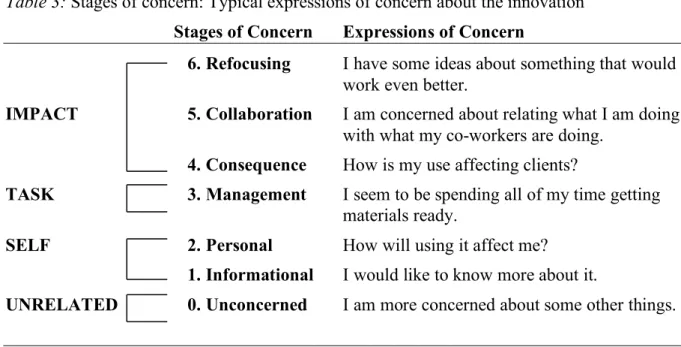
Table 3: Stages of concern: Typical expressions of concern about the innovation Stages of Concern Expressions of Concern
6. Refocusing I have some ideas about something that would work even better.
IMPACT 5. Collaboration I am concerned about relating what I am doing with what my co-workers are doing.
4. Consequence How is my use affecting clients?
TASK 3. Management I seem to be spending all of my time getting materials ready.
SELF 2. Personal How will using it affect me? 1. Informational I would like to know more about it.
UNRELATED 0. Unconcerned I am more concerned about some other things.
Source: Hall, G., & Hord, S. (2014). Implementing change: Patterns, principles, and potholes (Fourth ed.). Pearson. Kindle edition. (p. 85)
distinguished from one another, individuals may indicate concerns at more than one stage at the same time. Understanding and using SoC can lead significantly more effective implementation practices of change process through personalizing school personnel support (Hall & Hord, 2014).
In Stage 0 (unconcerned) individuals indicate little concern or involvement with the change efforts. In Stage 1 (informational) individuals would like to know more about the
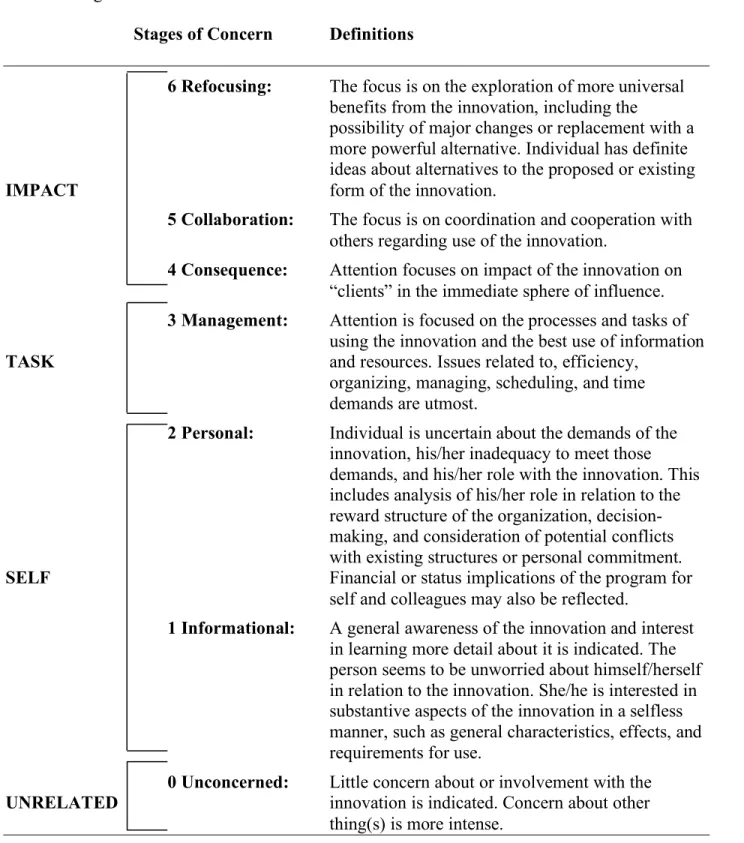
innovation. In Stage 2 (personal) individuals are concerned about how using the innovation will affect them. In Stage 3 (management) individuals are concerned primarily with managing processes, tasks, and resources. In Stage 4 (consequence) individuals are concerned about how the innovation is impacting the students. In Stage 5 (collaboration) individuals are interested in how colleagues are using the innovation. In Stage 6 (refocusing) individuals are concerned with making the innovation work even better (Hall & Hord, 2014). A more detailed description of each of the seven stages is reported in Table 4.
Level of use. Hall and Hord (2014) identified eight behavioral profiles that describe individuals implementing an innovation. These profiles describe distinctions between whether an individual is a user or a non-user of the innovation. Three different types of nonusers include (a) nonuse, (b) orientation, and (c) preparation. Five different types of users include: (a) mechanical use, (b) routine, (c) refinement, (d) integration, and (e) renewal.
Table 4: Stages of concern about the innovation: Definitions
Stages of Concern Definitions
6 Refocusing: The focus is on the exploration of more universal benefits from the innovation, including the possibility of major changes or replacement with a more powerful alternative. Individual has definite ideas about alternatives to the proposed or existing
IMPACT form of the innovation.
5 Collaboration: The focus is on coordination and cooperation with others regarding use of the innovation.
4 Consequence: Attention focuses on impact of the innovation on “clients” in the immediate sphere of influence. 3 Management: Attention is focused on the processes and tasks of
using the innovation and the best use of information
TASK and resources. Issues related to, efficiency,
organizing, managing, scheduling, and time demands are utmost.
2 Personal: Individual is uncertain about the demands of the innovation, his/her inadequacy to meet those demands, and his/her role with the innovation. This includes analysis of his/her role in relation to the reward structure of the organization, decision- making, and consideration of potential conflicts with existing structures or personal commitment.
SELF Financial or status implications of the program for
self and colleagues may also be reflected.
1 Informational: A general awareness of the innovation and interest in learning more detail about it is indicated. The person seems to be unworried about himself/herself in relation to the innovation. She/he is interested in substantive aspects of the innovation in a selfless manner, such as general characteristics, effects, and requirements for use.
0 Unconcerned: Little concern about or involvement with the UNRELATED innovation is indicated. Concern about other
thing(s) is more intense.
Summary. Rogers’s DOI model describes innovation and adoption in a more general way by providing us a model of how an individual goes through the stages of the decision-making process about whether or not to adopt a new initiative. It also illustrates the complexity of an innovation diffusion process regarding the differences in individuals' attitudes and
perceptions of innovation and the influences of external factors on adoption rates (Lee & Strobel, 2014). Whereas, Hall and Hord’s CBAM focuses more on the educational innovations,
particularly in the K-12 system (Lee & Strobe, 2014). Hence, this study uses DOI model to provide guidance at the macro level and focuses on the Stages of Concern component of CBAM and seeks to investigate school personnel’s concerns regarding the implementation of MTSS in North Carolina public schools. According to Hall (1976), individuals’ concern levels correlate with their levels of performance. The SoC element of CBAM allows the researchers to
understand and evaluate individuals' progress and experience in the MTSS adoption and implementation process by using individuals' concerns as an indicator.
Historical Overview of Identification of Students with Specific Learning Disability
Specific learning disability (SLD) identification and eligibility practices and policies have varied over the last three decades. These variations included using the identification of the
presence of a severe discrepancy between intellectual ability and achievement and
implementation of RTI to identify students with SLD, which created uncertainties regarding how best to determine SLD eligibility for special education services. Given these issues,
understanding the SLD definition and a historical overview of how SLD identification emerged is vital to inform current challenges regarding identification and service delivery for students with SLD.
A disorder in one or more of the basic psychological processes involved in understanding or in using language, spoken or written, which disorder may manifest itself in the
imperfect ability to listen, think, speak, read, write, spell, or do mathematical
calculations. Such term includes such conditions as perceptual disabilities, brain injury, minimal brain dysfunction, dyslexia, and developmental aphasia. Such term does not include a learning problem that is primarily the result of visual, hearing, or motor
disabilities, of mental retardation, of emotional disturbance, or of environmental, cultural, or economic disadvantage (20 U.S.C. § 1401 (30)).
SLD is included in 13 national categories of disabilities defined within Individuals with Disabilities Education Act (IDEA) (IDEA, 2004), which allows students to receive special education services in the United States. The prevalence of students with SLD ranges from 5-15% among various cultures, and SLD continues to be the largest classification area for special
education services under the IDEA in the United States (American Psychiatric Association, 2013; Zirkel, 2013b).
Discrepancy Model. In 1975, President Gerald Ford signed Education for All
Handicapped Children Act (EAHCA) into law that required school districts to provide free and appropriate education for all students, including students with SLD. In 1977, U.S. Office of Education defined SLD as EAHCA reached full implementation:
The term "specific learning disability" means a disorder in one or more of the psychological processes involved in understanding or in using language, spoken or written, which may manifest itself in an imperfect ability to listen, speak, read, write, spell, or to do mathematical calculations. The term does not include
children who have LD which is primarily the result of visual, hearing, or motor handicaps, or mental retardation, or emotional disturbance, or of environmental, cultural, or economic disadvantage. (U.S. Office of Education, 1977, p. 65083)
responses, the model was not included (Swanson, Harris, & Graham, 2013). An ability-achievement discrepancy model was presented to determine whether or not substantial
discrepancy existed between a student's scores on an individualized test of general intelligence and one or more areas of academic achievement (e.g., reading decoding, reading comprehension, math calculation) for identification in the area of SLD. Most states adopted the discrepancy between ability and achievement approach in the United States; however, criticisms quickly arose regarding its reliability, which continues today. Scientific evidence emphasizes that an ability-achievement discrepancy model not be relevant to the identification of SLD and may also cause disproportionate identification (Mather & Gregg, 2006). Kovaleski, VanDerHeyden, and Shapiro (2013) claim that "a student's response to robust interventions is the best evidence for the existence of SLD rather than the student's performance on a group of norm-referenced tests" (p.8.). These arguments resulted in the promotion of alternatives to the discrepancy-based
identification, which included phonological assessments, treatment validity approaches, and later RTI (Swanson, Harris, & Graham, 2013).
According to the National Association of School Psychologists’ (NASP; 2011) position statement, evidence-based multi-tiered service delivery systems provide a continuum of high-quality data-based instruction and intervention strategies for academic and behavior practices within general education for children with SLD. Therefore, identification of children with SLD should be implemented within the context of these delivery systems.
With the recognition of RTI, the substantial debate has focused on the roles of general intelligence measures, broad and narrow cognitive processing measures, and oral language measures in the identification of SLD identification (Mather & Gregg, 2006).
According to IDEA Regulations (2011), each state in the United States must choose either (a) to permit or require RTI; (b) to permit or prohibit severe discrepancy; or (c) to permit or omit a third option which is “other alternative research-based procedures” (§ 300.307[a]; Zirkel (2013a). In January 2011, 13 states required RTI for identification of SLD and increased to 14 by March 2012 (Zirkel, 2011). Complete and exclusive use of RTI for SLD identification is mandated in Colorado, Connecticut, Florida, Idaho, Louisiana, Rhode Island, West Virginia, and Wisconsin. Complete with the option of adding severe discrepancy of RTI for SLD identification is mandated in Georgia, Illinois, and Maine; and in Delaware (reading and math), New Mexico (Grades K–3), and New York (reading in Grades K–4) partially (Zirkel, 2012). In addition, Iowa requires the districts to use either RTI or another alternative research-based procedure (Zirkel, 2012).
NCDPI has proposed a 5-year plan for the elimination of ability-achievement discrepancy model for SLD identification. The timeline for this change is as follows:
February 2015 Policy changes; public notice and comment
June 2015 Policy changes seek School Board of Education approval 2015-2016 Rollout for the elimination of 15-point and alternative to
discrepancy begins
2020-2021 All K-12 use MTSS data for eligibility decisions for SLD (simple discrepancy eliminated)
Source: North Carolina Department of Public Instruction. (n.d.). Specific learning disabilities eligibility. Retrieved from http://mtss.ncdpi.wikispaces.net/SLD+Eligibility
NCDPI believes that being the most effective and efficient approach to improving student outcomes, RTI/MTSS ensures equitable access to education for all students.
Multi-Tiered System of Supports
Schools have been adopting the multi-layered response to intervention systems to improve student outcomes in both academics (i.e. RTI) and behavior (i.e. PBIS). Integrating academic and behavior support into one system has become an area of increasing interest because such systems require an intensive level of resources to implement and sustain
(McIntosh, Goodman, & Bohanon, 2010). There is growing consensus that integrating academic and behavior support should be considered together because there is evidence that problem behavior is associated with low academic skills and vice versa. For example, McIntosh,
Goodman, and Bohanon (2010) indicate that the risk for problem behavior and depression later in life is at a higher level for students with low academic skills.
a systems approach using data-driven problem solving to maximize growth for all” (NCDPI, 2015).
MTSS is an umbrella term that includes a data-based problem-solving approach with tiered interventions for both academics and behavior. Many existing initiatives such as PBIS and RTI, share the typical components of data-based problem-solving approach. PBIS is a multi-layered data-based problem-solving approach, which aims to support and improve student behavior. RTI is a well-known multi-tiered approach to supporting student academic
achievement. MTSS and RTI are sometimes used interchangeable, and both terms may be used within a state, which causes confusions among professionals. For example, in Florida, RTI integrates academic and behavioral instruction and intervention and "has been described as a multi-tiered system of supports (MTSS) for providing high-quality instruction and intervention matched to student needs using learning rate over time and level of performance to inform instructional decisions" (Florida's Multi-Tiered System of Supports). Therefore, in this study, to avoid confusions resulting from using different terms to refer the same approach the term MTSS is used and defined as; a systematic framework that utilizes data-based problem solving and decision making with multi-layered instructions and interventions to integrate academic and behavior instruction and intervention in a continuum of evidence-based practices (Gamm et al., 2012).
MTSS is a problem-solving process that focuses on the instructional needs of students, necessitates adjustments for continued improvement of student academic performance and behavior, and assesses the efficacy of instructions and interventions on student outcomes.
varying levels of intensities to ensure that students receive resources at an adequate level of quality to improve the performance of all students (Gamm et al., 2012).
The MTSS framework facilitates the early identification of behavior and learning problems; therefore, provides an opportunity to assist students immediately rather than waiting for academic and behavioral difficulties to become more significant (Gresham, 2007). Students are screened for potential academic and behavior problems early in school and are provided with supplemental evidence-based instruction and intervention based on their needs; thus, problem behaviors are prevented from becoming more serious.
MTSS employs a three-tiered approach in which the intensity of the intervention is increased when the student does not demonstrate an adequate response to an intervention (Gresham, 2007).
Tier I, or core universal instruction, is designed and provided for all students in general education classrooms to address the majority of students' instructional needs (Algozzine et al., 2012; Gamm et al., 2012; Richards et al., 2007). Core instruction is differentiated to address diverse student classroom needs. Desired positive behaviors are taught and reinforced for all students. All students receive screening assessments to identify who meet grade-level standards with the universal core instruction, and who do not (Richards et al., 2007). For those who have not demonstrated mastery of grade level standards, additional instruction/intervention is provided based on their specific needs through Tier II or targeted intervention.
Tier II support is provided in addition to Tier I instruction/intervention; however, the progress of students receiving Tier II interventions is assessed more frequently (Richards et al., 2007).
Students, who also demonstrate insufficient progress after receiving Tier II interventions, are provided the most intensive Tier III interventions (Fuchs et al., 2007). Tier III intensive individualized instruction and intervention is provided to a few students based on their specific and individual academic or behavioral needs (Algozzine et al., 2012; Gamm et al., 2012). Tier III interventions may replace some part of the core curriculum because of the increased length of time needed (Richards et al., 2007).
Facilitating MTSS Implementation. Implementation of MTSS framework requires all school personnel change the teaching and learning practices, which they have traditionally performed. This change underlines the motivation and competency of school personnel to work toward a common goal collaboratively. “Educators must understand the need for the change, have the skills required to meet the needs of the organization, and be confident in their ability to function within the changing environment” (Castillo et al., 2012, p. 5).
One system change model to facilitate MTSS implementation involves three stages: consensus development, infrastructure building, and implementation (Castillo et al., 2012).
Consensus development. An essential principle of facilitating implementation through a systems change is the development of consensus among key stakeholders regarding the
implementation of the new initiative. According to Curtis, Castillo, and Cohen (2008), the majority (80% is often suggested) of stakeholders (e.g., principal, teachers, instructional support personnel, student services personnel) should commit to implementing the new initiative before proceeding with implementation of new practices. The level of commitment from school
therefore, it is essential to evaluate factors that may impact buy-in from educators. Achieving consensus is facilitated by ensuring that school personnel is aware of the need for the
implementation process and believes that they have necessary skills for successful implementation of the framework.
Examining the perceptions of school personnel in regard with their own skills will help inform the decisions regarding the consensus development and facilitate the appropriate
professional development by examining and addressing needs of school personnel to enhance the implementation of MTSS practices.
Infrastructure building. Infrastructure building involves creating the structures required to promote and support MTSS implementation. According to Castillo et al. (2012), a school must examine its current goals, policies, resources, and school personnel responsibilities concerning their alignment with MTSS service delivery. Castillo et al. (2012) indicate that to enhance their capacity to implement MTSS practices schools must consider addressing structures including but not limited to:
• Development/adoption of standards-based comprehensive assessment systems
• Identification of which Tier I, II, and III resources are available to teachers and the development/adoption of resources that are needed
• Alignment of existing policies and procedures to be consistent with the use of MTSS practices across tiers
• Development/adoption of technology to facilitate efficient data collection and graphical display of data that is useful to teachers when making decisions about student progress
• Determination of what existing meeting times educational personnel can use to employ MTSS practices or how to rearrange personnel schedules to create time
• Time to provide ongoing professional development (i.e., training, coaching, and follow-up support) to all educators in the building who are expected to implement the MTSS model (p. 7).
Examining perceptions of school personnel in regard with their school’s MTSS practices will give insight into the weakness and strengths of the process of infrastructure building and help determine future steps and what to intervene for improved outcomes.
Implementation. Implementation stage begins with accomplishing action plans
developed during infrastructure and may occur at various levels across a school or district. An implementation may begin on a smaller scale for achieving consensus development and infrastructure building. Evaluating the extent to which critical components of MTSS are being implemented with integrity is essential before decision-making regarding the framework's impact on student outcomes (Castillo et al., 2012).
Conclusion
RTI has become one of the most discussed innovation initiatives since its recognition by the IDEA in 2004. With the reauthorization of IDEA in 2004, RTI was recognized as an
RTI is a problem-solving process that focuses on the instructional needs of students, necessitates adjustments for continued improvement of student academic performance, and assesses the efficacy of instructions on student outcomes.
RTI is now considered as a part of MTSS and integrated with PBIS. Schools in the United States have begun to implement MTSS framework for improved academic and behavioral student outcomes. In all North Carolina public K-12 schools, students with SLD will be
identified and qualified for special education services using MTSS data by the 2020-2021 school year. Changes in policy put pressure on educators as they raise questions related to their concerns about the implementation of the MTSS framework. According to Hall, George, and Rutherford (1977), not necessarily the situation around them but individuals' perceptions are the predictors of their concerns; therefore, it is essential to take into account how they perceive their skills and MTSS practices of their schools before addressing their concerns.
Purpose of the Current Study
Exploring school personnel’s concerns about MTSS is critical to understand the factors that can support the adoption and subsequent implementation of MTSS framework in school settings. As such, investigating school personnel’s concern profiles must be considered. Additionally, assessing concerns toward MTSS framework can be used to understand the supports needed to support schools and educators. To ensure program adoption, implementation effectiveness, and subsequent positive student outcomes, educators must not only understand the benefits of the innovation, but they must also feel adequately trained and supported.
The independent variables include staff position (administrator, teacher, and school
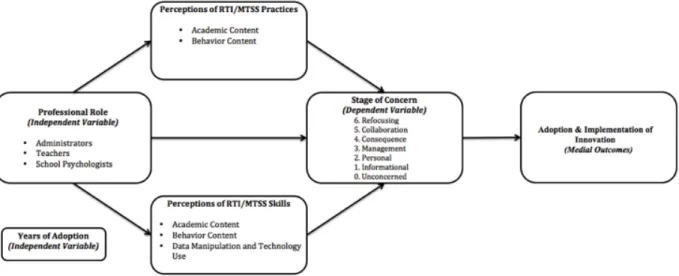
psychologist), and implementation length. Stage of concern toward MTSS implementation is considered dependent variable and proximal outcomes. As innovation adoption and
implementation have been found to be associated with concerns demonstrated toward the
innovation implementation (Hall & Hord, 2014), adoption and implementation of innovation are considered medial outcomes. Figure 1 provides a conceptual framework for the predicted
relationship between staff position, school personnel’s perceptions of their skills and their school’s practices, and school personnel’s stages of concern.
Figure 2. Predicted relationship between staff position, school personnel’s perceptions of their skills and their school’s practices, and school personnel’s stages of concern
Research Questions and Hypotheses
Research question 1. What are the differences in school personnel’s perceptions of their MTSS skills and perceptions of their school’s MTSS practices as a factor of staff position?
Research question 2. What is the relationship between MTSS implementation length and staff position, and school personnel’s perceptions of their MTSS skills, perceptions of their school’s MTSS practices, and stages of concern?
Hypothesis associated with research question 2. Within the same staff position, school personnel who have spent more years in MTSS implementation are more likely to demonstrate higher levels of perceived skills, distinguish their school’s MTSS practices as being more frequent, and exhibit later stages of concern.
Research question 3. To what extent do school personnel’s staff position and perceptions of their MTSS skills predict their stages of concern?
Hypothesis associated with research question 3.1. School psychologists and
administrators are more likely to demonstrate later stages of concern whereas teachers are more likely to demonstrate earlier stages of concern.
3.2. School personnel who demonstrate lower levels of perceived skills are more likely to demonstrate earlier stages of concern.
3.3. School personnel who demonstrate higher levels of perceived skills are more likely to demonstrate later stages of concern.
Research question 4. To what extent do school personnel’s staff position and perceptions of their school’s MTSS practices predict their stage of concern?
Hypothesis associated with research question 4.1. School personnel who perceive their school’s practices as being occurred less often are more likely to demonstrate earlier stages of concern.
CHAPTER III
METHODS AND PROCEDURES
To address previously mentioned research questions, a quantitative study design was used in this study to understand how K-12 school personnel perceives their MTSS skills and their school’s MTSS practices and to what extent their perceptions predict their stages of concern regarding implementing MTSS practices. The proposed study included the collection and
analysis of the quantitative data from self-report measures. Individual items included in the survey measured demographics, including staff position, years of implementing MTSS, years in current school, and years in current position. School personnel's ratings of their perceptions about the skills they possess to implement MTSS were measured with Perceptions of RTI Skills survey (Florida Statewide Problem Solving and Response to Intervention Project, 2012). School personnel’s ratings of their perceptions on the extent to which their schools practice or
the strength of the relationship between Staff Position and Years of Implementing MTSS and Perceptions of MTSS Skills, Perceptions of School’s MTSS Practices, and Stages of Concern. Hierarchical multiple regression analysis was conducted to determine if the addition of
Perception of MTSS Skills or Perceptions of MTSS Practices improved the prediction of Stage of Concern over and above Staff Position alone.
Procedures
In order to protect the rights and privacy of the participants involved in this research project, several measures were taken to ensure that individuals were informed about their involvement and responsibilities as participants. Before data collection took place, the project was submitted to the University of North Carolina at Chapel Hill Institutional Review Board for approval. Participants read and signed an informed consent form that was made available online before participating in the study. The informed consent explained the purpose of the study, benefits, and risks of participation, responsibilities of participants, information regarding confidentiality, and the rights of the individuals to terminate participation at any time without penalty. Also, the participants' identities and the information they divulge in surveys were kept confidential and secure. Individual and school names were not recorded.
Educators in North Carolina’s public school system were asked to participate in the study via educational contacts from North Carolina school districts and schools. An email to district level and school level contacts were sent to distribute electronic survey email to solicit school personnel to participate in the study. Emails contained the title and the purpose of the study, the risks and benefits to the participants, and the procedures for accessing the survey.
accuracy of the terms used in the survey items.
To ensure that scales are appropriate for educators in North Carolina public schools, the
language on Perceptions of RTI Skills and Perceptions of Practices surveys were slightly altered. For example, the item "Select appropriate data (e.g., Curriculum-Based Measurement, DIBELS, FCAT, behavioral observations) to use for progress monitoring of student performance during interventions:" was changed to "Select appropriate data (e.g., Curriculum-Based Measurement, DIBELS, behavioral observations) to use for progress monitoring of student performance during interventions:" because FCAT, The Florida Comprehensive Assessment Test, is an assessment tool specific to Florida's education system and is not used in North Carolina.
Participants
Participants were recruited from approximately 60 K-12 schools distributed across North Carolina. To recruit participants, electronic method of recruitment was used and request emails to district, and school contacts were sent to distribute survey invitation emails to school
personnel across North Carolina via listservs. Participation in this study was voluntary.
Principals, assistant principals, general education teachers, special education teachers, and school psychologists were included for the purposes of this study. The inclusion criteria for participant selection included being experienced with MTSS implementation for at least one year. School personnel working at charter schools and school personnel who implemented MTSS for less than one year were excluded from the study.
Coach) category for Staff Position and were also excluded from the study. Principals, assistant
principals, general education teachers, special education teachers, and school psychologists were included in the data analysis. The final analytical sample included 84 participants
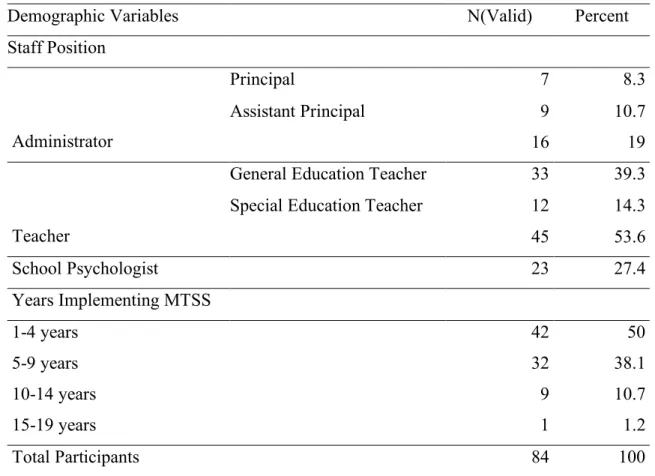
(administrators, teachers, and school psychologists). Most respondents reported implementing MTSS for 1-4 years (50%). 38.1% of the respondents have implemented MTSS for 5-9 years. In addition, most participants were teachers (53.6%), while 27.4% of the participants were school psychologists and 19% were administrators.
Measures
Demographics. The demographics measure used in this study is a set of items that allow the researcher to identify participant's demographic information including, job description, years of experience in their current position, in their current school, and implementing MTSS and if a participant currently works at a charter school. The measure includes five items. The first item, "Job Description" allows respondents to select their staff position category and includes
following response options: Principal; Assistant Principal; General Education Teacher; Special Education Teacher; School Psychologist; or Other. The second item asked the respondents "Do you currently work at a charter school?" and allows them to select from "Yes" or "No" response options. Third item "Years in Current School," fourth item "Years in Current Position," and fifth item "Years Implementing MTSS" allows respondents select from following response options: Less than one year; 1-4 years; 5-9 years; 10-14 years; 15-19 years; or 20 or more years.
practices to (1) academic and (2) behavior content as well as skills in (3) data manipulation and technology use. Respondents can select from the following scale when responding to items on the survey: 1 = I do not have the skill at all (NS); 2 = I have minimal skills in this area; need substantial support to use it (MnS); 3 = I have the skills, but still need some support to use it (SS); 4 = I can use this skill with little support (HS); 5 = I am highly skilled in this area and could teach others this skill (VHS). Examples of questions include: “The skill to: Access the data necessary to determine the percent of students in core instruction who are achieving benchmarks in: (a) Academics, (b) Behavior; The skill to: Identify the most appropriate type(s) of data to use for determining reasons (hypotheses) that are likely to be contributing to the problem for: (a) Academics, (b) Behavior” (see Appendix A).
Castillo et al. (2012) indicate that project staff conducted content and construct validity on the Perceptions of RTI Skills Survey. Results indicated that the three factors, (1) Perceptions of RTI Skills Applied to Academic Content, (2) Perceptions of RTI Skills Applied to Behavior Content, and (3) Perceptions of Data Manipulation and Technology, collectively accounted for 80% of the common variance. The factor analysis yielded internal consistency reliability
estimates of α = .98 for the subscale of perceptions of RTI skills applied to academic content; of α = .97 for perceptions of RTI skills applied to behavior content; and α = .94 for perceptions of
data manipulation and technology use skills, as measured by Cronbach’s alpha (Castillo et al., 2012).
This measure will be referred as Perceptions of MTSS Skills Survey in this study. Perceptions of Practices Survey. The Perceptions of Practices Survey (Florida
RTI/MTSS practices. The instrument contains 42 Likert scaled items that examine the
perceptions of school personnel regarding implementation of RTI/MTSS practices applied to (1) academic and (2) behavior content across tiers. Respondents select from the following scale when responding to items on the survey: 0 = Do Not Know (DK); 1 = Never Occurs (NO); 2 = Rarely Occurs (RO); 3 = Sometimes Occurs (SO); 4 = Often Occurs (OO); 5 = Always Occurs (AO). Examples of questions include: "In my school: Progress monitoring occurred for all students receiving supplemental and/or intensive interventions for: (a) Academics, (b) Behavior; In my school: Data were collected to confirm the reasons that the student was not achieving the desired level of performance for (a) Academics, (b) Behavior" (see Appendix A).
Castillo et al. (2012) indicate that project staff conducted content and construct validity on the Perceptions of Practices Survey. Results indicated that the two factors, (1) Perceptions of RTI Practices Applied to Academic Content and (2) Perceptions of RTI Practices Applied to Behavior Content, accounted for 75% of the common variance. The factor analysis yielded internal consistency reliability estimates of α = .97 for the subscale of perceptions of RTI practices applied to academic content; and of α = .96 for perceptions of RTI practices applied to behavior content, as measured by Cronbach’s alpha (Castillo et al., 2012).
of me now; 3-4-5 = Somewhat true of me; 6-7 = Very true of me now. Examples of questions include: "I have very limited knowledge of the innovation; I am concerned about my inability to manage all that the innovation requires" (see Appendix A).
Results from SoCQ can be used to establish concern profiles in individual,
organizational, or systems level. Hall and Hord (2014) describe what an ideal goal of concerns-based implementation effort is best represented by high Stage 4 (Consequence) and Stage 5 (Collaboration) in a concerns profile.
The questionnaire has strong reliability estimates and internal consistency; test/retest reliabilities range from .65 to .86 and alpha coefficient ranges from .66 to .83 (Hall & Hord, 2014).
Data Analyses
The data analyses of this study consisted of three types of analyses, first, MANOVA second, a series of Kendall’s tau-b correlations, and third, hierarchical multiple regression.
The Perceptions of MTSS Skills and the Perceptions of MTSS Practices surveys used in this study included several factors. The Perceptions of MTSS Skills survey included three factors: 1. Academic; 2. Behavior; and 3. Data Manipulation and Technology Use. Perceptions of MTSS Practices Survey included two factors: 1. Academic; and 2. Behavior. Before analyzing data, the researcher divided items in both surveys based on their factors and calculated mean scores for each factor repeated for each participant. After mean scores were calculated, data was entered to SPSS, each factor being treated as a variable: 1. Perceptions of MTSS Skills -
The researcher repeated similar procedures for SoCQ. SoCQ consisted of 35 items and seven categories: 1. Unconcerned; 2. Information; 3. Personal; 4. Management; 5. Consequence; 6. Collaboration; and 7. Refocusing. Each category included five items. The researcher divided items based on their categories and calculated raw and percentile scores for each category. The category with the highest percentile score represented the participant's stage of concern profile and data was entered to SPSS under variable "Stage of Concern Profile." Other variables included "Staff Position" and "Years Implementing MTSS."
To examine the research question 1, MANOVA was conducted for Perceptions of MTSS Skills and Perceptions of MTSS Practices as a factor of Staff Position using data from Staff Position, Perceptions of RTI Skills, and Perceptions of Practices. The researcher explored
whether there were differences in school personnel’s perceptions of their MTSS skills and perceptions of their schools’ MTSS practices as a factor of staff position. Independent variables included one categorical variable, Staff Position (Administrator, Teacher, or School
Psychologist). Dependent variables included three factors from Perceptions of MTSS Skills Survey: (1) Academic Factor, (2) Behavior Factor, and (3) Data Manipulation and Technology Use Factor; and two factors from Perceptions of MTSS Practices Survey: (1) Academic Factor and (2) Behavior Factor.
To examine the research question 2, Kendall’s tau-b correlation coefficients were conducted to evaluate the strength of the relationship between Staff Position and Years Implementing MTSS and Perceptions of MTSS Skills, Perceptions of MTSS Practices, and Stages of Concern using data from Staff Position, Years Implementing MTSS, SoCQ, Perceptions of RTI Skills, and Perceptions of Practices. The researcher investigated the relationship between
skills, perceptions of their schools’ MTSS practices, and stages of concern. Independent variables included one categorical variable, Staff Position (Administrator, Teacher, or School Psychologist) and one continuous variable, Years Implementing MTSS. Dependent variables included three factors from Perceptions of MTSS Skills Survey: (1) Academic Factor, (2) Behavior Factor, and (3) Data Manipulation and Technology Use Factor; two factors from Perceptions of MTSS Practices Survey: (1) Academic Factor and (2) Behavior Factor; and Stages of Concern.
To examine the research question 3, hierarchical multiple regression analysis was conducted to determine if the addition of Perception of MTSS Skills improved the prediction of Stages of Concern over and above Staff Position alone, using data from Staff Position,
Perceptions of RTI Skill, and SoCQ. The researcher investigated to what extent school
personnel's staff position and perception of MTSS skills predicted their stages of concern. Independent variables included one categorical variable, Staff Position (Administrator, Teacher, or School Psychologist); and three factors from Perceptions of MTSS Skills Survey: (1)
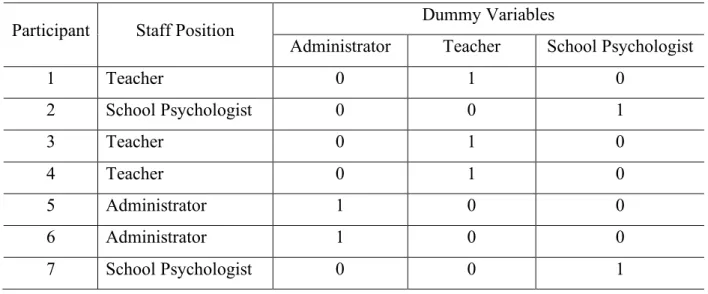
Table 5. Dummy coding for categorical independent variable (staff position)
Participant Staff Position Dummy Variables
Administrator Teacher School Psychologist
1 Teacher 0 1 0
2 School Psychologist 0 0 1
3 Teacher 0 1 0
4 Teacher 0 1 0
5 Administrator 1 0 0
6 Administrator 1 0 0
7 School Psychologist 0 0 1
To examine the research question 4, hierarchical multiple regression analysis was
conducted to determine if the addition of Perception of MTSS Practices improved the prediction of Stages of Concern over and above Staff Position alone, using data from Staff Position,
Perceptions of RTI Practices, and SoCQ. The researcher investigated to what extent school
CHAPTER IV RESULTS
The purpose of this study was to investigate how K-12 school personnel perceives their MTSS skills and their school’s MTSS practices and to what extent their perceptions predict their stages of concern regarding implementing MTSS practices. Following these purposes, the researcher conducted an electronic survey consisting of two surveys: (1) Perceptions of MTSS Skills Survey, and (2) Perceptions of MTSS Practices Survey; and a questionnaire: Stages of Concern Questionnaire.
This chapter describes the data that were collected and analyzed to
investigate the research questions and presents the results of the electronic survey. The results of each question follow each research question.
Participant Demographics
Participants were recruited from approximately 60 K-12 schools distributed across North Carolina. Principals, assistant principals, general education teachers, special education teachers, and school psychologists were included for the purposes of this study. The inclusion criteria for participant selection included having experience with MTSS implementation for at least one year. School personnel working at charter schools and school personnel who implemented MTSS for less than one year were excluded.
This study included a total of 84 who completed the electronic survey. No missing or incomplete data were recorded.
description, General Education Teacher, Special Education Teacher, Principal, Assistant
Principal, School Psychologist, and Other. Because the focus of this study was on staff positions based on broader categories, the staff position variables were recoded to include Administrator, Teacher, and School Psychologist. Assistant Principal and Principal were recoded into one variable, Administrator. General Education Teacher and Special Education Teacher were recoded into one variable, Teacher. School Psychologist remained in its unique category.
Therefore, the new staff positions were recoded to form three variables, Administrator, Teacher, and School Psychologist. Table 6 below explains the actual number of participants for the study and categorizes them by their staff position.
Table 6. Participants’ staff positions and years of implementing MTSS
Demographic Variables N(Valid) Percent
Staff Position
Administrator
Principal 7 8.3
Assistant Principal 9
16
10.7 19
Teacher
General Education Teacher 33 39.3
Special Education Teacher 12 45
14.3 53.6
School Psychologist 23 27.4
Years Implementing MTSS
1-4 years 42 50
5-9 years 32 38.1
10-14 years 9 10.7
15-19 years 1 1.2
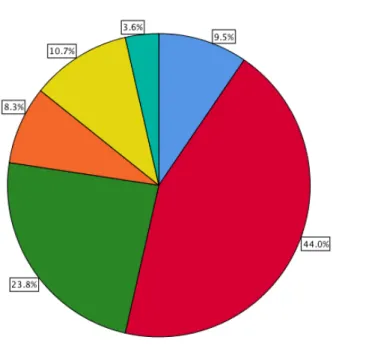
Participants’ number of years in their current school are reported below in Figure 3. This figure shows that participants who have spent 1-4 years in their current school made up 44% of the study participants (n = 37). These numbers reflect the actual sample size after adjustments were made for the inclusion criteria.
Figure 3. Participants’ number of years in their current school
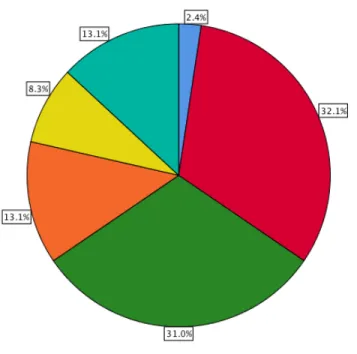
Figure 4. Participants’ number of years in their current position
Research Questions
Research question 1. What are the differences in school personnel’s perceptions of their MTSS skills and perceptions of their school’s MTSS practices as a factor of staff position?
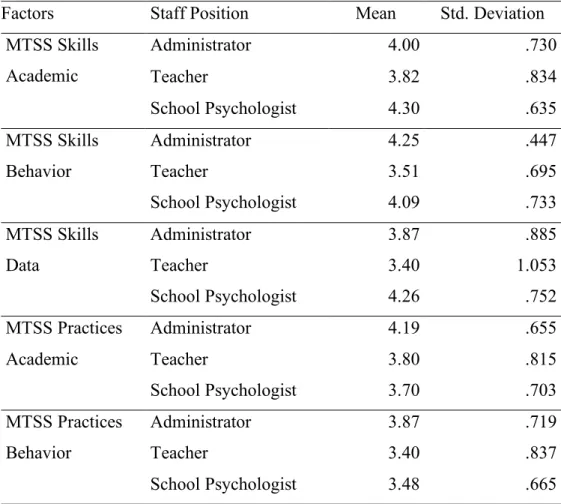
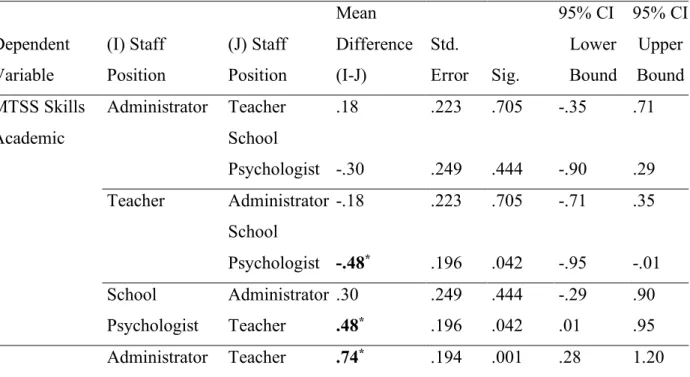
A MANOVA was run to determine the effect of school personnel’s staff position on their perceptions of their MTSS skills and perceptions of their school’s MTSS practices. The
independent variable Staff Position (i.e., the between-subjects factor) had three categories: Administrator, Teacher, and School Psychologist. The five dependent variables (i.e., the within-subjects factors) were (1) Academic Skills, (2) Behavior Skills, and (3) Data Manipulation and Technology Use Skills as measured by the Perceptions of MTSS Skills Survey; and (4)