R E S E A R C H A R T I C L E
Open Access
An arthropod
cis-regulatory element functioning
in sensory organ precursor development dates
back to the Cambrian
Savita Ayyar
1, Barbara Negre
1, Pat Simpson
1, Angelika Stollewerk
2*Abstract
Background:An increasing number of publications demonstrate conservation of function of cis-regulatory elements without sequence similarity. In invertebrates such functional conservation has only been shown for closely related species. Here we demonstrate the existence of an ancient arthropod regulatory element that functions during the selection of neural precursors. The activity of genes of theachaete-scute(ac-sc) family endows cells with neural potential. An essential, conserved characteristic of proneural genes is their ability to restrict their own activity to single or a small number of progenitor cells from their initially broad domains of expression. This is achieved through a process called lateral inhibition. A regulatory element, the sensory organ precursor enhancer (SOPE), is required for this process. First identified inDrosophila, the SOPE contains discrete binding sites for four regulatory factors. The SOPE of theDrosophila asensegene is situated in the 5’ UTR.
Results:Through a manual comparison of consensus binding site sequences we have been able to identify a SOPE in UTR sequences ofasense-like genes in species belonging to all four arthropod groups (Crustacea, Myriapoda, Chelicerata and Insecta). The SOPEs of the spiderCupiennius saleiand the insectTribolium castaneum are shown to be functional in transgenicDrosophila. This would place the origin of this regulatory sequence as far back as the last common ancestor of the Arthropoda, that is, in the Cambrian, 550 million years ago.
Conclusions:The SOPE is not detectable by inter-specific sequence comparison, raising the possibility that other ancient regulatory modules in invertebrates might have escaped detection.
Background
The initiation of development of the nervous system in vertebrates and higher invertebrates involves the activity of proneural genes that encode transcription factors of the basic helix-loop-helix (bHLH) class [1]. Their expression in the neuroectoderm endows cells with neural potential and also contributes to the specification of neuronal identity. Proneural genes are conserved throughout the animal kingdom and fall into two main classes: theachaete-scute (ac-sc) and atonal (ato) gene families. They are initially expressed during development in groups/domains of equivalent neuroectodermal cells. An essential, conserved characteristic of proneural genes is their ability to restrict their own activity to single or a
small number of progenitor cells within these domains [1]. This is achieved through a process called lateral inhibition, mediated by Notch signaling [2]. The Notch ligand Delta is up-regulated by proneural proteins in future neural precursors and activates the Notch signal-ing cascade in neighborsignal-ing cells, resultsignal-ing in down-regu-lation of proneural gene expression [3,4]. Repression of proneural genes is mediated by the products of the Notch target genesHairy/Enhancer of split. This ancient regulatory network was probably inherited from the ear-liest Metazoa [5].
Regulatory sequences involved in the restriction of proneural gene expression from proneural domains to selected neural precursors have mostly been studied in Drosophila melanogaster, in particular with respect to the ac-sc genes and their role in the development of sensory bristles of the adult peripheral nervous system.
The D. melanogaster ac-sc gene complex (AS-C)
* Correspondence: [email protected]
2
School of Biological and Chemical Sciences, Queen Mary University of London, Mile End Road, London E1 4NS, UK
Full list of author information is available at the end of the article
comprises four genes, three of which are required for bristle development.acandsc are expressed in discrete proneural clusters through the activity of a number of independently acting cis-regulatory modules that are scattered throughout the approximately 150 kb of the AS-C and respond to positional cues [6-9]. Subse-quently, the expression of ac and sc refines to single sensory organ precursors (SOPs) where high levels of Ac/Sc activate the third gene, asense (ase), whose expression is limited to SOPs [10-13]. Lateral inhibition and SOP expression is mediated by a specific cis-regula-tory element, the SOP enhancer (SOPE) [14]. The SOPE contains binding sites for a number of transcription fac-tors. Auto-regulation in the SOP relies on E boxes, binding sites for Ac, Sc and Ase, which activate their own transcription [15]. The E boxes also mediate repression in cells not selected to be SOPs: products of theEnhancer of split (E(spl)) genes activated by Notch signaling associate with Ac-Sc, leading to transcriptional repression [16]. Binding sites for NF-B proteins, a boxes, are present and also mediate both activation and repression [14,17]. It is likely that low levels of NF-B and high levels of Ac-Sc activate, whereas high levels of NF-B and low levels of Ac-Sc repress, the neural pro-gram [18]. In addition, the SOPEs contain AT-rich sequences,b boxes, of unknown function and N boxes that, in the case of the ac-SOPE, have been shown to bind the transcriptional repressor Hairy [14,15,19,20]. All three genes bear their own SOPE. That ofac is in the promoter close to the transcription start site and differs from the others in being devoid of a boxes (unpublished observations, P. Simpson) [15,19]. It drives expression of reporter genes first in proneural domains and then in SOPs [15,19]. The SOPE ofsc, positioned 3 kb upstream of the transcriptional start site, and that of ase, positioned in the 5’UTR, drive expression of repor-ter genes exclusively in the SOP [13,14]. The SOPEs are strongly conserved in other Drosophilidae.
Proneural genes of both theac-scand atoclasses have undergone independent duplication events in different taxa. The ato gene family is much expanded in verte-brates whereas duplication of ac-scgenes has taken place in different groups of arthropods [21-24]. Previous data from available insect genomes have shown that whileac-sc genes have undergone a number of duplica-tion events, all species analyzed bear a single asegene. Conservation of both specific amino acid sequences and the SOPE in the 5’ UTR suggest that the insect ase genes are derived from a common ancestor [22]. Here we show that achaete-scute homologue(ASH) and ase-like genes are present in arthropods other than insects. We present evidence that gene duplications separating proneural from precursor-specific (ase-like) functions possibly occurred independently in different arthropod
groups and that a SOPE in UTR sequences in ase-like genes of all groups has been inherited from an ancestral ASH/ase precursor gene in the last common ancestor of the Arthropoda.
Results
Conservation of coding sequences suggest duplication and subfunctionalization of an ancestral arthropod gene into proneural andase-like functions
A highly conserved bHLH domain characterizes pro-teins encoded by theac-sc gene family, but outside this domain conservation is very low. Recently, two con-served domains were identified that, in insects, enable a distinction to be made between ASH genes that are expressed in proneural domains, called henceforth pro-neural ASH genes, and the sensory organ precursor-specificase genes [22]. Firstly, proteins encoded byASH genes contain a 16 amino acid carboxy-terminal domain (PDDEELLDYISWWQQQ) that is characteristic of all insect ASH proteins but is less well conserved in Ase proteins (50% identity or less). Secondly, Ase proteins have a characteristic five amino acid motif (hydropho-bic-Lys-polar-Glu-hydrophobic) that is absent in all proneural ASH proteins outside the Diptera. These motifs allowed a clear subdivision of theASH and ase genes in different orders of insects, which is upheld by phylogenetic analysis [22,25]. A single ase gene (but a variable number of ASH genes) is present in each spe-cies analyzed.
In order to classify proneural and precursor-specific genes in other arthropod groups, we applied the above criteria to recently published sequences. TwoASHgenes were described in the crustacean Triops longicaudatus [24]. The authors show that the deduced amino acid sequence of Tl-ASH1 bears the ASH carboxy-terminal domain, while this sequence is not conserved in Tl-ASH2. We identified the Ase motif in Tl-ASH2, con-firming that this gene is in fact an asenseorthologue (Figure 1). Furthermore, we detected singleASHand ase orthologues, Dpu-ASH and Dpu-ase, in the Daphnia pulex genome (Daphnia Genome Consortium), which can clearly be distinguished by the presence of the respective domains (Figure 1). The spiderCupiennius salei(chelicerate) displays twoASHorthologues [23] but sequence analysis does not unambiguously distinguish a bona fide asegene in this species. The carboxy-terminal domain of CsASH1 displays a greater similarity to that of insect and crustacean ASH proteins (56% amino acid identity) than does that of CsASH2 (30%). However, neither CsASH1 nor CsASH2 contain the five amino acid motif characteristic of Ase (Figure 1). A single orthologue has been identified in each of the myriapods Glomeris marginata[26] andStrigamia maritima
Consortium, Baylor College). We are confident that there is only a single copy present in the S. maritima genome (see Materials and methods). They show 50% and 62% identity with the insect ASH carboxy-terminal domain, respectively, and 78% identity with the carboxy-terminal domain of CsASH1. They lack the Ase-specific motif and would appear to beASHgenes.
Earlier analyses suggested that the two ASH genes of T. longicaudatusand ofC. salei arose from duplication events that are independent from those of insects and from each other [23,24]. We have performed a new phy-logenetic analysis that includes the D. pulexsequences that were not previously available. All ASH and ase genes from the insectsD. melanogasterand Tribolium castaneum, the crustaceans T. longicaudatus and D. pulex, the chelicerate C. salei and the myriapods G. marginataandS. maritimawere included. The phy-logenetic tree shows that the ASH and Ase proteins of insects group together, as do those of crustaceans, while the ASH proteins of myriapods and of chelicerates are arranged in a single group (Figure 2). Both the insect and the crustacean proteins are clearly subdivided into the ASH and Ase groups, that is, T. castaneum Ase groups with D. melanogaster Ase and T. castaneum ASH is arranged in a group withD. melanogasterAc, Sc and the proneural protein Lethal of Scute (L’sc). Similarly, the D. pulex Dpu-Ase protein groups with T. longicaudatus Tl-ASH2, and Tl-ASH1 groups with Dpu-ASH, rather than with the insect orthologues (Fig-ure 2). The spider CsASH1 and CsASH2 are arranged in a group with the single myriapod homologues (Figure 2). The analysis suggests independent duplication events in insects, crustaceans and chelicerates. However, two features confound the phylogenetic inference. First, the ASH andasegenes in the individual arthropod groups
might have evolved at different rates - for example, a faster evolution of insectASHandase genes would pre-vent them from grouping with their crustacean ortholo-gues. Second, the myriapod and the chelicerate ASH genes might group together because they have retained many ancestral homologies.
To gain further insight into patterns of gene duplica-tion, we have directly tested three different tree topolo-gies in support of: a single ancestral duplication giving an ASH-like and an ase-like gene at the base of the arthropods; independent duplications at the base of the insect-crustacean lineage and of the chelicerate-myriapod branch; and independent duplications at the base of each of the insect, crustacean and chelicerate lineages. The Shinodaira-Hasegawa test discards the first possibility. It supports a single duplication in the chelicerate-myriapod branch. However, it cannot distin-guish whether a duplication took place in the last com-mon ancestor of insects and crustaceans or whether it occurred independently in each of these groups. The presence of the Ase-specific domain (which was not used for construction of the phylogenetic tree), together with the position of the ase-SOPE (see below), favors a single duplication common to insects and crustaceans. Thus, within the limits of this analysis, which employs only very short sequences (66 amino acids), the data suggest an independent ASH/ase-like duplication in insects/crustaceans and chelicerates.
C. salei CsASH2rescuesase-specific defects inD.
melanogaster
Insect AS-C genes are also distinguishable by their expression patterns: ASHgenes are expressed in pro-neural domains prior to the segregation of pro-neural pre-cursors, in contrast to the ase genes, which are only
Figure 1Conserved domains of the arthropod ASH and Ase proteins. Alignment of the bHLH domain, Ase motif and carboxy-terminal motif of ASH and Ase. Am,Apis mellifera; Cs,Cupiennius salei; Dm,Drosophila melanogasster; Dp,Daphnia pulex; Gm,Glomeris marginata; Sm,
expressed in neural precursors after they have been singled out [7,8,11,12,27,28]. In a similar fashion, the crustacean proneural gene Tl-ASH1 was shown to be expressed in clusters of cells, whereas Tl-ASH2 is expressed later in only a subset of the Tl-ASH-expres-sing cells [24], providing further evidence thatTl-ASH2 is likely to be an ase orthologue. Interestingly, in the spider, CsAHS1 is expressed in proneural domains whereas expression of CsASH2 is restricted to neural precursors (groups of precursors, instead of single cells, are formed in this species [23]). This suggests thatCsASH2 might carry out an ase-like function. We therefore investigated whether CsASH2can rescue the specific defects caused by a loss of ase activity in D. melanogaster.
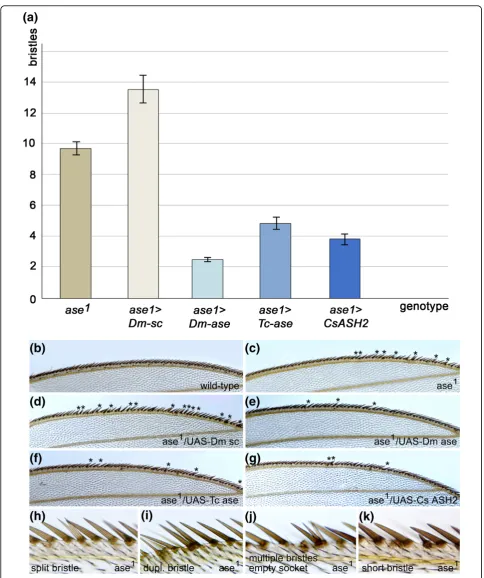
Flies lackingasefunction exhibit only a mild pheno-type because activity ofac,scand senselesscompensates for most of the defects [11,13,29,30]. However, one defect is specific to ase: differentiation of the stout mechanosensory bristles of the triple row of bristles on the anterior wing margin is impaired [11,13]. In ase1 mutant flies these bristles show variable defects that include a split shaft, two to three shafts arising from a single socket, an empty socket or a complete duplication (Figure 3H-K). When over-expressed, Dm-ase, but neither Dm-ac nor Dm-sc, has been shown to rescue these defects [11,13]. We found that CsASH2, as well as Tc-ase, display a rescuing activity comparable to that of Dm-ase(Figure 3A-G). The number of defective bristles inase1 flies is reduced from an average of 9.7 to 2.5, 4.9
Figure 2Phylogenetic analysis of the arthropod ASH and Ase-like proteins. ASH and Ase of insects group together, as do those of crustaceans, while the ASH proteins of myriapods and of chelicerates are arranged in a single group. Both the insect and the crustacean proteins are clearly subdivided into ASH and Ase groups. The spider proteins CsASH1 and CsASH2 are arranged in a group with the single myriapod orthologues. Cs,Cupiennius salei; Dm,Drosophila melanogaster; Dp,Daphnia pulex; Gm,Glomeris marginata; Sm,Strigamia maritima; Tc,
and 3.9 in flies expressingDm-ase, Tc-aseandCsASH2, respectively (Figure 3A-G; Additional file 1). CsASH2 can therefore substitute for functions specific to Dm-ase, which suggests that it might carry out precursor-specificase-like functions in the spider.
ase-like genes of insects, crustaceans and chelicerates and theASHgenes of myriapods bear a conserved regulatory sequence in the UTR
Theasegene ofD. melanogaster bears acis-regulatory sequence in the 5’UTR, the SOPE, that drives expres-sion of a reporter gene in the SOP [13]. Although equivalent enhancer elements drive expression ofscand acin SOPs, they are located upstream of the transcrip-tion start site [14,15,19]. Genome analysis indicates that the ase SOPE is conserved in the 5’ UTR of the ase gene of other insects whereas no such sequence is found in the transcribed regions of insect proneural ASHgenes [22]. The presence of a SOPE in the UTR therefore provides another feature with which to distin-guish betweenASHandase-like genes.
The SOPE bears binding sites for four specific tran-scription factors. Interestingly, we identified clusters of the relevant binding sites in the UTR of D. pulex ase and inCsASH2ofC. salei. The putative SOPE is located in the 5’UTR ofDpu-ase and in the 3’UTR of CsASH2. No such sequence is found in the UTR ofCsASH1. Indi-vidual binding sites were identified by manual compari-son of consensus sequences (Figure 4; Additional file 2). TheDm-ase SOPE, located 144 bp upstream of the start codon, contains four E boxes, twoa boxes, oneb box and one N box. We identified a putative SOPE in an additional insect, T. castaneum, which covers 1,145 bp of the 5’ UTR starting 95 bp upstream of theaseopen reading frame (ORF). It contains three E boxes, twoa,
five band one N box (Figure 4; Additional file 2). In D. pulexthe putative SOPE is located 1,048 bp upstream of the ase ORF and extends over 882 bp in the pre-sumptive 5’ UTR. One E box, oneabox, two b boxes and one N box are present in this region (Figure 4; Additional file 2). The putative SOPE of C. salei CsASH2 is also close to the ORF but is located in the 3’ UTR, between 3 bp and 249 bp downstream of the stop codon. It contains three E boxes, one a box, and one
b box. No N box can be identified in this species (Figure 4; Additional file 2).
Remarkably, we also detected a putative SOPE in the 5’UTR of the single S. maritima ASHgene (Strigamia Genome Project, Human Genome Sequencing Consor-tium, Baylor College). It covers the region between 36 and 601 bp upstream of the ORF and contains four E boxes, threea boxes, fivebboxes and one N box (Fig-ure 4; Additional file 2). These data suggest that a cis-regulatory element located in the UTR, the SOPE, is conserved in the ase-like genes of insects, crustaceans and chelicerates and in theASHgene of myriapods.
In order to identify conserved motifs and demonstrate the level of conservation, we generated sequence ‘logos’ [31] based on the aligned sequences of the individual arthropod SOPE boxes (Additional file 3). The a box shows the most degenerate consensus sequence, with conservation limited to the central part of the NF-B binding site. However, a clear motif is recovered for the E, b and N boxes. We could not detect a significant conservation of nucleotides surrounding the motifs of the boxes (Additional file 3). In line with previous publi-cations, we identified the E box‘logo’as CAGCTG. This consensus sequence binds strongly to daughterless-AS-C heterodimers. Moreover, unlike ASC homodimers, the binding of Ase-Ase homodimers to this site was
observed [13]. It is interesting to note that E boxes with the CAGCTG logo are present once in each arthropod species, although, overall, the motif is present in only 5 of the 17 E boxes identified.
The SOPE ofC. salei CsAHS2andT. castaneum aseare functional inD. melanogaster
TheDm-aseSOPE had been shown to display enhancer activity when placed upstream of an hsp70 promoter and a reporter gene [13]. To test its effects when posi-tioned in the UTR, we generated transgenic lines carry-ing UAS constructs containcarry-ing either the entire transcribed region (including the UTR sequences) or merely the ORF. Since reporter gene fusion constructs that cover different regions upstream of the ORF only restrict expression to single SOPs if the 560-bp UTR containing the SOPE is present [13], the ORF+SOPE constructs should reduce the number of bristles. Three independent lines of each construct were crossed to four differentGal4lines, each of which drives expres-sion in all or part of theD. melanogaster notum. As expected, both transgenes caused the development of ectopic bristles but their number was significantly reduced in the construct containing the entire UTR. Flies expressing the UAS-Dm-ase ORF displayed, in total, an average of 10.9 ectopic bristles, compared with 7.3 in flies expressing the UAS-Dm-aseORF+SOPE (Figure 5A-C; Additional file 4). We therefore conclude that the SOPE regulates gene activity from its position in the UTR and that, when transcription is initiated from exogenous UAS sequences, it functions to dampen transcription. This is consistent with its proposed func-tion to restrict proneural gene activity from broad expression domains to single neural progenitors.
To see whether the strong conservation of binding sites in the UTR of other arthropod ase-like genes is meaningful, we tested the putative SOPEs ofT. casta-neumandC. saleifor function in transgenic flies. Trans-genic lines were made containing UAS sequences and the entire transcribed regions or just the ORFs ofTc-ase andCsASH2. Three independent lines of each construct were crossed to the same four Gal4lines as above. The number of ectopic bristles was used to measure activity. Flies expressing theUAS-Tc-aseORF displayed an aver-age of 6.0 ectopic bristles, and those expressing UAS-Tc-ase ORF+SOPE an average of 4.4 (Figure 5A, D, E; Additional file 4). Flies expressing the UAS-CsASH2 ORF displayed an average of 14.3 ectopic bristles, and those expressing UAS-CsASH2ORF+SOPE an average of 3.4 (Figure 5A, F, G; Additional file 4, misexpression experiment). These data indicate that the SOPEs of T. castaneum andC. saleifunction in a similar fashion to that ofD. melanogaster, consistent with the conserva-tion of binding sites in these sequences.
Discussion
Subfunctionalization and divergence ofASHand
ase-like genes
Most new genes are thought to arise through gene duplication because of the need to evolve simultaneously signals for regulation and transcript processing. Our data suggest that gene duplications in individual arthro-pod lineages have led to the segregation of proneural (ASH) and precursor-specific (ase-like) functions of a single ancestral gene. We show here thatbona fide ase genes are present in crustaceans. Phylogenetic analysis was unable to resolve whether theaseandASHgenes of insects and crustaceans are derived from the duplication of an ancestral gene in the last common ancestor of both groups or rather from independent duplications in the individual lineages. However, the presence of the Ase motif in both insect and crustacean ase genes would support a common origin. This is consistent with the Tetraconata hypothesis, which suggests a sister group relationship of insects and crustaceans [32]. We are confident that the myriapodS. maritimahas a single ASH gene. This gene would therefore need to perform both proneural (ASH) and precursor-specific (ase) func-tions. This is likely to reflect the ancestral state. Myria-pod and chelicerateASH genes group together in our phylogenetic analysis. We think this might simply reflect the retention in both groups of many ancestral homolo-gies. Although the phylogenetic position of myriapods is still under debate, most phylogenies are consistent with the Mandibulata hypothesis, which proposes a sister group relationship of Myriapoda and Tetraconata (insects and crustaceans) [33]. The chelicerate lineage represents a basal branch of the arthropods. An inde-pendent duplication in chelicerates resulting in two ac-scorthologues is supported by our phylogenetic analysis. Sequence comparison based on the conserved domains of the insect and crustacean genes does not distinguish a proneural ASH and a precursor-specific ase gene. However,CsASH2is expressed exclusively in neural pre-cursors and contains an SOPE in the transcript. This, together with its ability to rescue theasemutant pheno-type in D. melanogaster, strongly suggests thatCsASH2 carries out anase-like function. Together, the data sup-port the hypothesis of subfunctionalization and gradual divergence of arthropodASHand ase-like functions.
Figure 5Comparison of the number of ectopic bristles (macrochaetes) displayed by transgenic flies after ectopic expression. UAS constructs containingD. melanogaster ase,T. castenum aseandC. salei CsASH2(ORF alone or the entire transcribed region (ORF+SOPE) ofaseor
SOPE do not drive reporter gene expression in single cells. Furthermore, mutations of the E boxes abolish the activity of the SOPE enhancer [13]. Thus, we are confi-dent that the reduction of ectopic bristles in our trans-genic flies containing the ORF+SOPE results from the activity of the SOPE enhancer. In view of the high level of conservation of the specific binding sites, it is likely that it requires not only auto-regulation and Notch-mediated lateral inhibition but also an important contri-bution from NF-B signaling [14,18]. A unique feature of thease-like genes is the location of the SOPE in the UTR of the transcript. The singleASHgene ofS. mari-timahas retained the SOPE in the transcript. IfS. mari-tima does indeed reflect the ancestral condition, it would indicate that the SOPE was present in the UTR of the ancestral ASH/ase precursor gene. This would place the origin of this regulatory sequence as far back as the last common ancestor of the Arthropoda, that is, in the Cambrian, 550 million years ago.
Position of the SOPE and evolution of proneural gene expression
It appears that in both chelicerates and Tetraconata, the SOPE has been retained in the transcript of thease-like gene after duplication. InD. melanogasterwe know that the ASH duplicates are also regulated by a SOPE but that it has been dislocated from the transcription unit. Like those of Diptera, expression of the ASH genes of crustaceans and spiders is refined from initially broad domains to neural precursors, suggesting that they too are subject to lateral inhibition and the activity of a SOPE [23,24,34]. Therefore, in these species also, a SOPE might reside amongst regulatory sequences out-side the transcription unit of theASHgenes.
The fact that the SOPE is found in the UTR of all ase-like genes, including the single myriapod orthologue, whether 5’or 3’, suggests that this location is important. One possible reason is that it is protected here and is less likely to become separated from the gene since re-arrangement would more often lead to mutations and loss of gene activity. Moreover, if the gene comes under the influence of any other regulatory sequences (outside the transcription unit) the SOPE would still be active. Analysis of the activity of the transgenes whose tran-scription is initiated by Gal4 > UAS sequences indicates that the presence of the SOPE in the UTR dampens activity. Perhaps the protected location is a failsafe mechanism to ensure refinement of expression to single progenitors. In this context it is interesting to note that we identified a putative SOPE enhancer in the 5’ UTR of senseless, another gene whose expression becomes restricted to SOPs [29,35] (Additional file 5). Alterna-tively, the SOPE might have been retained in the UTR because it covers an area that contains additional
elements for controlling post-transcriptional regulation such as RNA folding. The predicted secondary structure (using the RNAfold WebServer [36]) of the UTRs shows characteristic structures such as stem-loops and pseudo-knots (Additional file 6). However, whether these arrangements exert influence on the regulation of the ase-like genes remains to be shown.
Separation of the SOPE from the transcription unit in ASHgenes presumably occurred during (or after) dupli-cation of the ancestral ASH/ase precursor gene. In D. melanogastser, the Dm-sc SOPE is 3 kb upstream of the transcription unit and, furthermore, another cis-reg-ulatory element is situated between the SOPE and the transcription start site [14,37].Dm-scis subject to regu-latory input from an array of independently acting enhancer elements, in addition to the SOPE, each of which has to be brought into close proximity to the basal promoter to drive expression in distinct regions [9,38,39]. One consequence of this is that the SOPE is probably only active at certain times. In contrast, the Dm-aseSOPE would continuously modulate the rate of transcription after initiation from the basal promoter by virtue of its position in the UTR.
Cis-regulatory elements for spatial expression might have been acquired more recently. Indeed, the most complex regulation of ASHgenes is seen in cyclorra-phous flies, where expression in small clusters of cells at precise positions prefigures the development of large sensory bristles, macrochaetes. Macrochaetes are an evolutionary novelty of higher flies and are found in species-specific patterns. In D. melanogaster the patterns rely on an array of independently acting cis-regulatory elements [9] that are likely to have arisen in the Cyclorrapha along with the additional duplication events of the ancestralASHgene [25,40].
Conclusions
An increasing number of publications demonstrate conservation of function of cis-regulatory elements without sequence similarity (reviewed by [41]). In ver-tebrates the functional conservation even spans the evolutionary distance between humans and zebrafish [42]. In invertebrates such functional conservation has only been shown for closely related species that diverged from their common ancestor not longer than 25 to 60 million years ago (for example, [43,44]). Our results demonstrate for the first time the existence of an ancient arthropod regulatory element dating back to the Cambrian (about 500 million years ago). The element shows a conserved function but without suffi-cient sequence conservation to be detected on the basis of sequence alignment, opening the possibility that other ancient invertebrate regulatory elements remain to be discovered.
Materials and methods
Drosophilaculture and stocks
Flies were maintained on standard cornmeal-agar med-ium at 18°C and Oregon-R was used as a control. Strains used were: ase1 (formerly known as sc2 [10]), toll-8 [MD806] Gal4[18],ptc-Gal4,sca[537.4] Gal4,achaete [SBM] Gal4[45],UAS-sc(FlyBase [46]). UAS-constructs for ectopic expression ofD. melanogasterandT. casta-neum aseandC. salei CsASH2were generated by stan-dard techniques. P-element-mediated transformation was performed by standard techniques.
Rescue experiment
ase1 flies were crossed tohsp70Gal4 > UAS Dm-ase, hsp70Gal4 > UAS Tc-aseandhsp70Gal4 > UAS CsASH2 flies, respectively, and allowed to lay eggs in culture bot-tles for 3 days. Heat shocks were preformed between 16 hours and 8 hours before puparium formation. Heat shock expression was driven by three 1-hour heat shocks at 37°C, separated by 2 hour intervals at 25°C. Wings were mounted in glycerol and analyzed under a com-pound microscope (Leica).
Bristle scoring
Three independent lines were generated for each UAS construct (ORF only and ORF+SOPE) and crossed to four differentGal4lines that activated the constructs in the expression domains oftoll-8,patched, scabrousand ac. Flies of the appropriate genotype were selected, mounted and the bristles were counted under the dis-secting microscope (Leica). Statistical analysis was per-formed using Microsoft Excel.
Identification ofASHandasegenes
The sequenced genomes of D. pulex (Daphnia_pulex 2006-09 JGI) and S. maritima (Strigamia maritima Genome Project by Baylor College of Medicine, NCBI Project ID 20501) were searched using tblastn with the ASH and Ase proteins of D. melanogaster, T. casta-neum and C. salei as queries. Hits with relevant homology to the bHLH domain were further character-ized. Three genes were identified in theD. pulex
gen-ome: an ASH homologue (JGI_V11_254034), an ase
homologue (JGI_V11_254038) and a truncated copy of ase (JGI_V11_232740). In the S. maritima genome only one ASH homologue was identified; a second gene analyzed was too divergent in the basic region of the bHLH domain to be classified as anASHgene.
Phylogenetic analysis
Phylogenetic trees were constructed using allASH and asegenes from the insectsD. melanogasterandT. casta-neum, the crustaceansT. longicaudatus and D. pulex, the chelicerate C. saleiand the myriapods G. marginata and S. maritima. Amino acid sequences have been aligned with ClustalW2 [47], manually improved and conserved regions selected with Gblocks (using permis-sive parameters) [48]. The resulting alignment is only 66 amino acids long and corresponds roughly to the basic region and helixes of the bHLH domain and to the car-boxy-terminal domain. Trees have been constructed by maximum likelihood methods and tree topologies com-pared with the Shinodaira-Hasegawa test as implemen-ted in the Phylip package [49].
Additional material
Additional file 1:asenserescue experiment. Comparison of the number of stout bristles exhibiting differentiation defects inase1flies
(first column) andase1flies carryinghsp70Gal4 > UAS Dm-sc,hsp70Gal4 > UAS Dm-ase,hsp70Gal4 > UAS Tc-aseandhsp70-Gal > UAS-CsASH2
transgenes
Additional file 2: Alignment of the SOP enhancer elements. Nucleotide sequence alignments of the individual transcription factor binding sites ofDrosophila,Tribolium,Daphnia,StrigamiaandCupiennius. Additional file 3: Sequence logos of the SOPE boxes. Graphic representation of the aligned sequences of the SOPE binding sites of
Additional file 4: Misexpression experiment. Comparison of the number of ectopic bristles in flies carrying theUAS-ase/ASH2ORF only and ORF+SOPE constructs.
Additional file 5: SOP enhancer in thesenseless5’UTR. Arrangement of the SOPE boxes in the 5’UTR of the senseless transcript.
Additional file 6: Secondary structure of thease-like UTRs. Graphic representation of the secondary structure of the UTRs of theDrosophila melanogaster,Tribolium castaneumandDaphnia pulex asensegenes and the UTRs ofStrigamia maritima ASHandCupiennius salei CsASH2.
Abbreviations
AC:achaete; AS-C: Achaete-Scute complex;ASE:asense;ASH:achaete-scute homologue;ATO:atonal; BHLH: basic helix-loop-helix; BP: base pair; NF: nuclear factor;SC:scute; ORF: open reading frame; SOP: sensory organ precursor; SOPE: sensory organ precursor enhancer; UTR: untranslated region.
Acknowledgements
We are grateful to Michael Akam for giving us access to the unpublishedS. maritimagenome data. We thank Andrew Jarman and Aziz Aboobaker for helpful discussions and Sung Ly for technical assistance. This work was supported by grants 29156 (Wellcome Trust) to PS and STO 361/2-1, STO 361/6-2 (German Research Foundation) and BB/F021909/1 (Biotechnology and Biological Sciences Research Council) to AS.
Author details
1
Department of Zoology, University of Cambridge, Downing Street, Cambridge CB2 3EJ, UK.2School of Biological and Chemical Sciences, Queen
Mary University of London, Mile End Road, London E1 4NS, UK.
Authors’contributions
Conceived and designed the experiments: SA, PS, AS. Performed the experiments and analyzed the data: SA, BN, AS. Wrote the manuscript: AS, PS. Contributed to writing and editing: BN.
Competing interests
The authors declare that they have no competing interests.
Received: 5 July 2010 Accepted: 24 September 2010 Published: 24 September 2010
References
1. Bertrand N, Castro D, Guillemot F:Proneural genes and the specification of neural subtypes.Nat Rev Neuro2002,3:517-530.
2. Heitzler P, Simpson P:The choice of cell fate in the epidermis of Drosophila.Cell1991,64:1083-1092.
3. Heitzler P, Bourouis M, Ruel L, Carteret C, Simpson P:Genes of the Enhancer of split and Achaete-Scute complexes are required for a regulatory loop between Notch and Delta during lateral signalling in Drosophila.Development1996,122:161-171.
4. Künisch M, Haenlin M, Campos-Ortega J:Lateral inhibition mediated by theDrosophilaneurogenic gene Delta is enhanced by proneural proteins.Proc Natl Acad Sci USA1994,91:10139-10143.
5. Richards G, Simionato E, Perron M, Adamska M, Vervoort M, Degnan B: Sponge genes provide new insight into the evolutionary origin of the neurogenic circuit.Curr Biol2008,18:1156-1161.
6. Ghysen A, Dambly-Chaudière C:From DNA to form: the Achaete-Scute conmplex.Genes Dev1988,2:495-501.
7. Cubas P, de Celis J, Campuzano S:Proneural clusters ofachaete-scute expression and the generation of sensory organs in theDrosophila imaginal wing disc.Genes Dev1991,5:996-1008.
8. Skeath J, Carroll S:Regulation ofachaete-scutegene expression and sensory pattern formation in theDrosophilawing.Genes Dev1991, 5:984-995.
9. Gomez-Skarmeta J, Rodriguez I, Martinez C, Culi J, Ferres-Marco D, Beamonte D, Modolell J:Cis-regulation ofachaeteandscute: Shared enhancer-like elements drive their coexpression in proneural clusters of the imaginal disc.Genes Dev1995,9:1869-1882.
10. Gonzalez F, Romani S, Cubas P, Modolell J, Campuzano S:Molecular analysis of theasensegene, a member of the Achaete-Scute complex of Drosophila melanogasterand its novel role in optic lobe development.
EMBO J1989,8:3553-3562.
11. Dominguez M, Campuzano S:asense, a member of theDrosophila Achaete-Scute complex, is a proneural and neural differentiation gene.
EMBO J1993,12:2049-2060.
12. Brand M, Jarman A, Jan L, Jan Y:asenseis aDrosophilaneural precursor gene and is capable of initiating sense organ formation.Development
1993,119:1-17.
13. Jarman A, Brand M, Jan L, Jan Y:The regulation and function of the helix-loop-helix gene,asense, inDrosophilaneural precursors.Development
1993,119:19-29.
14. Culi J, Modolell J:Proneural gene self-stimulation in neural precursors: An essential mechanism for sense organ development that is regulated by Notch signaling.Genes Dev1998,12:2036-2047.
15. Ohsako S, Hyer J, Panganiban G, Oliver I, Caudy M:Hairy functions as a DNA-binding helix-loop-helix repressor ofDrosophilasensory organ formation.Genes Dev1994,8:2743-2755.
16. Giagtzoglou N, Alifragis P, Koumbanakis K, Delidakis C:Two modes of recruitment of E(spl) repressors onto target genes.Development2003, 130:259-270.
17. Lenardo M, Baltimore D:NF-kappa B: a pleiotropic mediator of inducible and tissue-specific gene control.Cell1989,58:227-279.
18. Ayyar S, Pistillo D, Calleja M, Brookfield A, Gittins K, Goldstone C, Simpson P: NF-κB/Rel-mediated regulation of the neural fate inDrosophila.PLoS ONE
2007,2:e1178.
19. Van Doren M, Ellis H, Posakony J:Negative regulation of proneural gene activity: Hairy is a direct transcriptional repressor ofachaete.
Development1994,113:245-255.
20. Rebeiz M, Stone T, Posakony J:An ancient transcriptional regulatory linkage.Dev Biol2005,281:299-308.
21. Hassan B, Bellen H:Doing the MATH: is the mouse a good model for fly development?Genes Dev2000,14:1852-1865.
22. Negre B, Simpson P:Evolution of theachaete-scutecomplex in insects: convergent duplication of proneural genes.Trends Genet2009, 25:147-152.
23. Stollewerk A, Weller M, Tautz D:Neurogenesis in the spiderCupiennius salei.Development2001,128:2673-2688.
24. Wheeler S, Skeath J:The identification and expression ofachaete-scute genes in the branchiopod crustaceanTriops longicaudatus.Gene Expression Patterns2005,5:695-700.
25. Skaer N, Pistillo D, Gibert J, Lio P, Wülbeck C, Simpson P:Gene duplication at theachaete-scutecomplex and morphological complexity of the peripheral nervous system in Diptera.Trends Genet2002,18:399-405. 26. Dove H, Stollewerk A:Comparative analysis of neurogenesis in the
myriapodGlomeris marginata(Diplopoda) suggests more similarities to chelicerates than to insects.Development2003,130:2161-2171. 27. Wheeler S, Carrico M, Wilson B, Brown S, Skeath J:The expression and
function of theachaete-scutegenes inTribolium castaneumreveals conservation and variation in neural pattern formation and cell fate specification.Development2003,130:4373-4381.
28. Pistillo D, Skaer N, Simpson P:scuteexpression inCalliphora vicinareveals an ancestral pattern of longitudinal stripes on the thorax of higher Diptera.Development2002,129:563-572.
29. Jafar-Nejad H, Acar M, Nolo R, Lacin H, Pan H, Parkhurst S, Bellen H: Senseless acts as a binary switch during sensory organ precursor selection.Genes Dev2003,17:2966-2978.
30. Nolo R, Abott L, Bellen H:Senseless, a Zinc finger transcription factor, is necessary and sufficient for sensory organ development inDrosophila.
Cell2000,102:349-362.
31. WebLogo.[http://weblogo.threeplusone.com/create.cgi].
32. Scholtz G:Baupläne versus ground patterns, phyla versus monophyla: aspects of patterns and processes in evolutionary developmental biology.InEvolutionary Developmental Biology of Crustacea.Edited by: Scholtz G. Lisse: Balkema; 2004:3-16.
33. Regier J, Shultz J, Zwick A, Hussey A, Ball B, Wetzer R, Martin J, Cunningham C:Arthropod relationships revealed by phylogenomic analysis of nuclear protein-coding sequence.Nature2010,463:1079-1084. 34. Stollewerk A:Recruitment of cell groups through Delta/Notch signalling
35. Gibert JM, Simpson P:Evolution of cis-regulation of the proneural genes.
Int J Dev Biol2003,47:643-651.
36. RNAfold WebServer.[http://rna.tbi.univie.ac.at/cgi-bin/RNAfold.cgi]. 37. Wrischnik L, Timmer J, Megna L, Cline T:Recruitment of the proneurall
genescuteto the Drosophila sex-determination pathway.Genetics2003, 165:2007-2027.
38. Garcia-Garcia M, Ramain P, Simpson P, Modolell J:Different contributions ofpannierandwinglessto the patterning of the dorsal mesothorax of Drosophila.Development1999,126:3523-3532.
39. Ramain P, Khechumian R, Khechumian K, Arbogast N, Ackermann C, Heitzler P:Interactions between Chip and the Achaete/Scute-Daughterless heterodimers are required forpannier-driven proneural patterning.Mol Cell2000,6:781-790.
40. Simpson P, Marcellini S:The origin and evolution of stereotyped patterns of macrochaetes on the nota of cyclorraphous Diptera.Heridity2006, 97:148-156.
41. Weirauch MT, Hughes TR:Conserved expression without conserved regulatory sequence: the more things change, the more they stay the same.Trends Genetics2010,26:66-74.
42. Fisher S, Grice EA, Vinton RM, Bessling SL, McCallion AS:Conservation of RET regulatory function from human to zebrafish without sequence similarity.Science2006,312:276-279.
43. Romano LA, Wray GA:Conservation of Endo16 expression in sea urchins despite evolutionary divergence in bothcisandtrans-acting
components of transcriptional regulation.Development2003, 130:4187-4199.
44. Ludwig MZ, Bergman C, Patel NH, Kreitman M:Evidence for stabilizing selection in a eukaryotic enhancer element.Nature2000,403:564-567. 45. Marcellini S, Gibert JM, Simpson P:achaete, but notscuteis dispensable
for the peripheral nervous system ofDrosophila.Dev Biol2005, 285:545-533.
46. FlyBase.[http://flybase.org/].
47. Thompson J, Higgins DG, Gibson TJ:CLUSTAL W: improving the sensitivity of progressive multiple sequence alignment through sequence weighting, position-specific gap penalties and weight matrix chocies.
Nucleic Acids Res1994,22:4673-4680.
48. Castresana J:Selection of conserved blocks from multiple alignments for their use in phylogenetic analysis.Mol Biol Evol2000,17:540-552. 49. Felsenstein J:PHYLIP (Phylogeny Inference Package) version 3.6.[http://
evolution.genetics.washington.edu/phylip.html].
doi:10.1186/1741-7007-8-127
Cite this article as:Ayyaret al.:An arthropodcis-regulatory element functioning in sensory organ precursor development dates back to the Cambrian.BMC Biology20108:127.
Submit your next manuscript to BioMed Central and take full advantage of:
• Convenient online submission
• Thorough peer review
• No space constraints or color figure charges
• Immediate publication on acceptance
• Inclusion in PubMed, CAS, Scopus and Google Scholar
• Research which is freely available for redistribution