Experimental techniques in hadron spectroscopy
P. Gianotti1,a
1INFN, Laboratori Nazionali di Frascati, via E. Fermi 40, 00044 Frascati, Italy
Abstract.Quantum Chromodynamics (QCD) is the theory of the strong interaction, but
the properties of the hadrons cannot be directly calculated from the QCD Lagrangian and alternative approaches are then used. In order to test the different models, precise mea-surements of hadron properties are of extreme importance. This is the main motivation for the hadron spectroscopy experimental program carried out since many years with dif-ferent probes and different detectors. A survey of some recent results in the field is here presented and commented, together with the opportunities offered by the forthcoming experimental programs.
1 Introduction
Quantum ChromoDynamics (QCD) is the theory of strong interaction that binds quarks and gluons to form hadrons. QCD is a non-linear theory that is not analytical. This implies that we are not able to solve the equations that derive from the QCD Lagrangian. At high energies, in order to describe strong interactions, perturbative approaches are successful, but in the low energy domain, to predict the properties of the hadrons, we have to use models.
Strong interaction is under study since long time, but recent findings of new and unexpected resonances show that the hadron spectrum is not yet completely understood. This is also underlined by the ongoing discussion on multi-quark states, and other exotic states with gluonic degrees of freedom. Indipendentely from the theoretical framework used, it is undoubtful that not only mesons and baryons are possible. Other types of hadronic matter, multi-quark states or particles in which gluons contribute to the overall quantum numbers, should exist. Furthermore, all theoretical models rely on approximations and/or free parameters that must be constrained. This is why an intense activity in the hadron spectroscopy field is carried out since many years in different laboratories using different tools. The main goal is that to give an answer to the following questions:
• How we recognize nonqq¯states?
• Can we observe experimentally gluonic degrees of freedom?
• How would these manifest themselves in terms of the excitation spectrum and also in the strong decays of hadrons?
A lot of information has been already collected and the complete puzzle is becoming more clear. Nevertheless, some unexpected and contradicting findings point out that we need to identify precisely all the physical states and their quantum numbers, and measure their masses and widths. We must
ae-mail: paola.gianotti.lnf.infn.it C
determine the decay modes and branching ratios and study the underlying dynamics of production and decay. Only with such a complete set of experimental data, we can help guiding and constraining the theory. In the following sections I will briefly describe the analysis methods used and present an overview of some recent measurements performed in the hadron spectroscopy field.
2 Partial Wave Analysis
The most used tool to perform analyses of complex final states is Partial Wave Analysis (PWA). Within this framework a multi-particle phase space is expanded into a (truncated) series of angular momentum functions which describe the reaction matrix element [2, 3]. The matrix elementM of some “decay operator”Ubetween an initialiand a final f state is written:
M“ă f|U|ią“ă f|UAUB....|ią (1)
as the sum of all possible decays (A,B,etc...). The goal is to learn something aboutU parameteriz-ingM, and to determine the fitting parameters from the data. These parameters are the coefficients of “partial waves”. To write down these waves, assumptions have to be made on how particles are grouped to construct the decay/reaction chain. The most used approach is the isobar model. It as-sumes that all sequences of decays appear to be two-body reactions. If we consider a particle 1 that has angular momentum quantum numbersJandMand that decays in two particles 2 and 3 having helicitiesλ2andλ3we can write:
M“ă f|U|ią“ă2`3|U|1ą“ăθ, φ, λ2, λ3|U|J Mą (2)
having parameterized the interactionU for the decay of a particle of spin Jinto daughter particles with helicitiesλ2 andλ3. θis the angle for the angular decay distribution andφ defines the phase convention. The best fit values of the free parameters are determined using an extended maximum likelihood technique or minimizing theχ2of a set of histograms.
Figure 1: Example of theK`K´π0final state originated in the ¯ppannihilation via different reactions.
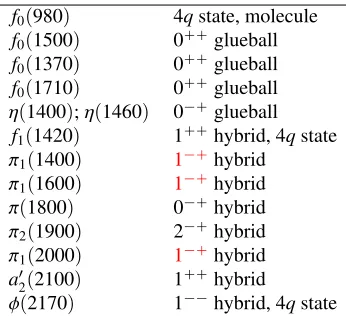
f0p980q 4qstate, molecule f0p1500q 0``glueball f0p1370q 0``glueball f0p1710q 0``glueball ηp1400q;ηp1460q 0´`glueball
f1p1420q 1``hybrid, 4qstate π1p1400q 1´`hybrid
π1p1600q 1´`hybrid
πp1800q 0´`hybrid
π2p1900q 2´`hybrid
π1p2000q 1´`hybrid a12p2100q 1``hybrid
φp2170q 1´´hybrid, 4qstate
Table 1: Main non-qq¯candidates in the light energy sector. In red states with exotic quantum numbers.
Nowadays, all the experiments studying hadron spectroscopy are using PWA techniques for the identification of the resonances and for the unambiguous determination of their properties: quantum numbers, pole positions, masses and widths. In the following sections I will show and comment some results of these activities.
3 The low energy sector
Thanks to the great variety of facilities available all over the world, in the last 30 years a wide harvest of data, in the mass range between 1 and 2 GeV/c2, has been collected with the intention to search for
exotic hadrons,i.e.hybrids, glueballs, multi-quark states predicted by the theory. Table 1 gives a list of states for which an exotic interpretation has been claimed.
Within exotics, there are states that are, in principle, easier to identify, since they exhibit non-qq¯ quantum numbers.π1p1600q, having quantum numbersJPC“1´`, is one of these, but its existence
is strongly disputed within the community since the analyses done up to now are not conclusive and sometime they are not in agreement [4]. It has been identified for the first time in the 3πfinal state fromπ´Ninteraction (BNL E852 and Protvino VES), and then confirmed in ¯ppannihilation (CERN Crystal Barrel) [5–9]. The analyses performed by these collaborations were controversial since they were incomplete or relying on poor statistics. Recently, the COMPASS collaboration has published a new analysis of a sample of 420.000π´π´π`events from the diffractive reaction
π´`PbÑX` pPbq reco
ëπ´π´π`
at 190 GeV/cbeam momentum[10] reporting a significant fraction (1.7˘0.2)% of theπ1p1600qexotic wave decaying toρπ. This is coming out from an accurate PWA performed within the framework of the isobar model and including all known isovector and isoscalarππresonances in the fit. In total, 42 partial waves are included in the first step of the fit, while, in a second step, aχ2fit of the spin-density
) 2 System (GeV/c + Mass of
0 0.5 1 1.5 2 2.5 3
)
2
Events / (5 MeV/c
0 0.5 1 1.5 2 2.5 3 3.5 3 10 (1260) 1 a (1320) 2 a (1670) 2 event distribution background wave ) 2 System (GeV/c + Mass of 0.6 0.811.2 1.4 1.6 1.822.2 2.4
)
2
Intensity / (40 MeV/c
0 2 4 6 8 10 12 14 16 3 10 S + 0 ++ 1 (a) ) 2 System (GeV/c + Mass of 0.6 0.811.2 1.4 1.6 1.822.2 2.4
)
2
Intensity / (40 MeV/c
0 0.5 1 1.5 2 2.5 3 3.5 3 10 S 2 f + 0 -+ 2 (b) ) 2 System (GeV/c + Mass of 0.6 0.811.2 1.4 1.6 1.822.2 2.4
)
2
Intensity / (40 MeV/c
0 2 4 6 8 10 12 3 10 D + 1 ++ 2 (c) ) 2 System (GeV/c + Mass of 0.6 0.811.2 1.4 1.6 1.822.2 2.4
)
2
Intensity / (40 MeV/c
0 100 200 300 400 500 600 700
8001-+1+ P (d)
Figure 2:(left)Invariant mass of the 3πsystem for 0.1 GeV2{c2 ăt1 ă1.0 GeV2/c2(histogram), and
intensity of the background wave with a flat distribution in 3-body phase space (triangles), obtained from a partial wave analysis in 40 MeV/c2 bins of the 3πmass and rescaled to the binning of the
histogram (from [10]). (right)Intensities of major waves 1`` 0`ρπ S (a), 2´`0` f2πS (b), and 2``1`ρπD (c), as well as the intensity of the exotic wave 1´`ρπP (d), as determined in the fit in mass bins (data points with error bars). The lines represent the result of the mass-dependent fit (from [10]).
to 2.32 GeV/c2. Figure 2(right) displays the intensities of the three more prominent waves resulting
from the analysis, together with the exotic 1´`1`ρπP wave.
Despite the COMPASS result, the hadron physics community is not yet convinced that such a state exists. This is due to the fact that similar searches led to different results. For instance, at the Jefferson Laboratory, the CLAS experiment has performed a PWA on a sample of 83.000 events of the reaction
γp Ñ π`π`π´pnq[11] with the intention to confirm the COMPASS result, but the outcome was eventually different. The analysis shows production of thea2p1320qand of theπ2p1670qmesons, but
no evidence for thea1p1260qand theπ1p1600qexotic state has been found. I do not want to enter into
the details of these analyses. I just want to stress their complexity that is paradigmatic to understand why the search for non-qq¯ state is so hard. The signal of the exotic meson is not evident from the invariant mass plot. It comes out only after complicated and difficult to control analysis procedures, and this feeds skepticism and disputes. The production and decay amplitudes can be described with different spin formalisms; the complete input settings like the list of the hypotheses, the choice of the spin formalism and the description of the dynamics are subjective and there is no general consensus on which parameterization is best.
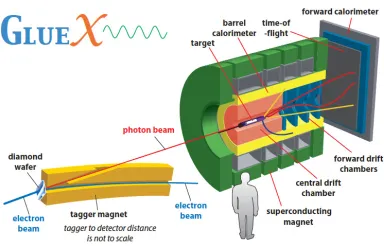
In the low energy domain, a new experiment that aims to map the complete spectrum of exotic hybrid mesons using photo-production is GlueX [12]. The GlueX detector will take data in a new experimental area (Hall D) built as part of the 12 GeV upgrade project of the Jefferson Laboratory [13].
Figure 3: Layout of the GlueX experiment installed in Hall D of the Jefferson Laboratory.
set of detectors in the forward region. Charge particle tracking will be performed by means of a cylindrical drift chamber, made of straw tubes, and by four layers of planar chambers with cathode and strip readout, placed downstream. Neutral particles will be detected with a barrel calorimeter, made of lead and scintillating fibers, and with a forward module consisting of lead-glass blocks. A Time Of Flight system placed in the forward region, completes the setup.
4 The charmonium energy sector
Looking in the Particle Data Book [15], we see that in the mass region 1 ˜2 GeV/c2 there are
hundreds of states. The average level spacing of mesons is 15 MeV/c2 while the average width is
150 MeV/c2. This implies superpositions and interferences that makes the experimental spectroscopy
a very difficult job. This is another reason explaining why many states have been considered exotic candidates, but none of them is unambiguously assigned to the category.
In order to overcome these limitations, the spectroscopy activity moved to higher energies. Large data sets have been collected ate`e´machines by BaBar, Belle, CLEO, and BES collaborations. On the side of hadronic machines, the Tevatron experiments CDF and D0 have contributed significantly, and nowadays excellent data are coming form the LHC experiments.
In the sector of heavy quarks, the density of states is not so high and particle widths are narrower, then interference problems should be reduced. In particular, in the charmonium energy range only eight states are present below theDD¯ threshold, and their width is in the MeV/c2range. Actually, the
outcome of the spectroscopy studies performed in this energy range, has been extremely important. Thanks to this activity, it has been possible to prove the existence of exotic states. In fact, a series of new charged resonances has been identified whose quark composition cannot simply beqq¯.
Nowadays, the set of new particles that are not fitting the conventional scheme, the so called"X Y Z states", is quite large. These mesons are a class of hadrons that are seen to decay to final states that contain a heavy quark and a heavy antiquark, but that cannot be assigned to any unseenqq¯level [16]. The first non-qq¯particle discovered in this energy range is theXp3872q[17]. It has been identified in 2003 by the Belle collaboration in the reaction chain:
and then intensively studied by several experiments. Since its discovery, it triggered many specula-tions about its nature since it could not be any of the expected unseen charmonium excited states. The proximity of its mass to theD˚0D¯0threshold has been a source of speculation on its nature. There are
claims that this could be aD˚0´D¯0molecule, but to say more on this option, precise determinations
of the particle characteristics are still needed. Furthermore, to establish whetherXp3872qis below or aboveD˚0D¯0threshold also a more accurate measurements of theD0mass is required.
Concerning the quantum numbers ofXp3872q, the LHCb collaboration has recently established that the values of the total angular momentum, parity, and charge-conjugation eigenvalues are 1`` [18]. This has been achieved through a complete analysis of the full five-dimensional angular corre-lation between final state decay particles using a likelihood-ratio test.
About the mass, performing over-constrained fits, values below detector resolutions have been determined by many collaborations [19–22]. The mean value obtained combining all the available measurements for theJ{ψπ`π´final state is 3871.68˘0.17 MeV/c2. This is slightly different from the
value obtained studyingD˚0D¯0final state (3874.4˘0.7 MeV/c2), and this has triggered speculations
on the possibility that two states, very close in mass, could exit.
For the width, up to now, there is just an upper limit:ă1.2 MeV/c2[23], and it will be difficult for
all present experiments to better determine it.
The Xp3872q precise width measurement will be one of the key features of the forthcoming PANDA experiment. PANDA (antiProtonANnihilation atDArmstadt) [24] is a hadron spectroscopy experiment in preparation for the new Facility for Antiproton and Ion Research (FAIR) of Darmstadt [26]. PANDA will use a high intensity antiproton beam (2ˆ107 p¯/s) width high momentum
resolu-tion (δp{p»2ˆ10´5) to perform resonance scans. The technique consists in measuring the decay
rate of a state, varying the energy of the beam in small steps [25]. With this method, the masses and the widths of all charmonium states could be measured with excellent accuracy, thanks to the precise knowledge of the initialpp¯state, and without any limitation due to the detector resolution. Further-more, it would be also possible to evaluate the line shape of the resonances measuring several decay modes at the same time. For theXp3872qby measuringJ{ψπ`π´andD˚0D¯0 final states, it would
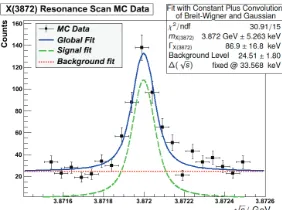
be possible to check whether there is one or two states close in mass and to determine their nature. Figure 4 shows the results of an energy scan simulation performed by the PANDA collaboration for the channelXp3872q ÑJ{ψπ`π´with subsequentJ{ψÑe`e´decay. Data points have been simu-lated varying the antiproton energy by 0.5 MeV and assuming a peak cross section of 50 ns [27]. The input values for the particle mass and width are 3782 MeV/c2and 100 keV/c2, respectively. A four
pion background has been also considered.
The PANDA experiment will also have another big advantage. Inpp¯annihilation it is possible to produce all final states that haveqq¯quantum numbers, unlikee`e´interactions where only 1´´final states can be directly accessed. Here, all other quantum numbers can be accessed only via secondary decays, and this limits the mass resolution achievable. Furthermore in pp¯ annihilation, final states with "exotic" quantum numbers (e.g. non- qq¯), can be directly formed if a recoil particle will be produced at the same time. As an example, PANDA will be able to study all the chargeedZ states lying in the energy range from 2 to 5.5 GeV.
The first of such states has been found in theπ`ψ1 invariant mass distribution by the Belle col-laboration, studying B Ñ Kπ`ψ1 decay [28]. If this peak, called theZp4430q, is interpreted as a meson, its minimum quark content should be|ccu¯ d¯ą. The LHCb collaboration, in a recent paper, has confirmed this discovery and has determined itsJPvalues to be 1`[29].
By using alternatively the production reaction, ¯pp Ñ Z˘π¯, or the formation one, ¯pd Ñ Z´pspectator, a complete analysis of this new particle will be performed by the PANDA
Figure 4: Result of a Monte Carlo simulation performed to check mass determination possibilities of PANDA forXp3872q. Each data point corresponds to a change in energy of 500 KeV. A four charge pion background has been also included [27].
In the meanwhile, other similar states have also been found in the bottomonium energy range by Belle [30], while the BES III collaboration has discovered another charged charmonium-like axial: theZCp3900q[31].
Figure 5 shows the proposed layout of the PANDA experiment. As for GlueX, this is a fixed target detector consisting of a super-conducting Target Spectrometer (TS), surrounding the interaction point, and a Forward Spectrometer (FS), placed within and after a normal conducting dipole. Figure 5 also points out the main components of the apparatus.
(a) (b) (c)
Figure 5: Layout of the PANDA apparatus (a); detailed view of the Target Spectrometer (TS) (b) and of the Forward Spectrometer (FS) (b).
5 Conclusions
Since its foundation, hadron spectroscopy has been trying to confirm the existence of the exotic states predicted by QCD. In the low energy sector, many hints for exotic states have been observed, but the big number of broad overlapping ordinary mesons has not yet allowed to firmly establish none of the candidates.
The new generation of experiments carried out at the upgraded Jefferson Laboratory and at the new FAIR international center, will help shed new light in this interesting and fundamental field of basic research.
References
[1] K. G. Wilson Phys. Rev. D102445-2459 (1974). [2] M. Jacob and G.C. Wick, Ann. Phys.7, 404 (1959). [3] B. S. Zou and D. V. Bugg, Eur. Phys. J.A16, 537 (2003). [4] D.V. Amelinet al., Phys. At. Nucl.68, 359 (2005). [5] G.M. Beladidzeet al., Phys. Lett. B313, 276 (1993). [6] G.S. Adamset al., Phys. Rev. Lett.81, 5760 (1998). [7] E. I. Ivanovet al.Phys. Rev. Lett.86, 3977 (2001). [8] S. U. Chunget al., Phys. Rev. D65, 072001 (2002). [9] C. A. Bakeret al., Phys. Lett. B563, 140 (2003).
[10] M.G. Alekseevet al., Phys. Rev. Lett.104, 241803 (2010). [11] M. Nozaret al., Phys. Rev. Lett.102, 102002 (2009).
[12] Proposal for JLab Experiment E12-06-102:Mapping the Spectrum of Light Quark Mesons and Gluonic Excitations with Linearly Polarized Photons, http://www.jlab.org/exp_prog/proposals/06/ PR12-06-102.pdf (2006).
[13] D. Lawrence, EPJ Conf. Ser66, 06011 (2014). [14] J. J. Dudeket al., Phys. Rev. D79, 094504 (2009).
[15] J. Beringeret al.(Particle Data Group), Phys. Rev. D86, 010001 (2012). [16] S. Olsen, Int. J. Mod. Phys. Conf. Ser.29(2014).
[17] S. K. Choiet al., Phys. Rev. Lett.91, 262001 (2003). [18] R. Aaijet al., Phys. Rev. Lett.110, 222001 (2013). [19] R. Aaijet al., JHEP1306, 065 (2013).
[20] S.-K. Choiet al., Phys. Rev. Lett.91, 262001 (2003). [21] D. Acostaet al., Phys. Rev. Lett.93, 072001 (2004). [22] B. Aubertet al., Phys. Rev. D71, 071103 (2005). [23] S.-K. Choiet al., Phys. Rev. D84, 052004 (2011). [24] W. Erniet al., arXiv:0903.3905v1.
[25] P. Dalpiaz, Proceedings ofPhysics With Cooled Low Energetic Antiprotons, edited by H. Poth, 111 (1979).
[26] http://www.fair-center.com/.

![Figure 2: (left)histogram (from [10]).mass bins (data points with error bars). The lines represent the result of the mass-dependent fit (from Invariant mass of the 3π system for 0.1 GeV2{c2 ăt1 ă 1.0 GeV2/c2(histogram), andintensity of the background wave with a flat distribution in 3-body phase space (triangles), obtainedfrom a partial wave analysis in 40 MeV/c2 bins of the 3π mass and rescaled to the binning of the (right) Intensities of major waves 1`` 0`ρπ S (a), 2´`0` f2π S (b), and2``1`ρπ D (c), as well as the intensity of the exotic wave 1´`ρπ P (d), as determined in the fit in[10]).](https://thumb-us.123doks.com/thumbv2/123dok_us/8173346.1364885/4.482.80.413.75.184/invariant-andintensity-background-distribution-obtainedfrom-intensities-intensity-determined.webp)