A Conditional Random Field Framework for Thai Morphological Analysis
Canasai Kruengkrai, Virach Sornlertlamvanich, Hitoshi Isahara
Thai Computational Linguistics Laboratory
National Institute of Information and Communications Technology 112 Paholyothin Road, Klong 1, Klong Luang, Pathumthani 12120, Thailand
{canasai,virach}@tcllab.org, [email protected]
Abstract
This paper presents a framework for Thai morphological analysis based on the theoretical background of conditional random fields. We formulate morphological analysis of an unsegmented language as the sequential supervised learning problem. Given a sequence of characters, all possibilities of word/tag segmentation are generated, and then the optimal path is selected with some criterion. We examine two different techniques, including the Viterbi score and the confidence estimation. Preliminary results are given to show the feasibility of our proposed framework.
1.
Introduction
Morphological analysis is the process of segmenting text into morphemes and performing some tasks such as word formation analysis or part-of-speech (POS) tagging. Mor-phological analysis is often an initial step for many kinds of text analysis of any languages. In English and other Western languages, text can be tokenized into words by whitespace or punctuation, and morphological analysis can start by considering words as primitive units. In unseg-mented languages, such as Chinese, Japanese, and Thai, words are not explicitly delimited by whitespace. As a re-sult, the problem of morphological analysis is more diffi-cult for these languages. More specifically, in the context of Thai morphological analysis, a major challenge is how to solve ambiguities of both word boundary detection and POS tagging simultaneously.
The morphological analysis task can be thought of as the sequential supervised learning problem (Dietterich, 2002), where text is formulated as a sequence of characters. In se-quential supervised learning, one of the most widely used techniques is hidden Markov models (HMMs). Based on the concept of generative models, HMMs typically define the joint probability distribution p(y,x)over an observa-tion sequence x and a label sequence y. The limitaobserva-tion of generatively-trained models is that they must make in-dependent assumptions among elements of the observation sequence in order to make inference tractable. In the mor-phological analysis task, non-independent elements of the observation sequence, such as prefixes, suffixes, or sur-rounding words, are useful features for learning and pre-dicting.
One solution to relax the independent assumptions is to formulate the model with the conditional probability dis-tribution p(y|x). McCallum et al. (2000) proposed max-imum entropy Markov models (MEMMs) that can learn an observation-dependent transition from the previous la-bel to the current lala-bel. However, MEMMs and other dis-criminative models with independently trained next-state classifiers suffer from a serious problem called the label-bias. To deal with this problem, Lafferty et al. (2001) pro-posed conditional random fields (CRFs) that globally nor-malize the probability of the label sequence to avoid the
label-bias problem. CRFs also provide the flexibility to use non-independent features. Recently, CRFs have been suc-cessfully applied in many tasks in natural language process-ing, including morphological analysis (Kudo et al., 2004), noun-phrase chunking (Sha and Pereira, 2003), and name entity recognition (McCallum and Li, 2003).
In this paper, we propose a unified framework for dealing with ambiguities in Thai morphological analysis based on the theoretical background of CRFs. As mentioned earlier, the Thai writing system has no word boundary indicators. This leads to a problem where elements of the observation sequence are inconsistent due to word boundary ambiguity. Unlike the Chinese writing system which is monosyllabic, the Thai writing system is alphabetic. Each Chinese char-acter can function as a single morpheme, so the ambiguity of the observation sequence can be avoided by performing word segmentation and POS tagging at the character level (Peng et al., 2004). However, Thai word formation is sim-ilar to English in which it is composed of consonants and vowels but without tense and inflection. Thus, tagging at the character level for Thai is not a practical way.
Our framework is more closely related to morphological analysis for Japanese (Kudo et al., 2004). Given a se-quence of characters, all possibilities of word/tag segmen-tation are first generated. We present the combination of the longest matching algorithm and the backtracking tech-nique for constructing the word/tag lattice. Then, the op-timal path is selected with some criterion. In our work, we examine two different techniques for selecting the most likely word/tag path, including the Viterbi score and the confidence estimation. Preliminary results on a standard benchmark for the Thai POS tagging task named the OR-CHID corpus are provided. To the best of our knowledge, a study of Thai morphological analysis based on the concept of CRFs has not been reported on the literature.
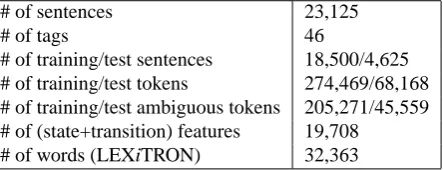
# of sentences 23,125
# of tags 46
# of training/test sentences 18,500/4,625 # of training/test tokens 274,469/68,168 # of training/test ambiguous tokens 205,271/45,559 # of (state+transition) features 19,708
# of words (LEXiTRON) 32,363
Table 1: Statistics of ORCHID used in our experiments
We think that these situations may occur from the ambi-guity in the observation sequence. Thus, we examine an alternative score to measure the confidence of candidate word/tag paths. The confidence estimation (CE) is equal to the normalized value of a constrained lattice (Culotta and McCallum, 2004):
CE= Z
0
λ(x) Zλ(x)
(11)
In our context, the constraintsCcorrespond to a set of seg-mented tokens with their specified tags. We estimate the confidence of the entire word/tag path. For example, in Fig-ure 1, the constrained lattice is marked by the bold path. In order to obtain the normalization termZλ(x), we have to marginalize out the label selection probabilities, which can be computed by applying the Constrained Forward al-gorithm. Instead of selecting the optimal label sequence as performed in the Viterbi algorithm, the Constrained For-ward algorithm evaluates all possible label sequences given the observation sequence. Only themaxterm in Eq. (9) is replaced by the summation, so we can compute the forward value by:
αt+1(yi) =
X
y0
αt(y0) exp X
k
λkfk(y0, yi,x, t) .
(12) In the termination step, we obtain:
Zλ(x) =X
i
αT(yi). (13)
Let C = hyt, yt+1, . . .ibe a constrained path. The
con-strained forward value is defined by:α0t+1(yi) =
P
y0
α0t(y0) exp P
kλkfk(y0, yi,x, t)
ifyi=yt+1,
0 otherwise,
(14) and we finally obtain the constrained lattice value in the termination step as follows:
Zλ0(x) = X
i
α0T(yi). (15)
5.
Preliminary Experiments
5.1. Data Sets and Evaluation Methods
We performed experiments on a standard benchmark for the Thai POS tagging task named the ORCHID corpus. The ORCHID corpus was constructed at the Linguistics and
Knowledge Science Laboratory under the National Elec-tronics and Computer Technology of Thailand. The statis-tics of the ORCHID corpus used in our experiments are given in Table 1.
We randomly split the corpus into 80% for training and the remaining 20% for testing. We de-segmented the test set by removing all tags from words. We then merged all the words in each sentence into a character sequence. Thus, the task is to recover the word boundaries and assign the words with the most likely tags. In our preliminary ex-periments, we only trained a linear-chain CRF with basic features. Transition features are based on the first-order Markov assumption, and state features are composed of tokenized words found in the training set. In particular, for the state features, we also added unknown features that are generated when the frequencies of the tokenized words are less than 4 times. The word list for the lattice con-struction process was taken from an online lexicon called LEXiTRON1.
For the propose of comparison, we experimented with two different techniques of the decoding process (Viterbi and CE) as described in Section 4.2. We also compared our techniques with another two methods: the longest match-ing (LM) algorithm and the maximum matchmatch-ing (MM) al-gorithm. After obtaining the segmented tokens, both the LM and MM algorithms performed POS tagging with the unigram baseline (UB) technique. The idea of this tech-nique is just to assign each token with the most likely tag that can be estimated from the training set (Jurafsky and Martin, 2000).
We used precision, recall, andF1for evaluation. For word
segmentation, precision is defined as the percentage of to-kens recovered by the algorithm that also occurred in the test set in the same sentence, whereas recall is defined as the percentage of tokens in the test set recovered by the al-gorithm. For POS tagging, a token is considered to be a correct one only if both the word boundary and its corre-sponding POS tag are correctly identified. In order to get a single measure of effectiveness, we employF1 that is a
combination of precision and recall. These measures can be summarized as follows:
Precision= # of correct tokens
# of tokens recovered by the algorithm,
Recall= # of correct tokens
# of tokens in the test set ,
F1=
2·Precision·Recall Precision + Recall .
We implemented a parallel version of the CRF trainer with C language and MPI (Massive Passing Interface) library. We observed that the process of computing the log likeli-hood function and its gradient is inherently data-parallel, and this process runs iteratively. Thus, the loop can be par-allelized by evenly distributing the training samples across processors, and computing the log likelihood function and its gradient simultaneously. At the end of each iteration,
Method Precision Recall F1
LM 82.717% 82.059% 82.389%
MM 83.305% 82.392% 82.846%
CRF-Viterbi 74.727% 84.147% 79.157%
CRF-CE 83.991% 83.149% 83.568%
Table 2: Results of word segmentation on ORCHID
Method Precision Recall F1
LM-UB 75.715% 75.113% 75.413%
MM-UB 76.272% 75.436% 75.851%
CRF-Viterbi 70.955% 79.900% 75.162%
CRF-CE 79.744% 78.945% 79.342%
Table 3: Results of POS tagging on ORCHID
all the values are summed up and redistributed to all pro-cessors. We ran the training process on a Linux cluster, consisting of 10 nodes. Each node is an Intel®Xeon™3
GHz with 4 Gbytes of RAM.
5.2. Results
We now provide experimental results with some discus-sion. Table 2 shows the summary of the word segmenta-tion results produced by LM, MM, Viterbi, and CRF-CE. We can see that the two baseline methods give ac-ceptable results. However, the CRF-Viterbi yields poor results in terms of precision andF1, while CRF-CE
pro-vides the best results onF1score. We check the
segmenta-tion results to see why CRF-Viterbi performs worse on the word segmentation task. We observe that CRF-Viterbi of-ten prefers paths that have greater numbers of segmented tokens. This corresponds to the segmentation results in which CRF-Viterbi achieves the highest recall value. In contrast, CRF-CE can select better paths. It is interesting to note that the path selection of CRF-CE seems to be inde-pendent from the number of segmented tokens.
Table 3 shows the summary of the POS tagging results. The two baseline methods perform well even with the simple tagging technique. CRF-Viterbi still yields unsatisfactory results, while CRF-CE outperforms other methods for the POS tagging task.
6.
Conclusion and Future Work
This paper has described our initial effort to deal with ambi-guities in Thai morphological analysis based on the concept of conditional random fields. We present a unified frame-work for performing word segmentation and POS tagging at the same time. The word/tag lattice is efficiently con-structed, and then the optimal segmentation path on the lat-tice is selected. Preliminary experiments find that the path selection with the Viterbi score often prefers paths that con-tain greater numbers of segmented tokens. This can yield unsatisfactory segmentation results. To alleviate this prob-lem, we apply an alternative path selection criterion called the confidence estimation. This criterion is the normalized value of the constrained lattice, which can be computed by the Constrained Forward algorithm. The evaluation on the
ORCHID corpus shows that selecting the optimal path with the confidence estimation is very promising.
Several issues of future work remain. In the current work, we use only basic features for learning and predicting. However, one of strengths of CRFs is to allow using arbi-trary, overlapping, and non-dependent features. The feature induction technique will be explored (McCallum, 2003). The unknown word problem is also an issue in morpho-logical analysis. We will integrate this problem into our framework. In (Peng et al., 2004), the authors show that the confidence estimation is very useful for unknown word detection.
7.
References
Wirote Aroonmanakun. (2002). Collocation and thai word segmentation. In Proc. of the 5th SNLP & 5th Oriental
COCOSDA Workshop, pages 68–75.
Paisarn Charoenpornsawat. (1999). Feature-based Thai
Word Segmentation. Master’s Thesis, Computer
Engi-neering, Chulalongkorn University.
Aron Culotta and Andrew McCallum. (2004). Confidence estimation for information extraction. In Proc. of
HLT-NAACL 2004 (short paper).
Thomas G. Dietterich. (2002). Machine Learning for
Se-quential Data: A Review. In T. Caelli (Ed.) Structural,
Syntactic, and Statistical Pattern Recognition, Lecture Notes in Computer Science, Vol. 2396, Springer-Verlag. Chuleerat Jaruskulchai. (1998). An automatic thai lexical acquisition from text. In Proc. of PRICAI’98, pages 289– 296.
Daniel Jurafsky and James H. Martin. (2000). Speech
and Language Processing: An Introduction to Natural Language Processing, Computational Linguistics, and Speech Recognition. Prentice-Hall, Inc.
Asanee Kawtrakul and Chalatip Thumkanon. (1997). A statistical approach to thai morphological analyzer. In
Proc. of the 5th Workshop on Very Large Corpora, pages
289–296.
Taku Kudo, Kaoru Yamamoto, and Yuji Matsumoto. (2004). Applying conditional random fields to japanese morphological analysis. In Proc. of EMNLP 2004. John Lafferty, Andrew McCallum, and Fernando Pereira.
(2001). Conditional random fields: Probabilistic models for segmenting and labeling sequence data. In Proc. of
ICML 2001.
Andrew McCallum and Wei Li. (2003). Early results for name entity recognition with conditional random fields, feature induction and web enhanced lexicon. In Proc. of
CoNLL 2003.
Andrew McCallum, Dayne Freitag, and Fernando Pereira. (2000). Maximum entropy markov model for informa-tion extracinforma-tion and segmentainforma-tion. In Proc. of ICML
2000.
Andrew McCallum. (2003). Efficiently inducing features of conditional random fields. In Proc. of the 19th Annual
Conference on Uncertainty in Artificial Intelligent (UAI-03).
Masaki Murata, Qing Ma, and Hitoshi Isahara. (2002). Comparison of three machine-learning methods for thai part-of-speech tagging. ACM Trans. Asian Lang. Inf.
Process., 1(2):145–158.
Fuchun Peng, Fangfang Feng, and Andrew McCallum. (2004). Chinese segmentation and new word detection using conditional random fields. In Proc. of COLING
2004.
Fei Sha and Fernando Pereira. (2003). Shallow parsing with conditional random fields. In Proc. of HLT-NAACL
2003.
Virach Sornlertlamvanich. (1993). Word Segmentation for
Thai in Machine Translation System. Machine