R E S E A R C H
Open Access
Multi-objective model selection algorithm
for online sequential ultimate learning
machine
Xinyuan Jin
2, Tao He
3*and Yezhi Lin
1,4*Abstract
In order to improve the channel equalization, improve the control quality, and reduce the error of the target output of the online sequential learning machine, a multi-objective model selection algorithm is proposed based on feedback compensation and adaptive equalization control. The channel equalization model of online sequential ultimate learning machine is constructed. The sensor fusion information of online sequential limit learning machine is selected adaptively by multi-objective combined control, and the multi-objective combined control is carried out by using matched filtering method. Combined with feedback compensation and adaptive equalization control method, the classification selection and equalization of network multi-objective models are realized. The simulation results show that the algorithm has good accuracy in classifying and selecting multi-objective models of online sequential LLM, the adaptive equalization performance of the channel is better, and the error of LLM control is low.
Keywords:Online sequential extreme learning machine, Multi-objective model, Classification selection, Equilibrium
1 Introduction
With the development of network information tech-nology, using network control to transmit data be-comes a necessary means for people to transmit data and exchange information. An online sequential ex-treme learning machine is constructed to realize low frequency, middle frequency, and high frequency. VHF and UHF signals interact with information and improve the quality of data transmission through channel equalization and modulation and demodula-tion. The traditional network is a platform for infor-mation transmission, and receiving and sharing users can connect various kinds of rich information to-gether, so as to realize the information sharing be-tween different regions. Cognitive network is a new advanced communication technology in recent years. The technology of perception, learning, and reconfig-uration is adopted comprehensively, so it has im-portant application value [1]. Cognitive network is a
network with cognitive process. It can understand and learn by itself by perceiving the current network environment. Then the internal configuration is ad-justed to adapt to the change of the external net-work according to the understanding and the learning knowledge [2]. It has a certain adaptive ability. That is, it can continuously learn and accu-mulate relevant knowledge in the process of dynamic adaptation, and based on it, it can adjust, decide, and reconfigure the network [3]. In order to improve the data configuration and clustering ability of the network, it is necessary to use the ultimate learning machine to optimize the target combination control, to improve the network transmission control ability and to realize the optimal selection of the multi-objective model of the ultimate learning machine.
Extreme learning machine (ELM) algorithm is pro-posed by Huang based on a single-hidden layer feed-forward neural network (SLFN) algorithm. Because of its strong mathematical background, fast learning speed, ability to approach complex nonlinear func-tions, and high generalization ability, ELM algorithm has become a widely used machine learning technol-ogy. It has been successfully applied to many fields,
© The Author(s). 2019Open AccessThis article is distributed under the terms of the Creative Commons Attribution 4.0 International License (http://creativecommons.org/licenses/by/4.0/), which permits unrestricted use, distribution, and reproduction in any medium, provided you give appropriate credit to the original author(s) and the source, provide a link to the Creative Commons license, and indicate if changes were made.
* Correspondence:[email protected];[email protected] 3
Department of Electrical and Electronic Engineering, Wenzhou Vocational & Technical College, Wenzhou 325035, People’s Republic of China
1The First Affiliated Hospital of Wenzhou Medical University, Wenzhou
325000, People’s Republic of China
such as pattern recognition, data mining, and so on [4]. Different from the traditional neural network algo-rithm based on gradient descent and error back propaga-tion, it is necessary to iterate and determine the optimal solution of all parameters several times during the training process, which results in a large amount of computation [5]. The slow learning speed of ELM algorithm is taken based on the fact that the learning ability of SLFN is only related to the number of hidden layer nodes but independ-ent of the weight of the input layer. Therefore, in the process of ELM learning, a large number of artificial net-work parameters are not required, and the learning speed of the algorithm is significantly higher than that of the trad-itional neural network learning algorithm, because the ELM learning algorithm considers all training samples equally. Each positive class sample and negative class sample in the dataset have the same effect on the formation of the classifi-cation surface, while the negative class accumulates as all the samples of most classes, and finally has a great influence on the formation of the classification surface [6].
In order to solve the above problems, this paper proposes a multi-objective model selection algorithm based on feed-back compensation and adaptive equalization control. Firstly, the channel equalization model of online sequential ultimate learning machine is constructed. The sensor fusion information of online sequential limit learning machine is selected adaptively by multi-objective combined control, and the multi-objective combined control is carried out by using matched filtering method. Combined with feedback compensation and adaptive equalization control method, the classification selection and equalization of network multi-objective models are realized. Finally, the perform-ance test is carried out through the simulation experiment, which shows the superior performance of this method in improving the ability of selecting the multi-objective model of the ultimate learning machine.
2 Methods
2.1 Channel characteristics of online sequential extreme learning machine
In order to optimize the classification and selection of multi-objective models of molecular exchange networks
and improve the network performance and data trans-mission capability, the channel model of online sequen-tial extreme learning machine should be constructed first. The channel of online sequential extreme learning machine is a limited bandwidth [7]. The tap delay line model of the channel is a wideband channel transmis-sion model. Let the time delay of each multipath reach be an integer multiple of the width of symbol. The chan-nel impulse response of the online sequential extreme learning machine can be expressed as follows:
hðtÞ ¼X
i
aiðtÞejθiðtÞδðt−iTSÞ ð1Þ
The wideband propagation characteristics of data transmission in online sequential extreme learning ma-chine have a serious effect on the multipath propagation phenomenon in the actual network channel. Using the tap delay line model with tap interval MT/Nto suppress multipath propagation will cause inter-symbol interfer-ence of transmitted signal, whereM and Nare integers and M<N. The received signal spectrum is equalized, and the channel characteristics in the online sequential learning machine are described as follows:
CT0ð ÞYf T0ð Þ ¼f CT0ð Þf X
n
x f−n T0
ej2π f− n T0
τ¼CT0ð Þf X fð Þej2πfτ
ð2Þ
whereX(f) is the bandwidth limited spectrum of chan-nel impulse response of online sequential learning ma-chine, YT0ðfÞ is the spectrum of sampling signal, andτ0
is the time delay of data transmission by online sequen-tial ultimate learning machine.
2.2 Phase shift calculation of multi-objective model of online sequential extreme learning machine
On the basis of the analysis of the channel characteris-tics of the online sequential limit learning machine, the phase shift of the multi-objective model of the online se-quential limit learning machine is calculated, the
migration is suppressed, the network channel model is constructed, and the channel average is improved [8]. On the assumption that the channel model expressed in the network is ideal, the amplitude equalization principle is used to modulate the channel. The online sequential extreme learning machine node is com-posed of N= 2P elements, and the online sequential extreme learning machine data transmission system is based on the principle of amplitude equalization and channel modulation. The signal reception model is expressed as follows:
xmð Þ ¼t
XI
i¼1
sið Þet jφmiþnmð Þt ;−pþ1≤m≤p ð3Þ
where si(t) is the i phase deflection information in
the input component of the excessive path of the online sequential extreme learning machine node and xm(t) is the equalization transfer phase model of
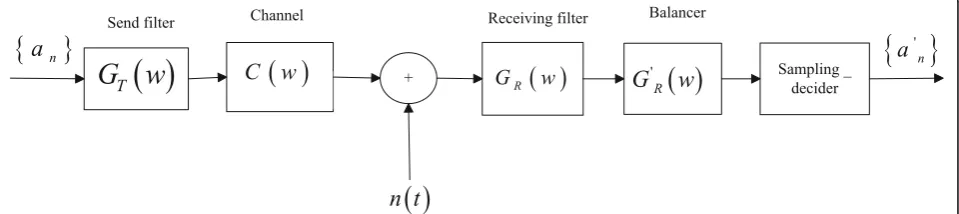
the receiving terminal of the online sequential ultim-ate learning machine, and the time delay of each multipath arrival is obtained [9]. The data transfer structure model of online sequential extreme learn-ing machine is shown in Fig. 1.
Assuming that the length of LFM period in LLM isT, the objective model is constructed by using multi-path signal to realize time compression, and the data multi-objective model of online sequential LLM is ob-tained as follows:
x tð Þ ¼½x−Pþ1ð Þt ;x−Pþ2ð Þt ;…;xPð Þt TN1 ð4Þ
s tð Þ ¼½s1ð Þt ;s2ð Þt ;…;sIð Þt TI1 ð5Þ
By adding phase shift of multipath component, the dir-ect sequence spread spdir-ectrum component of online se-quential extreme learning machine data transmission is obtained as follows:
yð Þ ¼k að Þk hð Þ þk nð Þk ð6Þ
The multi-objective model of online sequential ex-treme learning machine is fixed compensated for shrink-age [10], and the filter is used to compensate the cost. The pulse response of equalizer compensation distortion is expressed as follows:
JMDMMA¼ρE jz kð Þj2−RMDMMAð Þk
2
h i
ð7Þ
In order to reduce the steady-state error, the adap-tive phase offset compensation is used to suppress the channel interference after receiving the training sequence. The iterative formula of interference sup-pression is obtained as follows:
fðkþ1Þ ¼ fð Þk −μρeMDMMAð Þk yð Þk ð8Þ
where
eMDMMAð Þ ¼k z kð Þjz kð Þj2−RMDMMAð Þk ð9Þ
Because the value of the iterative step size or the adap-tive control factor of the equalizer has a great influence on the equalization algorithm, the value ofρis satisfied:
ρ¼ 1; sgn jz kð Þj2−RMDMMAð Þk
The channel equalization model of online sequential ul-timate learning machine is constructed. The sensor fusion information of online sequential limit learning machine is se-lected adaptively by multi-objective combined control [11].
3 Improved algorithm for classification and selection of multi-objective models
3.1 Adaptive channel selection of ultimate learning machine based on multi-objective combined control On the basis of constructing the multi-objective model of online sequential limit learning machine, the optimization design of channel classification selection algorithm is car-ried out. An online sequential limit model based on feed-back compensation and adaptive equalization control is proposed in this paper [12]. The classification and selection algorithm of learning machine multi-objective model is used to select the sensor fusion information of online se-quential extreme learning machine by using multi-objective combined control. The matched filter structure model is used to optimize the channel transmission performance of the online sequential learning machine. The linear trans-verse equalization analysis is carried out by using the least mean square error (LMS) criterion [13]. It is obtained that the complete baud interval in the frequency band p(t) of the ultimate learning machine is as follows:
prið Þ ¼t p tð Þ hið Þ þt npið Þt ð11Þ
The frequency response of the transverse equalization between the i node in an online sequential extreme learning machine:
where ck is the normalized amplitude, N is the
sampling length of the recovery time frequency char-acteristic data, and P is the spectrum characteristic of the received signal. In addition, the T'= MT/N
expression of the baseband envelope of the jamming signal is described as:
sgnz2Rð Þk −RMDMMA R¼ sgnzR2ð Þk −^e2Rð Þk ð13Þ
sgnz2Ið Þk −RMDMMA I¼ sgnzI2ð Þk −^e2Ið Þk ð14Þ
Where, ^e2RðkÞ is the demodulation output sample of multi-objective model of online sequential extreme learning machine, z2
RðkÞis an adjustable filter correction ratio, z2
IðkÞ is carrier frequency, and ^e2IðkÞ is over ad-justed equalizer parameter.
According to the phase offset between each path and the direct path, the multi-objective combinatorial control is used to filter the channel by fuzzy adaptive [14], and the decision function of the multi-objective combined control is obtained as follows:
fFðkþ1Þ ¼ fFð Þk −μ∇fFð Þk JMMDMMA ¼ fFð Þk −μ∇fFð ÞkðJMMDMMA RþJMMDMMA IÞ ¼ fFð Þk −μF½ρð Þk eMDMMAð Þ þk ð1−ρð Þk Þe kð Þyð Þk
¼ fFð Þk −μF½ρð Þk eMDMMA Rð Þ þk jeMDMMA Ið Þk
þ
1−ρð Þk
ð ÞðeRð Þ þk jeIð Þk Þyð Þk
ð15Þ
The steady-state error of channel offset phase estima-tion in constellaestima-tion circle is:
eMDMMAð Þ ¼k z kð Þjz kð Þj2−RMDMMAð Þk ð16Þ
The phase shift of multipath component is added, and the multi-objective combination control is used to filter the sensor fusion information of the online sequential
limit learning machine [15]. The iterative transfer function of the adaptive filtering of phase information is obtained:
d tð Þ ¼a tð Þc tð Þ ¼X
∞
n¼0
dngcðt−nTcÞ ð17Þ
where
dn¼ þ−1
1
an¼cn
an≠cn
n−1
ð ÞTc≤t≤nTc ð18Þ
Based on the multi-objective combined control method, the channel of online sequential extreme learning machine is selected adaptively. The decision error function of the channel equalization is obtained as follows:
^e kð Þ ¼zRð Þk jzRð Þk j2−^s2Rð Þk
þjzIð Þk jzIð Þk j2−^s2Ið Þk
ð19Þ
3.2 Channel classification selection based on feedback compensation and adaptive equalization control
The multi-objective model of LLM is classified and equalized through adaptive channel selection, feed-back compensation, and adaptive equalization con-trol. Based on the direct sequence spread spectrum principle, the constellation radius of the online se-quential extreme learning machine is obtained as
RMDMMA _ i(i= 1,⋯,N), and the QAM modulation
RMDMMA(k) is used for Doppler expansion:
abs z kj ð Þj2−R kð ÞMDMMA
where ρis used to adaptively adjust the weight of the control array unit of online sequential limit learning ma-chine. 0≤ρ≤1 adaptive feedback equalization design is realized, and the channel time domain expansion and Doppler expansion are realized [16]. The expansion process is expressed as follows:
aðθ0þΔθÞ ¼½1; expð−jϕ1Þ;…; expð−j Mð −1Þϕ1ÞT
ð21Þ
aðθ0−ΔθÞ ¼½1; expð−jϕ1Þ;…; expð−j Mð −1Þϕ2ÞT
ð22Þ
In order to improve the envelope directivity of data transmission and reduce the output bit error rate (BER), adaptive noise cancellation is adopted and feedback equalization is carried out. The characteristic coefficients of the output envelope are obtained as follows:
bð Þ ¼θ0 1
2½aðθ0þΔθÞ þaðθ0−ΔθÞ ð23Þ
Combined with the pulse response of multipath chan-nel, the relationship between transmission and channel classification selection in online sequential learning ma-chine is obtained as follows:
wBLCMV¼R~−y1½atð Þθ0 ;btð Þθ
ð½atð Þθ0 ;btð Þθ H 1
g ð24Þ
By adopting the channel decision feedback equalization design, the classification and selection func-tion of the online sequential extreme learning machine multi-objective model is obtained as follows:
~
where the load overhead W(es) of online sequential
learning machine control channel is described as follows:
W eð Þ ¼S
X
v∈es
SNðt−;vÞ;∀v∈es ð26Þ
Based on the above processing, combining the feed-back compensation and the adaptive equalization control method, the classification selection and equalization of the multi-objective model of the ultimate learning ma-chine are realized, and the quality of the multi-objective model of the online sequential ultimate learning ma-chine is improved.
0 500 1000 1500 2000 2500 3000 3500 4000
-20
4 Experience
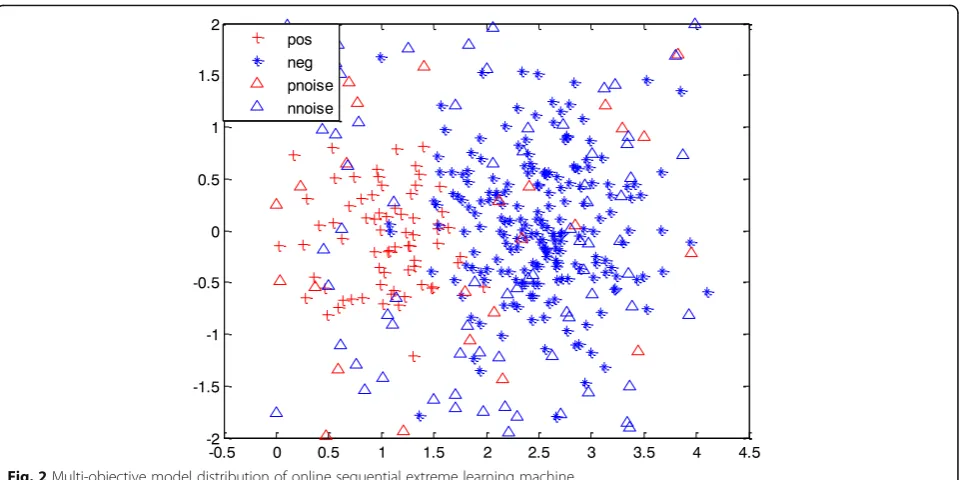
In the experiment, the data transmission rate of online sequential extreme learning machine is 100 kBaud. The order of matched filter is 10, and the iterative step size is 0.023, a= 0.37, β= 2.5 × 10⁻⁵, multipath amplitude par-ameter (1, 0.32,−0.34, 0.56,−0.15), and multipath delay parameter (0, 0.63, 1.63, 3.32, 3.34). The frequency is 3 kHz, the BPSK modulation data information is used as the test signal, and the multi-objective combined control is used to self-adaptively filter the sensing fusion infor-mation of the online sequential limit learning machine and to suppress the phase shift and obtain the online se-quential limit. The constellation diagram of the multi-objective model of learning machine is shown in Fig.2.
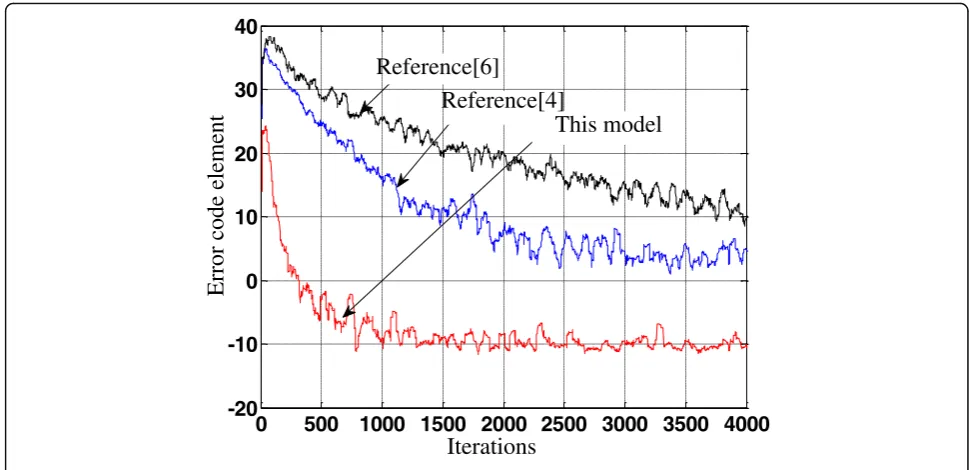
It can be seen from Fig.2that the proposed method is used for adaptive channel selection, which makes the channel equalization assignment performance better and realizes the classification and selection of multi-objective models. Different methods are used for multi-objective classification, and the error code comparison results of the online sequential extreme learning machine are ob-tained as shown in Fig.3.
The result of analysis Fig. 3shows that the method of this paper is used to classify and select the multi-objective model of online sequential extreme learning machine, which reduces the output error and increases the number of ultimate learning machine. Target selec-tion and data transmission quality are improved.
5 Results and discussion
In this paper, a multi-objective model selection algorithm is proposed based on feedback compensation and adaptive equalization control. The channel equalization model of online sequential ultimate learning machine is con-structed. The sensor fusion information of online sequen-tial limit learning machine is selected adaptively by multi-objective combined control, and the multi-multi-objective com-bined control is carried out by using matched filtering method. Combined with feedback compensation and adaptive equalization control method, the classification se-lection and equalization of network multi-objective models are realized. The simulation results show that the algorithm has good accuracy in classifying and selecting multi-objective models of online sequential LLM, and the adaptive equalization performance of channel is better, and the error of LLM control is low. This method has good application value in extreme learning machine con-trol and multi-objective learning.
Abbreviations
LLM:Limit learning machine; SLFN: Single-hidden layer feedforward neural network; UHF: Ultra high frequency; VHF: Very high frequency
Acknowledgements
This work was supported by Zhejiang Provincial Natural Science Foundation of China under Grant No. LQ15A010009 and LY16G010009, the public
welfare science and technology project of Wenzhou city (R20150010), Zhejiang provincial academy of social sciences research (2015 N068), the Science and Technology Project of Wenzhou Science and Technology Bureau No. G20150005, and the Science and Technology Project of Education Department of ZhejiangProvince No. Y201840743.
Funding
This work was supported by Zhejiang Provincial Natural Science Foundation of China under Grant No. LQ15A010009 and LY16G010009, the public welfare science and technology project of Wenzhou city (R20150010), Zhejiang provincial academy of social sciences research (2015 N068), the Science and Technology Project of Wenzhou Science and Technology Bureau No. G20150005, and the Science and Technology Project of Education Department of ZhejiangProvince No. Y201840743.
Availability of data and materials
The datasets used and/or analyzed during the current study are available from the corresponding author on reasonable request.
Ethics approval and consent to participate
The research in this paper does not involve any ethical research.
Consent for publication
All authors agree to publish this paper.
Competing interests
The authors declare that they have no competing interests.
Author details
1The First Affiliated Hospital of Wenzhou Medical University, Wenzhou
325000, People’s Republic of China.2Oujiang College, Wenzhou University,
Wenzhou 325035, People’s Republic of China.3Department of Electrical and
Electronic Engineering, Wenzhou Vocational & Technical College, Wenzhou 325035, People’s Republic of China.4School of Information and Engineering,
Wenzhou Medical University, Wenzhou 325035, People’s Republic of China.
Received: 19 January 2019 Accepted: 22 May 2019
References
1. K. Drakakis, S. Rickard, R.D. Frein, et al., Analysis of financial data using nonnegative matrix factorization. Int Math Forum3(38), 1853–1870 (2008) 2. B. Ju, Y.T. Qian, M.C. Ye, Collaborative filtering algorithm based on structured
projective nonnegative matrix factorization. J Zhejiang Univ Eng Sci49(7), 1319–1325 (2015)
3. B.F. Li, Y.D. Tang, Z. Han, A geometric structure preserving nonnegative matrix factorization for data representation. Inf. Control.46(1), 53–59 (2017) 4. Y. Wu, B. Shen, H. Ling, Visual tracking via online nonnegative matrix
factorization. IEEE Trans Circuits Syst Video Technol24(3), 374–383 (2014) 5. M. Ye, Y. Qian, J. Zhou, Multitask sparse nonnegative matrix factorization for
joint spectral-spatil hyperspectral imagery denoising. IEEE Trans. Geosci. Remote Sens.53(5), 2621–2639 (2015)
6. L.R. Hu, J.G. Wu, L. Wang, Application and method for linear projective non-negative matrix factorization. Comput Sci40(10), 269–273 (2013) 7. C.H. Ju, J.B. Zou, An incremental classification algorithm for data stream
based on information entropy diversity measure. Telecommunications Sci 31(2), 86–96 (2015)
8. Y.X. Lyu, C.Y. Wang, C. Wang, et al., Online classification algorithm for uncertain data stream in big data. J Northeast Univ (Nat Sci Ed)37(9), 1245–1249 (2016)
9. Y. Chen, L.J. Li, Very fast decision tree classification algorithm based on red-black tree for data stream with continuous attributes. J Nanjing Univ Posts Telecommunications (Nat Sci Ed)37(2), 86–90 (2017)
10. Z.W. Qiao, W.X. Sun, Two improments to C4.5 algorithm. J Jiangsu Polytechnic Univ20(4), 56–59 (2008)
11. S.C. Huang, Y. Liu, Classification algorithm for noisy and dynamic data stream. J Jiangsu Univ Sci Technol (Nat Sci Ed)30(3), 281–285 (2016) 12. B. Sun, J.D. Wang, H.Y. Chen, et al., Diversity measures inensemble learning.
Control Decision29(3), 385–395 (2014)
14. H.E. Si-Min, K. Mu-Ning, Z. Xiao, et al., Research on Cloud Storage Performance Evaluation Technology and Methods[J]. Comput Mod12(12), 1–4,8 (2011)
15. C.Y. Qi, Z.H. Li, X. Zhang, et al., The research of cloud storage system performance evaluation. J Comput Res Dev51(S1), 223–228 (2014) 16. P. Shivam, V. Marupadi, J.S. Chase, et al.,Cutting corners:Workbench
automation for server benchmarking[C]//Proceedings of USENIX 2008 Annual
Technical Conference(USENIX Association, Berkeley, CA, 2008), pp. 241–254
6 Publisher’s Note