DOI : https://doi.org/10.32628/CSEIT195213
Blue Brain : Bringing a Virtual Brain to Life
Lokeswaran. M1, Sarnaya. J2
1B.Sc. Computer Technology, Sri Krishna Adithya College of Arts and Science, Coimbatore, Tamil Nadu, India 2Assistant Professor, Department of Information and Computer Technology, Sri Krishna Adithya College of
Arts and Science, Coimbatore, Tamil Nadu, India ABSTRACT
The Blue Brain Project is the first complex project in which a human is been portrayed in such a way that it helps us to understand its function and dysfunction through detailed simulations. The main aim is to upload human brain into a machine. So that man can think, take decision without any effort. After the death of the body, the virtual brain will act as the man .So, even after the death of a person we can use it for the development of the human society.
Keywords : BCI Application, Nanotechnology, Blue-Gene, Neural Code, Biomedical Development, The Human Brain Project.
I. INTRODUCTION
No one has ever understood the complexity of human brain. It is complex than any circuitry in the world. With the increasing number of people having mental disorders the accuracy to detect the particular mental illness has reduced. Doctors are unable to differentiate between symptoms of Autism and Memory Retardation which is just one such example. One of the main goals of neuroscience is to understand the biological mechanisms responsible for human mental activity. In particular, the study of the cerebral cortex is and without any doubt will be the greatest challenge for science in the next centuries, since it represents the foundation of our humanity
In other words, the cerebral cortex is the structure whose activity is related to the capabilities that distinguish humans from other mammals. Thanks to the development and evolution of the cerebral cortex we are able to perform highly complex and specifically human tasks, such as writing a book, composing a symphony or developing technologies.
For these reasons the Blue Brain project emerged in 2005, when the L‟Ecole Polytechnique Fédérale de Lausanne(Switzerland) and IBM jointly launched an ambitious project to create a functional brain model by means of reverse engineering of the mammalian brain, using the Blue Gene supercomputer from IBM. The aim was to understand the functioning and dysfunction of the brain through detailed simulations [6].
MOTIVATION
brain regions, the whole brain). This strategy allows the project to build digital reconstructions (computer models) of the brain at an unprecedented level of biological detail. Supercomputer-based simulation of their behavior turns understanding the brain into a tractable problem, providing a new tool to study the complex interactions within different levels of brain organization and to investigate the cross-level links leading from genes to cognition [6].
WHAT IS BLUE BRAIN?
BLUE BRAIN is a virtual brain, which is not the actual natural brain, but it act as the brain. It can think like brain, take decisions based on past experiences, and respond as the natural brain does. The human brain is the most complex thing in the world. So is it possible to create a virtual version of it and store it? Yes. It is possible by using a super computer, with a huge amount of storage capacity, processing power and an interface between the human brain and this artificial one. Through this interface the data stored in the human brain can be uploaded into the computer. So anyone‟s knowledge can be kept and used even after the death of that person. This is not happening today. Nor tomorrow [2]. But we should be expecting this in near future. The Blue Brain Project uses the BlueGene supercomputer by IBM [7].
II. METHODS AND MATERIAL
WORKING OF THE HUMAN BRAIN
The brain essentially serves as the body‟s information processing center. It receives signals from sensory neurons in the central and peripheral nervous systems, and in response it generates and sends new signals that instruct the corresponding parts of the body to move or react in some way. It also integrates signals received from the body with signals from adjacent areas of the brain, giving rise to
perception and consciousness. The brain weighs around 1,300-1,400 g i.e. about 3 pounds and constitutes about 2 percent of total body weight.
The human ability to feel, interpret and even see is controlled in computer like calculations, by our nervous system. The nervous system is quite magical because we can‟t see it, but its working through electric impulses throughout our body. One of the world‟s most “intricately organized” electron mechanisms is the nervous system. Not even engineers have come close to making circuit boards and computers as precise as the nervous system. To understand this system, one has to know the three simple functions that it puts into action; sensory input, integration & motor output [3].
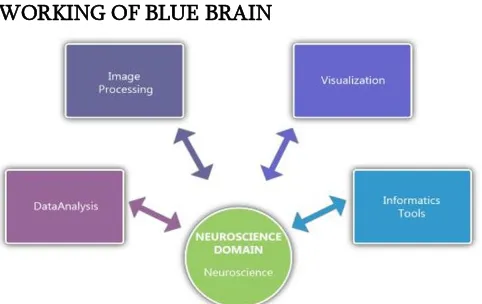
WORKING OF BLUE BRAIN
Figure 1. Functional block diagram of Blue Brain
level and at the level of the whole brain , metabolism, development, adaptation, learning, perception, cognition, and behavior [3]. One of the project‟s key strategies is to exploit interdependencies in the experimental data to build comprehensive digital reconstructions of the brain, including features that have yet to be characterized experimentally. The BBP has applied this strategy in several different areas (prediction of the spatial distribution of ion channels in 3D model neurons, prediction of neuronal firing properties from expression data for a selected set of ion channels, prediction of synaptic connectivity from neuronal morphology). In future work, the project plans to extend its use to new domains, including the prediction of structural and functional features of the human, from sparse human data augmented with data collected in rodent [7]. Examples include the equations used to describe the functioning of individual ion channels (based on the Hodgkin-Huxley phenomenological model) and flows of electric current along neuronal fibers (based on discretized versions of classical cable equations). Raymond Kurzweil recently provided an interesting paper on this topic. In it, he describes both invasive and noninvasive techniques. The most promising is the use of very small robots, or nanobots. These robots will be small enough to travel throughout our circulatory systems. Traveling into the spine and brain, they will be able to monitor the activity and structure of our central nervous system. They will be able to provide an interface with computers that is as close as our mind can be while we still reside in our biological form. then continue to function as us. All that is required is a computer with large enough storage space and enough to travel throughout our circulatory system. Traveling into the spine and brain, they will be able to monitor the activity and structure of our central nervous system. They will be able to provide an interface with computers that is as close as our mind can be while we still reside in our biological form. Nanobots could also carefully scan the structure of our brain, providing a complete readout of the connections. This information, when entered into continue to function as us. Thus the data stored in the entire brain will be uploaded into the computer. Merits and demerits With the blue brain project the things can be remembered without any effort, decisions can be made without the presence of a person. Even after the death of a man his intelligence can be used. The activity of different animals can be understood. That means by interpretation of the electric impulses from the brain of the animals, their thinking can be understood easily. It would allow the deaf to hear via direct nerve stimulation, and also be helpful for many psychological diseases. Due to blue brain system human beings will become dependent on the computer systems. Technical knowledge may be misused by hackers; Computer viruses will pose an increasingly critical threat. The real threat, however, is the fear that people will have of new technologies. That fear may culminate in a large resistance. Clear evidence of this type of fear is found today with respect to human cloning [1].
HOW WILL THIS PROJECT SERVE?
working will be better understood with the help of a model and allow fine control of any of the elements and allow a systematic investigation of their emerging behavior. (2) Detailed and accurate data for analyzing the brain and how information is transmitted within the neural networks have not yet been learnt. (3)Using BLUE BRAIN technology will enable us to learn how a newborn neuron is connected to the neural network and whether it carries a pattern. (4)Understanding complexity: At present, detailed, accurate brain simulations is the only approach that can allow us to explain why the brain needs to use many different ion channels, neurons and synapses, aspect rum of receptors, and complex dendritic and axon alarborizations, rather than the simplified, uniform types found in many models.
5) Tracking the emergence of intelligence: This approach offers the possibility to re-trace the steps taken by a network of neurons in the emergence of electrical states used to embody representations of the organism and its world. (6) Simulating disease and developing treatments: Such simulations could be used to test hypotheses for the pathogenesis of neurological and psychiatric diseases, and todevelop and test new treatment strategies. (7) Exploring the role of dendrites. (8) Revealing functional diversity (9) Providing a circuit design platform: Detailed models could reveal powerful circuit designs thatcould be imple- mented into silicone chips for use asintelligence devices in industry. (10) Cracking the Neural Code The Neural Code refers to how the brain builds objects using electrical patterns. In the same way that the neuron is the elementary cell for computing in the brain, the NCC is the elementary network for computing in the neocortex. Creating an accurate replica of the NCC which faithfully reproduces the emergent electrical dynamics of the real microcircuit, is anabsolute requirement to revealing how t he neocortex processes, stores and retrieves information. (11)A Novel Tool for Drug
Discovery for Brain Disorders Understanding the functions of different elements and pathway s of the NCC will provide a concrete foundation toexplore the cellular and synaptic bases of a wide spectrum of neurological and psychiatric diseases. The impact of receptor, ion channel, cellular and synaptic deficits could be tested insimulations and the optimal experimental tests can bedeterm ined. (12)A Global Facility: Software replica of a NCC will allowresearchers toexplore hy potheses of brain function and dysfunctionaccelerating researc h. Simulation runs could determinewhich parameters should b e used and measured in theexperiments. An advanced 2D, 3D and 3D immersivevisualization system will allow “imaging” of many aspects of neural dynamics during processing, storage and retrieval of information. Such imaging experiments may be impossible in reality or may be prohibitively expensive to perform. (13)A Foundation for Molecular Modeling of Brain Function: An accurate cellular replica of the neocortical column will provide the first and essential step to a gradual increase in model complexity moving towards a molecular leveldescriptio n of the neocortex with biochemical pathways being simulated [2].
IV.LIMITATION
and digital technologies. While the road ahead is long, already researches have been gaining great insights from their model. Using the Blue Gene supercomputers, up to 100 cortical columns, 1 million neurons, and 1 billion synapses can be simulated at once. Despite the sheer complexity of such an endeavor, it is predicted that the project will be capable of this by the year 2023.
VI.REFERENCES
[1]. IJAIEM Paper (2013) - http://www.ijaiem.org/Volume2Issue3/IJAIEM-2013-03-28-091.pdf
[2]. L. McKinney. (July 24, 2009). Firing Up the Blue Brain - We Are 10 Years Away From A Functional Artificial Brain‟.” The DailyGalaxy.(OnlineArticle).
http://www.dailygalaxy.com/my_weblog/2009/0 7/firing-upthe-blue-brain-.html. box-.10066 [3]. “Blue Brain” IEEE paper by D.Stalin and
S.Venkatesh
[4]. http://electronicsforu.com/electronicsforu/circui tarchives/view
_article.asp?sno=2183&b_type=new&id=13544& group_type=
[5]. https://www.humanbrainproject.eu/faq/neurosci ence
[6]. http://bluebrain.epfl.ch/page-56882-en.html [7]. http://bluebrain.epfl.ch/page-125409-en.html [8]. BlueGene:
http://www.research.ibm.com/bluegene
[9]. http://cajalbbp.cesvima.upm.es
Cite this article as :