RESEARCH ON RESOURCE SCHEDULING ALGORITHM
BASED ON FUZZY CLUSTERING AND SMART AGENTS IN
CLOUD COMPUTING
1FUFANG LI, 2DONGQING XIE, 3DEYU QI, 4LINGXI PENG, 5YUANYONG FENG, 6†GUOWEN
XIE
{1,4,5Assoc. Prof., 2Prof.}, School of Computer Science and Educational software, Guangzhou University,
Guangzhou 510006, P. R. China
3Prof., School of Computer Science and Engineering, South China University of Technology, Guangzhou
510006, P. R. China
6Prof., School of Life Science, GuangZhou University, Guangzhou 510006, P. R. China
E-mail: 1,2,4,[email protected], [email protected], [email protected]
†
Corresponding author
ABSTRACT
Cloud computing has been a hot spot in recent years. In complex and dynamically changing cloud computing environment, resource management and scheduling is a hard and challenging problem, and should be solved at first. This paper presents an effective resource management model and the corresponding resource scheduling algorithm is based on fuzzy clustering and smart agent. With the help of fuzzy clustering method, the proposed model and algorithm can accurately and effectively schedule resources to the resource requestor which exactly meet it’s needs of resource, while skillfully avoiding unreasonable scheduling of resources. Moreover, by using smart agent technology, the presented model and algorithm can also adaptively and intelligently manage and schedule the cloud resources smartly and robustly. Simulation experiments show that the proposed approach is advanced and reasonable.
Keywords: Resource Scheduling Algorithm, Cloud Computing, Fuzzy Clustering, Smart Agents,
Self-Adaptive
1. INTRODUCTION AND RELATED WORK
Cloud computing has been introduced as a new large-scale distributed computing paradigm, which virtualized various physical computing resources into a shared pool of configurable virtual computing resources, such as virtual networks, servers, storage, applications, and services. And more, the virtualized cloud computing resources should be ubiquitously, conveniently and rapidly accessed, provisioned and released with minimal management effort or service provider interaction through Internet. In recent years, cloud computing has been intensely focused by both academia and industry all over the world. Due to the dynamic changing environment of cloud computing environment, resource management and scheduling is one of the most hard and challenging problems which should be solved at first [1] [2] [3].
or to better suit a specific application, they point out that much more work needs be done to improve the existing schedulers in Cloud computing in the future. Focusing on how to increase utilization and achieve near-optimal throughput performance on heterogeneous cloud/grid computing environment, paper [6] proposed a batch-based DAG scheduling algorithm, which can achieve superior performance (such as throughput) than existing algorithms. To obtain best advance reservation of resources in cloud computing, Chaisiri [7] proposes an optimal cloud resource provisioning (OCRP) algorithm by formulating a stochastic programming model. With different approaches and multiple factors being considered, the OCRP algorithm can successfully minimize total cost of resource provisioning for consumers and can be used as a resource provisioning tool for the emerging cloud computing market in cloud computing environments.
As is mentioned above, much work has been done in the area of resource management and scheduling in cloud computing, but this problem is still far to be solved satisfactorily. Fuzzy clustering method [8] [9] and Smart Agent technology [3] [10~13] have been widely used for resource management and scheduling in dynamically changing distributed computing environment, such as grid and P2P computing system. This paper tries to present a novel and effective resource management and scheduling model and related algorithm based on fuzzy clustering and Smart Agents. By using fuzzy clustering and Smart Agents to aid cloud resource management and scheduling, the proposed model and algorithm can appropriately and effectively schedule resources to the tasks which exactly meet the tasks’ needs of resource. Simulation experiment shows that our model and algorithm works well and soundly.
The remainder of the paper is organized as following: The proposed cloud resource management model based on fuzzy clustering and smart agents is presented in Section 2. The main idea and detailed description of the corresponding cloud resource scheduling algorithm is derived in Section 3. Simulation experiments and results are put forward in Section 4. Some concluding remarks are drawn in Section 5.
2. RESOURCE MANAGEMENT MODEL
BASED ON FUZZY CLUSTERING AND SMART AGENTS IN CLOUD COMPUTING
The proposed Cloud computing Resource Management Model based on Fuzzy Clustering and
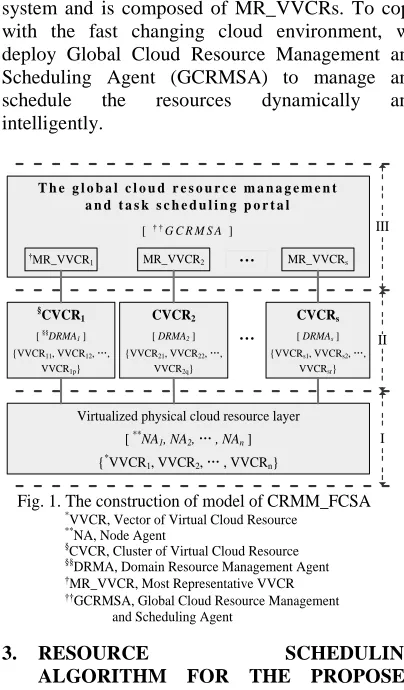
Smart Agents (CRMM_FCSA) is a distributed hierarchical infrastructure. The model of CRMM_FCSA is constructed as three logical layers: The virtualized cloud resource layer ( Ⅰ); The cloud resource management and scheduling domain layer ( Ⅱ); And the global cloud resource management and task scheduling portal (Ⅲ). The construction of CRMM_FCSA is shown in Fig. 1.
As is shown in Fig. 1, details of the three layers are as following:
(1) The virtualized cloud resource layer consists of various virtualized physical resources, such as virtual machine, virtual network, virtual servers, virtual service, virtual storage and so on. We use consolidated cloud resource vectors to represent various virtual cloud resources (VVCRs, Vectors of Virtual Cloud Resources). The vectors of VVCRs are the representation of resources to organize the cloud resource management model. All the vectors of VVCRs are composed of the same number of components which representing different attributes of virtual cloud resources, such as processing power, load condition, available memory size, network bandwidth, etc.
In order to manage the virtual cloud resources efficiently and conveniently, we implement and deploy Node Agents (NA) to be responsible for monitoring the physical resources of the node in real time. By this way, the real-time condition of parameters of the node can be obtained, and thus the self adaptability and intelligence of the proposed cloud resource management model and related scheduling algorithm will be improved soundly.
(2) In the Cloud Resource Management and Scheduling Domain (CRMSD) layer, we firstly divide the virtual cloud resources (represented by VVCRs) into a certain number of groups by doing fuzzy clustering on the VVCRs. By doing this, all virtual cloud resources are divided into a certain number of Clusters of Virtual Cloud Resources (CVCR). According to the theory of fuzzy clustering, resources in the same fuzzy cluster has greater similarity than that in different fuzzy clusters, which will effectively reduce the search space when scheduling resources (will be analyzed in sub section 3.1). We then construct each CVCR as a Cloud Resource Management and Scheduling Domain (CRMSD), so as to make it more convenient to manage the domain resources.
are deigned and arranged to deal with this work. The DRMAs are in charge of three aspects of functions: (1) To intelligently organize all the resources that are included in CVCRs as a whole resource management domain, and thus to support efficient scheduling of the resources; (2) To monitor the virtual cloud resources in real time and simultaneously update the component parameter of the VVCRs, which may help the model and algorithm to schedule resources more accurately and efficiently; (3) To dynamically and intelligently select out a Most Representative VVCR (MR_VVCR) as the delegation of the domain (i.e. CRMSD), so as to attend the construction of the global resource management and scheduling portal.
(3) The global cloud resource management and task scheduling portal is the pivot of the whole system and is composed of MR_VVCRs. To cope with the fast changing cloud environment, we deploy Global Cloud Resource Management and Scheduling Agent (GCRMSA) to manage and schedule the resources dynamically and intelligently.
III
I T h e g l o b a l c l o u d r e s o u r c e m a n a g e m e n t
a n d t a s k s c h e d u l i n g p o r t a l
[ † †G C R M S A ]
Virtualized physical cloud resource layer
[ **NA1, NA2, … , NAn ]
{*
VVCR1, VVCR2, … , VVCRn}
§
CVCR1
[ §§DRMA
1 ]
{VVCR11, VVCR12, …, VVCR1p}
CVCR2
[ DRMA2 ]
{VVCR21, VVCR22, …, VVCR2q}
CVCRs
[ DRMAs ]
{VVCRs1, VVCRs2, …, VVCRsr}
[image:3.612.89.291.297.642.2]… II
Fig. 1. The construction of model of CRMM_FCSA
*
VVCR, Vector of Virtual Cloud Resource **
NA, Node Agent §
CVCR, Cluster of Virtual Cloud Resource
§§DRMA, Domain Resource Management Agent
†MR_VVCR, Most Representative VVCR
††GCRMSA, Global Cloud Resource Management
and Scheduling Agent
†MR_VVCR
1 MR_VVCR2 … MR_VVCRs
3. RESOURCE SCHEDULING
ALGORITHM FOR THE PROPOSED MODEL OF CRMM_FCSA
3.1 The Main Idea of the Proposed Algorithm The main idea of the proposed algorithm for the model of CRMM_FCSA (Alg_CRMM_FCSA) is as following:
(1) When managing the virtual cloud resources in the model of CRMM_FCSA, we introduce fuzzy clustering approach to divide the whole virtual cloud resources into a certain groups of resources, by doing fuzzy clustering on VVCRs (which are the representation of virtual cloud resources). Because the number of resources in each group has been sharply cut down, the search time of resources will be reduced considerably, which will consequently enhance the efficiency and performance of resource scheduling.
resource request represented by VCRR. Thus, to fulfill the resource scheduling, we can simply choose a cloud resource (represented by VVCR) from the MMSC and schedule it to the resource requestor (represented by VCRR). As fuzzy clustering is a multivariate clustering method, this scheduling method will accurately and effectively satisfy the requestor’s multi-QoS needs of resource.
3.2 The Procedure and Detailed Description of the Proposed Algorithm of Alg_CRMM_FCSA
The procedure of resource scheduling algorithm of Alg_CRMM_FCSA is as following: (1) Activate the NAs deployed in the cloud nodes and virtualizes various physical resources into virtual cloud resources, and let the virtual resources be described and presented by VVCRs in the mean time. (2) Do fuzzy clustering on all VVCRs of the whole cloud computing system, and divide them into a certain amount of sub clusters. In each sub cluster, a most representative VVCR (i.e. MR_VVCR) should be selected out as the delegation of the sub cluster. (3) Let every sub cluster of virtual cloud resources be a resource management and scheduling domain (CRMSD). Then, Activate the DRMA in every domain, and let it manage all cloud resources in this domain. (4) Construct the global cloud resource management and task scheduling portal by collecting and organizing all MR_VVCRs of all sub resource clusters. (5) Accept the resource request from cloud users, and translate the resource request into cloud resource request vector (i.e. VCRR) which has the same structure with the vector of VVCR. (6) Activate the agent of GCRMSA, and then let it carry out the first level of fuzzy clustering and scheduling on HVS_L1. By this way, the very MR_VVCR from the global resource management and task scheduling portal that appropriately matches with the VCRR of the resource requestor would be found out, and then submit the resource request vector of VCRR to the domain where the most matching MR_VVCR comes from. (7) Hybrid the VCRR accepted from the requestor with VVCRs of the matching domain to construct hybrid vector set of VCRR and VVCRs. Then, do the second level of fuzzy clustering and resource scheduling on HVS_L2, which will divide HVS_L2 into a certain number of sub clusters. (8) Find out the sub cluster which the requestor’s VCRR resides in, and then schedule the resource (represented by VVCR of the sub cluster) to the resource requestor. Come here, we’ve successfully finished the scheduling of cloud resource.
Detailed description of the algorithm of Alg_CRMM_FCSA is as below:
Step 1: Activate the NAs deployed in the cloud nodes and let virtualized cloud resources be described and presented by VVCRs;
Step 2: Divide all VVCRs into several groups (i.e. sub cluster) by fuzzy clustering;
Step 3: Let every groups of virtual cloud resources be a CRMSD, and meanwhile, Activate DRMA in every domain, and let it manage all cloud resources (represented by VVCRs) in this domain;
Step 4: Select out the MR_VVCRs from all CRMSDs, and then activate the agent of GCRMSA to construct the global portal;
Step 5: Accept resource request and translate it into VCRR;
Step 6: Do the first level of fuzzy clustering and scheduling on HVS_L1; Submit the resource request vector of VCRR to the domain where the most matching MR_VVCR comes from;
Step 7: Mix the VCRR and VVCRs to construct hybrid vector set of VCRR and VVCRs; Do the second level of fuzzy clustering and resource scheduling on HVS_L2;
Step 8: Find out the sub cluster which the requestor’s VCRR resides in, then schedule the resource (represented by VVCR of the sub cluster) to the resource requestor;
Step 9: end.
4. SIMULATION EXPERIMENTS AND
ANALYSE
experimental setup consists of 100 virtual cloud resources, and accordingly, we generate 2000, 2500, 3000, 3500, 4000 resource requests to be scheduled. All simulation experiments are repeated 20 times, and the final results of the experiments are the average of values of 20 times. The simulation experimental results are shown in Fig. 2, Fig. 3 and Fig. 4.
1.0 1.5 2.0 2.5 3.0 3.5 4.0
50 100 150 200 250
Number of Resources
C
ons
tr
uc
ti
on T
im
e (
0.1s
[image:5.612.96.295.364.510.2])
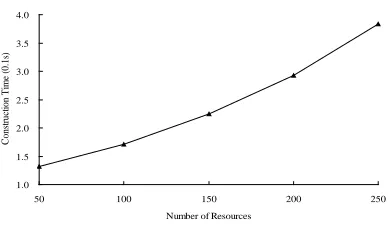
Fig.2 Construction Time Of The Resource Management Model Of CRMM_FCSA
20 30 40 50 60 70 80
2000 2500 3000 3500 4000
Number of Resource Requests
Ma
k
esp
an
(
/s)
[image:5.612.96.290.531.654.2]Alg_CRMM_FCSA Alg_DARM Alg_OCRP
Fig.3 Makespan Of The Algorithms
1.0 1.5 2.0 2.5 3.0 3.5 4.0
2000 2500 3000 3500 4000
Number of Resource Requests
Average Response Time (/0.1ms)
Alg_CRMM_FCSA Alg_DARM Alg_OCRP
Fig.4 Average Response Time
As is shown in Fig. 2, the construction time of the proposed cloud resource management model increases with the total number of resources to be managed. It can be seen from Fig. 2 that the construction time’s increasing curve is not sharp
which shows that it increases approximately linearly, which tells us that the proposed model has sound performance and efficiency. As is shown in Fig. 3 and Fig. 4, considering the makespan and average waiting time of tasks of the algorithms, the proposed algorithm of Alg_CRMM_FCSA works better than that of the other two comparing algorithms. This means that the algorithm of Alg_CRMM_FCSA has better performance and efficiency compared with other two similar algorithms. Fig. 3 shows that the proposed algorithm can obtain higher throughput and performance than that of other two similar algorithms, while Fig. 4 shows that our algorithm will respond to the user’s requests more quickly than the two comparing algorithms. In one word, the presented algorithm of Alg_CRMM_FCSA works better than the other two comparing algorithms in both aspect of scheduling make-span and average response time of tasks. From Fig. 3 and Fig. 4, we can find out that, as the number of tasks increases, the algorithm of Alg_CRMM_FCSA shows better performance and efficiency.
5. CONCLUSIONS
In order to gain better performance and efficiency of resource management and scheduling in cloud computing, this paper proposes an effective resource management model and the corresponding resource scheduling algorithm. The proposed model and algorithm is based on fuzzy clustering and smart agent technology. By using fuzzy clustering method, the proposed model and algorithm can appropriately and effectively schedule resources to the tasks which exactly meet the tasks’ needs of resource, while skillfully avoid assigning powerful resources to simple or medium scale tasks or assigning poor resources to complex large-scale tasks, which may leads to unreasonable scheduling of resources. Further more, by introducing smart agent technology to manage and organize the cloud resources, the presented model and algorithm can adaptively manage and schedule the cloud resources intelligently, self-adaptively and robustly. Simulation experiments show that our approach works better than similar algorithms. In the future, we’ll try to introduce effective prediction methods to predict the stability, reliability and credibility of the cloud resources, so as to improve the stability, reliability and credibility of cloud resource management and scheduling.
6. ACKNOWLEDGEMENTS
China under Grant No. S2011040003843, S2011040004528, GuangZhou Municipal High School Science Research Fund under grant No. 10A009, National Natural Science Foundation of China under Grant No. 61100150, 60903165, 61070015, 30970191, and Foundation of Comprehensive Strategic Cooperation between the Guangdong Province and the Chinese Academy of Sciences under Grant No. 2009B091300069, and Guangzhou City Council's Science & Technology Projects Funding Scheme under Grant No. 12C42011622. We also discussed the work with the colleagues of both School of Computer Science & Educational Software of GuangZhou University and College of Computer Science & Engineering of South China University of Technology, thank for their self-giving helps.
REFRENCES:
[1] I. Foster, Y. Zhao, I. Raicu, and S. Lu, “Cloud computing and grid computing 360-degree compared”, Grid Computing Environments
Workshop (GCE 2008), Austin TX (United
States), November 12-16, 2008, pp. 1-10. [2] The NIST Definition of Cloud Computing, on
http://csrc.nist.gov/publications/nistpubs/800- 145/SP800-145.pdf, accessed November 2012. [3] Yazir Yagiz Onat, Matthews Chris, Farahbod
Roozbeh, Neville Stephen, Guitouni Adel, Ganti Sudhakar, Coady Yvonne, “Dynamic resource allocation in computing clouds using distributed Multiple Criteria Decision Analysis”,
Proceedings - 2010 IEEE 3rd International Conference on Cloud Computing (CLOUD
2010), Miami FL (United States), July 5-10,
2010, pp. 91-98.
[4] Jianfeng Zhao, Wenhua Zeng, Miu Liu, Guangming Li, “A model of Virtual Resource Scheduling in Cloud Computing and Its Solution using EDAs”, International Journal of
Digital Content Technology and its Applications,
Vol. 6, No. 4, 2012, pp. 102-113.
[5] Elghoneimy Eman, Bouhali Othmane,
Alnuweiri Hussein. “Resource allocation and scheduling in cloud computing”, 2012 International Conference on Computing,
Networking and Communications (ICNC'12),
Maui HI (United states), January 30-February 2, 2012, pp. 309-314.
[6] Boonyarith Saovapakhiran, George Michailidis, Michael Devetsikiotis, “Aggregated-DAG Scheduling for Job Flow Maximization in Heterogeneous Cloud Computing”, 2011 IEEE Global Telecommunications Conference
(GLOBECOM 2011), Houston TX (United
states), December 5-9, 2011, pp. 1-6.
[7] Chaisiri Sivadon, Lee Bu-Sung, Niyato Dusit. “Optimization of resource provisioning cost in cloud computing”, IEEE Transactions on
Services Computing, Vol. 5, No. 2, 2012, pp.
164-177.
[8] Tamra S, Higuchi S, Tanaka K, “Pattern classification based on fuzzy relations”, IEEE
Transactions on Systems, Man, and Cybernetics,
Vol. SME-1, No. 1, Jan 1971, pp. 61-66. [9] Martaras R.L.D., Valverde L., “New results in
fuzzy clustering based on the concept indistinguishabilithy relation”. IEEE Transaction on Patter Analysis and Machine
Intelligence, Vol. 10, No. 5, 1988, pp. 754-757.
[10]Xu Xiao-Long, Cheng Chun-Ling, Xiong Jing-Yi, “Conjunct model of cloud & client computing based on multi-agent”, Journal on
Communications (in Chinese), Vol. 31, No. 10,
2010, pp. 203-211.
[11]Werner Streitberger, Torsten Eymann, “A simulation of an economic, self-organizing resource allocation approach for application layer networks”, Computer Networks, Vol. 53, No. 10, 2009, pp. 1760–1770.
[12]Gutierrez-Garcia J. Octavio1, Sim Kwang Mong, “GA-based cloud resource estimation for agent-based execution of bag-of-tasks applications”, Information Systems Frontiers, Vol. 14, No. 4, 2012, pp. 925-951.
[13]Shang Qinghong, Zhou Mingtian, Fukuda Munehiro, Bic Lubomir, Dillencourt Michael B, “An efficient methodology for resource discovery on distributed computing”, Advances
in Information Sciences and Service Sciences,
Vol. 4, No. 10, 2012, pp. 434-441.