AN EFFICIENT IMAGE DOWNSAMPLING TECHNIQUE
USING GENETIC ALGORITHM AND DISCRETE WAVELET
TRANSFORM
1N.JAGADEESAN, 2Dr.R.M.S PARVATHI
1
Assistant Professor Faculty of Electronics and Communication Engineering,
Annai Mathammal Sheela Engineering College, Namakkal
2
Principal Sengunthar College of Engineering, Tiruchengode
E-mail: [email protected], [email protected]
ABSTRACT
Digital images are used everywhere and it is easy to manipulate and edit because of availability of various image processing and editing software. Resizing the image to a lower resolution can alter the appearance of an image. It is useful at times to create a downsampled version of the image that gives the same impression as the original. There are many methods for image downsampling. In this paper, an efficient thresholding technique is used for image downsampling based on Discrete Wavelet Transforms and Genetic Algorithm. We have combined Genetic Algorithm (GA) with Discrete Wavelet Transform (DWT) to make the image down sampling faster and to get adequate results. First the length of the histogram is reduced by using DWT. Using this reduced histogram, the number of thresholds and threshold value are determined by applying Genetic Algorithm. From the analysis of results, it can be concluded that the proposed method is fast and accurate.
Keywords: Image Downsampling, Genetic Algorithm (GA), Discrete Wavelet Transform (DWT), Motion Filter, Soft Thresholding.
1. INTRODUCTION
Nowadays wired and especially wireless networks are widespread, and therefore transmitting data packets over error-prone networks is a very important task [6]. Accelerated development in electronic technology and computer hardware brought about substantive increase in display devices offering a wide range of image resolutions (e.g., computer monitors, laptop computer screens, personal digital assistants, and cell phones). To convert images with different resolutions between devices with different display sizes, it is desirable to develop efficient image down sampling and up sampling (interpolation) techniques. Image down sampling is a process to make a digital image smaller by removing pixels [1]. Conventionally, digital color images are represented by setting specific values of the color space coordinates for each pixel. Color spaces with decoupled luminance and chrominance coordinates (YUV type) allow the number of bits required for acceptable color description of an image to be reduced. This reduction is based on greater sensitivity of the
human eye to changes in luminance than to changes in chrominance. The idea behind this approach is to set individual value of luminance component to each pixel, while assigning the same color (chrominance components) to certain groups of pixels (sometimes called macro pixels) in accordance with some specific rules. This process is called downsampling and there are different sampling formats depending on the underlying scheme.
performed by directly retaining the corresponding pixels within the input image, while the latter obtains the down-sampled pixels according to the image content as well as sampling ratio. The direct down-sampling is much easier compared with the adaptive one [4]. Image downsampling is usually manipulated in spatial or frequency domains. In the spatial domain, downsampling can be performed by uniformly retaining the corresponding pixels within the input image. It is also referred to as direct downsampling, which is the easiest downsampling algorithm. However, aliasing artifacts can be observed in the direct downsampled image due to the overlapping of downsampled spectra [1].
While high resolution images are needed for a number of applications such as on-camera previewing, print output or cropping, the image is often previewed on a display of lower resolution. As a result, image downsampling has become a regular operation when viewing images. Conventional image downsampling methods do not accurately represent the appearance of the original image, and lowering the resolution of an image alters the perceived appearance. In particular, downsampling can cause blurred regions to look sharp and the resulting image often appears higher quality than its full-size counterpart. While the higher quality images can be desirable for purposes such as web publishing, the change is problematic in cases where the downsampled version is to be used to make decisions about the quality of the full-scale image, for example in digital view finders [12].
Traditional approaches for down-scaling rely on decompressing the bit streams first and then applying the desired processing function (re-compression). In the present communication, an efficient down-sampling technique is presented, in which full transition to the spatial domain is avoided. The organization of the paper is as follows. Section 2 gives some of the previous researches done by the researchers depend upon the image downsampling techniques. Section 3 gives some basics about the image downsampling techniques. The proposed downsampling method is given in the section 4. Section 5 gives the results and discussion about the proposed work. And section 6 gives the conclusion about the proposed downsampling method.
2. A SURVEY OF RECENT RESEARCHES IN FIELD
Previous researches have shown that down-sampling (DS) before encoding and up-down-sampling
after decoding can improve the quality of coded image at low bit rates. Nowadays, there appear more and more downsampling methods with
superior performance. However, few
downsampling algorithms are studied in the literature.
Karl S. Ni and Truong Q. Nguyen [3] proposed research work, in which a thorough investigation of the application of Support Vector Regression (SVR) to the super resolution problem was conducted through various frameworks. Prior to the study, the SVR problem was enhanced by finding the optimal kernel. This was done by formulating the kernel learning problem in SVR form as a convex optimization problem, specifically a semi-definite programming (SDP) problem. An additional constraint was added to reduce the SDP to a quadratically constrained quadratic programming (QCQP) problem. After the optimization, investigation of the relevancy of SVR to super resolution proceeds with the possibility of using a single and general support vector regression for all image content, and the results were impressive for small training sets. That idea was improved upon by observing structural properties in the Discrete Cosine Transform (DCT) domain to aid in learning the regression. Further improvement involved a combination of classification and SVR-based techniques, extending works in resolution synthesis. The method, termed kernel resolution synthesis, uses specific regressors for isolated image content to describe the domain through a partitioned look of the vector space, thereby yielding good results.
Kong Wan-zeng and Zhu Shan-an [9] presented a multi-face detection method for color images. That method was based on the assumption that faces were well separated from the background by skin color detection. Those faces can be located by that method which modifies the subtractive clustering. The modified clustering algorithm proposed a new definition of distance for multi-face detection, and its key parameters can be predetermined adaptively by statistical information of face objects in the image. Downsampling was employed to reduce the computation of clustering and speed up the process of the proposed method. The effectiveness of the proposed method was illustrated by three experiments.
conventional square sample grid, and, thus, it can be compressed and transmitted without any change to current image coding standards and systems. The decoder first decompresses the low-resolution image and then upconverts it to the original resolution in a constrained least squares restoration process, using a 2-D piecewise autoregressive model and the knowledge of directional low-pass prefiltering. The proposed compression approach of collaborative adaptive down-sampling and upconversion (CADU) outperforms JPEG 2000 in PSNR measure at low to medium bit rates and achieves superior visual quality, as well. The superior low bit-rate performance of the CADU approach seems to suggest that oversampling not only wastes hardware resources and energy, and it could be counterproductive to image quality given a tight bit budget.
Yongbing Zhang et al. [4] proposed an interpolation oriented adaptive down-sampling algorithm for low bit-rate image coding. Given an image, the proposed algorithm was able to obtain a low resolution image, from which a high quality image with the same resolution as the input image can be interpolated. Different from the traditional
down-sampling algorithms, which were
independent from the interpolation process, that sampling algorithm hinges the down-sampling to the interpolation process. Consequently, that down-sampling algorithm was able to maintain the original information of the input image to the largest extent. The down-sampled image was then fed into Joint Photographic Experts Group (JPEG). A total variation (TV) based post processing was then applied to the decompressed low resolution image. Ultimately, the processed image was interpolated to maintain the original resolution of the input image. Experimental results verified that utilizing the downsampled image by that algorithm, an interpolated image with much higher quality can be achieved. Besides, that algorithm was able to achieve superior performance than JPEG for low bit rate image coding.
Lu Fang et al. [7] have concerned with image down sampling using sub pixel techniques to achieve superior sharpness for small liquid crystal displays (LCDs). Such a problem exists when a high-resolution image or video is to be displayed on low-resolution display terminals. Limited by the low-resolution display, need to shrink the image. Signal-processing theory tells us that optimal decimation requires low-pass filtering with a suitable cutoff frequency, followed by down
sampling. By doing so, need to remove many useful image details causing blurring. Subpixel-based down sampling, taking advantage of the fact that each pixel on a color LCD is actually composed of individual red, green, and blue sub pixel stripes, can provide apparent higher resolution. They use frequency-domain analysis to explain what happens in subpixel-based down sampling and why it is possible to achieve a higher apparent resolution. According to frequency-domain analysis and observation, the cutoff frequency of the low-pass filter for sub pixel-based decimation can be effectively extended beyond the Nyquist frequency using a novel antialiasing filter. Applying the proposed filters to two existing sub pixel down sampling schemes called direct subpixel-based down sampling (DSD) and diagonal DSD (DDSD), Obtained two improved schemes, i.e., DSD based on frequency-domain analysis (DSD-FA) and DDSD based on frequency-domain analysis (DDSD-FA). Experimental results shows that the proposed DSD-FA and DDSD-FA can provide superior results, compared with existing sub pixel or pixel-based down sampling methods.
Yongbing Zhang et al [8] has proposed an interpolation-dependent image down sampling (IDID), where interpolation is hinged to down sampling. Given an interpolation method, the goal of IDID is to obtain a down sampled image that minimizes the sum of square errors between the input image and the one interpolated from the corresponding down sampled image. Utilizing a least squares algorithm, the solution of IDID is derived as the inverse operator of up sampling. We also devise a content-dependent IDID for the interpolation methods with varying interpolation coefficients. Numerous experimental results demonstrate the viability and efficiency of the proposed IDID.
Yongbing Zhang et al. [1] proposed an Interpolation-Dependent Image Down Sampling (IDID), where interpolation was hinged to down sampling. Given an interpolation method, the goal of IDID was to obtain a downsampled image that minimizes the sum of square errors between the input image and the one interpolated from the corresponding downsampled image. Utilizing a least squares algorithm, the solution of IDID was derived as the inverse operator of up sampling. They also devise a content-dependent IDID for the interpolation methods with varying interpolation coefficients. Numerous experimental results demonstrate the viability and efficiency of that proposed IDID.
The restoration of a blurry or noisy image is commonly performed with a Maximizing the Posterior Probability (MAP) estimator, which maximizes a posterior probability to reconstruct a clean image from a degraded image. A MAP estimator, when used with a sparse gradient image prior, reconstructs piecewise smooth images and typically removes textures that were important for visual realism.
Taeg Sang Cho et al. [10] presented an alternative de convolution method called Iterative Distribution Reweighting (IDR) which imposes a global constraint on gradients so that a reconstructed image should have a gradient distribution similar to a reference distribution. In natural images, a reference distribution not only varies from one image to another, but also within an image depending on texture. They have estimated a reference distribution directly from an input image for each texture segment. Their algorithm was able to restore rich mid-frequency textures. A large scale user study supports the conclusion that their algorithm improves the visual realism of reconstructed images compared to those of MAP estimators.
3. IMAGE DOWNSAMPLING TECHNIQUE
Down sampling and up sampling are two fundamental and widely used image operations, with applications in image display, compression, and progressive transmission. Down sampling is the reduction in spatial resolution while keeping the same two-dimensional (2D) representation. It is typically used to reduce the storage and/or transmission requirements of images. The down-sampling of a still image in the spatial domain consists of two steps. First the image is filtered by an anti-aliasing low pass filter and then it is sub-sampled by a desired factor in each dimension [11].
Up sampling is the increasing of the spatial resolution while keeping the 2D representation of an image. It is typically used for zooming in on a small region of an image, and for eliminating the pixilation effect that arises when a low-resolution image is displayed on a relatively large frame. More recently, down sampling and up sampling have been used in combination: in lossy compression, multiresolution lossless compression, and progressive transmission. The standard
methods for down/up sampling are
decimation/duplication and bilinear interpolation, which yield low visual performance. The increasing use of down/up sampling, especially in combination, warrants the development of better methods for them.
Since down sampling reduces the sampling rate, we must be careful to make sure the
Shannon-Nyquist sampling theorem criterion
− −
=
∑
−∞ =
) 2 (
) 2 ( sin 2 )
(
n wt
n wt w
n f t f
n
π π
is maintained.If the
sampling theorem is not satisfied then the resulting digital signal will have aliasing. To ensure that the sampling theorem is satisfied, a low-pass filter is used as an anti-aliasing filter to reduce the bandwidth of the signal before the signal is down sampled; the overall process (low-pass filter, then down sample) is called decimation. Note that if the original signal had been bandwidth limited, and then first sampled at a rate higher than the nyquist minimum, then the down sampled signal may already be nyquist compliant, so the down sampling can be done directly without any additional filtering. Down sampling only changes the sample rate not the bandwidth of the signal. The only reason to filter the bandwidth is to avoid the case where the new sample rate would become lower than the nyquist requirement and then cause the aliasing by being below the nyquist minimum. Thus, in the current context of down sampling, the anti-aliasing filter must be a low-pass filter. However, in the case of sampling a continuous signal, the anti-aliasing filter can be either a low-pass filter or a band-low-pass filter.
4. PROPOSED WORK
levels of operation to down sample the input image. Fig. 1 shows the proposed flow of the down sampling technique.
Fig.1 Proposed Flow Diagram
The four levels of our proposed approach are given below:-
• Preprocessing
• Discreet Wavelet Transform • Soft Thresholding
• Genetic Algorithm
In our proposed approach, the input image is preprocessed to make the image ready for down sampling. Then DWT was applied to the image and then apply Soft thresholding which is used to reduce the background. After that, Genetic Algorithm is used to find the soft thresholding values of the image and then using Euclidean distance, the similar blocks are removed to reduce the size of the image. This gives the down sampled output of the given input image.
4.1 Preprocessing
Here the input image is converted from RGB scale to Gray scale image for convenient down sampling. Then the converted image is given as input to the motion filter to reduce the motion blur content in the image. Then the filtered image was segmented into small blocks as shown in Fig. 2 for further process of image down sampling.
Fig. 2 Sample Segmentation of images
4.2 Discreet Wavelet Transform (DWT)
After segmentation of images into blocks, DWT have to be applied to each blocks of the segmented image. The Discrete Wavelet Transform [13] is basically used to reduce the size of the image at each level, e.g., a square image of size 2i ×2i pixels at level
L
reduces to size 2i/2 × 2i/2 pixels at next levelL
+
1
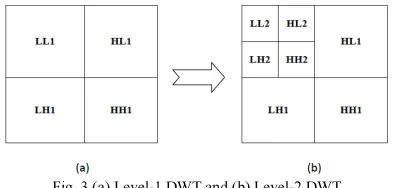
.The image is decomposed into four sub images, at each level. The sub images are labeled LL, LH, HL and HH. LL corresponds to the coarse level coefficients or the approximation image. This image is used for further decomposition.Fig. 3 (a) Level-1 DWT and (b) Level-2 DWT
After that a
B
×
B
block is slided over the resulting image and image is scanned from the upper left corner to the lower right corner. The DWT transform is calculated, for each block, the DWT coefficients are stored as one row in the matrixA
. The matrix will have (M−B+1) (×N−B+1) rows andB
×
B
columns, WhereM
andN
represents number of rows and columns of inputimage respectively.
4.3 Soft Thresholding
After applying DWT to all the blocks in the image, soft thresholding is applied to reduce the background in the image, so VoXels with intensity values below the threshold value are reduced (set to lower values, or even zero). During visualization, these thresholded voxels become more transparent. If the original value
S
i of a voxel is(
threshold
value
range
/
2
)
[image:5.595.308.505.389.483.2]final filtered value
D
i does not change(
D
i=
S
i)
.If
S
(
threshold
value
range
/
2
)
i
<
−
then thevoxel is deleted
(
=
0
)
iD
For the values inbetween, a smooth function is applied: if
(thresholdvalue range/2) S (thresholdvalue range/2) i< + <
−
then
D
i=
f
( )
S
i according to the shape function, which in the case of the FastMip renderer, for instance, is a sinusoidal.( ) + ≥ + < ≤ − − < = 2 2 2 2 0 range threshold S If S range threshold S range threshold If S f range threshold S If D i i i i i i (1) A soft threshold can also be applied during analysis, for example for the intersection coefficients in the Co-localization Analyzer. These intersection coefficients are based on binary images, where voxels with intensities below the threshold are set to zero and intensities above the threshold are set to one to count for overlapping volumes. To avoid sharp transitions, this image can be made not exactly binary (0 or 1) but gray-scaled, with intermediate values for pixels with intensities falling in a certain limited range around the threshold.
4.4 Genetic Algorithm (GA)
After applying soft threshold to all the blocks of the image, GA [14] is applied to find the number of Thresholds and Threshold Value. In this method, the chromosome A is encoded as a binary string of the same size
L
rof the reduced histogram, suchthat
A
a
a
a
a
a
Lr1 3
2 1
0
,
,
,
,
,
−
=
K
K
, where thecharacter
a
i is equal to 0 or 1. Wherei
a
indicatesthe peak or valley of the histogram. If
=
0
i
a
, thenthe position
i
indicates the value of the threshold.Hence the number of zeros-bits occurred in
A
indicates number of thresholds.The fitnessF
( )
k
for an image has defined as follows
( )
(
( )
)
(
( )
)
22 2 / 1 log k k Disk k
F =ρ∗ + (2)
Here
Disk
( )
k
represents the within-class variance( )
k
( )
k
( )
k
Disk
B T w 2 22
σ
σ
σ
=
−
=
(3)The first term of
F
( )
k
measures the costincurred by the discrepancy between the thresholded image and the original image. The
second term measures the cost resulted from the number of bits used to represent the thresholded image. In this equation,
ρ
is a positive weightingconstant.
The
(
k
−
1
)
number of thresholds is determinedby counting the number of zero-bits in the string and the threshold values are determined by the positions occupied by these zero-bits in the string. The function
F
( )
k
has a unique minimum, whichis an important advantage. The optimum class number
k
*
and the(
k
*
−
1
)
best thresholds canbe determined by the following equation:
( )
k
{
F
( )
k
}
F
*
=
min
(4)The genetic algorithm starts with a randomly generated population of solutions. The initial population is of fixed size
P
:
A
,
A
,
K
A
P2
1 . For
each string
i
in the population(
i
=
1
,
2
,
3
,
K
P
)
, rL
bits (0 or 1) are randomly generated. The current population evolves to the next population of the same size using three standard genetic operations: selection, crossover and mutation. The evolution process is iterated until a specified number of generations are reached.Selection is a process which mimics the natural survival of the fittest creatures. Each string has a fitness value obtained by evaluating the fitness function. The probability of each string to be selected is proportional to its fitness value. In this paper, the tournament selection procedure is performed as follows: two strings
A
'
andA
''
of the current populations are randomly selected and the string with the best fitness value is chosen to belong to the mating pool. This procedure is repeated, until filling a mating pool of the same sizeP
that the population.The crossover operator chooses two strings
A
'
andA
''
of the current population. Single crossover is applied as follows: generate a random integer numberq
within[
0
,
r−
1
]
L
and create twooffspring by swapping all the characters of
A
'
and''
Mutation is an occasional alteration of a character with a low probability
P
m. The proposed mutation is performed in two steps. First, a standard mutation is used in the following way: for each string produced by crossover operation, a random value is generated within [0, 1]. If the random number is less thanP
m, then a character at a random position is chosen and its value is altered (i.e. one changes 0 to 1, or 1 to 0). However, the crossover and standard mutation operators can create strings with several successive zero-bits. In this situation, several thresholds with successive values appear. To overcome this undesirable situation, a solution consists in keeping, among successive zero-bits, only the first one, and in mutating the remaining successive zero-bits.Because of the reduced dimension of the histogram, the threshold values
t
i determined bythe GA are at lower level, i.e. ti∈[0L]. Thus, the
thresholds determined by the GA must be expanded in the original space. In this case, each threshold
t
iis multiplied by a factor r
2
, as follows,r i i t
t = 2 ∧
, for
i
=
1
,
K
k
−
1
, such that t[
L]
i∈0∧
(5) After finding the threshold value, each block are compared with all other blocks using Euclidean distance method. This comparison helps us to find the similar blocks which have to be removed for downsampling. After comparing and removing all the similar blocks, the downsampled output of the image is obtained.
5. RESULTS AND DISCUSSION
In this section we can find the results and discussion of the proposed method. Our proposed image downsampling method is applied and analyzed with various images and the results obtained are given in this section.
Fig. 4 (a) Input image and (b) DWT Quantization output image
[image:7.595.308.504.213.307.2]Initially the input image is converted from RGB scale to Gray scale image for the convenient process of the proposed method. Then the converted gray scale image is filtered using motion filter to remove the blur content in the image. After applying filter, the image has to be segmented into small blocks to apply the downsampling technique. The sample image after segmentation is shown in Fig.2. Then DWT is applied to the segmented input image. The output obtained by applying DWT is given in Fig. 4.
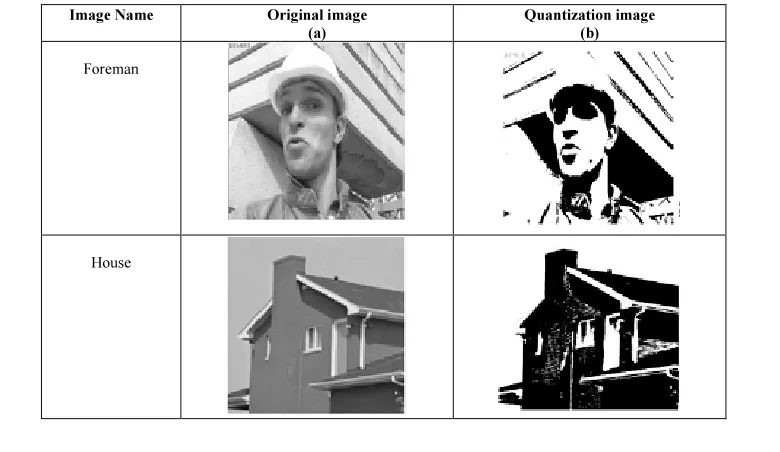
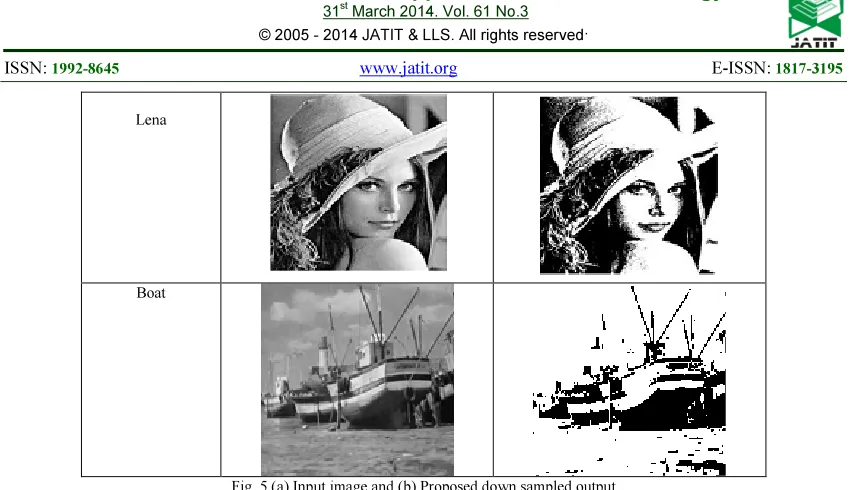
Then soft thresholding is applied to the output image and then GA is applied to get the clear downsampled image. Fig. 5 shows the output of the proposed method for several input images.
Image Name Original image
(a)
Quantization image (b)
Foreman
[image:7.595.106.496.527.753.2]Lena
Boat
Fig. 5 (a) Input image and (b) Proposed down sampled output
5.1 Performance Analysis
Our proposed method was applied to some sort of images and the performance was identified. In this section, the performance of the proposed image downsampling technique was analysed using Peak Signal to Noise Ratio (PSNR).
Peak Signal to Noise Ratio (PSNR)
PSNR is the ratio between the maximum possible power of a signal and the power of corrupting noise that affects the fidelity of its representation. Its value can be determined using the following equation.
dB
MSE
PSNR
=
20
log
(
255
)
2 (6)(
)
(
)
(
)
2,
,
ˆ
1
∑
−
=
f
x
y
f
x
y
MN
MSE
(7)Where MSE represents the Mean Square Error between input and output images. Here
MN
is thetotal number of pixels in the image.
f
ˆ
(
x
,
y
)
is thedownsampled image and
f
(
x
,
y
)
is the originalinput image.
In this section, our proposed downsampling method is compared with Interpolation-Dependent Image Downsampling (IDID) [1] to know about the improved performance as compared with the existing system. Table I gives the values of PSNR for the existing method and also the proposed
[image:8.595.86.511.81.326.2]downsampling method for two various kinds of images.
Table I: PSNR values of existing and proposed methods
Method PSNR (in dB)
Lena Boat
Existing method 35.533 30.894 Proposed method 37.214 32.432
Fig. 6 Graphical representation of PSNR values
Fig. 6 shows the graphical representation of the PSNR values of existing and proposed method for Lena and Boat images. By analysing the values of PSNR, we can come to know that, the proposed downsampling technique is efficient than existing system and also improved in performance.
6. CONCLUSION
[image:8.595.303.513.371.562.2]applied to get the quantized image. The proposed image downsampling algorithm uses soft thresholding to provide smoothness and better edge preservation. Then GA is used for the perfect downsampling. The proposed algorithm is tested with several types of images and the result shows that the generated output images are improved in performance as compared with existing method. From the comparative analysis, we come to know that, this method is more efficient than the existing method.
REFERENCE
[1]Yongbing Zhang, Debin Zhao, Jian Zhang, Ruiqin Xiong, and Wen Gao, "Interpolation-Dependent Image Downsampling," IEEE
Transactions on Image Processing, Vol. 20, No.
11, Nov 2011.
[2]C.O.S. Sorzano, A. Iriarte, R. Marabini, and J.M. Carazo, "Effects of the downsampling scheme on three-dimensional electron microscopy of single particles," In Proc. of the IEEE International Symposium on Intelligent Signal
Processing, Cantoblanco, Spain, pp. 175-179,
Aug 2009.
[3]Karl S. Ni and Truong Q. Nguyen, "Image Super resolution Using Support Vector Regression,"
IEEE Transactions on Image Processing, Vol.
16, No. 6, pp. 1596-1610, Jun 2007.
[4]Yongbing Zhang, Jian Zhang, Ruiqin Xiong, Debin Zhao, and Siwei Ma, "Low Bit-rate Image Coding via Interpolation Oriented Adaptive Down-sampling," IEEE Transactions
on Image Processing, Vol. 18, No. 3, pp.
552-561, Mar 2009.
[5]Fang, Lu, Oscar C. Au, Ngai-Man Cheung, A. K. Katsaggelos, Houqiang Li, and Feng Zou."Luma-chroma Space Filter Design for
Subpixel-based Monochrome Image
Downsampling.", Image processing, IEEE
Transactions, Vol.No: 22.10, pp: 3818-3829,
2013.
[6]Wu, Xiaolin, Xiangjun Zhang, and Xiaohan Wang. "Low bit-rate image compression via adaptive down-sampling and constrained least squares upconversion." Image Processing, IEEE
Transactions on Vol.No:18.3, pp: 552-561,
2009.
[7]Fang, Lu, Oscar C. Au, Ketan Tang, and Aggelos K. Katsaggelos. "Antialiasing Filter Design for Subpixel Downsampling via Frequency-Domain Analysis." Image Processing, IEEE
Transactions on, Vol. no: 21.3, pp: 1391-1405,
2012..
[8]Zhang, Yongbing, Debin Zhao, Jian Zhang, Ruiqin Xiong, and Wen Gao. "Interpolation-dependent image downsampling." Image
Processing, IEEE Transactions on
Vol.no:20.11, pp: 3291-3296, 2011.
[9]Kong Wan-zeng and Zhu Shan-an, "Multi-face detection based on downsampling and modified subtractive clustering for color images," Journal
of Zhejiang University Science, Vol. 8, No. 1,
pp. 72-78, 2007.
[10] Taeg Sang ChoC, Lawrence Zitnick, Neel Joshi, Sing Bing Kang, Richard Szeliski, and William. T. Freeman, "Image restoration by matching gradient distributions," IEEE Transactions on Pattern Analysis and Machine
Intelligence, 2011.
[11]A. N. Skodras and C. A. Christopoulos, "Down-sampling of compressed images in the DCT domain," In Proc. of European Signal
Processing Conference (EUSIPCO), Rhodes,
Greece, 1998.
[12]Matthew Trentacoste, Rafa Mantiuk, and Wolfgang Heidrich, "Blur-Aware Image Downsampling, Euro Graphics, Vol. 30, No. 2, 2011.
[13]Preeti Yadav and Yogesh Rathore, "Detection of Copy-Move Forgery of Images Using Discrete Wavelet Transform," International Journal on Computer Science and Engineering, Vol. 4, No. 04, pp. 565-570, Apr 2012.