This is a repository copy of
Deep depth-based representations of graphs through deep
learning networks
.
White Rose Research Online URL for this paper:
http://eprints.whiterose.ac.uk/130212/
Version: Accepted Version
Article:
Bai, Lu, Cui, Lixin, Bai, Xiao et al. (1 more author) (2018) Deep depth-based
representations of graphs through deep learning networks. Neurocomputing. ISSN
0925-2312
https://doi.org/10.1016/j.neucom.2018.03.087
[email protected]
Reuse
This article is distributed under the terms of the Creative Commons Attribution-NonCommercial-NoDerivs
(CC BY-NC-ND) licence. This licence only allows you to download this work and share it with others as long
as you credit the authors, but you can’t change the article in any way or use it commercially. More
information and the full terms of the licence here: https://creativecommons.org/licenses/
Takedown
If you consider content in White Rose Research Online to be in breach of UK law, please notify us by
Deep Depth-based Representations of Graphs through Deep
Learning Networks
Lu Bai1∗
, Lixin Cui1∗
, Xiao Bai2, Edwin R. Hancock3 1Central University of Finance and Economics, Beijing, China.
2Beihang University, Beijing, China. 3University of York, York, UK.
Abstract
Graph-based representations are powerful tools in structural pattern recognition and
machine learning. In this paper, we propose a framework of computing the deep
depth-based representations for graph structures. Our work links the ideas of graph
complexity measures and deep learning networks. Specifically, for a set of
graph-s, we commence by computing depth-based representations rooted at each vertex as
vertex points. In order to identify an informative depth-based representation subset,
we employ the well-knownk-means method to identifyMdominant centroids of the
depth-based representation vectors as prototype representations. To overcome the
bur-densome computation of using depth-based representations for all graphs, we propose
to use the prototype representations to train a deep autoencoder network, that is
opti-mized using Stochastic Gradient Descent together with the Deep Belief Network for
pretraining. By inputting the depth-based representations of vertices over all graphs to
the trained deep network, we compute the deep representation for each vertex. The
re-sulting deep depth-based representation of a graph is computed by averaging the deep
representations of its complete set of vertices. We theoretically demonstrate that the
deep depth-based representations of graphs not only reflect both the local and global
characteristics of graphs through the depth-based representations, but also capture the
main structural relationship and information content over all graphs under
investiga-tions. Experimental evaluations demonstrate the effectiveness of the proposed method.
∗These authors contribute equally to this work and are co-first authors *Manuscript
Keywords: Depth-based Representations, Deep Representations, Deep Autoencoder
Networks, Prototype Representations
1. Introduction
Analyzing data using graph-based representations has attracted an increasing
in-terest in machine learning and pattern recognition, due to the representational
pow-er of graph structures. Typical applications include a) analyzing bioinformatics and
chemoinformatics data [1] (e.g., classifying graph-based representations of proteins or
5
chemical compounds into different species), b) recognizing graph-based object
descrip-tions from images [2], c) visualizing social networks [3] (e.g., Twitter and Facebook
friendship networks, DBLP citation networks), etc. One challenge arising in
analyz-ing graph-based representations of data is how to convert the discrete graph structures
into numeric features, since this allows standard pattern recognition techniques to be
10
directly applied to graphs.
The aim of this paper is to propose a new framework of computing deep
depth-based representation of a graph through the use of deep learning networks [4]. Our
ap-proach is to identify a family of dominant depth-based representations [5] as prototype
representations, and then train a deep network that can better preserve the non-linear
15
graph structure information. The resulting deep depth-based representations of graphs
are computed through the trained deep networks.
1.1. Literature Review
Although graph-based representations are powerful tools for structural pattern
recog-nition, the main drawback associated with graph structures is the lack of a
correspon-20
dence order or labels for the vertices, i.e., we do not explicitly know how to align
different graph adjacency matrices. Compared to vector-based pattern recognition, this
in turn limits the set of standard machine learning algorithms that can be directly
ap-plied to problems of graph classification or clustering [6]. One way to overcome this
problem is to convert the graph structures into a numeric characteristics [7].
25
Generally speaking, most existing methods can be categorized into two classes,
graph kernel to characterize the similarity of different graph structures in a high
di-mensional Hilbert space. Proponents of the first class of methods tend to represent
graphs as permutation invariant features in a vector space, where standard machine
30
learning techniques designed for vector-based data can be directly employed. For
in-stance, Wilson et al. [8] have computed graph invariant from algebraic graph theory.
They use the spectral decomposition of a Hermitian property matrix as the complex
analogue of the Laplacian, and construct symmetric polynomials associated with the
eigenvectors. Bunke et al. [7] have embedded graphs into vectors by employing both
35
vertex and edge attributed statistics. Ren et al. [9] have computed vectorial graph
fea-tures via the Ihara zeta function. They first transform each graph into a directed line
graph and then identify the cycles residing on the line graph. The resulting graph
fea-tures are computed by counting the number of cycles having different lengths. Kondor
and Borgwardt [10] have computed invariant graph skew spectrum features, by
map-40
ping each graph adjacency matrix into a symmetric group function and computing the
associated bispectral invariants. Bai and Hancock [11] have developed a framework to
compute depth-based representations of graphs. Specifically, they first decompose each
graph into a family of expansion subgraphs with increasing size, and then measure the
entropy-based information content of these substructures. Unfortunately, these
state-45
of-the-art methods tend to approximate graph structures in a low dimensional vector
space, and thus discard correlation information. By contrast, the proponents of graph
kernels can characterize graphs in a high dimensional Hilbert space and thus better
preserve the structural correlations of graphs [12].
One of the most generic frameworks of defining graph kernels is the concept of
50
R-convolution proposed by Haussler [13]. The main idea underpinning R-convolution
graph kernels is that of decomposing graphs into substructures of limited sizes and
then comparing pairs of specific substructures, such as walks, paths, subtrees and
sub-graphs. Under this scenario, Kashima et al. [14] have defined a marginalized kernel by
comparing pairs of random walks associated with vertex and edge labels. Costa and
55
Grave [15] have proposed a pairwise neighborhood subgraph distance kernel, by
count-ing pairs of isomorphic pairwise neighborhood subgraphs. Bach [16] has proposed a
graphical model on the subtrees. Wang and Sahbi [17] have defined a graph kernel for
action recognition, by describing actions as directed acyclic graphs (DAGs) and
count-60
ing the number of isomorphic walk pairs. Harchaoui and Bath [18] have proposed
a segmentation graph kernel for images by counting the inexact isomorphic subtree
patterns between image segmentation graphs. Bai et al. [19] have defined an aligned
subtree kernel by counting pairs of inexact isomorphic subtrees rooted at aligned
ver-tices. Alternative state-of-the-art graph kernels based on R-convolution include a) the
65
subtree-based hypergraph kernel [20], b) the subgraph matching kernel [1], c) the
opti-mal assignment kernel [21], d) the aligned Jensen-Shannon subgraph kernel [22], and
e) the fast depth-based subgraph kernel [23].
Unfortunately, as we have stated, the R-convolution graph kernels usually employ
substructures of limited sizes. As a result, most of the aforementioned kernels only
70
reflect local graph characteristics, i.e., these kernels cannot capture characteristics of
graph structures at the global level. To address this problem, Bai et al. [2, 24] have
developed a family of graph kernels based on information theoretic measures, namely
the classical and quantum Jensen-Shannon divergence. Specifically, they use either the
classical or the quantum random walk associated with the divergence to measure the
75
similarity between graphs at a global level based on entropies. Johansson et al. [25]
have developed a global graph kernel based on geometric embeddings. Specifically,
they use the Lov´asz number as well as its associated orthonormal representation to
capture the characteristics at a global level.
One common weakness arising in most of the aforementioned state-of-the-art
meth-80
ods, either graph embedding methods or graph kernels, is that of ignoring information
from multiple graphs. This is because the graph embedding method usually captures
characteristics for each single graph structure. On the other hand, the graph kernel
only reflects graph characteristics for each pair of graphs. As a summary, developing
effective method to preserve the structural information residing in graphs still remains
85
1.2. Contribution
To overcome the shortcoming of both existing graph embedding methods and graph
kernels, in this paper, we aim to present a novel framework for computing deep
depth-based representations for graph structures. Our work links the ideas from graph
com-90
plexity and deep learning networks [4]. In particular, for a set of graphs under analysis,
we commence by computing the depth-based representations rooted at each vertex [23].
This is done by decomposing a graph structure into a family of expansion subgraphs
of increasing sizes rooted at a vertex, and then measuring the entropy-based
complexi-ties of the subgraphs and use this to construct a complexity trace, i.e., the depth-based
95
representation of the root vertex. Since the complexity trace encapsulates entropic
information flow from the root vertex to the global graph structure, the depth-based
representation can simultaneously capture both local and global graph characteristics.
With the depth-based representations of vertices over all graphs to hand, we
em-ploy the well-knownk-means method [26] to identifyk dominant centroids of these
100
depth-based representation vectors as prototype representations. Since the prototype
representations are identified by minimizing the sum of square distances between all
depth-based representations and the centroid points (i.e., the prototype representations)
of their clusters, the prototype representations can reflect representative characteristics
of all depth-based representations encountered. As a result, the prototype
representa-105
tions can encapsulate dominant characteristics over all used graphs.
In order to reflect the high dimensional structural information of graphs well, we
propose to further capture the manifolds of these prototype representations using deep
learning networks [4]. This is motivated by the recent success of deep learning [3, 27],
that has been proven a powerful tool of learning complex relationships of data [28].
110
Specifically, with the prototype representations as input data, we train a deep neural
network (i.e., the deep autoencoder network [3]) that is optimized using Stochastic
Gra-dient Descent together with the Deep Belief Network [29] for pretraining. Note that,
training the deep network associated with the smaller set of prototype
representation-s can representation-significantly reduce the burdenrepresentation-some computation arepresentation-srepresentation-sociated with depth-barepresentation-sed
115
representations of all graphs. Since the deep autoencoder network can minimize the
the dominant structural information over the vertices of all graphs, the deep network
can capture the salient information for these graphs in a highly non-liner latent space.
By inputting the depth-based representations of vertices over all graphs to the trained
120
deep network, we compute the deep representation for each vertex. The resulting deep
depth-based representation of a graph is computed by averaging the deep
representa-tions of all its vertices. We theoretically demonstrate that the deep depth-based
repre-sentations of graphs not only reflect both the local and global characteristics of graphs
through the depth-based representations, but also capture the main relationships and
125
information over all graphs under investigations. Experimental evaluation demonstrate
the effectiveness of the proposed method.
1.3. Paper Outline
The remainder of this paper is organized as follows. Section 2 reviews the
prelimi-nary concepts that will be used in this work. Section 3 details the proposed framework
130
for computing deep depth-based representations of graphs. Section 4 provides the
ex-perimental evaluation of the new method. Section 5 concludes this work.
2. Preliminary Concepts
In this section, we review some preliminary concepts that will be used in this work.
We commence by reviewing the concept of depth-based representation from
entropy-135
based complexity measures. Finally, we show how to identify the k dominant centroids
of the depth-based representation vectors as prototype representations based on the
well-knownk-means clustering method.
2.1. Depth-Based Representations
In this subsection, we review how to compute the depth-based representation
root-140
ed at each vertex of a graph [23]. The depth-based representation is a powerful tool
for characterizing the topological structure in terms of the intrinsic complexity. One
way of computing the representation is to gauge the information content flow through
a family of K-layer subgraphs of a graph (e.g., subgraphs around a vertex having
min-imal path length K) of increasing size and to use the flow as a structural signature. By
measuring the entropy measure of each expansion subgraph, Bai et al. [23] have shown
how to use this this to characterize each graph as a depth-based complexity trace
repre-sentation that gauges how the entropy-based complexities of the expansion subgraphs
vary as a function of depth.
Specifically, assume a sample graph is denoted asG(V, E), whereV andEare the
vertex and edge sets respectively. We first compute the shortest path matrix ofG(V, E)
asSGbased on the well-known Dijkstra’s algorithm. Note thatSGfollows the same
vertex permutation with the adjacency matrix ofGand each elementSG(v, u)indicates
the shortest path length between verticesuandv. Assume the neighbourhood vertex
set ofv∈V is denoted asNK
v and satisfies
NvK ={u∈V |SG(v, u)≤K}. (1)
For each vertexv∈VofG(V, E), a family ofK-layer expansion subgraphsGK
v(VK;EK)
rooted atvis defined as
⎧
⎨
⎩ VK
v ={u∈NvK};
EK
v ={(u, v)⊂NvK×NvK|(u, v)∈E}.
(2)
Note that theK-layer expansion subgraphGK
v is the global structure ofG(V, E)ifK
150
is equal or larger than the length of the greatest shortest path starting from vertexvto
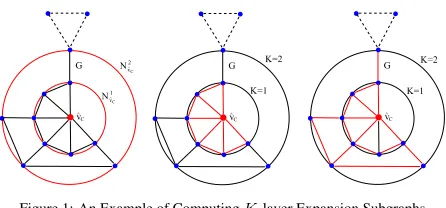
the remaining vertices ofG(V, E). Fig.1 gives an example to explain how to compute
aK-layer expansion subgraph rooted at a sample vertexˆvC∈V. The left-most figure
shows the determination ofK-layer expansion subgraphs for a graphG(V, E)which
hold|Nˆv1C|= 6and|Nvˆ2C|= 10vertices. While the middle and the right-most figure
155
show the corresponding1-layer and2-layer subgraphs regarding the vertexvˆC, and are
depicted by red-colored edges. In this example, the vertices of differentK-layer
sub-graphs regarding the vertexˆvCare calculated by Eq.(1), and pairwise vertices possess
the same connection information in the original graphG(V, E).
Definition (Depth-based representations of vertices): For the graphG(V, E), let
the family ofK-layer expansion subgraphs rooted at each vertexv ∈ V be denoted
as{G1
depth-Figure 1: An Example of ComputingK-layer Expansion Subgraphs.
based representationDBL
v of vertexvis defined as
DBL
v ={HS(Gv1),· · ·, HS(GKv),· · ·, HS(GvL)}, (3) whereK≤LandHS(GvK)is the Shannon entropy ofGvKcomputed using the steady
160
state random walk [2]. ✷
We observe a number of interesting properties for the depth-based representation.
First, it is computed by measuring the entropy-based complexity on the gradually
ex-panding subgraphs rooted at a vertex, and thus encapsulates rich intrinsic depth
com-plexity information rooted at the vertex. Second, since the computational comcom-plexity
of the required Shannon entropy associated with the steady state random walk is only
quadratic in the number of vertices [2], the depth-based representation can be
efficient-ly computed [23]. Furthermore, based on Eq.(2), we observe that the famiefficient-ly ofK-layer
expansion subgraphs rooted at a vertexvsatisfy
v∈Gv1· · ·⊆GvK ⊆· · ·⊆GLv ⊆G.
This observation indicates that these expansion subgraphs form a nested sequence, i.e.,
the sequence of subgraphs gradually expand from the local vertexvto the structure
of the global graph. As a result, the depth-based representation can simultaneously
capture the local and global graph structure information.
165
2.2. Identifying Prototype Representations
In this subsection, we identify the centroids over all depth-based representation
vec-tors. In particular, assume a set ofNgraphs is denoted asG={G1,· · ·, Gi,· · ·, GN}. Based on Eq.(3), for each graphGi we commence by computing theL-dimensional
[image:9.595.185.408.163.267.2]nvertices over all graphs inG, and theL-dimensional depth-based representations of
these vertices areDBL= (DBL1,DB2L, . . . ,DBLn). We use thek-means method [26] to identifyM centroids over all depth-based representations inDBL, i.e., we divide
these representations intoM clusters and compute the mean vector for each cluster.
Specifically, givenMclustersΩ = (cL
1, cL2, . . . , cLM)whereLcorresponds to the pa-rameter of theseL-dimensional depth-based representations, thek-means method aims
to minimize the following objective function
arg min
Ω
N
$
i=1
$
DBL j∈cLi
∥DBL j −µ
L
i∥2, (4)
whereµLi is the mean of the depth-based representation vectors belonging to clustercLi.
Since Eq.(4) minimizes the sum of the square Euclidean distances between the vertex
pointsDBL
j and their centroid point of clustercLi, theMcentroid points{µL1,· · ·, µLM} can reflect main characteristics of all L-dimensional depth-based representations in
170
DBL. In other words, these centroid can be seen as a family ofL-dimensional
pro-totype representations that encapsulate representative characteristics over all graphs in
G.
3. Deep Depth-based Representations of Graphs
In this section, we introduce a framework of computing the deep depth-based
rep-175
resentations of graphs, by linking the ideas of depth-based complexity measures and
the powerful deep learning networks. We commence by reviewing the concept of deep
autoencoder network [29]. Finally, we show how to compute the deep depth-based
representation through the deep network.
3.1. Deep Autoencoder Networks 180
In this subsection, we briefly review the concept of deep autoencoder, that is a
deep learning network [29]. This network is one kind of unsupervised model and is
composed of a encoder network and a decoder network. The encoder network consists
of multiple non-linear functions that map the input data to a representation space, i.e.,
the encoder network transforms the original data into the deep representations [3]. On
Figure 2: The Architecture of the Deep Autorencode Network.
Table 1: Terms and Notations
Symbol Definition
n number of vertexes
K number of layers
S={s1, ..., sn} the adjency matrix for the network
X={xi}ni=1,Xˆ={ˆxi}ni=1 the input data and reconstructed data
Yk
={yk i}
n
i=1 the k-th layer hidden representation
Wk,Wˆk the k-th layer weight matrix
bk,ˆbk the k-th layer biases
θ(k)={Wk,Wˆk, bk,ˆbk
} the overall parameters
the other hand, the decoder network consists of multiple non-linear functions mapping
the deep representations in the representation space to the reconstruction space, i.e., the
decoder network reconstructs the original data based on the deep representations. It has
been proven that the deep representation between the encoder and decoder networks
smoothly captures the data manifold embedded in a highly non-liner space. As a result,
190
the deep representation enhances the linear separability of the original data [29], and
provides an elegant way of analyzing the original data.
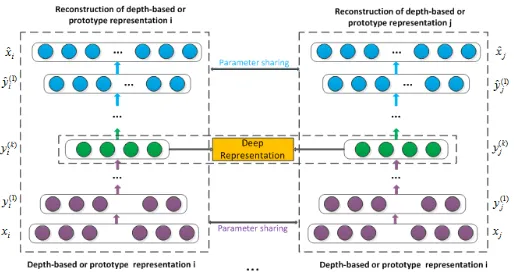
The architecture of the deep autoencouder network used in this work is shown in
is the input, then the hidden representations for each layer are computed as
yk i =
⎧
⎨
⎩
σ(W(1)x
i+b(1)) ifk= 1;
σ(W(k)yk−1
i +b(k)) ifk= 2, ..., K.
(5)
AfterKsteps, we obtainy(iK)through the encoder network, i.e., we transformxiinto
yi(K)(the deep representation ofxi). Then, after anotherKsteps, we can obtain the outputxˆiby reversing the calculation process of encoder through the decoder network,
i.e., we reconstruct the inputxiasxˆithroughyi(K). The objective of the deep autocoder network is to minimize the reconstruction error of outputxˆiand inputxi, and the loss
function is defined as
L=
n
$
i=1
∥xˆi−xi∥22 (6)
To optimize the deep autocoder network, we first use the Deep Belief Network [29]
to pretrain its parameters to avoid trapping in local optimum in the parameter space.
Then, the deep network is optimized by means of the Stochastic Gradient Descent
195
method, where the gradients can be conveniently obtained by applying the chain rule
to backpropagate error derivatives first through the decoder network and then through
the encoder network, i.e., back-propagate∂∂θLto updateθ k.
As [3] stated, although the reconstruction process does not explicitly preserve the
original inputxi, minimizing the reconstruction error can smoothly capture the
mani-200
folds of original data and thus capture the main characteristics of the data.
3.2. The Deep Representation through Deep Networks
In this subsection, we propose a new deep depth-based representation that
repre-sents a graph as embedding vector. LetG={G1,· · ·, Gi,· · ·, GN}be a set of graph-s. For each graphGi(Vi, Ei) ∈ G, we commence by computing theL-dimensional
depth-based representation of each vertexv∈Vibased on Eq.(3) as
DBL
i;v={HS(Gi1;v),· · ·, HS(GiK;v),· · ·, HS(GiL;v)},
where the subscriptsi,vandLcorrespond to the graphGi∈G, the vertexv∈Viand
definition in Section 2.2, we identify a family ofL-dimensional prototype
representa-tions. Specifically, with theL-dimensional depth-based representations of all graphs in
Gto hand, we perform thek-means method to identifyMcentroids, i.e., we divide the
depth-based representations intoMclusters and compute the means{µL
1,· · ·, µLM}of these clusters as theL-dimensional prototype representations. We further use the
pro-totype representations{µL
1,· · ·, µLM}as input data to train a deep autoencoder network proposed in Section 3.1. Training the deep network using the smaller set of prototype
representations not only avoids the burdensome computation of using depth-based
rep-resentations of all graphs inG, but also preserves the dominant information of these
graphs for the training process. With the trained deep autoencoder network to hand,
for each graphGi(Vi, Ei)∈G, we use itsL-dimensional depth-based representations
DBsG
i={DB
L
i;1,· · ·,DBLi;v,· · ·,DB L
i;|Vi|}rooted at all vertices inVias input, here the subscripts1to|Vi|ofDBsGicorrespond to the1-th toVi-th vertex inVi. Based
on Eq.(5) we obtain a set of|V|deep representation vectors of all vertices inVias
DRsG i={y
(K)
1 ,· · ·, y(vK), . . . , y
(K)
|Vi|}, (7)
wherey(vK)is the deep representation ofDBLi;v, i.e.,y
(K)
v is the deep representation of
vertexv∈ViforGi. Then, the deep representation ofGiis
DRGi=
$
v∈|Vi|
y(vK), (8)
i.e.,DRGiis the mean vector of the deep representation vectors inDRsGi. The
re-sulting deep depth-based representationDDBGi of each graphGi ∈ Gis computed
by performing the Principle Component Analysis (PCA) [30] on the graph deep
rep-205
resentation matrixDRG = (DRG1| · · · |DRGi| · · · |DRGN)to embed the each deep
representationDRGiofGiin a principle space. Since the deep representationDRGi
of each graphGican effectively capture the manifold of all graphs in the deep space,
the deep depth-based representationDDBGi enhances the linear separability of the
graphs. The algorithm of computing the deep depth-based representation is shown in
210
Algorithm 1Vertex labels strengthening procedure Input:A set of graphsG={G1,· · ·, Gi,· · ·, GN}.
Output: The deep depth-based representationDDBGiof each graphGi, and parametersθof
the Deep Autoencoder Network (DAN).
1: Initalization
• For each graphGi(Vi, Ei)∈G, compute theL-dimensional depth-based representations
DBL
i;vfor each vertexv∈Vibased on Eq(3).
• Use thek-means method to divide the depth-based representation vectors of all graphs in
GintoMclusters and compute these cluster means{µL1,· · ·, µ
L
M}as theL-dimensional
prototype representations.
2: Train the DAN with Parameters in Table.1.
• Input the prototype representations as the input dataX, and pretrain DAN through Deep
Belief Network to initialize the parametersθ={θ(1),· · ·,θ(K)}for DAN.
• Repeat
• Based onXandθ, computeXˆusing Eq.(5).
• Compute the least square error betweenXˆandXasL=!n
i=1∥Xˆ−X∥ 2 2.
• Using the Stochastic Gradient Descent to updateθ, i.e., back-propagate∂L
∂θ to updateθ.
• Untilconverge
3: Compute Deep Depth-based Representations.
• Based on Eq.(7) and (8), compute the deep representation DRGi for each graph
Gi through the trained DAN, perform PCA on the deep representation matrix
DRG = (DRG1| · · · |DRGi| · · · |DRGN)to compute the deep depth-based
3.3. Discussions and Related Works
The deep depth-based representationDDBGiof a graphGi∈Gproposed in
Sec-tion 3.2 has a number of advantages.
First, unlike most state-of-the-art graph kernels mentioned in Section 1.1, the
pro-215
posed deep depth-based representationDDBGi can simultaneously capture the local
and global graph characteristics. This is because the associated depth-based
repre-sentation for our framework is computed from the entropy measures on the family of
expansion subgraphs, that gradually lead a local vertex to the global graph structure. By
contrast, the mentioned R-convolution graph kernels [1, 14, 15, 16, 17, 18, 19, 20, 23]
220
are computed by comparing pairs of subgraphs of limited sizes (e.g., paths, cycles,
walks, subgraphs and subtrees), and thus only reflect local topological information
of graphs. On the other hand, the graph kernels based on the classical and quantum
Jensen-Shannon divergence [2, 24], as well as the Lov´asz graph kernel [25] are
com-puted based on global graph characteristics (e.g., Shannon or von Neumann entropies,
225
and Lov´asz number associated orthonormal representation). These kernels can reflect
global graph characteristics, but tend to ignore local graph information. As a summary,
most existing graph kernels cannot reflect complete information of graph structures.
Second, unlike most state-of-the-art graph embedding methods mentioned in
Sec-tion 1.1, the proposed deep depth-based representaSec-tionDDBGi can effectively
cap-230
ture the manifold of the graphs in a highly non-liner latent space, and thus reflect rich
characteristics of graph structures. This is because the deep depth-based
represen-tationDDBGiis computed through the powerful deep autoencoder network, that can
smoothly capture the data manifold in a highly non-linear space. By contrast, the graph
embedding methods [6, 7, 8, 7, 9, 10, 11] tend to embed graphs from high dimensional
235
structure space in a low dimensional vectorial space, and thus lead to information loss.
Third, unlike the state-of-the-art graph kernels and graph embedding methods, the
proposed deep depth-based representationDDBGi can reflect comprehensive
charac-teristics of all graph under investigations. This is because the required deep
autoen-couder network is trained by using the prototype representations. These
representa-240
tions are identified by employing thek-means clustering method on the depth-based
S-ince the prototype representations can represent the main characteristics of all graphs,
the deep autoencoder network trained from these representations can simultaneously
capture the main information of all graphs. As a result, the deep depth-based
repre-245
sentationDDBGicomputed through the deep autoencouder network can encapsulate
all graph characteristics. By contrast, most existing graph kernels [1, 14, 15, 16, 17,
18, 19, 20, 23] compute the kernel value based on pairs of graphs. On the other hand,
the graph embedding methods [6, 7, 8, 7, 9, 10, 11] compute the graph feature vector
based on each individual graph.
250
Finally, note that, the depth-based complexity traces [11] and the fast depth-based
subgraph kernel [23] are also based on the depth-based representations. Thus, similar
to the proposed deep depth-based representation, these two existing methods can
si-multaneously capture the local and global graph characteristics too. However, as one
kind of graph embedding method, the depth-based complexity trace can only represent
255
graphs in low dimensional vectorial space, and leads to information loss. By contrast,
the proposed method can capture richer graph characteristics through the powerful deep
autoencoder network. Furthermore, both the depth-based complexity trace and the fast
depth-based graph kernel suffer from the drawback of ignoring comprehensive
infor-mation over all graphs under investigations, because these methods only capture graph
260
information for each individual graph or pairs of graphs.
The above observations reveal the theoretical effectiveness of the proposed deep
depth-based representation. The proposed method provides an effective way of
analyz-ing graph structures for classification or clusteranalyz-ing problems.
3.4. Computational Analysis 265
The computational complexity of the proposed deep depth-based representation is
governed by the following computational steps. Consider a set ofNgraphs each having
Svertices andT edges, and the greatest lengthLof the shortest paths over all these
graphs. Computing the depth-based representations of vertices for each graph relies on
the calculation of the shortest path matrix, and thus computing the representations of all
270
graphs requires time complexityO(Nlog(S)T). The identification of theMprototype
depth-Table 2: Information of the Graph-based Datasets
Datasets MUTAG ENZYMES BAR31 BSPHERE31 GEOD31 CATH2
Max # vertices 28 126 220 227 380 568
Min # vertices 10 2 41 43 29 143
Mean # vertices 17.93 32.63 95.42 99.83 57.42 308.03
# Graphs 188 600 300 300 300 190
# Classes 2 6 15 15 15 2
# Disjoint graphs 0 31 0 0 0 7
Proportion of disjoint graphs 0% 5.16% 0% 0% 0% 3.68%
Datasets NCI1 NCI109 COIL5 Shock PPIs PTC
Max # vertices 111 111 241 33 218 109
Min # vertices 3 4 72 4 3 2
Mean # vertices 29.87 29.68 144.90 13.16 109.63 25.60
# graphs 4110 4127 360 150 219 344
# classes 2 2 5 10 5 2
# disjoint graphs 580 605 0 0 0 0
Proportion of disjoint graphs 14.11% 14.73% 0% 0% 0% 0%
based representations of all graphs, and thus requires time complexityO(N SM W)
where W is the iteration number. Training the deep autoencoder network requires
time complexityO(LDCI), whereLcorresponds to the dimension of input data,D
275
is the degree of the deep network,C is the dimension of the hidden layers andI is
the iteration. As a result, computing the deep depth-based representations of all graphs
requires time complexityO(Nlog(S)T+N SM W+LDCI).
4. Experimental Results
In this section, we empirically evaluate the performance of the proposed deep
280
depth-based representations of graphs. We commence by testing the proposed method
on the graph classification problem using standard graph datasets that are abstracted
from bioinformatics and computer vision databases. Furthermore, we also compare the
proposed method with several state-of-the-art methods, e.g., graph kernels and graph
embedding methods.
[image:17.595.131.519.186.439.2]4.1. Graph Datasets
We demonstrate the classification performance of the proposed method on twelve
standard graph-based datasets abstracted from both bioinformatics and computer
vi-sion datasets. These datasets include: MUTAG, ENZYMES, BAR31, BSPHERE31,
GEOD31, CATH2, NCI1, NCI109, COIL5, Shock, PPIs, and PTC(MR). More details
290
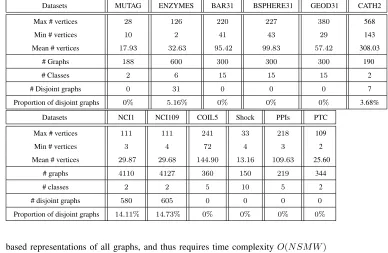
concerning the datasets are shown in Table.2.
MUTAG: The MUTAG dataset consists of graphs representing 188 chemical
com-pounds, and here the goal is to predict whether each compound possesses
mutagenic-ity [31]. The maximum, minimum and average number of vertices are 28, 10 and
17.93 respectively. As the vertices and edges of each compound are labeled with a real
295
number, we transform these graphs into unweighted graphs.
ENZYMES:The ENZYMES dataset consists of graphs representing protein tertiary
structures, and contains 600 enzymes from the BRENDA enzyme database [32]. In
this case, the task is to correctly assign each enzyme to one of the 6 EC top-level
classes. The maximum, minimum and average number of vertices are 126, 2 and 32.63
300
respectively.
BAR31, BSPHERE31 and GEOD31: The SHREC 3D Shape database consists of
15classes and 20 individuals per class, that is 300 shapes [33]. This is a standard
benchmark in 3D shape recognition. From the SHREC 3D Shape database, we
estab-lish three graph datasets named BAR31, BSPHERE31 and GEOD31 datasets through
305
three mapping functions. These functions are a) ERG barycenter: distance from the
center of mass/barycenter, b) ERG bsphere: distance from the center of the sphere that
circumscribes the object, and c) ERG integral geodesic: the average of the geodesic
distances to all other points. Details of the three mapping function can be found in
[33]. The number of maximum, minimum and average vertices for the three datasets
310
are a) 220, 41 and 95.42 (for BAR31), b) 227, 43 and 99.83 (for BSPHERE31), and c)
380, 29 and 57.42 (for GEOD31), respectively.
CATH2:The CATH2 dataset has proteins in the same class (i.e., Mixed Alpha-Beta),
architecture (i.e., Alpha-Beta Barrel), and topology (i.e., TIM Barrel), but in different
homology classes (i.e., Aldolase vs. Glycosidases). The CATH2 dataset is harder to
315
protein graphs are10times larger in size than chemical compounds, with200−300
vertices. There is190testing graphs in the CATH2 dataset.
NCI1 and NCI109: The NCI1 and NCI109 datasets consist of graphs representing
two balanced subsets of datasets of chemical compounds screened for activity against
320
non-small cell lung cancer and ovarian cancer cell lines respectively [34]. There are
4110 and 4127 graphs in NCI1 and NCI109 respectively.
COIL5: We establish a COIL5 dataset from the COIL database. The COIL image
database consists of images of 100 3D objects. We use the images for the first five
objects. For each object we employ 72 images captured from different viewpoints. For
325
each image we first extract corner points using the Harris detector, and then establish
Delaunay graphs based on the corner points as vertices. As a result, in the dataset there
are 5 classes of graphs, and each class has 72 testing graphs. The number of maximum,
minimum and average vertices for the dataset are 241, 72 and 144.90 respectively.
Shock:The Shock dataset consists of graphs from the Shock 2D shape database. Each
330
graph is a skeletal-based representation of the differential structure of the boundary of a
2D shape. There are 150 graphs divided into 10 classes. Each class contains 15 graphs.
PPIs: The PPIs dataset consists of protein-protein interaction networks (PPIs). The
graphs describe the interaction relationships between histidine kinase in different species
of bacteria. Histidine kinase is a key protein in the development of signal transduction.
335
If two proteins have direct (physical) or indirect (functional) association, they are
con-nected by an edge. There are 219 PPIs in this dataset and they are collected from 5
different kinds of bacteria (i.e., a)Aquifex4 andthermotoga4 PPIs fromAquifex
aeli-cusandThermotoga maritima, b)Gram-Positive52 PPIs fromStaphylococcus aureus,
c)Cyanobacteria73 PPIs fromAnabaena variabilis, d) Proteobacteria40 PPIs from
340
Acidovorax avenae, and e)Acidobacteria46 PPIs). Note that, unlike the experiment
in [24] that only uses theProteobacteria40 and theAcidobacteria46 PPIs as the
test-ing graphs, we use all the PPIs as the testtest-ing graphs in this paper. As a result, the
experimental results for some kernels are different on the PPIs dataset.
PTC:The PTC (The Predictive Toxicology Challenge) dataset records the
carcino-345
genicity of several hundred chemical compounds for male rats (MR), female rats (FR),
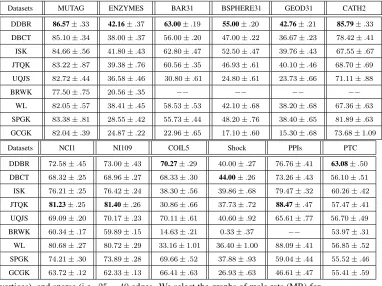
Table 3: Classification Accuracy (In%±Standard Error) Comparisons
Datasets MUTAG ENZYMES BAR31 BSPHERE31 GEOD31 CATH2
DDBR 86.57±.33 42.16±.37 63.00±.19 55.00±.20 42.76±.21 85.79±.33
DBCT 85.10±.34 38.00±.37 56.00±.20 47.00±.22 36.67±.23 78.42±.41
ISK 84.66±.56 41.80±.43 62.80±.47 52.50±.47 39.76±.43 67.55±.67
JTQK 83.22±.87 39.38±.76 60.56±.35 46.93±.61 40.10±.46 68.70±.69
UQJS 82.72±.44 36.58±.46 30.80±.61 24.80±.61 23.73±.66 71.11±.88
BRWK 77.50±.75 20.56±.35 −− −− −− −−
WL 82.05±.57 38.41±.45 58.53±.53 42.10±.68 38.20±.68 67.36±.63
SPGK 83.38±.81 28.55±.42 55.73±.44 48.20±.76 38.40±.65 81.89±.63
GCGK 82.04±.39 24.87±.22 22.96±.65 17.10±.60 15.30±.68 73.68±1.09
Datasets NCI1 NI109 COIL5 Shock PPIs PTC
DDBR 72.58±.45 73.00±.43 70.27±.29 40.00±.27 76.76±.41 63.08±.50
DBCT 68.32±.25 68.96±.27 68.33±.30 44.00±.26 73.26±.43 56.10±.51
ISK 76.21±.25 76.42±.24 38.30±.56 39.86±.68 79.47±.32 60.26±.42
JTQK 81.23±.25 81.40±.26 30.86±.66 37.73±.72 88.47±.47 57.47±.41
UQJS 69.09±.20 70.17±.23 70.11±.61 40.60±.92 65.61±.77 56.70±.49
BRWK 60.34±.17 59.89±.15 14.63±.21 0.33±.37 −− 53.97±.31
WL 80.68±.27 80.72±.29 33.16±1.01 36.40±1.00 88.09±.41 56.85±.52
SPGK 74.21±.30 73.89±.28 69.66±.52 37.88±.93 59.04±.44 55.52±.46
GCGK 63.72±.12 62.33±.13 66.41±.63 26.93±.63 46.61±.47 55.41±.59
vertices), and sparse (i.e.,25−40edges. We select the graphs of male rats (MR) for
evaluation. There are344test graphs in the MR class.
4.2. Experiments of Graph Classifications 350
Experimental Setup:We evaluate the performance of the proposed deep depth-based
representations (DDBR) on several standard graph datasets, and then compare them
with several alternative state-of-the-art graph kernels and a graph embedding method.
The graph kernels used for comparison include: 1) the fast depth-based subgraph
ker-nel based on entropic isomorphism test (ISK) [23], 2) the backtraceless random walk
355
kernel using the Ihara zeta function based cycles (BRWK) [35], 2) the
Weisfeiler-Lehman subtree kernel (WL) [36], 3) the shortest path graph kernel (SPGK) [37], 4)
the graphlet count graph kernels with graphlet of size3(GCGK) [38], 5) the unaligned
the Jensen-Tsallis q-differences associated withq = 2(JTQK) [39]. The graph
em-360
bedding method for comparison is the depth-based complexity trace of graphs
(DBC-T) [11], and for each dataset the trace dimension number of the DBCT method
corre-sponds to the greatest shortest path length rooted at a vertex to the remaining vertices
over all graphs in the dataset, following the concept of the depth-based representations
developed in [11].
365
For the proposed DDBR method, we train a multi-layer deep autoencoder network
for each graph dataset, and the dimension of each layer is500,250,100and30, i.e., the
associated encoder and decoder network both have4layer learning structures.
More-over, we set 5%of the vertex number of all graphs in the dataset as the prototype
representation numberM, e.g., there are100vertices of all graphs in a dataset andM
370
is 5. Each deep network is pretained using the Deep Belief Network and then optimized
using the Stochastic Gradient Descent. With the trained deep autoencoder network for
each dataset to hand, we compute the deep depth-based representation vector as the
feature vector for each testing graph. Furthermore, we also compute the depth-based
complexity trace as the feature vector for each graph using the DBCT method. We
375
then perform 10-fold cross-validation using the Support Vector Machine
Classifica-tion (SVM) associated with the Sequential Minimal OptimizaClassifica-tion (SMO) [40] and the
Pearson VII universal kernel (PUK) [41] to evaluate the performance of the proposed
DDBR method and the DBCT method. We use nine folds for training and one fold
for testing. For each method, we repeat the experiments 10 times. All parameters of
380
the SMO-SVMs were optimized for each method on different datasets. We report the
average classification accuracies and standard errors of each method in Table.3. For
the WL and JTQK kernels, we set the largest iteration of the required vertex label
strengthening methods (i.e., the required tree-index method for the two kernels) as 10.
With each kernel to hand, we calculate the kernel matrix on each dataset. We perform
385
10-fold cross-validation using the C-Support Vector Machine (C-SVM) Classification,
and compute the classification accuracies. Similar to the SMO Classification, we also
use nine samples for training and one for testing, and each classification was performed
with its parameters optimized on each dataset. We report the average classification
ac-curacies and standard errors of each graph kernel in Table.3. Moreover, we also exhibit
the runtime of each graph kernel and graph embedding method on different datasets,
and this is measured under Matlab R2011a running on a 2.5GHz Intel 2-Core processor
(i.e., i5-3210m). We these results in Table.4. Finally, note that, the JTQK, WL
kernel-s are able to accommodate attributed graphkernel-s. In our experimentkernel-s, we ukernel-se the vertex
degree (not the original vertex labels) as the vertex label for these kernels.
395
Experimental Results:Overall, in terms of the classification accuracies exhibited by
Table.3, the classifications associated with the proposed DDBR method exhibit better
performance than state-of-the-art methods for comparisons. Specifically, among the12
testing graph datasets, the DDBR method achieves the best classification accuracies on
8datasets, i.e., the MUTAG, ENZYMES, BAR31, BSPHERE31, GEOD31, CATH2,
400
COIL5 and PTC datasets. On the other hand, for the NCI1, NCI109 and PPIs datasets,
only the accuracies of the JTQK and WL kernels is obviously better than the proposed
DDBR method, and our DDBR method outperforms the remaining methods.
More-over, although the classification associated with the proposed DDBR method does not
achieve the best accuracy on the Shock dataset method, the DDBR method is still
com-405
petitive to the DBCT graph embedding method and the UQJS kernel, and outperforms
the remaining methods.
In terms of the runtime exhibited by Table.4, the proposed DDBR method is not
the fastest method, but it can still be computed in a polynomial time. By contrast,
some graph kernels obviously have more computational time, and even cannot finish
410
the computation in one day. Furthermore, considering the impressive classification
accuracies of the proposed DDBR method on most datasets, the proposed method has a
good trade off between the classification performance and the computational efficiency.
Experimental Analysis:Table.3 indicates that the proposed method has better
perfor-mance on classification problems. The reasons for the effectiveness of the proposed
415
DDBR method are threefold. First, the proposed DDBR method can simultaneously
capture the local and global graph characteristics, through the required depth-based
representations that can lead a local vertex to the global graph structure in terms of
en-tropy measures. By contrast, the alternative graph kernels only capture local or global
graph characteristics, and thus lead to information loss. Second, the required deep
au-420
representations that encapsulate the dominant structural information over the vertices
of all graphs. Thus, only the proposed DDBR method can reflect comprehensive
in-formation of all graph under investigations. By contrast, the alternative DBCT method
and the alternative graph kernels can only reflect information of each individual graph
425
or each pair of graphs. Third, the required deep autoencouder network for the proposed
DDBR method can minimize the reconstruction error of the output and input prototype
representations and effectively capture the manifold of the graphs in a highly non-liner
latent space. As a result, the proposed DDBR method based on the deep network can
capture the salient information for these graphs in a highly non-liner latent space. By
430
contrast, the alternative DBCT method is one kind of graph embedding method that
represents a graph structure in a low dimensional space. Moreover, although the graph
kernels can well represent graph structure information in a high dimensional Hilbert
space, the proposed DDBR method can smoothly captures the characteristics of graphs
through the powerful deep autoencoder network and has better representative power to
435
preserve the graph structure information.
On the other hand, in terms of the less effectiveness of the proposed DDBR method
on the NCI1 and NCI109 datasets, Table.2 indicates that there are14.11%and14.73%
of graphs in the two datasets are disjoint graphs, i.e., some vertices have no path to
all the remaining vertices. Since the required depth-based representations for the
pro-440
posed DDBR method is computed by measuring the entropies on a family of expansion
subgraphs rooted at each vertex, the disjoint graph cannot guarantee that its gradually
expending subgraphs can accommodate any vertex. In other words, the depth-based
representations of disjoint graphs cannot fully capture the whole information of global
graph structures. This in turn leads to information loss and influences the
effective-445
ness of the proposed method on the NCI1 and NCO109 datasets. However, even under
such a disadvantageous situation, the propose methods still outperform most
alterna-tive methods except the JTQK and WL kernels on the two datasets. Furthermore, we
observe that only the JTQK and WL kernel can significantly outperform the proposed
kernel on the PPIs dataset, since only the two alternative kernels can accommodate
450
vertex labels. The proposed DDBR method outperforms the other alternative methods
Table 4: CPU Runtime Comparisons
Datasets MUTAG ENZYMES BAR31 BSPHERE31 GEOD31 CATH2
DDBR 68” 4′50” 9′39” 8′10” 7′35” 15′30”
DBCT 1” 1” 3” 3” 3” 4”
ISK 15” 3′30” 3′50” 3′10” 2′40” 9′51”
JTQK 3” 30” 1′22” 1′35” 1′17” 39′14”
UQJS 20” 4′23” 10′30” 13′48” 8′49” 1h14′
BRWK 1” 13” −− −− −− >1day
WL 3” 21” 30” 25” 15” 53”
SPGK 1” 2” 11” 14” 11” 4′13”
GCGK 1” 2” 2” 2” 2” 8”
Datasets NCI1 NCI109 COIL5 Shock PPIs PTC
DDBR 20′30” 20′20” 10′21” 45” 2′10” 2′42”
DBCT 4” 4” 4” 1” 1” 1”
ISK 2h19′ 2h20” 9′55” 6” 1′40” 59”
JTQK 10′50” 10′55” 7′19” 3” 1′43” 8”
UQJS 2h55′ 2h55′ 18′20” 14” 3′24” 1′46”
BRWK 6′49” 6′49” 16′46” 8” >1day 29”
WL 2′31” 2′37” 1′5” 3” 20” 9”
SPGK 16” 16” 31” 1” 22” 1”
5. Conclusion
In this work, we have proposed a new framework of computing the deep
depth-based representation for graphs. This work is depth-based on the ideas of depth-depth-based graph
455
complexity measures and the powerful deep learning networks. We have identified a
family of prototype representations that represent the main characteristics of the
deprh-based representations of all graphs. Furthermore, with the prototype representations as
input data, we have trained a deep autoencoder network that can capture the main
char-acteristics of all graphs in a highly non-linear deep space. This deep network was
op-460
timized using the Stochastic Gradient Descent together with the Deep Belief Network
for pretraining. The resulting deep depth-based representation of a graph is
comput-ed through the traincomput-ed deep network associatcomput-ed with its depth-bascomput-ed representations as
input. The deep depth-based representations of graphs not only reflect both the local
and global characteristics of graphs through the depth-based representations, but
al-465
so capture the main relationship and information over all graphs under investigation.
Experimental evaluations demonstrate the effectiveness of the new proposed method.
Our future work is to extend the proposed method to a new deep graph
represen-tation learning method that can accommodate both vertex and edge attributed graphs.
Moreover, we will also develop a new framework of computing deep representations
470
for hypergraphs [42] that can preserve higher order information than graphs.
Acknowledgments
This work is supported by the National Natural Science Foundation of China (Grant
no. 61503422 and 61602535), the Open Project Program of the National Laboratory
of Pattern Recognition (NLPR), and the program for innovation research in Central
475
University of Finance and Economics.
References
[1] N. Kriege, P. Mutzel, Subgraph matching kernels for attributed graphs, in:
[2] L. Bai, E. R. Hancock, Graph kernels from the jensen-shannon divergence,
Jour-480
nal of Mathematical Imaging and Vision 47 (1-2) (2013) 60–69.
[3] D. Wang, P. Cui, W. Zhu, Structural deep network embedding, in: Proceedings of
KDD, 2016, pp. 1225–1234.
[4] G. E. Hinton, Deep belief networks, Scholarpedia 4 (5) (2009) 5947.
[5] L. Bai, E. R. Hancock, Fast depth-based subgraph kernels for unattributed graphs,
485
Pattern Recognition 50 (2016) 233–245.
[6] K. Riesen, H. Bunke, Graph classification by means of lipschitz embedding, IEEE
Trans. Systems, Man, and Cybernetics, Part B 39 (6) (2009) 1472–1483.
[7] J. Gibert, E. Valveny, H. Bunke, Graph embedding in vector spaces by node
at-tribute statistics, Pattern Recognition 45 (9) (2012) 3072–3083.
490
[8] R. C. Wilson, E. R. Hancock, B. Luo, Pattern vectors from algebraic graph theory,
IEEE Trans. Pattern Anal. Mach. Intell. 27 (7) (2005) 1112–1124.
[9] P. Ren, R. C. Wilson, E. R. Hancock, Graph characterization via ihara coefficients,
IEEE Transactions on Neural Networks 22 (2) (2011) 233–245.
[10] R. Kondor, K. M. Borgwardt, The skew spectrum of graphs, in: Proceedings of
495
ICML, 2008, pp. 496–503.
[11] L. Bai, E. R. Hancock, Depth-based complexity traces of graphs, Pattern
Recog-nition 47 (3) (2014) 1172–1186.
[12] M. Neuhaus, H. Bunke, Bridging the Gap between Graph Edit Distance and
Ker-nel Machines, Vol. 68 of Series in Machine Perception and Artificial Intelligence,
500
WorldScientific, 2007.
[13] D. Haussler, Convolution kernels on discrete structures, in: Technical Report
UCS-CRL-99-10, Santa Cruz, CA, USA, 1999.
[14] H. Kashima, K. Tsuda, A. Inokuchi, Marginalized kernels between labeled
graph-s, in: Proceedings of ICML, 2003, pp. 321–328.
[15] F. Costa, K. D. Grave, Fast neighborhood subgraph pairwise distance kernel, in:
Proceedings of ICML, 2010, pp. 255–262.
[16] F. R. Bach, Graph kernels between point clouds, in: Proceedings of ICML, 2008,
pp. 25–32.
[17] L. Wang, H. Sahbi, Directed acyclic graph kernels for action recognition, in:
Pro-510
ceedings of ICCV, 2013, pp. 3168–3175.
[18] Z. Harchaoui, F. Bach, Image classification with segmentation graph kernels, in:
Proceedings of CVPR, 2007.
[19] L. Bai, L. Rossi, Z. Zhang, E. R. Hancock, An aligned subtree kernel for weighted
graphs, in: Proceedings of ICML, 2015, pp. 30–39.
515
[20] L. Bai, P. Ren, E. R. Hancock, A hypergraph kernel from isomorphism tests, in:
Proceedings of ICPR, 2014, pp. 3880–3885.
[21] N. M. Kriege, P. Giscard, R. C. Wilson, On valid optimal assignment kernels and
applications to graph classification, in: Proceedings of NIPS, 2016, pp. 1615–
1623.
520
[22] L. Bai, Z. Zhang, C. Wang, X. Bai, E. R. Hancock, A graph kernel based on the
jensen-shannon representation alignment, in: Proceedings of IJCAI, 2015, pp.
3322–3328.
[23] L. Bai, E. R. Hancock, Fast depth-based subgraph kernels for unattributed graphs,
Pattern Recognition 50 (2016) 233–245.
525
[24] L. Bai, L. Rossi, A. Torsello, E. R. Hancock, A quantum jensen-shannon graph
kernel for unattributed graphs, Pattern Recognition 48 (2) (2015) 344–355.
[25] F. D. Johansson, V. Jethava, D. P. Dubhashi, C. Bhattacharyya, Global graph
kernels using geometric embeddings, in: Proceedings of ICML, 2014, pp. 694–
702.
[26] I. Witten, E. Frank, M. Hall, Data mining: Practical machine learning tools and
techniques.
[27] A. Jain, A. R. Zamir, S. Savarese, A. Saxena, Structural-rnn: Deep learning on
spatio-temporal graphs, in: Proceedings of CVPR, 2016, pp. 5308–5317.
[28] Y. Bengio, Learning deep architectures for AI, Foundations and Trends in
Ma-535
chine Learning 2 (1) (2009) 1–127.
[29] G. E. Hinton, R. R. Salakhutdinov, Reducing the dimensionality of data with
neural networks, science 313 (5786) (2006) 504–507.
[30] C. M. Bishop, Pattern Recognition and Machine Learning (Information Science
and Statistics), Springer-Verlag New York, Inc., Secaucus, NJ, USA, 2006.
540
[31] A. Debnath, R. L. de Compadre, G. Debnath, A. Shusterman, C. Hansch,
Structure-activity relationship of mutagenic aromatic and heteroaromatic nitro
compounds, correlation with molecular orbital energies and hydrophobicity, J.
of Med. Chem. 34 (1991) 786–979.
[32] I. Schomburg, A. Chang, C. Ebeling, M. Gremse, C. Heldt, G. Huhn, D.
Schom-545
burg, The enzyme database: Updates and major new developments, Nucleic
Acid-s ReAcid-search 32 (2004) 431–433.
[33] S. Biasotti, S. Marini, M. Mortara, G. Patan`e, M. Spagnuolo, B. Falcidieno, 3d
shape matching through topological structures, in: Proceedings of DGCI, 2003,
pp. 194–203.
550
[34] P. Dobson, A. Doig, Distinguishing enzyme structures from non-enzymes without
alignments, J. Mol. Biol. 330 (2003) 771–783.
[35] F. Aziz, R. C. Wilson, E. R. Hancock, Backtrackless walks on a graph, IEEE
Transactions on Neural Networks and Learning Systems 24 (6) (2013) 977–989.
[36] N. Shervashidze, P. Schweitzer, E. J. van Leeuwen, K. Mehlhorn, K. M.
Borg-555
wardt, Weisfeiler-lehman graph kernels, Journal of Machine Learning Research
[37] K. M. Borgwardt, H.-P. Kriegel, Shortest-path kernels on graphs, in: Proceedings
of the IEEE International Conference on Data Mining, 2005, pp. 74–81.
[38] N. Shervashidze, S. Vishwanathan, K. M. T. Petri, K. M. Borgwardt, Efficient
560
graphlet kernels for large graph comparison, Journal of Machine Learning
Re-search 5 (2009) 488–495.
[39] L. Bai, L. Rossi, H. Bunke, E. R. Hancock, Attributed graph kernels using the
jensen-tsallis q-differences, in: Proceedings of ECML-PKDD, 2014, pp. 99–114.
[40] J. C. Platt, Fast training of support vector machines using sequential minimal
565
optimization, Sch¨olkopf, B., Burges, C.J.C., and Smola, A.J. (Eds.) Advances in
Kernel Methods (1999) 185–208.
[41] W. Sanders, C. Johnston, S. Bridges, S. Burgess, K. Willeford, Prediction of cell
penetrating peptides by support vector machines, PLoS Computational Biology 7
(2011) e1002101.
570
[42] L. Bai, F. Escolano, E. R. Hancock, Depth-based hypergraph complexity traces