www.ijemst.com
Creating a Taken-As-Shared
Understanding for
Scientific Explanation: Classroom Norm
Perspective
Yilmaz Saglam 1,Emre Harun Karaaslan 2, Alipasa Ayas 3
1
University of Gaziantep 2 Karadeniz Technical University 3 Bilkent University
To cite this article:
Saglam, Y., Karaaslan, E.H., & Ayas, A. (2014). Creating a taken-as-shared understanding
for scientific explanation: Classroom norm perspective. International Journal of Education
in Mathematics, Science and Technology, 2(2), 149-163.
This article may be used for research, teaching, and private study purposes.
Any substantial or systematic reproduction, redistribution, reselling, loan, sub-licensing,
systematic supply, or distribution in any form to anyone is expressly forbidden.
Authors alone are responsible for the contents of their articles. The journal owns the
copyright of the articles.
Volume 2, Number 2, April 2014, Page 149-163
ISSN: 2147-611X
Creating a Taken-As-Shared Understanding for
Scientific Explanation: Classroom Norm Perspective
Yilmaz Saglam 1*, Emre Harun Karaaslan 2, Alipasa Ayas 3
1
University of Gaziantep 2 Karadeniz Technical University
3 Bilkent University
Abstract
The study aimed to investigate whether classroom norm perspective influence the students’ capability of elucidating a natural phenomena and beliefs about scientific explanation. In particular, our objective was to explore the process by which the norm for scientific explanation was established and discover how the students’ explanation and their beliefs about scientific explanation altered in this process. A case study approach was adopted and a total of 51 students participated in the study. The data has included videotapes of classroom periods for an entire school semester, individual interviews with the students conducted at the beginning and at the end of the semester, and students’ written responses collected in the middle and at the end of the semester in the year of 2012. In creating a sociocultural norm for scientific explanation, the teacher, in the class, was seen declaring his own expectation, negotiating the meaning by making comments on and legitimizing students’ accounts, and calling the students’ attention towards the important parts of an acceptable explanation. The results indicated that towards the end of the semester, the students’ explanation and their beliefs about scientific explanation have considerably improved.
Key words: Scientific explanation, classroom norm, taken-as-shared understanding.
Introduction
Explaining a natural phenomenon is one of the primary objectives of science (Hempel, 1966). Why the sky is blue, how dinosaurs did extinct, why seasons occur, what is thunder, and why day and night cycle occur are only those few questions that scientists have found essential to explain. Generally, scientists by employing such theories as gravity, gene, atom, molecules, electrons, natural selection and so forth make many scientific explanations, which provide underlying causes of natural phenomena. In 1996, the US National Science Education Standards (NRC, p. 113) called educators’ attention towards this essential way of communication amongst scientists and overwhelmingly stressed on the requirement in the science classroom for a change from providing answers to questions about science content to communicating science explanations and from viewing science as exploration and experiment to science as argument and explanation. Likewise, in the Benchmarks (AAAS, 2009), a strong emphasis was made on the critical role of scientific explanation in making sense of gathered data. Consistently, in Beyond 2000: Science Education for the Future (Millar & Osborne, 1998, p. 2021), it was emphasized that pupils had to analyze and interpret evidence and construct sound and persuasive arguments. Also, in a lately published report on European Science Education by Osborne and Dillon (2008), it was recommended that the primary goal of science education across the EU has to be to educate students about the major explanations of the natural world that science offers. Therefore, in science education reform documents and reports, a significant emphasis has been put on the importance of scientific explanation. However, although this emphasis was made on scientific explanation, there is no one unique straightforward meaning attributed to this term. This is due to the variation of explanations in different disciplines in the field of science and even in the same discipline depending on its context. A very recently published article (Braaten & Windschitl, 2011) highlighted this vigorous fact and specified that there is a lack of clear vision and definition about the substance and function of scientific explanations. This however creates a vagueness or confusion for both teachers and students. How can one teach or learn something that possesses no well-defined meaning?
*
However, to Yackel and Cobb (1996) meaning of such a word that has no one upfront account could be constituted in a socialization process. They particularly showed how teacher and students interactively established the meaning of mathematical difference in a classroom activity. In the study, in the absence of a predetermined definition for mathematical difference, students were to provide responses to a particular problem without knowing in advance how the teacher would view their responses. The session started with a mat question posed as a mental computation activity. The students were specifically asked to calculate the result of 16 + 14 + 8. In the class, every after receiving a response from a student, the teacher constantly asked for a different solution. The teacher was further seen legitimizing students’ solutions comprising decomposing and recomposing numbers in differing ways, but not confirming those that were typically restatements of previously given solutions. The teacher, in the class, acted as a partaker approving or disapproving student’ solutions.
Hereby, by participating this action, the students witnessed the situations of what and what does not count as a mathematical difference. This emergent situation was therefore created through the interaction between teacher and students and, as a result of this, by providing solutions and confirming and disconfirming those solutions, the students and teacher together established a taken-as-shared meaning for mathematical difference.
For another instance, in 2002, Yackel and Rasmussen conducted a case study on general classroom norms and selected a group of students that had not been involved in such a class in which the teacher’s aim was to develop an inquiry based instruction and this form of instruction was a novel experience for the students. The students’ beliefs about their individual roles, teacher’s role and the general nature of mathematical activity were indeed different from the teacher’s expectations. However, these different expectations of students and teacher resulted in situations of explicit negotiation. In the class, the teacher continuously asked the students to provide thorough explanations and justifications for their responses, and further listen to and try to make sense of others’ explanations. Eventually, these students-teacher interactions, towards the end of the semester, became typical and led to the emergence of general social norms. The following student’s utterance evidently illustrates this normative understanding.
‘The way I thought about it at first, to make me think that all the points weren’t saddles, is that if the next one was a saddle—see how [Bill] has got the one line coming in towards [referring to the phase portrait that Bill had drawn on the blackboard]. Well, if the next one was like that, then you would have to have another point in between those two equilibrium points, like separating, like a source or something. So that’s how I started thinking about it. So then 3π/2 might be a source or maybe a saddle point with opposite directions’.
This spontaneous utterance indicates that this particular student felt obligated to develop a meaningful account, consider what other students think, and explain and justify his own solution. Further to this, the student’s utterance also points out that teacher’s aim of developing an inquiry valued classroom culture seemed to have been largely successful. In this micro-culture, explaining and justifying solutions, and trying to understand responses given by others are highly valued and it seemed to have become normative. In the present study, we wondered whether this method of instruction, the norm perspective found flawlessly working in math classes, also works in a science classroom. Specifically, our aim was to investigate the processes by which the norm of scientific explanation is established.
Theoretical Framework: Classroom Norms
From a symbolic interactionism perspective, meaning is a social product created in and through the activities of people as they interact with one another (Blumer, 1969, pp 4-10). According to this view, in interacting with one another, one has to take account of or interpret what the other is doing or about to do (Blumer, 1969, p. 8-9; Yackel, 2010). To illustrate, in a particular classroom setting, the teacher’s expectation influences students’ interpretation of how to engage in an activity (Cobb, Yackel & Wood, 1989). Students plan their responses on the basis of what the teacher’s expectation means to them and the teacher makes an expectation as a sign of what he/she is planning to do and also what he/she wants the students to do or understand. Thus, the expectation has a meaning for both the teacher who makes it and for the students to whom it is directed. When the expectation has the same meaning for both the teacher and students, they appreciate each other. The use of meaning therefore depends on this interpretation action.
classroom communication (Cobb, Yackel & Wood, 1993). The taken-as-shared understanding is therefore not a rule that prescribes individual actions: rather, it refers to an interpretation that has become normative in due course in a particular setting (Yackel, 2004).
Study Context: Scientific Explanation
In the philosophy of science there have been a variety of views on scientific explanation such as Covering Law Model by Hempel and Oppenheim (1948), Probabilistic Explanation by Hempel (1966, p. 58), Explanatory Unification by Friedman (1974) and also by Kitcher (1997), Causal Model by Salmon (1978), and so forth. The main reason for this diversity in definitions is due to the variations in the explanations operated in the actual practices of scientists. To illustrate, scientists sometimes employ laws to explain a natural phenomenon. In such a case, the explanation involves consecutive explanans (a set of covering laws or nomological explanations) and an explanandum (a description of phenomenon). Explanans provide causal reasons for the occurrence of explanandum and expressed in statements as natural laws. To illustrate, why one feels cool as one dries off after getting wet. How do we explain this phenomenon? Essentially, after one gets wet, a thin layer of water remains on one’s skin where evaporation occurs and the evaporation is a cooling process (Explanan). This process causes the body temperature gets drop leading the one to feel cool (Explanandum). In an acceptable scientific explanation, therefore, some logical conditions must be met. The explanandum first and foremost must be a logical consequence of the explanans. Second, the explanans must involve general laws and they must be true and have testable empirical content. However, not all natural phenomena could be explained by solely utilizing laws. The comments on weather, the likelihood of a baby’s gender, risk of getting cancer, and so on include scientific explanations of different kind. Professors of medicine, for instance, frequently operate statistical data to explain a scientific phenomenon. Let us imagine a doctor talking to his patient about a particular drug and explaining how the drug is useful for a particular disease. He/she states, ‘if one has been infected and takes two pills of the drug a day, after seven days of treatment, the probability of relief will be 92 %’. In this probabilistic account, unlike the law model, the explanans does not make the truth of the explanandum certain. That is, the explanandum is not unquestionably a result of explanans. Rather, there is a high probability of the occurrence of it.
Besides, scientific explanations might also embrace theories. To illustrate, an earthenware pot keeps water cool. How is this phenomenon to be explained? A typical explanation could be that because of being made of clay, the pot is permeable (explanan 1); accordingly, a small amount of water is always being drawn through the walls of it (explanan 2); this causes a thin layer of water to form on the surface of the pot (explanan 3); the water molecules in the layer move about in all directions (explanan 4); they travel at different speeds and bump into one another, which leads them to lose or gain kinetic energy (explanan 5); when possessing sufficient energy to break the intermolecular forces, the molecules evaporate off and get into the space above the liquid (explanan 6); this results in a decrease in the average kinetic energy of the molecules remaining in the liquid (explanan 7). This ultimately causes the pot to keep the water inside cool (explanandum). A scientific explanation therefore might include theories providing noteworthy accounts for an unobservable natural occurrence. As seen in the explanation, the premises of kinetic molecular theory (explanan 4-7) provided an exhaustive justification and underlying mechanism for the evaporation process. According to both explanatory unification and causal models, involving powerful theories like this thus offers comprehensive explanations.
To sum up, there is a high variance in scientific explanations in the philosophy of science literature and it seems difficult to provide teachers and students with one universal and generally accepted model of scientific explanation. However, basing on the causal and unificationist models, Braaten and Windschitl (2011) suggested a mixed model. The model, called Explanation Tool, which we found appropriate in evaluating the depth of explanations for elementary school level chemistry concepts, distinguished three levels of explanation: That are, (1) a low level of explanation that involves descriptions of what happened without addressing any theoretical component, (2) an average level of explanation that involves descriptions of how something happened, but it uses theoretical components tangentially, and (3) a high level of explanation involves an account of why something happened using theoretical components within a causal story. A high level of explanation, according to this model, must therefore involve causatively linked theoretical premises given in the form of a complete story.
The Research Questions
The following research questions became the focus of concern for the present study.
Design and Procedures
Sample Description
The study is conducted at a state university in 2012. A total of 59 college freshmen participated in the study. The students were primary school teacher candidates. Though, out of these students, eight were excluded from the study. Students’ nonattendances, their unwillingness to get involved in the study or the difficulty of communicating with foreign students have become the reasons for this exclusion. Accordingly, the work group consisted of 51 students, of which 18 students were male and the remaining 33 were female. The initial queries on students’ basic understanding of chemistry indicated that, of these students, 45 students received only one course related to chemistry in high school signifying their possession of weak background knowledge on chemical notions. Further, the students’ attendance was recorded and these records were depicted as missed sections in Table 1. The letter M stands for male students and the letter F stands for female ones.
Table 1. The students’ nonattendance for the thirteen-week course.
Nonattendance Students
One week M-1, M-6, M-11, M-17, M-18, F-4, F-6, F-9, F-13, F-19, F-20, F-22, F-23, F-28, F-29, and F-31.
Two weeks M-16
Three weeks F-18
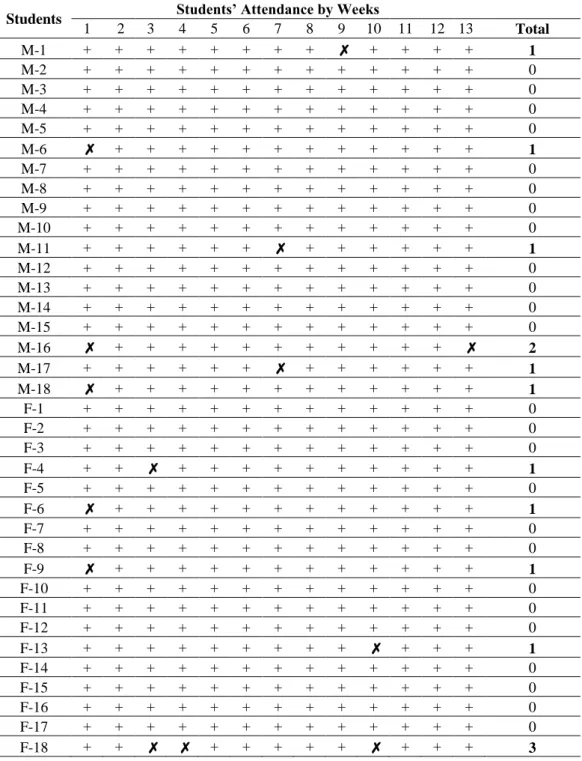
As indicated in Table 1, sixteen students missed only one period, one student missed two periods and another one missed three periods. The remaining thirty-five students joined in all the periods. Appendix B further depicts particular period(s) these students missed within the thirteen-week course. Because in the initial four weeks the negotiations for scientific explanation had not begun yet, the nonattendance in those weeks could hence be ignored. If such to be done, in the remaining weeks the students including M-16 and F-18 would have missed only one period or none, which we thus considered to be negligible.
Info about the Course
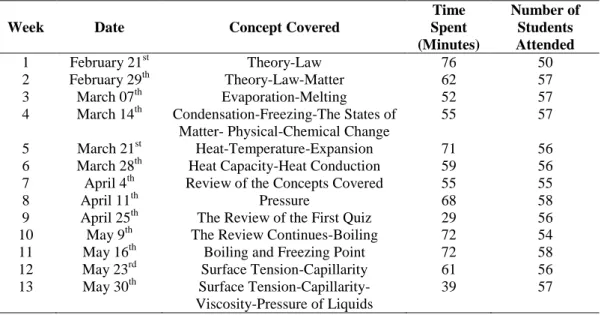
A science course, named General Chemistry for Classroom Teachers, was purposefully selected for the study and aimed to have students appreciate fundamental concepts of chemistry. The information about those concepts, the specific week and date in which the concepts were covered, the time spent and the number of students present were in detail depicted in Table 2. The course where a semester long teaching experiment was conducted in the year of 2012 and continued about 13 weeks.
Table 2. Info about the thirteen-week course.
Week Date Concept Covered
Time Spent (Minutes)
Number of Students Attended
1 February 21st Theory-Law 76 50
2 February 29th Theory-Law-Matter 62 57
3 March 07th Evaporation-Melting 52 57
4 March 14th Condensation-Freezing-The States of Matter- Physical-Chemical Change
55 57
5 March 21st Heat-Temperature-Expansion 71 56
6 March 28th Heat Capacity-Heat Conduction 59 56
7 April 4th Review of the Concepts Covered 55 55
8 April 11th Pressure 68 58
9 April 25th The Review of the First Quiz 29 56
10 May 9th The Review Continues-Boiling 72 54
11 May 16th Boiling and Freezing Point 72 58
12 May 23rd Surface Tension-Capillarity 61 56
13 May 30th Surface Tension-Capillarity-Viscosity-Pressure of Liquids
All the teaching periods were videotaped and the videotaping started on February 21st. In the first four weeks, the teacher was seen asking the students to explain such phenomena as evaporation, melting, condensation, and freezing. However, in the classroom, in those weeks he neither made comments on the students’ explanations nor provided any recommendation to them. In other words, in those weeks the students did not receive any feedback on whether their explanations were appropriate or not. In the 5th week and following ones, however, the teacher began to encourage the students to make explanations. In this period, he negotiated the meaning of scientific explanation with the students and made comments on their emergent explanations. During this time, the concepts such as heat, temperature, expansion, heat capacity, heat conduction, gas pressure, boiling, boiling and freezing point, surface tension, capillarity, viscosity, and pressure of liquids were covered. The teacher was also seen persistently renegotiating the meaning of scientific explanation with the students. At different times, he constantly made comments on and legitimized the students’ accounts. The course ended and a final video recording was done on May 30th.
Data Gathering Procedure
In order to get initial beliefs about scientific explanation and capability of explaining a natural phenomenon, individual interviews were conducted with the students between the dates of December 22, 2011 and January 10, 2012. A semi-structured interview protocol (see Appendix A) was used. Yet, when necessary, additional questions were posed in order to further probe the students’ beliefs. In the interviews, the students were particularly asked to (1) put forward a natural phenomenon that they have encountered in everyday life, (2) provide an explanation for it if they could, and (3) state what they know about scientific explanation. These questions were repeatedly posed to the students both at the beginning and at the end of the semester. The closing interviews were done between September 24 and October 9, 2012. A total of 51 students participated in the interviews and each one lasted approximately 6-10 minutes. Before the interviews, the interview protocol was piloted and a revision is made in wording and order of the questions. Piloting also allowed specifying the amount of time required for the interviews.
Additionally, in order to investigate the development and quality of students’ explanations, twice, on April 20th and June 8th, the students received open–ended questions asking them to explain a natural phenomenon. The students were particularly asked, ‘Do you think what change occurs when a piece of butter melts on a fire? Please explain it scientifically'. And on June 8th, they were asked, ‘John one day perspired quite a lot after a soccer game and noticed chilled. He wondered why he felt cold. Can you help him explain this phenomenon? Please explain it scientifically’. The students were asked to give written responses to these questions, which were later collected for analysis.
In brief, data from the teaching experiment involved videotapes of classroom practices for the entire school semester, individual interviews with the students conducted at the beginning and end of the semester, and students’ written responses collected in the middle and at the end of the semester.
The Process of Developing the Norm of Scientific Explanation: Episodes from the Classroom Practice
Episode Begins: Students’ Beliefs about Scientific Explanation
In the first four weeks of the course, the teacher was seen asking questions to the students, but not making comments on their responses. The following episode illustrates this state. In the next and following dialogues the letter T stands for teacher and S stands for student. In the class, the teacher at the beginning requested volunteers for an activity. Two students volunteered and one of them took a piece of napkin and dipped it into a jar filled with water. He then soaked his friend’s face with the wet napkin. Hereafter, the teacher asked what the wet student did feel. After the student stated that he felt cold, the teacher asked the class why their friend sensed that way. Then, the episode continued as follows:
F-27: Because his face temperature has a lower degree. If his face had had a higher temperature, he most likely would not have experienced the coldness. I mean he felt cold because his face temperature is lower than that of the water.
T: Any idea?
M-13: He felt cold because, when he is wet, he got in contact with the air. T: Okay, any different idea? Yes.
T: What does loose? And what does gain?
F-11: Because the napkin is wet and it is a little colder, since his face is warmer, their heats try to synchronize with each other. For that reason, he felt coldness. The napkin cools down. There is a heat exchange.
T: But he feels cold. I am not asking what happens to napkin. Okay, you explain pretty well, but. F-11: Uhm. How can I explain this? If there is a heat exchange, heats must be synchronized. T: Okay.
F-11: Since one side looses heat, he inevitably feels cold. T: You said heat exchange right?
F-11: Yes. T: …
M-11: I think his face temperature is higher than that of napkin. T: Then, what happens?
M-11: He felt cold. T: You say so. M-11: Yes.
T: A similar idea was stated. Any different idea? F-29: Because it touched his skin.
T: Do you mean because the water touches his skin? F-29: If it does not touch his skin, he would not feel cold.
In the dialogue the students invoked a number of explanations for the phenomenon observed. The students particularly seemed to think that the reason for experiencing cold was due to the difference in temperature between the face and the napkin or water, contact with air, high classroom temperature, heat exchange, or contact with water. These ideas are voiced in such a way that, ‘he felt cold because his face temperature is lower than that of the water’, ‘he felt cold because, when he is wet, he got in contact with the air’, ‘because our class is warmer’, ‘since his face is warmer, their heats try to synchronize with each other’, ‘since one side looses heat, he inevitably feels cold’, ‘his face temperature is higher than that of napkin’, and ‘because it touched his skin’. These students’ utterances however imply that the students seemed to believe that an appropriate explanation is a short causal premise that could involve either a brief description or theoretical account.
Teacher’s Expectation from Students
In order to create a normative understanding of scientific explanation, the teacher, in the fifth week, overtly declared his expectation. The following dialogue illustrates how the teacher initiates an interactive constitution of scientific explanation. The dialogue started with an argument on the linkage between temperature and motion of the atoms in a piece of iron and it continued as follows:
T: There happens a temperature increase when a piece of iron is hit. Is there any different idea? Have you ever tried that? Have you ever tried when you were a child? Do you think why its temperature increases? Any idea?
F-29: We had thought that motion caused an increase in temperature. Therefore, iron when it is hit, it starts to move. This might be the cause.
T: Okay, let us elaborate more. I think this explanation is not satisfactory. Let us make our explanations better. They should be thorough. (?) unclear Yes.
M-5: If we hit a piece of iron or move it, it moves and when we hit it, we apply a kind of force. That force turn into heat. The heat is sent out.
T: Okay. When you offer an explanation, I would like you to provide a detailed account. What happens first and what happens next. I want to get a step-by-step explanation. Recall my explanations. They were made stepwise. The explanations involved built-in stages. I would like you to offer explanations in that way.
student’s account and underlined the importance of making it comprehensive and stepwise. In this part of the dialogue, therefore, an inconsistency between the teacher’s expectations from the students and the students’ beliefs about scientific explanation were witnessed. In other words, the students’ beliefs about or subjective understanding of an appropriate explanation was seen conflicting with that of the teacher. And, these differing beliefs eventually resulted in the emergence of situations of explicit negotiations (Yackel & Rasmussen, 2002). In the subsequent weeks, the teacher was observed insistently renegotiating the meaning of scientific explanation with the students.
Emergence of Classroom Negotiations between Teacher and Students
In the sixth and following weeks, the teacher was seen probing students’ understanding and asking for explanation. In return, the students were offering explanations without knowing in advance how the teacher would view them. In those emergent contexts, the students witnessed cases of acceptable and unacceptable explanations and instantaneously learned what counts as a scientific explanation (Yackel & Cobb, 1996). Therefore, the teacher and students interactively constituted the meaning of scientific explanation. On April 20th, for instance, the students were particularly asked to explain what happens to a piece of butter when heated on a fire. In the ninth (the following) week, the teacher was seen reviewing the students’ responses. In the class, he projected the responses onto the board and negotiated the meaning of an acceptable explanation. The following episode illustrates this negotiation action.
Response 1: There happens a heat transfer from the fire to the butter. The energy of the butter particles rises. The particles move faster and detach from one another and the butter changes from solid to liquid phase.
Teacher: …Pay attention to what he said. He said that there happens a heat transfer from the fire to the butter. Then, what did he say? The energy of the butter particles rises. Suppose heat comes from the fire, and then what follow it? Remember! When we explain something, we should provide all the details in a complete story. The story starts with: First, there is a heat transfer from the pan to the butter. Second, how does the heat transfer influence the motion of the particles? Increase. When their kinetic energy increases, third, the particles detach from one another. And, fourth, consequently the butter changes from solid to liquid phase. This is what your explanation should look like.
Response 2: We place a piece of butter on a fire. The butter gains thermal energy. Let us assume the butter is in a pan when we give thermal energy. A heat transfer happens from pan to butter. Accordingly, the particles move faster and so the distance amongst the particles increases. Consequently, the butter in solid state turns into liquid.
Teacher: … Pay attention to how your friend did explain. He first placed the butter in a pan. Then, he said that the butter gains thermal energy. Let us assume the butter is in a pan when we give thermal energy. A heat transfer happens from the pan to the butter. This is an important utterance. This is what I think is required in your explanations. Pay attention! He first puts it in a pan and says there happens a heat transfer from the pan to the butter, which I found important to say. He also meant that because of this, the kinetic energy of the particles rises, which I also found important to address. He further meant that the particles start to move faster and so the distance amongst particles expands. Because they move faster, the distance expands. Then what happens? Consequently, the butter in solid state turns into liquid. These are all statements that I think is necessary.
Response 3: When we place a piece of butter in a pan and heat it, the particles forming butter moves away from one another. Thus, the heated butter in solid turns into liquid. And it would get melted. Teacher: …This explanation is okay but it is not complete. However, it is not so bad. It embraced most of the details, but missed only few. To illustrate, pay attention! He said that when we place a piece of butter in a pan. So he started well. He then meant that when heated, the particles forming butter moves away from one another. Do you think what he has overlooked? (The dialogue continues).
presenting premises within a complete story (i.e. remember! when we explain something, we should provide all the details in a complete story; these are all statements that I think is necessary). In evaluating response 3, the teacher called attention towards the missing component of the explanation. Therefore, by attending the important elements of the students’ responses the teacher disclosed the meaning of an acceptable and unacceptable explanation. He, rather than providing a general definition for scientific explanation, negotiated the meaning of explanation by reflecting on these and similar specific instances. Such negotiations served an important function in displaying what counts as a scientific explanation (Yackel & Cobb, 1996). The students, on the other hand, by generating their own personally meaningful accounts contributed to the creation of such situations, in which the teacher had the chance to discuss what is valued scientifically. In this course of classroom activity, the teacher and the students, therefore, interactively built what constitutes an acceptable explanation.
Data Analysis and Results
The Students’ Explanations
In order to probe the development and quality of students’ explanations, a semi-structured interview protocol was used at the beginning of the semester. In the interview, the students were particularly asked to (1) put forward a natural phenomenon that they have encountered in everyday life, (2) provide an explanation for it if they could. Furthermore, the students also received open–ended questions twice, one in the middle and another at the end of the semester. In around the middle of the semester, on April 20th, the students were particularly asked, ‘Do you think what change occurs when a piece of butter melts on a fire? Please explain it scientifically'. And, on June 8th, they were asked, ‘John one day perspired quite a lot after a soccer game and noticed chilled. He wondered why he felt cold. Can you help him explain this phenomenon? Please explain it scientifically’. The students were to offer written responses. In order to assess the students’ responses, enthused by the mixed model (Braaten & Windschitl, 2011), we developed a scoring rubric. It included three levels of explanation, which are depicted in Table 3. The examples designated in this table are taken from the second interviews on melting.
Table 3. A Scoring rubric adapted from Braaten and Windschitl (2011).
Beginning (1) Developing (2) Exemplary (3)
- A description made without providing any theoretical component or an incorrect explanation made or related premises presented tangentially without forming a story.
- Explaining made from the beginning and causative links made to the subsequent premises, but at least one premise is missing in the story.
-Explaining made from the beginning and causative links made to the subsequent premises and the premises presented within a complete story.
Exemplary Students’ Explanations Example 1: If a piece of butter is left on a fire, it starts to slowly melt.
Example 2: There happens a chemical change. The chemical structure of the butter decomposes. Because of this, it was advised not to reuse oil after frying potatoes. The candle also melts in a similar way. We could not turn a molten candle into its former state. Since candle is made of oil, we could not turn it into its former state.
Example 1: The butter is placed on a fire. There is a heat transfer from the fire to the butter. Because of heat transfer, the butter soon starts to melt. Thereafter, the butter changes from solid to liquid.
Example 2: After placing a piece of butter in a pan and thermal energy is provided, the particles making up the butter starts to detach from each other. Accordingly, after receiving heat, the butter in solid state turns into liquid one. It eventually melts entirely.
Example 1: We place a piece of butter on a fire. The butter gains thermal energy. Let us assume the butter is in a pan when we give thermal energy. A heat transfer happens from pan to butter. Accordingly, the particles move faster and so the distance amongst the particles increases. Consequently, the butter in solid state turns into liquid.
The second author scored the students’ explanations and in order to test the reliability of those scores, two fellows also used the rubric and independently scored randomly selected responses. Then, a pairwise percent agreement as a measure of inter-rater reliability was computed (Miles & Huberman, 1994, p. 64). The average agreement was 93 % indicating strong inter-coder reliability. The initial interviews conducted at the start of the semester signified that the students’ explanations were entirely at the beginning level. That is, the students without any exception gained a score of 1 when they tried to explain a natural phenomenon. This finding indicated that no student had had a competency of explaining a phenomenon scientifically before the course begins.
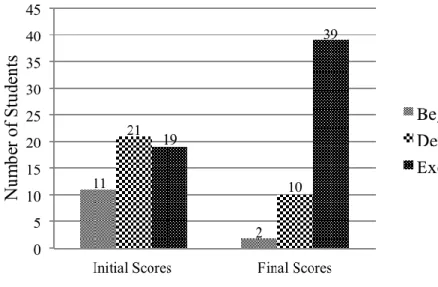
Further, the students were, in the middle of the semester, asked, ‘Do you think what change occurs when a piece of butter melts on a fire? Please explain it scientifically'. And at the end of the semester, they were further asked, ‘John one day perspired quite a lot after a soccer game and noticed chilled. He wondered why he felt cold. Can you help him explain this phenomenon? Please explain it scientifically’. The students were asked to give written responses to these questions. The scores gained in the middle of the semester were considered to be the initial scores and those gained at the end were considered to be the final ones. The students’ scores are depicted in Figure 1.
Figure 1. The students’ explanations
As shown in Figure 1, when the students’ explanations made in the middle of the semester are compared to those made at the beginning, the number of students gaining a score of 2 lifted to 21 and that gaining a score of 3 lifted to 19. Further, when the students’ explanations made in the middle of the semester are compared to those made at the end, the number of students that gained a score of 1 dropped from 11 (22 %) to two (4 %). In a similar tendency, towards the end of the semester the number of students gaining a score of 2 dropped from 21 (41 %) to 10 (20 %). On the other hand, the number of students that gained a score of 3 increased from 19 (37 %) to 39 (76 %). At the end of the semester, therefore, a total of 39 students were able to provide explanations that were scientifically acceptable. Only twelve students were seen gaining a score of 2 or lower. In other words, the number of students at the beginning and developing level decreased; whilst, that of those at the exemplary level increased. These results indicated that there had been a development in the quality of the students’ explanations. In other words, the number of the students that invoked better explanations increased by the end of the semester. The students, initially invoking the beginning level explanations, mostly expressed exemplary level explanations towards the end of the semester.
The Students’ Beliefs about Scientific Explanation
themes and categories, the data was inductively analyzed (Patton, 2002, p.453) and a table of operational definitions for coding categories (see Table 4) was built.
Table 4. Operational definitions for coding categories 1. Scientific Knowledge
1.1. Evidence based Statements that point to empirical aspect of scientific knowledge such as ‘to explain based on experimental and/or observational data’ or ‘explain based on statistical measures or proofs’.
1.2. Objective Statements that point to objectivity of scientific knowledge such as ‘the validity and accuracy of the explanations should be acceptable by everyone’, or ‘explanations should embrace objective premises’ or ‘they should be universal’ or ‘explanations should involve premises that everyone has a consensus on’.
2. Explanation
2.1. Authorized Statements that point to the approval of science authority such as ‘It should look like the scientists’ explanations’ or ‘It should utilize the terms of the books’ or ‘It should look like the explanation in an article or a book’ or ‘It should involve scientific ideas’.
2.2. Scientific Statements that point to the story likeness or relationship amongst the components of an explanation such as ‘It should explain a phenomenon step by step from the beginning’ or ‘It should show causal relationships amongst the premises’ or ‘It should explain one by one and in order’ or ‘It should involve premises presented within a complete story’. 2.3. Reasonable Statements that point to the rationality of the explanation
such as ‘It should be made based on logic and reason’ or ‘It should be made based on reason rather than basing on sense’.
1.3. Intelligible Statements that point to the intelligibility of the explanation such as ‘It should be understandable by every one’.
1.4. Clear Statements that point to the clearness and completeness of the explanation such as ‘It should be invoked in such a way where no one should ask further questions for clarity’. 1.5. Other Few statements that is not really understood such as ‘It is
something that one does on one’s own’ or ‘It is something that every one does and it is concrete’ or ‘It should get in the root of the problem’.
31
18
6
5
4
2
1
1
0
5
10
15
20
25
30
35
N
um
be
r
of
C
od
es
Codes
Figure 2. The students’ beliefs about scientific explanation before the intervention.
As seen in Figure 2, the students’ descriptions suggested eight codes. Because some students’ views suggested more than one code, a total of 68 codes emerged. The proportion of beliefs that a scientific explanation must be evidence based was 46% (voiced 31 times). Further, objective was 26% (voiced 18 times), scientific 9% (6), authorized 7% (5), reasonable 6% (4), other 3% (2), intelligible 1% (1), and finally clear was 1% (1). A total of 72% of the descriptions fell into either the code of evidence based or that of objective. On the other hand, only six (M-2, M-18, F-3, F-13, F-20, F-29) students’ utterances underlined the aspect of causal relationship amongst the components of an appropriate explanation.
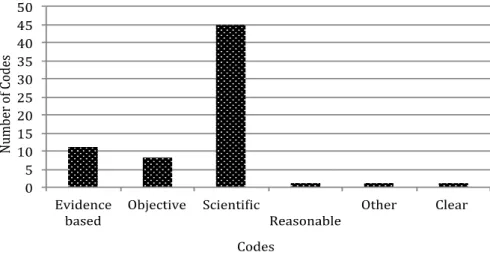
At the end of the semester, on the other hand, the students’ utterances saved between September 24 and October 9, 2012, suggested six distinctive codes. Figure 3 displays the frequency of these codes.
Figure 3. The students’ beliefs about scientific explanation before the intervention.
1% (1), and the codes of other and clear did not change residing at 1 % (1). These results indicated that compared to the beginning of the semester, at the end of the semester, the description of the students showed a trend towards a more scientific one. Towards the end of the semester, the students’ seemed to possess a more scientific view on explanation.
Conclusion and Discussion
The results of the present work indicated that the students’ subjective understanding of explanation was initially at the beginning level signifying a low level understanding. Largely, the students believed that an acceptable explanation could be one word, a short phrase or descriptions of phenomena. However, this belief was in conflict with that of the teacher and caused numerous classroom negotiations to emerge. In the class, the teacher purposefully had the students face numerous natural phenomena and asked for an explanation. This request made the students’ accounts explicit. This ultimately caused surfacing of such situations where the teacher got the chances for discussing legitimacy of, reflecting and making comments on the students’ accounts. The teacher and students therefore together contributed to the interactive constitution of situations for explanation. By witnessing such situations of what is or what is not an acceptable explanation, the students learned what it means to explain something scientifically. The classroom socialization process has therefore influenced both the students’ ability to explain and beliefs about explanation. By participating classroom social activities, many students have been able to learn the meaning of what counts as a scientific explanation. That is, the students’ beliefs about explanation and capability of explaining have in time improved and the term scientific explanation has, in time, seemed to become taken-as-shared.
Further, the teacher assumed a role of representing scientific community (Yackel & Cobb, 1996) and played an active role in declaring her own expectations, planning situations where students were to offer accounts, and legitimized or made comments on those accounts emphasizing significant aspect of an acceptable explanation. The teacher therefore plays a significant role in creating socioscientific norms in the classroom. The students by participating this socialization process, however, have become a part of the community and learnt its culture. Consequently, they have begun to use a special language, science language, to communicate in this unique social group. The important concepts in science such as science as argumentation, the nature of science, scientific thinking, and so forth could be therefore taught in this way.
Acknowledgment
This paper is developed based on a doctoral thesis by Emre Harun Karaaslan
References
.American Association for the Advancement of Science. (2009). Benchmarks for science literacy. (Online). Available: http://www.project2061.org/.
Blumer, H. (1969). Symbolic İnteractionism. Englewood Cliff, NJ: Prentice-Hall.
Braaten, M & Windschitl, M. (2011). Working toward a stronger conceptualization of scientific explanation for science education, Science Education, 95 (4), 639–669.
Cartwright, N. (1997). The truth doesn’t explain much. In D. Rothbart (Ed.), Science, reason, and reality: Issue in the philosophy of science (pp. 161 – 166). Fort Worth, TX: Harcourt Brace.
Cobb, P., Yackel, E. & Wood, T. (1993). Theoretical orientation. In T. Wood, P. Cobb, E. Yackel, & D. Dillon (Eds.) Rethinking elementary school mathematics: insights and issues. Reston, VA: National Council of Teachers of Mathematics.
Cobb, P., Yackel, E., & Wood, T. (1989). Young children's emotional acts while doing mathematical problem solving. In D. B. McLeod & V. M. Adams (Eds.), Affect and mathematical problem solving: A new perspective (pp. 117-148). New York: Springer-Verlag.
Friedman, M. (1974). Explanation and scientific understanding. Journal of Philosophy, 71, 5 – 19. Hempel, C. G. (1966). Philosophy of natural science. Princeton University, NJ: Prentice-Hall.
Hempel, C. G., & Oppenheim, P. (1948). Studies in the logic of explanation. Philosophy of Science, 15(2), 135 – 175.
Millar, R., & Osborne, J. F. (Eds.). (1998). Beyond 2000. Science education for the future. London: King’s College London.
National Research Council. (1996). National science education standards. Washington, DC: The National Academies Press.
Osborne, J., & Dillon, J. (2008). Science education in europe: critical reflections. London: King’s College. Salmon, W. C. (1978). Why ask “Why?” An inquiry concerning scientific explanation. Proceedings and
Addresses of the American Philosophical Association, 51(6), 683 – 705.
Voigt, J. (1995). Thematic patterns of interaction and socio-mathematical norms. In P. Cobb & H. Bauersfield (Eds.), The emergence of mathematical meaning (pp.163-203). New Jersey: Lawrence Erlbaum Associates.
Voigt, J. (1992, August). Negotiation of mathematical meaning in classroom practices: Social inter-action and learning mathematics. Paper presented at the Seventh International Congress on Mathematical Education, Quebec City.
Vygotsky, L. (1981). The genesis of higher mental functions. In J. V. Wertsch (Ed.), The concept of activity in Soviet psychology (pp. 144–188). Armonk, NY: M. E. Sharpe.
Vygotsky, L. S. (1978). Mind in society: The development of higher psychological processes. Cambridge, MA: Harvard University Press.
Yackel, E., & Cobb, P. (1996). Sociomathematical norms, argumentation, and automony in mathematics. Journal for Research in Mathematics Education, 27, 458-477.
Yackel, E., & Rasmussen, C. (2002). Beliefs and norms in the mathematics classroom. In G.C. Leder, E. Pehkonen, & G. Toerner (Eds.), Beliefs: A hidden variable in mathematics education? (pp. 313–330). Dordrecht, The Netherlands: Kluwer.
Appendix A:
Interview Protocol
1- Could you remember a scientific phenomenon that you encountered in everyday life?
- (If she/he recalls one) How do you explain it?
2- Do you think what the term scientific explanation is? Please explain it.
Appendix B
Table below indicates the students’ attendance for the thirteen-week course by weeks. The symbols ✗ and + stands for nonattendance and attendance respectively.
Students Students’ Attendance by Weeks
1 2 3 4 5 6 7 8 9 10 11 12 13 Total
M-1 + + + + + + + + ✗ + + + + 1
M-2 + + + + + + + + + + + + + 0
M-3 + + + + + + + + + + + + + 0
M-4 + + + + + + + + + + + + + 0
M-5 + + + + + + + + + + + + + 0
M-6 ✗ + + + + + + + + + + + + 1
M-7 + + + + + + + + + + + + + 0
M-8 + + + + + + + + + + + + + 0
M-9 + + + + + + + + + + + + + 0
M-10 + + + + + + + + + + + + + 0
M-11 + + + + + + ✗ + + + + + + 1
M-12 + + + + + + + + + + + + + 0
M-13 + + + + + + + + + + + + + 0
M-14 + + + + + + + + + + + + + 0
M-15 + + + + + + + + + + + + + 0
M-16 ✗ + + + + + + + + + + + ✗ 2
M-17 + + + + + + ✗ + + + + + + 1
M-18 ✗ + + + + + + + + + + + + 1
F-1 + + + + + + + + + + + + + 0
F-2 + + + + + + + + + + + + + 0
F-3 + + + + + + + + + + + + + 0
F-4 + + ✗ + + + + + + + + + + 1
F-5 + + + + + + + + + + + + + 0
F-6 ✗ + + + + + + + + + + + + 1
F-7 + + + + + + + + + + + + + 0
F-8 + + + + + + + + + + + + + 0
F-9 ✗ + + + + + + + + + + + + 1
F-10 + + + + + + + + + + + + + 0
F-11 + + + + + + + + + + + + + 0
F-12 + + + + + + + + + + + + + 0
F-13 + + + + + + + + + ✗ + + + 1
F-14 + + + + + + + + + + + + + 0
F-15 + + + + + + + + + + + + + 0
F-16 + + + + + + + + + + + + + 0
F-17 + + + + + + + + + + + + + 0
F-19 + + + + + ✗ + + + + + + + 1
F-20 + + + + + + + + + ✗ + + + 1
F-21 + + + + + + + + + + + + + 0
F-22 + + + + + + ✗ + + + + + + 1
F-23 + + + + + ✗ + + + + + + + 1
F-24 + + + + + + + + + + + + + 0
F-25 + + + + + + + + + + + + + 0
F-26 + + + + + + + + + + + + + 0
F-27 + + + + + + + + + + + + + 0
F-28 + ✗ + + + + + + + + + + + 1
F-29 + + + + + + + + + ✗ + + + 1
F-30 + + + + + + + + + + + + + 0
F-31 + + + + + + + + + + + ✗ + 1
F-32 + + + + + + + + + + + + + 0
F-33 + + + + + + + + + + + + + 0