Churn Identification in Microblogs using Convolutional Neural Networks
with Structured Logical Knowledge
Mourad Gridach
Department of Computer Science High Institute of Technology
Ibn Zohr University, Agadir Morocco
Hatem Haddad
Department of Computer and Decision Engineering, Universit´e Libre de Bruxelles
Belgium
Hala Mulki
Department of Computer Engineering Selcuk University, Konya
Turkey
Abstract
For brands, gaining new customer is more expensive than keeping an existing one. Therefore, the ability to keep customers in a brand is becoming more challenging these days. Churn happens when a cus-tomer leaves a brand to another competi-tor. Most of the previous work consid-ers the problem of churn prediction using CDRs. In this paper, we use micro-posts to classify customers into churny or non-churny. We explore the power of CNNs since they achieved state-of-the-art in var-ious computer vision and NLP applica-tions. However, the robustness of end-to-end models has some limitations such as the availability of a large amount of la-beled data and uninterpretability of these models. We investigate the use of CNNs augmented with structured logic rules to overcome or reduce this issue. We devel-oped our system called Churn teacher by using an iterative distillation method that transfers the knowledge, extracted us-ing just the combination of three logic rules, directly into the weight of Deep Neural Networks (DNNs). Furthermore, we used weight normalization to speed up training our convolutional neural net-works. Experimental results showed that with just these three rules, we were able
to get state-of-the-art on publicly avail-able Twitter dataset about three Telecom brands.
1 Introduction
Customer churn may be defined as the process of losing a customer that recently switches from a brand to another competitor. The churn problem can be tackled from different angles: most of the previous work used Call Detail Records (CDRs) to identify churners from non-churners (Zaratiegui et al., 2015). More recently, with more data became available on the web, brands can use customers opinionated comments via social net-works, forums and especially Twitter to detect churny from non-churny customers. We used the churn dataset developed by (Amiri and Daum´e III, 2015). This dataset was collected from Twitter for three telecommunication brands: Verizon, T-Mobile, and AT&T.
In recent years, deep learning models have achieved great success in various domains and difficult problems such as computer vi-sion (Krizhevsky et al.,2012) and speech recogni-tion (Dahl et al.,2012;Hinton et al.,2012). In nat-ural language processing, much of the work with deep learning models has involved language mod-eling (Bengio et al.,2003;Mikolov et al.,2013), sentiment analysis (Socher et al.,2013), and more recently, neural machine translation (Cho et al., 2014;Sutskever et al.,2014). Furthermore, these models can use backpropagation algorithm for
training (Rumelhart et al.,1988).
Regardless of the success of deep neural net-works, these models still have a gap compared to human learning process. While the success came from the high expressiveness, it leads them to pre-dict results in uninterpretable ways, which could have a negative side effects on the whole learn-ing process (Szegedy et al., 2013;Nguyen et al., 2015). In addition, these models require a huge amount of labeled data, which is considered as time consuming for the community since it re-quires human experts in most applications (natu-ral language and computer vision). Recent works tackled this issue by trying to bridge this gap in different applications: in supervised learning such as machine translation (Wu et al.,2016) and unsu-pervised learning (Bengio et al.,2015).
In the Natural Language Processing (NLP) community, there has been much work to aug-ment the training process with additional and use-ful features (Collobert et al.,2011) which proved its success in various NLP applications such as Named Entity Recognition (NER) and Sentiment Analysis. The majority of these works used pre-trained word embeddings obtained from unlabeled data to initialize their word vectors, which allow them to improve the performance. Another solu-tion came from integrating logical rules extracted from the data directly into the weights of neu-ral networks. (Hu et al., 2016) explored a distil-lation framework that transfers structured knowl-edge coded as logic rules into the weights of neural networks. (Garcez et al.,2012) developed a neural network from a given rule to do reasoning.
In this paper, we combine the two ideas: firstly, we used unsupervised word representations to ini-tialize our word vectors. We explored three differ-ent pretraiend word embeddings and compared the results with a randomly sampled one. Secondly, we used three main logic rules, which were proven to be useful and crucial. The “but” rule was ex-plored by (Hu et al.,2016) in sentiment analysis and we add two new rules: “switch to” and “switch from”. (Amiri and Daum´e III,2016) showed that the last two rules have a remarkable influence into the churn classification problem.
Moreover, in order to accelerate training our model on churn training dataset, we conduct an investigation of using weight normalization ( Sali-mans and Kingma,2016), which is a new recently developed method to accelerate training deep
neu-ral networks.
Experiments on Twitter dataset built from a large number of tweets about three Telecommu-nication brands show that we were able to obtain state-of-the-art results for churn classification in microblogs. Our system, calledChurn teacher, is constructed by using a structured logical knowl-edge expressed into three logic rules transferred into the weights of convolutional neural networks. We outperform the previous models based on hand engineering features or also using recurrent neural networks combined with minimal features. Our system is philosophical close to (Hu et al.,2016), which showed that combining deep neural net-works with logic rules performed well on two NLP tasks: NER and Sentiment Analysis.
The rest of this paper is structured as follows: in section 2, we discuss the related work done in churn prediction application. In section 3, we present our churn prediction approach which is based on structured logical knowledge transferred into the weights of Convolutional Neural Net-works (CNNs). In section 4, we discuss the impact of pretrained word embeddings on the churn clas-sification. The experimental results are presented in section 5. Finally, we present the conclusion with the future work in section 6.
2 Related Work
Churn prediction is an important area of focus for sentiment analysis and opinion mining. In the 2009, ACM Conference on Knowledge Dis-covery and Datamining (KDD) hosted a compe-tition on predicting mobile network churn using a large dataset posted by Orange Labs, which makes churn prediction, a promising application in the next few years. We can divide the previ-ous work on Customer churn prediction in two research groups: the first group uses data from companies such as Telecom providers, banks, or other organizations. More recently, with the ex-plosion of social networks, researchers are inter-ested to use social networks such as Twitter to pre-dict churners.
etc.), transaction data through electronic banking portals (ATM, mobile bank, telephone bank, etc.), and others. They used a method called CRISP-DM which contains six phases: Business under-standing, Data underunder-standing, Data preprocessing, Modeling, Evaluation and Deployment. At the final stage, they used a decision tree method to model the previous phases.
(Backiel et al.,2016) studied the impact of in-corporating social network information into churn prediction models. The authors used three dif-ferent machine learning (ML) techniques: logistic regression, neural networks and Cox proportional hazards. To extract features to use with these ML techniques, they built a call graph, which allowed them to extract the relevant features.
(Li et al., 2016) developed a model based on stacked auto-encoder as a feature extractor to de-tect the most influential features in Telecom churn prediction. In addition, they proposed a second model where they augmented the previous model with a Fishers ration analysis called Hybrid Stack Auto-Encoder (HSAE). The models were evalu-ated on Orange datasets. Experimental results showed that the HSAE model outperformed all the other models including Principal Component Analysis (PCA).
More recently, researchers tackle the churn pre-diction problem using data collected from mi-croblogs. (Amiri and Daum´e III,2015) developed a system for churn prediction in microblogs. They investigated the machine learning models such as support vector machines, and logistic regression with the combination of extracted features. Fur-thermore, they investigated the use of three differ-ent churn indicators: demographic, contdiffer-ent, and context indicators. Experimental results showed that the combination of the three indicators lead to the best performance.
(Amiri and Daum´e III, 2016) used the power of Recurrent Neural Networks (RNN) as a repre-sentation learning models in order to learn micro-post and churn indicator representations. The ex-periments on publicly available Twitter dataset showed the efficiency of the proposed method in classifying customers in churners and non-churners. Moreover, authors showed that the churn classification problem is different from clas-sical sentiment analysis problem since the pre-vious state-of-the-art sentiment analysis systems failed to classify churny/non-churny customers.
In this work, we focus on churn prediction in microblogs where we use a publicly available Twitter dataset provided by (Amiri and Daum´e III, 2015) to evaluate our system.
3 The Proposed System
In this section, we introduce our system that en-ables a convolutional neural network to learn si-multaneously from logic rules and labeled data in order to classify customers as churners and non-churners. The general architecture of our sys-tem can be seen as the combination of the knowl-edge distillation (Hinton et al., 2015) and the posterior regularization method (Ganchev et al., 2010). (Hu et al.,2016) explored this combination to build two systems for English sentiment analy-sis and named entity recognition. We show that this framework can also be applied to customer churn prediction by deriving more logic rules and transfer the structured logical knowledge into the weights of a convolutional neural network.
3.1 Problem Formulation
For the purpose of this paper, let us assume we havex∈ X is the input variable andy∈ Y is the target variable. Let us consider the training data
D={(xn, yn)}Nn=1which is a set of instantiations of(x, y) andN is the number of training exam-ples in our dataset. For the purpose and the clar-ity of this paper, we focus on classification prob-lem where the target y is a one-hot encoding of the class labels. We consider a subset of the train-ing data (X, Y) ⊂ (X,Y) as a set of instances of(x, y). A neural network defines a conditional probabilitypθ(y|x)parameterized byθ.
3.2 Neural Network with Structured Logical Knowledge
In this section, we describe the distillation method that allowed our system to transfer the structured logical knowledge into the weights of convolu-tional neural networks to classify customers as churners and non-churners.
Let us define the set of constraint functions fl
such that: fl ∈ X × Y → R, wherelis the index
to satisfy (i.e., maximize by optimizing the predic-tions y) with confidence weightsλl ∈ R.
The construction of a structure-enriched teacher network q at each iteration from the neural net-work parameters is obtained by solving the fol-lowing optimization problem:
min
q∈P KL(q(Y)||pθ(Y|X))−C X
l
λlEq[fl(X, Y)]
(1)
where P denotes the appropriate distribution space; and C is the regularization parameter. In this paper, the teacher is called Churn teacher where its main goal is to teach the model to clas-sify customers from churners and non-churners. The closeness between our Churn teacher and pθ, which represents the conditional probability
obtained by the softmax output layer of the con-volutional neural network, is measured using the Kullback-Leibler (KL) divergence where the aim is minimizing it. We note that problem (1) is con-vex and has a closed-form solution given by the following:
q∗(Y)∝pθ(Y|X) exp{C X
l
λlfl(X, Y)} (2)
It should be noted that the normalization term can be computed efficiently through direct enu-meration of the chosen rule constraints. At each iteration, the probability distribution of the neu-ral networkpθis updated using the distillation
ob-jective (Hinton et al.,2015) that balances between imitating soft predictions of ourChurn teacher qand predicting true hard labels:
θ(t+1) =arg min
θ∈Θ 1 N
XN
n=1(1−π)l(yn, σθ(xn))
+πl(sp(nt), σθ(xn))
(3)
whereldenotes the cross entropy loss function that we used in this paper;N is the training size; σθ(x)is the softmax output ofpθ onx;spnis the
soft prediction vector of theChurn teacher qon training pointxnat iterationtandπ is the
imita-tion parameter calibrating the relative importance of the two objectives. In addition to their teacher
q, (Hu et al.,2016) tested their results using a stu-dent networkp. Related to their experimental re-sults, the teacherqalways gives better results than the studentp. We decide to only use the teacher networkqcalled in our work theChurn teacher. 3.3 Neural Network Architecture
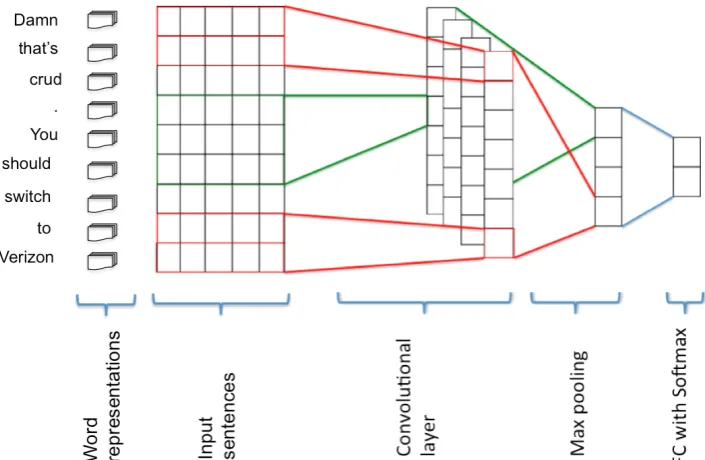
In this section, we give an overview of the con-volutional neural network used in our work. The main architecture of our CNN is depicted in Figure 1. We followed the convolutional neural network architecture as proposed by (Kim,2014).
In the first step, we initialize each word in a sentence T with length n with pretrained word representations learned from unannotated corpora. Then, we add padding whenever it is necessary for the model.T is represented as the following:
vn1 =v1⊕v2⊕...⊕vn (4)
wherevirepresents the word vector of thei−th
word in the sentenceT and⊕represents the con-catenation operator. We use successive filterswto obtain multiples feature map. Each filter is applied to a window of m words to get a single feature map: Fi = φ(w.vii+m−1+b)wherebis the bias
andφdenotes an elementwise nonlinearity where we used ReLU (Rectified Linear Unit). In the next step, we applied a max-over-time pooling opera-tion (Collobert et al.,2011) to the feature map and take the maximum value. The results are fed to a fully connected softmax layer to get probabilities over the sentences. Figure 1 illustrates the archi-tecture of our system where we consider the sys-tem is classifying the input sentence: “Damn thats crud. You should switch to Verizon”.
3.4 Logic Rules
In the early stages of the expansion of artificial in-telligence, (Minsky,1983) argued that the cogni-tive process of human beings learn from two dif-ferent sources: examples as deep neural networks are doing these days and also from rich experi-ences and general knowledge. For this reason, we will use both of the sources for churn predic-tion in microblogs where the convolupredic-tional neural network learns from examples and logic rules add structured knowledge into the weights of CNN by playing a role of a regularizer in the learning pro-cess.
Figure 1: The system architecture. The word vectors are initialized with pretrained word representa-tions from one of the three models: GloVe, Skip-Gram or CBOW. We feed these word vectors to the convolutional neural network as input sentences followed by a max-pooling overtime followed by a fully-connected layer and softmax to get probabilities (FC with Softmax)
borrow the first logic rule from sentiment analy-sis literature by using the conjunction word “but”. It has been shown that “but” played a vital role in determining the sentiment of a sentence where the overall sentiment is dominated by the clauses following the word “but” (Jia et al.,2009;Dadvar et al., 2011; Hogenboom et al., 2011; Hu et al., 2016). For a given sentence with “C1butC2”, we assume that the sentiment of the whole sentiment will take the polarity of clauseC2.
The second logic rule that we used is “switch from” considered as a target-dependent churn classification rule. (Amiri and Daum´e III, 2016) showed that “switch from” can have an important role to classify if the customer will be churner or non-churner. The last logic rule that we explored in our work is similar to the second rule for be-ing target dependent churn classification where we substitute the preposition “from” to be the prepo-sition “to” to obtain “switch to”. For a given sentence with the form “C1 switch to C2”, it is clear that the customer will choose to switch to the brand present in clauseC2.
Consider the two examples from the training data:
• Damn thats crud. You should switch to Veri-zon.
• Gonna switch from bad @verizon internet to @comcast. @VerizonFiOS will never be in my area and i bet @googlefiber will get here first.
In the first example, the customer will switch to the brand “Verizon” while for the second exam-ple, the customer will leave the brand “Verizon” to another competitor. Consequently, with respect to the brand “Verizon”, the first tweet is classified as “Non-churny” and the second tweet is classified as “Churny”.
To encode these rules, we used soft logic (Bach et al., 2015) where we can represent truth values from the interval [0, 1]. The main Boolean opera-tors are formulated as the following (Foulds et al., 2015):
X&Y =max{X+Y −1,0}
X∨Y =min{X+Y,1}
X1∧...∧XN = X
i
Xi
N
¬X= 1−X
This logic rule “but” is written as follows:
has“C1-but-C2”structure(S) =⇒
[1(y= +) =⇒ σθ(C2)+∧σθ(C2)+ =⇒ 1(y= +)]
(6)
In the equation above,1(.)represents an indica-tor function that can take two values:1if the argu-ment is true, and0otherwise. Class “+” represents “positive”; andσθ(C2)+is the element ofσθ(C2)
for class “+”. Following the Equation 5, whenS has the “C1- but-C2” structure, the truth value of the above logic rule equals to (1 +σθ(C2)+)/2 when y = “+”, and(2−σθ(C2)+)/2otherwise.
For the two other logic rules “switch to” and “switch from”, we followed the same structure of the “but” rule with a slightly different settings:
has“C1-switch to/from-C2”structure(S) =⇒
[1(y= +) =⇒ σθ(C2)+∧σθ(C2)+ =⇒ 1(y= +)]
(7)
For the logic rule “switch to”, if we are classi-fying the sentenceSwith respect to a brand in the clause C2, then the argument will be true which gives the formula: (1 + (σθ(C2)+)/2. The logic rule “switch from” plays an opposite role where if a brand is in clauseC2, the overall sentiment will be negative with respect to this brand, so we use this formula:(2−σθ(C2)+)/2.
3.5 Training Details
Training is done using stochastic gradient de-scent over mini-batches with the Adadelta up-date rule (Zeiler,2012). Word vectors are initial-ized using pretrained word embeddings and fine-tuned throughout training. At each iteration of the training process, we enumerate the rule con-straints (or a set of rules if we use them all at once) in order to compute the soft predictions of our Churn teacher q by using the equation 2. During the experiments, we choose the imitation parameter to be π(t) = 1−0.85tand the regu-larization parameter to be C = 100. We set the confidence levels of rules to beλl = 1. It should
be noted that we used the model results on devel-opment set in order to select the best hyperparam-eters. The training procedure is summarized in al-gorithm 1.
Algorithm 1: Churn prediction using CNN with logic rules Input: The training dataD={(xn, yn)}Nn=1
The rule setR={(Rl, λl)}3l=1 Parameters:π- imitation parameter
C regularization strength Initialize neural network parameters Choose the rule Rl or a set of rules do
Sample a minibatch (X, Y )⊂ D
Build theChurn teachernetwork using Equation 2 Updatepθusing Equation 3
while not converged Output: Churn teacher q
3.6 The Effect of Weight Normalization It should be noted that we use weight normaliza-tion which is a new method introduced by ( Sal-imans and Kingma, 2016) to reparameterize the weight vectors in a deep neural network in or-der to decouple the length of those weight vec-tors from their direction. Using this method, the authors showed that they were able to improve the conditioning of the optimization problem and speed up convergence of stochastic gradient de-scent. This method followed earlier work by (Ioffe and Szegedy, 2015) where they introduced batch normalization trying to normalize each neuron output by the mean and standard deviation of the outputs computed over a minibatch of examples. More recently, this method was widely used in deep learning architectures such as deep convolu-tional neural networks, deep reinforcement learn-ing, generative adversarial networks (GANs) and others (Smith and Topin, 2016; Gehring et al., 2017). Using weight normalization in training our convolutional neural network allowed us to accel-erate convergence of stochastic gradient descent.
4 Input Word Embeddings
Base NN Word Embeddings Model F1 score
CNN Random embeddings 77.13
CNN Continuous bag-of-words 79.89
CNN Skip-Gram 79.55
[image:7.595.80.283.62.113.2]CNN GloVe 80.67
Table 1: Results with different choices of pre-trained word embeddings with a comparison with randomly initialized ones on churn predicition in microblogs
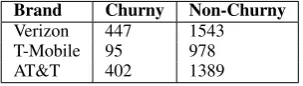
[image:7.595.306.531.62.135.2]Brand Churny Non-Churny Verizon 447 1543 T-Mobile 95 978 AT&T 402 1389
Table 2: Statistics and details about the churn mi-croblog dataset.
this model and word2vec models is the represen-tations of a word in vector space: word2vec mod-els use a window approach while GloVe uses the global statistics of word-word co-occurrence in the corpus to be captured by the model.
(Hisamoto et al.,2013) used word embeddings features for English dependency parsing where they employed flat (non-hierarchical) cluster IDs and binary strings obtained via sign quantization of the vectors. For chunking, (Turian et al.,2010) showed that adding word embeddings allows the English chunker to increase its F1-score. (Huang et al.,2014) showed that adding word embeddings as features for English part-of-speech (POS) tag-ging task helped the model to increase its per-formance. (Bansal et al., 2014) argued that us-ing word embeddus-ings in parsus-ing English text im-proved the system performance. For English sen-timent analysis, (Kim, 2014) showed that using pretrained word embeddings helped their system to improve its accuracy.
As in (Collobert et al., 2011), in order to test the importance of pretrained word embeddings in churn prediction for microblogs, we performed ex-periments with different sets of publicly published word embeddings, as well as a random sampling method, to initialize word vectors in our model. We investigate three different pretrained word em-beddings: Skip-Gram, continuous bag-of-words and Stanford’s GloVe model. Table 1 gives the performance of three different word embeddings, as well as the randomly sampled one. It should be noted that the random embeddings are uniformly sampled from range [−q 3
dim,+ q
3
dim], where
dimis the dimension of embeddings. According
Models Precision Recall F1
CNN 75.36 79 77.13
CNN + pretrained 79.28 82.11 80.67
CNN-pre + but 80.84 83.09 81.95
CNN-pre + switch from 79.74 82.14 80.92 CNN-pre + switch to 80.89 84.39 82.60 CNN-pre + all the 3 rules 82.56 85.18 83.85
Table 3: Results with the three logic rules com-pared to the without and with word embeddings. We test the model by using each rule indepen-dently and after that we combine them in one ex-periment.
to the results in Table 1, we see that using pre-trained word embeddings obtain a significant im-provement, about 3.54% in F1 score as opposed to the ones using random embeddings. This is consistent with results reported by previous work done in other NLP tasks (Collobert et al., 2011; Huang et al.,2015;Chiu and Nichols,2015).
For different pretrained embeddings, Stanford’s GloVe 300 dimensional embeddings achieves best results, about 1.12% better than Skip-gram model and 0.78% better than continuous bag-of-words model. One possible reason that Word2Vec is not as good as the Stanford’s GloVe model is because of vocabulary mismatch, since Word2Vec embed-dings were trained in case-sensitive manner, ex-cluding many common symbols such as punctua-tions and digits. Because we do not use any kind of data pre-processing to deal with such common symbols or rare words, it might be an issue for us-ing Word2Vec.
5 Experimental Results
For the evaluation of our model, we use the dataset provided by (Amiri and Daum´e III,2015). The au-thors collected the data from twitter for three tele-com brands: Verizon, T- Mobile, and AT&T. Ta-ble 2 presents the details about the entries of this dataset. We divide the experimental process into two stages: the first stage concerns running the experiments using the convolutional neural net-work without and with different logic rules in or-der to select the best achieved results. In the sec-ond stage, we compare our best settings with the previous state-of-art system in churn prediction in microblogs.
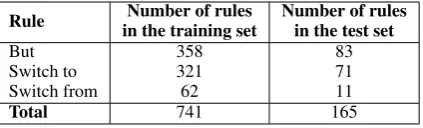
[image:7.595.106.258.188.231.2]Rule in the training setNumber of rules Number of rulesin the test set
But 358 83
Switch to 321 71
Switch from 62 11
Total 741 165
Table 4: Statistics about the three rules (but, switch to and switch from) in the training and test set.
pretrained word vectors using GloVe model since it gives us the best results among the other pre-trained word vectors. We get an improvement around 2.5% in F1-score. We refer to this model by “CNN-pre”. This results is consistent with the fact that these pretrained word vectors are univer-sal feature extractors that shown an important re-sults in different NLP applications such as senti-ment analysis, named entity recognition and Part-of-speech tagging.
By transferring the knowledge extracted using the “but” logic rule into the weights of the con-volutional neural network, we were able to im-prove the F1-score over the CNN-pre model by 1.28 points in F1-score. For the “switch from” logic rule, we get a slight improvement over the CNN-pre model by 0.25 points in F1-score. The biggest improvement among the three logic rules was obtained by the “switch to” rule where we were able to improve the performance over the CNN-pre model by 1.93 points in F1-score. The last row in Table 3 concerns the results that we ob-tained by using all the three logic rules where log-ically we achieved best results and outperformed the CNN-pre model by 3.18 points in F1-score.
While we do not have a complete explanation why we got better results with “switch to” rule, we believe that it is caused by the fact that there 321 sentences in the training data containing this rule which represents around 8% sentences con-tains the word “switch to”. Moreover, it will be clear that customer will leave a specific brand to another new brand. For the “switch from” rule, we get slight improvement over the CNN-pre model because few sentences containing this rule (around 2% sentences contains the word “switch from”).
Table 4 shows the statistics about the presence of the three rules in the training data. For “but” rule, we also get an important improvement over the CNN-pre model which confirms the results ob-tained by (Hu et al.,2016) using the same rule in sentiment analysis. We note that around 9%
sen-Models F1 score
Unigram + Nb (Amiri and Daum´e III,2015) 73.42 (Amiri and Daum´e III,2016) 78.30
[image:8.595.308.528.60.105.2]Churn teacher 83.85
Table 5: Comparison of our system with two pre-vious systems.
tences contains the word “but”. In the last row, we combine all the three rules and we were able to ob-tain the best performance. We refer to this model as “Churn teacher”. This is consistent with the argument by (Hu et al.,2016) where they argued that more rules will allow the system to improve its performance over the base convolutional neural network.
We test our model using this dataset and com-pare the obtained results with two other sys-tems. The state-of-the-art results were produced by (Amiri and Daum´e III, 2016) where they achieved 78.30% in F1 score. They used a com-bination of Bag of Words features and Recurrent Neural Networks. The second system referenced here as “Unigram + Nb” developed by (Amiri and Daum´e III, 2015) used different N-grams (n = 1,2,3)and their combination on both of the word and character levels.
By adding three rules to the convolutional neu-ral networks, we outperformed the “Unigram + Nb” system by a large margin (10.43 points in F1-score). Furthermore, our model also outperformed the system developed by (Amiri and Daum´e III, 2016) by a good margin (5.55 points in F1-score). Table 5 shows a brief presentation of the exper-imental results and the comparison with the two other systems.
6 Conclusion
In this paper, we explored the problem of target-dependent churn classification in microblogs. We combine the power of convolutional neural net-works with structured logic knowledge by con-structing a churn teacher capable of classifying customers into churners and non-churners. In addition, we confirm that initializing word vec-tors with pretrained word embeddings trained on unannotated corpora improved the system perfor-mance.
[image:8.595.77.289.62.126.2]com-bining three logic rules, our model largely outper-formed all the previous models on publicly avail-able Twitter dataset. We showed that “but” rule is also useful for churn prediction to confirm the results obtained for sentiment classification prob-lem. We consider the two other rules (“switch to” and “switch from”) as target-specific rules for churn classification problem which helped the sys-tem to improve its performance.
In the future work, we will explore the use of character-level embeddings where we will repre-sent word in a repre-sentence by a word vector rep-resenting the concatenation of two embeddings: its equivalent word embeddings obtained from the lookup table and the embeddings obtained from its characters. Furthermore, we will explore the use of named entity recognition to recognize differ-ent organizations where we will focus on brands which we believe could help us to a better churn classification.
Acknowledgments
We thank the anonymous reviewers for their valu-able comments. We would like to thank Doctor Hadi Amiri and Doctor Hal Daume III for provid-ing us with Twitter dataset for churn prediction in microblogs.
References
Hadi Amiri and Hal Daum´e III. 2015. Target-dependent churn classification in microblogs. In
AAAI. pages 2361–2367.
Hadi Amiri and Hal Daum´e III. 2016. Short text rep-resentation for detecting churn in microblogs. In
AAAI. pages 2566–2572.
Stephen H Bach, Matthias Broecheler, Bert Huang, and Lise Getoor. 2015. Hinge-loss markov random fields and probabilistic soft logic. arXiv preprint arXiv:1505.04406.
Aim´ee Backiel, Bart Baesens, and Gerda Claeskens. 2016. Predicting time-to-churn of prepaid mobile telephone customers using social network analy-sis. Journal of the Operational Research Society
67(9):0.
Mohit Bansal, Kevin Gimpel, and Karen Livescu. 2014. Tailoring continuous word representations for dependency parsing. InACL (2). pages 809–815. Yoshua Bengio, R´ejean Ducharme, Pascal Vincent, and
Christian Jauvin. 2003. A neural probabilistic lan-guage model.Journal of machine learning research
3(Feb):1137–1155.
Yoshua Bengio, Dong-Hyun Lee, Jorg Bornschein, Thomas Mesnard, and Zhouhan Lin. 2015. Towards biologically plausible deep learning. arXiv preprint arXiv:1502.04156.
Jason PC Chiu and Eric Nichols. 2015. Named en-tity recognition with bidirectional lstm-cnns. arXiv preprint arXiv:1511.08308.
Kyunghyun Cho, Bart Van Merri¨enboer, Dzmitry Bah-danau, and Yoshua Bengio. 2014. On the properties of neural machine translation: Encoder-decoder ap-proaches. arXiv preprint arXiv:1409.1259. Ronan Collobert, Jason Weston, L´eon Bottou, Michael
Karlen, Koray Kavukcuoglu, and Pavel Kuksa. 2011. Natural language processing (almost) from scratch. Journal of Machine Learning Research
12(Aug):2493–2537.
Maral Dadvar, Claudia Hauff, and FMG De Jong. 2011. Scope of negation detection in sentiment analysis . George E Dahl, Dong Yu, Li Deng, and Alex Acero.
2012. Context-dependent pre-trained deep neural networks for large-vocabulary speech recognition.
IEEE Transactions on Audio, Speech, and Language Processing20(1):30–42.
James Foulds, Shachi Kumar, and Lise Getoor. 2015. Latent topic networks: A versatile probabilistic pro-gramming framework for topic models. In Interna-tional Conference on Machine Learning. pages 777– 786.
Kuzman Ganchev, Jennifer Gillenwater, Ben Taskar, et al. 2010. Posterior regularization for structured latent variable models. Journal of Machine Learn-ing Research11(Jul):2001–2049.
Artur S d’Avila Garcez, Krysia Broda, and Dov M Gabbay. 2012. Neural-symbolic learning systems: foundations and applications. Springer Science & Business Media.
Jonas Gehring, Michael Auli, David Grangier, De-nis Yarats, and Yann N Dauphin. 2017. Convolu-tional sequence to sequence learning.arXiv preprint arXiv:1705.03122.
GE Hinton, DE Rumelhart, and RJ Williams. 1985. Learning internal representations by back-propagating errors. Parallel Distributed Processing: Explorations in the Microstructure of Cognition1. Geoffrey Hinton, Li Deng, Dong Yu, George E Dahl,
Abdel-rahman Mohamed, Navdeep Jaitly, Andrew Senior, Vincent Vanhoucke, Patrick Nguyen, Tara N Sainath, et al. 2012. Deep neural networks for acoustic modeling in speech recognition: The shared views of four research groups.IEEE Signal Process-ing Magazine29(6):82–97.
Sorami Hisamoto, Kevin Duh, and Yuji Matsumoto. 2013. An empirical investigation of word repre-sentations for parsing the web. In Proceedings of ANLP. pages 188–193.
Alexander Hogenboom, Paul Van Iterson, Bas Heer-schop, Flavius Frasincar, and Uzay Kaymak. 2011. Determining negation scope and strength in senti-ment analysis. In Systems, Man, and Cybernet-ics (SMC), 2011 IEEE International Conference on. IEEE, pages 2589–2594.
Zhiting Hu, Xuezhe Ma, Zhengzhong Liu, Eduard Hovy, and Eric Xing. 2016. Harnessing deep neural networks with logic rules. arXiv preprint arXiv:1603.06318.
Fei Huang, Arun Ahuja, Doug Downey, Yi Yang, Yuhong Guo, and Alexander Yates. 2014. Learning representations for weakly supervised natural lan-guage processing tasks. Computational Linguistics
40(1):85–120.
Zhiheng Huang, Wei Xu, and Kai Yu. 2015. Bidirec-tional lstm-crf models for sequence tagging. arXiv preprint arXiv:1508.01991.
Sergey Ioffe and Christian Szegedy. 2015. Batch nor-malization: Accelerating deep network training by reducing internal covariate shift. arXiv preprint arXiv:1502.03167.
Lifeng Jia, Clement Yu, and Weiyi Meng. 2009. The effect of negation on sentiment analysis and retrieval effectiveness. InProceedings of the 18th ACM con-ference on Information and knowledge management. ACM, pages 1827–1830.
Abbas Keramati, Hajar Ghaneei, and Seyed Moham-mad MirmohamMoham-madi. 2016. Developing a predic-tion model for customer churn from electronic bank-ing services usbank-ing data minbank-ing. Financial Innova-tion2(1):10.
Yoon Kim. 2014. Convolutional neural net-works for sentence classification. arXiv preprint arXiv:1408.5882.
Alex Krizhevsky, Ilya Sutskever, and Geoffrey E Hin-ton. 2012. Imagenet classification with deep con-volutional neural networks. In Advances in neural information processing systems. pages 1097–1105. Ruiqi Li, Peng Wang, and Zonghai Chen. 2016. A
feature extraction method based on stacked auto-encoder for telecom churn prediction. InAsian Sim-ulation Conference. Springer, pages 568–576. Tomas Mikolov, Ilya Sutskever, Kai Chen, Greg S
Cor-rado, and Jeff Dean. 2013. Distributed representa-tions of words and phrases and their compositional-ity. InAdvances in neural information processing systems. pages 3111–3119.
Marvin Minsky. 1983. Learning meaning. Artificial Intelligence Laboratory, Massachusetts Institute of Technology.
Anh Nguyen, Jason Yosinski, and Jeff Clune. 2015. Deep neural networks are easily fooled: High con-fidence predictions for unrecognizable images. In
Proceedings of the IEEE Conference on Computer Vision and Pattern Recognition. pages 427–436. Jeffrey Pennington, Richard Socher, and Christopher D
Manning. 2014. Glove: Global vectors for word representation. InEMNLP. volume 14, pages 1532– 1543.
David E Rumelhart, Geoffrey E Hinton, and Ronald J Williams. 1988. Learning representations by back-propagating errors.Cognitive modeling5(3):1. Tim Salimans and Diederik P Kingma. 2016. Weight
normalization: A simple reparameterization to ac-celerate training of deep neural networks. In Ad-vances in Neural Information Processing Systems. pages 901–901.
Leslie N Smith and Nicholay Topin. 2016. Deep con-volutional neural network design patterns. arXiv preprint arXiv:1611.00847.
Richard Socher, Alex Perelygin, Jean Y Wu, Jason Chuang, Christopher D Manning, Andrew Y Ng, Christopher Potts, et al. 2013. Recursive deep models for semantic compositionality over a senti-ment treebank. InProceedings of the conference on empirical methods in natural language processing (EMNLP). volume 1631, page 1642.
Ilya Sutskever, Oriol Vinyals, and Quoc V Le. 2014. Sequence to sequence learning with neural net-works. InAdvances in neural information process-ing systems. pages 3104–3112.
Christian Szegedy, Wojciech Zaremba, Ilya Sutskever, Joan Bruna, Dumitru Erhan, Ian Goodfellow, and Rob Fergus. 2013. Intriguing properties of neural networks. arXiv preprint arXiv:1312.6199. Joseph Turian, Lev Ratinov, and Yoshua Bengio. 2010.
Word representations: a simple and general method for semi-supervised learning. InProceedings of the 48th annual meeting of the association for compu-tational linguistics. Association for Computational Linguistics, pages 384–394.
Yonghui Wu, Mike Schuster, Zhifeng Chen, Quoc V Le, Mohammad Norouzi, Wolfgang Macherey, Maxim Krikun, Yuan Cao, Qin Gao, Klaus Macherey, et al. 2016. Google’s neural ma-chine translation system: Bridging the gap between human and machine translation. arXiv preprint arXiv:1609.08144.
Jaime Zaratiegui, Ana Montoro, and Federico Cas-tanedo. 2015. Performing highly accurate pre-dictions through convolutional networks for ac-tual telecommunication challenges. arXiv preprint arXiv:1511.04906.