Please cite this article as: S. Javanmardi, H. Hosseini-nasab, A. Mostafaeipour, M. Fakhrzad, H. Khademizare, Developing a New Algorithm for a Utility-based Network Design Problem with Elastic Demand, International Journal of Engineering (IJE), TRANSACTIONSB: Applications Vol. 30, No. 5, (May 2017) 758-767
International Journal of Engineering
J o u r n a l H o m e p a g e : w w w . i j e . i rDeveloping a New Algorithm for a Utility-based Network Design Problem with Elastic
Demand
S. Javanmardi, H. Hosseini-nasab*, A. Mostafaeipour, M. Fakhrzad, H. Khademizare
Department of Industrial Engineering, Yazd University, Yazd, Iran
P A P E R I N F O
Paper history: Received 30October2016
Received in revised form 04February 2017 Accepted 26February 2017
Keywords:
Network Design Problem Preventive Healthcare Utility
Elastic Demand Congestion
A B S T R A C T
Developing the infrastructures for preventing non-communicable diseases is one of the most important goals of healthcare context in recent years. In this regard, the number and capacity of preventive healthcare facilities as well as assignment of customers to facilities should be determined for each region. Besides the accessibility, the utility of customers is a determinative factor in participation of people in the offered programs. In this paper, a service network design problem is studied such that the utility function is incorporated in the objective function, and the constraints set. The travel distance is deterministic and demand elasticity results in congestion delays. After simplifying the nonlinear model, a bi-level optimization algorithm is proposed to obtain the optimal solution. Computational results assure the efficiency of the developed algorithm. Finally, the capability of the model is represented by discussing a case study of locating preventive healthcare facilities in Yazd, Iran.
doi: 10.5829/idosi.ije.2017.30.05b.16
1. INTRODUCTION1
According to the Iran's 20-year vision plan12, preparing the necessary plans to take care of causing factors of non-communicable diseases is one of the important topics in healthcare management context. Some of the national goals in the event of mentioned plans consist of developing the required infrastructures in order to control the causing factors of non-communicable diseases, assessment of the plans, and improving the knowledge level of the public. In some regions, preventive medical clinics, that offer the preventive care services, including blood pressure tests, diabetic tests, and cardiovascular tests are not sufficient. This results in increasing the number of people suffering from such diseases as well as imposing high expenses on the families and government. In order to resolve the shortage of preventive care centers, initially, the
required number and the capacity level of
aforementioned centers should be determined in each
*Corresponding Author’s Email: [email protected] (H. Hosseini-nasab) 1.2 Expediency Discernment Council, Iran's 20-year vision plan, 2003
region. This problem is analogous to the covering problem which has been studied for a long time. The review papers of schilling et al. [1] and Farahani et al. [2] summarized them as well. However, the problems that studied the accessibility of customers to facilities are different from the covering problems. Since, the accessibility of the customers to the facilities is decreased when the distance between customers and facilities is increased, and no fixed coverage radius is given.
preventive healthcare facilities. Recently, Aboolian et al. [11] discussed a network design problem with the objective of maximizing the accessibility of customers to facilities.
So far, several demand functions are introduced to the literature and the most prevalent ones can be mentioned as below. Linear functions can be seen in Parker and Srinivasan [12] and Verter and Lapierre [7]. Berman and Parkan [13, 14], and Berman and Drezner [15] utilized the exponential functions and Berman and Krass [16] and Berman et al. [17] worked with step functions.
From demand elasticity and congestion delay’s point of view, besides the mentioned studies in healthcare environment, the proposed models by Marianov and serra [18] and Marianov and Rios [19], explicitly restricted the waiting time in facilities. This point is considered implicitly in Wang et al. [20], and Berman and Drezner [15, 21] by assigning penalties to congestion delays. Jafari and Arkat [22] studied the network location problem for single-server facilities that are subjected to congestion. Zabihi and Sahraeian [23] presented an example of applying the bi-level optimization algorithm.
In addition to the shortage of preventive care centers, having more difficulty in receiving the services (such as time-related expenses) rather than the value of service to customers, results in not participating in the programs. Therefore, beyond the accessibility of customers, the level of utility of people should be considered as a determinant factor.
In this paper, a network design problem of preventive healthcare facilities is studied. The accessibility of customers is maximized, while the cost of locating the facilities is controlled, and the level of corresponding utilities is incorporated in the objective function. In this problem, the optimal number, the locations and capacity level of the facilities are determined. Also, the utility-related constrains are incorporated in the model. The travel distance is assumed to be deterministic, and the customer demand has been considered to be elastic. Initially, by applying a simple innovative method, the problem is simplified and a bi-level optimization algorithm is proposed to find the optional solution.
The most relevant paper to ours is Aboolian et al. [11]. The maximal covering-related constraints are considered in their paper. However, the level of utility of customers is incorporated in our objective function as a weight for accessibility of customers, which is not considered in Aboolian’s work. Furthermore, the total capacity of facilities is controlled in our objective function, but they restricted it by a constraint. In addition, the utility-related constraints are not incorporated in their model.
2. PROBLEM DEFINITION
Apreventive healthcare facility network design problem is represented in this paper. This problem is about to find out the optimal location and capacity of facilities as well as the optimal assignment of customers to facilities.
A network of single-server preventive healthcare facilities is considered and indicated as a set M={1,..,m}. Also, a set N={1,…,n} of customer nodes is assumed, such that each of the node represents one of the regions on which a group of customers residing. Each node’s demand follows a poisson process with homogeneous rate λi ≥ 0, and the maximum demand rate of node i ∈N,
max
0
i
. The travel distance between nodes i,j ∈M ∪N is shown by tij.It is assumed that a facility is chosen by a customer if it has a positive utility. Generally, a user-equilibrium problem is considered, where at equilibrium, no customer wants to change his/her choice.
Besides, the fraction of the population of node i ∈N that requests service from facility j ∈M is denoted by yij.
2. 1. Assumptions The assumptions and characteristics for the model are summarized as follows.
All customers are distributed on a network of nodes.
Without less of generality, M ⊂N.
The demand rate of all customers from a special population nodei ∈N is λi ≥ 0.
The travel distances are deterministic and predetermined.
Each facility is considered as a single-server markovian queue (M/M/1 queue).
Maximum waiting time in the facilities is considered.
A maximum total capacity level for all the facilities is given.
All customers are homogeneous in valuation of offered services (V is predetermined).
3. MODEL FORMULATION
According to the definitions presented in the prior section, the list of the utilized notations is provided here. Then, the mathematical problem formulation is presented
.
3. 1. Input Parameters
N set of customers’ nodes
M set of facilities’ nodes
MTC maximum total capacity
T travel distance matrix
max i
maximum demand rate of node i ∈N
max
W
Maximum waiting time in facilitiesh The cost per unit of capacity
3. 2. Variables
j
x
Binary variables taking the value 1 if the facility at node j is open and 0 otherwise.yij
Continious variables in [0,1] which is the fraction of the population of node i ∈N who request service from facilityj ∈M
j
Nonnegative continuous capacity allocation variables 3. 3. Mathematical Formulation Some mathematical relations are required in order to organize the objective function and constraints. In this section, the necessary utilized relations are concluded from the descriptions that are mentioned in the preventive sections.Then, the whole mathematical formulation is presented.The demand rate of node i,
λ
i:max
i i ij
j M
y
(1)And the aggregate demand arrival rate at facility j, denoted by
j:
max
j i ij i N
y
(2)The expected waiting time, W jis:
1 ( , ) W
W j j j
j j
jj (3)
It is assumed that, in each facility, the maximum waiting time, max
W ,is considered:
max
j W
W (4)
So:
max
max 0
j i ij
iN
j
y
x
W
(5)The utility of customers at node i,when receiving service from facility j, is denoted by
U
ij.V is the willingness to pay (participate) which represents the customers’ valuation of service and assumed to be homogeneous for all of them. In other words, it can be considered as the perceived value of service in customer’s mind. This value can be estimated via the comparison between being protected from catching a special preventable disease,as a result of participating in preventive medical care services, and suffering from that disease as a result of not benefiting from that services. This comparison may be discussed from various points of view such as medical expenses, psychological problems, social challenges, etc.In this study, medical expenses’ viewpoint is considered, forsimplicity. Similarly, the concept of utility can be quantitatively explained as the surplus of the perceived value of preventive services (for instance, from medical expenses’ viewpoint) over the travel and waiting costs of the customers (It should be noted that, the preventive services assumed to be free of charge for public, and performed via the subsidized plans of the government. However, the price of service can also be considered in the mathematical relation of the utility as another cost that reduces the value of V). Then, due to the definition presented by Hotelling [24]:
1
V Uij tij
j j
iN ,jM
(6)
The objective function of the problem aims at maximizing the total weighted participation of customers who would benefit from the service. A cost h per unit of capacity is assumed.
Now, the problem can be formulated as follows:
max ( , , )
max ( 1 )
z x y
i ij ij j
i N j M j j j M
V h
y t
(7)
Subject to
1,
ij j M
y
iN (8)j ij
y x
iN ,jM
(9)
max
max 0
j i ij iN
j
y
x
W
iN , jM (10)
max
1
0 ij
j i ij
i N V t
y
iN ,jM
(11)
. 0
ijU ij
y
, iN , jM (12)' ' '
. . ij . . ij
j jU j jU
x x
x x
fory
ijy
ij'0 (13)'
ij ij
U U ,if 0
ij
y
,' 0
ij
y
(14)0
ij
y
,x
j{0,1}, 0j
,iN , j M (15)to
W
max. Constraints (11) guarantee that customer's utility is nonnegative in case of assigning a customer to a facility. Actually, they are not necessary in the current formulation but will be useful later. Constraints (12) ensure that no assignment from customer at node i to facility j will be occurred in case of negative utilities. Constraints (13) guarantee that, at equilibrium, a customer can be assigned to more than one facility just if all the corresponding utilities are identical. Constraints (14) ensure that the assignment with greatest utility is chosen.3. 4. Transformation of the Proposed Model As it can be seen from the mathematical formulation presented in the previous section, the objective function (7) and constraints (12) to (14) are nonlinear. Also, the location decision variables are binary. So, the problem is very difficult to solve.
The purpose of this section is to transform the nonlinear model. At first, it is done by simplifying the primary formulation of the problem, by using the lemma 1, which is stated as follows.
Lemma 1. In the problem of jointly finding optimal location X*, optimal server allocation µ∗ and optimal customer allocation Y*, Z∗ (X∗, µ∗, Y ∗), there exists an
optimal solution such that yij∗>0, for all i ∈N,j ∈M, at most for one j.
The proof appears in the appendix 1.
By applying lemma 1, constraints (12) and (13) can be ignored. The resulted model is called secondary formulation as follows.
max ( , , )
max 1
( )
z x y
i ij ij j
i N j M j j j M
V h
y t
(16)
Subject to:
1,
ij j M
y
i ∈N(17)
yij ≤ xj, i ∈N,j ∈M (18)
max
max 0
j i ij iN
j
y
x
W
i ∈N,j ∈M (19)
max
1
0
ij
j i ij i N V t
y
i ∈N,j ∈M
(20)
Uij ≥ Uij′, if yij >0,yij′ = 0 (21)
yij ≥ 0,xj ∈ {0,1},µj ≥ 0,i ∈N,j ∈M (22)
However, because of the objective function and the nonlinear constraint (21), the secondary formulation is
not linear. So, a third formulation,as follows, is generated by ignoring constraint (21).
max ( , , )
max ( 1 )
z x y
i ij ij j
i N j M j j j M
V h
y t
(23)
Subject to:
1, ij jM
y
i ∈N(24)
yij ≤ xj, i ∈N,j ∈M (25)
max
max 0
j i ij iN
j
y
x
W
i ∈N,j ∈M (26)
max
1
0
ij
j i ij i N V t
y
i ∈N,j ∈M
(27)
yij ≥ 0,xj ∈ {0,1},µj ≥ 0,i ∈N,j ∈M (28)
After obtaining the optimal solution of the third formulation, the satisfaction of the ignored constraint (21) is checked. If it is not satisfied, the solution is adjusted by using rule 1, as follows.By applying it to the third formulation, the generated solution is optimal for the secondary formulation too.
Rule 1. If Z∗ (X∗, Y ∗, µ∗) is an optimal solution in the
problem of jointly finding optimal location X*, optimal server allocation µ∗and optimal customer allocation Y*, then, there exists an optimal solution in which the facilities are assigned to the customers such that the greatest utilities occur.
Mathematically, let JOpen = {j| xj >0, j ∈M}, ∀j ∈JOpen,
yij1 >0, If Uij1 <max j∈JOpen Uij, Then, Let
,
= 0 and
Now, it will be shown that after these substitutions in the objective function and the constraints (if needed), the
optimal solution will be obtained.
4. THE SOLUTION PROCEDURE
The main purpose of this sectionis to develop an
algorithm to solve the primary mathematical
which has discussed previously, the main algorithm is developed.
4. 1. The Solution Algorithm for the Third Formulation This algorithm works based on the bi-level optimization approach, and before developing it, two necessary subproblems, consist of an upper bound problem and optimal capacity decision problem, should be described.
Due to stability constraints (jj), the upper bound for the objective function of the third formulation is as follows.
1
maxy (V t ) maxy (V t )
ij ij
ij ij
i i
j
i N j M j i N j M
(29)
By substituting this upper bound in the objective function and considering the constraints of the third formulation, the following mixed integer programming model is obtained, and called the Upper bound formulation.
max ( , , )
max
(
)
U Z x y
i ij ij j
i N j M j M
V
h
y
t
(30)
Subject to:
1,
ij j M
y
i ∈N (31)yij ≤ xj, i ∈N,j ∈M (32)
max
max 0
j i ij iN
j
y
x
W
i ∈N,j ∈M (33)
max
1
0 ij
j i ij
i N V t
y
i ∈N,j ∈M
(34)
yij ≥ 0,xj ∈ {0,1},µj ≥ 0,i ∈N,j ∈M (35)
It is claimed that the optimal solution of the upper bound problem is an upper bound for the optimal solution of the third formulation problem. The proof appears in the appendix 3.
The other necessary subproblem is the optimal capacity decision problem, which is defined as follows. Suppose that the assignment vector of customers to facilities,Y, and subsequently, the location of facilities vector X(Y) has been given, and determining the optimal capacity vector of facilities( )Y is being
targeted. The set of open facilities is shown by
{j | 0,j M}
JOpen x j . The optimal capacity
decision problem for each of the open facilitiesj J Open
is considered as follows.
1 max
maxCj( , )x y i yij(V tij ) h( j)
j
i N j
(36)
Subject to:
max
max 1
0
j i ij iN
y
W
, i ∈N(37)
max
1
0 ij
j i ij
i N V t
y
, i ∈N
(38)
µj ≥ 0,i ∈N
It is claimed that, the above problem can be solved for each facility separately, and the optimal capacity vector of facilities ( )Y can be obtained. The proof and details
appear in appendix 4.
Now, after defining the two subproblems, the solution algorithm for the third formulation is outlined as follows.
Algorithm 1:
Step 0. K=0,
Step 1. While
K
m
,
letK
K
1
. Solve the upper boundproblem such that the maximum number of open facilities should be K. Therefore, the location vector of facilities and also the assignment vector of customers to facilities is obtained.Step 2. Determine the optimal capacity vector, by solving the optimal capacity decision problem to each open facility.
Step 3. Compare the current value of objective function of third formulation problem with the previously obtained value. If it doesn’t increase, stop. Otherwise, go to step1.
In step 1, the maximum number of facilities is determined, and the upper bound problem, that is a mixed integer programming model is solved. Then, the optimal capacity decision problemis solved, separately for each facility, and the capacity assignment vector is obtained, in step 2. By considering the optimal location and assignment vector, obtained in step 1, and the capacity assignment vector in step 2, the optimal value of objective function of the third formulation problem is found out, and it is compared to the previously obtained value. If it doesn’t increase, the algorithm is terminated. Else, the solution generating is continued by going to step1. The schema of the steps of the algorithm 1 is shown in Figure .
4. 2. The Solution Algorithm for the Primary Problem Due to the above explanations, the solution algorithm for the primary mathematical formulation of the problem is as follows.
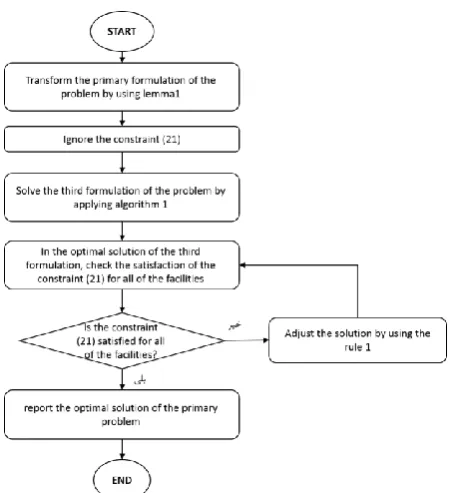
Step1. Transform the primary formulation of the problem by using lemma1, and ignore the constraint (21). Actually, the third formulation is obtained.
Step2. Solve the third formulation of the problem by applying algorithm 1.
Step3. In the optimal solution of the third formulation, if the constraint (21) is satisfied for all of the facilities, this solution is optimal for the primary problem. Else, adjust the solution by using the rule 1, and report the optimal solution of the primary problem.
The general schema of the algorithm 2 is shown in Figure .
5. COMPUTATIONAL EXPERIMENTS AND
RESULTS
The purpose of this section is to evaluate the performance of the proposed algorithm. In addition, the model is analyzed and capability of the model is represented via a representative case study .
5. 1. Evaluation of the Algorithm A number of numerical tests is designed to evaluate the algorithm. A random problem generating procedure is used here. The number of potential facilities (m) is set at 10, 20 and 40, and the number of population zones at 100, 200 and 400.
Figure 1. The schema of the steps of the algorithm 1
Figure 2. The schema of the steps of the algorithm 2
Totally, there are nine problem sets. Ten instances is considered in each set, such that the maximum total capacity (MTC) is set at (
2
n ) in each instance and the travel times were randomly generated in the interval [0,5]. The maximum demand rate at each zone is
max 1 i
, and the maximum waiting time, maxW , is set
at 100. The locating cost h was set at 80 per unit of time (hour) and the valuation of offered services was set at 100. The parameters’ values of this numerical example are summarized in Table 1.
The mathematical models are solved using Matlab 2014a and performed on a machine with AMD FX-7600 Radeon R7 with 2.7 GHz CPU and 8 GB of RAM, running Windows 8.
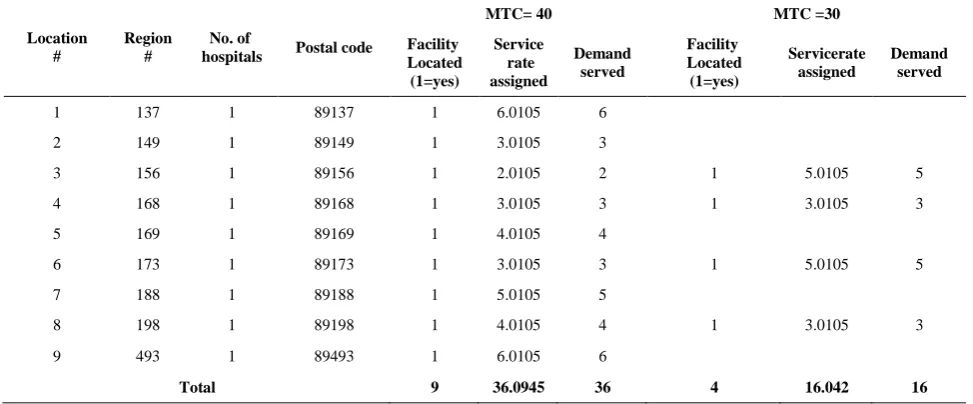
5. 2. An Illustrative Case Study Preventing and controlling non-communicable diseases is very critical to human societies. As a result, the government offers subsidized programs to provide customers’ welfare, so as to attract people to participate in the preventive programs, in all of the cities in Iran. In this case study, a hypothetical program of designing a network of preventive healthcare clinics in Yazd, Iran is analyzed and discussed. A 36-node network is considered where each node represents a region defined by the first 5 digits of the postal codes, and the nodes are placed at the centroid of each region. The number of public hospitals, as the preventive care centers, set at 9 clinics which serve about 500,000 residential in Yazd. The shortest distance between all node pairs is extracted from the Geographic Information System (GIS) and proportional to the dwellings of each region, the
maxi isdetermined. Other parameters’values are set as the values in Table 1. According to the above descriptions, determining the optimal location and capacity of each center as well as customer assignment to facilities are desired. The results are shown in Table 3.
6. CONCLUSION AND FUTURE RESEARCH
In this paper, a network design problem in the preventive healthcare environment is studied. This context attracts a lot of attentions in recent years, due to its great effects on human society and also the economy. Since, the utility of customers has an important role on the public participation in preventive medical programs, the utility concept is incorporated in both objective function and constraints.
TABLE 1. The parameters’ values of numerical example
Input Parameters Values
n 100,200,400
m 10,20,40
MTC n2
T
An m*n matrix, elements are the travel times which are randomly generated in the interval [0,5]
max
i
1V 100
max
W 100
h 80
TABLE 2. The Comparison of CPU times (sec)
N m CPU Time (Aboolian et al. 2012) CPU Time (Current)
100 10 3357.27 10.66
100 20 >3600 31.04
100 40 >3600 91.34
200 10 >3600 190.19
200 20 >3600 500.51
200 40 >3600 1400.01
400 10 >3600 1100.13
400 20 >3600 3400.22
400 40 >3600 >3600
TABLE 3. The optimal solution of the case study
Location #
Region #
No. of
hospitals Postal code
MTC= 40 MTC =30
Facility Located (1=yes)
Service rate assigned
Demand served
Facility Located (1=yes)
Servicerate assigned
Demand served
1 137 1 89137 1 6.0105 6
2 149 1 89149 1 3.0105 3
3 156 1 89156 1 2.0105 2 1 5.0105 5
4 168 1 89168 1 3.0105 3 1 3.0105 3
5 169 1 89169 1 4.0105 4
6 173 1 89173 1 3.0105 3 1 5.0105 5
7 188 1 89188 1 5.0105 5
8 198 1 89198 1 4.0105 4 1 3.0105 3
9 493 1 89493 1 6.0105 6
After transforming the nonlinear model, an algorithm to obtain the optimal solution is developed. Computational results show that, the proposed algorithm performs very fast even in the case of fairly large-sized problems. As the future research, the facilities can be considered as multi-server queues instead of single-server ones. In addition, the model can be studied such that the customers’ demand originate over a region or plane instead of the nodes of a network.
7. REFERENCES
1. Schilling, D. A., Jayaraman, V. and Barkhi, R., "A review of covering problems in facility location", Computers &
Operations Research, Vol., 1 No., 1 (1993), 25-55.
2. Farahani, R. Z., Asgari, N., Heidari, N., Hosseininia, M. and Goh, M., "Covering problems in facility location: A review",
Computers & Industrial Engineering, Vol. 62, No. 1, (2012),
368-407.
3. Berman, O. and Krass, D., "facility location problems with stochastic demands and congestion", In Z. Drezner, & H. W. Hamacher (Eds.), Location Analysis: Applications and Theory, New York: Springer, (2002), 329-371.
4. Marianov, V. and Serra, D., "Location problems in the public sector", Facility Location: Applications and Theory, Vol. 1, (2002), 119-150.
5. Daskin, M. S. and Dean, L. K., "Location of health care facilities", Operations Research and Health Care, (2005), 43-76.
6. Shishebori, D., "Study of facility location-network design problem in presence of facility disruptions: A case study (research note)", International Journal of
Engineering-Transactions A: Basics, Vol. 28, No. 1, (2014), 97-108.
7. Verter, V. and Lapierre, S. D., "Location of preventive health care facilities", Annals of Operations Research, Vol. 110, (2002), 123-132.
8. Zhang, Y., Berman, O. and Verter, V., "Incorporating congestion in preventive healthcare facility network design",
European Journal of Operational Research, Vol. 198, No. 3,
(2009), 922-935.
9. Zhang, Y., Berman, O., Marcotte, P. and Verter, V., "A bilevel model for preventive healthcare facility network design with congestion", IIE Transactions, Vol. 42, No. 12, (2010), 865-880.
10. Aboolian, R., Berman, O. and Krass, D., "Profit maximizing distributed service system design with congestion and elastic demand", Transportation Science, Vol. 46, No. 2, (2012), 247-261.
11. Aboolian, R., Berman, O. and Verter, V., "Maximal accessibility network design in the public sector", Transportation Science, Vol. 50, No. 1, (2015), 336-347.
12. Parker, B. R. and Srinivasan, V., "A consumer preference approach to the planning of rural primary health-care facilities",
Operations Research, Vol. 24, No. 5, (1976), 991-1025.
13. Berman, O. and Parkan, C., "A facility location problem with distance‐dependent demand", Decision Sciences, Vol. 12, No. 4, (1981), 623-632.
14. Berman, O. and Kaplan, E., "Facility location and capacity planning with delay-dependent demand", International Journal
of Production Research, Vol. 25, No. 12, (1987), 1773-1780.
15. Berman, O. and Drezner, Z., "Location of congested capacitated facilities with distance-sensitive demand", IIE Transactions, Vol. 38, No. 3, (2006), 213-221.
16. Berman, O. and Krass, D., "The generalized maximal covering location problem", Computers & Operations Research, Vol. 29, No. 6, (2002), 563-581.
17. Berman, O., Krass, D. and Wang, J., "Locating service facilities to reduce lost demand", IIE Transactions, Vol. 38, No. 11, (2006), 933-946.
18. Marianov, V. and Serra, D., "Probabilistic, maximal covering location—allocation models forcongested systems", Journal of
Regional Science, Vol. 38, No. 3, (1998), 401-424.
19. Marianov, V. and Rios, M., "A probabilistic quality of service constraint for a location model of switches in ATM communications networks", Annals of Operations Research, Vol. 96, No. 1, (2000), 237-243.
20. Wang, Q., Batta, R. and Rump, C. M., "Algorithms for a facility location problem with stochastic customer demand and immobile servers", Annals of Operations Research, Vol. 111, No. 1, (2002), 17-34.
21. Berman, O. and Drezner, Z., "The multiple server location problem", Journal of the Operational Research Society, Vol. 58, No. 1, (2007), 91-99.
22. Arkat, J. and Jafari, R., "Network location problem with stochastic and uniformly distributed demands", International
Journal of Engineering-Transactions B: Applications, Vol.
29, No. 5, (2016), 654-662.
23. Zabihi, F. and Sahraeian, R., "Trucks scheduling in a multi-product cross docking system with multiple temporary storages and multiple dock doors", International Journal of
Engineering Transaction B: Applications, Vol. 29, No. 11,
(2016), 1595-1603.
24. Hotelling, H., "Stability in Competition", The Economic
Journal, Vol. 39, No. 153, (1929), 41-57.
8. APPENDIX
8. 1. APPENDIX 1
Proof. The proof is similar to the proof of the similar lemma in (26) except for the objective function, which outlines as follows.
Objective function:
* *
*
*( *, , *) max( 1 1 2 2 ...
*
* * ... )
1 2
1 2
' '
/ ( )
1 2 1 2
* * * * *
( 1 2 ... 1 2 ... )
* *
' max ' max
1 2 2 2
y U y U
Z X Y i i i i i
i N
y U
yij Uij yij Uij im im
y or
Uij Uij ij yij
h j j m
y y
j i ij j i ij
Due to (13), Ify ij1
,
y ij20,
thenUij1Uij2.
So,* *
*
*( *, , *) max( 1 1 2 2 ...
*
* * ... )
1 2
1 2
' '
/ ( )
1 2 1 2
* * ' ' *
( 1 2 ... 1 2 ... )
y U y U
Z X Y i i i i i
i N
y U
yijUij yij Uij im im
y or
Uij Uij ij yij
h j j m
ThereforeZ*(X*,*,Y*)Z'*(X'*,'*,Y'*)
8. 2. APPENDIX 2
Proof. The proof is similar to the proof of the similar rule in (26) except for the objective function, which outlines as follows.
1 1 1
* *
p p p
n n
y yij yij y yij
ij ij
(39)
max max
1 1 1
* * *
p p n P
n n y y
j j k k kj
k
j j j
(40)
Objective function:
1
max max
( , , ) ( ) ( 1 1 ... 1 1
max
* * ... ) (1 2 ... 1 * ... ) 0
1 *
p
p p p
p y y U
Z X Y i N j M i ij V tij p hj M j i N i yi Ui ij ij y
i
j ij
i N
p p p
p
p y p p
yi j Ui j imUim h j j m n n j j
max( 1 1... 1 1 * *... )
0
(1 2 ... 1 *... )
1 *
n n
n y y n
yi Ui ij Uij ij Uij yim Uim i
i N j M
n n n n n
h j j m
n n j j
On the other hand, due to the basic assumption of the rule 1
,
U* U1ij ij .
Therefore, Zn(X Y, , ) Zp(X Y, , )
8. 3. APPENDIX 3 Observation1-The optimal value of the upper bound problem is a valid upper bound on optimal value of the third formulation.
The above result follows because the objective function of the upper bound problem depicts the difference between the upper bound on the first part of the objective function of the third formulation and facility costs, and the constraints equal the constraints of the the third formulation.
Since the upper bound problem is a linear mixed integer model, it can be solved by applying available algorithms and obtain an effective upper bound.
8. 4. APPENDIX 4 Observation 2-If *
j
is an optimal solution for the optimal capacity decision problem for eachj J Open
,
and forj J Open , let * 0j,
then the capacity vector is optimal regarding y, x(y). Note that the objective function of the optimal capacity decision problem is concave (i.e. its second derivative is negative everywhere in the feasible region of the problem) and the constraints create a close feasible region forj. This results in the following corollary: corollary1- The optimal capacity decision problem has an optimal solution *j
.
The condition of observation 2 is satisfied due to this result.
Corollary 2- The optimal capacity *
j
will be found out by applying the following algorithm.
Step1. Find the capacityjthat maximizes the objective function of the optimal capacity decision problem from the first derivative of the objective function. If the constraints are satisfied, stop and report the optimal solution *
j j
.
Else, proceed to step 2. Step2. Find thefirst non-negative value ofj
that satisfies the following constraints:1 max
max
y
j i ij
W i N
,
i ∈N,
1
maxy
j i ijV t ij i N
,
i ∈NTherefore,
1 1
max max
max( , )
max max
m y y
j j i ij i ij V t
W ij
i N i N i N
m j
is the optimal solution.
Proof. Since the objective function of the optimal capacity decision problem is concave and the constraints create a close feasible region forj
,
either the value ofjfound from the first derivative of the objective function or the first non-negative value ofjDeveloping a New Algorithm for a Utility-based Network Design Problem with Elastic
Demand
S. Javanmardi, H. Hosseini-nasab, A. Mostafaeipour, M. Fakhrzad, H. Khademizare
Department of Industrial Engineering, Yazd University, Yazd, Iran
P A P E R I N F O
Paper history: Received 30October 2016
Received in revised form 04 February 2017 Accepted 26 February 2017
Keywords:
Network Design Problem Preventive Healthcare Utility
Elastic Demand Congestion
ديكچ ه
لاس رد هعسوت ،ریخا یاه تخاسریز ی
هئارا تهج مزلا یاه یرامیب زا یریگشیپ تامدخ ی
سوئر رد ،رادریگاوریغ یاه
مهم هنیهب تیفرظ و دادعت یتسیاب ادتبا ،اتسار نیا رد .تسا هتفرگ رارق نامرد و تشادهب هزوح رد یروشک فادها نیرت
زکارم نازیم رب هولاع .دوش صخشم هیحان رهرد زکارم نیا هب نایرتشم صیصخت هوحن نینچمه و هناریگشیپ ینامرد
یم زکارم نیا هب هعجارم رد یا هدننک نییعت روتکاف نایرتشم یارب هدش داجیا تیبولطم ،یسرتسد کی ،هلاقم نیا رد .دشاب
هکبش یحارط لدم تمدخ ی
یم هعلاطم یهد هک یروط هب ،دوش
هتفرگ رظن رد اه تیدودحم و فده عبات رد تیبولطم عبات
فاطعنا و تسا هدش ضرف یعطق رفس تفاسم .تسا هدش تلایهست رد ماحدزا داجیا هب رجنم نایرتشم یاضاقت یریذپ
یم هداس زا سپ .ددرگ داهنشیپ هنیهب باوج نتفای یارب یا هلحرمود یزاس هنیهب متیروگلا کی ،هیلوا یطخریغ لدم یزاس
یم یم ناشن یتابساحم جیاتن .ددرگ یدروم هعلاطم ،تیاهن رد .تسا رادروخرب یئلااب یئآراک زا هدش هئارا متیروگلا دهد
یم ناشن لئاسم لح یارب ار لدم یئاناوت ،دزی رهش رد هناریگشیپ نامرد و تشادهب تلایهست .دهد